
In This Article
Education platforms win enrollments by targeting high-intent keywords, optimizing program pages with Course schema, and improving mobile speed.
Updated:
Trusted by 1,000+ teams
Startups use Averi to build
content engines that rank.
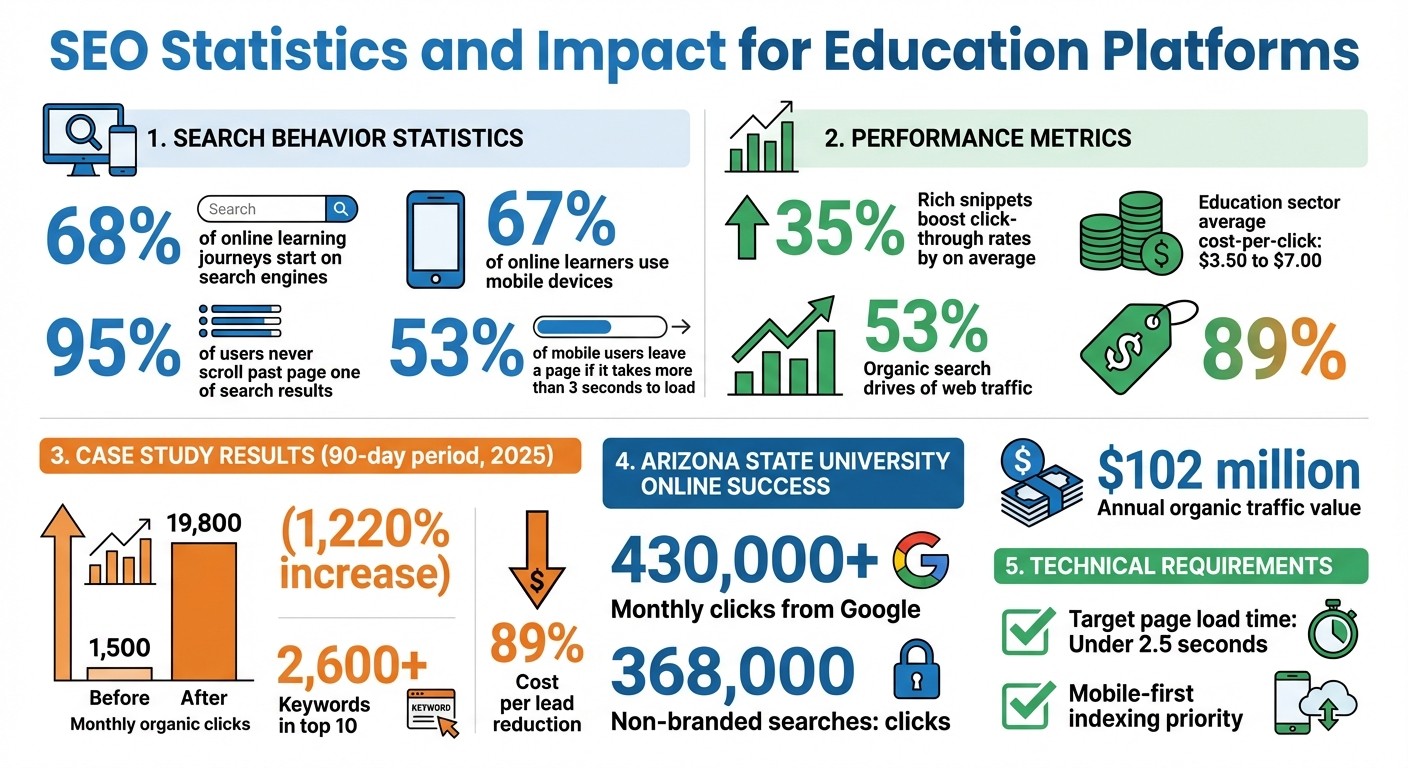
Education platforms face a tough challenge: staying visible and relevant during the 6–12 months that students and parents spend researching their options. With 68% of learning journeys starting on search engines and 95% of users never scrolling past page one, ranking high is non-negotiable. Here's the core strategy:
Keyword Focus: Target specific, high-intent phrases like "best coding bootcamps" or "online math tutoring for Grade 10" instead of broad, highly competitive terms.
Content Optimization: Create detailed, user-focused pages that answer questions, highlight career outcomes, and meet Google’s E-E-A-T (Experience, Expertise, Authoritativeness, Trustworthiness) standards.
Technical Setup: Ensure fast loading times (under 2.5 seconds), mobile responsiveness, and proper schema markup (e.g., Course, FAQ, and Review schemas) to improve visibility and credibility.
AI Integration: Use AI tools for keyword research, content creation, and performance tracking to save time and refine your strategy.
Platforms that implement these tactics can expect increased organic traffic, higher enrollment rates, and reduced reliance on expensive paid ads. The full article dives deeper into actionable tips for keyword research, content structuring, and technical improvements.
SEO Statistics and Impact for Education Platforms
Complete SEO Course for Beginners: Learn to Rank #1 in Google
Conducting Keyword Research for Education Platforms
Keyword research for education platforms isn't about chasing broad, high-traffic terms often dominated by big-budget competitors. Instead, the focus should be on identifying the specific phrases that prospective students, parents, and educators use when searching for solutions. This requires understanding both the searcher's intent and their stage in the decision-making process.
Start by aligning keywords with the learner's journey. For example, awareness-stage searches often include "why" or "how-to" queries, such as "how to become a data scientist", whereas decision-stage searches typically incorporate terms like "best", "reviews", "pricing", or "enroll" [4][3]. A student searching for "Python course for data analysts" is likely closer to enrolling than someone searching "learn Python." This level of precision not only affects ranking difficulty but also improves conversion rates.
It's also essential to segment keywords by audience. The searcher isn't always the buyer. For instance, parents of younger students often look for support-focused terms like "how to help a struggling reader", while adult learners may search for career-oriented phrases like "how to transition to software engineering." Meanwhile, educators might seek practical tools with terms like "math worksheets" or "lesson plans" [5].
Rowan Kunz, CEO of Art of Smart, explains: "To reach decision makers, you need to understand the student's pain points because they search on behalf of their kids, not themselves" [5].
Incorporate intent modifiers to refine traffic. For physical campuses, use location-specific terms like "near me", and for online platforms, include descriptors such as "remote", "certification", or "affordable" to attract users who are ready to act [5][2]. Tools like Google Keyword Planner, Ahrefs, and Semrush can help uncover these variations, but the real key lies in understanding what your audience needs.
A quick win is optimizing for "low-hanging fruit." Use Google Search Console to identify queries where your site already ranks in positions 8–20. By updating and improving this content, you can push it onto the first page faster than starting with entirely new keywords [1].
Finding High-Intent Educational Keywords
High-intent keywords signal that a searcher is nearing a decision. For education platforms, this often means focusing on terms that address career outcomes, return on investment, or solving specific challenges. Students might search for "how to become a data scientist" or "best coding bootcamps for career changers", while parents may look for phrases like "how to help a struggling reader" [5]. Educators, on the other hand, often seek actionable terms such as "closing the attainment gap" or "differentiated instruction strategies" [5].
In addition to using tools like Google Keyword Planner and Ahrefs (starting at $129/month), manually reviewing Google's "People Also Ask" boxes and autocomplete suggestions can reveal the exact questions your audience is asking. A growing trend is the shift toward mid-funnel (MOFU) content. With AI Overviews now answering simple top-of-funnel queries directly in search results, platforms are targeting MOFU keywords like "Is a computer science degree worth it?" or "How to transition to UX design from marketing" [5].
Will James, Co-Founder of 8 Bit Content, emphasizes: "SEO is a big opportunity for education institutions with many intent-based keywords and top-of-funnel content marketing opportunities available" [5].
Balancing branded and non-branded keywords is also critical. Successful platforms often dedicate about 80% of their SEO efforts to non-branded, problem-solving keywords to attract new audiences [4].
Targeting Long-Tail Keywords
Long-tail keywords offer a strategic edge, especially when competing against well-established institutions. These detailed, multi-word phrases - like "part-time business degree for working professionals Singapore" or "online math tutoring for CBSE Class 10" - may have lower search volumes but tend to attract users with higher conversion intent [10][2]. They also face less competition, making it easier to rank and connect with users who already know what they want. For instance, while broad terms like "online courses" are fiercely competitive, niche phrases like "Python course for data analysts" often come with 35% lower difficulty and target users further along the enrollment funnel [4].
Long-tail keywords also create opportunities for highly targeted content. Each phrase can inspire a dedicated landing page, blog post, or FAQ entry tailored to address a specific need. For example, if users are searching for "how to prepare for IELTS at home", crafting a comprehensive guide on that topic could boost both visibility and conversions. To discover these keywords, explore Google's autocomplete and "People Also Ask" features. Start with a seed term like "online MBA" and note the suggestions [10][5].
Don't overlook seasonality, either. Educational search terms often follow predictable academic cycles. For example, queries like "AP exam schedule" spike in May, while "when does school start" peaks in July and August [5]. Timing your content around these cycles can significantly increase traffic and visibility.
Using AI Tools for Keyword Research
AI tools are transforming keyword research by making it easier to analyze and group keywords based on search intent. These tools can categorize keywords as informational, navigational, commercial, or transactional, and group them into strategic topic clusters [6][8].
One standout feature is intent detection. AI can determine whether a search like "best coding bootcamps" is informational (indicating research) or commercial (suggesting readiness to compare options and enroll) [6][8]. This insight helps prioritize which keywords to target and shapes the type of content you create.
AI also uncovers niche "zero-volume" keywords - specific terms that conventional tools might miss but that reflect real user pain points discussed on platforms like Reddit or Quora [8]. For instance, a phrase like "how to explain calculus to a visual learner" might not appear in traditional databases but could attract highly qualified traffic.
To get the most out of AI, use persona-based prompting. When working with tools like ChatGPT, assign roles such as "Senior SEO Consultant for education platforms" to generate more focused keyword suggestions [9]. You can also ask AI to map keywords to different stages of the student journey, from awareness ("how to learn coding") to consideration ("best coding bootcamps") and decision ("[Platform A] vs [Platform B]") [8][3].
However, always validate AI-generated insights with established SEO tools like Semrush (starting at $165.17/month, billed annually) or Ahrefs (starting at $129/month) [7]. While AI excels at brainstorming and semantic ideation, verifying metrics like search volume and difficulty with these tools remains essential.
An emerging trend is Answer Engine Optimization (AEO), which focuses on optimizing content for conversational queries and featured snippets, helping capture traffic from voice and AI-driven search results [2].
Creating and Optimizing Content for Search Engines
Once you've pinpointed your target keywords, the next step is crafting content that speaks directly to both students and educators while meeting search engine standards. The aim goes beyond ranking high on search results - it's about drawing in the right audience and turning their interest into enrollment. To achieve this, your content must not only grab attention but also be structured so platforms like ChatGPT and Perplexity can recognize it as an authoritative source [4].
Take Arizona State University Online as an example. By early 2026, their program pages were driving over 430,000 monthly clicks from Google, with 368,000 of those clicks coming from non-branded searches. The annual value of this organic traffic is estimated at over $102 million [11]. They succeeded by creating detailed program pages targeting non-branded keywords, effectively reaching students who were still undecided about which institution to choose.
Writing SEO-Friendly Content for Students and Educators
When building program pages, include these five key elements:
Overview: Highlight delivery methods and what makes the program stand out.
Curriculum: Provide details on core and elective courses.
Career Outcomes: Include job placement rates and salary data to showcase value.
Admissions Requirements: Clearly outline prerequisites and deadlines.
Faculty Profiles: Feature credentials and real-world experience.
These components establish trust and naturally weave in long-tail keywords that align with your audience's search intent.
Different audiences have distinct priorities. Parents often focus on financial returns and safety, while students are drawn to the social aspects and campus facilities [2]. Your content must address both perspectives without diluting its message.
"Student loan debt is massive. It's the problem everyone has on their mind... because of that, students are more conscious than they have ever been about the decision they're making", says Granit Doshlaku, Chief Strategy Officer at Manaferra [5].
Target mid-funnel (MOFU) keywords to engage students during their research phase. For example, in 2023, Steve Toth of Notebook Agency helped a higher education client attract 50,000 organic clicks in just one year by focusing on phrases like "How to become a data scientist" and "How much do data scientists make?" rather than more competitive course-specific terms. This strategy delivered an estimated value of $500,000 to $1,000,000 in paid advertising spend [5].
Google's E-E-A-T (Experience, Expertise, Authoritativeness, and Trustworthiness) guidelines are especially strict for educational content [1][4]. To meet these standards, include professional bylines, detailed instructor bios, and verified industry credentials. Cite reliable sources for any claims or statistics. These efforts signal credibility to both search engines and prospective students, and AI tools can simplify the process of implementing these elements.
Boost your content's reach by incorporating structured data that search engines can easily interpret.
Adding Structured Data and Schema Markup
For educational platforms, three types of schema markup are especially impactful:
Course Schema: Include details like provider name, course description, credential awarded, duration, and cost. This ensures your programs appear in Google's course search features.
FAQ Schema: Display common questions and answers directly on the search results page, taking up more screen space.
Review Schema: Add aggregate ratings to show star reviews, which immediately build trust with potential students [1][4].
Rich snippets from structured data can boost click-through rates by an average of 35% [4].
For instance, an online learning platform focused on professional development implemented Course schema in 2025. Along with improving site speed and clustering topics, they saw a 1,220% jump in organic clicks - from 1,500 to 19,800 monthly - in just 90 days [4].
Use JSON-LD format for schema markup, as it's preferred by modern search engines and AI crawlers. Ensure your robots.txt file allows AI bots like GPTBot and PerplexityBot to access pages with structured data. This step enhances your content's chances of being cited in AI-generated responses, broadening your visibility beyond traditional search engines.
These structured data enhancements complement on-page SEO strategies by increasing visibility and driving user engagement.
Applying On-Page SEO Best Practices
On-page SEO starts with the basics but demands precision for educational sites. Keep title tags under 60 characters and meta descriptions between 150–160 characters, and include a clear call-to-action like "Apply Now" or "Learn More" [11]. Titles should naturally incorporate primary keywords while clearly communicating the page's value.
Use clean, logical URLs (e.g., site.com/online-degrees/masters/psychology) to improve both search engine crawlability and user comprehension [11].
Multimedia optimization is equally important. Add descriptive alt text to images, explaining their relevance to the content. Provide transcripts for videos to support accessibility, ensuring students with disabilities or those in environments where audio isn't feasible can still engage with your material. These steps not only improve rankings but also make your content more inclusive.
Internal linking strengthens your site's authority. Link general pages (e.g., "Online Master's Degrees") to specific program pages (e.g., "Master's in Data Science") using descriptive anchor text. This approach helps search engines understand how your pages connect while guiding prospective students through their decision-making process. Focus on optimizing pages currently ranking in positions 8–20, as these offer the quickest opportunities to move up to page one.
Building Content Clusters and Program Pages
Organize your website around pillar pages supported by related articles to showcase in-depth expertise. Each supporting piece links back to the pillar page, signaling to search engines that your platform thoroughly covers the topic [4]. This structure aligns with how students search - from broad inquiries to specific programs.
This method is effective because 68% of online learning journeys begin with a search engine [4]. By aligning content with the enrollment funnel - awareness (broad topics), consideration (comparisons), and decision (pricing and reviews) - you guide prospective students through their research while capturing traffic at each stage [2][4]. This strategy naturally leads to creating focused content hubs and dedicated program pages that address every step of the student's decision-making process.
Creating Content Hubs Around Core Topics
Develop hubs that address questions beginning with "how", "what", "why", and "which", as these often attract high-intent traffic and appear in featured snippets [2]. For instance, instead of limiting your content to pages about data science courses, create a hub answering questions like "How much do data scientists earn?" or "Do you need a degree to become a data scientist?" This approach to mid-funnel keywords generated over 50,000 clicks for a higher education client in 2023 [5].
For K-12 platforms, consider the differing priorities of parents and students. Parents often focus on safety and the return on investment, while students are more interested in the social environment and extracurricular options [2]. Create separate content clusters to address these audiences, such as "Best math apps for kids" for parents and "Best subject choices for [Career]" for older students making their own decisions.
If your platform offers a wide range of courses, utilize programmatic SEO to create optimized landing pages for queries like "Best [Subject] Courses for [Job Role]" [4]. This approach allows you to scale content production while staying relevant to specific search queries.
Designing Program-Specific Pages
Building on content hubs, program-specific pages should provide comprehensive details about each course, guiding prospective students from initial interest to enrollment. Use clean URL structures like site.edu/online-degrees/masters/psychology to make navigation intuitive for both users and search engines [11]. Key elements to include on these pages are an overview, curriculum, career outcomes, admission requirements, cost details, and faculty profiles [11].
These components naturally incorporate long-tail keywords while addressing the main concerns of prospective students. When paired with internal linking and clear URL structures, optimized program pages can significantly increase non-branded traffic and attract high-intent users.
Link general category pages (e.g., "Online Master's Degrees") to specific program pages using descriptive anchor text like "Explore our online biology tutorials" instead of generic phrases like "click here" [1][11]. This internal linking strategy distributes authority across your site and helps search engines understand how your content is interconnected. One online learning platform implemented this approach alongside topic clusters in 2025, achieving a 1,220% increase in monthly organic clicks - from 1,500 to 19,800 - and securing over 2,600 keywords in the top 10 positions within just 90 days [4].
Implementing Technical SEO for Education Websites
Even with strong content and well-chosen keywords, your website needs a solid technical foundation to deliver fast, accessible, and user-friendly experiences. This is especially critical for driving enrollment. Consider this: 67% of online learners use mobile devices, and 53% of mobile users will leave a page if it takes more than three seconds to load [4]. Technical performance doesn’t just influence search rankings - it directly affects how students interact with your site.
To align with how students search and learn, structure your site in a way that reflects their behavior. A hierarchical framework works well, starting with the homepage, branching into category pages (sorted by subject, grade level, or skill), and leading to individual course or lesson pages [4]. This setup helps search engines understand your content while making navigation seamless for users. If your courses are gated or behind login walls, consider creating publicly viewable preview pages. These can include syllabi, learning outcomes, and instructor details, ensuring search engines can still recognize the value of your offerings [4]. Regularly auditing your site ensures these technical elements consistently support your content and keyword strategies.
Auditing and Improving Site Architecture
Frequent checks for 404 errors, fixing broken links, and using canonical tags to manage duplicate content are essential [5][1]. Breadcrumb navigation can further clarify your site’s hierarchy for both users and search engines [2][4]. Clean, descriptive URLs, such as site.com/online-courses/math/algebra-101, are far more effective than generic strings of characters or numbers [1].
To avoid orphan pages, implement a strong internal linking strategy that spreads authority across your site [5][1]. Include links to high-priority pages - like course categories, FAQs, or contact details - in your footer so they’re accessible from anywhere on the site [1]. A well-organized architecture makes it easier for search engines to crawl and index your content while improving navigation for prospective students.
Once your site’s structure is in place, shift your focus to optimizing performance, particularly for mobile users.
Optimizing Mobile Performance and Page Speed
With Google’s mobile-first indexing, your mobile experience now determines your search rankings [4]. Aim for load times under 2.5 seconds, as speed is critical. For video-heavy pages, compress and lazy-load videos to avoid slowing down page rendering [4]. Use next-generation image formats like WebP instead of older formats like JPEG or PNG, and streamline your site by minifying CSS, JavaScript, and HTML [4][1]. A Content Delivery Network (CDN) can improve global load times, while browser caching helps returning users access content faster [4][1]. Tools like WP Rocket or Autoptimize can simplify this process [1].
For mobile usability, ensure buttons are at least 44×44 pixels and text is a minimum of 16px to eliminate the need for zooming [4]. Regularly monitor Core Web Vitals: aim for a Largest Contentful Paint (LCP) under 2.5 seconds, Interaction to Next Paint (INP) under 200 milliseconds, and Cumulative Layout Shift (CLS) below 0.1.
Meeting ADA Accessibility Standards
Improving accessibility doesn’t just meet legal requirements; it also enhances user experience and boosts SEO performance. For instance, descriptive alt tags on images help visually impaired users while providing context for search engines [12][13][14]. Similarly, transcriptions and closed captions for videos make content accessible to users with hearing impairments and offer additional text for indexing [13].
Logical heading hierarchies (H1, H2, H3) make it easier for screen readers to navigate your pages, while also helping search engines prioritize content [2][12][13][15]. Use descriptive, keyword-rich names for media files, like online-calculus-course-syllabus.pdf, to improve search visibility [14]. Given that organic search drives 53% of web traffic, these efforts are well worth it [15].
Accessibility Element | SEO Benefit | User Inclusivity Benefit |
|---|---|---|
Alt Text | Enhances image ranking and relevance | Helps visually impaired users interpret images |
Video Captions | Adds searchable text for videos | Aids users with hearing impairments or in noise-sensitive settings |
Heading Tags | Organizes content for search crawlers | Allows screen readers to navigate efficiently |
Mobile Optimization | Affects Google search rankings | Improves usability for the 64% of mobile users |
Breadcrumbs | Improves crawlability and internal linking | Simplifies navigation for users on complex sites |
Using AI Tools to Simplify SEO Workflows
Adopting AI tools has transformed SEO workflows, especially for education platforms, by making them faster and more efficient. Tasks that used to take hours each week can now be handled in a fraction of the time. For instance, automated keyword discovery has reduced research time from 3–4 hours to just 30–45 minutes per content cluster, while creating content briefs now takes about 5 minutes instead of 1–2 hours [16]. Tools like Averi AI not only monitor your market and track competitor content but also suggest high-potential topics tailored to your business. This means you're no longer starting from scratch.
The real game-changer isn’t just the speed but how seamlessly everything integrates. Instead of juggling multiple tools for strategy, drafting, optimization, and publishing, AI-driven workflows bring these steps together in one system. For example, Averi AI can generate SEO-optimized drafts and publish them directly to content management systems like WordPress, Webflow, or Framer, eliminating manual processes. A balanced 70/30 approach works best: let AI handle drafting, formatting, and SEO structuring while human experts focus on refining the brand voice, fact-checking, and ensuring the content aligns with subject matter expertise.
Automating Content Creation and Optimization
AI tools take over the repetitive and time-consuming parts of content production. Once a topic is approved, the system conducts in-depth research, drafts an initial version tailored to your brand, and optimizes it for both traditional Google search and Answer Engine Optimization (AEO). This ensures your content is easily referenced by AI platforms such as ChatGPT, Perplexity, and Google AI Overviews. To maintain quality, using prompt chains is recommended instead of asking for a complete article in one go. By generating an outline first, then research summaries, and finally the full draft, you can ensure a well-structured and engaging result while avoiding generic output.
Averi AI also provides a collaborative editing canvas where you can leave comments, tag team members, and highlight sections for the AI to rewrite or expand. It even suggests internal links and generates meta descriptions automatically, saving hours on each piece. These streamlined processes not only improve search rankings but also enhance user engagement on education platforms.
With content creation largely automated, the next step is to continuously monitor and refine its performance.
Tracking Performance with AI-Driven Insights
AI analytics go beyond basic data reporting by offering actionable recommendations. Instead of manually tracking keyword rankings or click-through rates, tools like Averi AI identify trends and opportunities. For example, they can highlight content ranking near position #8 that could be pushed to page one or suggest updates to counter competitor articles. Maintenance Agents detect signs of content decay, recommending updates to outdated statistics and re-optimizing articles to improve click-through rates.
To stay ahead, monitor metrics like keyword rankings (top 3/10), impressions, and AI citations weekly. Engagement metrics such as click-through rates and fact-check accuracy are best reviewed monthly, while business impact metrics like organic conversions, enrollment attribution, and revenue should be analyzed quarterly. Just as you would track site speed and architecture, these AI-driven insights ensure your content stays competitive. Averi AI itself demonstrated the power of this approach, scaling its web traffic by over 6,000% in just six months by building Google entity authority and driving AI citations through its automated content engine [Source: Averi.ai, 2025].
Conclusion
Success in SEO for education platforms hinges on a well-rounded strategy that combines keyword research, high-quality content, and technical performance. All three must work in harmony to achieve lasting results.
With 68% of online learning journeys beginning through search, the importance of technical excellence cannot be overstated [4]. A strong foundation includes proper site architecture, mobile optimization with load times under 2.5 seconds, and Course schema markup to enable rich search results.
Consider this: in a 90-day period ending in 2025, a professional development platform revamped its SEO strategy by overhauling keywords, creating 45 in-depth resources, and implementing Course schema. The results were transformative - monthly organic clicks surged from 1,500 to 19,800 (a 1,220% increase), over 2,600 keywords ranked in the top 10, and cost per lead dropped by 89% [4]. This kind of growth reinforces itself over time, which is critical since prospective students often spend 6–12 months researching before committing [2].
"Education SEO delivers sustainable growth that compounds over time. Each optimized page, earned link, and positive review strengthens your position." – Hashmeta [2]
AI tools are invaluable for automating research, drafting, and publishing, but human expertise remains essential for refining tone, ensuring accuracy, and building trust. Each new piece of content strengthens your library and sharpens future strategies. To stay on course, track visibility metrics weekly, engagement monthly, and overall business impact quarterly [4].
With the education sector's average cost-per-click ranging from $3.50 to $7.00, organic SEO is not only effective but also cost-efficient [4]. Given that 95% of searchers never go beyond the first page [4], a structured strategy - spanning keyword targeting, content clusters, and technical optimization - isn't just helpful; it's a necessity for staying competitive. By aligning every aspect of your SEO efforts, education platforms can achieve sustainable growth and long-term enrollment success.
FAQs
How do I pick keywords that lead to enrollments?
To attract enrollments effectively, target keywords that show clear intent and have lower competition, making them more accessible for your audience. Tools like Google Search Console can help identify phrases prospective students are actively searching for - think specific course names or unique program benefits. Focus on terms with a strong intent behind them, such as "best online math courses," which indicate a readiness to enroll. Regularly review performance data to fine-tune your approach and ensure your content aligns with these keywords. This strategy not only boosts visibility but also draws in highly motivated learners.
What should every program page include for SEO?
To make every program page effective, focus on creating content that aligns closely with user intent and follows technical SEO principles. Essential elements include:
Optimized Titles and Meta Descriptions: Clearly incorporate target keywords to improve visibility and click-through rates.
Header Tags: Use headers strategically, ensuring they include relevant keywords to structure the content effectively.
Structured Data: Implement schema markup to help search engines understand and display your content accurately.
Internal Links: Connect to other relevant pages to improve navigation and distribute link authority.
Fast Load Speeds and Mobile-Friendliness: Prioritize quick loading times and a seamless mobile experience to enhance user satisfaction and search rankings.
These components not only improve rankings but also attract more organic traffic and establish credibility for the program.
Which schema markup matters most for courses?
The Course schema is a crucial tool for educational content. It enables search engines to interpret and showcase detailed information about your courses, boosting their visibility in search results. This makes it simpler for prospective learners to discover what you offer online.
Related Blog Posts

Zach Chmael
CMO, Averi
"We built Averi around the exact workflow we've used to scale our web traffic over 6000% in the last 6 months."
Your content should be working harder.
Averi's content engine builds Google entity authority, drives AI citations, and scales your visibility so you can get more customers.