

In This Article
SEO tactics for financial firms: target high-intent keywords, meet YMYL/E-E-A-T compliance, fix technical issues, and build authoritative backlinks.
Updated:
Trusted by 1,000+ teams
Startups use Averi to build
content engines that rank.
When it comes to financial services, search engine optimization (SEO) is essential for attracting clients making critical financial decisions. Unlike other industries, financial SEO must meet strict compliance standards and Google's high-quality "Your Money or Your Life" (YMYL) guidelines. Here's what you need to know:
Focus on high-intent keywords: Target terms like "401(k) management for small businesses" or "tax planning for real estate investors" that align with user intent.
Comply with YMYL and E-E-A-T standards: Showcase expertise with credentialed authors, reliable sources, and updated content.
Overcome challenges: Navigate compliance hurdles, long publishing timelines, and tough competition from industry giants.
Leverage tools: Use platforms like SEMrush, Ahrefs, and AI tools like Averi AI for keyword research, content creation, and competitor analysis.
Improve technical SEO: Optimize for mobile, speed, schema markup, and site security to build trust and rank higher.
Build authority: Create in-depth content, earn backlinks, and organize information into topic clusters.
SEO for financial services requires patience but delivers long-term results by building trust and attracting qualified leads. This guide provides strategies to overcome challenges and succeed in this competitive space.
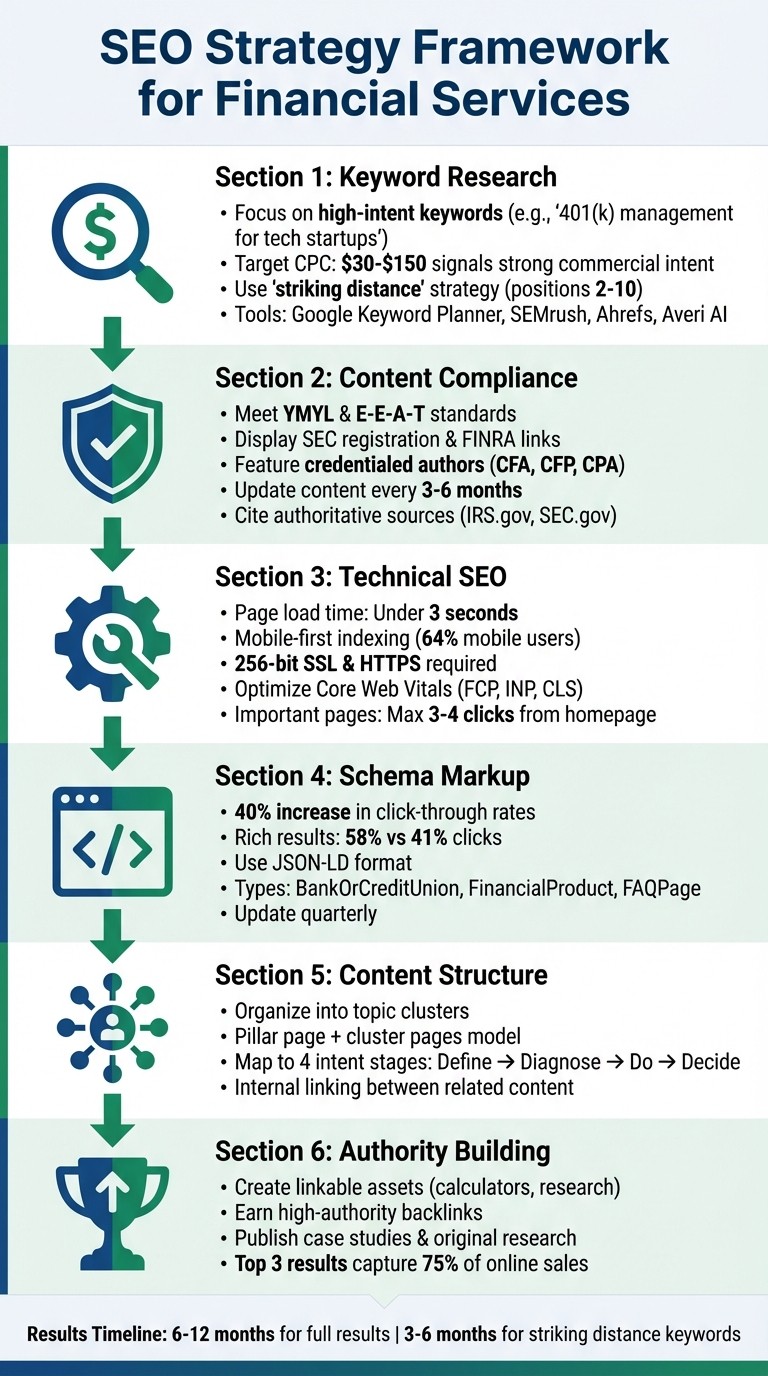
SEO Strategy Framework for Financial Services: 6-Step Implementation Guide
Keyword Research for Financial Services
Focus on High-Intent Keywords
When it comes to financial services, not all keywords are created equal. The goal isn't just to drive traffic - it's to attract prospects who are ready to take the next step. Instead of chasing broad, high-volume terms like "loans" or "investments", focus on keywords that reflect intent and align closely with your offerings.
Start by categorizing keywords based on service (e.g., "business loans"), problem (e.g., "how to avoid tax penalties"), location (e.g., "retirement planner in Boston"), and trust indicators (e.g., "SEC registered advisors"). Then, map these keywords to different stages of the sales funnel: Awareness (broad, informational searches), Consideration (comparisons and options), and Purchase (specific service-related queries) [5]. For example, targeting phrases like "401(k) management for tech startups" or "tax planning for real estate investors" can help you reach a more precise audience than generic terms ever could [5]. Even better, pay attention to questions your clients ask directly, such as "Can I contribute to both a SEP IRA and a Roth IRA?" These queries often convert exceptionally well because they reflect specific, actionable needs.
Once you've identified these keywords, use tools to refine and expand your list.
Keyword Research Tools and Methods
Tools like Google Keyword Planner, SEMrush, and Ahrefs are essential for assessing search volume and keyword difficulty. For financial firms, keywords with a cost-per-click (CPC) between $30 and $150 often signal strong commercial intent [5][1][7]. To uncover quick wins, use the "striking distance" strategy: check Google Search Console for keywords where your site ranks in positions 2–10. These are terms you can often push to page one with minor tweaks, like updating content or adding internal links [2].
AI tools like Averi AI can take your research a step further. Averi analyzes your website, suggests customer profiles, and generates keyword ideas tailored to your services and market position. It also tracks competitor content and industry trends, helping you prioritize high-potential topics without scrambling for last-minute ideas.
Once you have a solid keyword list, dive into competitor analysis to uncover additional opportunities.
Find Keyword Gaps Through Competitor Analysis
After identifying keyword opportunities, it's time to see where your competitors are gaining ground. Tools like SEMrush or Ahrefs can help you run a keyword gap analysis, revealing terms where competitors rank highly but your site has little or no presence [2]. Pay attention to their service pages and high-performing content to pinpoint topics you might be overlooking.
"Google relies more heavily on wider trust signals to determine the credibility of a brand in the financial services industry. Things such as reviews, brand mentions, and brand searches have more weight." - Rob May, Director & Freelance SEO Consultant [1]
Google's "People Also Ask" (PAA) sections are another goldmine for finding the exact questions your audience is asking. These ready-made content ideas can help you create highly relevant material [7]. Additionally, analyze which competitors dominate Featured Snippets, FAQs, and Local Packs for high-intent financial terms. Structuring your content with tables, lists, and schema markup can help you compete for these prominent spots [8].
Finally, take note of tools your competitors offer, like mortgage calculators or retirement estimators, as these can highlight additional keyword opportunities [6]. Reviewing their backlink profiles can also reveal high-authority financial publications or directories worth targeting for outreach [7]. By combining these insights with your keyword research, you'll be well-positioned to capture high-intent leads in the financial services space.
Creating Content That Meets Compliance Standards
Meet YMYL Content Standards
When it comes to financial topics, Google applies YMYL (Your Money or Your Life) standards, meaning the bar for content quality is exceptionally high. This makes sense - errors in financial advice can lead to tangible losses for readers. To meet these standards and rank well, your content must showcase E-E-A-T: Experience, Expertise, Authoritativeness, and Trustworthiness [9][1].
Trust is everything in the financial world. Make your commitment to compliance obvious by displaying your SEC registration, linking to official regulatory resources like FINRA’s BrokerCheck, and prominently featuring required risk disclaimers [9]. Author credibility matters too - create detailed bio pages for contributors, complete with professional credentials (e.g., CFA, CFP, CPA), headshots, and links to their LinkedIn profiles [9][3].
Cite authoritative sources like IRS.gov or SEC.gov when referencing regulations or tax information to build a reliable network of trust [9][6]. Keep your content current by scheduling updates every 3–6 months to reflect changes in interest rates, tax limits, or regulations. Outdated information can erode trust quickly [9][3]. Avoid using terms like "best" or "lowest" unless you can back them up with independent verification and clear documentation [9].
Once compliance measures are in place, you can focus on creating engaging service pages that attract high-intent leads.
Build Optimized Service Pages
Compliance is the groundwork, but service pages are where you turn interest into action. These pages are tailored to meet specific user needs, such as "Small Business Financial Planning" or "401(k) Rollover Services for Tech Employees", rather than broad categories like "Financial Planning." Pages designed this way align better with user intent and tend to rank higher [5].
Each service page should have a clear structure, breaking down what the service is, who benefits from it, how it works, and what sets your approach apart. Use internal links from educational content to guide readers toward these pages and encourage conversions [2]. For longer pages, include tools like a table of contents and FAQ schema markup to capture "People Also Ask" traffic [8]. Add client testimonials, case study highlights, or performance data to build credibility - just ensure any claims are accurate and meet regulatory guidelines [9][1].
Use AI Tools for Faster Content Creation
AI content tools can be a game-changer for content production, but in financial services, it demands careful oversight. Publishing unchecked AI-generated content can harm your rankings and expose you to regulatory risks. Elie Berreby, Senior SEO Strategist at Semking.com, puts it bluntly:
"AI-generated content is one of the fastest ways to drive a financial brand off a cliff" [1].
To avoid this, adopt a structured workflow that combines AI efficiency with human expertise. Here’s a three-layer review process:
First layer: Use AI to draft content with detailed prompts that reflect your compliance standards and brand tone.
Second layer: Have a qualified professional, such as a CFA, CFP, or CPA, review the draft for accuracy and depth.
Third layer: Secure final approval from a compliance officer before publishing [1].
Platforms like Averi AI are built for this kind of workflow. It learns your brand's tone by analyzing your existing content, stores pre-approved disclaimers for various offerings, and creates content optimized for both Google and AI-driven search engines like ChatGPT and Perplexity [1]. The platform also supports a structured review and update cycle, ensuring your content remains accurate as tax laws, interest rates, and regulations evolve [9][3]. This approach allows you to maintain control while saving your team countless hours on research, drafting, and optimization.
SEO for FinTech & the Financial Services Industry: Unique Challenges & Solutions
Technical SEO for Financial Services Websites
Even top-tier content can fall flat if your website is slow, unresponsive, or insecure. For financial services, technical performance doesn’t just affect rankings - it directly impacts user trust. Google now prioritizes mobile-first indexing, meaning your site’s mobile version determines its rankings for both mobile and desktop searches [10]. Considering that 64% of users accessed websites via mobile devices as of January 2025 [13], ensuring strong technical performance is a must.
Speed Up Your Site and Optimize for Mobile
Google’s Core Web Vitals focus on three critical metrics: First Contentful Paint (FCP) for loading speed, Interaction to Next Paint (INP) for responsiveness, and Cumulative Layout Shift (CLS) for visual stability [10][12]. As Andrew Shum, Head of SEO at SeoProfy, explains:
"A page load time of under 3 seconds is considered a satisfactory result. In the other case, a user is likely to leave your website" [4].
To improve site speed, consider these steps:
Compress images and use
srcsetto serve versions optimized for different devices [10][13].Implement lazy loading to defer non-essential resources [10].
Leverage caching to speed up repeat visits [13].
Use tools like Google PageSpeed Insights to identify and address bottlenecks [10][13].
Mobile optimization goes beyond shrinking a desktop layout. Buttons and links need enough spacing for touch interactions, and text should be readable without requiring zooming [10][11]. Use fluid layouts with relative units like vw and vh to ensure elements adjust seamlessly to varying screen sizes [10]. Simplify navigation with mobile-friendly features such as hamburger menus and sticky calls-to-action [10][11].
Once your site’s speed and mobile experience are polished, the next step is implementing schema markup to enhance data structure.
Add Schema Markup for Financial Services
Schema markup helps search engines better understand your content, increasing the chances of rich snippets - like FAQ accordions, star ratings, and sitelinks - appearing in search results. Websites using schema markup have seen a 40% increase in click-through rates, with rich results capturing 58% of clicks compared to 41% for non-rich results [16].
For financial services, use specific schema subtypes to improve visibility:
BankOrCreditUnionschema: Include properties likeaddress,telephone, andopeningHours[14][16].FinancialProductschema: Use for offerings like savings accounts or loans, detailing properties such asMonetaryAmountandOffer[14].ExchangeRateSpecificationschema: Ideal for displaying interest rates or currency exchange data, with properties likecurrentExchangeRateandpriceCurrency[14].Add
FAQPageschema to educational content to increase the likelihood of appearing in rich results [14][15].
Google recommends the JSON-LD format for schema because it’s less prone to errors and unaffected by layout changes [15][16]. Validate your markup with Google’s Rich Results Test to ensure accuracy and avoid syntax issues [15][16]. Regularly update your schema - quarterly, if possible - to reflect changes in financial data [16][5].
With schema markup enhancing search visibility, your focus should shift to security and navigation improvements.
Secure Your Website and Improve Navigation
Security is a confirmed ranking factor for Google, and financial sites - classified as YMYL (Your Money or Your Life) content - must meet strict standards [1][3]. As Ahrefs points out:
"If your site isn't encrypted, you risk SEO penalties and signal to visitors that their data might not be safe" [1].
Here’s how to bolster security:
Install 256-bit SSL and migrate to HTTPS to protect user data and avoid “Not Secure” warnings [3][6].
Display security certifications like ISO 27001, SOC 2 compliance, or Member FDIC badges in your footer to reassure visitors [1][6].
Encrypt all data collected through lead-generation forms and provide clear, accessible privacy policies [3].
Navigation is equally critical for user experience and search engine crawlability. Design menus around user needs (e.g., "How to retire early") rather than internal company structures [5]. Ensure important service pages are no more than three to four clicks from the homepage to optimize crawl budgets and improve accessibility [17]. Use breadcrumbs with Schema.org’s BreadcrumbList markup to clarify your site’s hierarchy for both users and search engines, potentially earning rich snippets [17]. Finally, maintain a clean XML sitemap that excludes duplicate or non-indexable pages, allowing search engines to focus on your high-value content [17].
Build Authority with Content and Backlinks
Once you've established a solid technical framework and ensured content compliance, the next step is building authority. In the financial sector, where Google's algorithms prioritize expertise and trustworthiness, backlinks and well-structured content are critical. With billions of monthly visits and intense competition among over a million finance-related businesses in the U.S. [7], standing out requires a focused strategy for content and link-building.
Organize Content into Topic Clusters
After addressing technical and compliance needs, structuring your content into topic clusters can further solidify your expertise. Instead of publishing standalone blog posts, adopt a pillar-and-cluster model. A pillar page offers a broad overview of a topic - such as "Retirement Planning for Physicians" - while cluster pages delve into related subtopics like "Tax Planning for High-Income MDs" or "Managing Student Loans." These pages interlink, signaling to Google that your site has in-depth knowledge of the subject.
This method aligns with how people search today. Instead of typing simple queries like "retirement planning", users now enter more specific, longer questions - sometimes exceeding 40 words [19]. Covering topics comprehensively boosts your chances of appearing in both traditional search results and AI-generated summaries.
To make this strategy effective, map your clusters to four intent stages:
Define: Early awareness content like "What is a Roth IRA?"
Diagnose: Articles that help users understand their situation.
Do: Step-by-step guides or actionable advice.
Decide: Comparisons of services or providers.
Reinforce the structure by adding a "Part of: [Topic Hub Name]" badge under the byline of each cluster article and a "Continue the Hub" block at the bottom with 2–3 related links. As Brent Carnduff, Founder of Advisor Rankings, explains:
"Keywords are ingredients. Topics are the recipe" [19].
Earn Backlinks Through Outreach
Backlinks remain one of the most powerful ranking signals, but earning them in the financial space requires a thoughtful approach. Start by creating linkable assets - resources like mortgage calculators, tax estimators, or original research reports that journalists and bloggers naturally want to cite.
A great example comes from Bankly, a Danish fintech startup that climbed to the #1 spot for competitive keywords like "lån penge" (borrow money). In 2022, they launched a targeted Digital PR campaign, conducting a nationwide "debt analysis" using municipal data to identify regions with the highest debt per capita. They enriched their findings with expert commentary from top bank economists and pitched the results to national journalists. This effort earned over 20 high-authority media backlinks and drove significant organic growth over 18 months [1].
Other effective tactics include:
Unlinked Brand Mentions: Identify instances where your firm is mentioned without a hyperlink and request a link.
Expert Commentary: Use platforms like Connectively to offer insights on financial trends, inflation, or regulations.
Resource Page Inclusions: Pitch your tools or content for inclusion in curated "best of" lists or niche resource pages.
Competitor Backlink Analysis: Tools like Semrush or Ahrefs can reveal sites linking to your competitors but not to you - target these for outreach.
Publish Case Studies and Research Reports
Original research and detailed case studies not only demonstrate expertise but also attract backlinks from industry publications. For example, conducting consumer surveys or analyzing proprietary market data - like loan application trends or investment behavior - creates "link magnets" that journalists and bloggers can cite as primary sources.
Collaborate with universities or industry associations to secure high-authority .edu or .org backlinks. Keep your content fresh by regularly updating tools like financial calculators and tax guides, as search engines and referring sites prefer linking to current and accurate information. Considering that the top three Google search results capture 75% of online sales, investing in authoritative content is a strategy that pays off [18].
Next Steps for Financial Services SEO
Review of Core SEO Strategies
Start by focusing on high-intent keyword research. Instead of generic terms, target phrases like "401(k) management for tech startups." Create content that aligns with E-E-A-T (Experience, Expertise, Authoritativeness, and Trustworthiness) and YMYL (Your Money or Your Life) standards. This means featuring named authors with verified credentials, such as CFA, CFP, or CPA, and linking to credible professional directories. Structure your site with topic clusters and pillar pages to showcase expertise and authority. On the technical side, ensure your site has a strong foundation - implement HTTPS, optimize for mobile, and incorporate schema markup tailored to financial products. Build authority by offering original research, interactive tools, and earning mentions on reputable, high-authority sites.
While SEO has consistently proven effective for financial services, it requires patience. Results typically take 6–12 months to materialize fully [5]. However, focusing on "striking distance" keywords - those ranking in positions 2–10 - can yield quicker wins, often within 3–6 months [2]. These steps lay the groundwork for a smooth transition into AI-driven SEO execution.
How Averi AI Simplifies SEO Execution
Executing such a strategy requires time and expertise - resources many financial firms may find stretched thin. AI-powered tools can take on much of the workload while adhering to the compliance and quality standards essential in this industry. Averi AI manages the entire SEO process, from keyword research and content briefs to first drafts, schema markup, and even publishing directly to your CMS. Your role? Approve the strategy and review the output. Averi handles the rest.
The platform is tailored to your brand, compliance needs, and audience. During setup, it analyzes your market and organizes content ideas by intent and type. Each piece is generated by AI, refined by experts, and verified for compliance [1]. This approach allows you to scale your content production without expanding your team or compromising the trust signals that Google prioritizes for financial content. With Averi, scaling your SEO efforts becomes a streamlined, compliant process.
Start Implementing These Strategies
To move forward, begin with a thorough site audit. Look for technical issues, duplicate content, and striking-distance keywords that could be optimized for better rankings [2][3][4]. Involve your legal and compliance teams early to prevent delays [5][9]. Set up a quarterly review cycle for high-value pages to ensure financial data, rates, and regulatory information remain current [5][6].
Expand your SEO efforts without increasing your team. Averi AI offers a seamless way to scale content marketing while maintaining compliance. Ready to take the next step? Sign up for the AI Marketing Workspace to receive a personalized marketing plan tailored to your needs.
FAQs
How do I choose compliant high-intent keywords for my services?
To choose the right high-intent keywords for financial services, begin with detailed research that aligns with your audience and industry. Prioritize terms directly related to financial products or services, ensuring they adhere to regulatory requirements. Incorporate localized and niche-specific keywords, such as "local bank near me" or "high-yield savings account," to draw in targeted traffic. Always double-check that your selected keywords comply with the regulations governing sectors like banking and investment to avoid potential complications.
What proof does Google expect for E-E-A-T on financial pages?
Google places a strong emphasis on financial pages exhibiting experience, expertise, authority, and trustworthiness (E-E-A-T) to build credibility. This means providing accurate, dependable content authored by qualified professionals while maintaining transparency and aligning with industry standards for trust.
What should I do first to achieve SEO results in 90 days?
To achieve noticeable SEO results in just 90 days, begin with a thorough SEO audit paired with detailed keyword research. This process uncovers technical issues, highlights keyword opportunities, and pinpoints your target audience. Addressing technical barriers, such as crawlability and indexing problems, ensures search engines can properly access your site. Then, focus on high-potential keywords to align your content with your objectives. These initial steps create a solid framework for measurable progress in your SEO efforts.
Related Blog Posts

Zach Chmael
CMO, Averi
"We built Averi around the exact workflow we've used to scale our web traffic over 6000% in the last 6 months."
Your content should be working harder.
Averi's content engine builds Google entity authority, drives AI citations, and scales your visibility so you can get more customers.