

In This Article
Guide to HIPAA-compliant healthcare SEO covering E-E-A-T content, local optimization, AI workflows, and privacy-safe analytics.
Updated:
Trusted by 1,000+ teams
Startups use Averi to build
content engines that rank.
The healthcare industry relies heavily on search engines to connect with patients, with 77% of patients using search engines before booking an appointment. To stay visible and competitive, healthcare providers must implement a robust SEO strategy that balances compliance, trust, and technical precision. Key takeaways include:
HIPAA Compliance: Ensure patient data remains secure by using tools like Piwik PRO or Matomo and avoiding non-compliant platforms like Google Analytics 4.
E-E-A-T Content: Publish medically accurate, expert-reviewed content to meet Google’s strict standards for medical information.
Local SEO: Optimize Google Business Profiles and create location-specific pages to attract patients searching for care nearby.
AI Integration: Use AI tools for research and drafting but maintain human oversight to ensure accuracy and compliance.
Performance Tracking: Monitor visibility, engagement, and compliance with privacy-safe analytics tools.
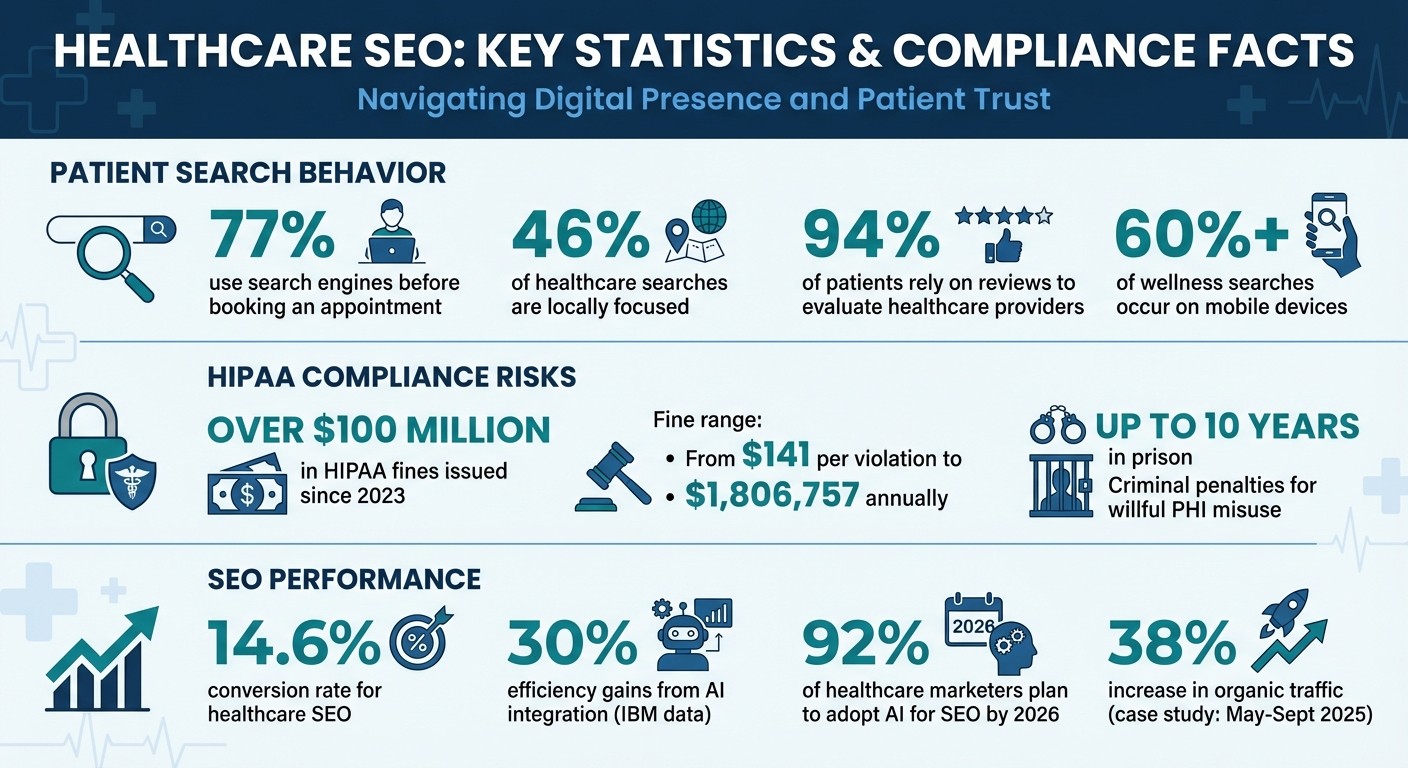
Healthcare SEO Statistics and HIPAA Compliance Fines
15 Tips for SEO for Doctors I've Learned After 10 years
1. Setting Up HIPAA-Compliant SEO
Before diving into SEO strategies, securing your digital infrastructure is critical - especially in healthcare, where Protected Health Information (PHI) extends beyond medical records. PHI includes details like IP addresses, user IDs, appointment requests, and any form submissions that can link a person to a health condition or service [10][11]. Unfortunately, standard SEO tools such as Facebook Pixel or Google Analytics 4 often collect this data without a Business Associate Agreement (BAA), leading to over $100 million in HIPAA fines since 2023 [11].
"HIPAA compliance isn't just a legal checkbox for healthcare brands. It directly influences how websites are structured, how ads are targeted, how leads are collected, and how SEO content is planned and distributed." - Healthus.ai [10]
Audit Your Digital Infrastructure
Start by reviewing all data entry points - forms, chat widgets, appointment schedulers - to ensure they have end-to-end encryption (AES-256 at rest, TLS 1.2+ in transit) and secure backups [9][6]. Pay close attention to URLs and query parameters; for example, URLs like ?condition=cancer can unintentionally expose PHI [6]. Remove marketing pixels from any password-protected patient portals or subpages that discuss specific diseases or treatments [11]. These pages should never transmit data to third-party ad networks.
Choose HIPAA-Compliant Tools
Standard analytics platforms such as GA4 and Adobe Analytics lack BAA provisions, making them unsuitable for healthcare [11][15]. Instead, opt for tools like Piwik PRO, Freshpaint, or Matomo, which are designed to meet compliance needs [15]. For collecting form data, consider using Jotform HIPAA, Formstack, or LuxSci, all of which offer encryption and are willing to sign BAAs [6]. If phone call tracking is necessary, CallRail offers HIPAA-compliant plans with features like voice redaction and access controls on its Essentials or Advanced tiers [15].
Document Your Compliance Processes
Keep a detailed compliance spreadsheet to track each vendor's BAA status, renewal dates, and security certifications such as SOC 2 Type II or HITRUST. Assign a privacy officer to oversee documentation and conduct quarterly risk assessments [14][15][9]. Develop a clear Standard Operating Procedure (SOP) for responding to patient reviews, ensuring replies are neutral and never reference specific treatments or conditions [16]. HIPAA violations can result in fines ranging from $141 per violation to $1,806,757 annually, depending on the level of negligence, with criminal penalties reaching up to 10 years in prison for willful misuse of PHI [11].
Once your HIPAA-compliant framework is established, you’ll be ready to focus on building authority through E-E-A-T content in the next section.
2. Building Authority Through E-E-A-T Content
In the healthcare space, where accuracy and trust are paramount, content must adhere to the highest standards of Expertise, Experience, Authoritativeness, and Trustworthiness (E-E-A-T) [6]. These rigorous standards aren't just about meeting search engine expectations - they're essential for building trust with your audience and aligning with HIPAA-compliant digital practices. To achieve this, your content strategy needs a well-rounded approach that combines authoritative topics, meticulous keyword research, and precise technical execution.
"In healthcare, you're operating in a YMYL (Your Money or Your Life) category. That means Google holds these sites to a higher standard."
Ashot Nanayan, CEO and Founder, Digital World Institute [6]
Define Your Content Topics
Start by establishing authority in your core specialties, then branch out to related health topics [1]. A "Condition-Symptom-Treatment" cluster strategy works well here. For example, a main page on "eczema" could link to subtopics like symptoms, treatments for different age groups, and guidance on when to seek care. This structure not only helps patients navigate their concerns but also signals to search engines that your site offers thorough coverage.
Every piece of content should be written or reviewed by qualified medical professionals [6]. Display the author's name, credentials, and a "Medically Reviewed By" tag prominently at the top of the page, along with the most recent review date [1]. Link these bylines to detailed bio pages showcasing the author’s education, certifications, and specialties, as well as the articles they’ve contributed to or reviewed [6]. This transparent approach fosters trust, which is critical for converting readers into patients.
Research Keywords Without Exposing Patient Data
Use tools like Ahrefs or Google Keyword Planner to identify high-intent, long-tail keywords such as "emergency hospital Los Angeles" or "eczema treatment for kids" [4]. Leverage aggregate data from platforms like Google Search Console and Google Ads to find relevant queries while ensuring no Protected Health Information (PHI) is involved [3]. Avoid using sensitive details in URLs - steer clear of formats like ?condition=cancer, as these can lead to HIPAA compliance issues [6].
Focus on addressing real, personal questions often found on platforms like Reddit or Quora instead of sticking to overly technical definitions [6]. Regularly update your content with current medical insights from trusted sources like the Mayo Clinic, NIH, or CDC to maintain credibility [1][6]. Once your topics and keywords are in place, you can enhance your content further with technical tools like schema markup.
Add Medical Schema Markup
Structured data is a powerful way to make your content machine-readable and validate its authority for AI-driven search engines [1]. Key schema types for healthcare include:
Schema Type | Purpose for Healthcare SEO |
|---|---|
| Defines symptoms, causes, and risk factors for specific illnesses [3] |
| Links doctors to their specialties, locations, and credentials [3] |
| Marks pages as authoritative medical resources for search engines [8] |
| Details treatments, surgeries, or diagnostic tests offered [3] |
| Structures common patient questions to capture "People Also Ask" snippets [3] |
Tools like ChatGPT can help generate initial JSON-LD markup, but always review the code for accuracy before publishing [6]. For the Physician schema, include links to trusted third-party platforms like Healthgrades or Zocdoc to further establish credibility [6]. Ensure that any ratings or credentials in the schema match the visible content on your site to prevent penalties from search engines [6]. Use Google Search Console to monitor your implementation and address any indexing errors related to schema formatting [3].
3. Optimizing Local SEO to Attract Patients
Local SEO plays a crucial role in driving patient engagement and supporting your overall digital strategy. With 77% of patients beginning their search for healthcare providers online and 46% of those searches being locally focused, your presence in local search results can significantly impact appointment bookings[1][7]. Securing a spot in the "Map Pack" - the top local results - can translate into dozens of new patients every week.
Optimize Your Google Business Profile
Start by claiming and verifying your Google Business Profile (GBP) and Bing Places listings to establish your local presence[4]. Consistency is key: ensure your Name, Address, and Phone (NAP) information is identical across all platforms. Even minor discrepancies, like "St." versus "Street", can negatively affect your rankings[8].
Select precise primary and secondary service categories, such as "Urgent Care Center" or "Dermatologist", to improve your visibility in the Map Pack[1]. Complete every available field on your profile, including details about accepted insurance, available treatments, appointment booking options, and parking. High-quality photos of your facility and staff can also help build trust with potential patients.
For practices with multiple locations, remove any duplicate listings immediately, as these can harm your rankings[1]. Use the "Posts" feature on GBP to share timely updates, like new services, seasonal health tips, or flu shot availability. Once your profile is fully optimized, focus on creating dedicated service pages to capture local traffic.
Create Pages for Each Service Area
Develop individual pages for each service and location, targeting specific neighborhoods or ZIP codes. For instance, instead of a single "Physical Therapy in Miami" page, create separate pages like "Sports Injury Rehab in Miami" and "Post-Surgical PT in Miami"[6][8].
Each location page should highlight unique aspects of that facility, such as on-site specialists, available services, accepted insurance, and parking or public transit instructions[1][6]. Embedding a Google Maps widget showing the entrance and nearby parking can make navigation easier for patients[6]. Since more than 60% of wellness searches occur on mobile devices, ensure your pages load quickly and are user-friendly, with touch-friendly buttons and readable text[7].
Place a clear call-to-action (CTA) above the fold to encourage high-intent users to book an appointment or call immediately[6][8]. Add medical schema markup (e.g., MedicalOrganization, Physician, Hospital) to help search engines verify your credentials and improve your search visibility[5]. Keep NAP information consistent across all location pages, GBP listings, and medical directories to maintain trust and accuracy[1][8].
Collect Patient Reviews Safely
Patient reviews are a powerful tool, with 94% of patients relying on them to evaluate healthcare providers[1]. However, HIPAA regulations mean you cannot acknowledge that a reviewer is a patient, even if they disclose their own information publicly[18][19].
Send neutral review requests after appointments, and when responding, avoid including any Protected Health Information (PHI), such as treatment details or appointment dates[17][18]. A compliant response might look like this: "Thank you for sharing your experience. We're happy to hear your feedback. Feel free to contact our office directly if you have any questions."
Monitor and respond to reviews consistently to maintain a positive reputation[4][7]. Additionally, update your operating hours promptly for holidays or unexpected closures to prevent patient frustration and negative reviews[4]. By staying proactive, you can enhance both your online presence and patient satisfaction.
4. Scaling Content With AI Tools
Healthcare teams face the challenge of consistently delivering compliant, clinically accurate content. AI tools offer a solution by automating tasks like research and drafting, while human experts maintain oversight. According to IBM, organizations incorporating AI into their workflows have seen efficiency gains of up to 30% [23]. Furthermore, 92% of healthcare marketers plan to adopt AI for their SEO strategies by 2026 [1]. This sets the stage for integrating AI-driven processes in research, drafting, and content review.
Use AI for Research and First Drafts
With a HIPAA-compliant framework in place, AI can streamline the research and drafting process. While AI excels at gathering data, organizing ideas, and producing initial drafts, it cannot replace medical expertise. For example, AI can compile research on treatment options, address common patient inquiries, or summarize condition overviews. These drafts can then be tailored to meet compliance requirements, such as including disclaimers, avoiding absolute claims like "guaranteed cure", and flagging terms that need human review [20].
To enhance this process, create an approved messaging library. This library should include pre-approved language about your services, treatments, and policies. AI can reference this resource when generating content and will flag any language outside the approved terms for review [20].
AI can also take on technical SEO tasks, such as identifying broken links, creating schema markup for FAQ or MedicalCondition pages, and suggesting internal links to connect related care pathways [22]. By automating these technical details, your team can focus on ensuring clinical accuracy.
Set Up Human Review Workflows
Every AI-generated draft must undergo human review. Google applies stricter quality standards to health-related content due to its "Your Money, Your Life" (YMYL) classification [22]. Licensed professionals should validate drafts for clinical accuracy, verify treatment details, and ensure compliance with E-E-A-T standards.
A multi-step workflow can help streamline this process. AI generates the draft, automated scans flag risky language (e.g., superlatives, guarantees, or references to Protected Health Information), and a professional reviews and approves the content [26,29]. As J.P. Gownder, a Forrester Analyst, emphasizes:
"Human oversight remains critical for setting goals, ensuring quality and making judgment calls" [22].
To build trust, add a "Medically Reviewed By" badge to each published piece. This should include the reviewer's name, credentials (e.g., MD, DO, RN), and the date of the last review. Transparency reassures readers and search engines that the content is vetted by qualified professionals [21]. For instance, a multi-specialty clinic partnered with Mirra Health Care and implemented a physician-reviewed content hub. Between May and September 2025, they saw a 38% increase in organic traffic over four months [21].
Publish Directly to Your CMS
Manual transfers can introduce errors like broken links or formatting issues. By connecting your AI workflow directly to a HIPAA-compliant CMS - such as WordPress, Webflow, or Framer - you can minimize these risks. Direct publishing ensures that approved content moves smoothly from review to publication.
Before integrating AI tools, confirm that the vendor signs a BAA [27,29]. The AI tool should not collect, store, or expose Protected Health Information during content creation. Additionally, configure automated checklists in your CMS to remind reviewers to verify disclaimers, privacy protections, and adherence to approved messaging before publishing.
As your content library expands, each published piece helps refine the AI’s understanding of your brand voice and clinical focus. This creates a compounding effect: the more content you produce, the better the AI becomes at generating accurate drafts. With seamless CMS integration, your team can move efficiently from research to publication, accelerating your overall workflow.
5. Tracking Performance and Staying Compliant
Once you've streamlined content production with AI tools, the next step is to carefully monitor performance while ensuring patient data remains secure. Publishing compliant content is just the beginning - you also need to measure effectiveness without risking HIPAA violations. Tools like Google Analytics 4, Facebook Pixel, or heatmaps might unintentionally capture Protected Health Information (PHI), which could lead to compliance issues. The Department of Health and Human Services emphasizes:
"Regulated entities are not permitted to use tracking technologies in a manner that would result in impermissible disclosures of PHI to tracking technology vendors or any other violations of the HIPAA Rules" [24].
Set Up Privacy-Safe Analytics
Out of the box, Google Analytics 4 is not HIPAA-compliant because Google does not sign a Business Associate Agreement (BAA) for it [24]. If you're tracking pages that might handle PHI - like appointment booking forms, patient portals, or symptom checkers - you'll need to explore alternative solutions. Privacy-focused platforms such as Piwik PRO, Adobe Customer Journey Analytics (with Healthcare Shield), or self-hosted Matomo allow you to maintain complete control over your data while staying compliant [12]. Matomo’s self-hosted version, in particular, offers a cost-effective option with full data ownership.
If using GA4 is unavoidable, consider adding a server-side privacy layer like Freshpaint. These tools intercept and de-identify PHI before sending data to third-party platforms. Additionally, configure your analytics to mask IP addresses and strip sensitive query strings (e.g., removing "?condition=cancer") before any data is stored [13]. For monitoring search engine performance - such as clicks, impressions, and rankings - Google Search Console is a safer choice since it relies on aggregated, non-user-specific data [24].
Track Algorithm Changes for Health Content
Healthcare content falls under Google's "Your Money, Your Life" (YMYL) classification, which subjects it to stricter quality and reliability standards [1]. Algorithm updates can significantly affect rankings, especially those targeting E-E-A-T (Experience, Expertise, Authoritativeness, and Trustworthiness) signals or technical performance. Keeping an eye on Core Web Vitals - like ensuring Largest Contentful Paint (LCP) is under 2.5 seconds and Interaction to Next Paint (INP) is below 100 milliseconds - can help maintain your site's technical health [2].
To measure progress effectively, focus on four performance layers: Visibility (keyword rankings and Map Pack presence), Engagement (calls and appointments), Outcomes (lead quality and customer acquisition costs), and the AI layer (inclusion in generative search results) [1]. As Adam Audette explains:
"Today, it's not about 'get the traffic' - it's about 'get the targeted and relevant traffic'" [1].
Use tools like Google Search Console and Ahrefs to track keyword performance, and regularly audit local listings to eliminate duplicate profiles while ensuring consistent Name, Address, and Phone (NAP) data. These insights can guide your compliance and performance strategies.
Run Regular Compliance Checks
To maintain compliance, quarterly audits are essential. These reviews ensure your systems and content remain aligned with evolving standards. Schedule these audits with privacy experts to address three critical areas: technical security (e.g., HTTPS and encryption), patient privacy (HIPAA/BAA compliance), and content quality (E-E-A-T and YMYL adherence). Confirm that all tools in your SEO stack - such as analytics platforms, CRMs, heatmaps, and form providers - have signed BAAs. Additionally, review URLs and tracking configurations to ensure no PHI is inadvertently passed to non-compliant platforms [6]. Avoid using session recording tools like Hotjar or Microsoft Clarity unless they are configured to meet privacy requirements.
On the content side, verify that all medical claims are backed by reliable sources and that clinician credentials are clearly displayed alongside a "last updated" date to meet YMYL standards. Patient reviews and testimonials should be anonymized and accompanied by legally compliant consent forms before publication. Also, ensure your CMS prevents internal search features from creating URLs that might expose sensitive medical terms. Regular audits help identify and resolve potential gaps, protecting both patient data and your site's search rankings.
Conclusion: Key Steps for Healthcare SEO
Building an effective healthcare SEO strategy means balancing the need for online visibility with strict regulatory requirements. Start by ensuring your digital infrastructure is HIPAA-compliant and secure. As Adam Audette highlights, 77% of patients turn to search engines before scheduling an appointment [1], so precision in targeting the right audience is far more important than sheer traffic volume.
A strong foundation begins with secure systems and authoritative content. To establish trust, have licensed professionals either author or review all materials, clearly displaying their credentials and including recent review dates. Implement medical schema markup, such as MedicalCondition and Physician, to help search engines and AI-powered tools verify your content’s credibility [3]. Local optimization is equally critical - claim your Google Business Profile, ensure NAP (Name, Address, Phone) data is consistent across directories, and respond to patient reviews professionally within three business days [25].
Once compliance and authority are in place, integrate AI-driven tools to streamline workflows and monitor performance. AI platforms like Averi can assist with research, drafting, and SEO optimization, but they should always function within a human-in-the-loop process. Use AI for initial drafts, but have medical experts review and approve all content before publication. This approach allows for scalable content production while maintaining the accuracy and compliance required for YMYL (Your Money or Your Life) content [8].
Regularly track performance metrics, including visibility, engagement, outcomes, and AI-driven insights [1]. Conduct quarterly audits to ensure tracking tools are compliant and that Core Web Vitals meet performance benchmarks [25]. With healthcare SEO boasting a 14.6% conversion rate, significantly outperforming traditional outbound marketing efforts [1], these steps - ranging from HIPAA compliance and E-E-A-T principles to local optimization and AI integration - create a strategy that ensures both regulatory adherence and measurable growth.
FAQs
How can I tell if my website is leaking PHI?
To determine if your website might be exposing PHI (Protected Health Information), it's essential to evaluate its compliance with HIPAA regulations. Start by examining how your site collects, stores, and shares data, ensuring these practices align with HIPAA requirements, such as implementing encryption and strict access controls. Additionally, review any tracking technologies in use, like cookies or analytics tools, to avoid unintentional exposure of sensitive information. Conduct regular audits of your systems and processes to uphold compliance and protect PHI effectively.
What should I prioritize first: HIPAA, E-E-A-T, or local SEO?
To safeguard patient data and steer clear of legal troubles, start with HIPAA compliance. This step is crucial for maintaining privacy and adhering to regulations in the healthcare industry. Once your foundation is secure, shift your attention to E-E-A-T (Experience, Expertise, Authoritativeness, and Trustworthiness). By showcasing your knowledge and authority, you can build trust with your audience, which is essential in the wellness and healthcare sectors. Finally, prioritize local SEO to connect with your community and enhance your visibility among nearby patients or clients. Following this approach helps ensure legal protection, credibility, and a stronger presence in your niche.
How can I use AI for SEO without risking compliance?
To integrate AI into SEO strategies for healthcare while maintaining compliance, opt for AI tools specifically built to align with HIPAA and other industry regulations. Prioritize platforms that offer features such as automated compliance checks, secure data-sharing capabilities, and robust encryption protocols. Ensure that only de-identified data is utilized, establish strict data-handling policies, and provide staff with thorough training on compliance standards. Additionally, using enterprise-grade tools equipped with audit trails can further safeguard privacy and ensure adherence to regulatory requirements.
Related Blog Posts

Zach Chmael
CMO, Averi
"We built Averi around the exact workflow we've used to scale our web traffic over 6000% in the last 6 months."
Your content should be working harder.
Averi's content engine builds Google entity authority, drives AI citations, and scales your visibility so you can get more customers.