

In This Article
Actionable SEO for hotels and travel brands: keyword strategy, local listings, schema markup, mobile speed, reviews, and AI visibility.
Updated:
Trusted by 1,000+ teams
Startups use Averi to build
content engines that rank.
SEO is essential for hospitality and travel businesses to drive bookings and reduce dependency on OTAs. With 32.8% of hotel revenue from organic search and 76% of travelers starting their planning on search engines, optimizing your website for both traditional and AI-driven search is critical. AI tools like ChatGPT and Google AI Overviews are reshaping search, with 60% of Google searches by 2025 answered directly via AI. This requires focusing on:
Keyword Strategy: Use long-tail keywords aligned with traveler intent (e.g., "family-friendly hotels in NYC").
Local SEO: Optimize your Google Business Profile (GBP) with accurate details, reviews, and photos.
Seasonality: Target seasonal and event-specific keywords like "hotels near Coachella 2026."
AI Visibility: Implement structured data (e.g., schema markup) to help AI tools cite your business.
Content Creation: Tailor content for all travel stages, from research to booking, and update it regularly.
Technical SEO: Ensure fast mobile load times and clean site structure for better user experience.
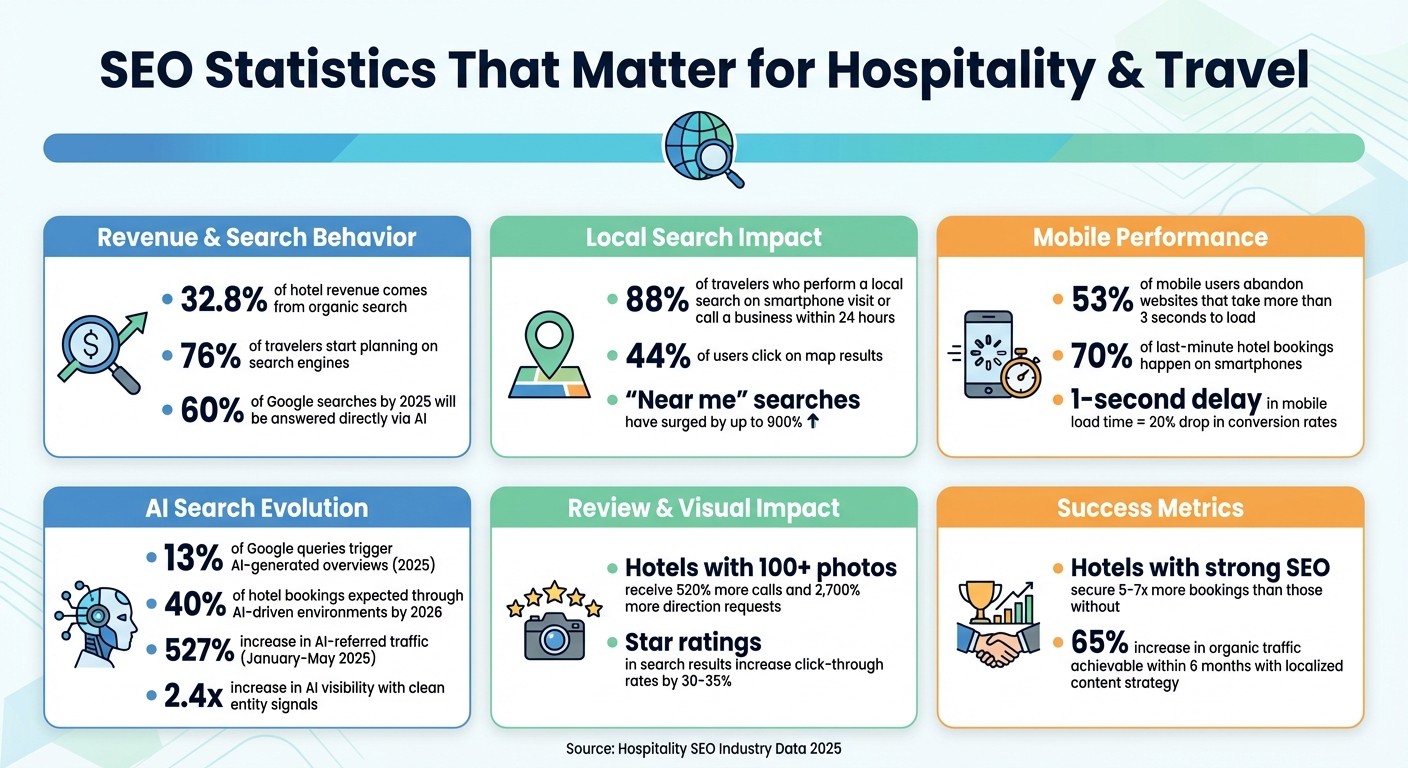
SEO Impact on Hospitality Revenue: Key Statistics for Hotels and Travel Businesses
Travel SEO Secrets: Stop Losing 70% of Bookings to OTAs in 2026
Finding the Right Keywords for Hospitality & Travel
Keyword research in the hospitality industry focuses on identifying terms that indicate a strong intent to book. Take the difference between "Dubai hotels" and "family-friendly hotels in Dubai with kids club" - the latter reveals a traveler who’s much closer to making a decision. These long-tail keywords, which include specific amenities, locations, or traveler preferences, are key to capturing visitors ready to book [1].
A great starting point is to align keywords with the five stages of the travel journey:
Awareness: Inspirational searches like "best destinations for families."
Research: Informational queries such as "best time to visit Morocco."
Decision-making: Commercial terms like "affordable Europe tours."
Booking: Transactional searches such as "luxury hotels in Santorini."
Travel: Local intent queries like "tours near me."
Each stage demands tailored content, but transactional and local keywords tend to convert at the highest rates.
To refine your strategy, use tools like Google Keyword Planner to assess search volume, and layer insights from Semrush or Ahrefs to evaluate keyword difficulty and competitive gaps [3][7]. Look for keywords your competitors rank for but you don’t - these gaps are opportunities. Assign one primary keyword per page to avoid cannibalizing your own content [7].
"Someone searching for 'luxury hotel New York City' could be anywhere in their journey. But someone searching for 'boutique hotel near Central Park with rooftop bar' knows exactly what they want." – DataFirst Digital [1]
To evaluate keywords, rate them on a 0–3 scale for commercial value, with 3 indicating the strongest alignment with user intent [7]. For example, "pet friendly hotels downtown [city] with parking" scores higher than "hotels in [city]" because it reflects a traveler with specific needs and a readiness to book.
Once you’ve mapped broad and transactional keywords, focus on local search terms to further sharpen your strategy.
Finding Local Search Keywords
Local search dominates hospitality bookings, especially with the rise of "near me" searches - queries like "hotels near me tonight" have surged by up to 900% [6]. These searches often signal urgency, making them a goldmine for conversions.
To capture this traffic, incorporate location modifiers into your strategy, such as:
"Hotels near [landmark]"
"[Neighborhood] boutique hotels"
"[City] hotels with free parking"
Tools like Semrush’s Keyword Magic Tool can uncover long-tail variations your competitors might miss [3][7]. Additionally, dig into your own customer data - guest inquiries, service questions, and reviews often reveal the exact phrases travelers use. For instance, if guests frequently ask about shuttle services or proximity to a convention center, those terms should become part of your keyword plan [9].
Create dedicated pages for specific neighborhoods, attractions, or amenities rather than relying solely on generic city landing pages. ChatGPT sources 58% of its local citations from business websites and 15% from directories [6], so your site needs to provide structured, detailed content that AI tools can easily reference.
While local keywords address immediate searches, incorporating seasonal trends can help you anticipate and meet shifting traveler demands.
Using Seasonal and Trending Keywords
Travel demand changes dramatically with the seasons, and your keyword strategy should adapt accordingly. Use Google Trends to identify when interest in certain destinations spikes, and publish content 2–3 months before peak season [5][8]. For instance, a ski resort targeting "best ski resorts in January" should have content live by October.
Local event calendars and tourism boards are also valuable resources for identifying high-intent seasonal keywords tied to festivals, concerts, or sporting events [3]. A hotel near a major music festival, for example, could target terms like "[festival name] hotel packages" or "where to stay during [event]." These event-driven keywords often face less competition and deliver higher conversion rates than generic seasonal terms.
AI tools, such as ChatGPT or Claude, can help you brainstorm comprehensive topic maps for your destination, revealing niche seasonal opportunities you might overlook [7]. For example, ask the AI to list all activities, events, and weather-related considerations for your location, then build keyword clusters around them.
Keep seasonal content updated quarterly to maintain visibility with AI systems. Outdated promotions - like a "Summer 2024" deal still visible in March 2026 - signal unreliability to AI recommendation engines [9]. Regularly refresh dates, pricing, and availability, and use Event schema markup to highlight timely content for festivals and seasonal activities [10].
Keyword Type | Example | Search Intent | Best Content Format |
|---|---|---|---|
Broad/Low Intent | "Dubai hotels" | Research/Comparison | Destination roundup |
Long-Tail/High Intent | "Family-friendly hotels in Dubai with kids club" | Specific Booking Need | Detailed property page |
Seasonal | "Christmas markets in Europe" | Time-Sensitive Planning | Seasonal guide with booking links |
Event-Driven | "Hotels near Coachella 2026" | Event-Specific Booking | Event landing page |
This approach to keyword research sets the stage for the local, content, and technical SEO strategies covered in later sections.
Optimizing for Local SEO
Local search is a major driver for hospitality bookings, with 88% of travelers who perform a local search on their smartphone visiting or calling a business within 24 hours [6]. To stay competitive, your business needs to stand out not just in traditional search rankings but also in AI-generated summaries and local packs that travelers encounter first. A key factor in achieving this visibility is entity clarity - ensuring that search engines and AI systems trust the accuracy of your hotel's identity and location.
Setting Up Your Google Business Profile
Your Google Business Profile (GBP) plays a pivotal role in local visibility, serving as the primary data source for Google's Gemini AI [6]. Start by claiming your GBP and making sure your hotel name matches exactly across your website and directories. Choose "Hotel" as your primary category and add secondary categories like "Resort", "Boutique hotel", or "Extended stay hotel" to reflect your offerings [11].
Fill out every attribute, including details like sustainability practices, accessibility features, pet policies, free Wi-Fi, and parking options. These attributes not only help inform travelers but also act as structured data points that AI systems rely on to match your property with specific search queries [11][1].
Regular updates are essential. Post weekly on Google Posts to share seasonal deals, restaurant specials, or event availability. Add fresh, authentic photos regularly, including shots of exteriors, lobbies, guest rooms, bathrooms, dining spaces, and event areas. These visuals can increase click-through rates and build trust. With 60% of Google searches in 2025 projected to end without a click, staying active and fresh on GBP ensures that AI systems favor your profile over less active competitors [6][9].
Respond to all reviews within 90 days, and personalize your responses by referencing specific amenities or features. For example, instead of a generic "Thank you for your review", say, "We're delighted you enjoyed our rooftop bar and the convenience of our location near the convention center." These thoughtful replies provide additional context that search engines use to assess relevance [11][6]. High-quality reviews are a major factor in boosting AI search visibility [6].
For businesses with multiple locations, each property should have a unique GBP with tailored descriptions, photos, and location-specific landing pages. Using identical profiles across locations can hurt visibility across the board [1].
Once your GBP is optimized, synchronize your details across all major directories to reinforce your local SEO efforts.
Managing Local Listings and Directories
Beyond your GBP, maintaining consistent profiles across platforms like TripAdvisor, Yelp, Booking.com, Expedia, Hotels.com, Apple Maps, Bing Places, and local tourism websites is key to building trust with AI systems [11][3]. Consistency in your business's Name, Address, and Phone number (NAP) is critical - minor discrepancies, such as "St." versus "Street" or "Suite 100" versus "#100", can create "entity doubt", leading AI models to favor competitors with cleaner data [6][11].
Clean entity signals, supported by schema markup and consistent directory information, can lead to a 2.4x increase in AI visibility [6]. Tools like Whitespark, BrightLocal, or Semrush's Review Management can help you monitor and update data across 70+ directories simultaneously [1][3]. Conduct audits at least quarterly - or monthly, if possible - to catch and correct inconsistencies introduced by aggregators [6].
Ensure your pricing and availability are consistent across your website, review platforms, and online travel agency (OTA) profiles. Discrepancies in pricing can signal unreliability to AI systems, which may prioritize competitors with better-maintained data [9]. Use Local Business schema markup (formatted in JSON-LD) on your website to match directory information exactly, reinforcing confidence in your data [6].
"If the information across these platforms is inconsistent, the search engine struggles to trust the entity. The foundation of hotel SEO is entity clarity and consistency." – LocalMighty [11]
It's worth noting that 80% of sources cited by AI search platforms do not appear in Google's top 100 organic results [6]. This highlights the importance of maintaining a strong presence in directories and niche blogs, which can help your hotel dominate AI recommendations even if it isn't at the top of the local pack.
Platform | Primary Local Data Source Mix | Optimization Priority |
|---|---|---|
ChatGPT | Business websites (58%), Directories (15%) | Website structure + Directory consistency |
YouTube (16.1%), Wikipedia (12.5%), Reddit (6.6%) | Video content + Community engagement | |
Google AI Overviews | Google Top 10 (76%), YouTube (9.5%), GBP | GBP optimization + Organic SEO |
Creating Content That Attracts Travelers
Organic search plays a major role in driving bookings, accounting for 32.8% of total revenue for hotels [1]. To tap into this potential, it's essential to create content that aligns with how travelers search - whether they’re exploring options on Google, asking AI assistants for recommendations, or scrolling through social media.
Tailor your content to match each stage of a traveler's journey. For example, someone searching for "best time to visit St. Tropez" is at a different stage than someone looking for "boutique hotels near Times Square with free parking." Build content that meets these needs: destination roundups for the awareness stage, detailed FAQs and seasonal guides for research, comparison lists for decision-making, booking checklists for conversions, and local itineraries for travelers already on their trip [3][5]. This approach ensures your content engages travelers at every decision point.
Content structure matters, too. AI search engines like ChatGPT and Perplexity prioritize "answer-first" sections of 120–180 words, which are 70% more likely to be cited than shorter snippets [6].
Timeliness is another key factor. Publish seasonal content 2–3 months ahead of peak interest and regularly update existing material with current prices, hours, and event details [5][9]. Neglecting updates - for example, leaving a "Summer 2024" promotion live in March 2026 - signals to AI systems that your site isn’t maintained, pushing users toward competitors [9].
Writing Destination Guides and Local Attraction Content
Creating detailed destination guides with actionable insights can set your content apart from generic OTAs. For example, include tips like "best restaurants within walking distance" or "hidden gem coffee shops in the Arts District" [1].
To help AI systems understand and connect your content, use entity-based SEO. Instead of simply mentioning "the Space Needle", describe it consistently across platforms: "the Space Needle, Seattle's 605-foot observation tower built in 1962." Pair this with schema markup types like TouristAttraction, TouristDestination, and Event to reinforce these connections [4][5].
Interactive tools can further boost engagement and bookings. Features like budget calculators, packing checklists, interactive maps, and "Find Your Perfect Room" quizzes not only keep visitors on your site longer but also improve your site's authority with both AI and traditional search engines [3][1]. These tools often attract natural backlinks when referenced by travel bloggers or forums.
Optimize your content for natural language queries that travelers use with AI assistants. Build FAQ-style sections answering questions like "what's the best time to visit Napa Valley for wine tasting?" or "how far is your hotel from the convention center?" Mining customer service inquiries and reviews can help identify these common questions, making it easier to create structured FAQs that AI systems can easily extract and cite [9][10].
Don't ignore the power of image captions. They’re some of the most-read text on a page after headlines [7]. Instead of a generic caption like "Hotel lobby", try something more engaging: "Our newly renovated lobby features complimentary coffee and 24/7 concierge service. Book your stay today."
Traveler Journey Stage | Content Type Examples | Search Intent |
|---|---|---|
Awareness | Destination roundups, aspirational videos, travel guides | Engaging |
Research | Destination FAQs, seasonal guides, budget tools | Informational |
Decision-making | Comparison guides, service reviews, curated accommodation lists | Commercial |
Booking | Step-by-step booking guides, checklists, exclusive deals | Transactional |
Travel | Interactive itineraries, "hidden gem" guides, local activity tips | Local/Navigational |
Once your strategy is in place, AI tools can help you maintain consistency and relevance.
Using AI Tools for Content Creation
AI tools can save time and improve alignment with search engine requirements, especially for small hospitality teams managing multiple responsibilities. These tools streamline research, drafting, and optimization, allowing you to focus on fine-tuning your brand’s voice and approving final content.
Averi AI is one such tool. It automates every step of the content creation process, from research to publishing. Averi starts by analyzing your website to learn your brand voice, services, and positioning, then identifies content gaps by researching competitors. It generates topic ideas based on keyword opportunities and industry trends, drafts articles with hyperlinked sources and FAQ sections, and even publishes directly to platforms like WordPress or Webflow - eliminating manual formatting.
One standout feature is compounding context. Each new piece of content feeds into Averi's system, making future drafts increasingly aligned with your brand. Performance data also helps the tool recommend updates, new keywords, and trending topics to focus on.
For FAQs, AI tools can mine customer service inquiries and online reviews to create content that mirrors the natural language travelers use. This ensures your site aligns with how people phrase questions to AI assistants [9].
Finally, don’t underestimate the value of named authorship. Content with recognized expert bylines - such as a local concierge, destination expert, or general manager - can boost AI citation likelihood by up to 340% [6]. Highlighting these experts on your guides not only builds credibility with travelers but also increases trust from AI systems.
Technical SEO and Schema Markup for Hospitality
When it comes to high-ranking hotel websites, the backbone lies in well-structured code that search engines can easily process. Technical SEO ensures your site is fast, mobile-optimized, and structured in a way that both Google and AI systems can interpret effectively. For hospitality businesses, this means using schema markup to showcase room rates and availability directly in search results while also optimizing Core Web Vitals to keep travelers engaged long enough to explore your offerings.
Here’s a key stat: 53% of mobile users will abandon a website if it takes more than 3 seconds to load [5]. This highlights how critical technical optimization is for turning visitors into actual bookings.
Adding Hotel and Room Schema Markup
Schema markup is essentially a way to organize your website’s data so search engines understand it better. For hospitality sites, this involves using specific schema types like Hotel, HotelRoom, Offer, Review, and FAQ. These help display rich snippets in search results, including pricing, star ratings, amenities, and availability [1][5][4].
With AI platforms increasingly relying on structured data, having complete schema markup is more important than ever. By 2025, 13% of Google queries are expected to trigger AI-generated overviews, and sites with thorough, machine-readable data will have a better chance of being featured [1].
To get started, use JSON-LD scripts to define key details about your property - room types, amenities (like "pet-friendly" or "rooftop bar"), your exact location, and real-time pricing. Make sure this information aligns with your Google Business Profile (GBP) and Online Travel Agency (OTA) listings. Any inconsistencies can lead AI systems to flag your site as unreliable, potentially steering customers toward competitors instead [9][4].
Schema Type | What It Displays | Impact on Visibility |
|---|---|---|
Hotel | Property name, star rating, address, contact info | Helps your site appear in local search and map results |
HotelRoom | Room types, bed configurations, square footage | Provides detailed room options directly in search results |
Offer | Real-time pricing, availability, booking links | Displays rates prominently in search snippets |
Review | Aggregate ratings, guest testimonials | Builds trust and improves click-through rates |
FAQ | Common questions and answers | Captures "People Also Ask" boxes and voice search |
For example, instead of just listing "free Wi-Fi" as text, schema markup can define it as an entity (e.g., amenityFeature: "Free Wi-Fi"). This allows AI systems to parse and compare it across different properties. This structured approach helps search engines better understand your offerings and recommend your property to the right audience [4].
But schema markup is just one piece of the puzzle. Ensuring your site performs well on mobile is equally critical.
Improving Mobile Speed and User Experience
With 70% of last-minute hotel bookings happening on smartphones [1], your mobile site’s performance is no longer optional - it’s essential. Google’s mobile-first indexing means your mobile experience directly impacts your search rankings. If your site is slow or clunky, you risk losing potential guests before they even reach your booking engine.
To optimize your site’s performance, focus on Core Web Vitals:
Largest Contentful Paint (LCP): Under 2.5 seconds
Interaction to Next Paint (INP): Below 200 milliseconds
"If your site takes longer than 2.5 seconds to load on mobile, you're hemorrhaging potential bookings." - Warren, Beesocial [2]
Use tools like Google PageSpeed Insights to test your site’s performance and aim for a mobile score above 70. Common fixes include:
Converting images to WebP format
Lazy loading offscreen content
Minifying CSS and JavaScript
Enabling browser caching
Leveraging a Content Delivery Network (CDN) to serve assets faster
Beyond speed, the overall mobile user experience (UX) plays a huge role. Booking buttons should be at least 48×48 pixels for easy tapping, text should be legible without zooming, and horizontal scrolling should be eliminated. Simplify booking forms by reducing the number of required fields - every extra step increases the likelihood of abandonment. In fact, just a one-second delay in mobile load time can slash conversion rates by 20% [1].
If your property uses a JavaScript-heavy booking interface, consider implementing dynamic rendering. This ensures search engines can crawl your inventory properly, even if it displays perfectly for human users [1]. By addressing these technical factors, you can create a seamless experience that keeps travelers engaged and ready to book.
Managing Your Online Reputation
Maintaining consistent local listings is just the start - actively managing your online reputation strengthens AI trust and improves SEO performance. Reviews play a crucial role here, acting as trust indicators for both search engines and AI systems. If guest reviews contradict your claims - like advertising a "luxury spa" that doesn’t meet expectations - your property could lose credibility and ranking [1]. It’s worth noting that only 25% of AI-generated travel answers come directly from your website. The other 75% comes from external sources like reviews, blogs, and social media [1].
The freshness of reviews is just as important as their volume. A property with hundreds of outdated reviews but no recent activity may appear inactive to algorithms. On the other hand, generating even a handful of new reviews each month signals that your business is engaged and dependable [9]. This is especially relevant as AI-generated overviews now appear in 13% of Google searches - a percentage that continues to rise [1].
Responding to Reviews
Engaging with all reviews - positive and negative - is critical. It shows both travelers and search algorithms that you’re attentive and transparent [1][9]. Aim to respond within 48 hours, as this quick turnaround can improve your local pack rankings and build trust with potential guests [2].
When replying, reflect the specific language guests use in their reviews. For example, if multiple reviews highlight a "rooftop bar with city views", using that exact phrasing on your website creates semantic alignment that search algorithms value [1].
For negative feedback, address concerns head-on and with transparency. A thoughtful response can turn a dissatisfied guest into a loyal one while demonstrating your commitment to improvement [3]. Additionally, using Review and AggregateRating schema markup ensures star ratings appear in search results, which can increase click-through rates by 30% to 35% [10].
This kind of engagement not only builds trust but also sets the stage for generating high-quality backlinks through strategic digital PR.
Getting Backlinks Through Digital PR
Backlinks remain a cornerstone of building domain authority and complementing other optimization efforts. To attract attention from journalists and bloggers, create "linkable assets" like travel calculators, interactive maps, destination rankings based on data, or detailed budget planners [13][16][7].
Reacting to trending topics can also be highly effective. Keep an eye on viral trends, like TikTok travel hacks, or seasonal events, such as International Women’s Day, and pitch relevant insights or data to journalists [13][14][15]. For example, a campaign focusing on solo travel destinations for International Women’s Day secured 28 media placements, including 13 links from high-authority sites with Domain Authority scores over 90 [13].
Additionally, collaborate with tourism boards, suppliers, and business partners to gain backlinks from their "partner" or "resource" pages [16][7]. Consistent digital PR efforts can boost website traffic by around 10% within six months [16]. Beyond hyperlinks, Google increasingly values brand mentions in reputable travel publications as authority signals, making it essential to get your property’s name featured in trusted outlets [15].
Tracking Performance and Adjusting Your Strategy
Measuring the impact of your SEO efforts is crucial when it comes to driving bookings. Organic search contributes to 32.8% of hotel revenue, so tracking performance isn’t just helpful - it’s necessary [1].
Start by keeping an eye on booking engine clicks, as this metric reflects actual reservation intent [2]. Additionally, monitor your Local Pack performance; with 44% of users clicking on map results, failing to appear in location-based searches could mean missing out on nearly half of your mobile traffic [12].
AI-driven platforms require a whole new set of metrics. Keep tabs on your "Share of Voice" in AI-generated responses. This measures how frequently tools like ChatGPT, Perplexity, or Google AI Overviews recommend your property when travelers seek suggestions [9][4]. Platforms like Profound and AirOps can help you track where and how often your property is mentioned in AI-generated itineraries, offering insights into your visibility compared to competitors.
Analyzing SEO Metrics
Focus on metrics that directly tie to revenue instead of vanity numbers. Google Analytics 4 should track both macro conversions, like completed bookings, and micro conversions, such as newsletter sign-ups or travel guide views [7]. Use tools like Semrush's Keyword Gap to uncover "Missing" keywords - terms your competitors, such as Expedia or TripAdvisor, rank for but you don’t [7].
Core Web Vitals are another key factor, as they can directly influence booking completion rates. Regular site audits can help you address indexing issues, duplicate content (like reusing destination descriptions across multiple pages), and broken links [7][3]. Also, review your Google Business Profile (GBP) insights to see which photos get the most engagement. Hotels with over 100 photos reportedly receive 520% more calls and 2,700% more direction requests compared to those with fewer photos [12].
These metrics provide actionable insights to refine your strategy and increase bookings. However, keeping up with AI search trends is equally critical to stay competitive.
Optimizing for AI Search Engines
While traditional metrics guide revenue, AI-driven metrics fine-tune your visibility. AI search engines prioritize entity recognition over basic keyword matching. They need to identify your property as a trusted source within their "mental map" of destinations and accommodations [4]. To assist AI in recognizing your property, implement structured data using Schema.org markups like HotelRoom, TouristTrip, and LocalBusiness to provide clear details about your amenities and pricing [1][5].
Content freshness is another key ranking factor for AI models. Outdated promotions - like a "Summer 2024" deal still visible in March 2026 - signal neglect and can cause your property to lose visibility in AI recommendations [9]. Automate content updates for destination pages and itineraries to ensure information remains current.
Align your website language with phrases from guest reviews. For instance, if multiple reviews highlight your "rooftop bar with city views", use that exact phrase in your website headers. This alignment strengthens trust signals that AI algorithms value, bolstering your overall SEO efforts [1]. Additionally, since a large portion of AI responses rely on external reviews and social signals, maintaining a diverse range of digital trust indicators is essential [1].
"AI visibility is the top of the funnel, not the bottom. You still need a complete conversion strategy." - Brainlabs [9]
It’s also important to measure how AI visibility translates into actual bookings. Leading travel brands now analyze their appearance in AI recommendations alongside increases in weekend booking volumes to demonstrate ROI [9]. With 40% of hotel bookings expected to come through AI-driven environments by 2026 [17], optimizing for AI isn’t just a trend - it’s a necessity for staying competitive in the long run.
Conclusion
This guide highlights the importance of focusing on keyword strategy, local SEO, and technical optimizations to achieve measurable results. In the hospitality and travel sector, SEO plays a critical role in standing out from Online Travel Agencies (OTAs). Organic search currently accounts for 32.8% of total hotel revenue [1], and hotels with strong SEO strategies secure 5–7x more bookings than those without [5]. With 76% of travelers beginning their journey on search engines [5], your visibility has a direct impact on revenue.
As digital habits shift, SEO strategies must adapt. AI is transforming how travelers plan trips, with AI-referred traffic surging by 527% between January and May 2025 [18]. Tools like ChatGPT and Google AI Overviews are enabling travelers to build entire itineraries before ever visiting a booking site. Structured data increases the likelihood of being cited by AI tools by over threefold [18], making schema markup and regularly updated content indispensable.
In this fast-changing landscape, focus on critical factors like local pack optimization (driving 44% of map clicks [12]), mobile speed (with 53% of users abandoning pages that take over 3 seconds to load [5]), and effective review management. Instead of chasing vanity metrics, track revenue-driving indicators such as booking engine clicks, AI visibility, and Core Web Vitals.
The most successful properties are not just chasing traditional search rankings. They’re creating hyperlocal content that OTAs can’t match, ensuring data consistency across platforms, and prioritizing visibility in AI-driven search. For instance, one city-center hotel implemented a localized content strategy targeting "location + amenity" searches and achieved a 65% increase in organic traffic for high-intent keywords within just six months [1].
Start with the basics - schema markup, mobile optimization, and responsive review management. Then, embrace AI-focused strategies like building entity-based content and maintaining freshness. Hotels that treat SEO as an ongoing, data-driven effort will secure more direct bookings, while others risk losing out to commission-heavy OTAs.
FAQs
What should I do first to get more direct bookings from SEO?
To drive more direct bookings through SEO, begin by boosting your website's visibility for key terms such as “hotels in [your city].” Prioritize optimizing your site's technical performance to ensure fast loading times and smooth navigation. Invest in local SEO strategies by claiming and enhancing your Google Business Profile, and target high-intent keywords that align with what potential guests are searching for. These efforts will help your site rank better on search engines, draw in more organic traffic, and make it easier for travelers to discover and book your property directly.
How do I show up in AI search results like Google AI Overviews?
To improve your chances of appearing in AI-driven search results like Google AI Overviews, focus on creating content tailored for AI visibility. Use structured formats such as direct-answer paragraphs, question-based headings, and schema markup (e.g., FAQPage, Article). Ensure your website includes up-to-date, accurate information, such as real-time pricing, product availability, and customer reviews. Strengthening your topical authority and keeping your content current and well-structured in line with AI search criteria will significantly boost your likelihood of being featured.
What schema markup is most important for a hotel website?
For a hotel website, using the right schema markup is crucial. Key details to include are amenities, reviews, pricing, availability, and location. These elements enable search engines to generate rich results, making your listing stand out and drawing in more potential guests.
Related Blog Posts

Zach Chmael
CMO, Averi
"We built Averi around the exact workflow we've used to scale our web traffic over 6000% in the last 6 months."
Your content should be working harder.
Averi's content engine builds Google entity authority, drives AI citations, and scales your visibility so you can get more customers.