

In This Article
Local SEO, neighborhood content, and technical fixes let agents outrank portals and capture high‑intent buyers.
Updated:
Trusted by 1,000+ teams
Startups use Averi to build
content engines that rank.
If you're a real estate agent, competing with giants like Zillow and Redfin might seem daunting. But SEO offers a way to stand out by targeting local audiences and capturing high-intent buyers and sellers. Here's what you need to know:
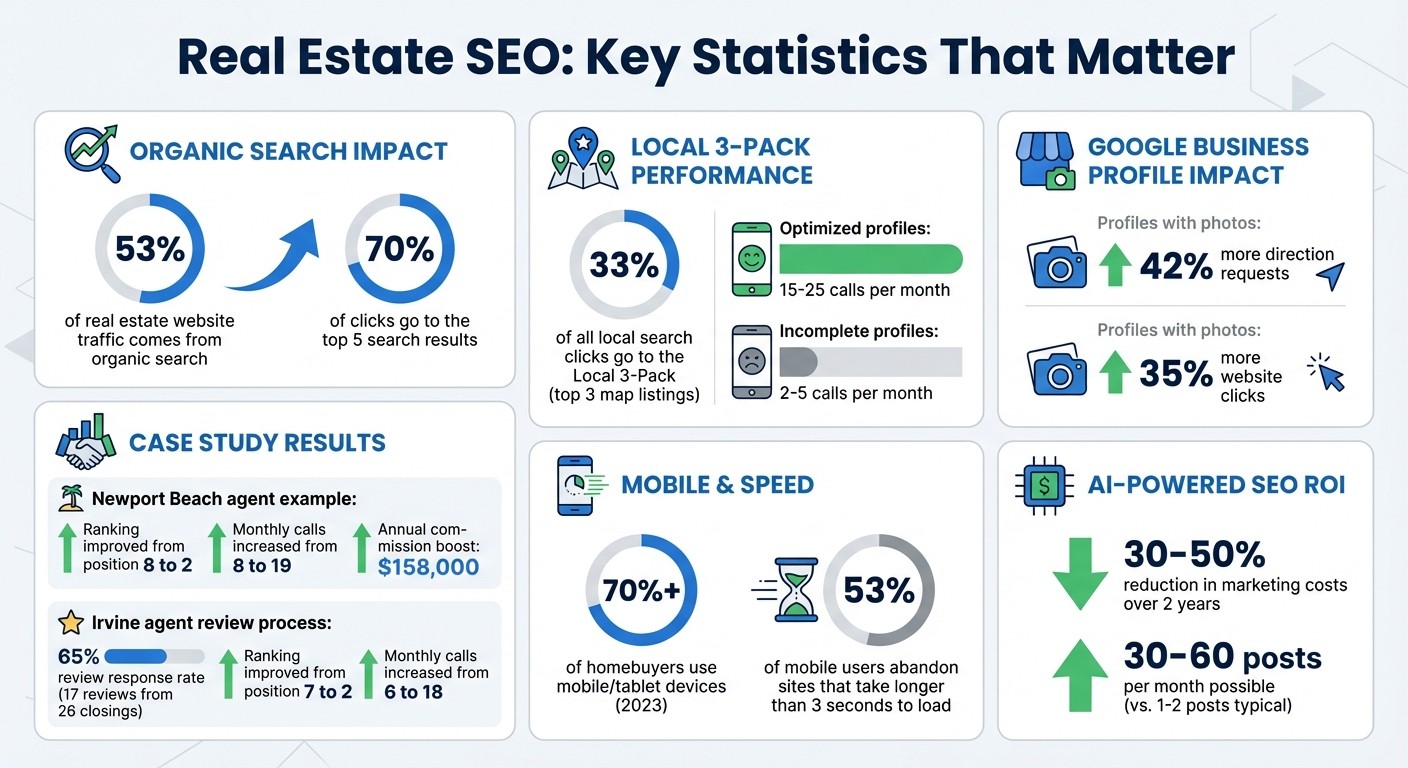
Why SEO Matters: 53% of real estate website traffic comes from organic search, and 70% of clicks go to the top five results.
Local Optimization: Focus on Google Business Profile and hyperlocal content to dominate local searches.
Content Strategy: Create neighborhood-specific guides and use long-tail keywords to attract buyers early in their research process.
Technical SEO: Ensure your site is mobile-friendly, fast, and optimized with schema markup for better visibility.
Backlinks: Build authority with links from local businesses, directories, and media.
Real Estate SEO Statistics: Traffic, Rankings, and ROI Impact
Real Estate SEO: the Ultimate Guide to Creating Community Pages That Rank on Google
Set Up Your Google Business Profile for Local Search
Your Google Business Profile is a powerful tool for dominating local searches. When someone searches "realtor near me" or "homes for sale in [your city]", Google often highlights the Local 3-Pack - those top three map listings. This section captures 33% of all local search clicks [7], making it essential for driving leads. Securing one of these coveted spots can significantly boost your business.
The difference between a fully completed profile and an incomplete one is stark. Agents with optimized profiles typically generate 15–25 calls per month, compared to just 2–5 calls for those with incomplete profiles [7]. Here's how to set yourself up for success.
Claim and Verify Your Profile
Start by logging into your Google account and heading to the Google Business Profile Manager. Enter your business name exactly as it appears across all platforms - consistency is key. Choose "Real Estate Agent" or "Real Estate Agency" as your primary category, and add your address and phone number [1][4][7].
Verification happens via phone call or postcard. Once verified, focus on NAP consistency - your Name, Address, and Phone number. Even small inconsistencies, like spelling out "Street" versus using "St.", can hurt your local authority. A Newport Beach agent found their NAP details inconsistent across 43 of 52 citations. After dedicating 12 hours over three weeks to standardizing this information, their Local Pack ranking for "Newport Beach realtor" jumped from position 8 to 2. This effort translated into an increase from 8 to 19 monthly calls, resulting in an estimated $158,000 boost in annual commission income [7].
Define your service area by specific zip codes rather than listing dozens of cities. Aim for 15–25 zip codes to clearly communicate your coverage to Google [4][7]. Once verified, enhance your profile with professional photos and detailed real estate information.
Add Property Photos and Real Estate Details
Photos make a big difference. Upload at least 20 high-quality images, including headshots, team photos, office views, "Just Sold" signs, and local neighborhood highlights [7][8]. Profiles with photos see 42% more direction requests and 35% more website clicks than those without [8].
Keep your profile fresh by adding new photos every month. Use the Posts feature to share updates like new listings, "Just Sold" properties, open house schedules, and market trends [7][4][5]. This activity signals engagement to Google.
In your business description (up to 750 characters), include key phrases like "[City] real estate", "[Neighborhood] homes for sale", and "[City] realtor" [1][5]. Highlight specific services such as "Buyer Representation", "Seller Representation", "Luxury Homes", and "Relocations" to match various search intents [4][5][3].
Use the Q&A section to address common buyer and seller questions, like "What are closing costs in [City]?" This not only provides value but also incorporates relevant keywords [7][3]. With your profile visually optimized, the next step is building trust through client reviews.
Get Client Reviews to Build Trust
Reviews are crucial for ranking in the Local 3-Pack, but consistency matters more than quantity. Google favors agents who receive steady reviews every 30–90 days over those with a large but outdated collection [4][7]. For example, an agent with 35 reviews and a few new ones each month will rank higher than one with 50 reviews from two years ago [7].
The ideal time to ask for reviews is 3–5 days after closing - when the immediate stress has subsided but before moving chaos begins [7]. One Irvine agent used a structured 4-step review process: they sent a thank-you gift at closing (without asking for a review), followed up with a review link on day 3, sent a reminder on day 7, and checked in again on day 30. Out of 26 closings in a year, they secured 17 new reviews - a 65% response rate. This effort boosted their Local Pack ranking from position 7 to 2, and monthly calls increased from 6 to 18 [7].
Simplify the process by sharing a direct review link from your Google Business Profile dashboard (e.g., g.page/r/XXXXX/review). Asking clients to "find you on Google" adds unnecessary friction and reduces response rates.
Respond to every review - positive or negative - within 24 hours [7][8]. This shows engagement to Google and professionalism to potential clients. For negative reviews, acknowledge the issue publicly, then take the discussion offline.
"Your Google Business Profile is the single highest-impact local SEO asset you control." - Jeff Lenney, SEO Expert [7]
Create Local and Neighborhood-Specific Content
Once your Google Business Profile is set up, the next step is building credibility through hyperlocal content tailored to specific neighborhoods. Neighborhood-focused pages often outperform broader city pages because they attract buyers and sellers who are 6–12 months away from making a decision[9].
While buyers can easily look up median prices, what they can’t find online is the kind of insider knowledge you can provide - details about walkability, trusted local builders, and the unique vibe of each neighborhood. These insights position you as the go-to expert in your area.
Write Neighborhood Guides and Market Reports
Develop in-depth guides ranging from 1,500 to 3,000 words that address common local questions, such as school districts, commute times, and HOA fees. Including a balanced pros and cons section can help build trust with your audience[7][9].
Comparison articles are especially effective for targeting buyers who are narrowing down their options. For instance, a guide like "Preston Hollow vs. Park Cities: Which Dallas Neighborhood Is Right for You?" appeals to high-intent readers and typically aligns with search volumes in the 50–200 range[13].
To keep readers engaged, incorporate practical tools into your content. Features like mortgage calculators, neighborhood-specific IDX listings, and video walkthroughs or drone footage can significantly boost "dwell time", which is an important ranking factor[9][2]. Make sure to update your guides annually with the latest market data to maintain their relevance and ranking power[9][12].
Use Long-Tail Keywords for Specific Searches
Long-tail keywords offer a strategic edge in real estate SEO. Instead of competing for broad terms like "Dallas homes", focus on more specific phrases such as "3-bedroom homes near Preston Hollow Park" or "walkable neighborhoods with cafes in [City]."[1][12][2] These searches may have lower volume but often indicate higher buyer intent.
Target keywords that reflect readiness to act, like "Homes for sale in [Neighborhood]", rather than early-stage queries such as "living in [City]."[12] School-related searches are also highly effective, as families often look for homes within specific school boundaries (e.g., "[School Name] homes for sale").
Organize your content with question-based headings to capture featured snippets or AI-generated overviews. For example, a heading like "What Is the Best Neighborhood for Families in [City]?" followed by a concise, 40–60 word answer can help your content appear in Google’s AI overviews[9][12].
Avoid spreading your efforts too thin by creating one comprehensive guide per neighborhood instead of multiple short pages. Once you’ve published 15–20 well-connected neighborhood guides, Google often starts recognizing your site as a topical authority[13].
"Real estate SEO is about owning specific searches that buyers and sellers are actually using when they're 6-12 months out from a transaction."
Jeff Lenney, SEO Expert[9]
Use AI Tools to Speed Up Content Creation
Publishing 15–20 neighborhood guides may sound daunting, but AI tools can simplify the process. Tools like ChatGPT or Averi AI can draft initial content, which you can then enhance with your local expertise. This approach saves time while preserving authenticity[10][9][6].
Averi AI streamlines the entire workflow, from keyword research to creating CMS-ready drafts complete with internal links and schema markup. It identifies high-potential topics, organizes content ideas by type (e.g., how-to guides or market reports), and lets you refine drafts in a collaborative editing space. You can even publish directly to platforms like WordPress, Webflow, or Framer, with all drafts saved in a Library for future use.
To ensure your content aligns with SEO best practices, use tools like Surfer SEO or NeuronWriter to optimize keyword density and structure[10]. Publishing consistently is key - 20 neighborhood guides can build more local authority than 100 generic blog posts[7]. With AI tools, even solo agents can produce this volume of high-quality content, leveling the playing field against larger brokerages with dedicated teams. This consistency strengthens your reputation as a neighborhood expert[10].
With your content strategy in place, you’re ready to tackle the technical SEO aspects of your website.
Fix Technical SEO Issues on Your Website
Even the most engaging local content won't rank if your website is slow or riddled with issues. Technical SEO ensures that both Google and potential clients can easily access and navigate your site. With over 70% of homebuyers using mobile or tablet devices during their home search in 2023[16], optimizing for mobile is no longer optional - it’s the backbone of your SEO strategy.
Speed Up Your Site and Optimize for Mobile
Since 2018, Google has prioritized mobile-first indexing, meaning it evaluates your mobile site before your desktop version[14]. If your mobile site isn’t up to par, your visibility could plummet. And with 53% of mobile users abandoning a site that takes longer than 3 seconds to load[5], speed is critical.
To improve load times, convert property images to WebP, enable lazy loading, and activate browser caching for static assets[14][15][16][17]. Focus on Core Web Vitals, which include:
First Contentful Paint (FCP): Measures how quickly content appears.
Interaction to Next Paint (INP): Tracks responsiveness.
Cumulative Layout Shift (CLS): Ensures page elements remain stable during loading[14][16].
Use tools like Google PageSpeed Insights and the Mobile Usability report in Google Search Console to identify and resolve performance issues[14][15].
Ensure that touch targets are large enough to avoid frustrating users[14][15]. Simplify navigation with a hamburger menu and add sticky calls-to-action like "Click-to-Call" or "Schedule Viewing" to make it easy for users to take action[14][17]. Properly configure viewport meta tags so content scales correctly across devices[14][17].
Once your site is mobile-friendly and fast, you can further enhance visibility with schema markup.
Add Real Estate Schema Markup
After optimizing for speed and mobile usability, help search engines understand your content with schema markup. This structured code allows search engines to display rich snippets in search results, such as property prices, bedrooms, bathrooms, and square footage - all directly on the results page[9][18]. These details not only attract clicks but also pre-qualify visitors.
Use the JSON-LD format and place the code in the <head> section of your HTML[9]. For property listings, apply schema types like SingleFamilyResidence, Condo, or House, but avoid misclassifications like "Product" schema, which could lead to penalties[9]. For your agency, use RealEstateAgent or LocalBusiness schema, and add Person schema for individual agent profiles to build credibility[9][18].
Include geo-coordinates (latitude and longitude) to ensure your business appears in "near me" searches and map results[9]. Format prices as numerical values (e.g., "2950000") with a separate currency field ("USD") instead of including the dollar sign in the price string[9].
Before publishing, validate your schema using Google's Rich Results Test or the Schema.org Validator to catch errors[9]. Regularly monitor the "Enhancements" section in Google Search Console for ongoing issues[9]. If you're using IDX plugins, verify they generate accurate and non-duplicative schema data for each property page[9]. Proper schema implementation boosts your listings' visibility, complementing the gains from site speed and mobile optimization.
Organize Your Site Structure for Easy Navigation
A well-organized site makes it easier for both users and search engines to find your content. Use a hierarchical structure where your homepage branches into main categories (e.g., Search Homes, Communities, About) and subcategories (e.g., specific neighborhoods or property types)[19][21]. Aim for a flat architecture where every page is accessible within 3 to 4 clicks from the homepage[21][22].
Implement topic clustering by creating central "pillar" pages for broader topics (e.g., "Dallas Real Estate") that link to more specific "spoke" pages like neighborhood guides and market reports[21][22]. This hub-and-spoke model signals expertise to search engines. Use breadcrumb navigation to improve user experience and keep URLs concise - under 75 characters, with hyphenated lowercase words[20][21][22]. Avoid unnecessary parameters or session IDs that might create duplicate content issues[21].
Regularly audit your site to identify and fix orphaned pages - those with no internal links - as they may never get indexed by search engines[22][1]. Place critical links at the top of each page since Google prioritizes higher-positioned links[19]. Maintain an up-to-date XML sitemap to ensure search engines can discover all your URLs, even those buried deep within the site[21][22]. A clear and intuitive site structure strengthens your SEO efforts and ensures your optimized content reaches potential clients effectively.
Build Local Backlinks and Partnerships
Once your website and content are optimized for local searches, the next step is to establish authority through strategic local backlinks and partnerships. Local backlinks are a powerful way to signal your relevance to search engines. A single link from a trusted local source, like your city’s chamber of commerce, can have a greater impact on your local rankings than multiple links from broader, national sites. As SEO expert Jeff Lenney explains:
"One link from your city's chamber of commerce is worth more for local rankings than ten links from national real estate blogs." [7]
Partner with Local Businesses and Organizations
Collaborating with local businesses that complement your services can open the door to valuable backlink opportunities. Think about teaming up with mortgage brokers, home inspectors, title companies, movers, interior designers, or renovation contractors. These partnerships allow for shared content and mutual promotion. For instance, you could work with a local interior designer to create a "Home Staging Guide for Sellers" on their blog, linking back to your listings. Or, co-host a "First-Time Homebuyer Seminar" with a lender and secure a backlink from their event page.
High-authority local organizations like chambers of commerce, neighborhood associations, charities, and school PTAs are also worth targeting. If you sponsor local events or sports teams, request a backlink on their "Sponsors" or "Partners" page. Tools like Ahrefs or SEMrush can help you analyze competitors’ backlinks to uncover local directories, media outlets, or organizations linking to them. Reach out with personalized pitches that highlight mutual benefits, such as expanding audience reach or creating cost-effective marketing opportunities.
Get Featured in Local News and Media
Being mentioned in local media can boost your brand’s authority with Google, even if it doesn’t include a direct backlink [4] [7]. To capture the attention of local outlets, pitch data-driven stories or create resources like detailed "Living in [Your City]" guides or interactive maps that journalists might reference [3] [5]. You could also contribute quarterly market trend reports or offer expert insights on real estate developments.
Platforms like Qwoted, JustReachOut, and JournoRequests connect you with journalists looking for real estate expertise. When featured, ensure your Name, Address, and Phone number (NAP) match your Google Business Profile exactly. If a backlink is missing, follow up to request one. Monitoring local mentions ensures you don’t miss these opportunities.
List Your Business in Real Estate Directories
Consistent directory listings are essential for building trust with Google. Even small discrepancies, such as using "Street" instead of "St.", can weaken your local SEO [7] [9]. Start with Tier 1 directories like Google Business Profile, Bing Places, Apple Maps, Zillow, Realtor.com, Trulia, Redfin, and Homes.com. Once those are updated, move on to Tier 2 directories, such as Yelp, the Better Business Bureau, your local chamber of commerce, and MLS member directories.
Priority Tier | Directory Type | Examples |
|---|---|---|
Tier 1 (Core) | Major Search & Real Estate Portals | Google Business Profile, Bing Places, Apple Maps, Zillow, Realtor.com, Trulia, Redfin, Homes.com [7] |
Tier 2 (Industry) | Local Business & Niche Directories | Yelp, Yellow Pages, BBB, Chamber of Commerce, Local Business Associations, MLS Member Directory [7] |
Tier 3 (General) | Social & General Directories | Facebook Business, LinkedIn Company Page, Foursquare, MapQuest, Yahoo Local [7] |
To find existing listings, use Google search operators like "[your full name]" "[your city]" real estate. Tools such as Whitespark Local Citation Finder (a $20 one-time fee) can help identify missing citations, while Moz Local (priced at $129/year) automates submissions to top directories. Decide on one standardized NAP format and use it consistently across all platforms. Responding to reviews within 24 hours is another way to show Google that your business is active and engaged [1] [7].
Conclusion: Use Technology to Scale Your Real Estate SEO
Real estate SEO is a momentum game. With a solid local SEO foundation in place, your visibility hinges on staying relevant to buyers who begin their search online and spend significant time researching before making contact. However, keeping up with manual updates can consume hours every week - time that most real estate agents simply can't spare.
This is where technology becomes a game-changer. Tools like Averi streamline the process by automating research, drafting, and optimization while keeping you in control. You can approve topics and fine-tune drafts in just minutes instead of hours. These systems learn your brand voice, monitor performance, and suggest new content based on real-time data. Over two years, AI-powered SEO can cut marketing costs by 30% to 50% compared to traditional methods, while enabling the production of 30–60 posts per month, far surpassing the typical 1–2 posts most agents manage [11][3].
The rise of Generative Engine Optimization (GEO) means your content must not only rank on Google but also be referenced by AI models like ChatGPT and Perplexity. AI tools can help format your content for this new landscape, incorporating answer-first structures, Schema markup, and FAQs to position you as the cited expert. As One Click SEO aptly puts it:
"AI Overviews are acting as a 'quality filter' for search traffic... The traffic is there - but only if you are the Cited Authority" [5].
FAQs
How long does real estate SEO take to generate leads?
Real estate SEO generally requires 4 to 6 months to start generating visible leads, with more impactful outcomes typically emerging within 6 to 12 months. These timelines can shift based on elements such as the level of competition, the strength of your content, and the specific conditions in your local market.
What’s the best way to choose neighborhood keywords that convert?
To find neighborhood-focused keywords that drive results, hone in on local search intent by using precise terms such as "homes for sale in [neighborhood]" or "realtor in [city]." Tools like Semrush can help generate keyword ideas, guiding you toward phrases with strong intent. Enhance your visibility by optimizing your Google Business Profile, crafting detailed neighborhood guides, and building content hubs. This targeted approach not only increases your chances of being discovered but also strengthens trust and improves conversion rates.
Which schema markup should I add to property and agent pages?
Adding schema markup to your property and agent pages is a smart way to boost search visibility. For property pages, incorporate the "Residence" or "RealEstateListing" schema, and for agent pages, use the "RealEstateAgent" schema. These structured data types help search engines interpret your content more effectively, improving the way listings and agents are displayed in search results - especially through rich snippets and enhanced local search features.
Related Blog Posts

Zach Chmael
CMO, Averi
"We built Averi around the exact workflow we've used to scale our web traffic over 6000% in the last 6 months."
Your content should be working harder.
Averi's content engine builds Google entity authority, drives AI citations, and scales your visibility so you can get more customers.