

In This Article
Learn how to effectively launch a B2B SaaS product with strategic pre-launch research, targeted campaigns, and ongoing post-launch improvements.
Updated:
Trusted by 1,000+ teams
Startups use Averi to build
content engines that rank.
Launching a B2B SaaS product requires a well-coordinated approach to ensure success in a competitive market. Buyers in this space demand clear ROI, thorough evaluation, and consistent messaging. Here's how to structure your campaign:
Pre-Launch: Research your audience deeply, test a streamlined MVP, and create a go-to-market plan tailored to your product's complexity. Use tools like surveys, beta testing, and account-based marketing (ABM) to refine your strategy.
Launch Execution: Run targeted multi-channel campaigns on platforms like LinkedIn, email, and webinars. Leverage AI tools to personalize outreach and create content efficiently. Engage with industry communities and influencers to build trust and visibility.
Post-Launch: Track key metrics like activation rates, CAC, and feature adoption. Use in-app surveys and customer feedback to improve your product and campaigns. Share updates to maintain user confidence.
AI tools can save time, reduce costs, and improve campaign performance by automating tasks and providing data-driven insights. A unified approach ensures that your product stands out and meets buyer expectations.
Go-To-Market Launch Plan For A New SaaS Product
Phase 1: Pre-Launch Setup
Preparing for a successful launch lays the groundwork for steady growth by targeting the right audience and avoiding unnecessary course corrections. This phase focuses on understanding your market, refining your product, and crafting a strategy that resonates with your audience.
Research Your Market and Target Audience
To truly understand your market, you need to uncover the deeper frustrations and challenges your potential customers face. Start by having in-depth conversations with people in your target segments. Go beyond surface-level complaints to identify how these issues directly impact their business operations.
Analyzing competitors is equally important. Study their positioning, messaging, and customer reviews on platforms like G2 and Capterra. Look for common complaints or unmet needs - these could highlight opportunities to stand out.
Develop detailed buyer personas that go beyond basic demographics. Dig into how decisions are made, budget cycles, and the roles of different stakeholders. In B2B settings, buying decisions often involve multiple influencers, so understanding these dynamics will help you create messaging that speaks to each decision-maker.
To confirm your assumptions, use surveys to reach a broader audience. Tools like Typeform or SurveyMonkey can help you gather data on pain points such as inefficiencies or dissatisfaction with current solutions. This quantitative validation ensures you're addressing real problems.
Build and Test Your MVP
When creating your Minimum Viable Product (MVP), focus on solving one key problem effectively. The goal is to confirm product-market fit with a simple, streamlined version of your solution before expanding.
Beta testing is a critical step. Partner with companies that match your ideal customer profile and offer early access in exchange for detailed feedback. Be clear about what type of input you’re seeking and establish a timeline for the testing process.
During beta testing, track metrics like user activation rates, feature adoption, and time-to-value. For instance, if users aren’t engaging with core features within the first week, it may indicate onboarding challenges. Similarly, if users struggle to see value quickly, you might need to simplify workflows or improve the user experience.
Organize feedback by urgency and impact. Prioritize fixing issues that hinder core functionality or prevent users from achieving their main goals. Create a feedback loop so participants can see how their input influences product development.
Act on feedback quickly. If recurring issues arise, address them before launch rather than relying on post-launch fixes. A well-tested and refined MVP sets the stage for a smooth transition into your go-to-market strategy.
Create Your Go-to-Market Plan
Your go-to-market (GTM) strategy should align with how your customers prefer to discover and adopt new solutions. For straightforward tools with clear value, a product-led approach might work best. However, for complex enterprise software, a sales-led strategy is often more effective due to longer implementation cycles and the need for personalized support.
A strong GTM plan combines personalized outreach, relevant content, and efficient lead processing. When prospecting, dive deep into target accounts and craft messaging that addresses their specific challenges. Avoid generic templates - focus on understanding each prospect’s unique situation.
Develop content that supports every stage of the buyer journey. From thought leadership to detailed case studies, your materials should help prospects see how your solution fits their needs. Coordinating efforts across SEO, social media, and sales enablement ensures maximum impact.
Efficient inbound lead processing is key to turning interest into meaningful conversations. Use tools that enrich incoming leads with additional data, allowing your team to quickly research accounts and route them to the right sales reps. In B2B sales, responding quickly can make all the difference.
For enterprise deals, account-based marketing (ABM) allows you to create highly targeted campaigns for specific companies. Research target accounts thoroughly to understand their industry challenges, recent developments, and existing technology stacks. Use these insights to craft tailored outreach and content.
"Thanks to Copy.ai, we're generating 5x more meetings with our personalized, AI-powered GTM strategy." - Jean English, Former Chief Marketing Officer, Juniper Networks [1]
Pricing is another critical component of your GTM plan. Study competitor pricing, but focus on the economic value your product offers. Whether it’s cost savings or efficiency gains, clearly demonstrate how your solution justifies its price.
Your sales process should reflect the complexity of your product. Enterprise software often requires extended proof-of-concept periods and multiple stakeholder meetings, while simpler tools might succeed with self-service trials. Tailor your approach to fit the needs of different customer segments.
If you’re planning to expand internationally, be prepared for added complexity. Localization goes beyond translating language - it involves adapting to local business practices, compliance standards, and cultural norms.
Finally, leverage AI to enhance your GTM strategy. Modern AI tools can automate research, personalize outreach at scale, and provide actionable insights, helping your team work more efficiently and make smarter decisions. By integrating AI across your sales and marketing efforts, you can eliminate inefficiencies and drive better results.
Phase 2: Launch Execution
This phase is all about putting your launch plan into action across various channels. It calls for a well-coordinated effort that combines traditional marketing methods with the efficiency of AI-driven tools to extend your reach and make a lasting impression.
Run Multi-Channel Campaigns
A successful B2B SaaS launch meets your audience where they are. LinkedIn is a key platform for connecting with decision-makers. Instead of generic product announcements, focus on content that addresses industry-specific challenges. Share insights into market trends, highlight customer success stories, and position your product as a solution to real-world problems.
For email campaigns, segmentation is essential. Tailor your messaging to different roles - technical evaluators need details on functionality and integration, while budget holders look for ROI data and cost-effectiveness. Use tools like case studies, ROI calculators, and implementation guides to nurture prospects through targeted sequences.
Webinars provide an interactive way to showcase your product. Design sessions to address specific pain points, include live Q&A opportunities, and follow up with personalized messages to attendees who show interest.
Platforms like Product Hunt can also be a valuable tool for gaining visibility. Plan your launch day meticulously, ensuring your team is ready to engage with early feedback and drive momentum.
AI-powered tools simplify multi-channel campaigns by creating tailored content for each platform while maintaining consistent messaging. These tools save time and resources, making it easier to scale your efforts.
"Copy.ai has been phenomenal in transforming the way we develop marketing content. By automating workflows that would typically take weeks and cost thousands of dollars through agencies, they've saved us $16 million dollars this year alone." - Roman Olney, Head of Global Digital Experience, Lenovo [1]
AI also enhances Account-Based Marketing (ABM) by enabling hyper-personalized outreach. Using AI research, you can reference specific company initiatives, recent news, or industry challenges, creating campaigns that resonate deeply with your target accounts and improve engagement.
Work with Communities and Influencers
Once your multi-channel campaigns are underway, expand your reach by connecting with industry communities and influencers. Participating in these communities builds credibility and fosters authentic engagement. Share your expertise by answering questions, contributing insights, and joining relevant discussions. When mentioning your product, frame it as one of several solutions rather than the only option.
Establishing thought leadership is another powerful strategy. Guest posts, podcast appearances, and conference presentations can position your team as knowledgeable leaders in the field. This approach not only builds trust but also attracts prospects who value your expertise.
In the B2B space, influencer partnerships often involve industry analysts, consultants, or respected professionals whose expertise complements your product. Additionally, customer advocacy programs can turn satisfied users into brand champions. Equip them with resources like templates and talking points, and consider offering incentives to encourage them to share their success stories.
Finally, building a strong partner ecosystem can amplify your launch. Integration partnerships, referral programs, and co-marketing efforts help you tap into audiences that already trust your partners. As your launch progresses, keep a close eye on performance metrics and be ready to refine your approach for continued success.
Phase 3: Post-Launch Improvement
Once your campaign is live, the work doesn’t stop - this is where the real learning begins. Post-launch analysis is all about maintaining momentum by closely monitoring performance and acting quickly on what you discover. Your ability to track results and respond to user feedback will determine long-term success.
Monitor Key Metrics and KPIs
The right metrics tell the story of your campaign’s impact. Instead of focusing solely on sign-ups, look for indicators that show users are actively engaging with your product - like completing onboarding, using a core feature, or achieving a specific goal. Metrics such as Customer Acquisition Cost (CAC) and Customer Lifetime Value (CLV) are particularly telling when broken down by channel. For instance, an email campaign might yield a lower CAC with strong retention, while paid ads might bring in quicker but less consistent results.
Other essential metrics include time-to-value, which measures how quickly users benefit from your product, and feature adoption rates, which highlight which functionalities resonate most. Analytics tools can help track these patterns, send alerts for notable changes, and guide real-time adjustments. Diving deeper with cohort analyses can reveal how user behaviors evolve, offering insights to fine-tune your acquisition strategies and overall product approach.
Update Based on User Feedback
Your pre-launch testing and multi-channel campaigns set the foundation, but collecting ongoing user feedback is key to continuous improvement. Tools like in-app surveys, strategically timed after specific actions or during potential sticking points, can provide targeted insights about features or processes. Additionally, reviewing customer support tickets can highlight recurring issues that may need fixes or clearer documentation.
Take it a step further by conducting user interviews. Speaking with new users, long-term loyalists, and even churned customers can uncover how your product fits into their routines and where adjustments are necessary. Focus on the most frequent and impactful feedback, and ensure users know their voices are being heard. Sharing updates - whether through a public product roadmap or detailed release notes - fosters trust and keeps users engaged.
Tool Comparison: Marketing Workspaces vs. Other Options
When preparing to launch a B2B SaaS product, you’ll encounter three main options to support your marketing efforts: AI-powered marketing workspaces, talent marketplaces, and single-purpose AI tools. Each comes with its own set of trade-offs in terms of integration, cost, and control, making it essential to understand which approach aligns best with your goals.
Marketing workspaces, like Averi AI, function as all-in-one environments where AI automation and human expertise come together seamlessly. On the other hand, talent marketplaces - such as Upwork or MarketerHire - connect businesses with freelancers or agencies for specific projects. Meanwhile, single-purpose tools, like Jasper or Copy.ai, focus on narrow tasks like content creation or ad copywriting.
Here’s a quick look at how these options stack up:
Comparison Table: Workspace vs. Marketplace vs. Single Tool
Feature | Marketing Workspace | Talent Marketplace | Single-Purpose Tool |
|---|---|---|---|
Work Delivery | AI-driven execution with human oversight | Manual coordination via freelancers/agencies | Self-serve AI prompting |
Quality Control | Ensures consistent brand voice with reviews | Varies depending on individual providers | Limited by AI training scope |
Context Retention | Maintains context across projects | Often lacks continuity | Limited session memory |
Integration Depth | Native integrations with key systems (CRM, CMS, analytics) | Requires manual handoffs between tools | Relies on API connections |
Time to Results | Fast outcomes via streamlined workflows | Slower due to coordination efforts | Quick outputs, but may need edits |
The total cost of ownership also differs significantly. While marketing workspaces can streamline operations and reduce overhead, talent marketplaces or single-purpose tools may require more internal management and coordination, potentially increasing the overall effort and expense.
Which Approach Fits Your Needs?
Marketing workspaces are ideal for complex launches requiring consistent messaging and integrated execution. Their ability to combine strategy and execution makes them a strong choice for SaaS companies managing multifaceted campaigns.
Talent marketplaces work well for one-off or highly specialized projects, especially for teams with limited internal resources. They provide access to expertise without the long-term commitment of a full-time team.
Single-purpose tools are suited for teams with established workflows in need of focused AI support for specific tasks. While they might be cost-effective upfront, they lack the cohesive benefits of a unified solution.
How Averi AI Works Differently
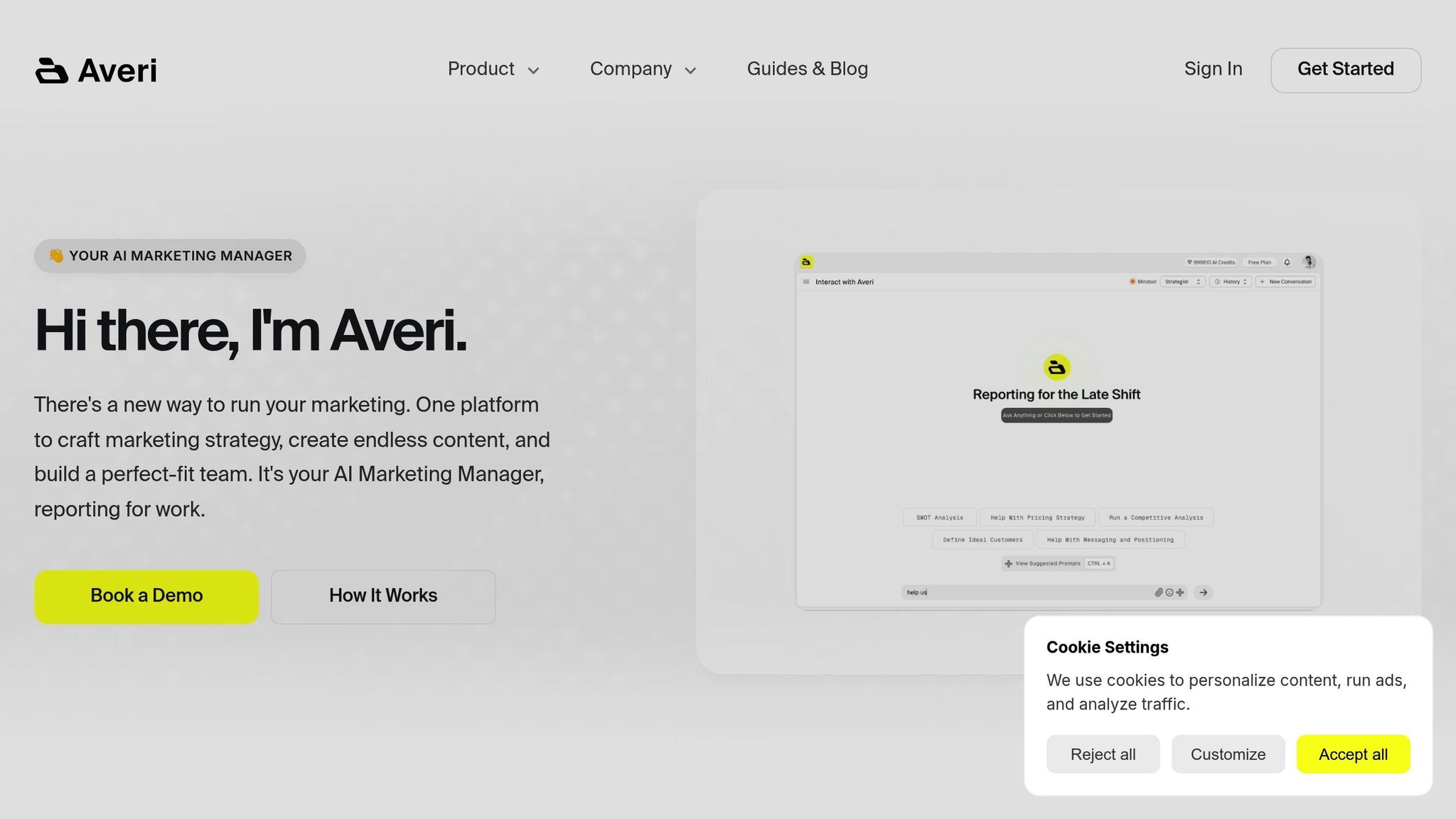
Averi AI takes the concept of a marketing workspace to a whole new level by combining advanced AI capabilities with human expertise, ensuring both efficiency and precision. Its Synapse system dynamically routes tasks between AI and human experts based on complexity. Unlike single-purpose tools, which often lose context between sessions, Averi AI retains strategic continuity. It carries over details like brand guidelines, audience insights, and prior conversations across projects.
Averi AI also stands out with its Adaptive Reasoning feature. For straightforward tasks, it operates in an "Express" mode for quick results. For more nuanced projects, it automatically shifts to deeper analysis, eliminating the need for manual adjustments.
Another key differentiator is Averi AI’s Human Cortex capability. This feature integrates vetted marketing experts directly into your workflow. Instead of constantly briefing external freelancers, these experts can step into your projects with full context, saving time and ensuring alignment.
Finally, Averi AI’s /create mode streamlines the entire content creation process. From initial brainstorming to deployment-ready assets, its three-phase system - Discuss → Draft → Edit - ensures every piece of content, whether an email sequence or landing page, aligns perfectly with your brand and campaign goals.
Conclusion: Key Points for Product Launch Success
Launching a successful B2B SaaS product is all about thoughtful preparation, seamless execution, and constant fine-tuning. From conducting in-depth market research to testing your MVP, every step lays the groundwork for long-term results. Skipping these early stages can lead to campaigns that miss the mark, but when done right, they ensure your strategies align with what customers truly need.
Once the foundation is in place, multi-channel execution becomes the key to extending your reach. Meanwhile, ongoing optimization ensures sustained growth. By tracking metrics like user activation rates and customer acquisition costs, you can pinpoint what’s working and adjust where necessary.
AI-powered platforms are revolutionizing how these launches come together. For example, some organizations have reported saving $16 million annually by automating marketing content workflows that once required weeks and significant agency fees [1]. Another company achieved five times more meetings by leveraging AI-driven GTM strategies [1]. These tools bring everything under one roof, from market research insights to personalized outreach and performance tracking, eliminating the chaos of managing multiple disconnected tools.
In today’s competitive B2B SaaS environment, speed and consistency are non-negotiable. AI tools can create SEO-friendly content, thought leadership articles, and social campaigns in mere seconds, giving businesses the agility to seize opportunities quickly. When paired with human expertise for strategy and creative oversight, these tools enable rapid execution without compromising quality or brand integrity.
A well-coordinated approach - covering everything from planning to execution - ensures that every campaign delivers measurable results and keeps your business ahead of the curve.
FAQs
What are the best AI tools to personalize outreach during a B2B SaaS product launch?
When launching a B2B SaaS product, tailoring your outreach can make a huge difference in driving engagement and boosting conversions. Here are a few standout AI tools that excel in helping you create personalized and impactful campaigns:
Averi AI: Simplifies the process of scaling personalized content by automating workflows, all while staying true to your brand's tone and style.
HubSpot's AI tools: Supports email personalization and automates follow-ups tailored to user behavior, ensuring timely and relevant communication.
Outreach.io: Leverages AI to analyze engagement data, refining your messaging to achieve stronger results.
By integrating these tools, you can streamline your outreach strategy, ensuring your message connects with your audience while conserving valuable time and effort.
How does account-based marketing (ABM) improve the effectiveness of a B2B SaaS product launch?
Account-based marketing (ABM) offers a powerful way to supercharge the launch of a B2B SaaS product by zeroing in on high-value accounts and crafting personalized experiences. By tapping into detailed insights about target industries, companies, and key decision-makers, ABM ensures your campaigns resonate deeply with the right audience.
AI tools make it even easier to scale this approach by enabling the creation of tailored content and assets for specific accounts. This blend of precise targeting and automation not only boosts engagement but also strengthens relationships and speeds up deal cycles - key ingredients for a successful product launch.
What are the key metrics to monitor after launching a B2B SaaS product to ensure long-term success?
To keep your B2B SaaS product thriving after launch, it’s important to monitor a handful of key metrics that reveal how well your business is performing and where adjustments may be needed:
Customer Retention Rate: This shows how many customers stick around and continue using your product. A high retention rate often signals satisfaction and loyalty.
Monthly Recurring Revenue (MRR): By tracking MRR, you can measure the growth of your recurring revenue, which is a strong indicator of financial stability and scalability.
Customer Acquisition Cost (CAC): Understanding how much it costs to bring in new customers ensures your spending aligns with your revenue goals and profitability.
Churn Rate: Keeping tabs on the percentage of customers canceling their subscriptions can help you spot and address potential issues early.
Net Promoter Score (NPS): This metric gauges customer satisfaction and how likely users are to recommend your product to others.
Paying close attention to these metrics allows you to fine-tune your strategy, address weaknesses, and sustain steady growth over time.
Related Blog Posts

Zach Chmael
CMO, Averi
"We built Averi around the exact workflow we've used to scale our web traffic over 6000% in the last 6 months."
Your content should be working harder.
Averi's content engine builds Google entity authority, drives AI citations, and scales your visibility so you can get more customers.