

In This Article
Target student personas, lead with outcomes, use AI for drafts, and run A/B tests to cut cost-per-enrollment and boost conversions.
Updated:
Trusted by 1,000+ teams
Startups use Averi to build
content engines that rank.
Ad copy for education platforms needs to do three things: grab attention fast, build trust, and clearly communicate value. With just 1.7 seconds to catch a user’s eye and 3 seconds to deliver your message, every word counts. Here’s how to create ad copy that works:
Understand your audience: Tailor your message to specific groups like recent grads, working professionals, or career changers. Use tools like quizzes to gather insights and build detailed personas.
Focus on outcomes: Highlight measurable results like "Land a tech job in 12 weeks" instead of vague promises.
Use proven frameworks: Apply structures like Problem-Agitate-Solution (PAS) to address pain points and offer solutions.
Leverage AI tools: Platforms like Averi AI can speed up drafting and testing, but human oversight ensures the message stays authentic.
Test and refine: Run A/B tests on headlines, calls-to-action, and visuals. Use metrics like click-through rates and cost per enrollment to guide improvements.
Ads Copywriting For Beginners: Complete Tutorial With Winning Examples
Know Your Audience Before Writing
Successful ad copy starts with a deep understanding of who you're speaking to. Education platforms cater to diverse groups - recent high school graduates, working professionals, and career changers - each with their own aspirations and hurdles. To connect effectively, your messaging must address their specific needs.
The first step? Collect zero-party data - information that your audience willingly provides. Tools like interactive quizzes (e.g., "What’s your biggest barrier to learning?") or preference centers where users share career goals can reveal exactly what they value most [4]. This data lays the foundation for creating targeted audience personas.
Create Specific Audience Personas
Build detailed personas that capture your audience's unique characteristics, including their educational background, career stage, goals, and challenges [2]. For instance, a recent graduate might prioritize affordability and landing their first job, while a working professional might focus on flexible scheduling and career advancement. Crafting messages that address these specific priorities ensures your ads resonate and drive results.
But it’s not just about the message - it’s also about where you deliver it. Map your personas to the platforms they use most. Professionals looking to upskill are likely to spend time on LinkedIn or listening to industry podcasts. On the other hand, younger audiences often gravitate toward short-form video content on Instagram and YouTube [4]. Choosing the right channels helps you reach your audience without wasting resources.
Identify and Address Common Problems
Once you’ve outlined your personas, it’s time to zero in on their challenges. Identify the top 3–5 issues each group faces and structure your ad copy around these pain points using the PAS framework. This involves:
Highlighting the Problem (e.g., "Feeling stuck in a dead-end job?"),
Agitating the issue (e.g., "Every year you wait is lost income"), and
Offering a Solution (e.g., "Our 12-week certification program gets you hired fast") [1].
This framework works because it mirrors how people approach their struggles - they feel the pain before actively seeking a way out.
Persona Segment | Primary Goal | Key Challenge | Preferred Channel |
|---|---|---|---|
Recent Graduates | Degree completion / First job | Tuition costs / Lack of experience | Instagram, TikTok, YouTube |
Working Professionals | Upskilling / Promotion | Scheduling conflicts / Time constraints | LinkedIn, Industry Podcasts |
Career Changers | New industry entry | Job placement / Transition risk | Search Engines, Review Sites |
Additionally, keep in mind that 89% of B2B buyers now use generative AI tools during their purchasing process [4]. This means your prospective students may rely on AI-driven search tools to explore options. By understanding their needs and challenges, you can craft ad campaigns that do more than grab attention - they inspire action and deliver results.
How to Write Ad Copy That Converts
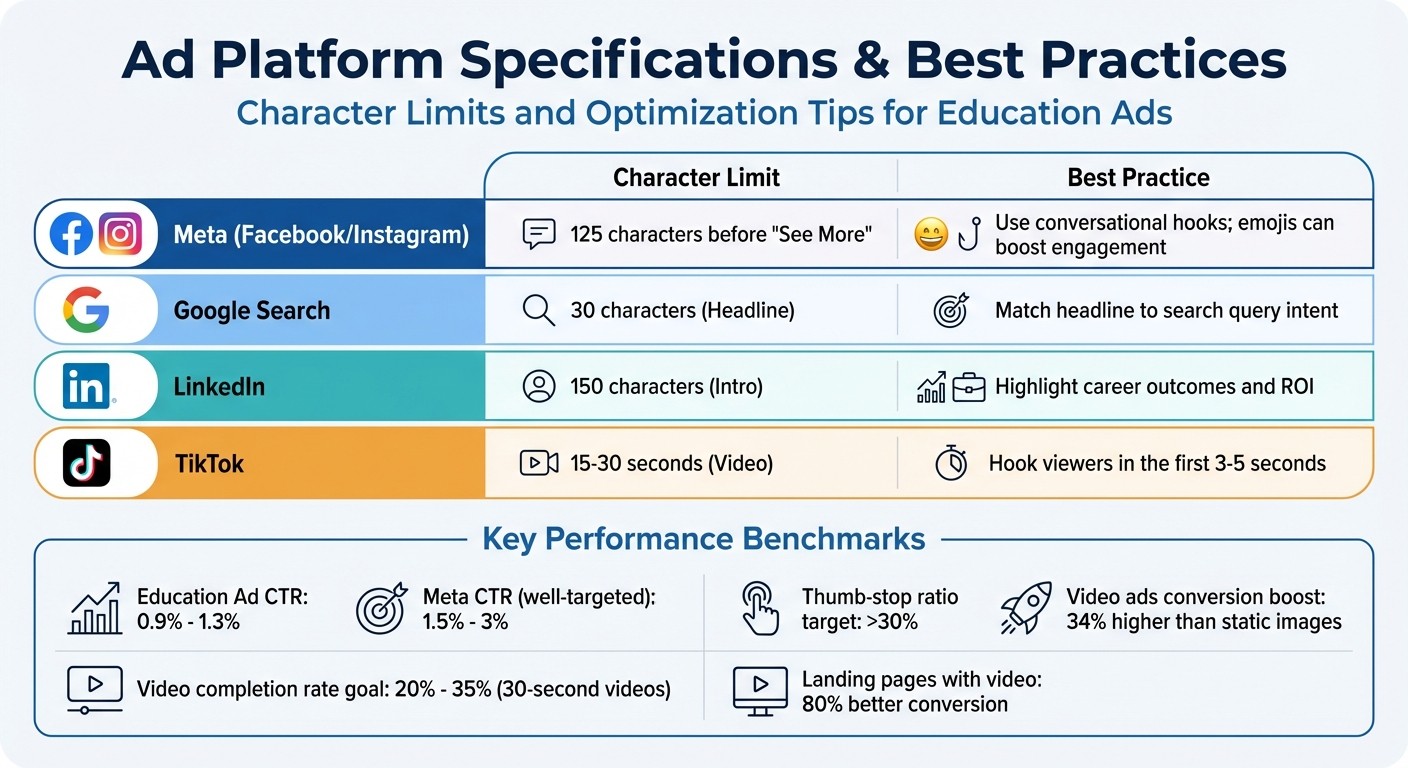
Ad Platform Specifications and Best Practices for Education Marketing
Crafting ad copy that turns curiosity into commitment is a skill, especially for education platforms. Prospective students aren't just buying a service - they're investing in a better future. Your job is to communicate that potential transformation in a way that's both emotionally resonant and grounded in reality.
Write Headlines That Get Attention
Your headline is the gateway to your message. As David Ogilvy famously said, "On average, five times as many people read the headline as read the body copy" [1]. In other words, if your headline doesn't grab attention, the rest of your ad might as well not exist.
To make an impact, focus on outcomes rather than features. Instead of saying, "50+ Course Modules Available", try something like, "Land a Data Analyst Job in 12 Weeks" or "Transform Your Career with This Certification." Proven frameworks like PAS (Problem-Agitate-Solution) can help craft compelling headlines:
"Stuck in a dead-end job? Every year you delay can hold you back. Start your career change today."
Similarly, the BAB (Before-After-Bridge) structure works wonders:
"From Retail Manager to UX Designer in 6 Months - Here's How" [1][5].
Tailor your headlines to the platform you're using. On Meta platforms like Facebook and Instagram, your message gets cut off after 125 characters, so make sure the hook is upfront. Google Search ads allow only 30 characters for headlines - align them directly with the user's search intent. LinkedIn, with its 150-character limit for intros, is ideal for emphasizing career outcomes or business value.
Platform | Character Limit | Best Practice |
|---|---|---|
Meta (FB/IG) | 125 chars before "See More" | Use conversational hooks; emojis can boost engagement |
Google Search | 30 chars (Headline) | Match headline to search query intent |
150 chars (Intro) | Highlight career outcomes and ROI | |
TikTok | 15–30 seconds (Video) | Hook viewers in the first 3–5 seconds |
Once your headline captures attention, your next task is to back it up with compelling proof of what sets your platform apart.
Showcase What Makes Your Platform Different
Generic claims like "high-quality courses" or "expert instructors" won't cut it. Instead, focus on specifics. For example, a headline like "Master Python with a Google Senior Engineer" immediately communicates authority and clear value. In education marketing, the instructor often is the product [5]. Highlight their credentials, teaching style, and personality to help potential students visualize the benefits they’ll receive.
Go deeper by explaining unique features. If your platform offers flexibility, spell it out: "Study on your schedule with recorded sessions available 24/7." If you provide career support, be specific: "Get 1-on-1 resume reviews and mock interviews." These details answer the critical question: "Why should I choose your platform over others?"
Balance Emotion and Facts
The most effective education ads strike a balance between emotional appeal and hard data. Highlight the frustrations of the "before" state - career stagnation, financial stress - and pair them with the tangible benefits of the "after" state, backed by real outcomes [3]. This combination reinforces your promise and builds trust.
For instance, a video ad could feature a graduate saying, "I was stuck making $35,000 as a customer service rep. After this bootcamp, I landed a $65,000 role as a junior developer." This blend of emotional storytelling and factual evidence connects deeply with viewers. In fact, video ads for online courses see 34% higher conversion rates than static image ads on Meta platforms, while landing pages with course preview videos convert 80% better than those without [5].
Using "salary reveal" videos - where graduates share redacted offer letters - can further emphasize career advancement. Testimonials that address skepticism, such as "I thought this was a scam, but…" also resonate strongly. These proof points are especially effective in education marketing, where the stakes are high and objections are common. With the average click-through rate for education ads ranging from 0.9% to 1.3% [3], every element of your ad must work hard to earn attention and action.
Use AI Tools to Speed Up Copywriting
Creating ad copy for education platforms can be a lengthy process, especially when juggling multiple campaigns and diverse audiences. AI tools can take on much of the heavy lifting - handling research, drafting, and repurposing tasks - allowing you to focus on the creative and strategic aspects. The trick lies in understanding when to rely on AI and when human judgment is essential.
Interestingly, data shows that human-created content generates 5.44x more traffic than purely AI-generated copy [4]. This isn’t a call to avoid AI but rather to use it wisely. AI shines in areas like research synthesis, first drafts, and scalable variations, while humans bring in the unique perspective, brand alignment, and final polish. As Zach Chmael, CMO of Averi, aptly explains:
"The winning approach isn't AI vs. human, it's AI + human. Use AI for research and drafting; keep humans for strategic direction and voice" [4].
Let’s dive into how AI can make your copywriting more efficient.
Generate Custom Ad Drafts with AI
Modern AI platforms like Averi AI and Copy.ai are designed to go beyond generic content. With features such as "Brand Core" or "Infobase", these tools can learn your messaging, product positioning, and audience personas. This ensures that every draft stays aligned with your platform’s mission and values [4][8]. These tailored drafts not only save time but also reinforce what sets your platform apart.
AI tools are also optimizing for Generative Engine Optimization (GEO), structuring copy into concise, 40–60 word "answer blocks." This approach is crucial as 89% of B2B buyers now use generative AI during their purchasing decisions [4], and 50% of B2B buyers begin their journey in AI chatbots rather than on Google [4]. By incorporating GEO techniques, brands can experience a 40% increase in visibility within AI-driven search results [4].
For education platforms, specialized tools like MagicSchool AI streamline tasks such as crafting rubrics, lesson plans, and quizzes, which can then be repurposed into lead magnets for ad campaigns [7]. Platforms like Creatify (rated 4.8/5 on G2) take it a step further, enabling "URL-to-video" transformations. This feature allows course landing pages to be turned into multiple video ad variations for TikTok, Meta, and YouTube [6]. Notably, AI-generated video ads have been shown to generate 2.7x more leads compared to static image ads [6].
Add AI to Your Copywriting Process
Once you’ve mastered custom draft generation, it’s time to integrate AI into your broader workflow. Start small - perhaps by repurposing a long-form blog post into ad copy or email sequences - before scaling to full campaigns [2]. Here’s a look at how AI can fit into your process, particularly for education platforms that require precise and fast messaging:
Research and ideation: AI consolidates insights from competitor ads, keyword trends, and industry reports, giving you a solid foundation. You guide the strategy, ensuring the angles align with your platform’s goals. This approach can save marketers an average of 3 hours per content piece and 2.5 hours per day overall [4].
Drafting: AI generates initial drafts based on your brand context. For instance, Averi AI can analyze your website to understand your products and tone, applying that knowledge to every draft [2]. You then refine the draft to include your unique perspective and emotional appeal.
Editing and optimization: AI tools handle grammar checks, suggest metadata, and even recommend internal links, freeing you to focus on higher-level quality control.
Repurposing: AI can transform one high-performing educational guide into over 15 short-form ad scripts or social media clips [4]. This allows you to create platform-specific variations quickly and efficiently.
Test and Improve Your Ad Performance
AI-driven copy generation is just the beginning. To keep your messaging relevant and engaging, systematic testing is essential. In the education sector, benchmarks indicate click-through rates (CTR) generally fall between 0.9% and 1.3%, while the target cost per enrolled student should stay under $300 for short courses and under $1,500 for degree programs [3]. Achieving these benchmarks consistently requires ongoing experimentation and data-based adjustments.
Run A/B Tests on Your Copy
A/B testing is a powerful way to understand what resonates most with your audience. The trick is to test one variable at a time - such as the headline, call-to-action, or social proof - so you can clearly identify what’s driving the results [9]. Ad platform tools make it easy to test 2–4 variations of a single element, helping you isolate impactful changes.
Each test should be guided by a clear hypothesis. For example, you might hypothesize: "Changing the headline from 'Learn Python' to 'Land a Python Job in 90 Days' will boost CTR by emphasizing outcomes over skills" [9]. This approach ensures your testing is focused and actionable.
Track the Right Metrics
The metrics that matter most depend on where your audience is in the funnel. For cold audiences, CTR is a key indicator of how effective your headline and hook are. Education ads on Meta often achieve a CTR of 1.5–3% when well-targeted [5]. For warm audiences closer to conversion, focus on metrics like conversion rate and cost per enrollment.
For video ads, specific metrics like the hook rate (how many viewers watch beyond the first 3 seconds) and completion rates (aim for 20–35% for 30-second videos) are critical [5]. On TikTok and Reels, a thumb-stop ratio above 30% signals that your opening is grabbing attention [3]. Looking ahead to 2026, consider tracking "Share of Answer" - a metric that measures how often your platform is mentioned in AI chatbot responses - since half of B2B buyers now begin their journey using AI chat tools [4].
By analyzing these metrics, you can make immediate adjustments to improve your campaigns.
Update Copy Based on Results
Once you’ve collected enough test data, focus on refining your copy. Allow each test to run for 7–14 days or until you’ve gathered 100–200 conversions to ensure the data is statistically reliable [9]. Pay attention to both absolute and relative improvements. For instance, a higher CTR that also increases acquisition costs might indicate a targeting issue [9].
Use your findings to establish a new baseline. For example, if a benefit-driven headline outperforms a feature-focused one, apply that insight across your campaigns and develop your next hypothesis. As Christopher Good from Integrail Corp explains:
"You don't have a creative problem; you have a learning-loop problem. Most teams test slowly, mix multiple variables, and decide based on limited data" [9].
Build a consistent feedback loop where each test informs the next. Incorporate customer insights - like student reviews, support tickets, or sales call transcripts - into your AI prompts to produce messaging that addresses real concerns and aspirations [9]. The goal isn’t to achieve perfection right away but to create a system that continually improves over time.
Conclusion
This guide has provided practical strategies to improve your educational ad campaigns. Crafting ad copy for education platforms isn't about flashy language - it's about clarity and impact. Focus on understanding your audience, addressing their needs, and consistently testing your approach. Start by creating detailed personas that reflect real student challenges, then write headlines and messages that directly highlight the outcomes they care about most. Frameworks like Problem-Agitate-Solution (PAS) can help you structure your copy for maximum resonance [1].
While AI tools can streamline your workflow, keep in mind that content created by humans attracts 5.44x more traffic than purely AI-generated material [4]. Use AI to generate ideas and variations quickly, but rely on human judgment to refine tone and ensure your message feels genuine. Combining AI's efficiency with human insight can produce campaigns that connect on a deeper level.
To optimize results, focus your A/B tests on a single variable at a time. Track key metrics like the thumb-stop ratio - aiming for a 3-second view rate above 30% [3] - and update your creative assets weekly to avoid ad fatigue. With over 4,000 ads competing for attention daily, standing out requires precise targeting, strong social proof, and constant fine-tuning [1]. These efforts can help you lower your cost per enrollment while building a sustainable, ever-improving system.
Start small: launch one campaign, test three headline options, and let the data guide your next steps.
FAQs
What proof should I include to make education ads trustworthy?
To make education ads resonate with trust, focus on showcasing proof of your platform's reliability and success. Share case studies, success stories, or testimonials that highlight real-world results and positive experiences. Use specific metrics or outcomes to illustrate the impact, such as increased enrollment rates or improved engagement. Transparency is key - clearly demonstrate how your strategies deliver measurable results. By providing concrete examples and evidence of effectiveness, you can build confidence in your platform and reassure potential users of its value.
How do I pick the best ad channel for each student persona?
To determine the most effective ad channel for each student persona, start by understanding their objectives, challenges, and platform preferences. Align these personas with the platforms they frequent - such as TikTok for a younger audience or LinkedIn for working professionals. Leverage testing and analytics to identify which channels yield the best engagement and enrollment results. Focus on performance metrics like Cost Per Enrolled Student (CPES) and engagement rates to fine-tune your strategy and ensure your ads are connecting with the right audience.
Which metrics matter most for lowering cost per enrollment?
Cost Per Enrolled Student (CPES) is a crucial metric to monitor, with benchmarks set at under $300 for short courses and $1,500 for degree programs. Other performance indicators to keep an eye on include the creative refresh rate (aiming for 3-5 new ads each week), a video view rate of 25% or higher on platforms like TikTok and Reels, and the specificity of outcomes, such as detailed job placement figures. Running tests with multiple ad variations is another effective way to fine-tune campaigns and minimize unnecessary spending.
Related Blog Posts

Zach Chmael
CMO, Averi
"We built Averi around the exact workflow we've used to scale our web traffic over 6000% in the last 6 months."
Your content should be working harder.
Averi's content engine builds Google entity authority, drives AI citations, and scales your visibility so you can get more customers.