
In This Article
Guide to researching audiences, crafting benefit-driven platform-specific ads, running A/B tests, and using AI tools to improve startup ad performance.
Updated:
Trusted by 1,000+ teams
Startups use Averi to build
content engines that rank.
Every word in your ad copy can make or break your startup's budget. With limited resources, you need messaging that converts while competing against bigger brands. This guide breaks down how to write ad copy that drives results without wasting time or money.
Key takeaways:
Start with research: Understand your audience deeply - beyond just demographics.
Set clear goals: Use measurable, specific objectives like generating "50 qualified leads per month."
Focus on benefits: Highlight how your product solves problems, not just what it does.
Write platform-specific copy: Tailor your ads for Google, Facebook, or Instagram to match user behavior.
Test and refine: Use A/B testing to improve performance and scale successful campaigns.
Leverage AI tools: Save time with platforms like Jasper, Copy.ai, or Averi, but choose based on your needs.
Ad Campaign Copywriting and Optimization with AI
Build Your Ad Copy Strategy
Before diving into writing ad copy, it's crucial to have a strategy that aligns your message with both your audience and your business objectives. Skipping this step often leads to mixed messaging, wasted budgets, and campaigns that fall short. A well-thought-out plan ensures every dollar spent delivers maximum impact. The first step? Researching your audience with precision.
Research Your Target Audience
Develop buyer personas that go beyond basic demographics. Understand their core challenges, goals, content preferences, and objections to purchasing. For instance, if you're selling project management software to small agencies, your persona might highlight issues like "difficulty tracking billable hours across multiple clients" or concerns such as "hesitation about team adoption."
Leverage tools like analytics, customer surveys, and competitor research to gather meaningful behavioral insights. Define Ideal Customer Profiles (ICPs) with firmographic details such as company size, industry, and existing tech stack. Consider this: websites that actively use blogs to engage their audience see 434% more indexed pages, offering valuable insights into what content resonates most [2]. This research lays the groundwork for crafting copy that addresses real needs, not assumptions. With a clear understanding of your audience, the next step is setting actionable goals.
Set Clear Advertising Goals
A focused strategy allows for measurable results. Vague objectives like "increase awareness" often lead to inefficient spending. Instead, use the SMART framework to set goals that are Specific, Measurable, Attainable, Relevant, and Timely [9]. For example, aim for something concrete, like "generate 50 qualified leads per month" [2].
Data backs this up: in 2024, accounting firm MECLABS tested ad copy that incorporated specific, data-driven messaging and saw an 88% increase in click-through rates and a 23% boost in conversions [5].
Align your metrics with your campaign's objectives. If you're targeting brand awareness, focus on metrics like website traffic and social shares. For lead generation, track conversion rates and cost per lead. Personalized calls-to-action perform 202% better than generic ones, so tailor your goals to specific audience segments [6]. Interestingly, 80% of your results often come from just 20% of your copy elements - headlines and CTAs deserve special attention [7]. With goals in place, it's time to refine how your brand communicates.
Define Your Brand Voice and Messaging
Consistency in brand presentation across platforms can drive revenue growth by up to 23% [8]. Create a brand voice guide that outlines 3-5 key traits (such as "data-driven", "confident", or "approachable"), adjusts tone based on the platform, and includes specific language guidelines - terms to use and those to avoid [4].
Tailor your messaging to match the buyer's journey. For the awareness stage, focus on educational content. During the consideration stage, provide comparisons and case studies. For the decision stage, highlight testimonials and pricing details [2]. Frameworks like AIDA (Attention, Interest, Desire, Action) can help structure persuasive copy that leads readers toward conversion. And while AI tools can assist, ensure they maintain your brand's unique voice across projects [3].
Write Ad Copy That Converts
Creating ad copy that draws attention, informs, and drives action is an art rooted in understanding your audience and building a startup marketing strategy for the platform you're using. The ads that succeed often excel in three areas: compelling headlines, clear benefits, and platform-specific messaging.
Write Headlines That Grab Attention
The headline is your one shot to grab a prospect's attention. A great headline combines benefits, numbers, action verbs, and emotional cues. For example, "Boost Startup Leads 3x" immediately communicates value and urgency [2].
With 60% of Google searches now ending without a click - thanks to AI-generated answers - headlines must be clear and direct to make an impact [3]. Think of them as your elevator pitch, condensed into a single line.
Highlight Benefits and Unique Selling Points
Benefits are what sell - not features. Instead of focusing on what your product does, show how it solves a problem. Replace generic claims like "high-quality service" with specifics such as, "Our CRM will optimize your sales planning and help you close more deals" [11].
To stand out, identify what sets you apart by mapping buyer challenges against your solution and those of your competitors. Dive into competitor reviews to uncover common complaints, then position your product as the answer to those frustrations [10]. Translate features into benefits with statements like, "On-the-go comfort and style that won't slow you down", instead of just "easy slip-on design" [11]. Reinforce your claims with social proof - like testimonials, case studies, or hard data - to show you deliver on your promises [11].
Once your messaging is sharp, fine-tune it for the platform you're using.
Adapt Copy for Each Platform
Every platform has its own vibe, audience, and formatting rules. For Google Ads, users are actively searching for solutions, so include their search query in your headline using Dynamic Keyword Insertion. Highlight the specific outcome they’re looking for [5].
Facebook Ads thrive on conversational language and social proof. Incorporate customer testimonials, user counts, or even emojis to make your ad feel like a natural part of the feed [5][12]. On Instagram, visuals are king. Use bold, benefit-driven text directly on images, paired with technical details or influencer quotes to enhance credibility [5].
Always adjust the tone, length, and style of your copy to suit the platform's unique audience and format. The more aligned your ad is with the platform's expectations, the better it will perform.
Use AI Tools to Speed Up Copywriting
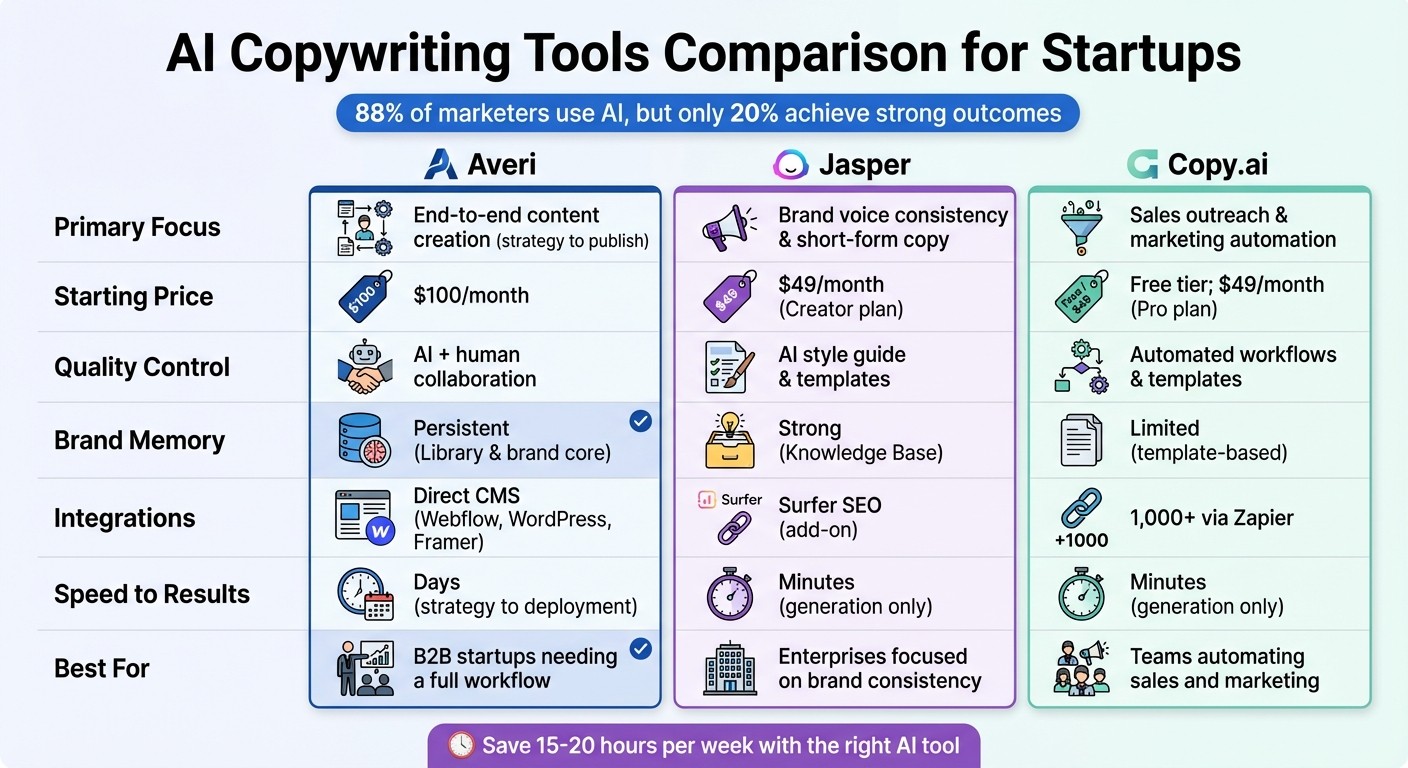
AI Copywriting Tools Comparison: Averi vs Jasper vs Copy.ai for Startups
Founders often find themselves stretched thin, balancing product development, customer engagement, and managing finances. Crafting ad copy can feel like an impossible addition to an already packed schedule. By adopting AI tools, founders can reclaim valuable hours in their week - up to 15–20 hours, according to research [1]. The key lies in choosing tools that not only generate copy but also streamline the entire workflow.
AI tools cater to different needs. Workspaces like Averi integrate AI with human collaboration for end-to-end content creation. Marketplaces such as Fiverr and Upwork connect users with freelance talent for specific projects. Meanwhile, AI point tools like Jasper and Copy.ai focus on scaling copy production. While 88% of marketers incorporate AI into their daily tasks [1], only 20% report achieving strong outcomes [3]. The challenge isn’t the technology itself - it’s about how effectively it’s implemented.
Compare Averi, Jasper, and Copy.ai
Jasper is ideal for maintaining a consistent brand voice across multiple ad variations. It’s especially valuable for large-scale Facebook campaigns, thanks to its Knowledge Base and style guides that ensure uniformity. However, it requires some upfront effort to set up templates and prompts before delivering results.
Copy.ai stands out for automating sales outreach alongside ad creation. Its AI agents personalize messaging at scale and integrate seamlessly with CRMs. With a free tier and a $49/month Starter plan, it’s a good option for teams looking to tie ad copy into broader workflows. However, it doesn’t handle strategy or publishing, so some manual effort is still required.
Averi, on the other hand, offers a more comprehensive solution. It analyzes your website to understand your business, identifies ideal customer profiles, and develops a content plan tailored to your needs. Whether it’s a listicle, how-to guide, or comparison piece, Averi drafts the copy and allows for real-time collaboration through a shared editing canvas. Completed content is saved to a Library, helping the AI refine your brand voice over time, and it publishes directly to platforms like Webflow or WordPress, removing the hassle of manual uploads. Averi’s Plus Plan starts at $100/month and includes self-serve onboarding.
"We built Averi around the exact workflow we've used to scale our web traffic over 6000% in the last 6 months." – Zach Chmael, CMO, Averi
These tools offer distinct advantages depending on your startup's needs, making it easier to find the right fit for your goals and constraints.
Evaluate AI Copywriting Tools
Choosing the right AI tool depends on your specific priorities. If maintaining a consistent brand voice across campaigns is your primary concern, Jasper is a strong contender. For teams focused on automating sales outreach alongside ad creation, Copy.ai is a solid choice. However, if your biggest challenge is time - essentially needing a "marketing department in a box" - Averi offers a holistic solution.
Here’s a quick comparison of the three platforms based on key criteria for startups:
Feature | Averi | Jasper | Copy.ai |
|---|---|---|---|
Primary Focus | End-to-end content creation (strategy to publish) | Brand voice consistency & short-form copy | Sales outreach & marketing automation |
Starting Price | $100/month | $49/month (Creator plan) | Free tier; $49/month (Pro plan) |
Quality Control | AI + human collaboration | AI style guide & templates | Automated workflows & templates |
Brand Memory | Persistent (Library & brand core) | Strong (Knowledge Base) | Limited (template-based) |
Integrations | Direct CMS (Webflow, WordPress, Framer) | Surfer SEO (add-on) | 1,000+ via Zapier |
Speed to Results | Days (strategy to deployment) | Minutes (generation only) | Minutes (generation only) |
Best For | B2B startups needing a full workflow | Enterprises focused on brand consistency | Teams automating sales and marketing |
It’s also worth noting that 60% of Google searches no longer result in clicks [3]. Tools like Averi and Jasper optimize content for Generative Engine Optimization (GEO), ensuring that it’s structured to be cited by platforms like ChatGPT or Perplexity, rather than just ranked on Google. This shift matters as traffic from generative AI platforms to e-commerce sites has surged by 4,700% year-over-year [3].
Streamline Your Workflow with Averi
Averi simplifies your marketing efforts by consolidating multiple tools into one platform. Instead of juggling strategy documents, keyword research tools, writers, editors, and CMS workflows, Averi handles it all. The process begins with strategy: share your website, and Averi analyzes your business, researches competitors, and creates a comprehensive content plan. Reviewing and refining this plan takes just 10 minutes.
From there, Averi continuously monitors industry trends to identify high-potential topics. It queues up ideas by type, and you decide what gets produced. Once you select a topic, Averi conducts in-depth research, applies SEO and GEO-optimized structures, and delivers a first draft. You can refine the content collaboratively within the platform, and the final version publishes directly to your CMS.
Each completed piece builds on the system’s understanding of your brand, making future drafts more aligned with your voice. Averi also tracks performance metrics like impressions, clicks, and keyword rankings, recommending what to create next. Over time, it becomes a self-sustaining content engine, freeing you to focus on growing your business.
Test and Improve Ad Performance
Startups that thrive often treat every ad as a chance to learn, using real-world data to shape their next move. By experimenting with different headlines, copy, and calls-to-action (CTAs), they uncover what truly connects with their audience - rather than relying on assumptions.
Run A/B Tests on Ad Variants
To run effective A/B tests, focus on one variable at a time. For example, keep the visuals consistent across versions and only tweak the text. This ensures that any performance differences come from the messaging, not the design [14]. Test key elements individually, such as headlines, CTAs, or value propositions, to pinpoint what drives results [13][16].
Even small adjustments can lead to big wins. During a fundraising campaign, the Obama team found that switching "SIGN UP" to "LEARN MORE" on a CTA button boosted sign-ups by 40.6% [18]. Similarly, Databricks tested different LinkedIn Message Ads and discovered that one version - featuring a hyperlink and event details upfront - achieved double the click-through rate (CTR) and double the conversion rate compared to others [18].
For reliable results, run tests for at least two full sales cycles or until each variation reaches 1,000–2,000 visitors [13]. Look for 95% statistical confidence before deciding on a winner to avoid relying on random fluctuations [13][15]. On Meta Ads, you can use Ad Budget Optimization (ABO) for clean 50/50 split tests or Advantage+ for faster learning driven by algorithms [14].
"If you're not testing, you're guessing. And in SaaS, guessing is expensive." - Phoebe Lown, SaaS Copywriter [13]
Once you identify high-performing variants, dive deeper into performance metrics to refine your approach.
Track Metrics and Refine Copy
Start by focusing on click-through rate (CTR) to quickly gauge how well your message resonates. CTR helps you evaluate the copy’s effectiveness without interference from factors like landing page design [14]. Once you spot a strong performer, shift to conversion-focused metrics such as free trial sign-ups, demo requests, and cost per acquisition (CPA) to assess the overall impact [13][15].
Ensure the messaging in your ads aligns with your landing pages. Inconsistent messaging can increase bounce rates and waste your budget [14][17]. For example, Artsy Editor tested different landing page CTA placements and found that a version with a clear headline and a simple CTA immediately beneath it led to a 47% increase in clicks to the pricing page over 30 days [18].
Monitor all key metrics regularly. A high CTR might look good, but if your cost-per-click (CPC) is climbing, it could mean wasted spend [20]. Use automated alerts to catch sudden changes, like a CPC spike of over 300%, to protect your budget during scaling [20].
Scale Successful Campaigns
Once you've nailed down a winning formula, scale your campaigns strategically. Apply insights from your A/B tests to refine messaging across all marketing materials. If a specific phrase or value proposition works in an ad, incorporate it into email campaigns and other paid channels to maintain a unified brand voice [19][20]. When scaling, start with audiences and platforms that closely resemble your original test environment before branching out [20].
Trainual provides a great example of scaling success. They tested a standard landing page against one with an interactive demo. The demo version resulted in a 450% increase in signups and a 175% boost in conversions to paid customers [18]. By extending this interactive approach to their ad campaigns, they maintained consistent messaging throughout the customer journey.
Dedicate at least 30% of your budget to ongoing creative testing [20]. Use automated triggers in ad platforms to increase spending on top-performing variants and pause the underperformers [20]. Aim for 100–200 conversions per variant before scaling further [20].
These continual refinements not only enhance conversions but also ensure your startup’s marketing evolves alongside your audience's needs.
Conclusion
Creating effective ad copy as a startup doesn’t require deep pockets or an expansive marketing team - it’s all about having a repeatable process. Begin with a solid strategy: understand your audience, set clear objectives, and define your brand voice before putting pen to paper. From there, focus on crafting benefit-driven, platform-specific copy and commit to rigorous testing. The most successful startups treat every ad as a chance to learn, leveraging A/B tests and performance data to fine-tune their approach and amplify what works.
AI tools like Averi can streamline this entire process while maintaining quality. By automating tasks like research, drafting, and optimization, you can save 15–20 hours a week, all while retaining the critical human touch. The real advantage comes from building a system that improves with each campaign - refining your brand voice, aligning messaging across platforms, and compounding ad performance over time. This kind of workflow isn’t just efficient; it’s the backbone of a sustainable ad strategy.
FAQs
What’s the fastest way to turn customer research into ad copy?
To get results quickly, leverage AI tools designed to analyze and categorize customer data. These tools can sort customers based on their behaviors and preferences, allowing you to create targeted, relevant ad copy without the hassle of manual work. This not only saves time but also ensures your messaging connects with the right audience.
How much budget should I spend on A/B testing before scaling?
When it comes to A/B testing, there’s no one-size-fits-all budget. For startups, it’s wise to begin with smaller, incremental tests. A typical range falls between $100 and $500 per test, targeting critical elements such as headlines or ad copy. Focus on variables that are likely to have the most impact, and adjust your efforts based on the results. The aim is to pinpoint successful variations without straining resources, maintaining a strategic and cost-conscious path toward growth.
How do I keep my ad copy and landing page message consistent?
To keep your ad copy and landing page in sync, start by defining your core value proposition and making sure it's echoed across both. Use effective copywriting frameworks to craft engaging messages, and test different variations to find what resonates best. Write tailored, context-specific copy directly within your page layouts for authenticity. Continuously review performance metrics and feedback, refining your messaging to ensure clarity and alignment throughout the user experience.
Related Blog Posts

Zach Chmael
CMO, Averi
"We built Averi around the exact workflow we've used to scale our web traffic over 6000% in the last 6 months."
Your content should be working harder.
Averi's content engine builds Google entity authority, drives AI citations, and scales your visibility so you can get more customers.