

In This Article
Founder-led marketing combines the founder’s voice with scalable AI workflows to build trust, increase engagement, and drive measurable pipeline growth for agencies.
Updated:
Trusted by 1,000+ teams
Startups use Averi to build
content engines that rank.
Founder-led marketing is about using the founder's voice to connect with audiences, build trust, and drive engagement more effectively than traditional methods. Here's why it works and how you can implement it:
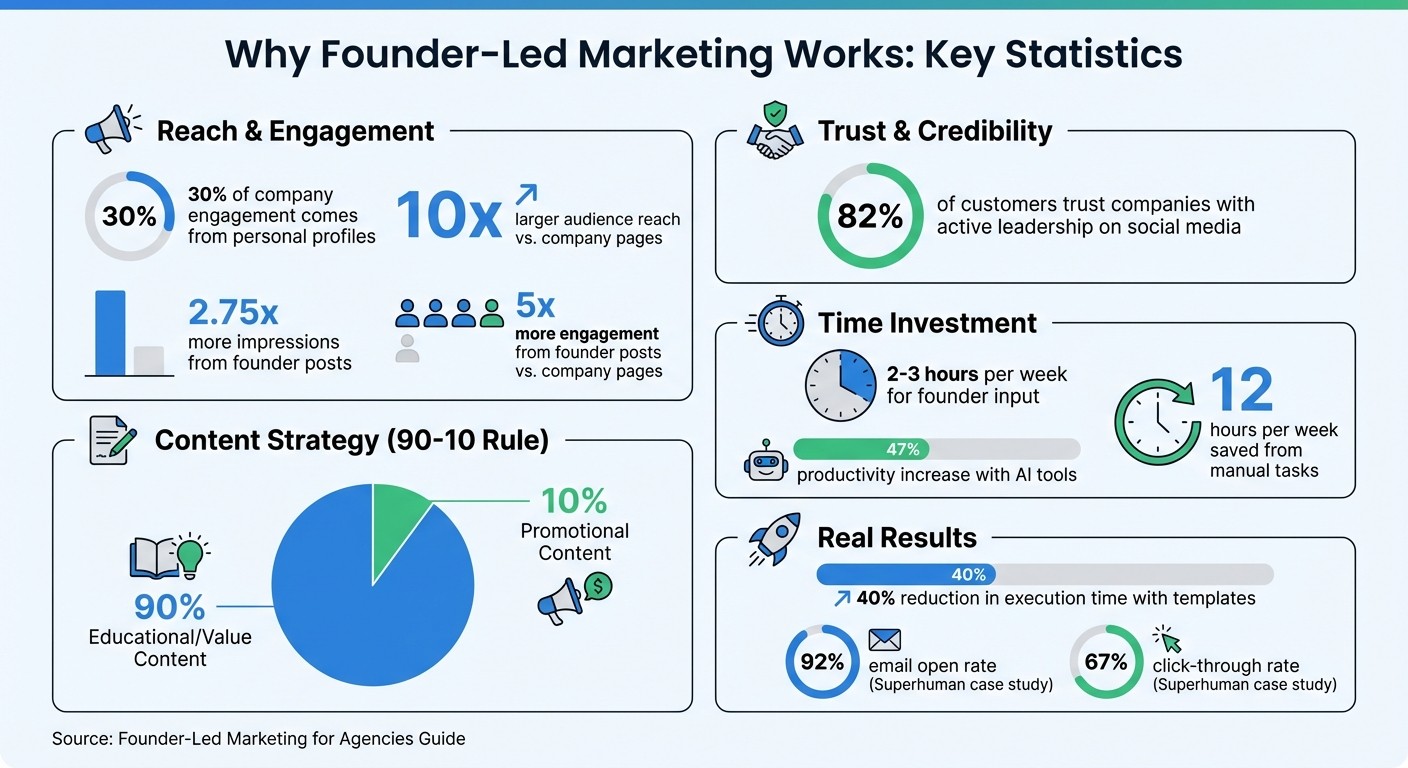
Why It Works: Personal profiles on platforms like LinkedIn generate 30% of a company’s engagement and reach audiences 10x larger than company pages. 82% of customers trust companies with active leadership on social media.
Key Approach: Focus on educating and solving client problems (90% of content) while limiting direct promotion (10%). Use the founder's unique insights to create relatable, human content.
Efficient Tools: AI tools like Averi AI can scale content creation while maintaining the founder’s tone, transforming raw ideas into polished posts, blogs, and more. This allows you to build a multi-channel content engine that maintains strategic alignment.
Workflow: Dedicate 2–3 hours weekly for founder input, then delegate execution to a team or tools. Use voice memos or interviews for content ideas.
Measure Success: Track metrics like engagement, qualified leads, and revenue impact. Use data to refine your strategy continuously.
This method builds a lasting connection with your audience, helping agencies stand out in a crowded market.
Founder-Led Marketing Statistics and Impact Metrics
Founder Led Marketing 101 - Content Creation for Business Owners
Step 1: Build Your Founder-Led Marketing Strategy
A founder-led marketing strategy connects your expertise directly to the challenges your clients face. The aim isn’t to post random content but to create material that earns trust and positions your agency as the go-to choice when prospects are ready to make a decision.
To guide your efforts, use the 90-10 Value Rule: dedicate 90% of your content to educating or providing insights, while reserving only 10% for promoting your services [3]. Take inspiration from Canva founder Melanie Perkins, who turned over 100 LinkedIn rejections into a thriving community that helped build a $26 billion brand [3].
Choose Your Content Pillars
Focus on three to four core themes that highlight your expertise and address your audience’s needs. These could include:
Industry analysis: Share insights on market trends to establish credibility.
Client case studies: Showcase real-world results your agency has delivered.
Solutions to common client problems: Address pain points directly and offer actionable advice.
Behind-the-scenes content: Give a glimpse into your process to humanize your brand and build trust [5].
A great example of this strategy in action is Barbara Jovanovic, co-founder of Startup Cookie. By September 2025, she had built a six-figure agency with no employees. Her method? Each month, she records a one-hour interview with her co-founder about industry challenges and client work. Using ChatGPT Projects, guided by her brand’s voice, she transforms that single conversation into a month’s worth of social media posts and blog content - all for under $1,000 annually in tools [4][5]. As Barbara puts it:
"We never start with just prompting AI by itself to do anything, even the simplest social media post. We always have something to start with." [5]
Once you’ve defined your content pillars, focus on platforms where your audience is most engaged.
Match Your Strategy to Your Audience
Understanding your target audience is key. Pinpoint where they spend their time and tailor your strategy to those channels. For B2B agencies, LinkedIn often serves as the main hub, backed by two or three additional platforms [2].
Consider the example of Tony, who built and sold BlackMagic for $186,000 in 2025. He concentrated solely on X (formerly Twitter) because that’s where developers gathered. By consistently sharing valuable insights and industry commentary, he built a loyal following [3].
To maintain authenticity, record conversations about client challenges or industry issues. Use the transcripts to extract specific insights that can be turned into compelling content hooks [4][5]. This ensures your voice remains genuine while leveraging AI to scale your content output effectively, without losing its personal touch.
Step 2: Set Up Your Workflow with Averi AI
Once you've outlined your content pillars and defined your audience, the next challenge is scaling content production while staying true to your founder's voice. Traditional workflows often rely on constant founder involvement, which can quickly become unmanageable. Averi AI changes the game by learning your brand voice once and applying it consistently across all content. Setting up Averi AI ensures your brand voice remains intact and effectively executed.
Configure Averi AI for Your Agency
This automated platform strengthens the founder-led strategy mentioned earlier. Begin by connecting Averi to your website. The system will crawl your site to understand your business, products, positioning, and existing tone. It also analyzes competitor content to spot gaps and craft a well-aligned content strategy. This initial setup takes only about 10 minutes, providing the foundation for all future content creation.
What sets Averi apart from tools like Jasper or Copy.ai is its persistent brand memory. Unlike other tools that require manual prompts and review for every draft, Averi builds a repository of your content, refining your brand voice with every new publication. This approach aligns with the trend of marketers consolidating their tools - 88% plan to reduce their tool count by 2025 - favoring integrated systems over fragmented ones [2].
Review and Edit AI-Generated Content
Averi AI works to amplify your founder's perspective, not replace it. It generates initial drafts based on your brand's context, but your unique insights and voice remain critical. Use the platform’s collaborative editing tools to tweak tone, insert personal stories, or fine-tune messaging. You can highlight any section and have Averi rewrite, expand, or adjust it - all within the same workspace.
To ensure quality, try the "Extract First" method: before drafting, have Averi pull the most distinct topics from your source material, such as founder interviews or client calls. Critically review this list to ensure the most valuable insights are captured [4][5].
Barbara Jovanovic from Startup Cookie uses this approach to transform one-hour founder interviews into a month's worth of content. She explains:
"You have to be present and think critically. Does this sound interesting? If not, let's move on to the next one." [5]
Focus your energy on refining content for high-impact channels, like LinkedIn or email, and let Averi adapt these polished pieces for secondary platforms. This ensures your best content is consistently optimized across all channels.
Publish and Monitor Results
After final approval, Averi publishes your content directly to platforms like Webflow, Framer, or WordPress, eliminating manual copy-pasting and formatting. Each piece is saved in the system, further improving the quality of future drafts.
Publishing is just the beginning - Averi tracks performance metrics like impressions, clicks, and keyword rankings. It then suggests actionable steps, such as updating content to boost rankings, targeting trending topics, or identifying new keywords to pursue. This creates a feedback loop where performance data informs and improves your content strategy.
Step 3: Create a Repeatable Founder Workflow
Agencies often struggle to balance founder involvement in marketing. Some founders are overly hands-on, while others are entirely absent. The solution lies in a time-efficient system that emphasizes strategic input from founders while delegating the execution. This approach ensures that leadership remains at the core of marketing efforts. Notably, personal posts from founders generate 2.75 times more impressions and 5 times more engagement compared to company page posts [6].
Set Up Weekly Founder Tasks
To make founder involvement manageable, start with a realistic time commitment. Most founders can spare 2–3 hours per week for marketing without disrupting their primary responsibilities. Divide this time into three focused activities:
15–30 minutes daily: Engage on social media by responding to comments and interacting with industry posts.
One 60-minute session weekly: Record insights or discuss key topics during a content capture session.
30 minutes weekly: Review performance metrics and plan topics for the upcoming week [5].
One effective method for capturing founder insights is the "Extract First" approach. For example, founders can record a 15-minute voice memo discussing an industry trend or client challenge. This raw, unpolished input can then be transformed into multiple pieces of content. Barbara Jovanovic from Startup Cookie exemplifies this approach by conducting one-hour interviews with her co-founder, Sam Claassen. Using AI tools, they extract enough material to sustain their content strategy, all while operating a six-figure agency with a tech stack costing under $1,000 per year - replacing the need for multiple staff members [5].
Tools like Super Whisper simplify this process by converting voice memos into text, allowing founders to "talk" to AI rather than type. Spoken input often captures richer context and authenticity compared to written prompts [5]. The founder’s role here is to provide raw insights and perspectives, leaving the polishing and execution to the team.
Once these weekly tasks are in place, it’s time to delegate the execution.
Hand Off Execution to Your Team
With the founder’s input as the foundation, delegate operational tasks to your team to ensure a smooth workflow. Assign clear responsibilities:
One team member handles transcription and drafts.
Another oversees scheduling and distribution across platforms.
A third tracks performance metrics and compiles reports.
To streamline processes, use templates for campaign briefs, emails, and social posts. Templates can cut execution time by 40% and maintain consistency even when the founder isn’t directly involved [2]. To avoid delays, limit content reviews to two rounds maximum, preventing perfectionism from stalling progress [2].
Another key adjustment is shifting from sequential to parallel workflows. Instead of waiting for the founder to approve every step, let the team draft content while the founder focuses on high-level direction. This approach significantly reduces delays. Research shows that projects with unclear ownership take 2.5 times longer to complete than those with a single decision-maker [2]. Assign one person - not a committee - to make the final call on each piece of content. This clarity ensures faster, more efficient execution.
Step 4: Keep Authenticity While Scaling
Scaling founder-led marketing comes with a big challenge - holding onto the founder's voice. As content production ramps up, it's easy to rely too heavily on AI, but that’s when the messaging can lose its personal touch. The key is to make sure the founder's voice stays at the heart of your strategy, even as you increase efficiency. By building on a structured workflow, you can scale content without sacrificing the unique tone and perspective that make it resonate. Tools like Averi AI can help amplify the founder's insights, but the goal should always be to enhance their voice, not replace it.
Use AI to Support, Not Replace, the Founder
AI is most effective when it works alongside human input. Barbara Jovanovic, co-founder of Startup Cookie, suggests using transcripts from webinars, podcasts, or founder interviews as the starting point for content. This approach allows AI to shape raw ideas into polished drafts while keeping the core message authentic and human.
Voice-to-text tools can capture the richness and subtlety of spoken content, which often gets lost in brief text prompts [5]. After recording, apply the "Extract First, Create Second" method: let AI identify key topics, then evaluate which ones stand out. Jovanovic explains, "You have to be present and think critically. Does this sound interesting? If not, let's move on to the next one" [5]. Only develop content from ideas that pass this test.
To avoid a robotic tone, establish a "Banned Words" list for your AI. Prohibit overused corporate jargon like "ensure" or "leverage" [4][5]. This simple guideline keeps the tone conversational and relatable. The founder’s role is to provide the raw material and set clear boundaries, while the team and AI handle execution. By prioritizing authenticity, you can ensure that your scaled efforts continue to connect with your audience.
Track Performance and Adjust
Scaling successfully means keeping a close eye on how your audience responds. Rather than obsessing over vanity metrics like follower counts, focus on qualitative engagement - comments, direct messages, and the overall sentiment of conversations sparked by your content. Founder-led posts consistently outperform company page posts, generating 5x more engagement and 2.75x more impressions [6]. Use these benchmarks to measure whether your scaled content is maintaining its impact.
Schedule a quick 15-minute weekly review with your marketing team to assess which posts feel true to the founder's voice and which come across as too generic. This feedback loop ensures that quality remains a priority as you increase output. Pay attention to email unsubscribe rates - a sudden spike might indicate that your content has lost its personal touch. For paid campaigns, keep your Customer Acquisition Cost (CAC) under 30% of Customer Lifetime Value (CLV) to maintain sustainable growth.
Cohort analysis can also provide valuable insights. Track whether audiences brought in through founder-led content show higher retention or lifetime value compared to other channels. Use this data to fine-tune your content pillars, posting frequency, or platform strategy based on what’s delivering real results. By continuously monitoring and adjusting, you can scale effectively without losing the authenticity that sets your brand apart.
Step 5: Track Results and Improve
Once your automated workflow is running, the next step is to measure its impact and fine-tune your approach. Founder-led marketing thrives when you focus on meaningful metrics, not surface-level numbers like follower counts. Instead, monitor Marketing Qualified Leads (MQLs), Sales Qualified Leads (SQLs), and the total pipeline value generated from founder-led activities [1]. Use UTM parameters for every link the founder shares to identify which specific LinkedIn post, podcast, or email drove action [1].
Revenue-focused metrics provide a clearer picture. Track the number of new clients acquired, closed Annual Recurring Revenue (ARR), and how founder-led content influences deal velocity for prospects already in your pipeline [1]. For agencies, comparing Customer Acquisition Cost (CAC) to Customer Lifetime Value (CLV) ensures growth remains sustainable.
Choose Your Success Metrics
Most agencies should focus on four main categories:
Reach: Impressions and mentions
Engagement: Comments, shares, and direct messages
Pipeline: MQLs and SQLs
Revenue: Closed ARR and new clients [1]
Efficiency metrics, like Time to Launch, are also key. For example, Notion introduced new AI features in September 2025 using a seven-day agile framework. This included founder-led social media and email outreach, resulting in 40% of their user base activating the features within the first month [2].
Automate weekly reports to have key metrics delivered to your inbox, saving time. Dedicate 15 minutes daily to "comment sprints" by engaging with your Ideal Customer Profile (ICP). This boosts organic reach and signals algorithms to distribute your content more widely [1]. Additionally, monitor email performance - open rates and click-through rates can reveal whether the founder's personal voice is connecting with the audience. For example, in September 2025, Superhuman achieved a 92% email open rate and a 67% click-through rate by using a founder-led strategy to announce new features [2].
Use Data to Improve Continuously
Data drives the evolution of founder-led strategies while supporting sustainable growth. Regularly analyze your metrics to identify what’s working and double down on those efforts. A weekly 15–20 minute review can help pinpoint which content generates meaningful engagement, such as comments or DMs that show genuine interest. Tools like Averi can simplify this process by surfacing insights and offering optimization suggestions without the need to sift through spreadsheets.
Experimentation is key - run A/B tests on one variable at a time, such as subject lines, posting times, or content formats, to determine what resonates best. Launch quick "Minimum Viable Campaigns" to gain momentum, then use real-time data to refine your messaging or incorporate social proof [2]. Regularly audit your content pillars to ensure alignment with your audience’s needs and your business objectives. Research suggests marketers using 3–5 channels outperform those spreading efforts across 10 or more, as focused execution yields better results [2]. By consistently refining your approach based on data, you create a feedback loop that strengthens every campaign.
Conclusion
Founder-led marketing combines the unique voice of a founder with the efficiency of scalable systems. By following the five steps outlined, agencies can create a process where the founder provides strategic guidance and messaging, while tools like Averi AI handle the repetitive tasks - drafting, scheduling, and repurposing content across multiple platforms.
Barbara Jovanovic emphasizes the importance of starting with meaningful input. Using voice notes, interview transcripts, or customer feedback ensures that AI tools stay aligned with the founder's authentic voice while scaling output. For example, a single one-hour founder interview can generate a month’s worth of content, reducing production timelines from weeks to just hours [4][5].
This approach doesn’t just save time - it delivers tangible results. AI increases productivity by 47%, freeing up 12 hours per week from manual tasks [2]. On LinkedIn, personal posts outperform company page posts significantly, earning 2.75x more impressions and 5x higher engagement [6]. Tools like Averi AI ensure that the founder’s vision is consistently executed at scale.
FAQs
How do I pick the right platforms for founder-led marketing?
When selecting platforms for founder-led marketing, it’s crucial to align with where your target audience spends their time and where the founder’s genuine voice can make an impact. For B2B audiences, LinkedIn often stands out, as founder-driven posts tend to build higher levels of trust and engagement. Consider factors like audience habits, the founder’s familiarity and ease with the platform, and the kinds of content that thrive in those environments.
How can I scale content with AI without losing the founder’s voice?
To expand content creation without losing the founder’s personal touch, combine their unique stories and insights with AI tools to handle repetitive tasks. This frees up time for more strategic, personalized engagement, maintaining a genuine connection while boosting efficiency.
What metrics show that founder-led marketing drives revenue?
Metrics that showcase the revenue impact of founder-led marketing include a rise in inbound inquiries, growth in social referrals, better response and positive reply rates in outbound efforts, and attribution data like increased bookings or leads from social channels within a 90-day period. These measurements provide clear insights into how founder-led initiatives drive tangible results.
Related Blog Posts

Zach Chmael
CMO, Averi
"We built Averi around the exact workflow we've used to scale our web traffic over 6000% in the last 6 months."
Your content should be working harder.
Averi's content engine builds Google entity authority, drives AI citations, and scales your visibility so you can get more customers.