How to Run Founder-Led Marketing for Creators & Influencers

Averi Academy
Averi Team
8 minutes

In This Article
Build trust and scale content as a creator with founder-led marketing: personal branding, storytelling, AI workflows, community engagement, and analytics.
Updated:
Trusted by 1,000+ teams
Startups use Averi to build
content engines that rank.
Founder-led marketing works because people trust and connect with individuals more than faceless brands. By sharing your personal journey, expertise, and challenges, you can build trust and drive engagement - founder-led content generates 8x more engagement than standard brand posts. Success stories like Chris Walker’s $10M annual revenue through LinkedIn or Gamma's growth to $100M ARR highlight its potential.
Here’s how you can implement this approach effectively:
Define Your Personal Brand: Identify your voice, values, and target audience. For example, Bumble’s Whitney Wolfe Herd built her brand on female empowerment, aligning it with her company’s mission.
Use Storytelling: Share narratives that resonate - whether educating, advising, or entertaining. Stories make content 22x more memorable.
Leverage AI Marketing Tools: Use tools like Averi for research, drafting, and scheduling, freeing time for strategy and personal touches.
Engage Your Community: Build two-way relationships through Q&A sessions, user-generated content, and active responses. Communities with strong engagement have 53% higher retention rates.
Automate and Scale: Use analytics to refine your strategy, automate repetitive tasks, and focus on high-impact content.
Founder-led marketing isn’t just about creating content - it’s about building trust and scaling it efficiently. By combining your voice with automation, you can grow your audience without overloading your schedule.
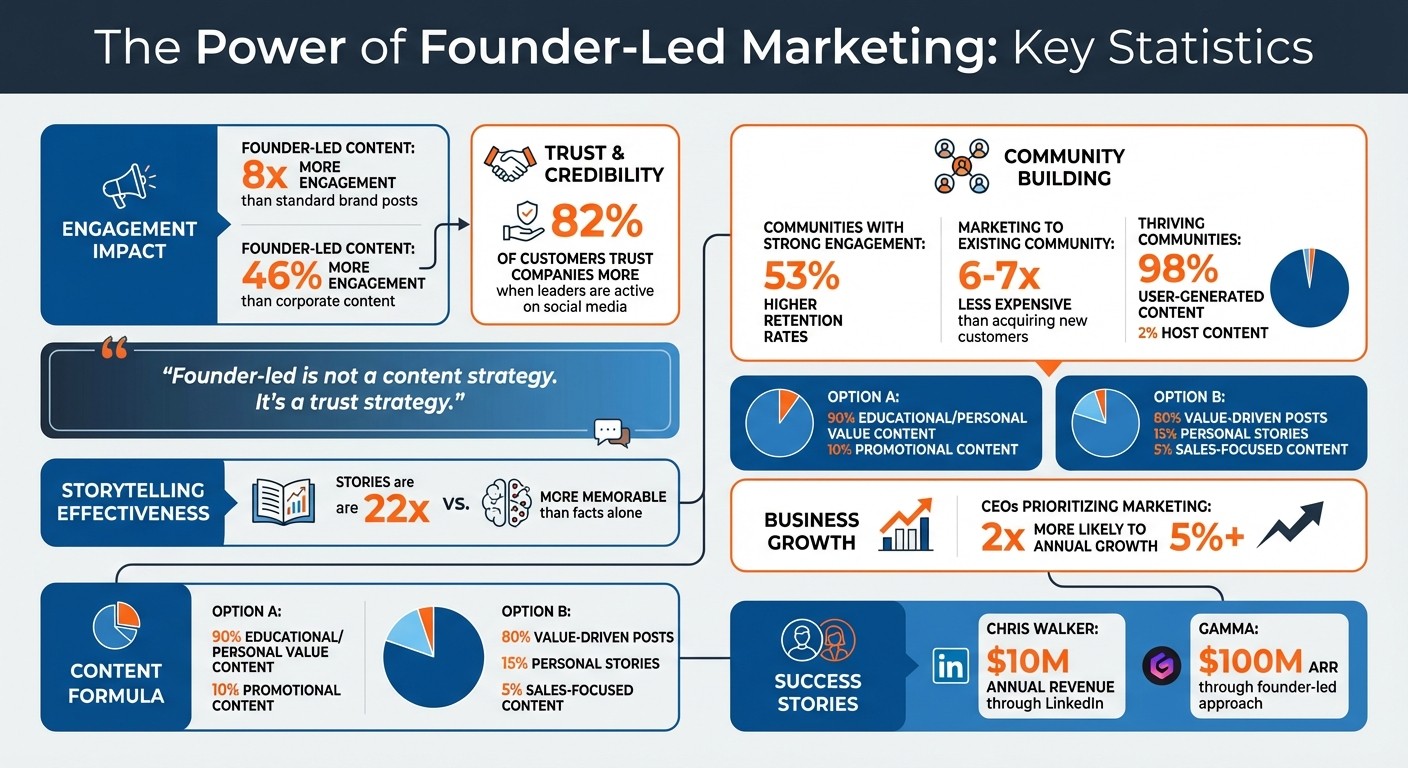
Founder-Led Marketing Statistics and Key Metrics
Founder-Led Marketing Without Becoming an Influencer
Build Your Personal Brand Foundation
Before jumping into creating content, take a moment to define who you are and who you’re speaking to. Without this clarity, your messaging can feel scattered and disconnected. Your personal brand is the foundation that ties all your content together.
Define Your Voice and Values
Start by figuring out your communication style. Are you someone who thrives on data and analysis, or do you prefer storytelling and emotional connections? Maybe humor is your go-to, or perhaps you lean toward a more professional and straightforward tone. Whatever it is, your voice should reflect you - not an imitation of someone else’s success.
Next, clarify your core values by identifying what you stand for and the problems you aim to address. Look at Whitney Wolfe Herd, the founder of Bumble. She built the brand around female empowerment, aligning her personal mission with Bumble’s unique features. Despite skepticism from investors who doubted women would “make the first move,” her unwavering authenticity helped Bumble go public and made her the youngest self-made female billionaire [2]. Similarly, Melanie Perkins of Canva turned over 100 investor rejections into a $26 billion company. She built her personal brand on transparency, openly sharing her journey, including financial challenges, on LinkedIn [2].
When your values match your audience’s expectations, trust builds naturally. In fact, research shows that 82% of customers are more likely to trust companies whose leaders are active on social media [1]. This isn’t about being flawless - it’s about being consistent. Stick to the 90-10 rule: dedicate 90% of your content to providing educational or personal value, and only 10% to promoting your product or service [1][2].
Identify and Analyze Your Target Audience
Knowing your audience requires more than just understanding their age or location. Dive into their psychographics, such as their values, challenges, motivations, and even the language they use [4]. For example, targeting “fitness enthusiasts” is broad and generic. Instead, focusing on a niche like “strength training for new moms” can lead to deeper engagement and make you more attractive to potential brand partnerships [4].
Leverage tools like SparkToro and platform analytics to uncover what truly matters to your audience. Track your engagement rate using this formula: (Likes + Comments + Shares) ÷ Total Followers. This metric offers a more accurate measure of connection than follower count alone [4]. Interestingly, only 34% of marketers feel confident about measuring influencer marketing ROI [5], so starting with the right metrics can set you apart.
As you grow, create a media kit that includes your bio, niche, engagement stats, audience demographics, and examples of past collaborations [4]. This document will be vital for scaling your efforts and securing partnerships. When you clearly define who you’re serving, it becomes easier to craft content that resonates deeply - and to streamline repetitive tasks with tools like Averi. With a solid grasp of your audience, you’re ready to build a content strategy that truly connects.
Create a Storytelling and Content Strategy
Once your brand foundation is in place, the next step is crafting an AI content creation framework that weaves compelling narratives into your posts. Stories have an incredible ability to stick with people - making your content 22 times more memorable [6]. By focusing on storytelling, you can align each piece of content with your broader goals while showcasing your personality.
Creators often succeed by adopting one of four narrative styles:
The Educator: Simplifies complex topics for the audience.
The Evaluator: Shares honest reviews and opinions.
The Advisor: Offers personal tips and lessons learned.
The Entertainer: Uses humor or creative visuals to engage.
Choose a style that feels natural to you, then plan content themes designed to spark emotions like humor, inspiration, or nostalgia [6]. A great example of this is Gymshark's #Gymshark66 campaign in May 2024. By featuring fitness influencers who shared "Stories of the 66" about building healthy habits, the campaign amassed 1.9 million likes, 12,576 comments, and 45.5 million views [7].
To keep things genuine, consider a trial run before going live, experimenting with both evergreen and story-driven formats to fine-tune your approach [6][8]. Micro-influencer Betty shared her perspective:
"I think a lot of people love to just see the tea that I do spill because I'm a consumer at the end of the day" [9].
Leverage AI tools like Averi to streamline your process - whether it’s generating content ideas, tracking trends, or automating your posting schedule. This frees up your time to focus on adding personal touches and behind-the-scenes glimpses [5][7].
The key is to balance efficiency with authenticity. Let AI handle tasks like research, drafting, and even spotting passive voice, while you focus on shaping your brand voice and ensuring it aligns with your chosen narrative [5]. With a solid strategy in hand, you’ll be ready to scale up your content production and make a lasting impression.
Execute Content with AI and Human Input
Once your content strategy is in place, it's time to bring those ideas to life and publish them. This phase is where your brand voice and storytelling take center stage. The most effective way to execute this is by dividing tasks between AI and human effort - AI takes on research, SEO structuring, and drafting, while you refine the tone, voice, and clarity. This teamwork speeds up production while keeping the personal touch that founder-led marketing thrives on.
Here’s how blending AI and human input can simplify your content creation process.
Simplify Research, Drafting, and Editing
AI can take on the heavy lifting when it comes to research. Tools like Averi can analyze industry trends, group keywords, and create initial drafts tailored to your brand’s context. Your role is to add the personal touch - sharing lessons learned, behind-the-scenes insights, and real-world experiences that make your content stand out.
Here’s a practical workflow: AI generates audience personas and outlines during the planning phase, drafts content with suggested creative ideas, and flags filler words or passive voice during editing. Your job is to fact-check, adjust the tone to fit your voice, and ensure the content aligns with your overall message.
For those who prefer batch production, try recording 1–2-hour sessions where you talk through your ideas. AI can transcribe, script, and edit these recordings into 30–60 pieces of content. This approach not only scales your output but also keeps your authentic voice front and center.
Publish and Manage Content with Ease
Once your content is polished, the next step is publishing it efficiently. Skip the hassle of manual uploads by using tools that integrate directly with your CMS, whether it’s WordPress, Webflow, or Framer. For instance, Averi can send finalized content directly to your platform and store it in a content library for easy access later. Over time, this library helps AI better understand and replicate your brand voice in future drafts.
For a balanced content strategy in founder-led marketing, aim for a mix of 80% value-driven posts (like industry insights and behind-the-scenes updates), 15% personal stories (your journey and challenges), and 5% sales-focused pieces. Keep an eye on engagement metrics - if educational content consistently outperforms promotional posts, tweak your calendar accordingly. Research shows that CEOs who prioritize marketing, including founder-led approaches, are twice as likely to achieve over 5% annual growth [11][14].
Engage and Scale Through Community Building
Once you've streamlined your content creation and publishing process, the next step is turning passive readers into an active, engaged community.
Publishing content is just the starting point. True growth happens when you foster a sense of connection - building a group of people who trust your voice, engage with your ideas, and naturally share your message. For creators and influencers, this means moving from one-way broadcasting to creating meaningful, two-way interactions. The payoff is clear: branded online communities experience a 53% higher retention rate compared to those without one [17], and marketing to an existing community costs 6 to 7 times less than acquiring new customers [18].
Build Direct Connections with Your Audience
Think of your audience as collaborators rather than just followers. Use interactive tools like Q&A sessions, live polls, or product demos on platforms like TikTok or Instagram Live to spark real-time conversations that establish trust [5]. When you take the time to respond to questions or highlight user feedback, your audience shifts from passive viewers to active participants.
User-generated content (UGC) is a powerful way to amplify this connection. Encourage your audience to post unboxings, testimonials, or their personal interpretations of your content, and then share those stories across your platforms [5]. This turns happy followers into vocal advocates. A good benchmark? In thriving communities, 98% of content is created by users, leaving just 2% from the host [18]. If you're doing all the talking, you're missing a big opportunity to let your community scale itself.
As you build these relationships, it's crucial to measure how well you're engaging your audience.
Measure Metrics That Matter
Focus on meaningful engagement rather than just reach. Calculate your engagement rate using this formula: (Likes + Comments + Shares) ÷ Total Followers [4]. This metric reveals how many people genuinely connect with your content, not just how many happen to see it. Pay special attention to saves and shares - these actions show that your audience finds your content worth revisiting or recommending, which fuels long-term growth [20].
Retention and churn are also key indicators. Track how many community members return over 30, 60, and 90 days. Use this formula to measure retention: (End Members - New Members) ÷ Start Members × 100 [18]. If you're losing members quickly, it might signal that your content or onboarding process needs improvement. Tools like Brand24 or Social Pinpoint can provide sentiment analysis to gauge whether your audience is supporting you or expressing frustrations [15][16]. This allows you to adjust your approach before minor issues escalate. Considering that 65% of marketing leaders need to demonstrate how social media supports business goals to gain leadership approval [19], tracking these metrics isn't just helpful - it's essential.
Automate and Scale Your Marketing Efforts
After streamlining your content creation process, it’s time to take things up a notch with automation. By turning your efforts into a repeatable, high-quality system, you free up time to focus on the bigger picture and strategic decisions.
Create a Feedback Loop with Analytics
The best content strategies grow by learning from audience responses. Start by tracking key metrics like engagement rates (likes, comments, shares divided by total followers), conversion actions (email signups or affiliate clicks), and follower growth within your target audience. Use this data to identify what resonates most and reallocate resources accordingly. For example, Melanie Perkins of Canva discovered through LinkedIn analytics that posts sharing personal vulnerabilities sparked stronger community support, which played a role in Canva’s massive growth [11].
Tools like Averi AI can simplify this process by consolidating analytics from platforms like Google Analytics, Instagram Insights, and Twitter Analytics. This can reduce analysis time by up to 70%. Additionally, Averi AI can help automate content ideation, drafting, and scheduling. Set up weekly automated reports to highlight top-performing themes, and refine your content pillars. For instance, if industry insights generate twice the conversions compared to customer stories, you can adjust your focus accordingly [11].
Scale Through Workflow Automation
Once you’ve identified what works through analytics, automation can help you scale those successes. Focus on 3–4 key content pillars - such as industry insights, customer stories, and how-to guides. Use AI content creation tools to brainstorm ideas, create outlines in your brand voice, and schedule posts across platforms like Instagram, LinkedIn, and TikTok [10] [11].
Emily Weiss of Glossier used automated community feedback to refine her content, keeping her audience engaged while maintaining a personal connection [12] [13]. To ensure your unique voice isn’t lost, reserve about 20% of your content for manual review. This balance between automation and human oversight lets you expand your reach while staying true to your brand.
Reed Manata’s work with Fitted shows how this can pay off. His team tested small-scale viral content on TikTok and Reels, cross-posted successful pieces, and added modest ad spend. The result? 500 million views and 600,000 downloads at an astonishing $0.01 per user [10]. Automation amplified what worked while leaving room for the insights only his team could provide.
Conclusion: Build a Scalable Marketing System
The strategies we've explored lay the groundwork for creating a marketing system that grows with you. Founder-led marketing thrives because it blends a personal, relatable touch with the power of modern AI tools. The numbers tell the story - founder-led content sees 46% more engagement than typical corporate material, and 82% of customers feel greater trust in companies when their leadership is active on social media [1]. The real advantage lies in scaling that trust without overwhelming your resources.
By combining personal branding with workflow automation, you amplify your efforts. Each piece of the puzzle strengthens your ability to balance genuine connection with streamlined processes. Tools like Averi AI take care of repetitive tasks, freeing you to focus on strategic decisions.
"Founder-led is not a content strategy. It's a trust strategy" [3]. - Adam Holmgren, CEO and Co-founder at Fibbler
The key to scaling trust is not working longer hours but building systems that maintain your voice while broadening your reach.
The most effective creators develop an automated content engine - one that handles routine tasks through automation while keeping you at the helm of growth. Start with a strong foundation, automate where you can, and let your system amplify your results over time. The journey to a sustainable, scalable content engine begins now.
FAQs
How do I pick my founder content pillars?
To decide on your content pillars as a creator or influencer, identify 3–5 broad themes that resonate with your brand, align with your audience's interests, and highlight your expertise. These pillars should represent what matters to your audience and showcase what makes you stand out - whether that's offering education, sparking inspiration, or providing entertainment.
Choose themes you can regularly create content around while staying aligned with your goals. Well-defined, niche-focused pillars help establish trust, showcase authority, and maintain consistency across all platforms.
What should AI handle vs me?
AI can take on repetitive and time-consuming tasks such as ideation, drafting, scheduling, and refining content, automating as much as 80% of workflows. This approach frees up significant time for creators to focus on more meaningful work.
Meanwhile, creators should dedicate their energy to tasks that require human insight and a personal touch - like developing authentic brand stories, connecting directly with their audience, and making creative choices that showcase their unique voice and vision. Striking this balance boosts efficiency while preserving originality and creativity.
What metrics show that founder-led marketing is working?
Key results highlight impressive outcomes: engagement rates climbing by up to 47%, sales cycles shortened by 40%, lead generation becoming 2.5x more efficient at 60% lower costs, and platform engagement seeing a 47% increase. These numbers showcase the ability of founder-led marketing to build trust, deepen audience connections, and deliver tangible business results.
Related Blog Posts

Zach Chmael
CMO, Averi
"We built Averi around the exact workflow we've used to scale our web traffic over 6000% in the last 6 months."
Your content should be working harder.
Averi's content engine builds Google entity authority, drives AI citations, and scales your visibility so you can get more customers.