

In This Article
Guide for nonprofit founders to build trust and drive donations using personal storytelling, donor personas, AI automation, and measurable KPIs on a lean budget.
Updated:
Trusted by 1,000+ teams
Startups use Averi to build
content engines that rank.
Your nonprofit’s most powerful marketing tool is you. Founder-led marketing builds trust and sparks deeper connections with supporters because it’s personal, relatable, and mission-driven. Nonprofits often operate on tight budgets, making this approach both effective and cost-efficient. Here’s how to make it work:
Set clear goals: Define measurable outcomes like raising $10,000 by a specific date or recruiting 20 volunteers for an event.
Understand your audience: Create donor and volunteer personas based on motivations, behaviors, and values.
Share your story: Highlight why you started your nonprofit, the challenges you’ve faced, and the impact you’ve achieved.
Leverage automation: Use AI tools for content marketing to streamline creation, social media scheduling, and email campaigns. You can even build an AI content engine to manage these channels efficiently.
Track results: Monitor key metrics like donation conversion rates, email open rates, and volunteer sign-ups to refine your approach.
Founder-led marketing isn’t just about promoting your cause - it’s about building relationships. By sharing your passion and engaging directly with your audience, you can amplify your mission without overextending your resources. Let’s dive into the details.
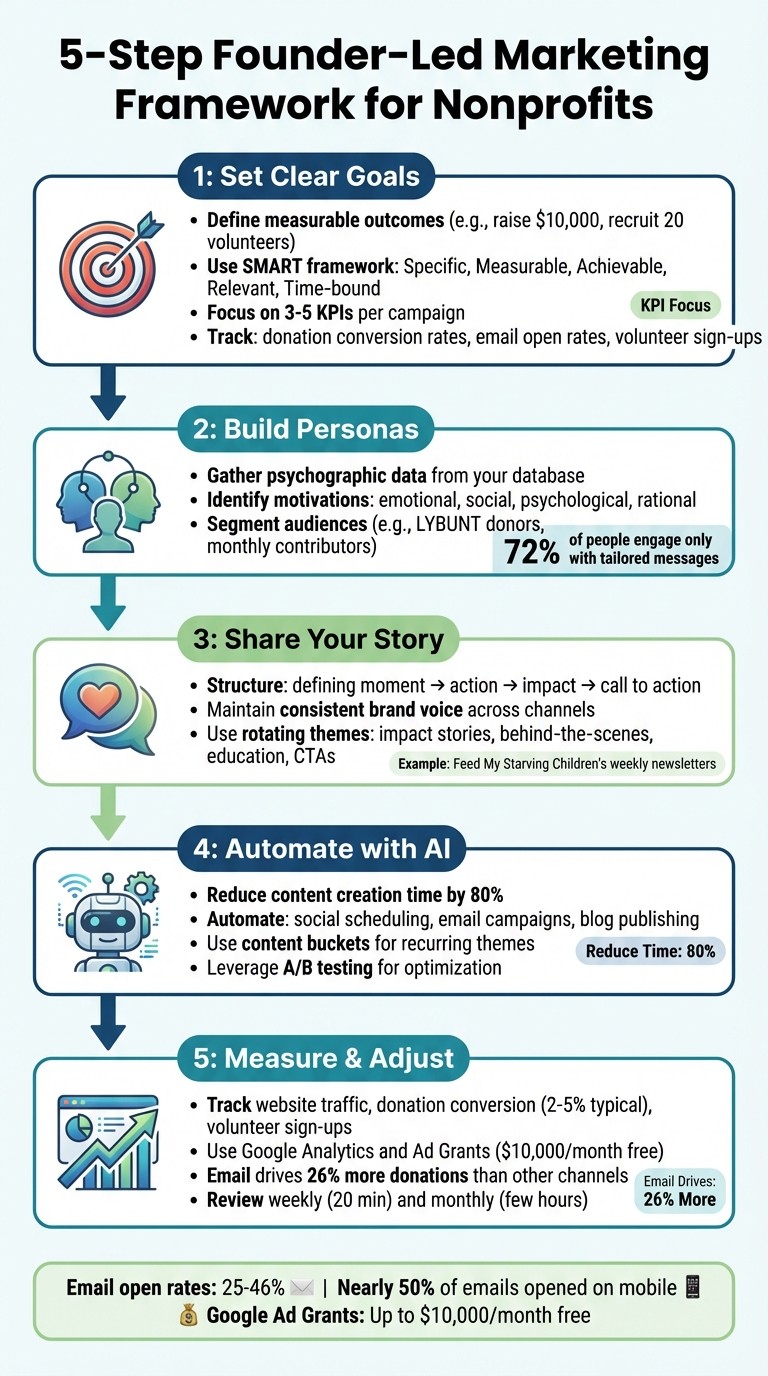
5-Step Founder-Led Marketing Framework for Nonprofits
3 Hats Nonprofit Founders wear when starting a Nonprofit
Set Clear Marketing Goals
Without defined objectives, marketing efforts can quickly spiral into a series of random posts and emails that achieve little. As a founder, it’s critical to pinpoint exactly what each campaign is meant to accomplish. Are you aiming to raise $10,000 by October 1? Attract 500 new visitors to your donation form? Recruit 20 volunteers for an upcoming event? Goals like these provide clarity and direction, unlike vague ambitions such as "increase awareness", which often lead to wasted energy and resources. Ground these targets in your mission to ensure they drive meaningful results.
The distinction between nonprofits and businesses is key: your focus is on creating impact, not generating profit [1]. Every choice you make must strike a balance between raising awareness, securing funds, and advancing your programs, ensuring that your efforts lead to measurable outcomes.
Connect Marketing Goals to Your Mission
Your marketing strategy should amplify your organization’s story in a way that resonates emotionally and aligns seamlessly with your mission [1]. Campaigns should not only capture attention but also reinforce the purpose behind your work.
Identify major initiatives that align with your goals - ticket sales and donations from annual galas, volunteer drives to boost engagement, or matching gift and peer-to-peer campaigns for timely fundraisers [1]. These events are opportunities to connect your mission with tangible action.
Define Your Key Performance Indicators (KPIs)
To measure success, set specific KPIs using the SMART framework - Specific, Measurable, Achievable, Relevant, and Time-bound. For instance, instead of saying "improve email marketing", aim for something concrete, like "increase email click-through rates by 20% over the next quarter" [1]. Clear KPIs transform your vision into actionable, trackable goals.
Different objectives require tailored KPIs. For fundraising, focus on metrics like donation form conversion rates and the total amount raised. For engagement, monitor email open rates, click-through rates, and social media interactions. Growth-focused efforts might track new email subscribers or website traffic from targeted campaigns, while volunteer recruitment should measure signup rates and event attendance [1].
Additionally, consider both historical performance and predictive indicators, such as donor retention, to refine your approach [4]. Many nonprofits also keep an eye on their efficiency ratio - striving to ensure that at least 75 cents of every donated dollar goes directly toward mission-related work rather than administrative costs [3]. This level of transparency helps build trust with donors who want to see their contributions making a difference.
Lastly, avoid spreading your team too thin by tracking an excessive number of metrics. Focus on three to five KPIs that align closely with your current campaign goals. Use tools like CRM dashboards to automate data collection and streamline the process [2][3]. This keeps your team focused and ensures your efforts remain impactful.
Build Donor and Volunteer Personas
Getting to know your supporters goes beyond simply tracking how much they donate. Personas provide a deeper understanding of why they choose to give - what they value, what motivates them, and how they connect with your mission. As a founder, you already have a unique perspective from your personal interactions with donors and volunteers. This insight is invaluable in shaping personas that align with your mission. By formalizing this understanding, you can create profiles that guide your messaging and campaigns, ensuring they resonate on a deeper level. This approach sets the stage for crafting impactful strategies, a theme explored further in the upcoming sections.
Start by gathering psychographic data - details about donors’ lifestyles, values, and interests - from your database. Look for patterns in how often they donate, which channels they prefer, and what triggers their contributions [5]. Then, identify their core motivations. Are they driven by emotional factors, such as compassion or empathy? Social drivers, like the desire for community recognition? Psychological needs, such as seeing tangible results? Or rational reasons, like tax benefits and financial transparency? [6]. As Mallory Erickson, Founder and CEO of Practivated, explains:
"At the core of successful fundraising is always motivation" [6].
Harness Supporter Motivation for Founder-Led Impact
Engage your supporters directly to uncover their motivations. Ask targeted questions like, "Which organizational values resonate with you?" or "What kind of impact do you hope your support achieves?" [5]. Dive into your email analytics to see which subject lines and stories get the most engagement - this can reveal the type of language and themes that strike a chord with your audience [5].
For corporate donors, highlight volunteer grant programs that offer dual benefits. For example, Microsoft provides nonprofits with $25 for every hour an employee volunteers, with a maximum grant of $15,000 per employee annually [8]. Understanding these programs allows you to craft appeals that tap into multiple motivations at once, making your messaging even more effective.
Segment Audiences
Once you’ve identified what drives your supporters, divide them into distinct groups based on their behaviors and engagement levels. Combine geographic data with engagement metrics to create valuable segments, such as LYBUNT donors (Last Year But Not This) - those who donated last year but haven’t yet contributed this year - or monthly contributors who provide consistent, recurring support [7][10]. Research shows that 72% of people engage only with marketing messages tailored to their specific interests [9], making segmentation a cornerstone of effective outreach.
Take it a step further with multi-attribute segmentation, combining characteristics like location and engagement level. This allows you to create highly targeted lists for specific efforts, such as local events or regional campaigns [10]. Ally Orlando, Senior Copywriter at DonorPerfect, underscores the importance of this approach:
"Personas are based on data, not stereotypes" [7].
Write Founder-Driven Messages
Your personal story is the heartbeat of your nonprofit's mission and marketing efforts. It’s what makes your organization relatable and memorable to donors and volunteers. People connect with people, not faceless entities. By sharing your journey - why you started your nonprofit, the struggles you’ve overcome, and the impact you aim to achieve - you build a connection that generic messaging simply can’t replicate. As the Averi Academy emphasizes:
"Your story is your strategy. Donors, volunteers, and partners need to understand your mission instantly" [1].
The best founder stories follow a clear and compelling structure: the moment you realized something needed to change, your decision to take action, the impact you’ve achieved, and an invitation for others to join you. A great example is Feed My Starving Children, which shares weekly newsletters featuring personal stories of children helped by their programs. These updates keep supporters engaged by showing the real-world results of their contributions, reinforcing why their involvement matters [13]. A personal narrative like this creates a foundation for every interaction, making your mission tangible and impactful.
Share Your Founder Story
Craft your story to forge an emotional connection. Begin with the defining moment - the pivotal event that inspired you to act. Perhaps you witnessed an injustice, experienced a personal loss, or identified a gap that no one else was addressing. Next, describe your immediate action - how you turned your concern into meaningful steps forward. Then, highlight the impact you’ve made, using real examples of lives changed or challenges overcome. Finally, close with a call to action, inviting others to join your mission and make a difference.
In 2019, SuicideCo launched a billboard campaign featuring personal letters, which led to a 40% increase in helpline calls. By sharing candid and vulnerable stories, they broke down barriers around mental health stigma [14]. Your founder story can have a similar effect - honest storytelling builds trust, and trust inspires action.
Keep Your Message Consistent Across Channels
Once you’ve crafted your founder narrative, ensure it stays consistent across all platforms. Develop a brand style guide to define your tone - whether it’s passionate and approachable, urgent but hopeful, or warm and conversational. Incorporate key phrases from your story into emails, social media posts, and your website to create a unified voice [11].
To maintain consistency without sounding repetitive, organize your content around rotating themes such as:
Impact Stories: Share highlights of individuals or communities benefiting from your work.
Behind-the-Scenes: Offer glimpses into your daily operations or challenges.
Education: Provide statistics, facts, or context about the cause you’re tackling.
Calls to Action: Encourage volunteering, donating, or other forms of support.
For instance, Faith in Texas revamped their advocacy software templates to ensure their communications felt personal while staying aligned with their organizational tone [11]. Similarly, the Human Rights Campaign’s equal-sign profile picture campaign demonstrated how a single, consistent idea can spread organically when supporters adapt it within their own networks [15]. This kind of cohesive storytelling not only strengthens your brand’s identity but also lays the groundwork for integrating more advanced tools, like AI marketing for non-technical founders, which we’ll explore next.
Use AI Tools to Automate Marketing
Running a nonprofit often means juggling many responsibilities at once. Marketing tasks like creating social media posts, drafting newsletters, and updating blogs can eat up hours you might prefer to spend on advancing your mission. AI-powered platforms can take over these repetitive workflows, freeing up your time while ensuring your marketing remains consistent and effective. By automating these tasks, you can shift your focus toward more impactful, strategic work.
Platforms such as Averi AI are built to handle the entire content cycle, making them ideal for teams with limited resources. Instead of relying on separate tools for writing, editing, scheduling, and publishing, you can manage everything in one place. For instance, you could prompt the system with something like, "Create a founder story post about our clean water mission for Instagram." The AI will then craft content aligned with your mission, suggest visuals, schedule posts for platforms like Facebook and Instagram, and even publish updates to your website - all in just a few minutes. This streamlined process can reduce the time spent on content creation by as much as 80% compared to traditional methods [12].
One standout feature of AI workspaces is their seamless workflow integration, which sets them apart from standalone tools like ChatGPT. Instead of manually transferring content between platforms, these systems connect directly to your CMS (e.g., WordPress or Squarespace) and social media accounts. This means you can approve content once and have it published everywhere, avoiding formatting issues or lost drafts. For example, Feed My Starving Children uses AI to automate the scheduling of weekly newsletters filled with personal stories, ensuring supporters stay engaged with meaningful updates [13].
Automate Content Creation and Publishing
To get started, link your AI platform to your website, email, and social media accounts. Then, build a content library that includes your brand voice guidelines, successful past campaigns, and donor testimonials. This serves as a "second brain" for your marketing, ensuring every piece of AI-generated content stays true to your mission and story.
You can also organize your content into recurring themes using "content buckets." For example, you might share impact stories on Mondays, behind-the-scenes updates on Wednesdays, and educational posts on Fridays. With this structure, AI can generate an entire month’s worth of posts while repurposing a single success story into a blog, email, Instagram carousel, and Twitter thread. This approach eliminates the daily scramble for new ideas while maximizing the reach of your content without adding extra work.
Direct publishing further simplifies the process. Once you approve a blog post - say, about an upcoming fundraising event - the AI can publish it to your website, create SEO-friendly meta descriptions, add internal links to related pages, and schedule supporting social media posts. Nonprofits using integrated publishing tools often find their campaign launches are three times faster than those relying on manual workflows [12].
Use Data to Improve Campaigns
AI platforms aren’t just about creating content - they also help refine your marketing strategy with data-driven insights. Performance dashboards track critical metrics like engagement, donation conversions, and volunteer sign-ups, offering actionable recommendations instead of overwhelming you with raw data. For example, if your video posts generate 15% higher click-through rates than static images, the system might suggest increasing your video content by 20% next month to further boost engagement.
AI can also automate A/B testing for email subject lines, social post formats, and donation page layouts. This allows the platform to identify the most effective call-to-action phrases and apply those insights to future campaigns. For instance, WaterAid’s #TeamWater campaign used real-time engagement data from micro-creators to refine its messaging, ultimately raising over $40 million. Similarly, SuicideCo leveraged AI insights to optimize a billboard campaign, resulting in a 40% increase in helpline calls [14].
Run Marketing Campaigns with Limited Resources
With AI making content creation more efficient, the next challenge is running impactful campaigns, even with limited resources at hand.
Nonprofit founders often face a familiar hurdle: staying visible and engaging supporters without a large marketing team or hefty budget. But impactful campaigns don’t have to come with a big price tag. By using free tools, forming strategic partnerships, and rallying the people already invested in your mission, you can create meaningful momentum.
Prioritize the channels that offer the best return on investment. For example, email marketing boasts open rates between 25% and 46%, making it a reliable option for engagement. Additionally, programs like Google Ad Grants provide nonprofits with up to $10,000 per month in free search advertising, offering a powerful way to reach more people without straining your resources [18][21]. Through all of this, your leadership and personal connection to the mission remain essential.
Use Social Media and Email Marketing
Zero in on one or two social platforms where your supporters are most active [20][22]. For example, if your target audience includes Gen Z, TikTok’s short videos and donation stickers could be the way to go. On the other hand, if you’re aiming to connect with corporate partners or industry leaders, LinkedIn’s professional network might be more effective [23][27].
To stay consistent, follow a simple three-post weekly schedule. For instance, post emotional impact stories on Mondays, highlight donors or volunteers on Wednesdays, and share behind-the-scenes glimpses on Fridays [22]. Free tools like Canva’s nonprofit version can help you create professional-looking graphics without hiring a designer [18][19].
For email marketing, segment your audience into groups like first-time donors, recurring supporters, and volunteers. Tailored messages for each group can significantly improve engagement. In fact, email inspires 26% more people to donate compared to other channels [26]. Use A/B testing to refine subject lines and calls-to-action, ensuring your messages resonate with your audience [24][25]. Since nearly half of all emails are opened on mobile devices [21], make sure your templates are mobile-friendly with concise copy and clear, clickable buttons.
To expand your reach further, consider tapping into the power of micro-influencers and volunteers.
Partner with Micro-Influencers and Volunteers
Your supporters can double as a powerful marketing team. Your personal story as a founder can inspire others to champion your cause. Peer-to-peer fundraising campaigns, for instance, are particularly effective for youth organizations and alumni networks, as they mobilize your community to fundraise on your behalf [1]. Encourage volunteers to share photos, videos, or testimonials from their experiences. This kind of user-generated content builds trust and credibility, all without added production costs [22].
"Collaboration can be a force multiplier for nonprofits. Whether it's teaming up with larger organizations, local businesses, or peer nonprofits, strategic partnerships allow you to tap into new audiences." - Averi Academy [1]
Begin small with partnerships by testing out a single co-branded social media post or a newsletter swap before committing to larger joint efforts [1]. For example, you could collaborate with a local business to cross-promote each other’s missions or partner with a complementary nonprofit to share event costs and attract new supporters. Highlight your volunteers with dedicated "volunteer spotlight" posts - tagging them can encourage them to share the content with their own networks, organically increasing your reach [1].
Measure Results and Adjust Your Strategy
Once your campaigns are up and running, the next step is to assess their effectiveness and fine-tune your approach. Launching campaigns is only part of the process - real progress comes from understanding what works and adapting based on that knowledge. Without proper measurement, you're essentially making educated guesses, which is a risk nonprofits can't afford. Tracking results gives you the clarity to evolve your founder-led message using real-time insights.
Focus on metrics that directly tie to your mission. For example, website traffic reveals how many people are engaging with your cause. Donation conversion rates - typically between 2% and 5% for nonprofits - show how well you're turning interest into action[17]. Similarly, volunteer sign-ups reflect how compelling your calls-to-action are. These numbers aren't just data points; they represent tangible progress toward your goals, such as increased funding, more volunteers, and ultimately, greater impact.
Track Key Metrics
Make use of free tools to monitor your progress. Google Analytics helps you track where visitors come from and what they do on your site, while Google Ad Grants can provide up to $10,000 per month in credits for impressions, clicks, and conversions[17].
Keep an eye on email open rates and click-through rates to see which messages resonate most with your audience. Track actions like completed donation forms or volunteer sign-ups. Using UTM parameters on links allows you to pinpoint which campaigns - whether a Facebook post or an email newsletter - are driving results[17]. These metrics give you a clear picture of what's working and where adjustments are needed.
Review Campaign Results as a Founder
Regularly reviewing your metrics turns raw data into actionable strategies. Dedicate 20 minutes each week and a few hours monthly to evaluate engagement and how well your results align with your goals. For instance, if your goal was a 20% increase in donations but you only achieved 15%, dig deeper. Are social media campaigns driving traffic but failing to convert visitors into donors?
Your perspective as a founder is essential during these reviews. Ask yourself, "Is this advancing our story?" If email campaigns are generating engagement but not donations, consider shifting to more narrative-driven content that highlights the impact of your work. Celebrate successes, like an uptick in website traffic, but also be ready to pivot when something isn't delivering. Your hands-on involvement ensures that every adjustment stays true to your mission.
Build a Self-Running Marketing System
Creating a marketing system that operates on its own allows you to concentrate on your core mission. After setting clear goals, defining your audience, and launching campaigns, the next step is to establish workflows that ensure your outreach to donors and volunteers remains consistent without requiring constant oversight. The key is to streamline repetitive tasks and keep engagement flowing smoothly.
Start by automating routine tasks. Tools like Google Ad Grants can manage up to $10,000 per month in ads, targeting keywords aligned with your cause[17]. Automated newsletters can pull compelling impact stories directly from your programs[13]. For instance, Faith in Texas used advocacy software with branded templates and automated personalization to send targeted action alerts, successfully building a grassroots network focused on economic and racial justice[11].
In addition to automation, expand your efforts by tapping into peer-to-peer fundraising. Encourage supporters to share your mission on social media, transforming them into ambassadors for your cause. Adding gamified elements, such as leaderboards for top fundraisers, can help maintain momentum and enthusiasm[16]. User-generated content is another powerful tool - it not only builds trust but also provides a cost-effective way to sustain engagement and expand your reach[16].
To keep all your communications aligned, create a messaging matrix that ties everything back to your mission[28]. Regularly review your system - monthly checkpoints are ideal - to refine AI prompts, tweak campaigns, and celebrate achievements. These reviews ensure that your system stays on track and aligned with your vision while handling day-to-day operations independently.
Building a self-running marketing system doesn’t mean stepping away; it’s about creating an infrastructure that amplifies your efforts without overwhelming you. With automation managing the execution and your periodic input guiding the strategy, your nonprofit’s marketing becomes a dependable engine. This approach allows you to focus on the work that matters most while ensuring your mission continues to grow and thrive.
FAQs
How do I start founder-led marketing if I’m short on time?
If your schedule is tight, let AI tools handle the heavy lifting in your marketing efforts. Set aside just 30 minutes each day to tackle essential tasks like engaging with supporters, fine-tuning your messaging, or analyzing campaign performance. Use AI to automate time-consuming tasks like content creation or scheduling social media posts. By focusing on these impactful routines, you can stay genuine in your approach and manage your marketing effectively without burning out.
What are the 3–5 KPIs to track first for my nonprofit?
To measure the success of your campaigns and understand their impact, focus on tracking donor retention, average gift size, and fundraising ROI. These metrics reveal donor loyalty, show how effective your fundraising strategies are, and highlight the financial returns from your efforts. By analyzing this data, you can better allocate resources and make informed decisions to strengthen your nonprofit's outcomes.
How can I use AI without losing my authentic founder voice?
To maintain your genuine founder voice while working with AI, think of it as a supportive tool rather than a substitute. Leverage AI for practical tasks like drafting content or managing schedules, allowing you to dedicate more energy to crafting your narrative and refining your strategic messages. Always take the time to review and fine-tune AI-generated content to ensure it reflects your unique voice and core values, keeping the personal connection your audience appreciates intact.
Related Blog Posts

Zach Chmael
CMO, Averi
"We built Averi around the exact workflow we've used to scale our web traffic over 6000% in the last 6 months."
Your content should be working harder.
Averi's content engine builds Google entity authority, drives AI citations, and scales your visibility so you can get more customers.