

In This Article
Guide for agencies to use AI to automate reporting, create consistent branded content, speed campaigns, and scale workflows.
Updated:
Trusted by 1,000+ teams
Startups use Averi to build
content engines that rank.
AI-powered marketing is reshaping how agencies operate, enabling them to save time, reduce costs, and improve client outcomes. By automating repetitive tasks like reporting, content creation, and campaign management, agencies can focus on strategic priorities. Tools like Averi streamline workflows, maintain brand consistency, and allow smaller teams to compete with larger firms. Here's what you need to know:
Why AI is Essential: 97% of marketing leaders see AI skills as critical, with the market projected to reach $47.32 billion by 2025.
Key Benefits: Agencies save up to 80% of time on reporting, increase content output by 300%-500%, and reduce costs by up to 75%.
How to Start: Focus on one bottleneck, choose tools like Averi for full workflows or Jasper for specific tasks, and gradually scale AI integration.
Scaling with AI: Automate repetitive tasks, build a self-sustaining content engine, and transition to fixed or output-based pricing models.
AI isn't just a tool - it's a game-changer for agencies looking to manage workloads, deliver better results, and scale efficiently. Let’s dive into how it works and how you can make the most of it.
Building an AI Marketing Strategy for Agencies
Analyze Client Needs and Goals
Start by mapping out each client's needs using the 3C model - Context, Content, and Control [2]. To do this effectively, centralize all relevant client data: their brand voice, target audience, competitors, and overarching goals. Once this foundation is set, use AI content creation frameworks to generate content, but ensure it undergoes human review to maintain quality. A clear understanding of client data paves the way for a steady stream of tailored content.
Select AI tools that align with your agency's specific needs. For example, Averi automates much of the setup process by analyzing a client’s website to capture their brand voice, positioning, and any content gaps. This process takes about 10 minutes and lays the groundwork for all future content creation. Tools like this demonstrate how AI can streamline workflows and ensure consistent, high-quality output.
Build a Steady Content Queue
One common challenge for agencies is determining the next steps in content creation across multiple clients. AI tools excel here by continuously researching industry trends to fill content pipelines. For instance, Averi tracks trends, monitors competitor activity, and identifies high-opportunity keywords. It then organizes content ideas by format - such as listicles, how-to guides, comparisons, or editorials - complete with suggested titles, target keywords, and content outlines. You simply approve or reject the suggestions.
This process significantly reduces manual effort, allowing agencies to scale their operations. Agencies using AI-driven workflows report content output increases of 300% to 500%, all while maintaining quality [3]. A key principle here is the 80/20 model: AI handles 80% of the work - research, drafting, and formatting - while your team focuses on the 20% requiring strategic oversight and final approval [3].
Align AI Output with Client Expectations
While AI can produce content rapidly, it’s crucial to ensure the output aligns with each client’s tone and objectives. Misaligned content can waste time and damage trust. The Control step of the 3C model emphasizes the importance of setting guardrails early on. This involves training AI tools to understand each client’s unique brand voice and carefully reviewing AI-generated strategies before presenting them.
Averi’s persistent brand memory is particularly helpful for maintaining alignment. As you approve content over time, the system becomes increasingly adept at producing drafts that match the client’s voice. For agencies juggling multiple clients, this kind of brand-specific understanding prevents generic content and reassures clients that their needs are being met with precision and care.
Running Campaigns with AI and Human Input
AI-Generated Drafts and Research
Once the AI-powered content strategy is approved, execution kicks off immediately. Tools like Averi combine SEO insights, competitor analysis, and stored brand data to create structured drafts. These drafts come complete with metadata, internal links, FAQs, and concise TL;DR summaries tailored for search engines.
A smart way to avoid delays is using the Reporter Model. Instead of waiting for subject matter experts (SMEs) to write content - a process that can take 10–15 days - agencies conduct a quick 15-minute interview with the SME. The insights from this session are fed into AI, producing a first draft the same day. In this workflow, the AI handles the bulk of the writing, while the expert provides the foundation. This approach accelerates the process, leaving more time for human-led refinement.
Once the draft is ready, it moves to the next stage: collaborative editing and review.
Collaborative Editing and Review
A first draft is just the starting point. Human input is essential to refine ideas, add clarity, and inject creativity. To ensure quality, successful agencies implement three critical review checkpoints: a strategic brief and outline, a review of the introduction to ensure it hooks the audience, and a final QA pass for accuracy and link validation.
This is where Averi's collaborative editing tools shine. Editors can leave comments, tag team members, and flag sections for changes - all within the same platform. AI-powered style validators, trained on the brand's guidelines, catch up to 89% of style errors before the draft even reaches a human editor. This allows the team to focus on refining ideas rather than correcting tone or formatting.
"The difference between traditional and AI-powered marketing automation isn't incremental - it's transformational. We're seeing enterprises reduce campaign deployment time by 70% while simultaneously improving conversion rates by 25–30%." - Enterprise AI Implementation Director [5]
Once revisions are complete, the workflow shifts to approvals and publishing.
Approval and Publishing Workflows
After passing review, the content should be ready for publishing with minimal manual effort. By connecting AI tools directly to a CMS like WordPress, Webflow, or Framer, agencies can eliminate the time-consuming copy-paste process. For instance, Averi integrates seamlessly with these platforms, publishing drafts with proper formatting and archiving them for future reference to improve AI-generated outputs.
Approval processes are also evolving. Instead of relying on lengthy email chains, agencies are adopting client dashboards. These platforms allow clients to monitor content progress in real time and approve drafts with just one click. A McKinsey study highlights that up to 45% of current workflows can be automated using today's technology [6], with approval routing being one of the most impactful areas for optimization. Automating these bottlenecks ensures smoother operations and strengthens the agency's competitive position.
I Replaced My Marketing Team With 3 AI Agents (Here’s The Workflow)
Comparing AI Tools for Agencies
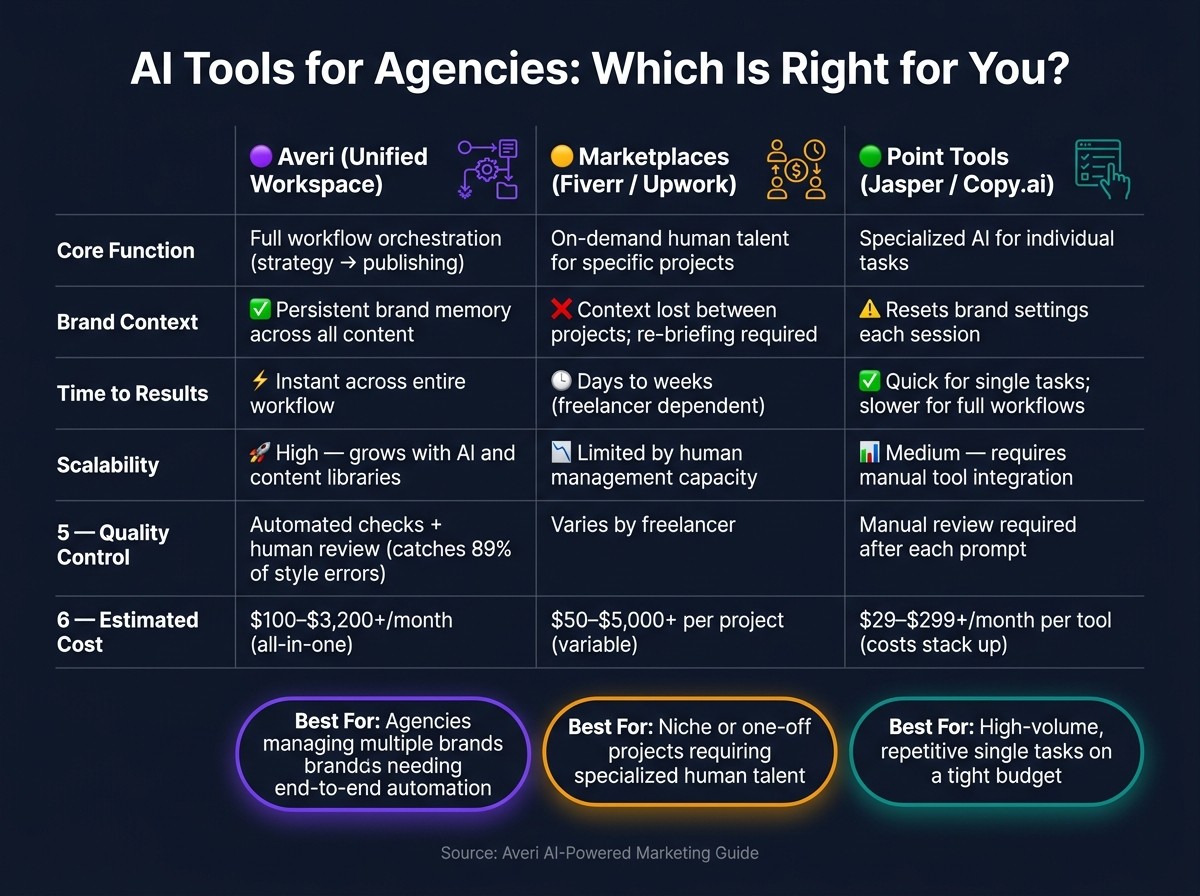
AI Tools for Agencies: Unified Workspaces vs. Marketplaces vs. Point Tools
Averi vs. Marketplaces vs. Point Tools
Once you’ve streamlined approval and publishing, the next step is ensuring your AI tool can handle the entire content lifecycle. To help agencies address their unique bottlenecks, it’s essential to compare the three main categories of AI tools: unified AI workspaces like Averi, talent marketplaces such as Fiverr and Upwork, and point tools like Jasper and Copy.ai. These categories serve very different purposes, and picking the wrong one can lead to unnecessary friction in your workflow.
Here’s a quick breakdown of how these options stack up in terms of functionality, trade-offs, and ideal use cases:
Feature | Averi (Workspace) | Marketplaces (Fiverr/Upwork) | Point Tools (Jasper/Copy.ai) |
|---|---|---|---|
Core Function | Comprehensive orchestration from strategy to publishing | On-demand human talent for specific projects | Specialized AI for individual tasks |
Brand Context | Maintains brand voice with persistent memory | Context lost between projects; requires re-briefing | Resets brand settings with each session |
Time to Results | Instant across the entire workflow | Days to weeks, depending on freelancer availability | Quick for single tasks but slower for full workflows |
Quality Control | Combines automated checks with human review | Varies; quality depends on the freelancer | Requires manual review after each prompt |
Scalability | High; adapts as AI and content libraries grow | Limited by human management capacity | Medium; needs manual integration between tools |
Estimated Cost | $100–$3,200+/month (all-in-one) | $50–$5,000+ per project (variable) | $29–$299+/month per tool (can add up fast) |
This comparison highlights how each tool type aligns with specific agency needs. As Ameya Deshmukh of EverWorker puts it:
"If the system can't move work forward without a human driving the next handoff, it's a tool - not an agent." [1]
Pros and Cons of Each Option
Option | Pros | Cons |
|---|---|---|
Averi (Workspace) | Manages the full workflow from strategy to publishing; retains brand memory; scales effectively with automation | Higher upfront costs; some features may be unnecessary for smaller teams; requires a setup phase for branding |
Marketplaces | Offers access to specialized human talent; no need for long-term software commitments; ideal for niche or one-off projects | High management effort for vetting and briefing; quality can vary between freelancers; brand context doesn’t carry over between projects |
Point Tools | Affordable for specific tasks; easy to deploy for quick fixes; great for repetitive tasks like product descriptions | Can lead to tool overload and fragmented workflows; requires manual data transfers; lacks cross-functional learning capabilities |
How to Pick the Right Tool for Your Agency
The best tool for your agency depends on your primary pain points. Are you focused on output (producing more content) or throughput (streamlining the entire process from concept to delivery)? [1]
Agencies prioritizing output might find point tools sufficient. These are great for high-volume, repetitive tasks.
Agencies focused on throughput, on the other hand, benefit more from unified systems like Averi, which can handle the entire pipeline seamlessly.
For small or newly established agencies, it’s smart to keep things simple - stick to one tool per job to avoid unnecessary complexity. Meanwhile, agencies managing multiple brands should prioritize tools with built-in brand controls. Features like role-based access and persistent brand memory can prevent voice inconsistencies across accounts, making tools like Averi a practical choice rather than just a luxury.
Start by identifying your biggest bottleneck and choose the tool that eliminates it most effectively.
Scaling Agency Work with AI Automation
Automating Repetitive Tasks
Agency teams often spend countless hours on repetitive tasks like pulling keyword data or drafting initial content. These time-consuming activities can bog down productivity and limit the potential for growth. AI steps in to handle these tasks seamlessly, reducing the operational drag that slows teams down.
By analyzing data, identifying patterns, and making decisions independently, AI enables automation on a large scale. The result? Marketing teams can redirect up to 30% of their time toward strategic initiatives when AI is integrated into their workflows [4]. This shift can mean the difference between a team constantly playing catch-up and one that’s proactively driving success.
Adam Orris, Director of Data and Analytics at Function Growth, shared his experience after adopting an AI analytics agent:
"Improvado transformed our approach to marketing analytics. Its automation capabilities and AI-driven insights allowed us to focus on optimization and strategy, without the need for manual data management." [4]
One underappreciated advantage of AI is automated data validation. AI systems can identify and correct naming convention errors across campaigns, ensuring clean and accurate reporting without requiring manual quality checks [4].
Cost and Time Savings for Agencies
The financial benefits of AI automation are hard to overlook. Automating workflows can reduce cycle times by 70% and cut costs by 30% [9].
These savings become even more striking when scaled. For instance, in 2025, BattleBridge deployed an AI agent system for USR Senior Living Directory, managing 4,757 community listings across 977 cities. The annual cost of the system was $21,600, a stark contrast to the estimated $216,000 required for a traditional agency approach. This resulted in a 900%+ ROI in the first year alone [8].
Implementing AI does come with initial costs, including setup fees ranging from $2,500 to over $15,000 and monthly retainers between $500 and $5,000 [7][10]. Mature agencies typically allocate 4%–8% of their revenue to AI infrastructure. However, when accounting for setup, integration, and ongoing maintenance, the long-term savings and efficiency gains far outweigh the upfront investment. These cost reductions lay the groundwork for developing an autonomous content system.
Building a Self-Running Content Engine
Once agencies achieve significant time and cost savings, they can shift their focus to building a self-sustaining content engine. AI integration amplifies benefits over time. For example, Averi operates on this principle: every published piece of content feeds back into the system. Performance data from previous campaigns informs future topic recommendations, sharpens brand context, and grows the content library into a lasting asset rather than a one-off project. This feedback loop strengthens the agency’s AI strategy and tools, ensuring that each campaign builds on the success of the last.
This AI-driven model, where technology handles workflows and humans concentrate on strategy, has been shown to increase revenue by 40% while reducing client workload by 75% [3]. It’s also transforming how agencies price their services. Many are moving away from hourly billing to flat monthly retainers or output-based pricing, where clients pay for a defined set of deliverables rather than time spent.
However, scaling with AI isn’t without challenges. One of the most pressing risks is quality drift - the possibility that prompts and workflows that once worked well may produce weaker results as AI models evolve. To avoid this, agencies should treat prompts as production assets, regularly auditing and versioning them to maintain consistent quality [7]. This proactive approach separates agencies that scale effectively from those that see their standards quietly decline.
Conclusion: Getting Started with AI for Your Agency
How AI Enhances Agency Marketing
AI isn't just about saving time - it’s about transforming how agencies operate. Structured workflows powered by AI can lead to up to an 80% increase in output per full-time employee (FTE) within just three months [7]. Costs for producing content can plummet from $125 per article to as little as $31, a sharp 75% reduction, while error rates drop by as much as 90% compared to uncoordinated, ad-hoc processes [7].
What sets AI-driven agencies apart is their ability to turn each piece of content into a long-term asset. Every publication feeds back into the system, improving future efficiency and quality. This shift moves content creation from being a repetitive task to a strategic advantage.
A Step-by-Step Plan for Agencies
Agencies shouldn’t rush to automate everything at once. A gradual, three-month rollout is a more effective approach:
Phase | Focus | Key Activity |
|---|---|---|
Month 1: Groundwork | Infrastructure | Map out workflows, establish baseline metrics, and train AI to align with the agency’s brand voice. |
Month 2: Pilot | Testing | Focus on one high-impact area, such as generating blog content, creating reports, or drafting social media captions. |
Month 3: Scale | Optimization | Expand AI's role to cover additional workflows and transition to fixed or performance-based pricing models. |
Start by addressing a single bottleneck - whether it’s manual reporting, first-draft creation, or scheduling social posts. Prove the return on investment (ROI) by using this simple formula: (hours saved × hourly rate) – monthly tool cost. This will help you measure the impact of any AI tool you’re considering.
As your processes evolve, make sure to build a library of effective prompts. Save the ones that work, update them regularly, and audit them as AI systems improve. Peter Palarchio, CEO & Co-Founder of NAV43, emphasizes the importance of this:
"Ad-hoc prompts don't scale. They're brittle, inconsistent, and create zero institutional knowledge." [7]
For agencies looking to streamline their efforts, tools like Averi offer a complete solution. Averi functions as a self-running content engine, handling everything from strategy and research to drafting, publishing, and tracking performance. At $100 per month, it simplifies the entire process - just approve the output and let Averi take care of the rest.
FAQs
Which agency tasks should I automate first with AI?
Marketing agencies can save time and resources by automating repetitive tasks such as research, content drafting, formatting, post scheduling, and approval management. By streamlining these processes, teams can cut production times, reduce costs, and improve quality control. This allows them to dedicate more energy to strategic planning, creative direction, and building stronger client relationships.
How do I keep AI-generated content on-brand for each client?
To keep AI-generated content aligned with your brand, start by training the AI using your brand voice guidelines, preferred tone, and examples of past copy. Offer detailed instructions and provide regular feedback during the creation process. This helps the AI better reflect your brand's personality, ensuring a unified voice across all platforms and minimizing the chances of straying from your established identity.
How can I measure ROI from adding AI to my agency workflow?
To gauge the return on investment (ROI) from incorporating AI into your agency's workflow, focus on tracking key metrics. Look at revenue growth generated by AI-powered campaigns, cost reductions achieved through automation, and performance improvements like higher conversion rates or better lead quality. Frameworks such as Incrementality Testing can be particularly useful for comparing outcomes between groups exposed to AI and those that aren’t. Additionally, keep an eye on operational savings, such as lower overhead costs, to assess how AI contributes to overall efficiency and profitability.
Related Blog Posts

Zach Chmael
CMO, Averi
"We built Averi around the exact workflow we've used to scale our web traffic over 6000% in the last 6 months."
Your content should be working harder.
Averi's content engine builds Google entity authority, drives AI citations, and scales your visibility so you can get more customers.