

In This Article
Cut listing work by 60%, sell faster, and boost leads using virtual staging, chatbots, and AI-driven lead scoring integrated with your CRM.
Updated:
Trusted by 1,000+ teams
Startups use Averi to build
content engines that rank.
AI is transforming real estate marketing by cutting time spent on tasks by 60% - from 18–25 hours to just 6–7 hours per listing - and delivering better results. With 72% of agents now using AI daily, tools like chatbots, virtual staging, and lead scoring are becoming essential. Properties marketed with AI sell 30–45 days faster and attract 3x more qualified inquiries. Here's what you need to know:
Key Benefits: Faster lead response, higher-quality listings, and reduced costs (e.g., virtual staging under $100 vs. $1,500+ for traditional methods).
Top Tools: Use AI for photo editing, property descriptions, lead capture, and predictive analytics.
Efficiency: Automate repetitive tasks like lead follow-ups, saving time for client relationships and negotiations.
Results: Listings with AI-driven visuals and descriptions sell faster and fetch 2–4% higher prices.
Start by identifying time-consuming tasks, choose tools tailored to your needs, and integrate them with your CRM for seamless workflows. AI isn't replacing agents - it’s helping them work smarter while delivering better outcomes.
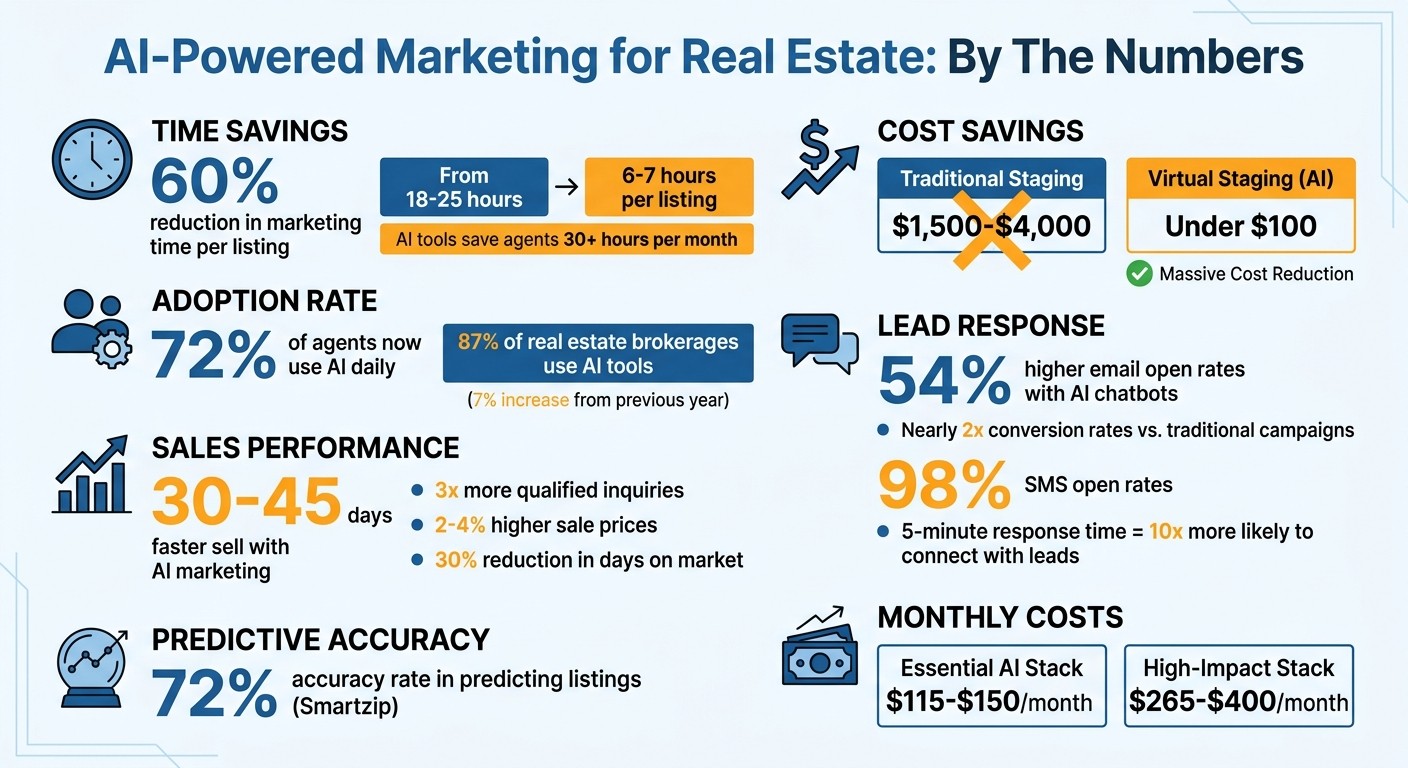
AI Marketing Impact on Real Estate: Key Statistics and ROI
7 Best AI Tools for Real Estate Agents (2026)
Building Your AI Marketing Foundation
Start by identifying where you're losing the most time. Whether it's photo editing, crafting property descriptions, or following up with leads, pinpointing these bottlenecks will guide you in selecting tools that address actual challenges instead of just adding clutter to your tech stack. The goal? Save time now while laying the groundwork for future growth.
Selecting AI Tools for Real Estate
Top-performing agents typically rely on 2–4 specialized tools rather than an all-in-one platform [3]. Think of it like assembling a dream team, with each tool excelling in a specific area. For instance:
Lead Capture: Tools like Perspective AI replace static contact forms with conversational systems that qualify prospects in real time, gauging intent and budget.
Lead Nurture: Platforms such as Ylopo and Structurely automate SMS and email follow-ups, keeping leads engaged without constant manual input.
Listing Prep: Tools like RealEstage.ai handle virtual staging and photo touch-ups, while ChatGPT Plus creates property descriptions tailored to your tone.
When deciding on tools, consider whether to go with real estate-specific options or more general-purpose AI. Vertical tools like Lofty or CINC are designed for real estate and understand MLS data, CMAs, and industry nuances, making them reliable for property-specific tasks. On the other hand, generic tools like ChatGPT are versatile but often need more precise guidance. Address your most pressing issue first - whether it's slow lead response or high staging costs - and build from there.
Workflow Stage | Example Tools | Monthly Cost Range | Primary Function |
|---|---|---|---|
Lead Capture | Perspective AI, Tidio | $50–$150 | Conversational intake, replacing static forms |
Lead Nurture | Ylopo, Structurely, CINC | $200–$400 | AI texting, voice nurture, automated follow-up |
Listing Prep | RealEstage.ai, REimagineHome, ChatGPT Plus | $20–$100 | Virtual staging, photo enhancement, listing copy |
Predictive Analytics | $1,000+ | Identifying likely sellers in farm areas | |
Transaction/CRM | Follow Up Boss, Lofty, Wise Agent | $58–$450 | Lead scoring, task automation, deal management |
For most agents, an Essential AI Stack costs around $115–$150 per month, covering tools for virtual staging, content creation, and social media scheduling. For those with higher volumes, a High-Impact Stack priced at $265–$400 per month adds advanced features like AI photo editing, lead scoring, and chatbots. Choose the stack that aligns with your business size and goals, and ensure that all tools integrate seamlessly with your CRM.
Connecting AI with Your Current Marketing Systems
Your CRM should act as your central hub - every AI tool you use should feed data back into it. This setup keeps your information organized and ensures better lead tracking and campaign analysis. Before connecting tools, standardize your data fields (e.g., zip codes, budgets, lead sources) to avoid compatibility issues.
For tools that don’t integrate directly, middleware like Zapier or Make.com can bridge the gap. For example, you can automate workflows where leads from your website chatbot are added to your CRM and receive an SMS acknowledgment with a booking link. A two-way sync ensures that when a lead revisits your site or saves a property search, your CRM updates automatically and triggers the appropriate follow-up.
Roll out AI tools in phases. Start with visual marketing tools, move to lead capture, and then expand to nurture and reporting systems. This phased approach helps you build a system that works seamlessly.
Training AI to Match Your Brand Voice
To make AI-generated content feel like your own, train your tools using examples of your best work. Most platforms offer pre-set tones like Professional, Engaging, or Luxury-focused, but for a closer match, upload samples of your top-performing content. Tools like Claude and ChatGPT can analyze these examples to better replicate your tone.
When creating content, provide detailed prompts that include property specifics, target buyer profiles, key selling points, and the desired tone. For instance: "Write a description for a 3-bedroom colonial in Westwood targeting growing families. Highlight the updated kitchen, spacious backyard, and proximity to top-rated schools. Tone: professional but warm." The more precise your input, the better the output.
While AI can speed up content creation, it can't replace local expertise. Always review and tweak drafts to include unique details, like a new coffee shop nearby or a neighborhood event. This step also ensures compliance with rules, such as disclosing virtually staged photos per NAR and MLS guidelines. Keeping the human touch is crucial for building trust and showcasing your local knowledge.
"AI is a tool - not a replacement - and when used properly, it can enhance your business without taking away the human touch that real estate requires."
Carrie Little, Designated Managing Broker, CarMarc Realty Group LLC [6]
For visual branding, tools like Canva's Brand Kit allow you to upload your logo, set brand colors, and pick fonts. This ensures your flyers, social media posts, and emails maintain a consistent look, freeing you to focus on the personal connections that close deals.
Putting AI Marketing Strategies into Action
Once you've established a solid foundation, it's time to put AI to work in areas that deliver the quickest results: lead generation, property listings, and customer communication. These are the core tasks that dominate an agent’s daily workload, and automating them not only saves time but also improves outcomes. With the right strategies, AI can help you capture leads faster, create more engaging property listings, and streamline how you interact with clients.
Automating Lead Generation and Scoring
AI doesn’t just gather leads - it pinpoints the ones most likely to take action. By analyzing data like ownership duration, mortgage details, and local trends, predictive tools such as Smartzip and Offrs can spot "likely sellers" up to a year before they list. For example, Smartzip’s algorithm boasts a 72% accuracy rate in predicting listings. Behavioral lead scoring platforms like Fello ($165/month) and Follow Up Boss assess engagement metrics - such as email opens and saved searches - to highlight high-priority leads buried in your CRM [7][9].
Quick follow-ups are essential. Responding within five minutes can significantly improve appointment rates. AI chatbots, like those offered by Structurely and Ylopo, engage leads immediately, asking key questions about budget, location, and timeline. These bots have been shown to deliver 54% higher open rates and nearly double the conversion rates compared to traditional campaigns [2][8].
To refine geographic targeting, consider using AI-powered quizzes like Marquiz (starting at $19/month). For instance, a "Calculate Your Home Value" quiz can collect both contact information and property details, replacing static forms that typically convert at just 2–4% [3][10]. Once leads are in your system, automated SMS triggers can engage them quickly. Asking simple questions like "Are you looking for a 3- or 4-bedroom home?" often prompts faster responses [2].
Creating Property Listings with AI
Once you’ve captured and scored your leads, the next step is crafting property listings that grab attention. Start with professional photography - AI tools rely on high-quality inputs to deliver strong results. From there, platforms like RealEstage.ai ($79/month) can handle virtual staging, photo enhancements, and batch processing, ensuring a polished and consistent look across all images [1].
For property descriptions, tools like ChatGPT Plus or Claude Pro ($20/month) can generate MLS-ready copy in seconds. By providing structured prompts that include key details like bed/bath counts, standout features (e.g., "quartz countertops" or "top-rated schools"), and the desired tone, you’ll get a draft that serves as a strong starting point. Add a local touch by mentioning nearby amenities, like a popular coffee shop or community events.
Virtual staging is another cost-effective option, typically priced under $100 per property compared to the $1,500–$4,000 monthly cost of physical staging [4].
"Virtual staging turns empty spaces into environments that people can actually imagine themselves in." - Ryan Serhant, CEO of SERHANT [5]
Just be sure to label these images as "virtually staged" to comply with NAR and MLS guidelines [1][4].
Don’t stop at the listing. Repurpose your content across multiple platforms. AI tools can transform a single photoshoot into a week’s worth of social media posts, including kitchen spotlights, neighborhood features, and before-and-after staging comparisons. Scheduling tools like Buffer or Hootsuite ($15–$50/month) ensure these posts go live during peak engagement times, while Canva’s Brand Kit keeps your branding consistent [1].
Automating Customer Communication
AI expands your availability by ensuring 24/7 communication through SMS, email, and chatbots [2]. Speed matters: agents who wait an hour to contact a new lead are 10 times less likely to connect and 6 times less likely to qualify them [5]. Chatbots like Structurely ($149–$499/month) and Ylopo eliminate this delay, instantly engaging prospects and collecting essential details [2].
For nurturing leads, segment them based on behavior and automate personalized email sequences. For instance, if someone repeatedly views waterfront properties, enroll them in a "waterfront digest" campaign [2]. SMS marketing is even more effective, boasting open rates near 98%. Tools like SlickText or Agent Legend can handle appointment reminders, new listing alerts, and follow-ups with ease [5].
AI-powered CRMs, such as Follow Up Boss ($50–$150/month) and kvCORE, monitor leads in real time, flagging those who show renewed interest. For example, if a lead revisits your site or opens multiple emails, the system can alert you to reach out personally. Including scheduling links, like Calendly, in your initial messages simplifies the process of booking showings [2].
After closing, automate review requests with tools like RealSatisfied. Sending branded surveys immediately post-close - when client satisfaction is at its peak - can help you gather testimonials. This matters because 74% of consumers consult at least two review sites before making a real estate decision [5]. Platforms like REsimpli save users over 30 hours per month through automation, freeing up time for tasks like in-person consultations and negotiations [5].
"Conversational engagement has been nothing short of transformative for us at Housing. It's reshaped how our audience discovers properties and has nearly doubled our conversions." - Kritika Rehan, Product Manager, Housing.com [8]
Using AI for Market Analysis and Predictions
Getting the price right can mean the difference between a quick sale and a property that sits on the market. AI tools dive into a wealth of market indicators - like historical sales data, neighborhood patterns, interest rates, and property specifics - to create pricing recommendations that go well beyond traditional market analyses. These tools don’t just look at recent sales; they predict market trends and identify periods of peak demand.
AI also helps uncover opportunities before they’re obvious. Predictive analytics platforms monitor factors such as ownership length, mortgage details, and life events to pinpoint homeowners who are likely to list their properties within the next 6 to 12 months. For commercial real estate, these tools track loan maturity dates, lease renewals, and zoning changes to identify off-market deals. This approach, often called "predictive farming", allows agents to focus their marketing efforts on the top 20% of potential sellers [9]. These insights pave the way for more targeted strategies in pricing and market opportunity identification.
Setting Prices with Predictive Analytics
Automated Valuation Models (AVMs) make it easy to generate competitive price ranges by pulling data from multiple sources. For example, HouseCanary ($19/month) enables agents to query 136 million properties using plain language, providing instant valuations and market forecasts [9][13]. Similarly, Smartzip ($500/month) achieved a 72% accuracy rate in predicting listings last year, helping agents set prices based on actual market trends rather than intuition [9].
When using these tools, pay attention to their confidence scores to gauge the reliability of each prediction. Use the suggested price ranges as a starting point, but adjust for elements AI can’t quantify, such as a seller’s motivation, emotional ties to the property, or unique features. Tools like Reonomy add another layer of insight with a "Likelihood to Sell" score, ranking properties based on their probability of being sold. This helps agents prioritize their outreach efforts [13].
AI also supports ongoing pricing adjustments. "Price-cut intelligence" features monitor real-time market shifts and flag listings that may be going stale. These insights can guide you in recommending price changes to sellers, backed by data that makes those conversations smoother [1]. Beyond pricing, AI tools are equally effective in uncovering untapped market opportunities.
Finding Market Opportunities with AI
AI doesn’t just refine pricing - it also identifies new opportunities in the market. Predictive lead scoring takes things further than basic demographic data. Platforms like Offrs ($399–$999/month) and Leadflow ($99/month) analyze factors such as ownership duration, mortgage conditions, and local trends to highlight motivated sellers before they even reach out to an agent [10]. For commercial properties, Catalyze AI ($60–$80/month) specializes in tracking signals like loan maturities and lease expirations, which often indicate readiness to transact [10].
For distressed properties, AI tools rank leads by urgency, monitoring indicators like tax liens, pre-foreclosure statuses, and absentee ownership [10]. This allows agents to focus their efforts on leads with the highest potential for conversion, rather than wasting time on cold prospects. Some platforms also keep an eye on competitor activity - tracking listing updates and ad campaigns to spot pricing gaps and underserved segments in the market. Meanwhile, AI assistants like Sidekick and Rechat can pull MLS data and generate Comparative Market Analyses instantly, making client presentations more efficient [9][11].
These tools streamline workflows and enhance broader AI-driven marketing efforts. It’s no surprise that over 87% of real estate brokerages now use AI tools - a 7% increase from the previous year - showing how quickly this technology is becoming a standard part of the industry [12].
Tracking Performance and Improving Campaigns
AI takes the guesswork out of marketing by automating processes and delivering insights that directly impact your bottom line. Instead of manually sifting through data, AI pinpoints areas for improvement and provides actionable recommendations. Here’s a closer look at the metrics that fuel these advancements.
Key Metrics to Track
One critical metric to monitor is speed-to-lead - the time it takes to respond to new inquiries. Aiming for a median response time of under two minutes can significantly increase contact and appointment rates [2]. AI can help by automating instant SMS or email responses, ensuring you hit this target effortlessly. Beyond response speed, keep an eye on Cost-Per-Lead (CPL) and Cost-Per-Acquisition (CPA) to identify which marketing channels deliver the best returns. AI enhances this process by scoring leads - categorizing them as hot, warm, or cold - based on behaviors like email opens, website activity, and saved searches [7].
Engagement metrics are equally important. Track click-through rates on listing alerts and SMS reply rates to gauge customer interest. On the sales side, focus on contact-to-appointment rates, pipeline velocity (how quickly leads progress from initial contact to closing), and days on market. AI-optimized listings have been shown to reduce days on market by 30% and increase final sale prices by 2-4% [1].
These metrics not only provide a snapshot of current performance but also lay the groundwork for AI-driven refinements in your campaigns.
Using Data to Improve Future Campaigns
Once you’ve established an AI-powered foundation, leveraging data becomes the key to fine-tuning your marketing strategies. AI tools can analyze showing feedback, identifying recurring themes such as pricing objections or layout concerns. This allows you to adjust your approach before a listing loses momentum [4]. For digital ads, AI automates A/B testing, reallocating budgets to high-performing headlines and creatives while sidelining those that underperform - ensuring your advertising dollars are spent wisely [1].
Don’t let campaigns stagnate. Conduct monthly reviews and refresh strategies quarterly to avoid fatigue [2]. Set up automated alerts to flag issues like slower response times, rising CPL, or declining conversion rates. Consolidate data from MLS views, social media reach, and web traffic into branded weekly reports. These reports not only guide your strategy but also bolster seller confidence and encourage referrals [4]. As AI tools gather more data over time, their recommendations become sharper and more effective, creating a self-improving system that keeps your campaigns ahead of the curve.
Conclusion
In today’s real estate market, leveraging AI tools isn’t just an option - it’s a necessity. With 72% of agents already incorporating at least one AI-powered tool into their daily routines, the real question is how quickly you can integrate these systems into your own operations to stay ahead of the curve[3]. Those who embrace AI are gaining a growing advantage, refining their processes with every listing, lead, and campaign.
The results speak volumes. Agents using AI have slashed marketing time from 18 hours per listing to just 6–7 hours - a 60% reduction that allows more time for pivotal tasks like negotiations and relationship building[1]. Listings enhanced with AI sell 30% faster and often fetch 2–4% higher sale prices. On top of that, virtual staging with AI costs under $100, a fraction of the $2,000–$5,000 price tag for traditional staging methods[1,5].
To begin, focus on the changes that will deliver the biggest impact. Start with AI-powered virtual staging to boost the visual appeal of your listings. Then, incorporate automated lead response systems to ensure every inquiry is addressed within the crucial five-minute window[5]. Build your AI marketing stack thoughtfully, selecting tools that solve specific challenges rather than opting for an all-in-one AI platform that may fall short in execution[3]. This step-by-step approach creates a smarter, more efficient marketing system over time.
AI’s real strength lies in its ability to systematize. The data collected by these tools doesn’t just automate tasks - it enhances your campaigns, sharpens lead scoring, and makes your listings more compelling with every iteration.
"Virtual staging turns empty spaces into environments that people can actually imagine themselves in"[5].
Ryan Serhant, CEO of SERHANT
Looking ahead, the agents thriving in 2026 won’t be those working harder - they’ll be those working smarter. By combining scalable AI systems with your expertise, local insights, and personal touch, you’ll position yourself to close more deals and build a business that outpaces the competition.
FAQs
Which AI tools should I start with first?
For those just starting out in real estate marketing, it's best to begin with AI tools that are simple to use and deliver immediate benefits. Tools like ChatGPT, Gamma, or Copy.ai can assist with crafting content and brainstorming marketing strategies. If lead generation is your focus, platforms such as Ylopo or Structurely are great for automating outreach through SMS and voice communication. These tools simplify tasks like creating engaging content and nurturing leads, giving you a strong starting point to build on as you gain confidence with AI-powered solutions.
How do I connect AI tools to my CRM safely?
To integrate AI tools with your CRM securely, always rely on official APIs or supported connectors. These methods ensure a safe connection and reduce the risk of unauthorized access. Use encryption to protect sensitive data during transfers, and establish strict access controls to determine who can view or modify information. It's also essential to review your CRM's data policies and compliance guidelines to identify and address potential vulnerabilities. Many AI tools come with built-in security features - configure these thoughtfully to keep client information well-protected.
How do I stay compliant with AI and virtual staging?
To navigate compliance when using AI and virtual staging in real estate, prioritize transparency and adhere to industry guidelines. Clearly disclose to clients when AI or virtual staging has been used to present a property, ensuring there’s no risk of misrepresentation. Make sure the virtual staging accurately portrays the property’s current condition without creating unrealistic expectations for buyers. Stay aligned with local advertising regulations and follow established best practices to uphold trust and safeguard consumer confidence.
Related Blog Posts

Zach Chmael
CMO, Averi
"We built Averi around the exact workflow we've used to scale our web traffic over 6000% in the last 6 months."
Your content should be working harder.
Averi's content engine builds Google entity authority, drives AI citations, and scales your visibility so you can get more customers.