How to Use AI-Powered Marketing for Hospitality & Travel

Averi Academy
Averi Team
8 minutes

In This Article
Use AI to personalize guest journeys, automate pricing and service, and increase direct bookings and revenue for hotels and travel brands.
Updated:
Trusted by 1,000+ teams
Startups use Averi to build
content engines that rank.
AI-powered marketing is transforming hospitality and travel by enabling businesses to deliver precise, personalized experiences while optimizing costs and boosting revenue. Here's how it works:
Personalization at Scale: AI analyzes customer data like booking history and browsing behavior to create tailored campaigns and experiences, turning one-time transactions into repeat engagements.
Efficiency and Cost Savings: Automation tools handle tasks like dynamic pricing, customer segmentation, and chatbot support, reducing manual effort and operational costs.
Revenue Growth: Predictive analytics and targeted campaigns help drive direct bookings, upsells, and loyalty program engagement, improving overall profitability.
Key Benefits:
Dynamic Pricing: Adjust rates in real-time based on demand, competitor activity, and local events.
Customer Engagement: AI chatbots and virtual assistants provide 24/7 support, managing inquiries and reservations while saving costs.
Improved Campaigns: AI generates and optimizes content, targeting specific audience segments for higher conversions.
Getting Started:
Consolidate guest data from systems like PMS and CRM into unified profiles.
Use AI to segment audiences and predict behaviors.
Automate campaigns and personalize guest interactions.
Monitor metrics like direct booking rates and refine strategies with AI insights.
AI tools are helping businesses like Choice Hotels save millions and increase direct bookings, proving their value in a competitive market. Start small with a 90-day pilot program to test these strategies and measure ROI before scaling up.
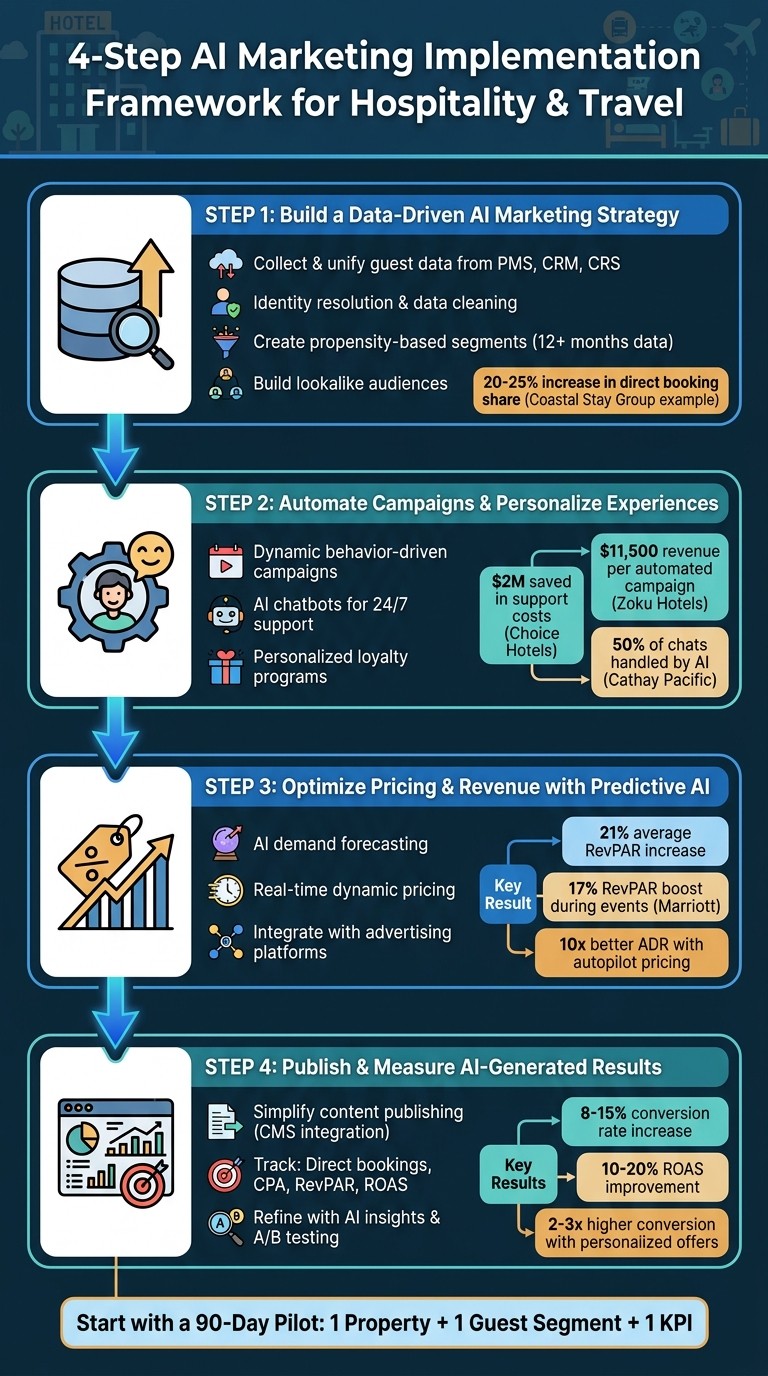
4-Step AI Marketing Implementation Framework for Hospitality
Step 1: Build a Data-Driven AI Marketing Strategy
Collect and Analyze Customer Data
The backbone of any AI-driven marketing approach lies in gathering and organizing guest data from multiple sources - your PMS, CRS, CRM/CDP, channel managers, web analytics, and booking engines - into a single, cohesive view. This unified data provides the clarity needed for effective decision-making.
A critical part of this process is identity resolution, where fragmented data is linked to create complete guest profiles. Take steps like standardizing room type names and rate plan descriptions while deduplicating records to ensure your AI operates with accurate and trustworthy information. With these clean guest profiles in place, you set the stage for sharp audience segmentation.
Identify Audience Segments and Preferences
Once your data is clean and unified, the next step is to divide your audience into meaningful segments that can predict guest behaviors. Relying on static email lists is now outdated. Instead, use AI to build propensity-based segments that forecast actions such as whether a guest is more likely to book directly or through an OTA, their chances of purchasing spa or dining upgrades, or their likelihood of becoming repeat customers. To capture seasonal trends and shifting preferences, train these models using at least 12 months of booking data.
Your most loyal guests can also help you widen your reach. For example, take your CRM email lists and create lookalike audiences on advertising platforms to identify high-potential travelers who share traits with your best customers. Dive deeper into segmentation by considering traveler types (e.g., business, family, or bleisure), booking windows, stay frequency, and responsiveness to offers. A real-world example comes from the Coastal Stay Group, a small hotel chain that implemented this strategy over 2025 and 2026. By combining clean CDP data with propensity-based segments, they achieved a 20–25% increase in direct booking share for promoted weekends and lowered their cost per acquisition by 18% on paid search campaigns over nine months.
Use AI to Generate Content Strategies
With your data streamlined and audience segments identified, AI can take the lead on content creation and planning. Adopt a "Human Strategy + AI Execution" approach: define your brand pillars, guest segments, and key performance indicators in a concise brief, and let AI handle the heavy lifting of creating content variations. This could include landing pages, email subject lines, and social media posts tailored to each segment.
Start small with a 90-day pilot focused on a single property, guest segment (e.g., weekend leisure travelers), and a specific KPI to measure ROI. Ensure brand consistency by setting up human checkpoints where all AI-generated content is reviewed before publishing. Align your content with the customer’s booking journey - use visually engaging stories to build awareness, destination guides for consideration, and urgency-driven messages (like limited availability) to drive conversions. This automated content strategy integrates seamlessly with dynamic campaigns, delivering personalized guest experiences across multiple channels.
Step 2: Automate Campaigns and Personalize Guest Experiences
Create Dynamic and Targeted Campaigns
AI simplifies campaign management by segmenting guests based on their behavior, demographics, spending habits, and travel intentions. Automation tools enable real-time, behavior-driven campaigns, such as re-engagement offers, price-drop alerts for abandoned bookings, or upsell opportunities for guests likely to book direct. These tools ensure you’re always targeting the right audience at the right time.
Marketing automation platforms can also generate tailored email content, ad copy, and social media posts at scale. Human editors then refine these materials to maintain brand consistency. For instance, Zoku Hotels utilized AI-driven campaigns to deliver personalized upsells and cross-sells, generating an impressive $11,500 in revenue per automated campaign [8]. Trigger workflows can be set up to respond to specific guest actions, such as browsing a particular room type, clicking on a spa package, or reaching a new loyalty tier. This level of automation extends naturally to guest interactions through AI-powered chatbots.
Use AI-Driven Chatbots and Digital Concierges
AI chatbots and virtual assistants are game changers for handling routine guest inquiries around the clock. From check-in details and Wi-Fi passwords to baggage tracking and local dining recommendations, these tools provide instant support. They can also manage reservations, loyalty rewards, and suggest relevant upsells, such as pet services when a guest mentions traveling with their dog.
For example, Choice Hotels adopted Capacity’s Intelligent Virtual Assistant (IVA) over an 8-month period, saving nearly $2M in support costs. The implementation reduced live agent escalations from 7.6% to 2.6% and successfully rerouted 97.4% of calls [1]. Similarly, Cathay Pacific introduced AI chatbots that now handle 50% of customer care chats while maintaining high service standards [7]. Multilingual capabilities in these systems further enhance guest experiences, with multilingual chatbots boosting in-room service revenue by over 20% [7]. These real-time, personalized interactions also pave the way for more engaging loyalty programs.
Improve Loyalty Programs with AI
AI takes loyalty programs beyond static point systems, creating adaptable, experience-focused rewards tailored to each guest's preferences and behaviors. Instead of offering generic discounts, AI analyzes historical data - such as preferred locations, stay durations, and spending patterns - to deliver personalized offers and exclusive upgrades.
The Arca leveraged AI to anticipate guest preferences, such as pillow choices, storing this data in unified profiles. This approach led to $200K in lifetime revenue from increased guest loyalty [8]. AI-driven systems continuously learn from guest interactions, refining rewards to better match individual needs. This personalized approach enhances satisfaction and encourages repeat bookings. Data supports this shift: 71% of customers now expect businesses to provide personalized attention, and 40% of revenue for the fastest-growing companies comes from personalized campaigns [1].
Step 3: Optimize Pricing and Revenue with Predictive AI
AI for Demand Forecasting
Predictive AI uses historical data, seasonal trends, and external factors like local events or weather to anticipate demand weeks or even months in advance. This allows businesses to adjust staffing, inventory, and marketing budgets ahead of time instead of scrambling to react. AI can also pick up on subtle warning signs, such as a decline in website activity or slower booking trends, making it possible to deploy promotions before revenue dips [10].
Hotels leveraging AI-driven pricing optimization have reported an average RevPAR increase of 21% [9]. By pinpointing peak and off-peak periods, managers can cut operational costs and maximize earnings during high-demand times. However, the accuracy of these forecasts depends heavily on the quality of the data. Ensure your data includes multiple dimensions (such as search volume and lead times), is up-to-date, accurate, and free from bias [9].
Dynamic Pricing Strategies
Dynamic pricing, powered by AI, tracks demand changes, competitor rates, and local events in real time to adjust prices instantly [10]. These systems rely on machine learning to analyze the outcomes of accepted or declined price recommendations, refining their accuracy over time. While AI handles tactical adjustments, human oversight is crucial to set strategic boundaries.
For example, Tempe Hotel in Sydney used Lighthouse's Pricing Optimization tool to adopt a smarter pricing strategy, doubling their revenue while boosting occupancy by nearly 50 percentage points [9]. Similarly, Marriott International implemented an AI-powered dynamic pricing system during a global sporting event in 2023. By combining real-time booking data with local traffic trends, they achieved a 17% increase in RevPAR [11]. Hotels using "Autopilot" features to automate price recommendations have seen ADR improvements up to 10 times greater than those relying on manual adjustments [9].
"In hotels, we manage different systems with different sources of information. So, it's interesting to see how AI can collect the different pieces of information, put them together, and give us a solution." - Jose Miguel Moreno, Vice President Corporate & MICE Sales, Meliá Hotels International [10]
Transparency is key when implementing dynamic pricing. Clearly communicate why prices fluctuate - whether due to limited availability or event-driven demand - to maintain guest trust and avoid frustration [11] [12]. AI can also help monitor pricing across channels like OTAs, direct bookings, and third-party sites to identify and resolve "rate leaks", which can confuse guests and hurt direct bookings [10]. This adaptability in pricing lays a strong foundation for incorporating AI into advertising strategies.
Integrate AI with Advertising Platforms
AI's capabilities extend beyond pricing to optimizing ad spend. By automating audience segmentation and campaign adjustments, predictive models can identify high-value customer segments and tailor offers to them, reducing CPA and increasing RevPAR [3]. This approach also helps measure the true impact of marketing investments [2] [6] [3].
Platforms such as Averi combine industry data with campaign insights to manage and optimize full-funnel strategies [4]. Similarly, Persado uses AI to craft emotionally resonant ad copy that improves digital conversion rates, while Pathmatics provides competitive intelligence by analyzing ad spend and creative trends in the travel sector [4].
Start small by testing AI-driven advertising on specific properties or customer segments to build confidence before scaling up [11] [3]. The momentum is undeniable: 92% of hospitality businesses plan to expand their AI investments, with the global AI market in the industry projected to hit $70.32 billion by 2031 [1].
Step 4: Publish and Measure AI-Generated Marketing Results
Simplify Content Publishing
Publishing content generated by AI doesn't have to be a complicated process. Tools like Averi make it easier for hospitality brands by enabling direct integration with CMS platforms such as Webflow, WordPress, or Framer. This eliminates the need for manual formatting and speeds up the publishing process. The approach follows an "AI-execution, human-strategy" model, where AI drafts content and places it in an editor queue for human review before it goes live. Interestingly, while 78% of B2B marketers use AI for task execution, only 6% depend on it for core positioning[3].
Hospitality businesses can use AI to scale creative efforts across various formats. These include customized landing pages, ad headlines, email subject lines, SMS flows, and OTA-optimized property descriptions. To maintain a cohesive brand voice, it's essential to rely on a clear Brand & Campaign Brief that ensures all AI-generated content aligns with your brand's identity. Automating tasks like booking abandonment recovery, price-drop notifications, and loyalty reactivation frees up your team to focus on strategic priorities. Once the content is live, the next step is to monitor the metrics that impact revenue.
Track Performance Metrics
After publishing, tracking the right metrics is essential to evaluate the effectiveness of your AI-driven campaigns. Focus on direct booking rates, CPA, incremental RevPAR, and creative win rates to gauge success[3]. AI-powered personalization can increase conversion rates by 8% to 15%, while AI-optimized ad spend can improve Return on Ad Spend (ROAS) by 10% to 20%[13]. Additionally, using AI can lower customer acquisition costs (CAC) by up to 20%[13].
Keep an eye on micro-conversions, such as price-watch signups, to assess the overall health of your funnel. Implement holdout experiments with randomized cohorts over a 30–90 day period to measure the true incremental lift of AI-driven campaigns[5].
Improve Campaigns with AI Insights
AI doesn't stop at executing campaigns - it also learns from them. Feeding performance data back into AI models allows for refined targeting and improved creative outputs[5]. Brands that leverage this data to align intent signals with personalized offers can achieve conversion rates that are 2× to 3× higher than batch campaigns[5]. Regular updates are crucial; retraining AI models monthly with fresh booking data helps account for changing traveler behaviors and seasonal trends[3].
For better results, create 5–10 AI-generated variants for each asset and deploy the top two, measuring their impact on direct booking rates and CPA[3]. Start small with a 90-day pilot, focusing on a single property, one guest segment, and one KPI - such as the percentage of direct bookings for weekend stays - to demonstrate ROI before scaling up[3].
"Marketing teams that embrace this performance mindset are emerging as strategic growth drivers rather than cost centers." – Julie Hoffmann, Entrepreneurial Executive at Adobe[2].
With 92% of companies planning to increase their AI investments, the momentum behind these tools is undeniable[1].
Conclusion
Summary of Main Benefits
AI-driven marketing is reshaping the hospitality industry by delivering tailored experiences, improving efficiency, and driving revenue growth. By analyzing browsing habits, previous stays, and guest preferences, AI crafts personalized itineraries and promotions that align with the growing demand for individualized travel experiences - 78% of travelers are more likely to book accommodations offering such customization[15]. Automation tools streamline routine operations, such as check-ins and inventory management, allowing staff to focus on meaningful guest interactions. Dynamic pricing systems adjust rates in real-time based on demand and competitor activity, helping to optimize both RevPAR and occupancy rates[14][15]. Brands that align intent signals with personalized offers report conversion rates 2–3 times higher than those relying on traditional batch campaigns[5].
The financial impact of AI adoption is clear. For example, in January 2026, Choice Hotels saved nearly $2 million in support costs within eight months by employing an Intelligent Virtual Assistant, which reduced live agent escalations from 7.6% to 2.6%[1]. Over 70% of hotel executives are prioritizing AI investments as of 2025, while 92% of hospitality companies plan to expand their AI budgets in the near future[14][1]. The global AI market in hospitality is expected to reach $20.47 billion by 2025, with an annual growth rate of 30.5%[14].
How to Get Started
These benefits make it easier than ever to start testing AI solutions with a focused, low-risk approach. A 90-day pilot program is an excellent starting point: choose one property, one guest segment, and one KPI - such as increasing the percentage of direct bookings for weekend stays - to measure ROI before scaling further[3]. To ensure accuracy and effectiveness, integrate your property management system (PMS), customer relationship management (CRM) platform, and booking engine for seamless data sharing[3]. Develop a Brand & Campaign Brief that outlines your brand values and guest profiles, serving as a central reference for AI prompts and human reviewers[3].
Leverage tools like Averi to speed up execution. Averi blends the efficiency of AI with human oversight, enabling you to launch your first campaign in under a week. It manages content creation, publishing to CMS platforms like Webflow and WordPress, and performance tracking - all while maintaining human approval processes to ensure brand consistency. Start by automating essential workflows, such as price-watch alerts, pre-trip upsell offers, and post-trip reactivation campaigns[5].
While AI handles repetitive tasks, humans remain essential for guiding brand strategy and positioning. As Julie Hoffmann, Global Executive Advisor at Adobe, emphasizes:
"The solution is not simply more automation, but better orchestration by embedding quality controls, traveler feedback loops, and cross-functional accountability into AI workflows so that efficiency gains can translate into sustained competitive advantage"[2].
The real opportunity lies in striking the right balance: letting AI take care of the heavy lifting while your team focuses on delivering meaningful, strategic value.
Hotels Will Never Be the Same Again | AI in Hospitality | Travel Tech Trends | Anurag Jain
FAQs
What data is needed to start AI marketing at my hotel?
To kick off AI-driven marketing for your hotel, start by collecting essential data such as customer preferences, booking histories, loyalty program details, and behavioral trends. This information allows AI tools to craft personalized campaigns, refine targeting, and enhance overall marketing performance. Pay close attention to customer interactions and booking patterns, as these insights are crucial for designing customized experiences that can fuel growth. Prioritize gathering detailed, actionable data to fully leverage AI's capabilities in your marketing approach.
How do I run a 90-day AI marketing pilot and prove ROI?
To launch a 90-day AI marketing pilot and showcase ROI, begin by defining specific goals such as boosting bookings or cutting costs. Implement AI-powered strategies like automated workflows or tailored content, and measure success using metrics such as conversion rates or customer satisfaction. Continuously track performance, refine your approach, and evaluate outcomes to highlight achievements like improved engagement or reduced expenses, ensuring they align with your original objectives.
How can I use AI without hurting guest trust or my brand voice?
To integrate AI effectively while safeguarding guest trust and staying true to your brand voice, use AI as a tool for execution rather than a substitute for your strategic direction. AI excels at tasks such as content creation, customer segmentation, and automation, but it's crucial to keep human oversight in place for branding and messaging. This ensures your communication remains authentic. By combining AI's efficiency with human-led branding, you can maintain trust and ensure your voice stays consistent and genuine.
Related Blog Posts

Zach Chmael
CMO, Averi
"We built Averi around the exact workflow we've used to scale our web traffic over 6000% in the last 6 months."
Your content should be working harder.
Averi's content engine builds Google entity authority, drives AI citations, and scales your visibility so you can get more customers.