

In This Article
Use AI-driven segmentation, predictive analytics, multi-channel automation, and real-time personalization to boost app acquisition, engagement, and retention.
Updated:
Trusted by 1,000+ teams
Startups use Averi to build
content engines that rank.
AI marketing is transforming how consumer apps attract, engage, and retain users. By automating tasks like segmentation, predicting churn, and crafting personalized campaigns, you can deliver tailored experiences at scale without adding to your team size. Here’s a quick breakdown:
Dynamic Segmentation: AI analyzes user behavior in real-time to create evolving user groups for targeted campaigns.
Predictive Analytics: Tools forecast user actions like churn or conversion, enabling proactive strategies.
Multi-Channel Automation: AI ensures consistent messaging across email, SMS, in-app notifications, and more.
Real-Time Personalization: Apps like Netflix and Spotify tailor content dynamically, boosting engagement and retention.
Performance Tracking: AI-powered attribution models identify which touchpoints drive results and recommend optimizations.
With platforms like Braze, HubSpot, and Klaviyo, consumer app teams can implement these strategies to improve user acquisition, engagement, and lifetime value - all without requiring advanced technical skills. Start small by testing AI tools on high-priority campaigns, then scale based on results.
Step 1: Use AI for User Segmentation and Personalization
Create Dynamic User Segments
Traditional user segmentation often relies on broad categories like age, location, or subscription level. But AI takes segmentation to a whole new level, diving into metrics such as session length, feature interactions, and purchase patterns to create real-time segments that evolve with user behavior. Modern Customer Data Platforms (CDPs) equipped with AI can resolve user identities, linking anonymous visitors to detailed profiles and automatically generating predictive segments based on anticipated actions [5][6].
To implement this, integrate a CDP with AI capabilities for identity resolution and predictive modeling. Set up behavior-based triggers, like app launches or purchases, to dynamically create segments for targeted campaigns. Companies leveraging billions of user interactions can fine-tune recommendations with precision. Machine learning models analyze historical campaign data, identify trends, and continuously retrain using fresh data. Real-time decision engines play a crucial role here, recognizing visitors through behavioral patterns and forming segments in mere milliseconds - faster than a webpage can fully load [5]. According to Salesforce, 78% of marketers are expected to rely on AI for decisions like segmentation by 2026, highlighting how integral this approach is becoming [5].
By refining user profiles with this method, businesses can achieve higher engagement levels, especially in consumer-focused apps. Once dynamic segments are in place, AI seamlessly transitions into creating campaigns that speak directly to the unique preferences of each user.
Deliver Personalized Campaigns and Recommendations
With dynamic segmentation as a foundation, AI can craft hyper-personalized campaigns by analyzing user profiles, behaviors, and contexts. This allows businesses to move beyond generic messaging and instead deliver tailored emails, SMS, and push notifications that resonate on an individual level. AI-powered next-best-action recommendations determine the ideal message, channel, and timing to maximize user engagement [5][6].
Platforms like ActiveCampaign use chatbots to design personalized email sequences based on user engagement patterns, while Infobip enables dynamic content creation for emails, SMS, and WhatsApp. These tools adjust creative elements in real time, tailoring them to demographics, location, and even time of day [6][8]. For mobile-first consumer apps, Braze offers features like "Personalized Paths", which adaptively guide users through the most effective journey based on predicted behaviors, such as the likelihood of making a purchase or churning [4].
To ensure success, track metrics like engagement and retention using AI-driven audience insights. These tools highlight trends, detect drop-offs, and flag anomalies, enabling real-time optimization. AI can then test different campaign variations, scaling the most effective ones to deliver measurable results [6].
Step 2: Apply Predictive Analytics to Optimize Campaigns
Score Leads with Predictive Models
Predictive analytics is reshaping how marketers prioritize efforts by assigning scores that reflect a user's likelihood to convert, engage, or churn. Using machine learning algorithms like Logistic Regression, Random Forests, and Neural Networks, these models analyze patterns in behavior - such as product usage frequency, transaction history, and support interactions - to generate actionable scores [10][11]. For example, a churn score of 0.8 indicates an urgent need for intervention [10].
Marketers can combine key metrics like app logins, purchase cycles, and customer sentiment to create detailed risk profiles [9][10]. A study employing a Random Forest classifier demonstrated 95.13% accuracy in predicting churn, with an AUC of 0.89 [11]. Tools such as Pecan AI are particularly useful for consumer apps, as they identify churn and retention drivers using in-depth behavioral data. These tools are especially effective in tracking key retention milestones, such as Day 1, Day 7, and Day 30 [7].
By leveraging predictive scoring, marketers can segment their audience based on both churn risk and Customer Lifetime Value (CLV). This allows them to allocate retention budgets more strategically, focusing on high-value users who are most at risk of leaving [10]. Considering that acquiring a new customer can cost five times more than retaining an existing one, this approach can significantly enhance cost efficiency [10]. Predictive scores also enable automated, real-time actions to mitigate churn risks.
Predict and Prevent User Churn
Once users are scored, AI systems can take immediate action to address those at risk by automating personalized re-engagement campaigns. These platforms monitor early warning signals - such as a drop in app logins, skipped purchase cycles, or an increase in customer service calls - and trigger tailored interventions. For instance, churn propensity often spikes after four or more support calls, signaling the need for immediate attention [10][11].
The stakes are high: U.S. businesses lose an estimated $136.8 billion annually due to preventable churn [9]. Even a modest 5% reduction in churn can lead to a 25%–95% increase in profits [10]. AI tackles both voluntary churn (when users actively choose to leave) and involuntary churn (caused by issues like expired credit cards or technical errors). While automated billing retries can address the latter, personalized offers or feature highlights can help retain users considering leaving [10][12].
Large Language Models (LLMs) now go beyond simple churn probabilities, creating natural-language retention strategies tailored to individual users [12]. Explainable AI (XAI) provides further insights by identifying specific risk factors - for example, high daytime charges or frequent support issues - allowing marketers to implement more precise and effective interventions [11].
Step 3: Automate Multi-Channel Marketing Workflows
Generate and Execute Content with AI
AI marketing platforms streamline the entire content creation process, from planning to publication, eliminating the need for separate tools for research, writing, scheduling, and analytics. Take Klaviyo, for example - it integrates with Shopify to analyze real-time user behaviors and automatically generate personalized email subject lines and SMS copy [14]. This level of automation can cut manual effort by 50–70% for consumer app campaigns targeting user acquisition [13].
Here’s how it works: AI examines app usage patterns and competitor strategies to pinpoint high-value content opportunities. Platforms like HubSpot and Marketo Engage then use this data to recommend content ideas and generate drafts, complete with built-in personalization tokens tailored to specific user segments [13]. For instance, a consumer fitness app could use AI to create workout tips customized for beginners and advanced users alike, scheduling email newsletters and Instagram posts without requiring manual input [14]. Klaviyo users have reported a 30% boost in open rates thanks to behavioral-triggered messaging [14].
Another advantage is maintaining a consistent brand voice across all content types. Modern AI tools can learn and replicate your tone, ensuring emails, social media posts, and in-app messages all align with your brand identity. Predictive intelligence takes this a step further by forecasting trends like seasonal usage spikes or potential churn, enabling proactive content creation rather than reactive campaigns [13].
This seamless content generation naturally integrates into orchestrated, multi-channel marketing efforts.
Manage Campaigns Across Multiple Channels
Once content production is automated, multi-channel orchestration ensures your messaging stays consistent and relevant across platforms like email, social media, and your app. Tools like Customer.io and Braze unify user data and trigger messages based on specific actions [14]. For instance, when a user completes a workout, the system might send a congratulatory email alongside an SMS reminder.
The impact of this approach is substantial. AI-driven multi-channel automation can shorten sales cycles by 25–35% and improve win rates by 40–50%, concentrating efforts on the platforms where users are most engaged [13]. Harley Davidson showcased this potential with Albert.ai, optimizing ad campaigns across channels to achieve a five-fold increase in site traffic and a staggering 2,930% growth in monthly leads through AI-powered testing and demographic targeting [3]. For consumer apps, combining predictive analytics with unified email, SMS, and social campaigns has led to a 30% increase in user engagement compared to single-channel strategies [14].
To get started, prioritize robust data integration - connect your app analytics platform directly to your AI marketing tool. Begin by testing automations on a small scale before rolling them out widely. Platforms like Customer.io rely on event-driven triggers to maintain consistent, ongoing communication with users [4].
Step 4: Personalize User Experiences in Real Time
Customize In-App Content Dynamically
Personalization in real time isn’t just about grouping users into broad categories - it’s about tailoring every interaction to the individual. By analyzing live data like clicks, gestures, or even location, apps can adjust their interface and content instantly to meet unique user needs. This "segment-of-one" approach ensures that features, layouts, and recommendations evolve based on user behavior in milliseconds [15].
The stakes are high: 71% of consumers now expect tailored interactions, and 76% express frustration when brands fail to deliver. Falling short can cost businesses up to 38% of their customers [15]. On the flip side, companies excelling in personalization see impressive results - 40% higher revenue, a 5–8x return on marketing spend, and acquisition costs slashed by up to 50% [15].
Take Netflix, for instance. Its AI-powered recommendation engine doesn’t just suggest what to watch next; it even personalizes thumbnail images for each user. This strategy drives 80% of the platform’s streamed content and saves the company an estimated $1 billion annually by reducing churn [15]. Similarly, Spotify’s 2020 Wrapped campaign captivated over 90 million users, boosting mobile app downloads by 21% [15].
Building a robust personalization strategy for apps involves three key layers: a Customer Data Platform (CDP) to consolidate user data, machine learning models for predictions, and generative AI to create customized content [15]. Carvana’s "Joyride" campaign is a great example - it used generative AI to craft over 1.3 million personalized videos, each featuring the customer’s name and their specific car model [15]. To implement this approach, start by mapping the user journey and pinpointing "aha" moments during onboarding. Real-time prompts at these critical stages can reduce friction and set the tone for a highly personalized experience.
Deploy AI-Powered Chatbots
AI-powered chatbots have evolved far beyond answering basic FAQs. Equipped with natural language processing, these bots understand context and sentiment, guiding users through onboarding, product discovery, and support - all without relying on rigid scripts [15]. They adapt to individual needs, providing instant assistance that can significantly reduce early-stage churn [7].
The shift here is from reactive to proactive engagement. Instead of waiting for users to ask questions, chatbots analyze behavior patterns to anticipate needs. For example, a fitness app might deploy a chatbot that suggests beginner-friendly workouts the moment a new user browses the exercise library. This kind of personalization pays off - customized calls-to-action convert 202% better than generic ones [15].
When rolling out chatbots, focus on areas where users often encounter friction. Build the chatbot on a strong data foundation, as unreliable data can lead to inaccurate responses. Start small by testing conversational flows with limited user groups before scaling up. And don’t forget to design for seamless handoffs to human support when issues become too complex for the bot to handle. By combining real-time content personalization with proactive chatbot guidance, apps can deepen user engagement and retention, while aligning with broader AI-driven marketing strategies.
Step 5: Track Performance and Improve with AI Insights
Attribute Conversions with AI Models
When it comes to consumer apps, relying on last-click attribution often misses the mark. Conversions are rarely the result of a single interaction; instead, they stem from a series of touchpoints. AI-powered attribution models like multi-touch attribution (MTA) and data-driven attribution (DDA) analyze the entire user journey, crediting each touchpoint based on its actual contribution. These models track interactions across channels - whether it’s an email open, a push notification, an in-app event, or an ad click - to pinpoint what truly drives conversions [3][4].
Take Harley Davidson, for example. By using AI attribution, they identified their most effective channels, leading to a staggering 2,930% increase in monthly leads and a fivefold jump in site traffic [3]. For mobile-first apps, tools like Braze's Canvas Flow simplify this process by tracking user journeys in real time and dynamically routing users based on predictive insights. This approach often boosts revenue by 20–30% by accurately assigning credit to impactful touchpoints [2][4].
To implement this, marketers can start by integrating first-party app analytics with AI platforms like HubSpot Marketing Hub or Marketo Engage. This involves collecting multi-channel data through APIs, training models on historical conversions, applying real-time scoring to assess ROI, and visualizing the results through dashboards [2][4]. Armed with these insights, the next move is to let AI guide actionable improvements.
Get AI-Driven Optimization Recommendations
AI doesn’t just stop at attribution - it helps fine-tune your strategy. These tools offer recommendations for refining target segments, tweaking messaging, or reallocating budgets across channels. For instance, platforms like Gumloop’s continuous AI agents automate A/B testing and suggest channel adjustments, while BrazeAI’s Personalized Paths predict user behavior to recommend churn prevention strategies [1][3][4].
The impact of these AI-driven insights is hard to ignore. They can lead to 20–50% higher engagement and significantly improve customer lifetime value (CLTV) and retention by leveraging first-party data [1][3]. To put these recommendations into action, marketers can integrate tools like Marketo Engage or SEMrush for seamless data ingestion. Automated alerts can flag underperforming metrics, enabling quick adjustments - such as reallocating budget to push notifications for users aged 18–24 - before running A/B tests [2]. This not only minimizes manual errors but also ensures your campaigns stay in sync with real user behavior, allowing your marketing strategy to evolve alongside your app's audience.
This App Makes $2M Using AI Ads (Learna App Review)
Compare AI Marketing Tools for Consumer Apps
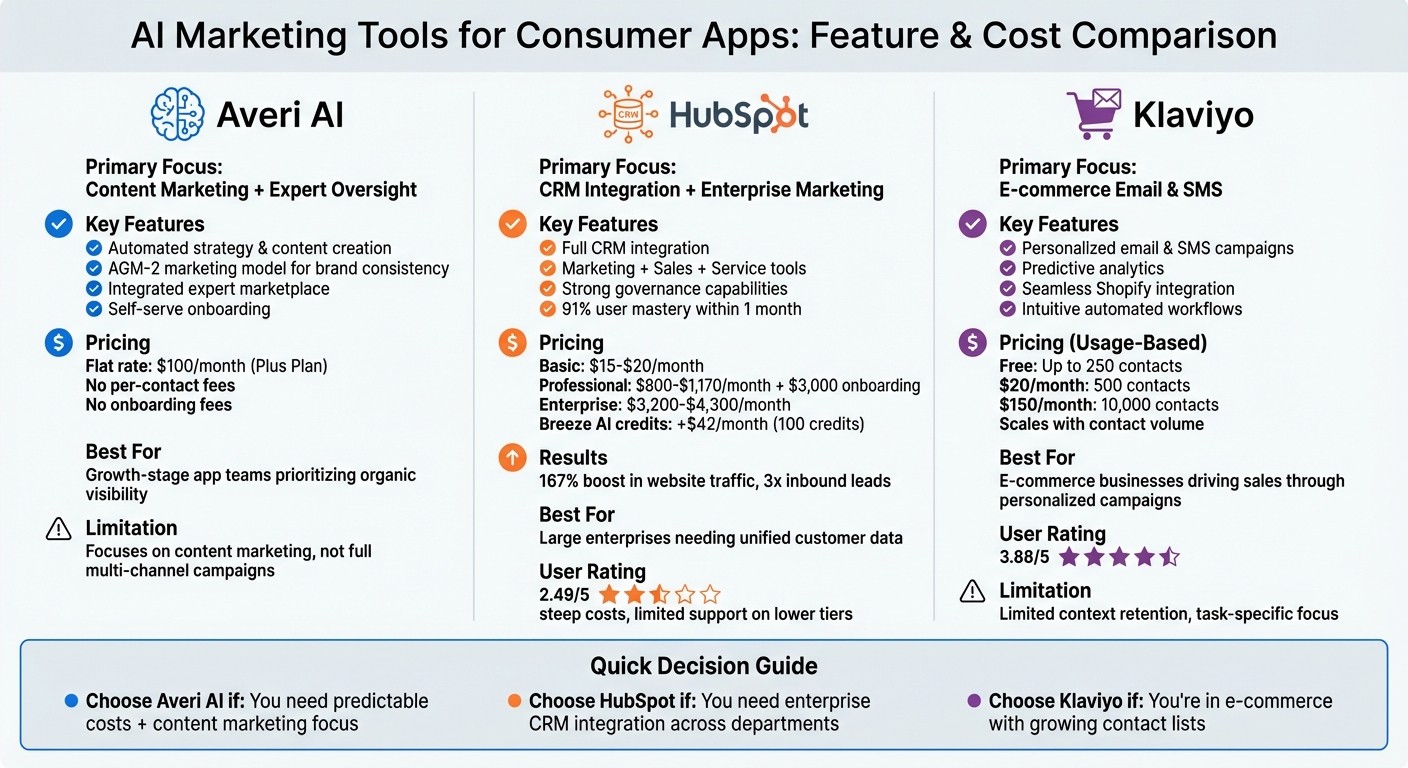
AI Marketing Tools Comparison: Pricing and Features for Consumer Apps
For teams managing consumer apps, selecting the right AI marketing tool can be just as important as deploying the technology itself. With AI's growing role in automating campaigns, let’s take a closer look at some leading tools to see which might best support app growth.
Feature and Cost Comparison
Each AI marketing tool brings its own unique strengths to the table. Averi AI combines automated strategy, content creation, and expert-reviewed publishing into a single workspace. HubSpot, on the other hand, is a CRM-focused platform that integrates marketing automation with sales and service tools, while Klaviyo specializes in e-commerce, offering personalized email and SMS campaigns powered by predictive analytics.
Their pricing structures reflect these differences:
HubSpot: Basic plans start around $15–$20 per month, but advanced options scale quickly. Professional plans cost between $800 and $1,170 monthly, with an onboarding fee of about $3,000. Enterprise tiers range from $3,200 to $4,300 monthly. Advanced AI features, available through Breeze AI credits, add approximately $42 per month for 100 credits.
Klaviyo: Pricing is usage-based, with a free tier for up to 250 contacts. Paid plans start at $20 per month for 500 contacts and climb to about $150 for 10,000 contacts.
Averi AI: Offers a flat $100 monthly Plus Plan, which includes self-serve onboarding without additional fees.
In terms of overall costs, HubSpot’s pricing can spike based on the number of active contacts, users, and additional modules. Klaviyo’s costs grow predictably with contact volume and message frequency, making it ideal for e-commerce but potentially expensive at scale. Averi AI, with its flat rate, provides predictable expenses that include strategy, execution, and publishing - eliminating per-contact fees.
Now, let’s explore the strengths and drawbacks of each tool.
Averi AI vs. Competitors: Pros and Cons
With pricing clarified, it’s time to evaluate how these tools compare in functionality and execution.
Averi AI shines with its combination of AI efficiency and human oversight. Its AGM-2 marketing model ensures long-term brand consistency, with each piece of content building on the last. Additionally, its integrated expert marketplace simplifies execution, eliminating the need to juggle freelancers. However, Averi AI focuses primarily on content marketing rather than full multi-channel campaign management, making it an excellent fit for growth-stage app teams prioritizing organic visibility.
HubSpot is celebrated for its powerful CRM integration and governance capabilities. Impressively, 91% of users report mastering the platform within a month, with marketing teams seeing a 167% boost in website traffic and tripling inbound leads. However, some users rate HubSpot at 2.49 out of 5, citing steep costs and limited support for lower-tier plans. This makes it a strong choice for large enterprises requiring a unified view of customer data across departments but less appealing for smaller teams.
Klaviyo stands out in the e-commerce space, offering intuitive automated workflows and seamless Shopify integration. It earns an average rating of 3.88 out of 5. As Giles Thomas, CEO of Whole Design Studios, notes:
Klaviyo is the clear winner for eCommerce businesses looking to drive sales through personalized email and SMS campaigns.
However, Klaviyo’s ability to retain context is somewhat limited, often focusing on task-specific execution rather than building cumulative brand intelligence over time.
Each of these tools has its strengths, making the choice largely dependent on your app’s growth stage, goals, and budget.
Key Takeaways
AI-powered marketing is reshaping how consumer apps attract, engage, and keep users. By automating tasks like AI marketing automation for segmentation, predicting user churn, and delivering personalized experiences instantly, it shifts marketing from reactive efforts to a forward-thinking approach. For example, brands utilizing AI platforms such as Albert.ai have reported impressive results, including up to a 2,930% increase in leads and a fivefold jump in website traffic[1].
The five core strategies covered in this guide - dynamic segmentation, predictive analytics, multi-channel automation, real-time personalization, and AI-driven performance tracking - combine to create a self-improving marketing engine. Each campaign generates data that feeds back into the system, refining future efforts. This ability to learn and adapt continuously sets AI marketing apart from traditional methods that rely heavily on manual adjustments.
When selecting tools, it's essential to align your choices with your app's unique needs. For consumer app teams, the right platform can make all the difference. For instance, Averi AI offers a flat $100 monthly fee, bundling strategy, content creation, and publishing without extra per-contact charges or the hassle of managing freelancers. On the other hand, HubSpot provides robust CRM integration for larger enterprises, while Klaviyo specializes in personalization for e-commerce. Your choice should reflect your team size, budget, and specific goals - whether that's focusing on content marketing or managing a multi-channel strategy.
Start small with a focused pilot program and scale up successful strategies. Evaluate your current workflows to pinpoint where AI can take over manual tasks, like lead scoring, crafting personalized emails, or fine-tuning onboarding processes. Begin testing predictive models with high-risk user segments, then expand based on results. Use AI dashboards to track ROI and gain actionable insights that guide your next steps.
FAQs
What data is needed to start AI segmentation?
To kick off AI segmentation, start by collecting data on customer behavior, preferences, and engagement metrics. This information enables AI tools to spot patterns, anticipate actions, and form precise user segments. For the best outcomes, make sure your data is reliable, your systems are interconnected, and customer details are thorough. These foundational steps pave the way for tailored marketing strategies and better campaign results through AI-powered insights.
How can I predict churn without a data team?
Predicting churn no longer requires a dedicated data team, thanks to AI-driven marketing tools equipped with built-in predictive analytics. These platforms assess customer behavior, engagement patterns, and transaction history to pinpoint users who might be on the verge of leaving - all without demanding technical expertise. Tools like Averi consolidate customer activity from various channels, leveraging machine learning to provide actionable insights that empower marketers to take proactive steps to boost retention.
How do I measure AI marketing ROI in my app?
To gauge the return on investment (ROI) of AI marketing strategies in your app, start by monitoring key performance indicators (KPIs) such as user acquisition, retention, and engagement growth driven by AI initiatives. Compare the expenses associated with AI tools and workflows to the revenue generated or the savings achieved. Pay close attention to metrics like Customer Acquisition Cost (CAC), Return on Ad Spend (ROAS), and improvements in campaign performance. Look for measurable outcomes such as increased engagement rates, quicker campaign launches, and lower operational costs to evaluate AI's overall impact effectively.
Related Blog Posts

Zach Chmael
CMO, Averi
"We built Averi around the exact workflow we've used to scale our web traffic over 6000% in the last 6 months."
Your content should be working harder.
Averi's content engine builds Google entity authority, drives AI citations, and scales your visibility so you can get more customers.