How to Use AI-Powered Marketing for Creators & Influencers

Averi Academy
Averi Team
8 minutes

In This Article
AI-driven tools automate research, content, outreach, and analytics so creators can scale while keeping their authentic voice.
Updated:
Trusted by 1,000+ teams
Startups use Averi to build
content engines that rank.
If you're a creator or influencer, managing content, brand partnerships, and audience engagement can be overwhelming. AI-powered marketing simplifies these tasks by automating research, content creation, and analytics, saving you time and improving efficiency. Here's what you need to know:
What AI Tools Can Do: Automate repetitive tasks like drafting captions, scheduling posts, and analyzing data. Tools range from AI content tools and all-in-one platforms like Averi AI to specialized point tools like Jasper for writing.
Why It Matters: AI reduces manual work by up to 70% and boosts ROI by 40–60%. Predictive analytics can forecast campaign results with 78–85% accuracy.
Key Considerations: Ensure data privacy, comply with FTC rules, and maintain your unique voice by reviewing AI-generated content carefully.
Workflow Tips: Use AI for research, scheduling, and analytics but handle audience interaction and creative decisions yourself.
Brand Partnerships: AI can streamline outreach, contract management, and campaign tracking, freeing you to focus on high-value tasks.
AI tools transform how creators work, enabling smarter strategies and faster execution. Start with one bottleneck - like research or scheduling - and expand as you see results. For those ready to scale, implementing a multi-channel content engine can drastically reduce production time.
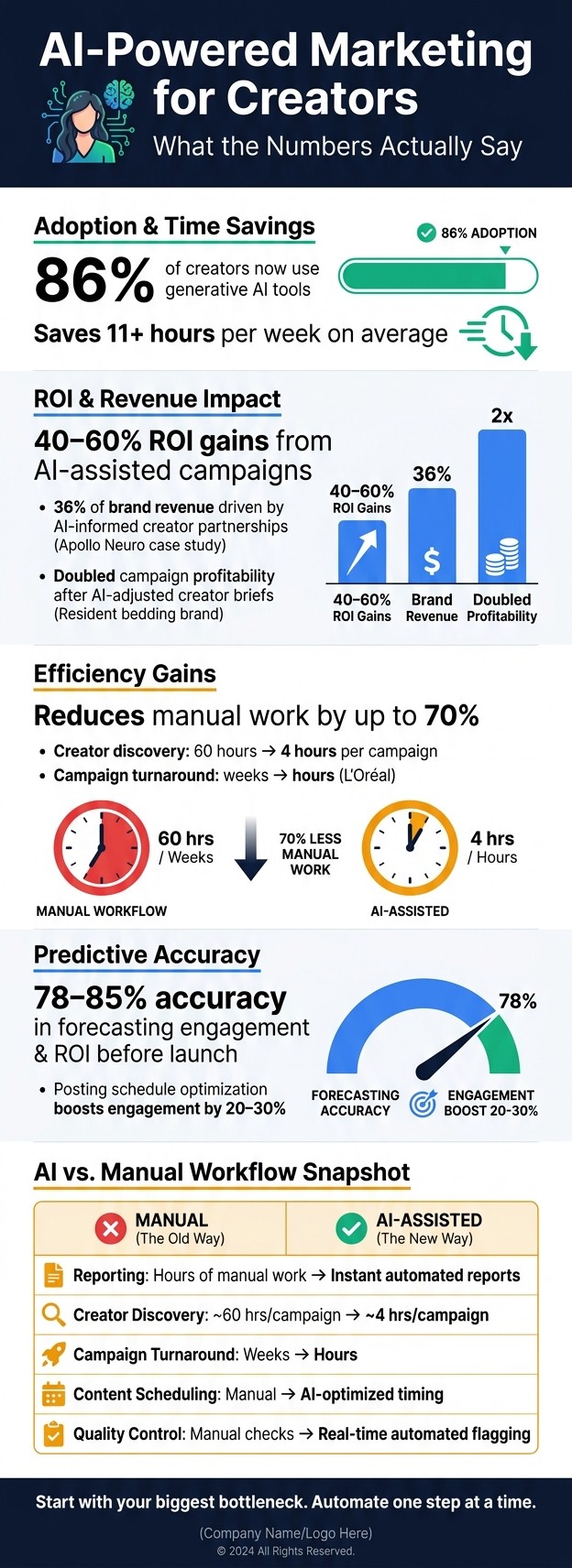
AI Marketing for Creators: Key Stats & Time Savings at a Glance
Planning a Content and Campaign Strategy with AI
Setting Goals and Metrics
Before diving into automated content creation, it's crucial to establish clear and measurable goals. Tie these objectives to specific KPIs - track follower growth for audience-building efforts or focus on clicks, leads, and conversions for monetization. The effectiveness of AI tools hinges on the clarity of the targets you set. Platforms like YouTube Studio and TikTok Analytics already provide insights such as engagement rate, average view duration, and audience retention. Pairing these with an AI platform like Averi allows you to take it further, linking content performance directly to business outcomes like affiliate clicks or product sales through multi-touch attribution.
One way to refine your approach is by moving beyond surface-level metrics. AI-powered predictive modeling can estimate engagement rates and revenue impact with 78–85% accuracy before launching a campaign [2]. This helps you set realistic benchmarks from the start, eliminating guesswork.
Once your KPIs are in place, you can leverage AI to dig deeper into research and planning.
Using AI for Research and Planning
With goals defined, let AI handle the heavy lifting when it comes to research. Instead of manually scanning for trends, tools like Google Trends, AnswerThePublic, and Averi can identify high-potential topics, locate gaps in your niche, and even suggest the best posting times tailored to your audience's activity patterns - not just general platform averages. Simply optimizing your posting schedule based on AI recommendations can boost engagement by 20–30% [4].
A compelling example of this approach comes from wellness brand Apollo Neuro. In 2025, they partnered with OAK Digital and impact.com to analyze historical content and audience sentiment. Their findings revealed that their product resonated most with individuals dealing with stress and insomnia, rather than the "biohacker" demographic they had initially targeted. This insight led to new partnerships that generated 36% of the brand's revenue, while male-focused content drove 22% of total traffic [1]. These insights weren't based on intuition - they were backed by data.
To further streamline your strategy, feed your top 10–20 posts into an AI tool to replicate your tone and generate tailored content ideas.
Knowing When to Use AI and When to Step In Yourself
Once research and planning are complete, it's important to determine which tasks AI can handle and which require your personal input. AI excels at behind-the-scenes work like research, scheduling, drafting, hashtag generation, and data analysis. However, tasks that involve direct audience interaction - such as responding to comments, sharing personal stories, hosting live streams, or making final creative decisions - are best left to you.
The table below outlines this division of labor:
Task Category | Safe to Automate with AI | Keep Human (Manual) |
|---|---|---|
Research | Trend identification, hashtag research | Personal insights, unique experiences |
Planning | Optimal posting times, content outlines | Final strategy approval, brand alignment |
Creation | First drafts, caption variations | Audience engagement, live streams |
Analysis | Data processing, sentiment analysis | Deciding strategic adjustments based on insights |
Always review AI-generated content carefully before publishing. AI can miss subtle nuances, misinterpret tone, or create content that, while accurate, doesn’t align with your voice. By taking the time to review, you ensure your content stays aligned with your brand and resonates authentically with your audience.
Automating Content Creation Workflows
Building a Content Pipeline with AI
Once you’ve solidified your strategy and gathered research insights, the next step is streamlining your content creation process. AI tools can take over much of the heavy lifting, from audience research to drafting and publishing, simplifying what used to be a complex series of manual tasks. These tools handle everything from analyzing audience sentiment and developing briefs to creating platform-specific content, scheduling posts, and monitoring early performance metrics - all without requiring constant human intervention.
Here’s how this typically works: during the research phase, AI reviews past data and audience feedback to identify promising topics and create data-informed briefs. A blog post, for example, can be transformed into tailored assets like TikTok scripts, Instagram carousels, or LinkedIn updates. Tools such as Averi make this seamless by learning your brand voice, generating content ideas with suggested titles and keywords, and even pushing polished drafts directly to your CMS. Automated systems can then schedule posts in a sequence (teasers, launches, reminders) and adjust strategies based on early engagement trends [3].
The benefits are clear - faster execution and consistent results. Take L'Oréal, for instance. By leveraging AI, the brand drastically reduced campaign timelines, transforming a process that once took weeks into one that now takes mere hours, all while maintaining their branding.
"This isn't experimentation anymore; this is a marketing transformation with AI at the core of brand interactions. We used to turn around campaigns in weeks, now we do it in hours." - Mark Lallemand, CMO of Western Europe, L'Oréal [1]
Keeping Quality and Brand Voice Consistent
While automation speeds up workflows, maintaining your brand’s unique voice is crucial. The main pitfall of AI-generated content isn’t inaccuracy - it’s the risk of sounding generic. To counter this, establish a detailed style guide for your AI tools, outlining approved phrases, tone examples, and terms to avoid. Platforms like Averi continuously refine their understanding of your brand voice by learning from every piece of content you approve.
In addition to voice consistency, real-time compliance checks are essential. AI can automatically flag issues like missing ad disclosures, unapproved claims, or off-brand language before content is published [1]. However, human oversight remains critical for compliance-sensitive content, especially when it involves statistics, pricing, or sponsorships. As Maya Thompson, Senior SEO Content Strategist, puts it:
"The right guardrail is not 'no autonomy.' It's 'bounded autonomy.' Let the agent handle repetitive execution while humans retain final authority over brand, compliance, and money decisions." [3]
Set automated alerts to monitor performance, too. For example, if engagement drops 30% below your baseline or negative sentiment spikes above 15%, it’s time to step in and adjust manually.
Manual vs. AI-Assisted Workflows: A Side-by-Side Comparison
The efficiency boost from AI-assisted workflows is hard to ignore. AI tools can cut manual effort by as much as 70%, with tasks like creator discovery shrinking from around 60 hours per campaign to just 4 hours [2]. The table below highlights how automation transforms each stage of the content process:
Workflow Stage | Manual | Automated |
|---|---|---|
Idea & Research | Manual keyword search and instinct-based | Predictive analytics and sentiment analysis [1] |
Briefing | Basic direction | Data-driven briefs with proven hooks and CTAs [1] |
Asset Creation | Manual rewriting for every platform | Modular adaptation of one core message [3] |
Quality Control | Manual quality checks | Real-time automated flagging of risks [1] |
Reporting | Hours compiling cross-platform data | Instant, presentation-ready reports [1] |
Optimization | Reactive changes post-campaign | Proactive mid-campaign A/B testing [3] |
If you’re just starting out, avoid trying to automate everything at once. Focus on the area that’s your biggest bottleneck - whether it’s reporting, caption writing, or scheduling - and expand from there [1]. A well-automated content pipeline not only saves time but also strengthens your ability to deliver research-driven, personalized campaigns at scale.
Personalizing Outreach and Managing Brand Partnerships
Automating Brand Pitches and Negotiations
Securing brand deals requires more than just a polished media kit - it demands consistent and personalized outreach at scale. AI tools like Jasper and Copy.ai simplify this process by crafting tailored pitch emails based on your past campaign data, audience demographics, and brand compatibility. These tools also analyze market rates using your follower count and engagement metrics to help you propose competitive, data-driven offers. On the contract side, some platforms can extract key terms, flag unusual clauses, and auto-fill your details to cut down on back-and-forth exchanges [2]. For example, Copy.ai provides over 90 templates for marketing emails and follow-ups [5], while Jasper ensures your brand's tone is consistent across all communications [6].
A smart strategy is to adopt a tiered outreach approach: let AI manage the entire outreach cycle for smaller partnerships, while you personally handle negotiations for high-value collaborations [2]. By automating outreach, you can dedicate more time to overseeing campaigns and building stronger relationships.
Managing Campaign Workflows with AI
Once a deal is secured, AI tools can streamline the administrative side of campaign management. Notion AI, for instance, allows you to ask plain-language questions about your workspace, automatically summarize meeting notes, and track deliverables and deadlines with ease [6]. Tools like Gumloop and Zapier integrate AI with platforms you already use - such as Slack, Google Sheets, and CRMs - automating status updates and sending reminders for approvals [6].
The concept of bounded autonomy is key here: let AI handle repetitive tasks like drafting recap emails, logging deliverables, and flagging missed deadlines, while you maintain control over brand voice, sensitive communications, and financial decisions [3]. This balance ensures campaigns run efficiently without compromising the judgment needed to protect your reputation.
AI Workspaces vs. Marketplaces vs. Point Tools: A Comparison
Choosing the right AI tool depends on your specific needs and workflow bottlenecks. Here’s how the main categories compare:
Category | Examples | Best For | Trade-Off |
|---|---|---|---|
AI Workspaces | Averi | Managing the full workflow - strategy, drafting, publishing, and analytics in one place. | Requires upfront setup; ideal for long-term marketing strategies. |
Creator Marketplaces | Handling brand-creator relationships: discovery, vetting, tracking, and payments [1]. | Less flexible for creators managing outreach independently. | |
Point Tools | Jasper, Copy.ai, Grammarly | Quick, high-quality copywriting and tone adjustments for specific tasks [5][7]. | Limited campaign oversight; manual integration needed. |
Your choice will depend on where you face the most challenges. If writing pitches and follow-ups consumes too much time, a point tool like Copy.ai (starting at $49/month for small business accounts) [7] can speed things up. For managing multiple deals and tracking deliverables, a creator marketplace like GRIN or impact.com provides robust infrastructure [1]. Alternatively, if you’re aiming to maintain a consistent content strategy that strengthens your brand over time, an AI workspace like Averi can handle everything from planning to publishing, freeing you up to focus on closing deals.
Using AI Analytics to Improve Content Performance
Bringing All Your Performance Data Together
Analytics tools built into platforms like YouTube Studio, Instagram Insights, and TikTok's dashboard only offer a slice of the full story. If your content lives across multiple platforms, manually piecing together all the numbers can drain your time and energy.
"The clues are out there for you too, right in your analytics. But if you're running multiple platforms, manually piecing together insights... is a real time sink." - Rochi Zalani [10]
Third-party tools such as CreatorIQ and Averi simplify this process by gathering data from various platforms into one unified dashboard. Averi, for instance, tracks metrics like impressions, clicks, and keyword rankings across all your content. By highlighting trends, it quickly shows what’s working and what’s not. This consolidated approach makes it easier to turn raw numbers into meaningful actions.
Using AI to Turn Data into Actionable Insights
AI doesn’t just help with creating content - it also sharpens performance through continuous analysis. By interpreting raw data, AI analytics tools uncover patterns and opportunities you might miss. For example, a fast-growing beauty brand used Writer's AI agents to analyze thousands of ads. The results? They discovered that their high-budget, cinematic ads performed 7x better on desktops and tablets during late-night hours but only delivered average results at other times. Armed with this insight, the brand shifted its holiday ad spend to focus on cinematic content for late-night desktop users, while opting for simpler, mobile-first ads during the day [8].
AI can also help pinpoint which video lengths, styles, or topics generate the most engagement. Predictive modeling offers another layer of insight, forecasting engagement and ROI with an accuracy of 78–85% before a campaign even launches. Additionally, automated alerts can flag issues, such as a 30% drop in engagement, allowing you to act quickly - whether that means tweaking a caption, boosting a post, or adjusting your broader strategy [2].
Building Feedback Loops for Ongoing Improvement
The real magic happens when you use these insights to create a system of continuous improvement. One successful campaign isn’t enough to sustain long-term growth; you need a strategy that evolves. Integrated analytics tools can track performance and feed insights back into your planning process. They can recommend which content to update, which topics to revisit, and even suggest fresh angles to explore. Over time, as more data is collected, the recommendations become increasingly precise.
Take Resident, a bedding brand that in 2025 used impact.com's AI-powered tracking to analyze user-generated content. They noticed a spike in searches related to back pain and price comparisons. By adjusting their creator briefs to focus on these topics, they doubled the profitability of each campaign post and video [1].
The focus is shifting from surface-level metrics like likes and shares to business-driven outcomes, such as clicks, leads, conversions, and revenue-based KPIs like eCPMs and RPMs [9]. These metrics provide a clearer picture of how well your content supports your overall business goals.
10 AI Tools That Save Creators 20+ Hours Every Week
Conclusion: How to Scale Your Marketing with AI
AI has taken over the time-consuming, repetitive tasks, allowing you to channel your energy into crafting your unique voice and forming stronger connections. With 86% of creators now using generative AI tools [4], those who integrate these tools thoughtfully are saving 11+ hours per week [4] - as highlighted in earlier discussions on workflow automation and analytics - while experiencing ROI gains of 40–60% [2]. These tangible benefits amplify each step outlined previously, setting the stage for marketing that can grow alongside your ambitions.
The secret lies in building a system for high-quality output rather than just relying on tools. Start by automating the most significant bottlenecks in your processes and expand gradually as you see results. Taking a phased approach often proves more effective than attempting a complete overhaul all at once.
Sustained growth hinges on creating a feedback loop that refines campaigns based on past outcomes. Tools like Averi are designed with this in mind - a self-sustaining content engine that adapts to your brand voice, analyzes performance, and uncovers fresh opportunities. The more content you produce, the smarter and more tailored its recommendations become.
Scaling effectively means creating systems that do the heavy lifting for you. AI provides the framework; your job is to steer it in the right direction.
FAQs
Which tasks should I automate with AI first?
To get started, consider automating tasks such as content brainstorming, drafting, scheduling, and finding influencers. AI tools are excellent for generating fresh ideas, producing initial drafts, and organizing posting schedules, significantly reducing the time spent on these activities. Similarly, platforms designed for influencer discovery can simplify research, slashing manual work by as much as 70%. By automating these repetitive processes, creators and marketers can dedicate more energy to strategic planning and creative execution, making it easier to expand their efforts efficiently.
How do I keep my voice when using AI?
To keep your voice consistent while using AI, establish clear boundaries and integrate human oversight into your processes. Develop structured workflows, centralize your brand assets, and combine AI's efficiency with human creativity. Make it a habit to review AI-generated content regularly, ensuring it reflects your tone and style. This approach allows you to maintain authenticity while letting AI manage repetitive tasks effectively.
How can AI prove ROI from my content?
AI proves the return on investment (ROI) of your content by directly linking it to business outcomes. By monitoring metrics such as conversion rates, lead quality, and revenue growth from AI-powered campaigns, it provides a clear picture of performance. Studies reveal that AI can boost sales ROI by 10–20% and generate returns of 5–8 times the marketing spend. This data-driven method replaces guesswork with concrete numbers, making it easier to justify content investments through measurable financial results.
Related Blog Posts

Zach Chmael
CMO, Averi
"We built Averi around the exact workflow we've used to scale our web traffic over 6000% in the last 6 months."
Your content should be working harder.
Averi's content engine builds Google entity authority, drives AI citations, and scales your visibility so you can get more customers.