

In This Article
Automate outreach, personalize content, and use AI workflows to boost enrollment, retention, and marketing efficiency.
Updated:
Trusted by 1,000+ teams
Startups use Averi to build
content engines that rank.
AI-powered marketing is reshaping how education platforms attract, engage, and retain students. By automating repetitive tasks, analyzing user behavior, and delivering personalized content, AI helps institutions improve enrollment rates and retention without increasing team size. Here's what you need to know:
AI Benefits: Faster outreach, tailored engagement, and optimized ad spending.
Key Goals: Boost application completion, increase enrollment yield, and reduce dropouts.
AI Use Cases: From keyword analysis for awareness to behavior-based personalization for retention.
Getting Started: Automate simple tasks like follow-ups first, then scale to advanced workflows like predictive lead scoring.
Content Creation: Tools like Averi generate tailored, SEO-friendly content for different student groups.
Metrics to Track: Monitor conversion rates, retention, and efficiency to refine efforts.
AI can handle up to 70% of marketing tasks, leaving humans in charge of oversight and strategy. Start small, measure results, and scale as you go.
Digital Marketing With AI Full Course 2026 Updated | Digital Marketing Full Course 2026 |Simplilearn
Matching Education Marketing Goals to AI Use Cases
AI Marketing for Education Platforms: Funnel Stages, Use Cases & Key Metrics
Setting Enrollment and Retention Goals
Before diving into AI implementation, it's essential to establish clear objectives. For most education platforms, these goals typically fall into three categories: boosting application completion rates, increasing enrollment yield (the percentage of accepted students who commit to enrolling), and minimizing early dropouts. Each of these aligns with a specific stage in the student journey and can be addressed with targeted AI capabilities. By focusing on these defined goals, you can better tailor your efforts to engage your audience effectively, building upon the outreach, engagement, and conversion strategies mentioned earlier.
A common misstep is viewing AI as a one-size-fits-all solution. Instead, AI works best when applied to a specific, measurable issue. For instance, if your application completion rate hovers around 40%, this points to a conversion challenge. If students enroll but disengage within the first 60 days, that's a retention problem. Pinpointing these gaps allows you to align the right AI tools with your objectives more effectively.
AI Use Cases by Funnel Stage
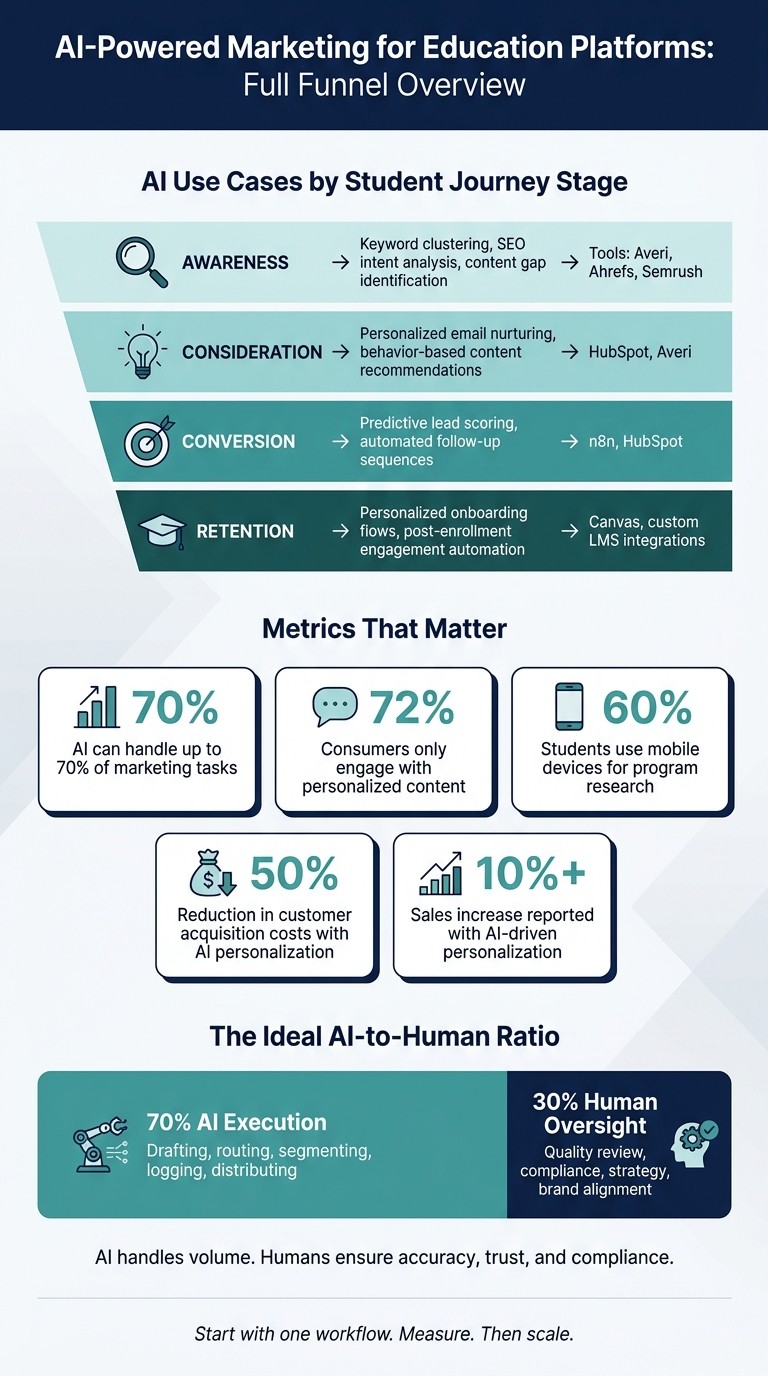
Once your goals are set, the next step is aligning AI applications with each stage of the student journey. The table below highlights where AI can add the most value:
Funnel Stage | AI Application | Key Tools |
|---|---|---|
Awareness | Keyword clustering, SEO intent analysis, content gap identification | |
Consideration | Personalized email nurturing, behavior-based content recommendations | HubSpot, Averi |
Conversion | Predictive lead scoring, automated follow-up sequences | n8n, HubSpot |
Retention | Personalized onboarding flows, post-enrollment engagement automation | Canvas, custom LMS integrations |
At the awareness stage, AI tools can analyze search intent and identify content gaps that might otherwise go unnoticed. Moving to the consideration stage, the focus shifts to tailoring content based on the needs of different groups, like undergraduates, graduate students, or working professionals. At the conversion stage, predictive lead scoring ensures your team focuses on high-intent leads, preventing valuable prospects from slipping through the cracks.
With these applications in place, the next logical step is determining which workflows to automate first.
Choosing Which Workflows to Automate First
After mapping AI use cases to the student journey, it's time to prioritize automation efforts. Not every workflow needs immediate attention, so an impact vs. effort framework can help you identify where to start. Focus on automating high-impact, low-effort tasks first, like responding to inquiries and sending follow-up emails, as these can quickly improve conversion rates.
More complex workflows, such as predictive lead scoring, offer great potential but require clean CRM data and time for proper training. Begin with straightforward automations, such as inquiry responses and drip email sequences, and gradually introduce advanced tools like scoring and personalization as your data and processes mature. This phased approach prevents overwhelm, ensures smoother implementation, and provides a chance to validate results before scaling to more intricate solutions.
How to Build AI-Powered Marketing Workflows
Setting Up Your Data and Tool Foundation
To successfully implement AI-powered marketing workflows, you first need a solid foundation of clean and connected data. The backbone of this setup typically includes three essential systems: your CRM (like HubSpot or Salesforce), your Student Information System (SIS), and your Learning Management System (LMS) such as Canvas. Integrating these systems ensures that AI tools have the necessary context to deliver the right message at just the right time.
If you're operating in the U.S., compliance with FERPA is non-negotiable. Be sure any third-party tools you use can isolate data and allow users to delete it as needed. For example, Averi adheres to rigorous enterprise-grade practices, ensuring that your data remains private and isn’t used to train other customers' models - a critical safeguard when dealing with sensitive student information.
For added security, store API keys and database credentials in a dedicated secrets manager. This precaution prevents potential vulnerabilities as your tech stack expands.
Building Automated Campaign Flows
Once your data systems are in place, you can start creating event-driven workflows. These workflows typically follow a four-step process: Trigger, AI Model Call, Tool Call, and Data Store [3]. For instance, imagine a prospective student downloads a brochure. AI can analyze their intent, enroll them in a personalized drip campaign through HubSpot, and log the interaction for lead scoring. If they ignore a pricing email, the workflow can pivot to sending them a case study instead of repeating the same message [1]. This kind of behavioral branching sets advanced workflows apart from simple autoresponders.
For decisions that carry more weight, it’s wise to include a human approval step. When AI confidence is low, the workflow should redirect the case to a team member for review instead of automating the response [3]. A good benchmark to aim for is letting AI manage about 70% of the process - handling tasks like drafting, routing, and logging - while humans oversee the remaining 30%, ensuring quality and accuracy.
With these automated flows managing complex student interactions, you can use AI chatbots to further strengthen real-time engagement on the front lines.
Using AI Chatbots for Front-Line Engagement
AI chatbots are a great way to complement your automated workflows by providing instant, personalized responses to prospective students. These bots often serve as the first point of contact, answering common questions about admissions deadlines, tuition fees, and program details 24/7. However, their success depends on clearly defined handoff protocols.
Establish specific rules for when the bot should escalate a conversation to a human. For example, inquiries about financial aid, appeals, or any scenario where the AI's confidence score drops below a certain threshold should be routed to a person. Without these safeguards, chatbots risk frustrating users at critical moments in their decision-making process. A well-configured bot can handle high volumes of inquiries, but a thoughtful handoff process ensures those interactions remain meaningful and effective.
How to Use AI for Content Creation and Personalization
With automated workflows in place, the focus shifts to content creation and personalization - key elements for driving enrollment and retention. These efforts build on the outreach and conversion strategies already established.
Setting Up a Centralized Content Engine
Once your workflows are running smoothly, the next hurdle is producing the sheer volume of content needed: blog posts, email campaigns, landing pages, and program guides. A centralized content engine brings strategy, research, writing, and publishing into one seamless system.
Tools like Averi simplify this process by analyzing your website to understand your product, brand voice, and content gaps. It then generates SEO-friendly content ideas tailored to specific student personas - whether you're targeting working professionals, first-time college students, or those pursuing continuing education. Averi also automates tasks like research, drafting, and publishing directly to CMS platforms, making content production more efficient.
Organize your content library by audience type (e.g., "Working Professionals" or "First-Time Students") to make retrieval faster. This structure lays the groundwork for delivering highly personalized messaging at scale.
Personalizing Messages at Scale
Generic messaging is no longer enough - 72% of consumers only engage with content that feels tailored to them [7]. In the crowded education space, personalization is critical.
AI enables this by adapting messages based on factors like site behavior, location, and past interactions. For instance, a prospective student browsing nursing program pages on their phone late at night may receive a follow-up tailored to their interests and timing. This approach aligns with the fact that 60% of students use mobile devices for program research [2]. In contrast, someone downloading a graduate school guide during standard business hours might get a completely different follow-up. Companies embracing AI-driven personalization have reported sales increases of over 10% [5], with the added benefit of reducing customer acquisition costs by up to 50% [4].
While personalization drives engagement, maintaining accuracy and credibility is non-negotiable.
Keeping Content Accurate and Compliant
Content speed and scale lose their value if accuracy is compromised. In education marketing, even one misleading claim can harm your reputation and lead to regulatory issues.
To ensure accuracy, integrate a human review step into your process. This step verifies that all content aligns with your brand voice and makes responsible claims. Tools like Averi facilitate this through a collaborative editing platform where team members can comment, request changes, and approve content before it goes live. Additionally, prioritize tools that offer encryption, user-level data deletion, and compliance with regulations like CCPA and FERPA - especially when handling sensitive student information [1].
"AI isn't taking human jobs – it's setting them up for better ones." - Salesforce [6]
This sentiment underscores that while AI speeds up content creation, human oversight remains crucial for ensuring credibility and compliance in education marketing.
How to Measure and Scale AI Marketing Operations
Metrics to Track
Keeping tabs on the right metrics is critical for ensuring your AI marketing efforts stay on track and deliver results. The best metrics tie directly to specific workflows, offering actionable insights rather than just filling up a dashboard.
Metric Category | Key Performance Indicators | AI Workflow Connection |
|---|---|---|
Efficiency | Time from brief to published; average editing time | Content generation and drafting |
Quality | Fact-check pass rate; brand voice alignment | Human review and approval layer |
Conversion | Lead-to-enrollment rate; cost per lead (CPL) | Funnel optimization |
Retention | Persistence rate; course completion rate | Personalized re-engagement campaigns |
For example, tracking lead-to-enrollment rates alongside cost per lead helps gauge how well AI-generated content is driving prospects through your funnel. With these metrics in place, you can fine-tune workflows and improve outcomes over time.
Refining AI Workflows Over Time
Once you’ve established baseline metrics, the focus shifts to making consistent improvements. Tools like Averi provide actionable insights by identifying bottlenecks, highlighting gaps compared to competitors, and recommending adjustments to messaging, timing, or audience focus.
Conduct regular audits - monthly is ideal - to review underperforming automated sequences. Look for areas where prospects drop off and refine your approach. For instance, dynamic behavioral segmentation can help tailor messaging to specific audience profiles. This method, proven to boost conversions, allows you to differentiate between an 18-year-old applicant and a 35-year-old adult learner based on their browsing habits. Additionally, consider reallocating your budget dynamically. Instead of waiting until the end of a campaign cycle, use AI-driven smart bidding to shift funds toward high-performing placements in real time.
Scaling from One Program to Many
After perfecting your workflows, the next step is scaling. Start small with a single program to validate your approach. Once you see consistent results - such as stable CPL, improving lead-to-enrollment rates, and content that aligns with your brand without heavy revision - you’re ready to expand.
Scaling doesn’t mean starting from scratch. Maintain brand consistency by using established audience profiles, your brand voice, and a library of past content. Platforms like Averi make this easier by storing these assets for reuse. When expanding, add new channels - such as paid social ads, SMS campaigns, or program-specific landing pages - gradually. Let performance data guide where to invest more heavily. Each new campaign builds on previous successes, making scaling faster and more efficient over time.
Conclusion
AI-powered marketing isn't just about adding new tools to your workflow - it's about creating a fully integrated system that aligns with clear, measurable goals. When education platforms use AI effectively, they can achieve faster content creation, better lead generation, and stronger student retention at every stage of their funnel.
The best way to get started? Focus on specific, manageable tasks. Instead of trying to overhaul everything at once, begin with one workflow - like automating email nurturing, creating targeted landing pages, or personalizing re-engagement campaigns. Prove its effectiveness before scaling up. This step-by-step approach minimizes risk while building confidence in your strategy.
At every stage, the human-in-the-loop model remains essential. AI can handle tasks like drafting, segmenting, and distributing content, but human oversight ensures everything stays accurate, aligned with your brand, and compliant with regulations like FERPA and COPPA. A balanced 70/30 mix of AI execution and human review is key to maintaining trust and quality.
Averi is a great example of this balance in action, blending AI efficiency with expert oversight. As Sarah Chen, Founder at TechScale, shared:
"We accomplished more in two weeks with Averi than we did in three months with our previous agency. The combination of AI speed and expert execution is exactly what we needed." [2]
The education landscape is shifting quickly, with trends like behavioral targeting and hyper-personalized messaging gaining traction. By adopting measurable and repeatable AI workflows now, platforms can position themselves to drive enrollments and retain students as market conditions evolve. This approach sets the stage for ongoing improvement in AI-driven marketing strategies.
FAQs
What data do I need before using AI for marketing?
Before diving into AI-driven marketing, it's crucial to collect the right data to set a strong foundation. Start by reviewing campaign performance metrics across all channels, mapping out the customer journey, and breaking down audience segments. Don’t forget to analyze content engagement statistics to see what resonates most with your audience.
Equally important is understanding your current workflows, defining clear goals, and setting measurable targets. With this information in hand, AI can help tailor customer experiences, anticipate trends, and streamline campaign automation for better results.
Which AI workflow should I automate first?
Automate content creation and marketing workflows to streamline tasks like writing blog posts, crafting landing pages, scheduling social media updates, and managing email campaigns. By automating these processes, you can connect with your audience more quickly and efficiently, scaling your outreach efforts without compromising quality. This approach is particularly valuable in the competitive EdTech space, as it frees up time to focus on strategic goals while ensuring consistent, meaningful engagement with your audience.
How do I keep AI marketing FERPA-compliant?
To maintain FERPA compliance in AI marketing, it's crucial to protect student data by keeping a close eye on the types of data collected, where it's stored, and how long it's retained. Use straightforward tools to monitor these aspects effectively. When selecting vendors, prioritize those that provide clear compliance documentation and demonstrate strong security practices. Additionally, offer privacy training tailored to the needs of staff, students, and parents to ensure everyone understands their responsibilities. Finally, confirm that the AI tools you use are designed to align with FERPA standards, emphasizing institutional control and robust data security.
Related Blog Posts

Zach Chmael
CMO, Averi
"We built Averi around the exact workflow we've used to scale our web traffic over 6000% in the last 6 months."
Your content should be working harder.
Averi's content engine builds Google entity authority, drives AI citations, and scales your visibility so you can get more customers.