

In This Article
Practical guide to using AI in financial marketing—covering personalization, compliance, tool selection, integration, and measuring ROI.
Updated:
Trusted by 1,000+ teams
Startups use Averi to build
content engines that rank.
AI-powered marketing is transforming financial services by addressing challenges like personalization, compliance, and cost efficiency. Here's how AI is reshaping the industry:
Personalized Campaigns: AI analyzes over 200 data points (transaction history, engagement metrics) to create dynamic customer segments, enabling tailored offers and reducing churn by 20–35%.
Cost Savings: Companies using AI report a 6% or more revenue increase, with tools cutting customer acquisition costs by 25–35% and boosting employee productivity by 26%.
Compliance Management: AI ensures regulatory adherence by automating disclosures, monitoring for bias, and maintaining audit trails.
Predictive Insights: Tools predict customer behavior, helping financial firms identify high-value leads and reduce churn months in advance.
Automation: Routine tasks, such as data entry and content creation, are automated, allowing teams to focus on strategic activities.
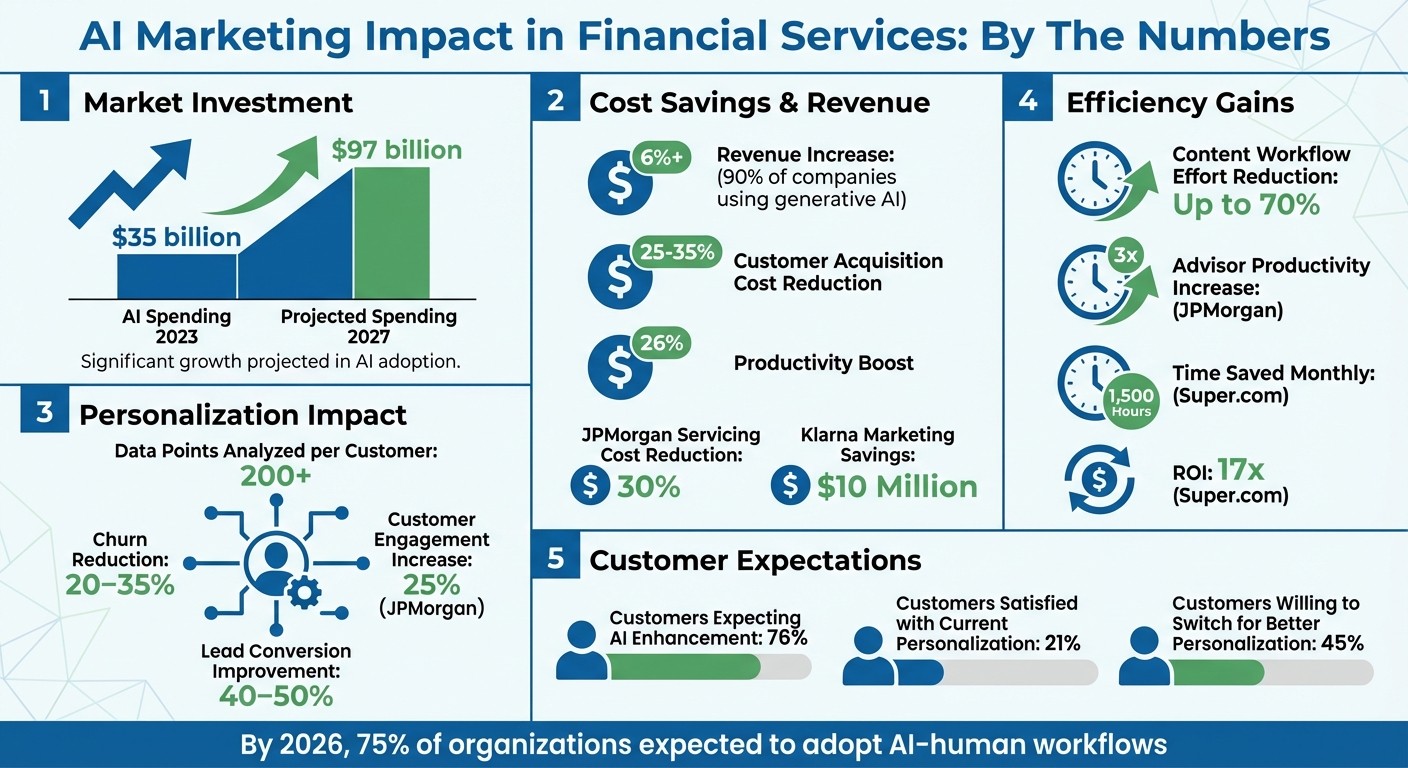
AI Marketing Impact in Financial Services: Key Statistics and ROI Metrics
Reimagining Financial Services Marketing in the AI Era
Why AI Works for Financial Services Marketing
Marketing in the financial services sector comes with unique challenges. Strict regulations like GDPR, CCPA, and fair lending laws, combined with the need to manage sensitive customer data, create a complex environment. At the same time, firms are expected to deliver personalized, trust-building experiences while staying compliant. AI offers solutions to these challenges that traditional tools simply can't match.
The numbers tell the story. Financial services companies allocated $35 billion to AI initiatives in 2023, with spending projected to hit $97 billion by 2027 [6]. This investment is transforming operations. For instance, JPMorgan Chase introduced a proprietary generative AI platform to 200,000 employees, which led to a 30% reduction in servicing costs and a 25% increase in customer engagement through personalized app features [8]. AI's ability to process hundreds of data points per customer and make decisions in milliseconds enables these results, a feat manual systems can't replicate.
AI goes beyond static demographic segmentation. It evaluates 200+ data points per user, such as transaction trends, spending habits, and life events, to create dynamic micro-segments that update weekly. This capability allows firms to predict customer churn 30–90 days in advance, reducing monthly churn by 20–35% [1]. Nationwide demonstrated the power of this approach by building a strong first-party data foundation, which helped them reach nearly 14 million prospects and convert over 1.3 million into known customers during their multi-year personalization journey [7].
AI also excels in compliance. It can automatically integrate required disclosures and risk warnings into every communication, ensuring regulatory consistency on a scale that's nearly impossible to achieve manually [1]. For example, JPMorgan Chase reduced account validation rejection rates by 20% using AI for payment validation screening [5]. Regular bias checks ensure AI systems meet ECOA and other regulatory standards, preventing discriminatory outcomes [1].
What AI Can Do for Financial Marketers
AI is reshaping financial marketing by enabling personalization, predictive analytics, and automation. Instead of sending generic emails to broad segments, marketers can now deliver tailored content based on an individual’s financial health, investment history, and engagement patterns. This shift from broad campaigns to 1:1 personalization allows small teams to manage over 50 personalized segments across multiple channels [1].
Predictive analytics is another game-changer. By identifying high-value customers before they even complete a transaction, AI-powered segmentation can cut Customer Acquisition Costs (CAC) by 25–35% within six months [1]. Wealthsimple, for instance, used AI to centralize knowledge across platforms like Google Docs and Slack, achieving a 98% employee adoption rate and saving over $1 million annually in time spent retrieving information [10]. Similarly, Super.com streamlined its knowledge base with AI, seeing a 17x return on investment, saving 1,500 hours monthly, and speeding up employee onboarding by 20% [10].
AI’s automation capabilities extend far beyond content creation. Tasks like data entry and responding to routine inquiries are now automated, freeing advisors to focus on high-value activities like navigating client emotions during market shifts [4]. JPMorgan’s AI deployment boosted advisor productivity by 3x, while Klarna optimized ad placements in 2024, saving $10 million in marketing costs [3].
Real-time decision-making is another area where AI outperforms traditional methods. When a customer logs into their banking app, AI evaluates their financial situation, recent transactions, and behavioral patterns to decide in milliseconds which products or offers to present. This replaces the slower, pre-scheduled campaigns of the past [8]. Notably, 76% of customers now expect AI to enhance their financial experience, yet only 21% of banking customers feel fully satisfied with their institution's personalization efforts [11].
How AI Helps with Compliance
Compliance is a cornerstone of AI-driven financial marketing. Modern AI systems maintain detailed audit trails for every decision, flag restricted terms, and ensure all required disclosures are included before content goes live. This approach is crucial, especially as 45% of consumers would consider switching banks for one offering more personalized services, provided these efforts stay within regulatory limits [9].
AI continuously monitors for bias, testing models to ensure they don’t unfairly impact protected groups based on race, gender, or age. These systems also document decision-making processes with explainability features, providing the transparency regulators demand [1]. When JPMorgan Chase’s CEO Jamie Dimon remarked:
"AI has the potential to augment virtually every job at our company and transform our operations" [3]
he highlighted both the opportunities and responsibilities tied to AI adoption.
AI integrates compliance into every customer interaction, offering live guidance to agents during calls or digital conversations. This includes real-time disclosures, risk warnings, and adherence to regulatory constraints, reducing the risk of violations. Privacy gateways further protect Personally Identifiable Information (PII) by masking sensitive data before it leaves internal networks [4]. As Assaf Baciu, President and Co-founder of Persado, explains:
"AI has paved the way for banks to create highly relevant, engaging, and compliant content at scale" [9]
These compliance-focused measures not only build trust but also enable cutting-edge marketing strategies. Organizations using generative AI report impressive results, with 90% seeing revenue growth of 6% or more [3]. However, these benefits are only achievable when AI is implemented with proper safeguards. By 2026, 75% of organizations are expected to adopt AI-human workflows, emphasizing the need for standardized processes, centralized data, and strategic prioritization of use cases [7].
With these systems in place, the next step is selecting the right AI tools to maximize these opportunities.
How to Choose AI Marketing Tools for Financial Services
When it comes to AI tools for financial services, the selection process demands a more tailored approach than in other industries. The stakes are undeniably high - 91% of bank boards had formally approved Generative AI programs by late 2023 [12]. These tools not only need to meet strict regulatory requirements but also deliver the personalized experiences that 71% of consumers now expect [12].
Start by prioritizing compliance. AI systems in financial services must explain decisions in clear, understandable terms, whether they’re setting dynamic pricing or tailoring offers. Tools that provide robust compliance checks and maintain detailed audit trails are essential for regulatory review [1]. Without these safeguards, even the most advanced AI could become a liability.
Integration is another key factor. The right tools should connect seamlessly with your existing systems, such as CRM, CMS, and email platforms, to eliminate manual data transfers and ensure smooth workflows. For example, Bank of America's AI assistant, "Erica", handled 676 million interactions in 2024, contributing to a total of 26 billion digital interactions - a 12% year-over-year increase - thanks to seamless integration across customer touchpoints [12].
Consider how the deployment model aligns with your team’s needs. AI workspaces like Averi manage workflows from strategy to publishing while maintaining brand context. Point solutions like Jasper or Copy.ai are excellent for specific tasks but often require manual integration. On-demand marketplaces like Upwork offer human expertise but may struggle with maintaining context across projects or scaling effectively as demand grows.
Finally, evaluate the total cost of ownership, which extends beyond subscription fees to include implementation time, training, and ongoing management. For example, NatWest’s AI assistant, "Cora", handled 11.2 million customer conversations in 2024 - equivalent to the combined workload of its branches and call centers - demonstrating how well-chosen AI tools can significantly reduce operational costs [12]. Consider whether the efficiency gains, such as time saved and error reduction, justify the investment.
AI Tool Comparison for Financial Services
AI tools vary widely in their functionality and suitability for financial services marketing. Understanding these differences ensures you invest in the right capabilities without overspending on unnecessary features or skimping on critical needs. Here's a breakdown of the primary categories:
Feature | AI Workspaces (Averi, HubSpot) | Point Solutions (Jasper, Copy.ai) | Marketplaces (Upwork, Fiverr) |
|---|---|---|---|
Core Functionality | Comprehensive workflows from strategy to publishing | Specialized tools for specific tasks (e.g., ad copy) | On-demand human talent for project-based work |
Context Preservation | Retains brand voice, compliance needs, and campaign history | Fragmented; resets with each use | Requires re-briefing for each project |
Compliance Controls | Built-in workflows and audit trails | Manual compliance checks required | Manual vetting for each deliverable |
Scalability | Easily scales with team size and AI learning | Medium; needs manual integration for growth | Limited by human capacity and coordination |
Best For | Teams needing consistent, compliant output | Specific tasks like ad variations or social posts | One-off projects or niche expertise gaps |
Pricing models differ across these categories. AI workspaces often provide scalable plans for small teams and enterprises, while point solutions focus on individual tasks. Marketplaces charge per project, which can add up quickly for ongoing needs.
Speed to results is another important consideration. For instance, JPMorgan Chase allocated $18 billion to technology spending in 2025, partly funding its proprietary generative AI platform. This platform, used by over 200,000 employees, contributed to a 30% reduction in servicing costs in certain areas [12]. Such examples highlight the potential return on investment when AI tools are integrated at scale.
Adding AI to Your Current Marketing Stack
Once you've chosen the right tools, the next step is integrating them into your existing workflow. Proper integration ensures that AI enhances productivity rather than creating new bottlenecks. The aim is to connect AI capabilities to your current systems, preserving data flow and minimizing manual handoffs.
Start with your CMS. Direct integration eliminates errors like copy-paste mistakes and ensures proper formatting. Tools like Averi can automatically push finalized content to your CMS, complete with metadata, internal links, and SEO structures, enabling you to move from approval to publication in minutes.
Next, link AI tools to your CRM and email platforms. Integration with CRMs like Salesforce, HubSpot, or Zoho allows AI to generate content tailored to customer behavior, transaction history, and engagement patterns. For email marketing, platforms like Mailchimp, Constant Contact, or ActiveCampaign can sync with AI tools to automate campaign creation while managing delivery and compliance with CAN-SPAM regulations.
Adopt a phased approach to integration. Begin with your CMS, ensuring seamless content flow, then connect the CRM for personalization, and finally integrate your email marketing platform for automated campaigns. This step-by-step process prevents overwhelming your team and allows you to troubleshoot issues as they arise. By taking these steps, you can ensure that your AI tools work in harmony with your existing systems, driving compliance, personalization, and efficiency.
How to Implement AI Marketing in Financial Services
Successfully integrating AI into financial services requires infrastructure that supports both advanced capabilities and strict regulatory compliance. Rushing the process can lead to compliance problems or resistance from teams. A phased approach that balances safety and efficiency is key to achieving a smooth rollout.
Start by auditing your data systems and preparing your team to work with AI tools. A step-by-step plan, from data evaluation to pilot testing and full-scale automation, can help ensure compliance and effective implementation.
Step 1: Prepare Data Systems and Train Your Team
Begin with a thorough audit of your data systems to ensure they align with AI requirements and regulatory standards. Identify where customer data is stored, how it moves between systems, and whether it complies with rules from the SEC, FINRA, and GDPR. These regulations are increasingly being incorporated into AI model design from the outset rather than as an afterthought [1].
Several tools can help manage compliance and security:
HubSpot: Offers GDPR and CCPA compliance through data encryption and role-based access controls across over 2,000 integrations.
Averi: Provides enterprise-grade security with zero data retention policies, VPC deployment, and encryption, along with access to a network of specialists.
Airtable: Delivers GDPR compliance with encryption and access controls across more than 1,000 integrations [2].
Training your team is equally important. Focus on how AI will change their daily tasks, not just on operating the tools. Teach marketers to review AI-generated content for compliance risks, refine prompts for better results, and establish clear approval workflows. Define responsibilities clearly - AI can assist with drafting, but strategic planning and compliance will still require human oversight.
Step 2: Pilot Predictive Analytics and Personalization
Pilot programs are essential to minimize risks and demonstrate value. Start with low-risk tasks like creating social media content or testing email subject lines before moving on to regulated areas like investment advice or loan offers. For example, you could run a two-week pilot producing 10-15 pieces of content both manually and with AI, then compare the results for accuracy, compliance, and efficiency.
Prudential Financial has successfully adopted this approach. Hema Widhani, CMO of Prudential Financial, shared:
"We are, for the first time, onboarding a digital co-worker in the content authoring space… to generate webpages tailored to the interests of millions of customers and advisers."
Their rollout began with simple personalization efforts and gradually expanded to more complex applications [2].
Bias audits are another critical step. Test predictive models for unintended biases that could lead to discriminatory outcomes based on factors like race or age [1]. Evaluate AI outputs across various customer segments, document the findings, and adjust models as needed. Run the pilot phase for a month to validate results before scaling.
Step 3: Scale and Automate Campaigns
Once the pilot phase confirms AI's capabilities, begin scaling and automating your campaigns. Map out your workflow from planning to publishing, identifying repetitive tasks that AI can manage while leaving strategic decisions to your team. AI’s strengths include trend analysis, data extraction, drafting, and flagging compliance risks, while humans remain essential for strategy, content curation, and final approvals [2].
One effective use of automation is predictive churn modeling, where AI can identify customers at risk of leaving 30-90 days in advance. This enables automated retention strategies, such as personalized offers and timely outreach [1]. To achieve this, connect your AI tools to your CRM, email platforms, and analytics systems, creating feedback loops that improve performance over time.
However, scaling personalization remains a challenge - 85% of financial institutions cite content workflow complexity as a major barrier [2]. Standardizing templates and approval processes can help. Use AI workspaces that maintain campaign context, allowing the system to learn from performance data and refine targeting, messaging, and timing with each campaign.
How to Measure and Improve AI Marketing Results
Evaluating AI-driven marketing demands a shift from traditional metrics to measures that capture efficiency, revenue impact, risk management, and strategic value [15][16].
Some key performance indicators (KPIs) include lead conversion rates, which can improve by 40-50% with AI predictive segmentation [1], customer acquisition cost (CAC) reductions of 25-35% within six months [1], and monthly churn decreases of 20-35%. Additionally, 70% of leading marketers report better multi-channel ROI measurement using AI [16].
To demonstrate the return on investment (ROI) of AI, establish baseline metrics such as client onboarding time, lead conversion rates, and content production speed. These benchmarks are essential for proving AI's value to stakeholders.
Metrics That Matter for AI Marketing
For financial services, tracking metrics across multiple dimensions is critical to understanding AI's performance.
Efficiency metrics: These include reductions in manual effort - AI agents can cut content workflow effort by up to 70% [2] - as well as error rates and process completion times.
Revenue metrics: Focus on lead conversion improvements, increases in average transaction value (which can rise 12-18% through dynamic pricing [1]), and customer retention gains.
Compliance and risk metrics: Track reductions in false positives for anti-money laundering systems (AI can lower these by 25% [14]), time spent on audit preparation, and decreases in regulatory warnings or fines.
Strategic metrics: These include customer satisfaction scores, employee productivity gains (AI has been shown to boost productivity by 26% in financial services [8]), and perceptions of brand strength.
In addition to direct metrics like revenue growth, consider proxy metrics to capture AI's intangible benefits. These might include reductions in full-time resource demands, improved forecasting accuracy, or increases in customer lifetime value [13][14]. While the median ROI for AI in finance functions is 10%, top performers report achieving 20% or more [13].
By using this measurement framework, financial marketers can effectively quantify AI's impact on personalization, compliance, and overall strategy. These metrics form the foundation for ongoing refinement.
How to Refine Your AI Marketing Strategy
After establishing key metrics, use them to guide continuous improvements in your AI marketing efforts. This requires systematic testing and feedback loops to optimize performance.
Start with A/B testing to refine messaging. AI can generate hundreds of message variations, which can then be tested across different customer segments to identify the most effective value propositions [1]. This data-driven approach eliminates guesswork, helping you make informed decisions about creative strategies.
Integrate AI tools with performance data to create automated feedback loops. For instance, if certain email subject lines consistently perform better, the AI can learn from these patterns and apply them to future campaigns, all while adhering to compliance standards [8].
Bias auditing is another critical step. Regularly review AI models to ensure they don’t unintentionally introduce biases related to race, gender, or age. This not only aligns with regulations like the Fair Credit Reporting Act (FCRA) and Equal Credit Opportunity Act (ECOA) but also helps maintain customer trust [1].
Leverage real-time journey orchestration to move from static marketing calendars to AI-driven, adaptive customer journeys [8]. Use AI to monitor competitors' pricing and marketing strategies in real time, enabling you to make strategic adjustments quickly - sometimes within days instead of months [1]. This speed can be a game-changer in competitive financial markets.
Finally, focus on high-impact use cases rather than just efficiency improvements. A "string-of-pearls" strategy - where related use cases are connected to maximize the reuse of data and technology investments - can yield compounding benefits over time [13]. Prioritize transformative applications like predictive churn modeling and personalized recommendations over basic automation to achieve meaningful results.
Conclusion
AI-driven marketing is becoming a cornerstone for financial services. With 76% of customers expecting AI to play a role in their financial interactions [8], institutions that hesitate risk falling behind more agile competitors. The benefits are clear: organizations leveraging AI report a 26% increase in productivity [8], and 90% of companies using generative AI in production have achieved revenue growth of 6% or more [3].
The challenge lies in balancing efficiency with compliance. Tools like Averi are designed to streamline critical processes - automating content creation, embedding regulatory workflows for SEC and FINRA compliance, and maintaining consistent brand messaging. At the same time, they ensure that human oversight remains central for high-stakes decisions. This combination of automation and human input delivers results without compromising the judgment financial services require.
"AI has the potential to augment virtually every job at our company and transform our operations." - Jamie Dimon, CEO, JPMorgan [3]
The most successful organizations start small, building on a strong data foundation, testing predictive analytics, and scaling what works. Companies like JPMorgan have demonstrated this approach's potential, achieving a 30% reduction in servicing costs and a threefold increase in advisor productivity [8]. These outcomes highlight the power of integrating AI to create personalized, efficient, and compliant marketing strategies.
Now is the time to embrace AI marketing to stay ahead. Choose tools tailored for financial services to move quickly from planning to execution while meeting regulatory requirements.
FAQs
What data is needed to start AI marketing?
To kick off AI-driven marketing in financial services, start by collecting essential data such as customer behavior, transaction patterns, engagement metrics, and financial health indicators. This information allows AI to craft tailored campaigns while adhering to industry regulations. Be sure to incorporate compliance-related data to meet legal standards.
Real-time data is critical - pull insights from products, payment networks, and third-party providers. This supports predictive segmentation and enables dynamic adjustments to campaigns. Prioritizing these data types ensures your AI marketing efforts are both effective and regulation-compliant.
How do we keep AI-driven marketing compliant?
To stay compliant in AI-driven marketing within financial services, leverage AI tools designed for automating content reviews, approvals, and regulatory checks. These tools actively monitor adherence to industry standards, flag potential risks in real time, and maintain detailed audit trails. By reducing the likelihood of human error and speeding up legal reviews, they enable scalable marketing strategies that remain compliant, all while safeguarding against fines and reputational harm.
Which AI marketing tool type fits our team best?
The best AI marketing tool for your team will hinge on your specific needs and how your workflow operates. If you're looking for a comprehensive platform that blends AI capabilities with human oversight, Averi is a solid choice. It supports scalable and compliant marketing efforts, making it ideal for teams managing diverse campaigns. On the other hand, if your focus is on task-specific solutions - like content creation, data analysis, or automation - tools such as Jasper or Copy.ai might be a better fit. These are simpler to implement but may require additional integrations to support broader marketing strategies.
Related Blog Posts

Zach Chmael
CMO, Averi
"We built Averi around the exact workflow we've used to scale our web traffic over 6000% in the last 6 months."
Your content should be working harder.
Averi's content engine builds Google entity authority, drives AI citations, and scales your visibility so you can get more customers.