How to Use AI-Powered Marketing for Healthcare & Wellness

Averi Academy
Averi Team
8 minutes

In This Article
How AI can personalize patient outreach, automate workflows, and maintain HIPAA-compliant data handling to boost conversions and operational efficiency.
Updated:
Trusted by 1,000+ teams
Startups use Averi to build
content engines that rank.
AI is reshaping healthcare marketing, enabling clinics and wellness providers to better connect with patients while navigating strict privacy regulations like HIPAA. This guide explains how AI tools can streamline outreach, personalize patient engagement, and improve operational efficiency - all without compromising compliance. Key takeaways include:
AI's Impact: Over 60% of patient searches are now influenced by AI systems, requiring marketing strategies to cater to both humans and AI algorithms.
Results: Clinics using AI have seen up to a 40% increase in conversions and significant revenue growth.
Compliance First: AI tools must meet HIPAA standards, support secure data handling, and include features like encryption and audit logs.
Automation Benefits: AI enables personalized messaging, automates routine tasks like appointment scheduling, and improves patient engagement without increasing staff workload.
Metrics to Track: Focus on SEO rankings, patient acquisition costs, and operational metrics like appointment adherence and chatbot success rates.
AI marketing platforms like Averi and Salesforce Health Cloud provide secure, scalable solutions for healthcare organizations, helping them boost efficiency and patient satisfaction. By starting with low-risk applications and integrating compliance into every step, healthcare teams can effectively leverage AI for growth.
Building a Trusted Healthcare Brand in the Age of AI Search
Healthcare Marketing Challenges
Healthcare marketing operates under unique pressures. HIPAA compliance isn’t just a guideline - it’s a legal mandate shaping every campaign. At the same time, patients expect the kind of personalized, instant experiences they encounter with top retail and tech brands. Navigating these competing demands can create significant obstacles, slowing down marketing efforts and curbing growth potential.
The rise of AI-powered discovery adds another layer of complexity. More than 60% of patient searches and research are now influenced by AI summaries[2]. This shift means marketers must appeal not only to human audiences but also to AI systems. Traditional SEO tactics designed for Google rankings may fall short when applied to AI-driven tools like conversational interfaces or AI Overviews. Adapting to these changes requires a careful balance between maintaining security and delivering personalized experiences.
Resource limitations are another common hurdle. Tailoring content for specific patient groups - whether for pediatric care, orthopedic services, or maternity programs - demands separate campaigns, compliance reviews, and approval processes. To meet these demands without overextending, automation becomes a necessity for achieving timely and effective personalization.
Compliance and Patient Privacy Requirements
When AI tools interact with protected health information (PHI), they must adhere to HIPAA’s strict security standards and data protocols[4]. This means any AI platform used in healthcare marketing must securely handle patient data, personalize content appropriately, and execute campaigns while maintaining compliance. Before adopting an AI marketing solution, it’s critical to ensure it has the necessary certifications, robust data governance policies, and the ability to sign a Business Associate Agreement (BAA).
For organizations serving international patients, compliance challenges extend to GDPR and other global privacy regulations[4]. Many generic AI tools rely on shared data models that don’t meet healthcare’s stringent security needs, requiring manual reviews of outputs to ensure compliance. While necessary, this process can erode the efficiency gains automation is supposed to deliver and increase liability risks.
Platform Type | Compliance Support | Data Security |
|---|---|---|
AI Workspaces (e.g., Averi) | Enterprise-grade governance; built-in review layers | |
Talent Marketplaces | Relies on individual freelancer expertise | Varies; requires manual vetting and BAAs |
AI Point Tools | Generic outputs; heavy manual review needed | Basic security; often uses shared data models |
While compliance ensures data security, it also adds to the complexity of scaling personalized outreach efforts.
Scaling Personalized Patient Engagement
Personalizing content manually for a wide range of patient needs simply isn’t scalable. Without AI, healthcare marketers often face a tough choice: rely on generic messaging that doesn’t connect with patients or invest heavily in time-consuming customization that limits their ability to expand.
AI-driven dynamic content offers a way forward. These systems analyze patient demographics, search behavior, and appointment history to automatically craft tailored communications[4]. Healthcare organizations using AI to guide patient journeys report a 40% increase in efficiency when converting conversations into bookings[1]. Beyond outreach, AI tools streamline routine tasks like appointment scheduling, answering FAQs, and pre-screening patients via 24/7 chatbots. This allows human teams to focus on more complex, high-value patient interactions.
The key to success lies in selecting AI platforms that combine robust compliance measures with advanced personalization capabilities. Platforms with HIPAA-aligned workflows enable healthcare marketers to scale engagement without compromising security or increasing regulatory exposure[1]. By automating these processes, marketing teams can shift from reactive, manual efforts to a proactive system that delivers personalized messages at just the right moment for each patient.
How to Implement AI Marketing in Healthcare
Transitioning from manual processes to AI-driven marketing requires careful planning. A thoughtful strategy ensures automation works hand-in-hand with compliance, enabling healthcare organizations to scale personalized outreach while maintaining security and adhering to regulations. Below, we’ll explore how to choose the right tools, design workflows, and use data effectively.
Selecting AI Marketing Tools
When evaluating AI tools for healthcare, compliance and security must come first. Ensure every tool provides a Business Associate Agreement (BAA) and SOC 2 Type II certification to meet healthcare standards. This safeguards patient trust and ensures regulatory alignment.
Key features to look for include end-to-end encryption, granular access controls, two-factor authentication, and audit logs. It’s also critical to confirm that your proprietary data remains private and isn’t used to train external AI models.
Opt for platforms that support human-in-the-loop workflows, enabling real-time compliance and accuracy reviews. Integration capabilities are equally important - your chosen platform should securely connect with your EHR/EMR system and CRM (e.g., HubSpot) while isolating or encrypting Protected Health Information (PHI). Increasingly, organizations are consolidating tools into integrated workspaces to reduce complexity and maintain a centralized, compliant brand memory.
Platform Type | Compliance Support | Data Security | Context Preservation |
|---|---|---|---|
AI Workspaces (e.g., Averi) | Built-in governance; layered reviews | Enterprise-grade encryption; GDPR/CCPA/SOC 2 compliant | Persistent; retains brand voice and history |
Point Solutions (e.g., Jasper) | Generic outputs; external manual review needed | Basic security; shared models | Fragmented; resets context per session |
Talent Marketplaces (e.g., Upwork) | Dependent on freelancer expertise | Varies by individual | Requires re-briefing for each project |
Pricing considerations go beyond subscription fees. For example, Averi’s Plus plan is $100/month, while HubSpot offers a free tier with paid options starting at $45/month. ActiveCampaign’s plans begin at $29/month, and Pipedrive’s tools start at $14/month per user. Point solutions like Jasper range from $39 to $59/month, and Surfer SEO costs between $89 and $299/month. Factor in integration costs, training time, and compliance audits when calculating total expenses.
Start with low-risk applications like keyword research or chatbot scheduling. Once your tools are securely in place, you can expand to more complex tasks, such as creating clinical content, while ensuring alignment with regulatory standards.
Building Automated Marketing Workflows
Once you’ve selected the right tools, the next step is to design workflows that combine speed, accuracy, and compliance. Create a centralized system that integrates your CRM, EHR/EMR, and automation tools to trigger tailored, compliant actions. This hub should house your brand guidelines, compliance protocols, and approved medical terminology to ensure consistent messaging across all patient interactions.
Focus on speed-to-lead workflows by automating responses to patient inquiries and embedding compliance checks directly into content creation. Use triggers like completed forms, abandoned appointment bookings, or repeated visits to specific health topics to launch personalized follow-up sequences. For technical or high-risk medical content, configure workflows to route drafts to subject matter experts for validation.
Automation not only improves efficiency but also bridges the gap between clinical accuracy and patient engagement. Define clear lifecycle stages in your CRM - such as Subscriber → Lead → Appointment Scheduled → Active Patient - and align content with each stage. This ensures every interaction is relevant to the patient’s journey.
Centralize your brand’s voice and expertise in an AI library to maintain consistency across automated messages. This repository should include tone guidelines, approved terminology, and compliance standards to reflect your organization’s values and empathy.
Finally, conduct quarterly audits of your workflows to ensure they stay compliant with evolving HIPAA regulations and internal policies. Regularly test sequences to identify outdated content, broken integrations, or messaging that no longer aligns with current guidelines.
Using Data to Personalize Patient Outreach
Personalization in healthcare marketing requires a delicate balance. Instead of focusing on specific conditions, tailor outreach based on broader health interests, such as general wellness topics or overall health goals. This approach respects patient privacy while still delivering relevant content[4].
Regularly audit AI models to identify and address biases related to race, gender, or socioeconomic status. Behavioral triggers, like frequent visits to orthopedic content or downloads of pediatric care guides, can signal interest areas for customized follow-ups - without referencing sensitive health information.
To protect PHI, store medical data exclusively in a HIPAA-compliant EHR, while using marketing databases (e.g., Airtable) for non-sensitive information like referral sources or appointment history. Predictive analytics can also play a key role. For instance, if engagement data reveals that patients in a certain age group frequently research joint pain, you can proactively offer educational materials about orthopedic consultations.
Monitor E-E-A-T principles (Experience, Expertise, Authoritativeness, and Trustworthiness) in all personalized content to avoid search engine penalties. As J.P. Gownder from Forrester explains:
"Human oversight remains critical for setting goals, ensuring quality and making judgment calls." [5]
Organizations that apply AI thoughtfully to personalize patient outreach while prioritizing ethical data practices are set to thrive. The global AI healthcare market, valued at over $32 billion in 2024, is projected to exceed $600 billion by 2034[4]. As Stewart Gandolf, CEO of Healthcare Success, puts it:
"AI is no longer optional. Health systems... that strategically apply AI for medical content optimization will enhance patient engagement [and] streamline operations." [5]
These strategies lay the groundwork for running effective, compliant AI-driven campaigns in healthcare.
Running and Improving AI Marketing Campaigns
With workflows in place, the next step is launching campaigns and tracking outcomes. For healthcare organizations, this means balancing speed with strict regulatory compliance - getting campaigns out quickly while ensuring every message adheres to industry standards. The goal is to blend compliance, personalization, and performance seamlessly in healthcare marketing.
Launching and Tracking AI Campaigns
Once your automated workflows are ready, you can use them to streamline patient outreach and improve efficiency. Start with low-risk campaigns, such as vaccination reminders, wellness education, or appointment follow-ups. Use AI workspaces to automate multi-channel outreach through email, SMS, and patient portals, but ensure all tools meet compliance standards before going live.
To protect patient privacy, keep Protected Health Information (PHI) isolated within your HIPAA-compliant EHR system. Use only non-sensitive data for outreach analytics, allowing for personalized communication without compromising confidentiality.
Every AI-generated clinical message must undergo human review. A qualified healthcare professional should verify clinical accuracy and confirm compliance with FDA and state-specific healthcare laws before sending messages to patients. Performance tracking is equally critical - monitor metrics like speed-to-lead, which measures how fast you respond to patient inquiries, and track the patient journey from subscriber to active participant.
A great example comes from a national nonprofit health system that partnered with PwC in May 2025 to implement Salesforce Health Cloud with conversational AI. This initiative led to an 85% reduction in call abandonment, resolved 11% of issues via self-service, and saved over 3,000 hours monthly[7].
These strategies not only ensure compliance but also set the stage for effective performance monitoring.
Metrics That Matter in Healthcare Marketing
To measure success, focus on metrics that highlight both marketing impact and operational efficiency. Key marketing metrics include SEO rankings, organic traffic, and cost per new patient acquisition, which help gauge reach and financial effectiveness. Operational metrics like appointment adherence (patient show-up rates) and engagement depth (time spent on wellness content and repeat visits) reveal how well your campaigns connect with your audience.
AI can also deliver measurable gains in efficiency. Cleveland Clinic implemented an AI assistant that reduced phone call volume by 60% and boosted online appointment bookings by 35%[6]. Similarly, AI chatbots can handle up to 40% of routine patient inquiries, significantly lightening staff workloads[6]. Metrics like hours saved per month, call abandonment rates, and first-call resolution rates provide a clear picture of these efficiency improvements.
Patient satisfaction is another critical area. Research shows that 89% of patients prefer practices with AI chat support over traditional methods[6]. Additionally, monitoring compliance accuracy - ensuring all communications meet HIPAA and regulatory standards - is essential to maintaining trust as your campaigns scale.
Tracking these metrics offers a snapshot of current performance and valuable insights for future campaign adjustments.
Using AI Analytics to Improve Future Campaigns
AI analytics go beyond reporting - they offer actionable recommendations. Predictive analytics, for instance, can identify patients likely to miss appointments and trigger personalized reminders through their preferred communication channels. Mount Sinai Health System used such tools to boost patient acquisition rates by 45%, targeting individuals likely to need preventive services[6].
Heatmaps are another valuable tool, helping you pinpoint where users drop off during the healthcare decision-making process[8]. For example, if engagement data shows that patients in a particular age group frequently research joint pain, you could provide targeted educational materials about orthopedic consultations. Mayo Clinic used AI-powered social listening to monitor patient sentiment, achieving a 25% increase in positive brand mentions in just six months[6].
Regular audits are essential to keep campaigns compliant and effective. Review CRM contacts monthly to confirm consent status, communication preferences, and data accuracy. Test automated workflows quarterly to ensure they align with the latest privacy policies and healthcare regulations. As Stewart Gandolf, CEO of Healthcare Success, puts it:
"The value of AI in healthcare marketing lies in measurable outcomes"[5].
AI workspaces also preserve your brand voice and campaign history, allowing context to improve with each cycle - unlike standalone solutions that start from scratch with every session. This ensures that your marketing efforts grow smarter and more effective over time.
AI Marketing Tool Comparison for Healthcare
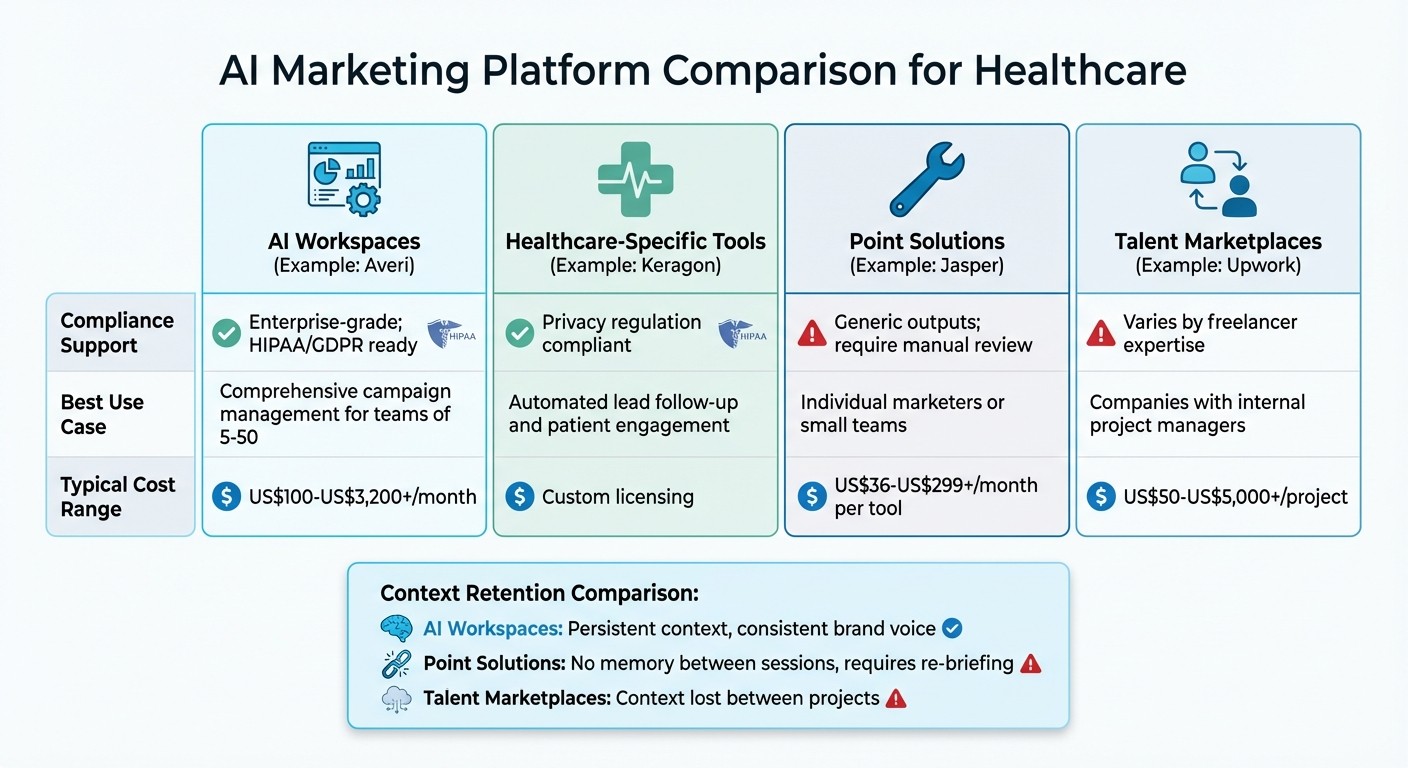
AI Marketing Platform Comparison for Healthcare: Features, Compliance & Pricing
Healthcare marketers often weigh their options between three main types of platforms: integrated AI workspaces (like Averi), point tools (such as Jasper), and talent marketplaces (e.g., Upwork). Each serves a distinct purpose. AI workspaces combine automation with centralized human collaboration hubs, point tools focus on specific marketing tasks, and talent marketplaces connect you with freelance experts. The best choice depends on factors like team size, compliance needs, and workflow complexity.
When working in healthcare, platforms must balance secure patient data management with automated, personalized engagement, all while keeping costs under control. This comparison outlines the essential features to help you choose a platform that aligns with your goals for effective and compliant AI-driven campaigns.
Feature and Pricing Comparison
Several platforms cater to healthcare marketing needs. For instance, Keragon offers HIPAA-compliant messaging with automated lead follow-ups and seamless integration into existing healthcare systems [4]. Salesforce Health Cloud consolidates patient data from billing systems, portals, and electronic health records (EHRs) to deliver personalized campaigns [9]. Meanwhile, Averi provides enterprise-ready AI workflows with a consistent brand voice and compliance with HIPAA and GDPR standards. When budgeting, remember to account not just for software costs but also for implementation, team training, and change management efforts [3]. Starting with focused, specific applications is often more effective than attempting an organization-wide overhaul from the outset [3].
Here’s a breakdown of the key platform types, highlighting their compliance capabilities, ideal use cases, and typical costs:
Platform Type | Compliance Support | Best Use Case | Typical Cost Range |
|---|---|---|---|
AI Workspaces (e.g., Averi) | Enterprise-grade; HIPAA/GDPR ready | Comprehensive campaign management for teams of 5-50 | US$100-US$3,200+/month |
Healthcare-Specific Tools (e.g., Keragon) | Privacy regulation compliant | Automated lead follow-up and patient engagement | Custom licensing |
Point Solutions (e.g., Jasper) | Generic outputs; require manual review | Individual marketers or small teams | US$36-US$299+/month per tool |
Talent Marketplaces (e.g., Upwork) | Varies by freelancer expertise | Companies with internal project managers | US$50-US$5,000+/project |
Selecting the right platform is pivotal for streamlining workflows while ensuring campaigns remain compliant and personalized. One critical advantage of AI workspaces is their ability to maintain persistent context, ensuring consistent brand voice and faster execution across campaigns. This context retention allows each piece of content to build on the last, improving compliance and efficiency over time. By contrast, point solutions require constant re-briefing as they lack memory between sessions, and talent marketplaces often lose all context between projects, forcing organizations to start anew each time. For healthcare organizations with frequent publishing needs, the ability to accumulate and retain context translates into more accurate compliance, stronger brand consistency, and quicker campaign rollouts.
Conclusion
AI automation has shown its ability to reduce call abandonment rates by 85% and save over 3,000 hours each month [7]. Additionally, AI-driven predictive analytics can enhance patient acquisition rates by 45% [6]. Institutions like Cleveland Clinic and Mount Sinai have already experienced measurable success, showcasing the potential for efficiency and scalability.
The choice of platform plays a crucial role in achieving these results. Comprehensive AI workspaces like Averi provide end-to-end orchestration with enterprise-grade compliance, making them a strong choice for teams seeking consistent and scalable solutions. On the other hand, point solutions are effective for automating specific tasks but often require extensive manual oversight, while talent marketplaces offer flexibility but may struggle with maintaining project context. Selecting the right platform depends on factors such as team size, compliance requirements, and coordination needs.
A practical approach is to begin with low-risk pilots, such as automating content ideation, routine scheduling, or follow-ups, to test outcomes before scaling further. It’s essential to prioritize platforms that integrate securely with your existing EHR systems and adhere to HIPAA compliance standards. As J.P. Gownder from Forrester emphasizes:
"Human oversight remains critical for setting goals, ensuring quality and making judgment calls" [5].
While AI takes on the heavy lifting, your team ensures that processes align with patient needs and regulatory requirements. This collaboration between automation and human oversight can lead to transformative results.
Healthcare marketing is evolving toward autonomous AI capable of managing complex, multi-step workflows [10]. By adopting these strategies, your practice can position AI as a strategic partner rather than just a tool. Organizations that invest in AI-driven workflows today will gain a competitive edge - enhancing patient engagement, reinforcing brand consistency, and optimizing operations with each campaign. Looking to streamline workflows while maintaining compliance? Discover how Averi's AI Marketing Workspace can help.
FAQs
How can I use AI in healthcare marketing without violating HIPAA?
To integrate AI into healthcare marketing while adhering to HIPAA regulations, safeguarding data and compliance must take center stage. Opt for AI tools specifically built to handle sensitive information, such as platforms designed with HIPAA considerations in mind, ensuring that patient data remains secure. Avoid using tools that lack robust security measures for processing protected health information (PHI). Evaluate AI vendors thoroughly, checking their compliance credentials, and prioritize automation tools that securely manage tasks like responding to leads and facilitating patient communications.
What’s the safest first AI marketing project to pilot in a clinic?
The most secure and effective way for a clinic to begin leveraging AI in marketing is by implementing AI-assisted content workflows. This approach boosts efficiency, ensures precision, and maintains compliance, all while producing personalized, patient-centered content. It’s a practical choice with minimal risk yet considerable benefits, as it automates content creation, simplifies communication processes, and adheres to regulations like HIPAA. Starting here delivers quick wins and sets the stage for adopting more advanced AI marketing strategies down the line.
How can we personalize outreach without using sensitive health details?
To craft personalized outreach while safeguarding sensitive health information, leverage AI tools designed to work with non-sensitive data. These tools can customize messaging by analyzing behavioral patterns, preferences, or demographic details, all without touching private health data. Additionally, conversational AI can improve patient interactions by using general communication insights, ensuring privacy remains intact. By concentrating on behavioral trends and contextual information, you can develop effective engagement strategies that respect privacy.
Related Blog Posts

Zach Chmael
CMO, Averi
"We built Averi around the exact workflow we've used to scale our web traffic over 6000% in the last 6 months."
Your content should be working harder.
Averi's content engine builds Google entity authority, drives AI citations, and scales your visibility so you can get more customers.