How to Use AI-Powered Marketing for Media & Entertainment

Averi Academy
Averi Team
8 minutes

In This Article
AI is remaking media marketing by automating metadata, personalization and content production to deliver faster, cheaper, smarter campaigns.
Updated:
Trusted by 1,000+ teams
Startups use Averi to build
content engines that rank.
The media and entertainment industry is transforming how it connects with audiences, and AI-powered marketing is at the center of this shift. By automating time-consuming tasks like content creation, audience targeting, and analytics, AI helps companies save time, reduce costs, and deliver highly personalized experiences. Here’s what you need to know:
85% of U.S. media companies are expected to use AI in marketing by 2026.
Netflix generates $1 billion annually through its AI-driven recommendation engine, improving subscriber retention by 25%.
Disney+ achieved a 35% boost in click-through rates and saved $5 million using AI for personalized trailers.
Generative AI tools like ChatGPT and Adobe Firefly enable marketers to create hundreds of ad variations in days, cutting production time by 40–60%.
AI-powered audience segmentation and targeting tools like Averi AI and Salesforce Einstein improve campaign precision and ROI.
From building smarter content libraries to automating personalized recommendations, AI is reshaping marketing strategies. Companies using these tools see faster campaign execution, better engagement, and measurable cost savings. Ready to integrate AI into your strategy? Let’s explore how it’s done.
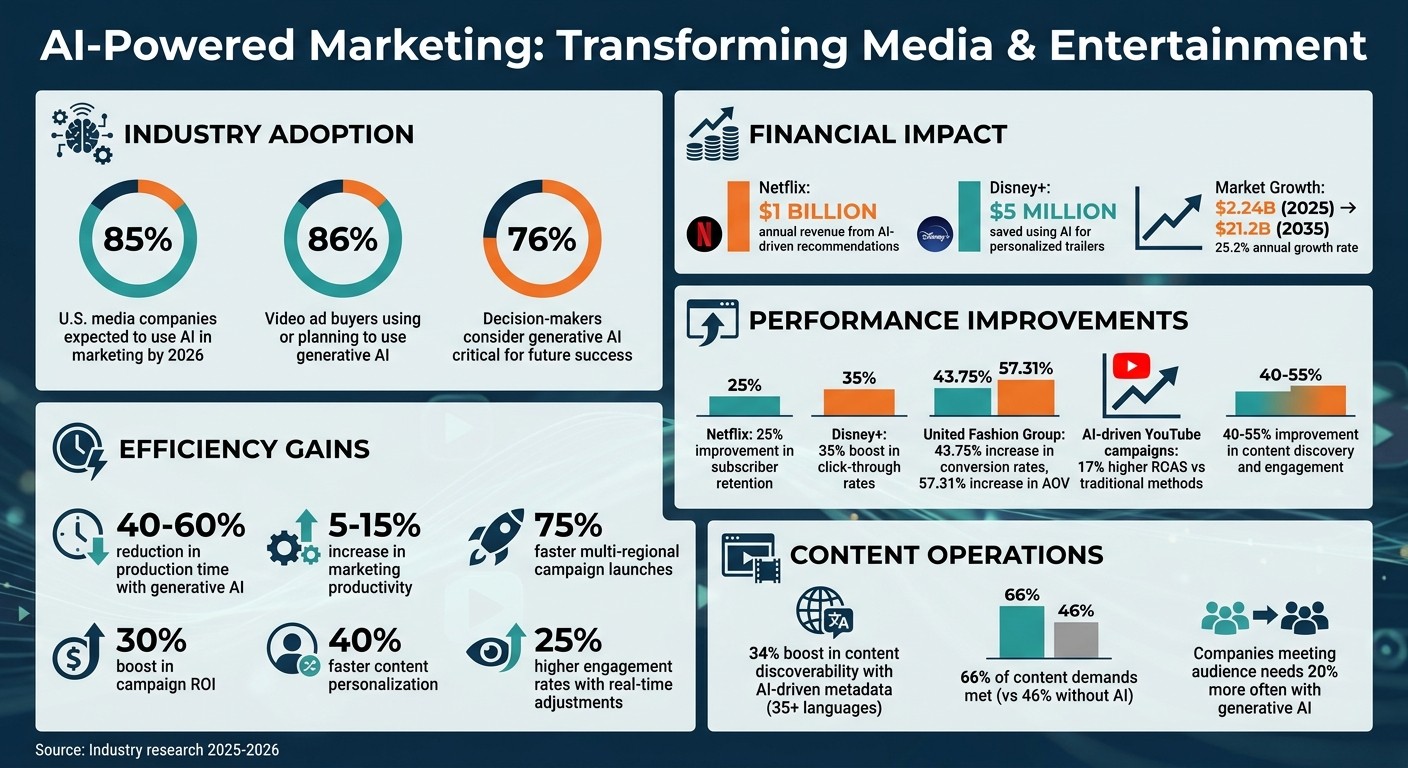
AI-Powered Marketing Impact in Media & Entertainment: Key Statistics 2026
Practical AI applications in media and entertainment
Building AI-Enhanced Content Libraries
Media companies often juggle vast collections of assets that need to be instantly accessible for campaigns. AI is reshaping how these libraries function by automatically tagging content with metadata, including details like emotions, facial expressions, and scene characteristics. This makes locating the perfect asset not just faster but also more accurate[1].
The true advantage lies in linking this metadata to performance data. When assets are tagged with creative context - such as identifying high-engagement scenes or the most effective thumbnails - the library becomes more than a storage system. It evolves into a powerful, strategic resource that highlights top-performing content. These enriched libraries play a key role in driving AI-powered campaign success in the media and entertainment sectors.
"We analyze footage frame by frame to match ads with viewer attention levels and emotional resonance,"
says Victoria Milo, SVP of Media Solutions & Emerging Technologies at Monks[2]. This approach transforms content libraries from static archives into dynamic tools for strategy. Next, let’s explore how AI optimizes metadata for precision and performance.
Metadata Optimization for Media Assets
AI excels at creating metadata on a massive scale. For instance, Amazon Prime Video employs real-time AI tagging to compile highlights from English Premier League matches. These clips are shared on social platforms almost immediately after key moments, boosting audience engagement[1]. What once required hours of manual effort now happens in seconds. This shift is a cornerstone of modern AI productivity for media teams.
But AI doesn’t stop at basic tagging. It can recognize objects, people, locations, activities, and even brand logos within video content[4][5]. It also supports natural language searches, enabling teams to find assets using phrases like "emotional reunion scene", even if such tags were never manually added[5]. For companies managing extensive archives, this capability is transformative. In fact, 76% of media and entertainment decision-makers consider generative AI a critical factor for future success[2].
The next step? Linking metadata to audience behavior to unlock strategic insights.
Connecting Metadata to Audience Data
When performance metrics - such as click-through rates, engagement duration, and conversions - are embedded into metadata, the library becomes a treasure trove of analytical insights. This allows teams to pinpoint what resonates with specific audience segments and replicate successful strategies.
Netflix showcases this concept on a massive scale. By using machine learning to predict demand, the platform pre-positions popular content on its content delivery network (CDN) nodes. This reduces load times and buffering, ensuring a smooth viewing experience that keeps subscribers engaged and minimizes churn[1]. By merging content metadata with viewing behavior data, Netflix optimizes its entire delivery system.
Tools and Solutions
Platforms like Averi AI simplify metadata tagging by combining creative context with performance data. This approach structures content libraries in a way that enhances content reuse and improves targeting. By embedding performance metrics directly into assets, Averi AI enables teams to identify the most engaging content while seamlessly linking metadata with audience behavior insights.
Other tools focus on specific aspects of library optimization. For instance, Twelve Labs and Bria AI specialize in video understanding and archive discovery[2], while Descript offers transcript-based editing, treating video and audio like text[3]. The key is selecting tools that integrate smoothly with existing workflows while delivering actionable insights, rather than just adding more data.
With 7 out of 10 industry leaders emphasizing that structured metadata is essential for AI success[6], it’s clear that prioritizing consistency and quality from the outset is critical. These tools not only streamline content management but also form the backbone of effective, data-driven marketing strategies.
Automating Personalized Content Recommendations
AI has revolutionized how platforms deliver personalized content recommendations by leveraging enriched metadata and audience analytics. Instead of relying on basic, rule-based systems, advanced deep learning models now predict user preferences before they even begin searching. By processing massive datasets, these systems can instantly serve content that aligns with individual tastes.
"The trouble with traditional marketing automation workflows is that they're only as smart as the rules they follow. They don't learn, predict, or adapt in real time."
Ian Donnelly, Senior Content Marketing Manager, Bloomreach[8]
Using AI for Audience Insights
AI goes beyond surface-level interactions, analyzing details like watch time, pauses, skips, and replays to create comprehensive audience profiles. These insights uncover patterns that manual methods often overlook. For instance, United Fashion Group used AI-powered contextual personalization to enhance its website experience. By tailoring content to match real-time customer needs and previous interactions, the company achieved a 43.75% boost in conversion rates and a 57.31% increase in Average Order Value (AOV) [8].
Another key advantage is AI's ability to uncover the "why" behind user engagement. This concept, known as "explainable intent", reveals the motivations driving behavior, offering teams actionable insights for smarter strategies [9]. With this level of detail, platforms can track trends and ensure their recommendations evolve alongside customer preferences.
AI-Driven Trend Tracking
AI platforms like Averi AI excel at identifying emerging trends and conducting keyword analysis to refine recommendations for specific Ideal Customer Profiles (ICPs). This approach ensures that suggestions are not only personalized but also aligned with broader business objectives. By analyzing data from social media, search patterns, and user behaviors, AI can prioritize trending content and adjust libraries accordingly.
A practical example comes from British retailer HMV, which adopted Bloomreach's AutoSegments in 2025 to optimize its PMAX campaigns. This AI-driven segmentation significantly improved campaign performance by identifying the audience segments most likely to convert and tailoring recommendations to meet their preferences [8].
Real-Time Adaptations Using Deep Learning
Deep learning takes personalization to the next level by adapting recommendations in real time based on user behavior. For example, if someone shifts from watching comedies to documentaries, the system recognizes the change and adjusts its suggestions within seconds. This responsiveness keeps content relevant, reducing churn and increasing engagement.
Netflix employs deep learning to anticipate demand by prefetching high-demand assets, minimizing load times and buffering [1]. This strategy has resulted in a 40–55% improvement in content discovery and user engagement [7]. By anticipating user needs and optimizing delivery, these dynamic systems set the stage for even more effective and adaptive campaigns.
Optimizing Marketing Campaigns with Generative AI
Generative AI is transforming how media companies approach marketing campaigns, enabling them to create and scale content faster than ever before. Instead of spending weeks crafting a few ad variations, teams can now produce hundreds of platform-specific assets in just days. This efficiency aligns with the rapid growth of the generative AI market in media and entertainment, which is expected to expand from $2.24 billion in 2025 to $21.2 billion by 2035, with an annual growth rate of 25.2% [12]. Companies leveraging generative AI are meeting audience content demands 66% of the time - 20% more often than their counterparts without this technology [10]. As the industry shifts toward real-time, data-driven marketing, an AI marketing manager is proving essential for accelerating variant creation, automating testing, and refining campaign execution.
Creating Campaign Variants with Generative AI
AI tools such as ChatGPT, Midjourney, and Adobe Firefly allow marketers to generate dozens of ad variations tailored to specific audience segments without starting campaigns from scratch. Video production benefits, too, with platforms like Runway, Kling, and Google Veo transforming static frames into dynamic scenes, cutting production time by 40% to 60%. This innovation is catching on: 86% of video ad buyers are either using or planning to use generative AI to create ad content, with 42% focusing on audience-specific versions, 38% on visual style adjustments, and 36% on contextual relevance [11].
Several recent campaigns highlight the potential of generative AI. In early 2025, H&M introduced 30 digital twins of real models, enabling the brand to produce scalable assets for multi-channel marketing while ensuring the original models retained ownership of their digital likenesses. During the 2025 NBA Finals, Kalshi, a finance platform, created and aired an AI-generated commercial in just 72 hours for $2,000, showcasing an unmatched combination of speed and cost-effectiveness for time-sensitive campaigns. This shift toward AI marketing automation allows organizations to scale sophisticated operations without massive overhead. Coca-Cola also embraced generative AI during its global holiday campaign, working with creative studios and tools like Leonardo, Luma, and Runway to produce snowy landscapes, iconic polar bears, and other brand elements. These assets were tested across platforms including YouTube, TikTok, and TV.
"The economics of advertising are being transformed. As the costs of production fall, the opportunities for advertisers multiply." - David Cohen, CEO, IAB [11]
Automating A/B Testing and Platform Adaptations
Once campaign variants are created, AI takes over to streamline testing and adaptation. Tools like Canva's Magic Design automatically generate platform-specific layouts - whether for YouTube thumbnails, Instagram posts, or LinkedIn carousels - based on a single frame or prompt, eliminating the need for manual resizing [3]. Advanced AI systems can even analyze footage to time ads with peak viewer engagement [2]. The rise of "agentic" AI platforms means these systems can propose ideas, test new formats, and adapt content in real time based on audience responses, all with minimal human intervention [1]. By 2026, generative AI is expected to account for 40% of all advertisements, making automated testing and adaptation the norm rather than the exception [11].
"Now my job changes from creation to curation, with 20 potential assets generated overnight." - Vered Horesh, Chief of AI Strategic Partnerships, Bria AI [2]
With AI handling testing and adaptation, platforms like Averi AI are stepping in to refine and execute campaigns with precision.
Averi AI's Role in Campaign Execution

Averi AI streamlines the entire campaign lifecycle, from research to execution, with tools designed to save time and maximize impact. Its Strategy Map feature creates a detailed visual content strategy by analyzing a brand's website to understand its positioning, voice, and target audience. This tool generates 5–6 content pillars, each with multiple layers of focus areas and structured briefs. Meanwhile, the Content Queue monitors trends, tracks competitors, and analyzes keywords, providing high-value topic recommendations that align with active campaigns.
The Execution & Editing Canvas offers a collaborative space where AI conducts in-depth research, complete with hyperlinked sources. Teams can highlight sections and request rewrites or tone adjustments to ensure alignment with the brand's voice. Averi's Content Scoring System evaluates content in real time, using a composite score based on SEO (55%) and GEO (45%) metrics. This system assesses "citation-worthiness" for AI engines like ChatGPT and Perplexity, helping brands optimize their presence [13]. The results speak for themselves: Averi has grown organic traffic from zero to over 26,000 monthly visitors, achieved 2.85 million Google impressions, and boosted AI referral traffic by 700% [13].
The platform also simplifies publishing with one-click CMS integration for tools like Webflow, Framer, and WordPress, ensuring all metadata and formatting remain intact. Once published, Averi can generate platform-specific content - such as LinkedIn posts - directly from blog articles while maintaining the brand's established voice. The Brand Core module stores data on voice and positioning, ensuring consistency across all campaigns. Additionally, Averi retains a memory of every published piece, allowing future content to become increasingly refined and aligned with brand goals.
"Averi doesn't just show you data. It tells you what to do about it... which pieces are at striking distance for page 1, which keywords are declining, and where new opportunities are emerging." - Averi AI v5 Release Notes [13]
AI-Driven Audience Targeting and Analytics
AI is transforming how media and entertainment companies understand and engage with their audiences. Instead of sticking to basic demographics like age or location, AI tools dive deep into user behavior - analyzing viewing habits, engagement times, and even when users stop watching - to predict who is most likely to act. Platforms like LiveRamp now use natural language prompts to quickly create audience segments from multiple data sources, merging online and offline identities and launching campaigns where users spend over 92% of their digital time [14]. Similarly, Salesforce Einstein leverages real-time behaviors, such as cart abandonment, to automate predictive lead scoring and map out customer journeys [15][16]. For media brands, this means targeting the right viewers at the right time, with less guesswork and more precision.
AI doesn’t just stop at identifying audiences - it’s revolutionizing segmentation and campaign analytics too.
Automating Audience Segmentation and Targeting
AI-powered tools take audience segmentation to the next level, replacing manual processes with dynamic, self-optimizing systems. Solutions like Pixis Advance provide codeless AI infrastructure for full-funnel marketing targeting, while Adobe Sensei processes massive datasets to predict customer behavior at scale. On social media, Meta Advantage+ automates audience expansion and optimizes creative elements to boost conversion rates [16]. The impact is clear: AI-driven YouTube campaigns have shown a 17% higher Return on Ad Spend (ROAS) compared to traditional methods, according to Nielsen [16]. Combining tools like Demand Gen with Search and Performance Max can further enhance ROAS by 10% to 12%, while also improving sales outcomes [16].
"AI audience targeting is an advanced marketing technique that uses machine learning to identify, segment, and reach the most valuable potential customers for your business." - Salesforce [15]
Platforms such as MNTN Matched focus on Connected TV (CTV) ads, targeting high-intent viewers and providing "Verified Visits" to track conversions directly from streaming ads [17]. Meanwhile, Segment by Twilio consolidates customer data from various touchpoints, enabling real-time activation. These tools allow brands to zero in on specific viewer preferences - like favorite genres or engagement patterns - rather than relying on broad assumptions.
With these advanced targeting methods, AI also sets the foundation for continuous performance improvement.
Performance Analytics and Campaign Recommendations
AI isn’t just about running campaigns - it learns from them and offers actionable insights for improvement. Modern platforms monitor metrics like impressions, clicks, and keyword performance while identifying new opportunities for optimization. For instance, Google AI integrates GA4 analytics with Google Ads, offering predictive metrics such as churn likelihood and purchase probability. This allows real-time adjustments to bidding strategies [16]. Tools like Averi AI go a step further, turning performance data into recommendations that help marketers refine their strategies as market conditions shift.
Direct Publishing and Workflow Integration
AI also simplifies campaign management by integrating directly with publishing systems. For example, Averi AI connects with CMS platforms to streamline workflows, ensuring consistency across all channels. For media companies juggling campaigns across streaming services, social media, and their own platforms, this level of automation reduces coordination challenges and ensures smooth execution at scale.
Scaling Marketing with Localization and Workflow Automation
For media and entertainment companies operating across multiple regions, AI has turned localization into a powerful tool rather than a logistical hurdle. By leveraging automated metadata and personalized recommendations, scalable localization combines global outreach with the ability to tailor content to local preferences. Campaign automation has now evolved to include streamlined localization and workflow management. Instead of translating content market by market, AI enables simultaneous workflows across dozens of languages - handling subtitles, dubbing, and cultural adjustments at scale. For instance, a major streaming platform currently manages 47 distinct metadata schemas and 23 language localizations per title across 190+ territorial markets [7]. Achieving this level of complexity without AI would require vast teams and months of effort.
Localization for Regional Campaigns
AI ensures cultural relevance by adapting imagery, expressions, tone, and structure to suit local audiences. Take B2B tech marketing as an example: in the UK, campaigns often highlight steady, incremental change, while in Middle Eastern markets, aspirational, future-focused messaging resonates more [18]. AI models trained on these regional preferences can suggest culturally appropriate variations while maintaining brand consistency.
"When we speak about localisation and culturalisation, these are the two things that you need to nail: make sure you're authentic to that specific region from a social, cultural, and economic perspective in your value proposition. The second bit is to remain within the legal compliance of that country." - Veronica Dumitrescu, EMEA Marketing Manager, Adobe [18]
AI also simplifies compliance verification, ensuring that content meets regional regulations before it goes live. This is crucial for media companies navigating frameworks like the EU AI Act or regional content standards. AI-driven metadata tools can generate localized titles, descriptions, and keywords in 35+ languages, boosting content discoverability by up to 34% [7]. With culturally tailored content ready, AI further streamlines workflows, ensuring efficient global operations.
Simplifying Workflow Automation
AI doesn’t just enhance content creation; it brings regional campaigns together under a unified, efficient workflow. By automating manual coordination, AI speeds up global campaign execution. Modern AI systems use learning-based models to analyze real-time data and continuously improve processes [19]. This automation reduces the time spent on coordination, enabling simultaneous multi-regional launches. For example, tools like Averi AI automate repetitive tasks and integrate seamlessly with platforms like Adobe Experience Manager and CMS systems, simplifying content ingestion and distribution.
By replacing manual processes with AI orchestration, teams can shift their focus from operational tasks to strategic planning. AI production agents manage campaign dependencies, while compliance agents ensure content meets platform-specific requirements. This level of automation is critical as content operations costs have surged 340% in the last decade, while revenue per asset has dropped 28% due to audience fragmentation [7]. These advancements not only accelerate workflows but also help reduce marketing expenses.
Measuring Total Cost of Ownership (TCO)
AI-powered workflows don’t just save time - they also significantly lower the Total Cost of Ownership (TCO) for global marketing operations. By eliminating manual translation, reducing coordination overhead, and minimizing costly errors, these systems deliver clear financial benefits. Generative AI can increase marketing productivity by 5–15% [19], while AI-driven solutions enable multi-regional campaigns to launch up to 75% faster [19]. For media companies managing campaigns across streaming platforms, social media, and regional channels, this efficiency directly impacts profitability - more content, faster delivery, and reduced operational costs.
Conclusion
AI-driven marketing has shifted from being a futuristic concept to an essential tool for media and entertainment companies in 2026. The numbers speak volumes: a 30% boost in campaign ROI, 40% faster content personalization, and 25% higher engagement rates thanks to real-time adjustments [20][21]. For businesses managing extensive content libraries across global audiences, these improvements mean reaching more viewers, reducing acquisition costs, and accelerating time-to-market. These outcomes align with the strategies outlined earlier - ranging from streamlining content libraries to automating campaign management.
By automating tasks like metadata creation, audience segmentation, and campaign variant generation with platforms such as Averi AI, companies can eliminate manual delays. Processes that once took days are now completed in hours, allowing marketing teams to concentrate on strategic planning rather than repetitive execution.
Consider this compelling example:
"In Q4 2024, Netflix used AI-powered recommendation engines to increase viewer retention by 25% (from 75% to 94% average watch time per session) across 200M+ subscribers. The initiative, led by Product Lead Aman Abid, involved deep learning models analyzing viewing patterns and metadata, resulting in $1.2B additional annual revenue from reduced churn." (Netflix Tech Blog, January 2025)
This case demonstrates how quickly AI integration can deliver tangible and impactful results.
To begin, evaluate your current workflows for potential AI integration, test a platform like Averi AI on a specific campaign, and track KPIs such as engagement and cost efficiency. Many companies report 20% efficiency improvements within the first month [22], with noticeable gains in both speed and quality. The secret lies in treating AI as a foundational element of your operations - embedding it into your CMS, analytics, and publishing systems to create a marketing engine that improves over time.
The benefits of AI adoption don't stop at individual campaigns. Each initiative provides insights into your audience, every piece of content enhances your metadata, and every regional launch fine-tunes your localization efforts. Media companies leveraging AI aren't just accelerating their processes - they're building smarter, adaptive systems that evolve with every campaign.
FAQs
What data is needed before using AI marketing?
Before diving into AI marketing, take time to collect and analyze data about your audience and how your campaigns are performing. Pay attention to audience behavior, preferences, and engagement trends - this will allow AI tools to tailor content specifically to their needs. Additionally, evaluate your existing content metrics to fine-tune strategies, pinpoint campaigns that aren't meeting expectations, and improve your return on investment. By doing this groundwork, you’ll set the stage for AI-driven automation to produce results that are precise, relevant, and measurable.
How do I measure ROI from AI-powered campaigns?
Measuring the return on investment (ROI) from AI-powered campaigns means assessing the tangible benefits delivered by AI-driven tools and strategies. Focus on key metrics such as increased engagement, revenue growth, cost reductions, and improved campaign performance. AI plays a crucial role in refining audience targeting, optimizing content scheduling, and tailoring personalization efforts - all of which contribute to higher conversion rates and trackable outcomes. By consistently monitoring these performance indicators, you can clearly gauge the impact and financial returns of your AI initiatives.
How can I use AI without risking privacy or compliance?
To use AI responsibly, consider leveraging AI-driven security and compliance tools designed to safeguard user data and meet regulatory requirements like GDPR and CCPA. Tools equipped with AI-powered scanning and centralized asset management can improve oversight, streamline governance, and align operations with legal standards. By adopting these solutions, organizations can reduce risks while ensuring privacy and compliance in an ever-changing regulatory environment.
Related Blog Posts

Zach Chmael
CMO, Averi
"We built Averi around the exact workflow we've used to scale our web traffic over 6000% in the last 6 months."
Your content should be working harder.
Averi's content engine builds Google entity authority, drives AI citations, and scales your visibility so you can get more customers.