

In This Article
Practical nonprofit content marketing: use storytelling, repurpose assets, set SMART goals, track metrics, and leverage AI where it fits.
Updated:
Trusted by 1,000+ teams
Startups use Averi to build
content engines that rank.
Nonprofits face the challenge of standing out in a crowded digital space while operating with limited resources. Content marketing offers a cost-effective way to connect with supporters, build trust, and drive donations. Here’s what you need to know:
92% of nonprofits use content marketing, but only 25% have a documented strategy.
Email marketing drives 11% of online revenue for nonprofits, with smaller organizations earning $6.15 per email subscriber.
Storytelling is key - personal stories resonate more than statistics.
Tight budgets and low social media reach (1-4%) are common hurdles. Repurposing content across platforms can help maximize impact.
A simple strategy document, SMART goals, and audience segmentation are essential for success.
AI tools like Averi can streamline content creation and boost efficiency, while traditional manual methods remain valuable for personal, high-touch projects.
Key takeaway: Focus on storytelling, repurposing content, and tracking measurable metrics to build trust and inspire action. Use tools and strategies that align with your team’s capacity and goals.
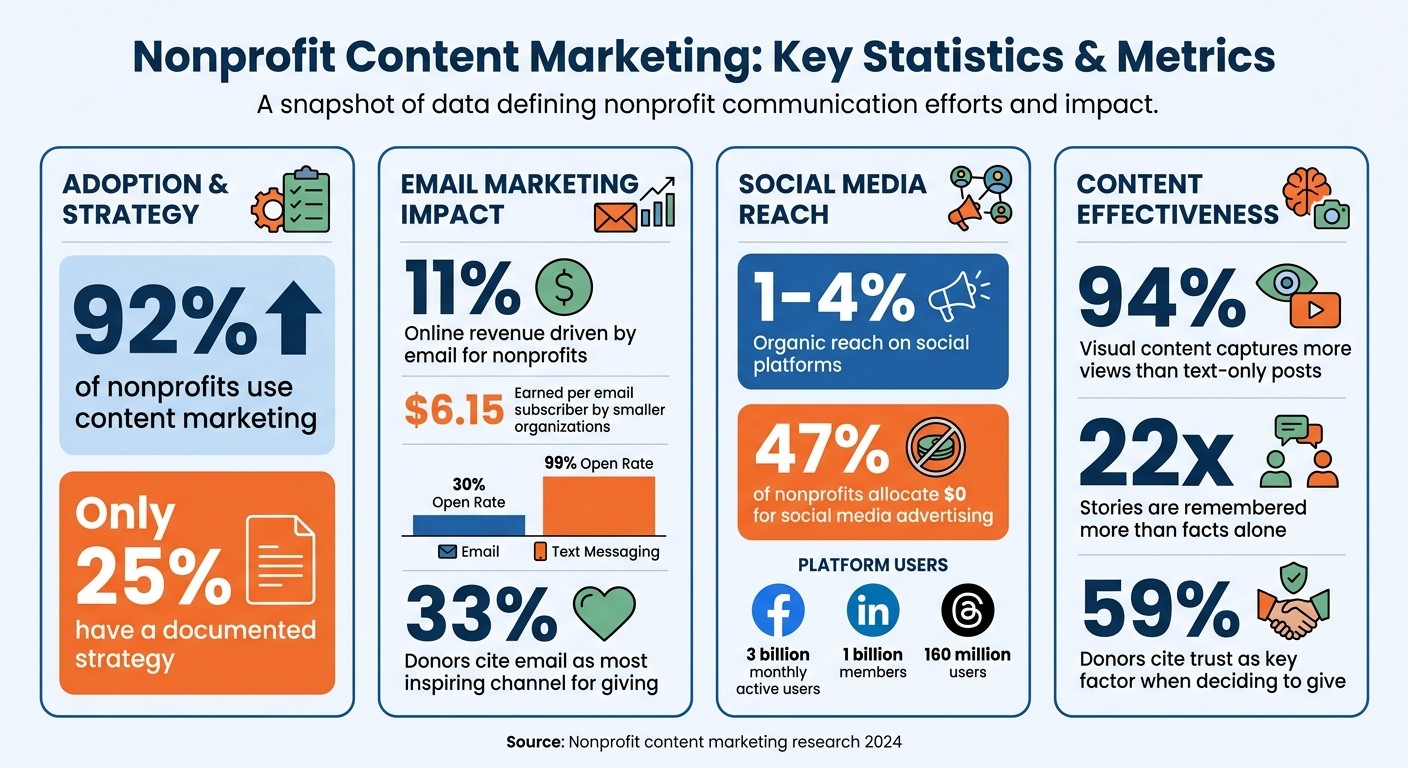
Nonprofit Content Marketing Statistics and Key Metrics
Ask the Expert: Successful Content Marketing Strategies for Nonprofits
Building a Content Marketing Strategy for Nonprofits
Only 25% of nonprofits have a documented content strategy [3]. Without a clear plan, it’s hard to maintain consistent progress. Start by drafting a straightforward strategy document that outlines your purpose and goals. Keep it concise and update it annually [1].
This doesn’t need to be a lengthy document. A single page that highlights your mission, audience, and core themes is enough to get started.
Set Goals That Align With Your Mission
Nonprofits aim for impact, not profit [3]. Your content marketing goals should reflect this. Use the SMART framework - Specific, Measurable, Achievable, Relevant, and Time-bound - to define what success looks like for your organization [3].
Focus on metrics that matter to your leadership team. Track website traffic, new email subscribers, volunteer signups, and donor conversion rates to gauge whether your content is effective [1][3]. Use these metrics to set realistic fundraising targets tied directly to measurable outcomes unique to your strategy.
Engagement often comes before conversions. Map out the donor journey with smaller goals - like newsletter signups, event participation, or social media follows - that lead supporters toward giving [3]. Segment your audience into groups such as current donors, potential supporters, volunteers, and beneficiaries, and set tailored goals for each [3][4].
Goal Category | Specific Measurable Metric (KPI) |
|---|---|
Brand Awareness | Website traffic, social media reach, follower growth |
Engagement | Click-through rates, social shares, email open rates |
Lead Generation | New email subscribers, volunteer signups, event registrations |
Conversion | Donation form completion rate, total funds raised, donor retention |
"Writing a content strategy that prioritizes measurable metrics, such as website traffic, new leads, and donors, will ensure that executive staff and board understand the value of your content marketing strategy." - Nonprofit Tech for Good [1]
Once you’ve set your goals, understanding your audience is the next essential step.
Identify Your Target Audience
Successful content starts with knowing who you're speaking to. Break your supporters into specific groups - current donors, potential supporters, volunteers, corporate partners, and local community members - based on their interests and behaviors [3].
Get direct feedback. Use tools like SurveyMonkey or Google Forms to ask donors and volunteers what motivates them to support your organization [3]. These insights will help refine your goals and messaging.
Choose platforms that match your audience. For example, Facebook is ideal for older donor groups, LinkedIn connects with corporate partners and grant funders, while Instagram or TikTok can engage younger, socially conscious individuals [3][1].
Develop Content Themes That Reflect Your Mission
Focus on 3–5 core content themes that will stay relevant for the next 6–12 months [1]. These themes should align with your mission and highlight issues your audience cares about. For example, a food bank might focus on food insecurity and meal delivery challenges, while an environmental nonprofit could spotlight conservation efforts and climate education. These themes should tie back to the goals you’ve set.
Use a variety of content types to keep things fresh. Rotate between categories like:
Impact Stories: Showcase beneficiaries and their experiences.
Behind-the-Scenes: Share moments from staff or volunteers.
Education & Awareness: Highlight key statistics or facts.
Calls to Action: Promote specific needs or campaigns.
User-Generated Content: Feature testimonials or supporter contributions [3].
Start with a manageable content schedule. For example, commit to two blog posts, two photo sets, and one video per month [1]. Repurpose this content across multiple platforms to maximize its reach. A single success story can become a blog post, an email feature, and several social media graphics, making it easier to stretch limited resources [3][5].
Next, focus on creating content that deeply resonates with your audience.
How to Create Content That Engages Your Audience
With your strategy in place, it’s time to create content that not only informs but also connects on a deeper level. Stories are remembered up to 22 times more than facts and figures alone [7]. This is crucial because 59% of donors cite trust as the key factor when deciding to give [7]. To inspire action, your content needs to build that trust while sparking an emotional connection.
Use Stories to Motivate Action
Focus on personal stories rather than overwhelming your audience with statistics. Instead of stating, "We served 10,000 meals last month", share the journey of one family who no longer has to worry about their next meal [7]. These individual narratives make your mission feel real and relatable.
To strike the right balance, try the 2-2-1 model: two informational posts, two inspiring stories, and one direct call-to-action. This approach keeps your messaging varied and avoids overwhelming your audience with constant fundraising appeals [6]. For urgent campaigns, negative appeals emphasizing the need for immediate action tend to have a stronger impact than positive ones - use these sparingly and strategically [6].
Additionally, take advantage of your most compelling success stories by repurposing them across multiple channels. Use them as the foundation for blog posts, social media quotes, email updates, or even video scripts [2][3].
Stories are powerful for building emotional connections. Next, let’s explore how using varied content formats can amplify that connection.
Mix Different Content Formats
Visual content captures 94% more views than text-only posts [7]. Incorporate videos featuring on-the-ground footage or volunteer testimonials, emails for personalized updates to donors, and blogs to address timely issues tied to your mission [2][3].
Email marketing is a significant revenue driver for nonprofits, accounting for about 11% of all online donations. On average, smaller organizations generate $6.15 per subscriber [1]. Text messaging, with its impressive 99% open rate compared to email’s 30%, is perfect for urgent appeals [1]. Tailor your formats to where your audience spends time. For example, older donors may prefer Facebook, while younger supporters are more likely to engage with Instagram Reels or TikTok content [1][3].
Now that you’ve got engaging content, it’s time to ensure it’s easily discoverable - both by search engines and AI platforms.
Optimize Content for Search Engines and AI Platforms
Many nonprofits miss out on visibility opportunities online. By 2026, optimizing for both traditional search engines and AI platforms like ChatGPT and Perplexity will be critical [3][8].
Target keywords related to your cause that align with what potential donors are already searching for - phrases like "food deserts" or "climate education" [1]. Consider applying for Google Ad Grants, which provide $10,000 in monthly advertising credits, to promote these keywords [8]. Regularly update your blog or news section to keep your content fresh and relevant for both search engines and AI crawlers [1].
Structure your content with clear headings and concise, factual details that AI systems can easily reference. Doing so enhances your organization’s credibility and increases the likelihood that your work will be cited in relevant queries [1][3]. By optimizing your content, you ensure your mission reaches the right audience and gains the attention it deserves.
How to Distribute and Promote Your Content
Creating engaging content is just the beginning - getting it in front of the right audience is where many nonprofits hit a wall. Even the most compelling stories can fall flat if they don’t reach the people who care. With social platforms limiting organic reach, only a fraction of your followers may see your posts unless you approach distribution strategically. The good news? A small budget can go a long way if used wisely.
Choose the Best Distribution Channels
Email remains a dependable tool, especially when tailored to specific audiences. For example, volunteers might appreciate behind-the-scenes updates, while major donors might engage more with detailed impact reports. This kind of segmentation can significantly increase engagement and, in turn, donations.
Social media platforms each have unique strengths. Facebook’s massive user base - 3 billion monthly active users - makes it great for community events and donor outreach. LinkedIn’s 1 billion members are ideal for connecting with corporate sponsors and grant funders. Meanwhile, Instagram shines for visual storytelling and showcasing volunteer activities. Threads, now with 160 million users and surpassing X in monthly activity, excels at fostering real-time conversations within your community [1].
Text messaging is another powerful tool, boasting an impressive 99% open rate compared to email’s 30%. This makes SMS particularly effective for urgent campaigns, like disaster relief or matching gift deadlines [1]. For platforms like TikTok and YouTube, which don’t naturally drive website traffic, paid promotion can help translate views into tangible support like donations [1].
Collaborate with Influencers and Local Leaders
Partnerships can dramatically expand your reach without requiring a huge investment of time or money. Seek out collaborators who align with your mission, audience, or geographic focus [3]. For example, a food bank might partner with local chefs to create recipe content, while an education nonprofit could team up with teachers who have strong social media followings.
Start small - newsletter swaps or co-branded social posts are easy ways to test partnerships. When you share success stories, be sure to tag sponsors and community partners. This not only increases visibility but also encourages them to reshare your content [1]. On LinkedIn, you can build credibility and reach by inviting business leaders to contribute guest posts or participate in webinars, tapping into their professional networks [1][3].
Mix Paid and Organic Promotion
Nearly half of nonprofits - 47% - don’t allocate any budget for social media advertising [1]. This lack of funding often explains why many struggle with visibility. However, you don’t need a massive budget. Even $50–$100 can significantly boost a high-performing post, helping it reach new audiences.
Paid promotion works best when combined with organic efforts. Use your email newsletters or blog posts to establish trust, then run paid ads to drive traffic to donation pages or event sign-ups [1][3]. Focus on posts that are already performing well organically - those with lots of comments or shares - and amplify them with paid promotion [1]. For platforms like YouTube and TikTok, where organic traffic rarely leads to donations, paid advertising is crucial to guide viewers to your website [1].
Retargeting is another effective strategy. You can reach people who’ve visited your blog but haven’t donated yet, or collaborate with partner organizations to split marketing costs and extend your reach [3]. By integrating these approaches, you can create a seamless system that not only promotes your content but also helps achieve your nonprofit’s broader goals.
Measuring Results and Using AI Tools
Publishing content is just the start; understanding its performance is what drives meaningful improvements. Recent data reveals that while 92% of nonprofits engage in content marketing [2], only 25% have a documented strategy [3]. Building a strong foundation for measurement is essential, especially when integrating AI tools to refine efforts.
Track Metrics That Matter
Kivi Leroux Miller, Founder and CSO of Nonprofit Marketing Guide, recommends a four-level framework for tracking success: Activity (frequency of posts and covered topics), Reach (audience size), Engagement (likes, shares, and comments), and Impact (conversions like donations or volunteer sign-ups) [9]. Pay close attention to engagement rates - calculated by dividing total post engagement by total reach - as it highlights how well your content resonates.
For email campaigns, key metrics include open rates (with a nonprofit average of about 30%), click-through rates, and revenue generated per campaign. Email marketing remains a powerful tool, accounting for 11% of all online revenue in 2024, with 33% of donors naming it as the most inspiring channel for giving [1].
Leverage AI Tools to Streamline and Scale
Once you know what works, AI platforms can amplify your success by simplifying the process. Tools like Averi automate content workflows, including planning, creation, and analytics, enabling small teams to achieve big results [3]. For instance, Sarah Chen, Founder at TechScale, shared that her organization accomplished more in two weeks using Averi’s AI-powered platform than in three months with a traditional agency [3]. Averi has helped organizations boost web traffic by over 6,000% within six months by combining research, SEO-optimized content, and actionable recommendations [3].
Other tools, such as ChatGPT (offering a 20% nonprofit discount on Team plans) and Canva (providing free access to its premium suite for eligible nonprofits), can assist with tasks like brainstorming and design [10][11].
Use Data to Refine Your Strategy
Maintain a monthly record of your top 5 to 10 posts by reach and engagement to identify trends in topics and formats that resonate [9]. Categorizing your content into 3–5 themes - like success stories, program updates, or advocacy - can further clarify what appeals to your audience [9]. Additionally, a year-over-year tracking spreadsheet can help measure growth in subscribers, followers, and online fundraising revenue, offering a clear picture of your digital marketing ROI for stakeholders and board members [1].
"Writing a content strategy that prioritizes measurable metrics... will ensure that executive staff and board understand the value of your content marketing strategy."
Nonprofit Tech for Good [1]
Averi vs. Manual Content Creation for Nonprofits
Nonprofits striving for efficient content marketing face a critical decision: rely on manual content creation with limited resources or adopt AI tools like Averi to streamline and scale their efforts.
Quick Comparison
Averi is an AI-driven platform designed to handle research, drafting, SEO optimization, and publishing, effectively acting as an extension of your marketing team without the need for additional hires [3]. On the other hand, manual content creation depends on internal staff or volunteers to manage every step, from brainstorming ideas to final edits [2]. Meanwhile, traditional agencies deliver custom work but often take months to produce results that AI platforms like Averi can achieve in just weeks [3]. Choosing the right approach is essential for nonprofits aiming to optimize their workflows and maximize impact.
How Each Workflow Operates
Averi's process begins by understanding your nonprofit's mission and audience. It generates content ideas using keyword research and industry trends, drafts SEO-optimized articles with sources and metadata, and publishes directly to your CMS. Performance data is then analyzed to recommend future content [3].
Manual workflows, on the other hand, require staff to manage every stage - research, drafting, editing, and SEO optimization - across various tools [2].
Pros and Cons
Feature | Averi AI | Manual Content Creation |
|---|---|---|
Time to Results | Days to weeks [3] | Months [3] |
Cost Efficiency | Lower overhead at scale [3] | Varies; staff or agency costs [3] |
Scalability | Easily scalable via automation [3] | Limited by staff capacity [1] |
Creative Voice | AI-generated; may need editing [12] | Unique human voice and nuance [12] |
SEO Authority | Optimized for search rankings [3] | Relies on manual SEO expertise [2] |
When to Consider Averi
Averi is ideal for nonprofits juggling multiple responsibilities beyond marketing, especially if they need to publish consistently (e.g., 2–3 posts per week) or aim to grow web traffic without expanding their team [3][8].
"We accomplished more in two weeks with Averi than we did in three months with our previous agency. The combination of AI speed and expert execution is exactly what we needed." - Sarah Chen, Founder at TechScale [3]
For organizations looking to build long-term SEO authority while focusing their in-house efforts on programs and fundraising, Averi offers an efficient, scalable solution.
When to Stick with Manual Methods
Manual content creation works best for projects requiring a deeply personal touch, such as annual reports or donor appeals, where storytelling and emotional connection are critical [12][1]. If your nonprofit has a dedicated creative team that values complete control over the writing process, or if your content needs are minimal (e.g., one piece per month), manual methods may be the better choice.
"Using the bland, uninspired voice of generative AI instead of your own will only get in your way. Your audience wants to hear your voice... they are eager for connection." - Sarah Moon, Marketing Strategist [12]
Ultimately, the choice depends on your team's capacity and strategic goals. Both approaches can amplify your mission, but the right method will align with your unique needs and priorities.
Conclusion: Building a Content Marketing System That Lasts
For nonprofits, the key to content marketing success lies in consistent effort and clear focus. Despite its importance, only 25% of nonprofits have a documented content strategy, leaving many organizations stuck in a cycle of disconnected campaigns rather than building systems that generate lasting momentum [3].
Start by documenting your strategy. Identify content themes such as impact stories, behind-the-scenes updates, and educational posts, and map them out on a 12-month calendar. Align this plan with major events like Giving Tuesday or your annual gala. Storytelling should take center stage. As Averi Academy explains, "Corporations optimize for profit. Nonprofits optimize for impact" [3]. Your stories are how you show your mission in action, earn trust, and inspire others to get involved. A clear, documented strategy becomes the backbone of your efforts.
Make the most of your resources by repurposing content with AI. For instance, a single volunteer interview can turn into multiple pieces: an email feature, several social media posts, a blog article, and even a testimonial for your next event. Combine this with AI tools like Averi to handle tasks like research, drafting, and SEO, enabling your small team to work with the efficiency of a much larger one. Focus on the platforms where your audience is most active - email remains a top driver of conversions [1]. These tactics help stretch limited resources while ensuring your efforts have maximum impact.
Track meaningful metrics to guide your efforts. Instead of chasing vanity metrics like social media likes, focus on actionable data such as donation form conversions, email click-through rates, and subscriber growth. As Averi Academy wisely points out, "Strategy without measurement is just guessing" [3]. Use this data to refine your content themes, adjust your schedule, and double down on what resonates most. Building a sustainable content marketing system requires consistent execution, resourceful repurposing, and an unwavering commitment to your mission.
FAQs
What content should we create first if we have no time or staff?
If time or staff is limited, concentrate on crafting straightforward, impactful content that aligns with your mission. Begin with short storytelling or mission-focused pieces such as quick videos, striking photos, or engaging narratives. These formats demand little effort but can still effectively connect with your audience and build awareness. Focus on content that quickly captures attention and clearly conveys your mission to make the most of your resources.
How can we measure content marketing impact beyond likes and shares?
To truly assess the impact of content marketing, it’s important to look past surface-level metrics like likes and shares. Instead, prioritize deeper engagement measures such as supporter loyalty, brand connection, and actions that reflect real commitment - like donations or advocacy efforts. Key indicators to track include retention rates, satisfaction levels, and the role your content plays in building trust and sustaining relationships. These metrics paint a more accurate picture of how well your content inspires meaningful involvement and long-term dedication.
When should a nonprofit use AI tools versus writing content manually?
Nonprofits can benefit greatly from AI tools when the goal is to save time, spark new ideas, or create large amounts of content quickly. AI is particularly effective for drafting, generating visual materials, and brainstorming concepts, allowing staff to focus on more strategic responsibilities.
However, when it comes to crafting personalized, mission-driven messages that connect on an emotional level, manual writing remains essential. Combining the strengths of AI for efficiency with the human touch for storytelling creates a balanced approach, ensuring both productivity and meaningful communication.
Related Blog Posts

Zach Chmael
CMO, Averi
"We built Averi around the exact workflow we've used to scale our web traffic over 6000% in the last 6 months."
Your content should be working harder.
Averi's content engine builds Google entity authority, drives AI citations, and scales your visibility so you can get more customers.