

In This Article
Guide for creators and influencers on using content strategy, AI, and platform tactics to grow audience, engagement, and income.
Updated:
Trusted by 1,000+ teams
Startups use Averi to build
content engines that rank.
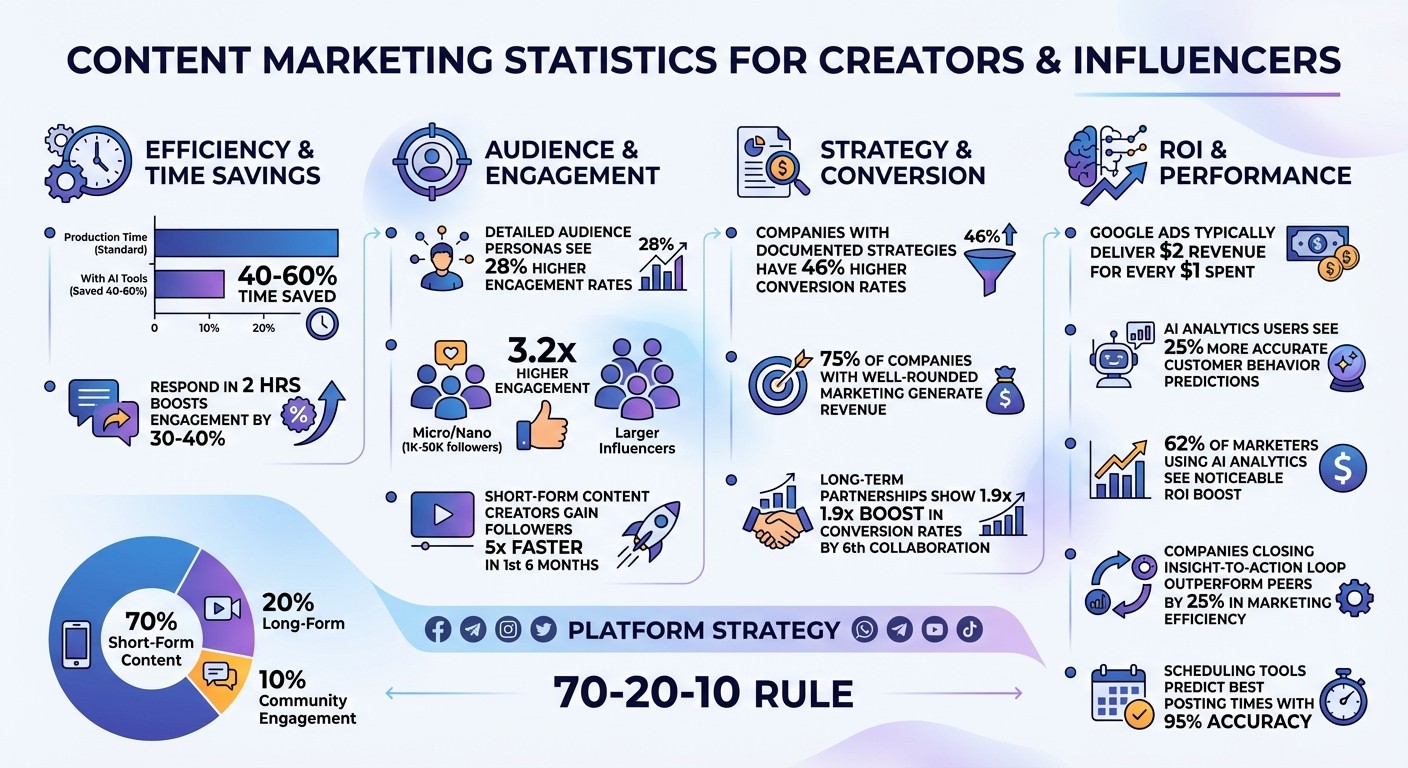
Content marketing helps creators and influencers grow their audience and income by building trust and visibility over time. Instead of chasing short-term trends, this approach focuses on consistent, high-quality content that aligns with your niche and audience. AI tools can save 40–60% of production time, allowing you to focus on your personal voice and stories while automating repetitive tasks like drafting, editing, and analyzing performance.
Key Takeaways:
You are the brand: Every piece of content contributes to your reputation and revenue opportunities like sponsorships, affiliate marketing, or direct sales.
AI as an assistant: Use an AI content creation framework for keyword research, drafting content, editing for clarity, and tailoring posts for different platforms. You remain the creative decision-maker.
Set clear goals: Use the SMART framework (e.g., "Gain 500 email subscribers monthly") and track metrics like engagement, retention, and conversions.
Platform-specific strategies: Tailor content for Instagram, TikTok, YouTube, and others. Short-form videos drive faster growth, while long-form content builds deeper connections.
Collaborations and ads: Partner with creators or use paid ads to expand reach. Long-term partnerships often yield better results than one-off campaigns.
Measure and refine: Track performance metrics like engagement rates and conversions. Use AI tools to analyze trends and improve content effectiveness.
Content Marketing Statistics for Creators and Influencers 2026
You're gonna be a full-time creator in 2026, here's how
Building Your Content Strategy
A well-thought-out content strategy turns random posting into a structured plan that helps grow your brand. It replaces guesswork with informed decisions, focusing on what your audience wants and what attracts potential sponsors.
Finding Your Niche and Target Audience
Your niche is the sweet spot where your passion, audience needs, and sponsor interest align. Instead of something broad like "fitness", consider narrowing it to something specific, like "15-minute workouts for busy parents." This precision allows you to address a specific problem more effectively than others in your space.
Define 3–5 core content pillars to showcase your expertise and give your audience a clear reason to follow you [1]. To pinpoint gaps in your niche, tools like Google Trends, AnswerThePublic, or niche subreddits can be invaluable for identifying common questions and untapped opportunities [2].
Understanding your audience means going deeper than just demographic data. Focus on psychographics - what drives them, what frustrates them, and how they describe their challenges [1]. Brands that build detailed audience personas often see 28% higher engagement rates because they connect directly with their audience's priorities [1].
AI tools can further streamline audience analysis. By studying competitor content and suggesting ideal customer profiles, these tools help refine your focus. This approach not only sets your content apart but also creates a foundation for measurable growth. A targeted strategy strengthens your community while reinforcing your brand's position in the market.
Once your niche and audience are clearly defined, the next step is to set measurable goals to track your progress.
Setting Goals and Tracking Progress
With a defined niche in hand, setting specific goals and tracking key metrics will keep your content strategy on course. Vague objectives won’t cut it - use the SMART framework to set clear, actionable targets. For example, aim for something like, "Increase email subscribers by 500 per month by Q2 2026" [1]. Research shows that companies with documented content strategies enjoy 46% higher conversion rates compared to those without [1].
Focus on metrics that matter: engagement (comments, shares, saves), retention (how long viewers stick around), and conversions (actions taken, like clicking a call-to-action) [1][2][3]. Engagement rates often carry more weight with brands than follower counts, and retention directly influences how platforms like YouTube and TikTok promote your content [1][2][3].
To track these metrics, tools like InfluenceFlow and Averi can help you adjust your strategy in real time [1][3]. For instance, responding to comments within the first two hours can boost engagement rates by 30–40% [3]. As your content library grows, analytics not only reveal what’s working but also suggest new content ideas based on emerging trends in your field.
Using AI to Speed Up Content Creation
AI tools are changing the game for content creators, taking over repetitive tasks like research and drafting so you can focus on creativity. Knowing where AI fits into your workflow and where your input is essential can make all the difference.
Generating Content Ideas Automatically
Hitting a creative block can be frustrating, but AI tools can help you get past it. By analyzing trends in your niche, keeping tabs on competitor content, and uncovering keyword opportunities, AI ensures you're never short on ideas. What used to be a blank slate on Monday mornings can now be a list of ready-to-go topics.
For instance, tools like Averi AI generate a queue of content ideas by examining market trends, search patterns, and content gaps. Each suggestion comes complete with a title, target keywords, and a brief overview. Instead of brainstorming from scratch, your job shifts to selecting the most promising topics from a list of well-researched options.
Creating Quality Content Faster
After choosing a topic, AI can draft an initial version in minutes, saving hours of work. Platforms like Averi AI leverage systems like Synapse and AGM-2 to deliver drafts that include in-depth research, SEO-optimized structures, FAQ sections, and even internal link suggestions. These drafts are designed for you to refine and personalize.
The process with AI workspaces is streamlined compared to traditional tools. AI workspaces manage the entire content cycle - from strategy to publishing - while retaining a memory of your brand voice. On the other hand, point tools like Jasper or Copy.ai are great for quick drafts but require manual effort for tasks like CMS uploads, formatting, and reapplying brand guidelines.
Here’s a quick comparison of AI workspaces versus point tools:
Feature | AI Workspace (e.g., Averi) | Point Tools (e.g., Jasper, Copy.ai) |
|---|---|---|
Brand Memory | Permanent; learns and adapts over time | Limited; requires re-entering guidelines |
Workflow | Covers strategy, drafting, publishing, and tracking | Focused on generation; manual coordination needed |
Publishing | Direct integration with platforms like WordPress and Webflow | Manual copy-pasting required |
Best For | High-volume, consistent production | One-off tasks or specific copy needs |
Your role remains vital in polishing the content. While AI can identify filler words, passive voice, and structural issues, it's up to you to add personal stories, verify facts, and fine-tune the tone to match your brand. This balance - AI handling the groundwork and you adding the human touch - ensures your content remains engaging and authentic while cutting down production time.
With faster drafts and an efficient workflow, you're better equipped to create, publish, and promote content at scale.
Publishing and Promoting Your Content
Once you've fine-tuned your content strategy and production process, the next step is making sure your work gets in front of the right audience. Great content alone isn't enough - it needs to be seen. Successful creators understand that each platform operates like its own ecosystem, requiring tailored content to match how users engage on TikTok, LinkedIn, YouTube, and beyond.
Adapting Content for Each Platform
Every platform has its quirks, and what resonates on one might flop on another. For instance, Instagram strategies won't necessarily work on Twitter, and a TikTok clip requires a completely different approach than a YouTube video. The 70-20-10 rule is a solid guideline to balance your efforts: dedicate 70% of your time to short-form content for growth (like Reels, TikToks, or Shorts), 20% to long-form content for monetization (such as YouTube videos, blog posts, or newsletters), and 10% to community engagement activities like live sessions or Q&As [3].
Short-form content is particularly powerful for building an audience, with creators gaining followers five times faster than long-form creators in their first six months [3]. Platforms like TikTok and Instagram Reels are at the heart of these growth strategies. Interestingly, audiences in 2026 lean toward raw, unpolished clips filmed on smartphones rather than heavily edited productions [3]. A simple, authentic video can often outperform a high-budget production.
To maximize your reach, tools like Buffer (starting at $19/month per channel) and Hootsuite (professional plans from $739/year) can analyze audience activity and predict the best times to post with 95% accuracy [4]. These platforms take the guesswork out of scheduling. Also, keep in mind that as of 2026, the FTC requires you to disclose when content is AI-generated or AI-assisted [4].
Once you've adapted your content for each platform, you can expand your reach by incorporating collaborations and targeted advertising into your strategy.
Expanding Reach Through Collaborations and Ads
While platform-specific strategies are essential, collaborations can supercharge your growth far beyond what organic posting alone can achieve. Partnering with creators who have 2–10 times your audience size is a proven way to grow [3]. Mega-influencers (1M+ followers) are great for broad visibility, while micro-influencers (10K–100K followers) tend to foster higher trust and better conversion rates [5].
Instead of relying on one-off posts, aim for long-term partnerships lasting 3–6 months. These partnerships often feel more authentic to audiences and drive better results [2]. Explore various collaboration types, such as affiliate campaigns, sponsored content, giveaways, or even co-created products. To attract potential partners, create a media kit showcasing your niche, engagement metrics, audience demographics, and past successes [2]. Additionally, using unique promo codes or affiliate links can help track which collaborations perform best, enabling you to focus on the most effective ones [5].
Paid advertising is another critical piece of the puzzle. Google Ads, for instance, typically delivers $2 in revenue for every $1 spent [7]. Before launching a campaign, define your goals - whether that's driving traffic, generating leads, or boosting sales. Adjust settings like "Audience Networks" or "Display Networks" to avoid low-quality, bot-driven traffic, which cost advertisers an estimated $84 billion in 2023 [6]. Pay attention to metrics like "Engagement Time" and "Scroll Depth" instead of just clicks to get a clearer picture of ad performance [6]. For example, Sensorem, a DTC brand, doubled its conversion rate by using behavioral analytics to cut underperforming campaigns [6].
"The best content doesn't win. The best-promoted content wins." – Andy Crestodina, Content Guru [8]
You can also amplify high-performing organic posts by turning them into paid ads through whitelisting - content created by influencers often outshines traditional branded ads [5]. Take it a step further by repurposing influencer-generated content across email campaigns, landing pages, and other platforms like Pinterest or blogs [5]. By combining platform-specific strategies with effective promotion, you can create a compounding effect that not only boosts visibility but also drives measurable growth over time.
Tracking Performance and Improving Results
Once you've used AI to accelerate content creation and fine-tune distribution, the next step is measuring performance to drive ongoing improvements. Tracking the right metrics ensures your efforts are purposeful and effective. The good news? You don’t need advanced data expertise to make smart, informed decisions.
Monitoring Metrics and Analyzing Data
Start by focusing on four key metric categories: consumption, engagement, audience growth and retention, and conversions.
Consumption metrics (like pageviews, unique visitors, and video watch time) reveal whether your content is reaching its audience in the first place [9][13].
Engagement metrics (such as likes, comments, shares, and saves) show how well your content resonates. To calculate engagement rate, divide total interactions by your follower count [11].
Audience growth and retention metrics (like follower growth, email subscriptions, and return visitors) highlight whether you're building a loyal community.
Conversion metrics (like newsletter signups, affiliate clicks, or sales) measure how effectively your content drives tangible business outcomes [10][11].
"Revenue. And anyone that says you can't attribute new customers and revenue down to a single piece of content, like a blog article, is doing it wrong" [13].
To pinpoint what’s working, track conversions using tools like unique promo codes, affiliate links, or custom landing pages. Sentiment analysis can also help by evaluating audience reactions through comment tone and interaction patterns [11].
AI can streamline this entire process. Businesses that use AI to analyze audiences report 25% more accurate predictions of customer behavior, and 62% of marketers using AI analytics see a noticeable boost in ROI from their content efforts [14]. For instance, The Economist leveraged AI-driven propensity models in 2025/2026 to target content effectively, generating 650,000 qualified prospects and achieving a 10-to-1 return on their marketing investment [14]. Tools like Averi AI can simplify performance tracking, offering actionable insights - like identifying trending topics, flagging content for updates, and suggesting future content based on real-world results. These insights enable you to refine your strategy in real time.
Adjusting Your Strategy Based on Results
Once you’ve identified what works, shift your resources to amplify those successes. For example, if your how-to videos consistently outperform product reviews, focus more on tutorials. If behind-the-scenes content sparks more engagement than polished productions, adapt your style accordingly. Keep an eye on your content decay rate - the decline in traffic for older posts - and refresh or repurpose them using AI techniques to maintain their value [9]. Metrics like pages per session also show whether your content encourages deeper exploration of your platform [9].
Establish a weekly review process to act on insights quickly. Companies that close the "insight-to-action" loop regularly outperform their peers by up to 25% in marketing efficiency [14]. Use straightforward formulas to measure impact, such as:
Engagement rate: (Likes + Comments + Shares) ÷ Total Followers[2].
Conversion rate: (Number of Actions ÷ Number of Clicks) × 100[2].
Pay attention to behavioral signals like increased dwell time or scroll depth on specific topics. Acting within 24 hours on these signals has been shown to improve lead quality by 29% in B2B pipelines [14].
Think of your content strategy as a dynamic system. What works today might not work tomorrow. Experiment with new ideas, phase out underperforming formats, and double down on the content your audience values most. It’s worth the effort - 75% of companies with a well-rounded content marketing strategy successfully generate revenue from their efforts [12]. The key difference? They track what matters and adapt based on the data.
Conclusion
Content marketing for creators and influencers in 2026 is shifting away from churning out endless posts and moving toward building systems that grow over time. The difference between creators who burn out and those who establish lasting brands boils down to three essentials: a well-defined strategy that aligns with your niche and goals, AI tools that handle repetitive tasks, and continuous testing to turn insights into better decisions.
The numbers back this up. Micro and nano creators with 1,000–50,000 followers generate 3.2x higher engagement than larger influencers when they focus on community-driven content [15]. Long-term collaborations also outperform one-off campaigns - by the sixth partnership with the same brand, creators experience a 1.9x boost in conversion rates compared to the first [16]. This highlights the value of consistency paired with efficient processes.
AI-powered platforms like Averi AI are game-changers, turning time-intensive tasks into quick wins. They automate brainstorming, content production, and performance analysis, freeing you to focus on connecting with your audience authentically. Instead of scrambling for new ideas every week, you’ll have a steady stream of research-backed topics tailored to your niche. Instead of relying on guesswork, you’ll have data-driven insights to refine your efforts.
The current landscape rewards creators who see content as a system, not just a to-do list. More than half of buyers now prioritize influencer partnerships as a key advertising strategy for 2026 [16], but they’re seeking creators who can deliver real results - engagement, retention, and measurable ROI - not just surface-level metrics. By establishing a structured content rhythm, tracking what works, and adapting based on data, you can build a brand that stands the test of time.
The tools are at your fingertips, and your audience is ready. Focus on strategy, let AI streamline the execution, and use data to refine your approach. The creators thriving in 2026 aren’t working harder - they’re working smarter.
FAQs
What content should I create first in a new niche?
To truly connect with your audience, begin by diving into their world - what are their challenges, questions, and interests? This understanding is the cornerstone of creating content that resonates. Focus on crafting essential resources like guides, tutorials, or how-to articles. These not only showcase your knowledge but also help you earn their trust.
Leverage AI tools to simplify your research and streamline the content creation process. These tools can help you identify trending topics and align your content with the questions your audience is actively searching for. Above all, ensure your work prioritizes value and relevance. High-quality, audience-centered content is key to grabbing attention and guiding people through the early stages of their journey with confidence.
What metrics matter most for creator income?
Key metrics that shape a creator's income include follower count, engagement quality, and conversion signals, as these directly affect monetization opportunities and financial consistency. While having a large follower base might seem important, it isn’t a standalone indicator of success. Instead, creators with strong engagement and clear purchase intent among their audience tend to secure higher earnings. Other influential factors include the platform they use, their niche, and their level of experience. At the top of the spectrum, leading creators can earn millions, but the majority make less than $5,000 annually.
How do I use AI without losing my voice?
You can make AI a helpful partner in your workflow without compromising your personal touch. Use it for tasks like brainstorming ideas, drafting content, or managing schedules, but keep human oversight at the core. Always review and tweak the output to ensure it reflects your tone and stays true to your brand. By setting clear boundaries and guidelines for how AI tools are used, you can safeguard your authenticity and maintain your unique perspective.
Related Blog Posts

Zach Chmael
CMO, Averi
"We built Averi around the exact workflow we've used to scale our web traffic over 6000% in the last 6 months."
Your content should be working harder.
Averi's content engine builds Google entity authority, drives AI citations, and scales your visibility so you can get more customers.