

In This Article
Practical guide to using SEO, short-form video, reviews, and AI to drive organic traffic, boost conversions, and scale ecommerce content.
Updated:
Trusted by 1,000+ teams
Startups use Averi to build
content engines that rank.
Ecommerce brands often struggle to stand out in a crowded market. The solution? Content marketing. This strategy helps drive organic traffic, build trust, and convert one-time buyers into loyal customers. Here's the core of what works:
SEO-optimized content: Blog posts and product guides tailored to search intent can direct traffic effectively.
Short-form videos: Platforms like TikTok and Instagram Reels are key for product discovery.
Customer reviews and user-generated content: These provide social proof that builds trust.
AI tools like Averi AI: Automate content creation, save time, and ensure consistent quality.
To succeed, focus on understanding your audience, setting measurable goals, and maintaining a consistent publishing schedule. Use data to refine your approach, prioritize high-impact content, and repurpose successful pieces across multiple channels. Tools like Averi AI simplify the process, enabling you to scale efforts while optimizing for results.
Content marketing isn't just about creating more - it’s about creating content that serves your business goals and resonates with your audience.
Want Free Traffic? Build an eCommerce Content Strategy That Works Without Ads - EP61
Build a Content Marketing Strategy for Your Ecommerce Store
To make your ecommerce content strategy work, you need a clear roadmap: understand your audience, define specific goals, and stick to a consistent publishing schedule. Without these essentials, your efforts might not deliver the results you’re aiming for. The good news? You don’t need a huge team or budget - just a focused, data-driven approach.
Define Your Target Customers
Start by identifying exactly who your customers are. Dive into buyer behavior and motivations using tools like Google Analytics, which can reveal bounce rates, traffic sources, and even whether your audience prefers Android or iPhone [6]. Reviews and analytics can also help you understand the language your customers use.
Speak their language. Customers often phrase their searches differently than how you describe your products internally. For instance, while your product might be labeled as "slip-resistant footwear", customers may be searching for "non-slip shoes for restaurant workers" [7]. Bridging this gap is essential for creating content that resonates and gets discovered.
Segment your audience into three key groups:
Existing customers: Use CRM data and post-purchase surveys to focus on retention.
Potential customers: Conduct keyword research to understand their search intent and attract new buyers.
End-consumers: Analyze product reviews and user-generated content to gather insights about their needs [8].
"As a content strategist for an ecommerce site, your goal is to help each customer navigate your site and answer any questions they may have." - Diane Burley, MarketMuse [7]
Set Measurable Goals and KPIs
To measure success, align your KPIs with the customer journey. For instance, a blog post designed to build awareness should be evaluated based on impressions, reach, and click-through rates - not immediate sales. On the other hand, conversion-focused content should track metrics like Average Order Value (AOV) and Return on Ad Spend (ROAS) [2].
In Google Analytics 4, set up conversion goals for high-intent actions such as "Add to Cart", "Newsletter Sign-up", and "Account Creation" [9]. Use UTM parameters (e.g., utm_campaign=2026-spring-launch) to trace which content directly drives revenue. Don’t forget to track "assisted conversions", where a blog post nurtures a lead that eventually converts through another channel [9].
As we move into 2026, it’s also worth monitoring AI visibility. Keep an eye on how often your brand is mentioned or recommended by AI tools like ChatGPT, Claude, and Perplexity [3][5]. These platforms are becoming key tools for product research, making them an essential part of your strategy alongside traditional SEO.
Once your goals are locked in, it’s time to plan your execution.
Create a Content Calendar
Your content calendar should be your go-to resource for tracking everything: titles, target personas, production stages, authors, publish dates, and platforms [9][4]. Prioritize content based on business impact. For example:
High-margin products: Create custom, detailed stories.
Mid-tier products: Use templates to streamline production.
Everyday essentials: Automate content for efficiency [3].
Structure your calendar around quarterly themes, and align monthly campaigns with product launches or seasonal trends [9]. When it comes to scheduling, consistency wins over volume. A single high-quality SEO blog each week paired with 3–5 strategic social media posts will outperform a flood of mediocre daily content [9].
"A winning ecommerce content strategy isn't about pumping out more content. It's about creating a clear path from a user's problem to your product as the solution." - Hasan Cagli, Founder, PostPlanify [9]
Types of Content That Work for Ecommerce
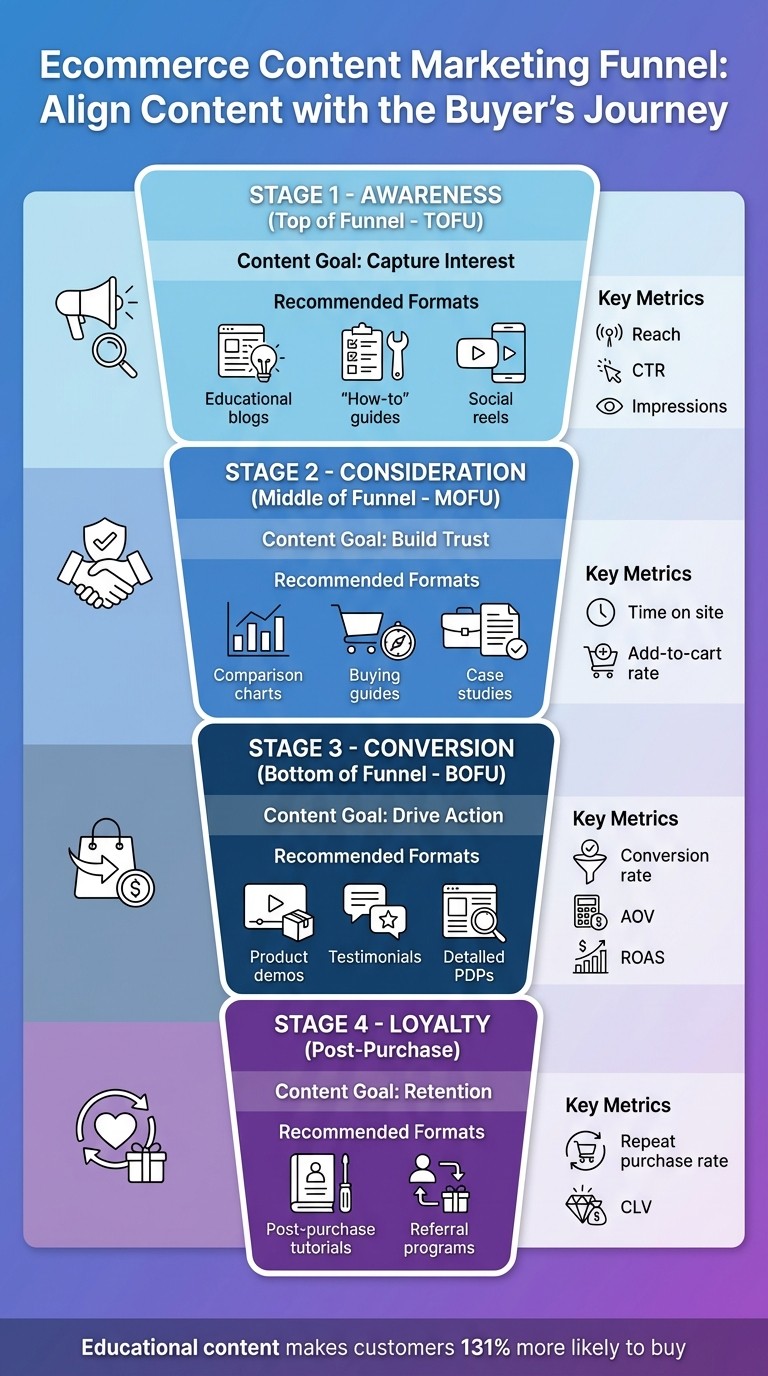
Content Marketing Funnel Strategy for Ecommerce: Content Types, Goals and Key Metrics by Stage
After crafting your strategic plan, the next step is choosing the right content formats to engage potential buyers at every stage of their journey. Each type of content serves a specific purpose: blog posts attract visitors researching solutions, product guides help shoppers compare options, short-form videos showcase your products in action, and customer reviews build trust for hesitant buyers. By aligning content formats with the buying journey, you can create a seamless path from discovery to purchase.
Research shows that engaging customers with educational content makes them 131% more likely to buy [10]. Additionally, content marketing generates about three times more leads than outbound efforts while costing 62% less [10]. The secret lies in matching the right content to your goals, ensuring every piece contributes to measurable outcomes.
SEO-Optimized Blog Posts and Product Guides
Blog posts are ideal for the awareness stage, drawing in visitors by answering questions, building trust, and introducing your brand. Product guides, on the other hand, help shoppers in the consideration stage by presenting detailed comparisons and assisting in decision-making [1].
For blogs, focus on topics that naturally tie back to your products, such as care tips, sizing advice, and use-case stories. REI, for example, uses a "gear education" strategy that combines practical advice with trip ideas, leading readers to product pages via contextual links and comparison charts.
Scaling content for large inventories can be streamlined by creating reusable components - like benefit statements and care instructions - that ensure consistency across product pages [3]. Start by auditing your current product descriptions, identifying areas with "thin content" (fewer than 150 words) or repetitive text that might hurt your search rankings [5].
To boost credibility, include author bylines, original images, and "last updated" dates on your blog posts. Structured data, such as Product and Review schema, helps search engines understand your content better. Additionally, mining customer reviews for common phrases and concerns can refine your keyword strategy and address buyer objections [3].
Here’s a simple framework to align content with the buyer’s journey:
Funnel Stage | Content Goal | Recommended Formats | Key Metrics |
|---|---|---|---|
Awareness (TOFU) | Capture Interest | Educational blogs, "How-to" guides, Social reels | Reach, CTR, Impressions |
Consideration (MOFU) | Build Trust | Comparison charts, Buying guides, Case studies | Time on site, Add-to-cart rate |
Conversion (BOFU) | Drive Action | Product demos, Testimonials, Detailed PDPs | Conversion rate, AOV, ROAS |
Loyalty | Retention | Post-purchase tutorials, Referral programs | Repeat purchase rate, CLV |
Short-Form Video for Social Media
Short-form videos have become essential for showing off your products in action. Platforms like TikTok and Instagram Reels are key discovery channels, especially for younger audiences. These videos allow you to highlight real-world performance and unique features that static images simply can’t capture.
Keep videos concise and engaging - demonstrating products in real-life scenarios with a clear call-to-action. With 79% of Shopify traffic coming from mobile devices [4], vertical, mobile-friendly formats are non-negotiable.
High production value isn’t necessary. In fact, simple behind-the-scenes clips or user-submitted videos often perform better than polished campaigns. Encourage customers to share their purchases by creating a branded hashtag, making it easy to collect and repurpose user-generated content.
Customer Reviews and User-Generated Content
Customer reviews and user-generated content (UGC) are powerful tools for converting hesitant buyers. They provide the social proof needed to reassure shoppers during the final stages of their journey.
"People trust real experiences more than marketing speak." - Entail Staff [10]
Incorporate reviews and UGC across your site: product and category pages, landing pages, and even email campaigns like abandoned cart reminders. Use a mix of formats, including text reviews, customer photos, video testimonials, and social media mentions. Highlight diversity by showcasing content featuring different body types, product configurations, or use cases.
Automate review collection through post-purchase emails or SMS campaigns, offering loyalty points or discounts as incentives. Rotate testimonials and UGC regularly to keep content fresh - stale reviews can erode trust. You can also use frequently asked questions from reviews to create FAQ sections, boosting both user experience and search visibility [3].
For a more active approach, consider building a brand community on platforms like Discord, Slack, or Facebook Groups. These spaces allow customers to share experiences and even co-create content.
"Community isn't just a flashy new marketing tactic; when done correctly, it will become one of your best organic growth engines." - Greg Shuey, CEO, Stryde [4]
Distribute and Repurpose Your Content
Creating great content is just the starting point - how you distribute it makes all the difference. Think of every piece of content as a reusable asset with multiple applications. A helpful framework to follow is the Hero-Hub-Hygiene model. Your "Hero" content serves as the centerpiece, like a detailed buying guide or a major product launch video. Supporting this are "Hub" pieces, such as social media posts, email snippets, or short-form videos, all designed to drive traffic back to your Hero content. Finally, "Hygiene" content consists of tailored variations, optimized for specific platforms and audience needs. Let’s dive into how you can share, repurpose, and promote content effectively.
Share Content Across Multiple Channels
Start by identifying where your audience spends their time and tailor your content for those platforms. For instance, a 2,000-word blog post can be transformed into various formats: Instagram carousels highlighting key points, a 60-second TikTok video summarizing the main idea, a three-part email series with actionable tips, or a condensed LinkedIn article aimed at B2B readers. This multi-channel approach ensures you reach customers at different stages of their journey.
To streamline this process, create a library of reusable content elements, such as benefit statements or product specifications. These can be repurposed across platforms, maintaining consistency while saving time. Imagine using the same product benefit statement in an email newsletter, on a product page, in an Instagram caption, and even in ad copy - without rewriting it each time.
Leverage automation tools like Repurpose.io and Buffer to adapt content for mobile-first platforms like TikTok, Instagram Reels, and YouTube Shorts. These tools help format content for short-form videos, which algorithms often prioritize for wider distribution.
Repurpose Content to Maximize ROI
Successful brands often follow a 60/40 budget split: 60% goes toward long-term brand-building efforts (like SEO blogs or storytelling videos), while 40% is allocated to performance-driven content, such as product ads or retargeting campaigns [4]. This strategy builds trust while also driving immediate results.
Don’t let your best content fade into obscurity. Refresh top-performing posts by updating keywords, statistics, or visuals to maintain their relevance and search rankings. Instead of starting from scratch, a simple update can breathe new life into older content.
In 2026, the supplement company Verde Wellness used Koro's "Auto-Pilot" mode to automate its social media efforts. By generating three UGC-style videos daily from existing product assets, they saved 15 hours per week and boosted their engagement rate to 4.2%, more than doubling their previous performance [13].
"In 2026, winning ecommerce content marketing strategies are going to be built like systems, not campaigns." - Greg Shuey, CEO, Stryde [4]
Once you’ve identified repurposed content that performs well, focus on amplifying its reach through paid promotion.
Use Paid Promotion for High-Priority Content
A good rule of thumb is the 80/20 promotion strategy: distribute 80% of your content organically to build trust and use paid promotion for the top-performing 20% to scale its impact [12]. Start by testing content organically, using engagement metrics like likes, shares, comments, and click-through rates to identify what resonates with your audience.
When you find a winning piece of content, amplify it with targeted ad campaigns on platforms like Facebook, Instagram, Google, or TikTok. For example, a blog post that drives strong organic traffic and conversions becomes even more valuable when supported by a paid campaign, as you already know it connects with your audience.
To keep your content fresh and relevant, set up automated triggers that adjust messaging based on real-time business conditions. For instance, you could automatically add urgency phrases when inventory levels are low [3]. This dynamic approach ensures your content stays timely without requiring constant manual updates.
Automate Content Marketing with Averi AI
Managing content marketing manually can feel like juggling too many tasks at once - spreadsheets, keyword tools, freelance writers, endless revisions, and CMS publishing - all while trying to grow your ecommerce business. Averi AI simplifies this chaos into one streamlined, automated system, handling everything from planning to publishing. This allows you to focus on selling products instead of getting bogged down by the content creation process.
What sets Averi apart from other AI tools is its ability to build a self-sustaining content engine. It adapts to your brand's voice, tracks performance, and even suggests new topics based on market trends and competitor activity. You guide the strategy, and Averi takes care of the rest. Here's how it works step by step.
Automate Strategy and Topic Research
Averi starts by analyzing your website to understand your products, messaging, and brand tone. It also evaluates your competitors to uncover content gaps and generates a tailored marketing plan in just 10 minutes. This initial setup ensures that every piece of content aligns with your goals.
From there, Averi operates continuously. It tracks industry trends, identifies high-intent keywords, and pinpoints content opportunities that resonate with your target audience. Instead of spending hours brainstorming or researching, you’ll receive a ready-to-go content queue, complete with suggested titles, keywords, and angles. All you have to do is approve what gets created.
AI-Powered Content Creation and Editing
Once you greenlight a topic, Averi dives into research, pulling in verifiable sources and hyperlinks. It drafts content using your brand’s unique tone, optimized to perform well on both traditional search engines like Google and newer AI-driven platforms like ChatGPT and Perplexity. This dual optimization ensures you capture traffic from both established and emerging search behaviors.
Averi’s real-time collaborative editor makes refining drafts easier than ever. Highlight a section, and you can request rewrites, expansions, or tone adjustments instantly. You can also tag teammates and leave comments for seamless collaboration. Features like internal linking suggestions and auto-generated meta descriptions eliminate time-consuming SEO tasks, speeding up the entire workflow. Once the content is finalized, Averi handles publication and keeps tracking its performance.
Publish and Track Performance Automatically
Averi integrates directly with platforms like WordPress, Webflow, and Framer, enabling automatic publishing of approved content. Thanks to its IndexNow integration, Averi notifies search engines the moment new content goes live, cutting down indexing time from weeks to just hours [5][11]. Each published piece is saved in your Library, creating a knowledge base that helps future AI drafts become even more aligned with your brand voice.
But Averi doesn’t stop at publishing. Its performance tracking goes deeper than standard analytics. It monitors impressions, clicks, keyword rankings, and even revenue per visitor, turning this data into actionable insights. For example, if a post is stuck at rank #8, Averi provides steps to push it to the top of page one. If a competitor publishes on a trending topic, it suggests a counter-strategy. This ongoing feedback loop ensures your content strategy stays sharp and delivers tangible results for your ecommerce business.
Measure Results and Improve Conversions
Publishing content is just the beginning. To turn traffic into revenue, it's essential to track performance, identify areas for improvement, and refine your strategy. Ecommerce brands should monitor metrics across every stage of the customer journey - from awareness to conversion to retention - using these insights to fine-tune their content approach.
Track Key Performance Metrics
Different stages of the customer journey require different metrics. For awareness-stage content like blog posts or guides, focus on reach, impressions, and click-through rates (CTR) to assess whether your content is being discovered. For consideration-stage content, such as product comparisons or detailed guides, track metrics like time on page, add-to-cart rates, and email signups to measure engagement. At the conversion stage, key indicators include conversion rate (CVR), average order value (AOV), and return on ad spend (ROAS) to evaluate revenue impact. Retention metrics, such as customer lifetime value (CLV) and repeat purchase rate, provide insight into whether your content is fostering long-term loyalty [2].
Beyond traditional metrics, pay attention to AI visibility. Track how often AI assistants like ChatGPT, Claude, or Perplexity mention your brand and in what context [5][11]. As recommendation traffic from AI platforms grows, optimizing for this visibility can lead to increased conversions. These metrics not only measure success but also inform adjustments to ensure every piece of content contributes to your bottom line.
Update Content Based on Performance Data
Evaluate your content's performance and act quickly. For instance, pages with high traffic but low conversions might need stronger calls-to-action or better messaging to address customer concerns. Product pages with brief descriptions (under 150 words) or duplicate content across variations should be refreshed with unique, detailed information [5][3].
Customer reviews are another goldmine for insights. Recurring themes - like "hydration" for skincare or "fit issues" for clothing - can guide updates to your content to address these concerns directly [3][4]. If a blog post is underperforming in search rankings, consider adding depth, updating statistics, or improving internal links to boost visibility. When competitors publish on trending topics, creating a counter-angle or more in-depth guide can help you capture additional traffic. These strategies, whether traditional or AI-powered, ensure your content remains relevant and effective.
Manual vs. AI-Driven Content Marketing
Performance data also helps you decide whether to stick with manual processes or transition to AI-driven workflows. The main differences between the two lie in scalability, speed, and consistency. Manual workflows often involve managing freelancers, tracking spreadsheets, and optimizing content piece by piece - an approach that limits output. On the other hand, AI-driven systems like Averi can handle thousands of SKUs, automate SEO and GEO optimization, and continuously improve based on performance data [5][11].
Feature | Manual Content Process | AI-Driven Workflow |
|---|---|---|
Scalability | Limited by team size | High (handles thousands of SKUs) |
Optimization | Manual keyword insertion | Automated SEO/GEO optimization |
Time to Publish | Days to weeks | Hours to days |
Cost | High (freelancers, tools) | 62% lower than outbound marketing [10] |
Consistency | Varies by writer | Maintains brand voice across content |
Content marketing generates three times as many leads as outbound marketing while costing 62% less, and customers who engage with educational content are 131% more likely to make a purchase [10]. The key is to build a system that tracks performance, adapts based on data, and continuously improves - turning content marketing into a reliable revenue generator.
Conclusion
To transform your content into a revenue-generating engine for your ecommerce brand, focus on a systematic approach. Start by identifying your target audience, setting clear, measurable goals for each stage of the funnel, and creating content that addresses genuine customer needs. This means crafting SEO-friendly guides for awareness, detailed product comparisons for consideration, and leveraging customer reviews to drive conversions. Distribute your content wisely across channels, repurpose successful pieces, and continuously monitor performance to refine your strategy.
Manual workflows can restrict both productivity and scalability. Averi AI eliminates these barriers by automating the entire content process - from strategy and topic research to AI-driven drafting, SEO/GEO optimization, and direct CMS publishing. You make the decisions; Averi handles the execution. The result? A growing content library, improved search rankings, and a system that gets smarter with every publish.
Adopt the 60/40 budget rule - dedicating 60% to long-term brand building and 40% to conversion-focused tactics - and apply tiered prioritization to allocate top resources to high-margin products. For lower-tier SKUs, rely on automated content solutions [3][4]. Build modular content libraries using reusable blocks, such as care instructions, brand narratives, and technical specifications, to ensure consistency across thousands of product listings [3].
The statistics speak volumes: content marketing generates three times more leads than outbound methods while reducing costs by 62% [10]. Moreover, increasing customer retention by just 5% can boost profitability by as much as 95% [2]. The most successful brands aren't just creating content - they're implementing systems that execute strategies, optimize results, and scale effortlessly.
Shift your perspective from isolated campaigns to a scalable content infrastructure. Sign up for Averi's AI Marketing Workspace and turn your content into an automated powerhouse that drives visibility, conversions, and growth - all while you focus on growing your business.
FAQs
How do I choose content topics that actually lead to sales?
To create content that resonates, focus on delivering value tailored to your audience's needs and search intent. Dive into the questions your customers are asking or the challenges they face, and craft responses through engaging storytelling, practical guides, and material optimized for search engines. Leverage AI tools and audience research to pinpoint high-traffic keywords, evaluate competitors’ strategies, and keep pace with evolving trends. By addressing real problems and offering meaningful solutions, you not only build trust but also boost the chances of converting engagement into sales.
What should I track to prove content marketing ROI in ecommerce?
To demonstrate the return on investment (ROI) of content marketing in e-commerce, focus on metrics that connect your content strategies to both revenue and audience engagement. Start by analyzing website traffic, conversion rates, and sales generated from content campaigns. These figures provide a direct link between your efforts and financial outcomes.
Additionally, keep an eye on search visibility and engagement metrics such as time spent on page and bounce rates to evaluate how well your content resonates with your audience. Beyond these, assess customer acquisition costs (CAC) and lifetime value (LTV) to understand the broader impact of your content on customer relationships. Finally, measure how your content influences the sales funnel, as this highlights its role in driving revenue and fostering customer loyalty.
How can I use AI to scale content without losing my brand voice?
To effectively expand your content using AI without losing your brand's voice, it's crucial to establish structured workflows and detailed style guidelines. AI can efficiently handle repetitive tasks such as writing product descriptions, but human oversight is essential to maintain the right tone and ensure consistency. Incorporating regular audits, training the AI to understand your brand's specific language, and implementing quality control measures will help preserve authenticity and keep your content aligned with your brand identity.
Related Blog Posts

Zach Chmael
CMO, Averi
"We built Averi around the exact workflow we've used to scale our web traffic over 6000% in the last 6 months."
Your content should be working harder.
Averi's content engine builds Google entity authority, drives AI citations, and scales your visibility so you can get more customers.