

In This Article
Practical strategies for education platforms to attract and convert learners using personas, AI-powered content workflows, SEO, and multi-channel distribution.
Updated:
Trusted by 1,000+ teams
Startups use Averi to build
content engines that rank.
Education platforms face a unique challenge: learners take time to decide on programs, often conducting extensive research. Content marketing helps guide them through this process, building trust and driving enrollments. Here’s what works:
Impact of Content: Engaging educational content increases conversions by 131% and generates 3x more leads than traditional ads, while costing 62% less.
AI Tools: AI platforms like Averi simplify tasks like research, SEO, and content creation, saving time and boosting efficiency.
Effective Strategies: Focus on learner personas, competitor analysis, and AI-powered content strategy to streamline efforts and connect with your audience.
Formats That Work: Blogs, videos, webinars, and tools like ROI calculators resonate with learners at different decision stages.
Distribution: Combine SEO and social media strategies to maximize content reach, targeting both traditional search engines and AI-driven tools.
How To Do Epic Content Marketing for Higher Education With Author and Content Strategist Brian Piper
Building a Content Strategy for Education Platforms
Without a clear plan, crafting content for education platforms can drain resources without delivering results. The key is to develop a strategy that connects with your audience, fills gaps left by competitors, and scales efficiently without overburdening your team. Here’s how to build a system that drives enrollment through targeted, high-quality content.
Defining Your Learner Personas
Start by understanding who’s already engaging with your platform. Analyze your current student base to identify trends - are you attracting STEM enthusiasts, working professionals seeking flexible learning options, or first-generation students prioritizing affordability? These insights will help you focus your content where it matters most.
Create 1–2 detailed personas representing your ideal future students. For example, are you targeting high schoolers exploring college options or adults considering a career shift? Identify their primary concerns, such as cost, job placement, or schedule flexibility. Use tools like Google Analytics, SparkToro, and student surveys to gather meaningful data.
Next, map these personas to a full-funnel student journey:
Awareness stage: Prospective students find you via SEO-optimized articles or social media posts.
Consideration stage: They evaluate your programs through reviews, testimonials, or outcome data.
Decision stage: They need hands-on experiences like free trials or guidance from enrollment counselors.
Tailor your content to address these stages. For example, a high schooler might benefit from "Day in the Life" videos, while a working professional might prefer ROI calculators or job placement statistics.
Persona Segment | Primary Content Needs | Key Decision Drivers |
|---|---|---|
Students | Guides, video tutorials, "Day in the Life" clips | Affordability, flexibility, job placement |
Educators | Classroom tools, lesson plans, teaching frameworks | Ease of use, student engagement, academic standards |
Administrators | ROI calculators, implementation roadmaps, case studies | Scalability, compliance (FERPA/GDPR), cost-efficiency |
Analyzing Competitor Content
Understanding what your competitors are doing can reveal opportunities to stand out. Examine their blogs, content formats, and high-ranking topics. Research shows that businesses publishing 9+ blog posts monthly experience 35.8% traffic growth compared to 16.5% for those posting just 1–4 times [2]. Consistency and quality both matter.
Look at how competitors structure their content. Using headers that answer specific user questions can improve your chances of being cited in AI-generated summaries. With AI-driven traffic showing higher conversion rates, optimizing for both traditional search engines and AI platforms is now a must.
Manual competitor analysis can be time-consuming, but tools like Averi simplify the process. Averi tracks competitor activity, identifies content gaps, and suggests high-potential topics, saving you hours each week.
Automating Your Content Plan
Automation can take your content strategy to the next level. For example, between 2022 and 2025, Colliers partnered with D2L for Business to scale their training content. By aligning content efforts with specific business goals, they grew course enrollments from 4,000 to over 10,000 - a 173% increase - while maintaining a 4/5 quality rating from 85% of learners [1].
Similarly, telehealth platform Wyndly leveraged AI-driven workflows to scale content production from 40 to 200 articles per month - a 5x increase. This approach boosted organic traffic by 20x, reaching 200,000 monthly clicks, and increased organic customer acquisition by 28% [3].
Averi can do the heavy lifting for your education platform. It analyzes your website’s tone and positioning, researches trends, and monitors competitors to generate a tailored content plan. The system handles research, keyword analysis, and structuring, while your team focuses on approval and fine-tuning. This shift from constant planning to strategic oversight lets you prioritize quality without scrambling for ideas.
Creating Content That Educates and Engages
The right content format can determine whether a prospective student clicks away or decides to enroll. Education platforms must create content that answers pressing questions, establishes trust, and demonstrates value - all before asking for any commitment. The secret lies in aligning the format with its purpose and using AI to scale production while maintaining high standards. By pairing thoughtful content strategies with AI-powered tools, platforms can turn curious prospects into enrolled learners.
Choosing the Right Content Formats
Once your content strategy is in place, selecting the right format becomes essential to connecting with various learner groups. Blog posts are perfect for driving SEO traffic and addressing common questions like "Is an online MBA worth it?" or "How can I study for the LSAT with a full-time job?" These posts position your platform as a reliable resource and attract students actively researching their options.
Video content is ideal for showcasing course previews, sharing student success stories, or simplifying complex topics through tutorials. Formats like "White Board Fridays" make challenging concepts more digestible while giving prospects a glimpse of your teaching approach. Webinars and live Q&A sessions allow prospective students to engage directly with instructors or experts, building trust during the decision-making process.
When prospects reach the decision stage, free mini-courses offer a low-risk way to experience your platform’s value firsthand. Tools like ROI calculators help administrators justify the investment, while downloadable guides such as "How to Compare Online Courses" provide in-depth resources for serious decision-makers. Infographics are another powerful tool, turning data like job placement rates or salary outcomes into visually engaging, shareable content across social platforms.
One standout example comes from AdvisorStream, which between January and June 2020 saw a 200% increase in views and a 260% boost in lead capture by integrating licensed content from The New York Times and Harvard Business Review [4].
AI technology plays a pivotal role in streamlining the creation of these formats, enabling platforms to maintain quality while scaling production.
Using AI to Draft and Optimize Content
AI tools like Averi remove the bottlenecks between content planning and publishing. Instead of hours of manual work, these tools can generate SEO-optimized drafts in just minutes. Averi analyzes your website to learn your brand voice and applies that understanding consistently across all content types, whether it’s study guides, course descriptions, or enrollment FAQs.
The process is straightforward. Averi conducts in-depth research with hyperlinked sources, organizes content for both Google search and AI platforms like ChatGPT and Perplexity, and even generates metadata automatically. Your team can then focus on refining the tone, adding unique insights, and verifying facts rather than starting from scratch.
For education platforms producing content at scale, this shift to AI-assisted workflows means faster turnaround times, increased output, and steady quality. The system also learns from every published piece, becoming more effective over time while leaving final approval firmly in your hands.
This AI-driven approach not only speeds up content production but also lays the groundwork for automated content workflows that can expand your platform’s reach even further.
Automating Content Workflows with AI
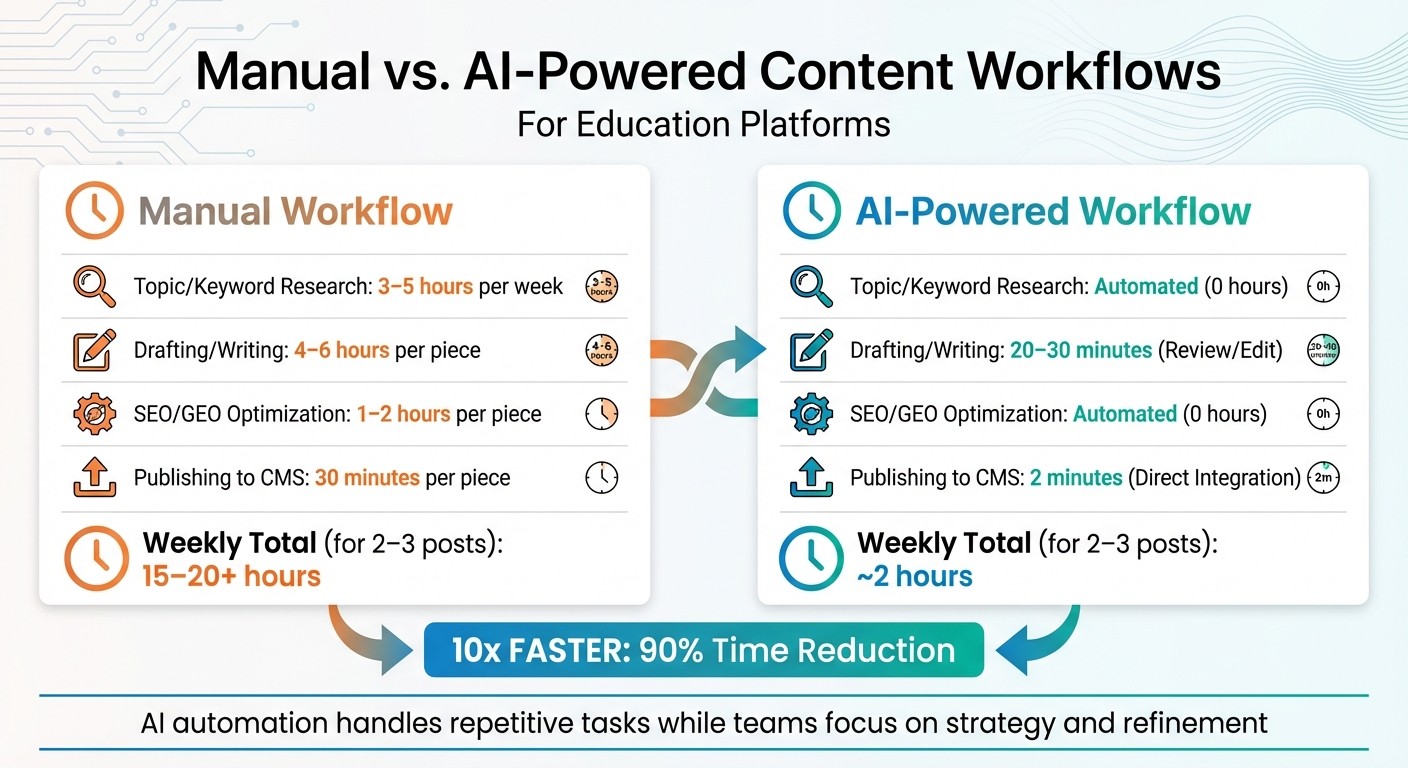
Manual vs AI-Powered Content Workflow Comparison for Education Platforms
Education platforms producing large volumes of content often hit snags due to time-intensive manual tasks. Creating a single blog post, course guide, or student spotlight involves multiple steps - research, drafting, editing, SEO optimization, and publishing. These processes can easily take 15–20 hours a week for just a handful of pieces. AI tools like Averi eliminate these hurdles by automating the workflow from start to finish, freeing your team to focus on fine-tuning rather than repetitive tasks. With Averi's built-in research, editing, and publishing features, the process becomes even more efficient.
Automating Research, Editing, and Publishing
Averi simplifies every stage of content creation. Its automation tools constantly track audience preferences, competitor trends, and emerging topics, ensuring your content pipeline stays relevant and up-to-date [1].
Once a topic is selected, Averi generates SEO-optimized drafts in a matter of minutes. Through its collaborative editing canvas, teams can adjust tone, inject unique insights, and verify facts in real time. Additional features like internal linking, meta descriptions, and FAQ schema streamline the optimization process. The result? Publishing time drops from 30 minutes to just 2 minutes per post within its fully automated system [1][2].
Publishing is seamless, too. Averi connects directly to platforms like WordPress, storing all content in a central Library. This repository helps the AI improve its drafts over time, making future content creation even faster. Sarah Chen, Founder of TechScale, shared her experience:
"We accomplished more in two weeks with Averi than we did in three months with our previous agency. The combination of AI speed and expert execution is exactly what we needed" [1].
Comparing Manual vs. AI-Driven Workflows
Manual workflows depend heavily on human effort at every stage, leading to delays and inconsistent results. In contrast, AI-powered workflows automate these processes while maintaining high standards through data-driven adjustments. The time savings are striking, as shown below:
Activity | Manual Workflow | AI-Powered Workflow |
|---|---|---|
Topic/Keyword Research | 3–5 hours per week | Automated (0 hours) |
Drafting/Writing | 4–6 hours per piece | 20–30 minutes (Review/Edit) |
SEO/GEO Optimization | 1–2 hours per piece | Automated (0 hours) |
Publishing to CMS | 30 minutes per piece | 2 minutes (Direct Integration) |
Weekly Total (for 2–3 posts) | 15–20+ hours | ~2 hours |
With AI handling these tasks, education platforms can scale their content output - whether it’s student success stories, enrollment guides, or webinars - without adding extra team members. AI ensures consistency in tone and SEO alignment across all formats, eliminating the variability that often comes with manual processes [1][5]. By slashing production time, teams can shift their focus to creating content that truly engages and attracts students.
Distributing Content to Reach More Learners
Creating great content is only half the battle - getting it in front of the right learners is just as critical. To truly connect with your audience, education platforms need a multi-channel distribution strategy that blends high-intent avenues like organic search with discovery platforms such as social media.
Organic search remains a cornerstone for driving results. It accounts for 44.6% of all B2B revenue and captures learners actively seeking courses, certifications, or educational resources [2]. However, traditional SEO alone no longer cuts it. With AI-powered search tools like ChatGPT and Perplexity on the rise, platforms must now optimize for both Google rankings and AI citations to stay visible.
Social media, on the other hand, excels at building awareness and engagement rather than immediate conversions. Platforms like LinkedIn are ideal for professional development programs, while Instagram and TikTok cater to visually engaging content, such as student success stories or quick learning tips. Since over 60% of students use mobile devices to research educational programs, ensuring your social content is mobile-friendly is a must [1]. YouTube serves as a hybrid, functioning as both a search engine and a discovery platform, making it a powerful tool for showcasing course previews, testimonials, and explainer videos [1].
Repurposing content across multiple channels is a smart way to maximize impact. For instance, a comprehensive guide can be transformed into a LinkedIn article, email series, social media posts, and even short video scripts [2]. Consistency is key - companies that publish 9+ blog posts per month see 35.8% traffic growth, compared to just 16.5% for those posting 1–4 times [2].
Using Social Media and SEO for Distribution
Combining SEO with social media creates a well-rounded approach to both capturing demand and building awareness. Start by focusing on SEO basics - target relevant keywords like "best online marketing courses" or "data science certification programs." Structure your content with clear headers, FAQ sections, and 40–60 word summaries at the start of key sections to increase the chances of being cited by AI search tools [2]. Implementing FAQ schema markup on educational posts can further improve visibility on both Google and AI platforms [2].
Social media broadens your reach beyond search results. LinkedIn is a hub for thought leadership and professional courses - share insights, success stories, and industry trends. Instagram and TikTok shine in visual storytelling, offering behind-the-scenes glimpses, quick tips, or transformation stories. Meanwhile, YouTube doubles as a search engine, so optimize video titles and descriptions with the same keyword strategy used for blogs [1].
Repurposing content ensures you get the most out of every asset. A single long-form guide or webinar can be broken down into 15–20 pieces of content. Pull quotes for social posts, create email sequences, or extract short video clips for TikTok or Instagram Reels. Tools like OpusClip can even automate the process of generating high-engagement clips from longer educational videos [6]. This approach stretches the value of your content without stretching your production resources.
Don’t overlook niche platforms like Class Central or Course Report, which cater to audiences actively comparing educational programs. Partnering with blogs, alumni referral programs, or guest posts on education-focused websites can also build credibility and drive targeted traffic [1]. Each channel plays a unique role in guiding learners from discovery to enrollment.
Tracking Distribution Performance
To refine your strategy, track key metrics that reveal which channels and tactics are working. Start with traffic sources - use tools like Google Analytics to determine whether organic search, social media, email, or referrals are driving the most visitors. Dive deeper into organic traffic to identify which keywords and pages are performing well.
Focus on keywords ranked between #10 and #30, as these are often the easiest to improve. Small tweaks to content already close to page one can lead to noticeable traffic boosts [2]. Monitor keyword rankings weekly to catch trends early.
For social media, prioritize engagement metrics over vanity numbers. While impressions are useful, clicks, shares, and comments provide a clearer picture of what resonates with your audience. Use platform-specific analytics tools like LinkedIn Analytics, Instagram Insights, or YouTube Studio to understand which content formats - videos, carousels, or text posts - perform best on each platform.
Lastly, track conversion metrics to tie your efforts back to business outcomes. How many visitors from each channel are converting into leads or course sign-ups? AI-referred traffic is particularly valuable, converting at 4.4x the rate of traditional search, so monitor these referrals separately [2]. Use UTM parameters on social links to follow the full journey from click to enrollment.
Let the data guide your next steps. If a blog post is ranking #8 for a high-value keyword, update it with fresh insights to push it higher. If a LinkedIn post generates 3x more clicks than others, replicate its style and tone. If video content outshines text on Instagram, allocate more resources to video creation. By continuously analyzing performance, you can fine-tune your strategy to maximize impact.
Measuring Results and Improving Over Time
For content marketing to thrive, it’s crucial to track performance effectively. Education platforms, in particular, need to identify the right metrics, make data-driven decisions, and understand the full cost of their content operations. AI tools are now stepping in to automate much of this analysis, allowing teams to focus on strategy instead of crunching numbers.
Tracking the Right Metrics
Not all metrics hold the same weight. Success depends on aligning metrics with the stages of your funnel and focusing on those that drive meaningful outcomes. For top-of-the-funnel efforts, focus on impressions, clicks, and site visitors to measure awareness. In the middle of the funnel, key metrics include time on page, bounce rate, and soft conversions like email signups to evaluate engagement. For bottom-of-the-funnel content, focus on form completions, enrollment rates, and revenue generation.
"Revenue has to be the mother of all metrics. It's what we're here for, right?"
HubSpot’s Founder and CTO, Dharmesh Shah, echoes this sentiment:
"The most important metric for us in measuring the success of our content efforts is number of qualified leads" [8].
SEO performance also plays a critical role. Metrics like keyword rankings, click-through rates (CTR), and impressions reveal how discoverable your content is. Pay special attention to keywords ranked between #10 and #30, as these are often the easiest to improve with targeted updates [2]. For lead generation, track inquiries, application rates, and cost per lead (CPL) to evaluate which content is delivering results [7][10].
However, marketers face challenges in this area: 48% cite difficulty in correlating data across platforms as their top obstacle, and only 49% believe their organization measures content performance accurately [9]. A centralized analytics tool or AI-powered dashboard can simplify this process by consolidating data from sources like Google Analytics, social media platforms, and CMS systems into one view.
Once the metrics are clear, the next step is to act on the insights they provide.
Using Data to Guide Next Steps
Collecting data is only the beginning. The real value lies in translating it into actionable steps. AI tools like Averi AI can analyze performance and suggest updates - whether that’s optimizing a blog post ranking #8 for a high-value keyword or responding to a competitor’s trending content with a counter-angle.
This automation saves significant time. Tasks like keyword research, which typically take 3–5 hours, and SEO optimization, which can take 1–2 hours per piece, are handled in the background. AI tools also monitor leading indicators like content completion rates for immediate feedback, while lagging indicators such as revenue growth and customer retention inform long-term strategy.
For example, Google Analytics assigns a "page value" to content, offering a clear picture of how engagement translates into revenue. This helps identify which types of content - whether guides, case studies, or comparison posts - are delivering the most financial impact.
Consider the University of LaVerne College of Law as a case study. Facing low search visibility, they conducted a technical audit that uncovered 25,000 issues. By implementing a strategic content optimization plan targeting high-value keywords for their Juris Doctor programs, they significantly boosted organic search rankings and attracted more qualified traffic [10]. This kind of data-driven decision-making transforms content from a cost center into a growth driver.
By combining data with clear, actionable steps, education platforms can refine their strategies to drive enrollment while maximizing the efficiency of AI-driven workflows.
Comparing Costs: Manual vs. AI-Powered Approaches
Understanding the total cost of content operations is essential. Traditional methods often rely on freelancers, agencies, or in-house teams, which can quickly become expensive. AI-powered tools like Averi AI offer a more cost-effective alternative without sacrificing quality.
Here’s a breakdown of costs across different team sizes:
Segment | Traditional Manual Method (Estimated) | Averi AI Powered Approach |
|---|---|---|
Startup | ~$2,500 - $5,000/mo (Freelancers/Time) | $100/mo (Plus Plan) |
Growth Team | ~$10,000 - $20,000/mo (Agency/Headcount) | $100/mo + Expert Review add-ons |
Enterprise | $50,000+/mo (Full Internal Team) | Custom Enterprise Tier |
Cost per Blog Post | ~$500 - $800 | ~$20 - $120 (including human review) |
The time savings are equally striking. A traditional workflow for producing 8–12 posts per week can take over 15–20 hours, including 3–5 hours for topic research, 4–6 hours for writing, 1–2 hours for SEO optimization, and 30 minutes for publishing. With an AI-driven content engine, this workload drops to just 2 hours per week, as automation handles most tasks, leaving humans to focus on review and approval.
The return on investment is clear. AI-referred traffic converts at 4.4 times the rate of traditional organic search [2], and organic search leads close at a rate of 14.6%, compared to just 1.7% for outbound marketing leads [2]. When you combine these performance gains with the cost savings, it’s evident that AI-powered workflows offer both efficiency and smarter results.
Conclusion
Content marketing for education platforms isn't just about producing more material - it's about creating a scalable system that delivers results. The strategies outlined here offer a clear roadmap: start by defining detailed learner personas, identify content gaps through competitor analysis, and use AI content creation strategies to maintain consistency. Choose formats that both inform and engage, and make use of AI tools to streamline research, drafting, and SEO efforts. From there, distribute your content effectively via SEO and social platforms, track meaningful metrics, and let the data shape your ongoing strategy.
Traditional manual workflows can be resource-intensive, but AI-powered tools like Averi AI simplify the process, significantly reducing labor while being more cost-efficient, with plans starting at $100 per month.
The performance benefits speak for themselves. Traffic driven by AI converts at 4.4 times the rate of traditional organic search, and businesses with active blogs see a 67% increase in lead generation compared to those without blogs [2]. These results can turn content marketing into a powerful growth engine rather than just another expense.
AI tools help lay the foundation for a self-improving, data-driven content system. By automating tasks like research and drafting, these tools allow your strategy to evolve with each new publication. Over time, this approach strengthens your content library, improves search rankings, and sharpens your brand voice - creating a cycle where every new piece builds on the success of the last.
As the education sector increasingly shifts toward personalized, AI-driven experiences, platforms that embrace these tools will stand out. By automating workflows, scaling high-quality content, and making decisions based on data, these platforms will be better equipped to attract, engage, and retain learners. Start building your content engine today, and let AI handle the heavy lifting while you focus on growing your platform and supporting your learners.
FAQs
How do I choose the best content topics for my learners?
To choose the most effective content topics, start by centering your approach on the needs, challenges, and interests of your audience. Begin by clearly defining who your target audience is, then map out their journey to understand what they’re looking for at different stages. Dive into trending questions and uncover areas where existing content falls short, offering solutions that truly add value. Leverage AI tools to simplify your research process and tailor topics to your audience, ensuring your content stays relevant, engaging, and aligned with search intent.
Which content formats drive enrollments fastest?
Video content, particularly webinars and live sessions, is one of the quickest ways to drive enrollments. By directly engaging audiences and offering immediate value, these formats create a powerful connection with viewers. Their interactive and shareable qualities make them especially effective at boosting conversions, solidifying their role as a key element in successful content marketing strategies.
How can I measure content ROI beyond traffic?
To gauge the return on investment (ROI) of your content beyond just traffic numbers, shift your focus to measurable business outcomes like revenue, pipeline influence, and customer lifetime value (CLV). Leverage data-driven techniques to directly tie your content efforts to conversions and sales. Key metrics to track include attribution models, customer behavior patterns, and performance analytics. These insights help clearly demonstrate how your content contributes to growth, ensuring your investments are backed by results that go far deeper than simple pageview counts.
Related Blog Posts

Zach Chmael
CMO, Averi
"We built Averi around the exact workflow we've used to scale our web traffic over 6000% in the last 6 months."
Your content should be working harder.
Averi's content engine builds Google entity authority, drives AI citations, and scales your visibility so you can get more customers.