

In This Article
Patient-focused content strategies for healthcare: E-E-A-T credibility, AI-assisted workflows, SEO/AEO, and measurement to boost trust and appointment conversions.
Updated:
Trusted by 1,000+ teams
Startups use Averi to build
content engines that rank.
Healthcare content marketing is about providing clear, accurate, and patient-focused information to build trust and help patients make informed decisions. With 80% of patients researching providers online and 70% looking up symptoms and treatments before visits, your content often serves as the first impression. A well-executed strategy can deliver a 200%-500% ROI, yet only 28% of healthcare marketers have a clear plan.
Key Takeaways:
Listen to Patients: Address real questions and concerns gathered from your clinical team and patient behavior analysis.
Focus on Trust: Use Google's E-E-A-T principles - Experience, Expertise, Authority, Trust - to establish credibility.
Content Formats That Work: Blog posts, videos, infographics, and patient testimonials are effective tools for education and engagement.
AI Tools: Use AI for content research, drafting, and performance tracking while ensuring human oversight for medical accuracy.
Measure and Update: Regularly update content and track metrics like appointment bookings, patient acquisition costs, and engagement to refine your efforts.
By combining patient insights, AI tools, and consistent publishing workflows, healthcare organizations can create content that informs, reassures, and drives measurable growth.
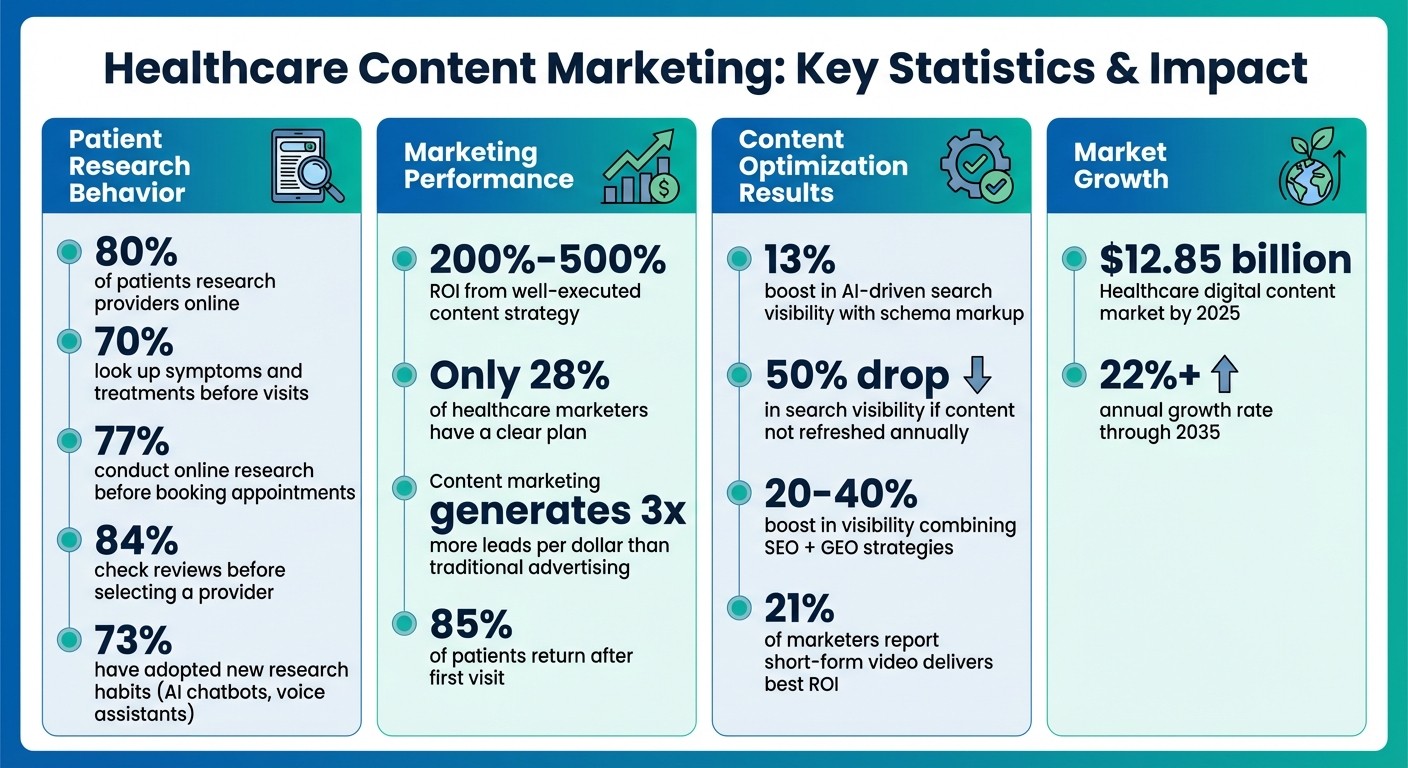
Healthcare Content Marketing Statistics and ROI Impact
How To Amplify Healthcare Marketing With AI Content Strategy
Building a Patient-Focused Content Strategy
Creating healthcare content that truly resonates with patients begins with one simple principle: listen before you write. The most impactful content addresses real questions and concerns that patients have. By understanding their needs, search habits, and collaborating with your clinical team, you can craft material that educates, reassures, and helps patients make informed decisions.
Understanding Patient Needs and Search Behavior
A great starting point is to talk to your in-house experts - doctors, nurses, and therapists who interact with patients daily. They often hear the same questions repeatedly, questions that may not appear in keyword research tools but are crucial to patients. Combine these insights with tools like Hotjar and Google Analytics to uncover patterns in patient behavior. From there, integrate targeted keyword research to identify common searches, such as symptom-related queries, treatment options, and insurance concerns.
For example, patients searching for terms like "when to see a cardiologist" or "is physical therapy covered by insurance" are looking for clear, reliable answers. Your content should meet them exactly where they are in their journey.
Leveraging E-E-A-T Principles (Experience, Expertise, Authority, Trust)
In healthcare, trust is non-negotiable. Google's E-E-A-T framework - Experience, Expertise, Authority, Trust - is a cornerstone for building credibility. Every article should highlight author credentials and the verification process. Include bylines from qualified professionals, cite peer-reviewed studies, and outline the medical review process for added transparency.
Technical enhancements like structured data and schema markup can make a big difference. Adding schema for author credentials, publication dates, and medical review status can boost your content’s visibility in AI-driven search by 13%[3]. These small but impactful steps signal both credibility and authority to search engines and, more importantly, to patients.
Balancing Patient Education with Organizational Goals
Effective content doesn’t just inform - it also aligns with your organization’s objectives. Map your content to the patient journey. For instance:
Awareness-stage content: Symptom guides or FAQs to attract attention.
Consideration-stage content: Treatment comparisons or expert advice to guide decision-making.
Decision-stage content: Testimonials, booking tools, and insurance FAQs to convert interest into action.
"You can't manage what you can't measure. With a healthcare content strategy, you can plan and schedule deliverables, monitor results, and measure against expectations." - Stewart Gandolf, CEO, Healthcare Success[4]
Keep content fresh by revisiting and updating it annually. Research shows that search visibility can drop by 50% if content isn’t refreshed at least once a year[3]. Regular updates ensure your information stays relevant and maintains its ranking.
Next, consider how to present this information in formats that engage and connect with your audience.
Content Formats That Work in Healthcare
Once you've crafted a strategy centered on patient needs, the next step is deciding how to present your message. Choosing the right content format ensures your message resonates across social platforms, search engines, and decision-making moments. Each format plays a unique role in guiding patients through their journey, and knowing when to use each can significantly impact engagement and conversions. Below are the formats that effectively connect with patients at various stages.
Educational Blog Posts and Articles
Blog posts are the cornerstone of organic and AI-driven search visibility in healthcare marketing. The secret lies in addressing the questions patients are actually asking. Instead of focusing on clinical jargon like "myocardial infarction", write for how patients search: "chest pain that won’t go away" or "heart attack symptoms in women." These relatable phrases capture patients who may not yet have a diagnosis.
To stand out in search results, use concise summaries, bullet points, and schema markup. Research the top 20 patient questions for a particular condition and let them guide your blog topics. For instance, a cardiology practice could create posts like "When to See a Cardiologist", "What Happens During a Stress Test", or "Natural Ways to Lower Cholesterol." This approach ensures your content aligns with patient intent and search trends.
Videos and Infographics for Visual Learning
Video content is unparalleled when it comes to building trust. Short videos (15–60 seconds) on platforms like Instagram and TikTok are perfect for raising awareness - think quick symptom breakdowns or debunking common health myths. Longer YouTube videos (3–8 minutes) work best for in-depth education, such as explaining chronic condition management or walking patients through a medical procedure. Videos led by physicians add a personal touch, making complex topics more approachable.
Infographics are another powerful tool, simplifying intricate health topics into easy-to-understand visuals. Use them to explain treatment steps, highlight risk factors, or present recovery timelines. Platforms like Instagram and LinkedIn are great for sharing these as carousel posts, breaking dense information into bite-sized, shareable slides. Always include medical disclaimers in captions and as on-screen text to meet regulatory requirements.
In addition to visual content, real patient stories can further build trust and encourage action.
Case Studies and Patient Testimonials
Patient stories turn trust into action. Genuine testimonials provide the emotional assurance patients need to take the next step. Craft case studies with a clear "before-and-after" narrative, focusing on the patient’s emotional journey and lifestyle changes rather than specific medical outcomes to stay HIPAA-compliant.
Always secure written consent before sharing any patient story, and anonymize sensitive details when necessary. Display real-time testimonials or review widgets prominently on decision-making pages, such as service descriptions, provider bios, and booking confirmation screens. Adding employee-generated content, like behind-the-scenes posts from nurses or staff, can further personalize your brand.
When combined with educational and visual content, patient testimonials complete a well-rounded strategy. This mix of relatable stories, expert insights, and clear visuals helps patients feel informed, reassured, and ready to schedule their care.
Using AI Tools to Automate Content Marketing
Creating high-quality healthcare content takes time and effort. AI tools now handle many repetitive tasks - like topic research, drafting, optimization, and tracking performance - so human experts can focus on ensuring medical accuracy and making strategic decisions. This approach allows healthcare marketers to maintain consistent publishing schedules without overwhelming their teams.
AI tools designed for healthcare also help preserve the trust patients place in medical content. By integrating AI into a patient-focused strategy, organizations can streamline their processes without compromising the credibility their audiences expect.
Automating Content Strategy and Topic Research
AI tools simplify content planning by analyzing three key data sources: patient search behavior, competitor content, and areas where your service lines need more visibility. Instead of spending hours on manual keyword research, these platforms pinpoint high-value topics that align with your organization’s goals. They also track trends - like the fact that 73% of patients have adopted new research habits in the past year, including using AI chatbots and voice assistants[5] - and suggest content ideas that address where patients are seeking information.
The most effective systems continuously monitor your market and organize content ideas by type, such as condition explainers, procedure guides, symptom checkers, or FAQs. While the AI handles the groundwork, you retain control by reviewing and approving which ideas move forward. This ensures your content calendar is always aligned with real patient needs.
AI-Powered Content Drafting and Editing
Medical accuracy remains the top priority. Once a topic is approved, AI tools can draft an initial version that follows your brand’s guidelines and SEO practices. These drafts are structured to answer specific patient questions - like "What is a stress test?" or "When should I see a cardiologist?" - in clear, patient-friendly language. They also come preloaded with features like schema markup, internal links, and meta descriptions.
However, human oversight is critical. Medical professionals must review every piece to ensure it meets compliance, maintains the right tone, and adheres to medical standards. The ideal workflow combines AI for drafting with collaborative editing environments where clinicians, marketers, and compliance teams refine the content. This partnership lets AI handle the technical and structural aspects while humans ensure the final product resonates with patients and remains trustworthy.
AI can also optimize content for Generative Engine Optimization (GEO), which increases the likelihood of being cited by tools like ChatGPT, Perplexity, or Google’s AI Overviews. Healthcare organizations that combine SEO with GEO strategies report a 20-40% boost in AI-driven visibility compared to those relying only on traditional SEO[5]. When configured properly, AI tools manage this dual optimization automatically, helping your content reach both search engines and AI-generated platforms.
Performance Analytics and Continuous Improvement
AI analytics platforms go beyond tracking impressions and clicks - they provide actionable insights. Instead of manually sifting through data, you’ll receive clear recommendations like, "This article ranks #8 for 'heart attack symptoms' - here’s how to improve it", or "This trending topic could be addressed with this content angle."
Looking ahead, 21% of marketers say short-form video delivers the best ROI among all content types[5]. AI tools help healthcare organizations determine if this holds true for their audience by analyzing which formats drive the most engagement and conversions. This data-driven strategy ensures resources are allocated to the content types and service lines that perform best.
Over time, performance data feeds back into the content planning process, allowing AI tools to recommend ideas based on what’s already proven effective. This creates a system that continuously improves, turning individual projects into part of a larger, ever-evolving strategy.
Setting Up Workflows for Consistent Publishing
Producing weekly healthcare content requires workflows that ensure timely, accurate publication without unnecessary delays. A well-structured, multi-step process can leverage AI for repetitive tasks while relying on human expertise to maintain clinical accuracy and build patient trust.
The most effective workflows divide content creation into clear stages: drafting, internal brand review, medical review by licensed professionals, compliance checks, and final approval. Each stage has a designated owner and specific deadlines, such as a 48-hour turnaround for medical reviews, ensuring experts provide input without missing publishing goals.
Batching tasks can also streamline operations and reduce mental fatigue. Instead of juggling strategy, writing, and analytics all day, assign dedicated time blocks for each. For instance, focus on approving AI-generated ideas on Monday mornings, editing collaboratively midweek, and reviewing performance metrics on Fridays. This approach keeps the process efficient while reserving energy for critical responsibilities like verifying clinical accuracy. Such structured steps create a reliable and efficient content production system.
Review Processes for Medical Accuracy
Healthcare content demands rigorous oversight at every step. For example, in 2024, Cleveland Clinic adopted an AI-assisted workflow for patient education materials, such as diabetes brochures. AI generated drafts in under 30 minutes using a centralized repository of compliance requirements, and licensed medical professionals reviewed these drafts for factual and regulatory accuracy [1]. This hybrid method preserved quality while significantly reducing production time.
Review Stage | Responsible Party | Key Focus |
|---|---|---|
Drafting | AI / Content Writer | Brand alignment and initial research |
Internal Review | Marketing Manager | Tone, engagement, and SEO optimization |
Medical Review | Licensed HCP / SME | Clinical accuracy and evidence-based claims |
Compliance Review | Legal / Regulatory Team | HIPAA, FDA, and FTC compliance |
Final Approval | Editor / Founder | Publication readiness and scheduling |
Automated compliance checks further enhance efficiency by flagging issues like unsubstantiated health claims or missing disclosures early in the process. This minimizes last-minute edits and keeps the workflow on track. All health claims must be backed by credible sources such as the CDC, WHO, or peer-reviewed journals, with audit trails documenting every change for regulatory compliance. Such meticulous processes are key to maintaining clarity and trust in patient education.
Once accuracy is ensured, the focus shifts to improving visibility through tailored SEO strategies.
SEO and AEO Optimization for Search Visibility
While traditional SEO targets Google, Answer Engine Optimization (AEO) focuses on AI-driven search platforms like ChatGPT and Perplexity. Techniques like schema markup and localized keywords ensure content aligns with patient preferences. For instance, a cardiology practice in Phoenix might optimize for "cardiologist near me Phoenix" and use an FAQ schema that AI systems can easily interpret and cite.
Addressing symptom-based searches is another crucial tactic. Patients often search in everyday language rather than clinical terms. Instead of focusing solely on "menopause", consider incorporating phrases like "meno belly" or "why am I gaining weight in my 40s." In 2025, the telehealth platform Wyndly boosted its organic traffic from 10,000 to 200,000 monthly clicks by automating content research based on expert-led videos. This ensured articles were both authoritative and relevant to patient concerns [2].
Weekly Publishing Schedules for Ongoing Engagement
A consistent publishing schedule builds audience trust and strengthens your content strategy. Weekly updates signal freshness to search engines while keeping readers engaged. AI tools can play a pivotal role by continuously generating content ideas, eliminating the Monday morning scramble to find something to publish.
Regular performance reviews, both weekly and quarterly, allow for adjustments to tactics. For example, if short-form videos begin outperforming blog posts, quarterly reviews can help shift resources toward video production.
Marketing lead Sung Jo at Descript used AirOps to update over 1,000 existing content pieces, leading to a 35% increase in organic traffic and a 33% boost in AI search visibility within just 60 days [3].
This approach treats your content library as a dynamic resource, constantly refined based on performance data. The workflow evolves over time - AI tools optimize content, performance insights reveal what works, and your publishing schedule adapts to keep delivering results.
Measuring Results and Scaling Your Content Efforts
To ensure long-term success, simply publishing content isn’t enough. The real growth happens when you measure outcomes and scale based on solid data. Moving away from vanity metrics like page views toward actionable indicators - such as appointment bookings and patient acquisition costs (PAC) - provides a clearer picture of your content’s impact [7][9].
Frequent campaign evaluations, ideally on a weekly basis, can help you spot early trends and make smarter budget decisions [6][7]. Focus on metrics that reflect patient behavior, such as appointment bookings, inquiry form submissions, click-to-call actions, and conversion rates from Marketing Qualified Leads (MQLs) to Sales Qualified Leads (SQLs) [7][10]. Actions like viewing "insurance" or "location" pages, or downloading health guides, often signal intent and can guide your priorities for content investment [10].
Calculating PAC - by dividing total spend by the number of new patients - helps measure growth efficiency [7]. Meanwhile, engagement metrics like time on page, bounce rates, and social shares show how well your content connects with audiences. Email open rates of 22–26% are considered typical, with anything above 35% indicating strong performance [7][8]. For AI tools like chatbots, monitor containment rates (aim for 60–70%) and ensure lead response times stay under two hours to track operational improvements [7].
Data also plays a critical role in keeping your content relevant. Regular audits can help you pinpoint gaps in the consideration stage and remove outdated medical information [13][14]. With 77% of patients conducting online research before booking an appointment and 84% checking reviews before selecting a provider, maintaining accurate, timely content is essential [15][12]. Businesses combining SEO with Generative Engine Optimization (GEO) have reported a 20–40% boost in visibility across AI-driven platforms [12].
Tracking Key Metrics: Impressions, Clicks, and Engagement
Healthcare content teams that align their KPIs with the patient journey see the best results. During the awareness phase, organic traffic, impressions, and social engagement help measure reach. For the consideration phase, metrics like dwell time, bounce rate, email signups, and downloads assess whether the content resonates. Finally, conversion metrics - appointment bookings, SQLs, and conversion rates - show the direct impact when patients are ready to make a decision.
KPI Category | Key Metrics | Purpose |
|---|---|---|
Traffic | Page views, Unique visitors, Traffic sources | Measure reach and channel effectiveness |
Engagement | Time on page, Bounce rate, Social shares | Assess content resonance and quality |
Conversion | Appointment bookings, Form fills, Click-to-call | Measure direct business impact |
SEO/AI | Keyword rankings, Backlinks | Track search authority and discoverability |
AI Efficiency | Chatbot containment, Lead response time | Measure operational improvement |
Unlike paid ads, which stop delivering results as soon as the budget runs out, content marketing offers ongoing returns [7]. With 85% of patients returning after their first visit, your content library can become a long-term revenue generator when you focus on pieces that drive the highest lifetime patient value [10].
Using Data to Update Content and Spot Trends
Data provides clarity on which content deserves more attention and which needs a refresh. For instance, if a blog post ranks #8 for a valuable keyword, updating it with fresh data, patient testimonials, or embedded videos could push it to page one. Similarly, if short-form videos start outperforming blog posts, you can reallocate resources toward video production during quarterly reviews.
To maintain consistency, use an editorial calendar and establish Standard Operating Procedures (SOPs) to guide your team, even during transitions [13][14]. A centralized content hub can act as the "single source of truth", ensuring alignment across marketing, medical, and legal teams [11]. This approach also makes it easier to break content into reusable components that can be shared across multiple platforms without needing manual updates [11].
The healthcare digital content market is projected to reach $12.85 billion by 2025, with an annual growth rate exceeding 22% through 2035 [12]. This reflects a growing demand for video-based education, with 21% of marketers finding short-form videos (like TikTok and Reels) the most effective for engaging younger audiences [12]. Staying on top of these trends by tracking which formats and topics perform best keeps your strategy relevant.
Building a Self-Running Content System
When performance data is deeply integrated into your content strategy, it creates a system that practically runs itself. AI tools can automate repetitive tasks, freeing up your team to focus on big-picture goals while ensuring clinical accuracy and brand consistency. Platforms like Averi can monitor industry trends, analyze competitor content, and identify high-potential topics that align with your audience. This eliminates the stress of scrambling to find something to publish.
AI-driven insights complete the feedback loop. They highlight trending topics, suggest updates for underperforming content, and identify keywords with low competition but high relevance. Over time, your content strategy sharpens, aligning more closely with patient behavior.
The benefits compound: your content library grows, data improves, rankings rise, and recommendations become more precise. Instead of treating your content as a static archive, this approach turns it into a dynamic, evolving asset. It allows lean teams to focus on growing their practice while the content engine works efficiently in the background.
Conclusion
By leveraging focused patient insights and establishing efficient, compliant workflows, your content strategy can effectively build trust while driving measurable growth.
Healthcare and wellness content marketing thrives on strategic, patient-centered publishing. A plan rooted in E-E-A-T principles - combined with educational blogs, engaging videos, and detailed case studies - fosters trust and delivers tangible results. With content marketing generating three times more leads per dollar than traditional advertising [16], the return on investment speaks for itself.
AI-powered tools like Averi simplify the often overwhelming planning process. Instead of juggling tasks like keyword research, drafting, editing, and publishing across multiple platforms, Averi provides a unified workflow that manages strategy, execution, and performance tracking. It adapts to your brand's voice, keeps tabs on industry trends, and suggests what to create next - allowing your team to focus on what matters most: patient care.
Streamlined workflows - including medical reviews, SEO and GEO optimization, and consistent publishing schedules - transform disjointed efforts into a cohesive, scalable system. These workflows not only meet strict compliance requirements but also ensure steady output. By tracking key metrics such as appointment bookings, patient acquisition costs, and engagement levels, you can refine your approach, amplifying what works and discarding what doesn’t.
As the healthcare digital content landscape continues to expand and patient expectations climb, having a robust strategy is essential. AI can handle the heavy lifting, while scalable workflows prevent burnout and ensure long-term success. Over time, your content library becomes a valuable asset, building visibility and patient trust month after month.
Ready to create a content engine that works for you? Sign up for the AI Marketing Workspace and let your team focus on patient care while your content delivers results.
FAQs
How do I choose healthcare topics patients actually want?
To truly connect with your audience, prioritize gathering direct feedback. Use tools like surveys or email campaigns to uncover their preferences and concerns. Tailor health content to meet individual needs, making it more relatable and actionable. Incorporate interactive platforms - such as webinars, Q&A sessions, or social media polls - to foster trust and encourage meaningful engagement. These approaches ensure your content resonates with what patients genuinely care about, creating stronger connections and more impactful results.
How can I use AI without risking medical accuracy?
To integrate AI into healthcare content responsibly, it's crucial to pair AI tools with human expertise. Having professionals review the output ensures the information is clinically accurate, complies with regulations, and remains trustworthy. While AI can streamline workflows, enhance personalization, and support compliance, every piece of content must be validated by qualified experts before publication to uphold medical accuracy and reliability.
Which metrics prove content drives appointments?
Metrics that highlight how content drives appointments include bookings, inquiries, email sign-ups, purchases, retention rates, and actions like direct messages. These measurements provide insight into how well your content captures interest and turns engagement into tangible results.
Related Blog Posts

Zach Chmael
CMO, Averi
"We built Averi around the exact workflow we've used to scale our web traffic over 6000% in the last 6 months."
Your content should be working harder.
Averi's content engine builds Google entity authority, drives AI citations, and scales your visibility so you can get more customers.