

In This Article
Centralize your clients' data, automate reporting with AI, and use real-time analytics to improve ROI, CAC, and LTV.
Updated:
Trusted by 1,000+ teams
Startups use Averi to build
content engines that rank.
Marketing agencies often face the challenge of managing large amounts of data from platforms like Google Ads, Meta, LinkedIn, and GA4, but struggle to turn it into actionable insights. Manual reporting processes waste valuable time, leaving teams focused on outdated data rather than real-time solutions. By integrating AI-powered analytics and automating workflows, agencies can save 2–4 days per month, reduce bias, and improve campaign performance.
Key takeaways:
Focus on core metrics: ROI, CAC, and LTV directly link marketing efforts to client success.
Centralize data: Use tools like Funnel.io or Supermetrics to combine data from multiple platforms into unified dashboards.
Leverage AI: Platforms like Averi AI provide predictive insights, anomaly detection, and automated reporting, cutting manual work by up to 70%.
Improve reporting: Replace static reports with live dashboards and set up consistent schedules for updates.
Drive better results: Use real-time analytics to refine campaigns, run A/B tests, and allocate budgets effectively.
Agencies that embrace these practices can shift from reactive reporting to proactive decision-making, delivering measurable results and scaling operations efficiently.
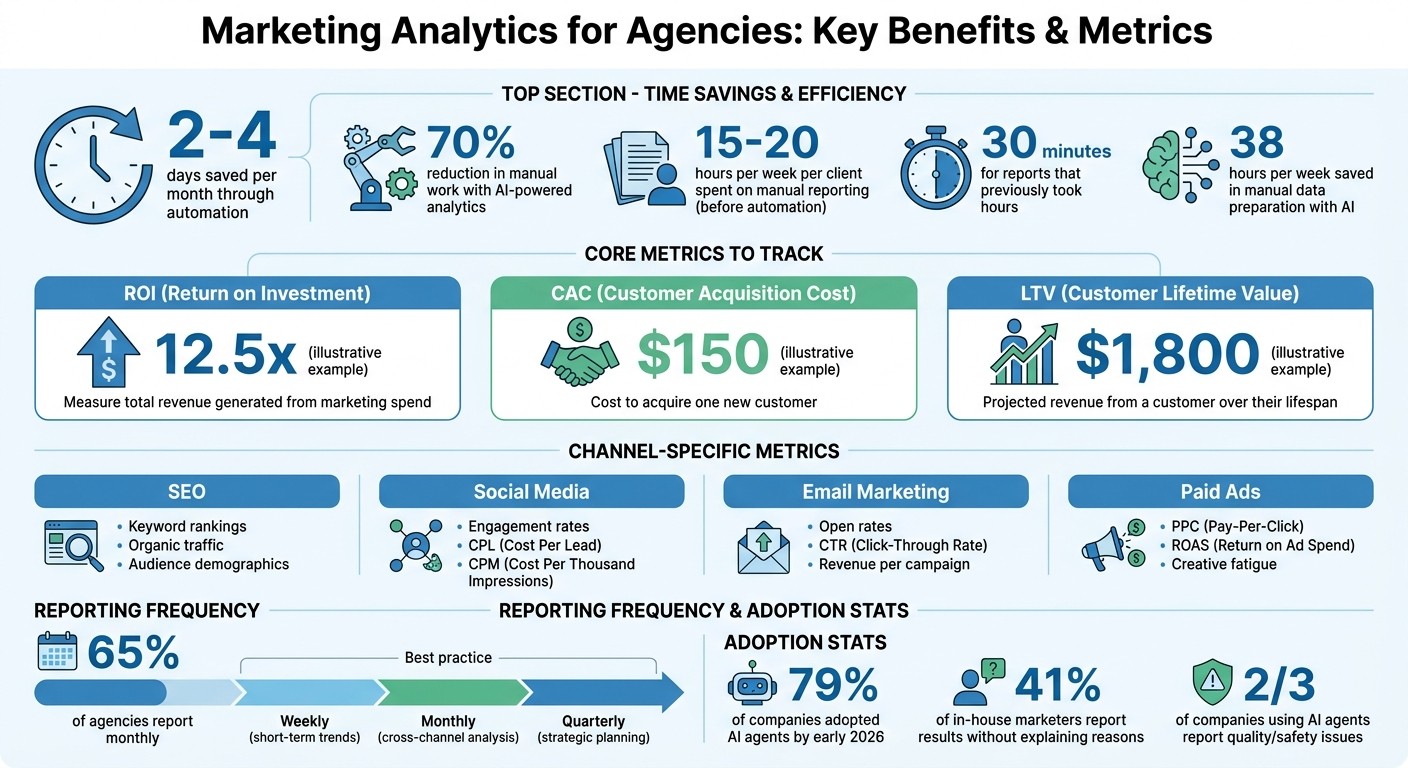
Marketing Analytics Benefits and Key Metrics for Agencies
Key Metrics Agencies Should Track
Core KPIs That Matter to Clients
When it comes to metrics, the focus should always be on what drives client profitability and growth. Three key figures stand out: ROI (Return on Investment), CAC (Customer Acquisition Cost), and LTV (Customer Lifetime Value). These metrics tie your marketing efforts directly to tangible business results [5]. As digital marketing consultant James Cole puts it:
"Marketing analytics data alone isn't enough unless you can connect it to meaningful outcomes" [6].
Beyond these foundational metrics, it's important to monitor channel-specific KPIs. For example:
SEO: Keep an eye on keyword rankings, organic traffic, and audience demographics.
Social Media: Track engagement rates, CPL (Cost Per Lead), and CPM (Cost Per Thousand Impressions).
Email Marketing: Measure open rates, click-through rates (CTR), and revenue per campaign.
Paid Ads: Focus on PPC (Pay-Per-Click), ROAS (Return on Ad Spend), and signs of creative fatigue [5].
Looking ahead, agencies are starting to measure "AI Visibility" - a new metric that tracks how often a client’s brand is featured in AI-driven answers from platforms like ChatGPT and Perplexity [5]. Guy Hudson, founder of Bespoke Marketing Plans, underscores the importance of focusing on actionable metrics:
"Metrics are only useful if they help to drive decision-making. As a result, we focus on identifying actionable metrics that can be used to inform and improve marketing efforts" [3].
By integrating these metrics with centralized data tools, agencies can deliver real-time insights that lead to better campaign outcomes.
Connecting Data Sources for Complete Visibility
Fragmented data is a roadblock to clarity. Customers interact with brands across multiple platforms - Google Analytics 4, Meta Ads, Google Ads, and CRMs like HubSpot or Salesforce. To create a full picture of the customer journey, from the first click to a closed deal, agencies need to consolidate these data sources into a unified dashboard [5][6].
API integrations can streamline this process by automating data collection. Tools like Funnel.io (starting at $500/month) and Supermetrics (from $37/month) can pull information from over 500 platforms into structured, searchable databases [1]. For presenting data to clients, platforms like AgencyAnalytics ($79/month for five campaigns) and Whatagraph ($199/month) offer customizable, white-labeled dashboards [1].
A critical step in this process is standardizing metric definitions across platforms. For instance, ensure that "conversions" mean the same thing in Google Ads, Meta, and your CRM to avoid inconsistencies [4]. Vinod Samuel, operations director at myheartcreative, explains why this is vital:
"Accuracy is extremely important because it allows our clients to make important decisions as the data rolls in, and as an agency, it allows us to advise based on the data for a better return on their investments" [3].
Best Marketing Analytics Tools for Agencies: How to Track Campaign Performance & Revenue
Building an Analytics Framework
Once you've organized your key metrics and data sources, the next step is implementing an analytics framework. This framework transforms raw data into actionable insights for clients. It’s not just about gathering information - it’s about creating repeatable processes that turn scattered data into clear, meaningful insights. Without a structured approach, agencies may waste valuable time recreating reports month after month.
Setting Up Unified Dashboards and Tools
The explosion of marketing tools has left many agencies juggling disconnected data sources [7]. On average, agencies spend 15–20 hours per week per client just compiling reports from these fragmented systems [7]. The solution? Unified platforms that streamline data extraction, storage, and visualization [7][1].
Start by integrating client platforms like Google Ads, Meta, TikTok, Shopify, and CRMs through APIs. These integrations automatically feed data into a single, centrally managed database [4][1]. As mentioned earlier, tools that consolidate data across platforms can standardize metrics, making cross-channel comparisons more reliable [1].
Ditch static PDF reports and instead provide clients with live, secure dashboard links that refresh hourly. Kevin Watts, founder of Raincross, highlights the efficiency of this approach:
"Using the AI features in AgencyAnalytics helps us summarize a client report much faster than reading through results, typing up an email, and sending it to the client" [3].
To stay ahead of potential issues, configure AI-powered alerts to flag anomalies like unexpected spikes in spending or drops in conversions [3][4].
Once dashboards are in place, focus on creating a consistent reporting schedule to fully leverage the real-time insights these tools provide.
Creating Regular Reporting Schedules
While 65% of marketing agencies send reports monthly [9], the most effective teams use multiple reporting frequencies to serve different purposes: weekly updates for short-term trends, monthly summaries for cross-channel analysis, and quarterly reviews for strategic planning [9][10].
Automation ensures consistency. Scheduled email dispatches guarantee reports are delivered on time, regardless of staff availability [11]. Darian Kovacs from Jelly Marketing underscores the importance of this:
"Reporting is everything in the world of digital marketing. It is how our work is measured with clientele, and it's how we continuously evaluate campaign strategy internally for our client portfolios" [11].
Place key metrics - like ROI, leads, and spending - front and center so clients can quickly assess whether goals are being met [11].
It’s worth noting that 41% of in-house marketers report results without diving into the reasons behind performance [8]. Your reports should go beyond presenting data; they should explain what happened and outline actionable next steps. To reinforce this, schedule a brief check-in after each report is sent to ensure clients understand the insights and recommendations [11].
Using AI-Powered Analytics for Better Results
With a solid analytics framework in place, incorporating AI takes insights to the next level, enabling more proactive campaign management. By early 2026, 79% of companies had adopted AI agents to autonomously manage complex workflows - from linking data sources to adjusting budgets across platforms [2]. For agencies, this evolution moves them from relying on static reports to embracing predictive analytics that identify and address issues before they impact campaign performance.
Getting Predictive Insights with Averi AI
AI-driven platforms like Averi AI go beyond basic automation by analyzing performance data to uncover optimization opportunities that human analysts might overlook. These AI agents can detect anomalies, monitor spend pacing, and flag creative fatigue before key metrics suffer [2].
In 2026, Signal Theory transformed its reporting process with the help of the Improvado AI Agent. Shayna Tyler, an analyst at the agency, highlighted the time-saving benefits:
"Reports that used to take hours now only take about 30 minutes. We're reporting for significantly more clients, even though it is being handled by one person" [2].
AI-powered platforms also introduce conversational analytics interfaces, allowing team members to ask straightforward questions - like "What was our ROAS last month?" - and receive quick, data-backed answers [2][3]. This feature makes analytics accessible to account managers and clients without requiring technical skills like SQL.
However, the accuracy of AI insights hinges on having a clean and unified data infrastructure. Without properly normalized data, AI agents can produce incorrect or misleading results, often referred to as "hallucinations" [2]. In fact, two-thirds of companies using AI agents report encountering quality and safety issues, underscoring the need for human oversight to review and validate AI-generated insights [2].
Beyond predictive capabilities, AI also excels in automating routine analytics tasks, saving time and improving operational efficiency.
Automating Routine Analytics Work
Building on predictive insights, AI automation takes over repetitive tasks, freeing up analysts to focus on more strategic work. From trend monitoring to data visualization and anomaly detection, AI can save analysts approximately 38 hours per week in manual data preparation [2].
For example, AI-driven reporting can generate detailed reports in just 15 to 30 minutes, slashing manual reporting time significantly [3]. By reducing labor by up to 70%, these tools allow teams to shift their focus from compiling data to delivering strategic insights for clients [4].
To effectively integrate AI into your analytics processes, start by automating data collection, then incorporate anomaly detection, and finally, introduce automated report narratives [2][4]. Always cross-check AI-generated insights against raw data to catch potential errors, and maintain human oversight for strategic recommendations before presenting them to clients [4]. This approach ensures data is transformed into actionable decisions that drive better results for clients.
Improving Campaigns with Data-Driven Decisions
With the power of real-time analytics, agencies can now go beyond simply reporting past outcomes. Instead, they can actively refine campaigns as they unfold. The key lies in shifting from passive observation to actionable strategies - pinpointing what works, experimenting with tweaks, and adjusting budgets based on hard data rather than guesswork.
Running A/B Tests and Experiments
For testing to yield meaningful results, clean and consistent data is essential. Without standardized metrics across platforms, outcomes can be misleading. For instance, an ad that performs well on one platform might falter on another if the metrics aren’t aligned [2]. Before diving into any test, it’s crucial to work alongside clients to set measurable goals that tie directly to their business priorities - like reducing cart abandonment instead of simply boosting traffic. Real-time alerts should also be configured to catch metric shifts within hours, rather than relying on monthly reviews [6][4].
AI tools streamline these processes by linking data sources and delivering actionable insights without the need for constant manual oversight [2]. For example, AI-driven creative fatigue modeling can identify when ad performance starts to decline, signaling it’s time for a refresh - well before the campaign’s effectiveness drops off entirely [1]. This proactive strategy helps avoid wasted ad spend and keeps campaigns running efficiently.
When experiments uncover successful variations, these insights can directly guide decisions about where to allocate resources for maximum impact.
Finding Your Best-Performing Channels
Determining which channels deliver the best results requires a deeper dive into metrics. Calculating a blended Customer Acquisition Cost (CAC), which combines both paid and organic efforts, provides a clearer picture of channel efficiency [1]. Tools that standardize data across platforms like Meta, Google Ads, and TikTok make metrics such as "cost per result" and "conversions" more comparable and actionable [1].
AI-based anomaly detection is another game-changer, automatically flagging significant changes like unexpected traffic drops or sudden increases in ad spend [6][4]. Features such as "Ask AI" can quickly surface opportunities or identify issues within client datasets, enabling swift adjustments and campaign scaling [3]. This evolution from monthly reporting to real-time, autonomous optimization - where AI can pause underperforming campaigns or reallocate budgets instantly - marks a new era in channel management [1].
Scaling Agency Operations with Analytics
Analytics goes beyond improving individual campaigns - it’s a driving force behind agency growth. When applied thoughtfully, data can reshape how agencies attract new clients, maintain long-term partnerships, and expand operations without significantly increasing staff. These tools don’t just refine campaigns; they enable agencies to scale smarter. As Kevin Watts, Founder of Raincross, noted:
"The predictive analytics in Ask AI has certainly increased our productivity, helping us to do things much faster" [3].
Let’s explore how leveraging client data and creating compelling case studies can fuel agency expansion.
Using Client Data for Better Pitches
Clients want results, not empty promises. The most effective pitches tie analytics directly to tangible business outcomes - like higher revenue, reduced costs, or improved customer loyalty - rather than focusing on surface-level metrics.
Competitive benchmarking can strengthen these pitches. For example, showing a client how their performance improved while competitors struggled creates a persuasive story. AI tools can uncover these hidden wins by analyzing complex datasets for patterns that might otherwise go unnoticed [3]. Predictive analytics also shifts the focus from looking at past performance to discussing future opportunities [4]. Instead of static case studies, agencies can use real-time dashboards to show how they monitor and adapt strategies to achieve results.
But analytics doesn’t just enhance pitches; it’s also the foundation for building impactful case studies.
Building Case Studies from Campaign Data
Great case studies aren’t just about numbers - they tell a story. They explain why changes happened and use visual tools, like dashboards, to illustrate the customer journey and campaign milestones [4] [6]. Clients want to know what strategic decisions drove the results, not just review data in a spreadsheet.
Automated reporting tools play a vital role here, cutting down the time needed to create reports and freeing up agencies to focus on strategy. Daniel Dye, President of Native Rank, highlights this advantage:
"Winning back billable time is important to our agency's growth because it allows us to focus on activities that generate revenue and add value for our clients" [3].
AI-powered anomaly detection adds another layer to case studies by pinpointing moments when performance issues were identified and resolved quickly [4]. To make these insights even more valuable, agencies should provide context - such as seasonal trends or market shifts - that influenced the results [4].
Conclusion
Marketing analytics plays a key role in driving agency success. automating reporting can improve marketing team productivity and save senior members 2–4 days each month [4], giving them more time to focus on what truly matters to clients: strategic insights, creative solutions, and delivering measurable results. Beyond just saving time, automating data collection transforms the way agencies operate, influencing not only reporting but also broader strategies.
The most successful agencies today are building systems that unify scattered data sources, identify performance issues in real time, and turn raw numbers into actionable insights. Tools like Averi AI simplify this process by blending automated analytics with human expertise, ensuring high-quality results while scaling operations efficiently.
A practical approach is to start small. Select one or two clients, streamline your reporting templates, and automate data collection as a first step. Once that process is stable, you can introduce advanced features like anomaly detection and AI-generated insights. The goal isn’t to replace your team’s expertise but to enhance it. As James Cole, Digital Marketing Consultant, explains:
"Marketing analytics data alone isn't enough unless you can connect it to meaningful outcomes" [6].
This shift in strategy supports every facet of agency growth. Agencies that treat analytics as a core part of their infrastructure - rather than an afterthought - are the ones gaining new clients, building compelling case studies, and positioning themselves as indispensable partners. The message is clear: integrating AI-powered analytics is no longer optional. The real challenge is deciding how quickly you can implement it.
FAQs
Which KPIs should my agency prioritize for client reporting?
Your agency needs to prioritize KPIs that clearly reflect campaign performance, ROI, and overall marketing effectiveness. Focus on metrics such as conversion rates, click-through rates, cost per acquisition, web traffic, engagement levels, and revenue attribution. Always align your reports with each client’s specific objectives - whether they’re aiming to boost brand awareness or improve customer retention. Incorporate data from various channels to deliver a well-rounded perspective, ensuring your insights are both relevant and actionable.
How do we unify GA4, ad platforms, and CRM data without inconsistencies?
To bring together GA4, ad platforms, and CRM data seamlessly, agencies often rely on AI-driven platforms like Hyper, Kleene.ai, and Glean. These tools take charge of automating data integration, aligning metrics, and maintaining consistency by merging all data into a unified database.
This method minimizes manual mistakes, allows for real-time updates, and enhances cross-platform analysis. The result? More precise attribution and smarter decisions for marketing campaigns.
How can we use AI analytics safely without inaccurate insights?
To ensure the safe use of AI analytics and avoid misleading insights, it's crucial to implement strong oversight and validation processes. While AI excels at automating analysis and generating insights, human involvement is key to maintaining accuracy. Agencies should put in place review systems, routinely compare AI outputs to raw data for validation, and resist the temptation to depend solely on automation. Striking this balance helps keep insights reliable and actionable, adhering to best practices for responsible AI analytics.
Related Blog Posts

Zach Chmael
CMO, Averi
"We built Averi around the exact workflow we've used to scale our web traffic over 6000% in the last 6 months."
Your content should be working harder.
Averi's content engine builds Google entity authority, drives AI citations, and scales your visibility so you can get more customers.