

In This Article
Use analytics and AI to track leads, predict market shifts, automate workflows, and boost ROI for real estate marketing.
Updated:
Trusted by 1,000+ teams
Startups use Averi to build
content engines that rank.
Marketing analytics is transforming real estate by turning data into actionable strategies. From tracking leads to predicting seller behavior, analytics tools help agents make smarter decisions, save resources, and improve ROI. Here’s how you can leverage analytics to stay ahead:
Track Performance: Measure key metrics like lead volume, conversion rates, customer acquisition cost (CAC), and return on ad spend (ROAS) to identify what works and what doesn’t.
Use the Right Tools: CRMs like Follow Up Boss and integrations like Zapier streamline data management. Predictive tools like Smartzip help spot potential sellers early.
Segment Audiences: Group leads by behavior or demographics to target effectively. Use AI and lookalike targeting to refine campaigns.
Predict Market Trends: Tools like HouseCanary analyze local data to forecast demand shifts, helping you act before competitors.
Automate Workflows: AI tools reduce repetitive tasks like content creation and photo editing, saving time and boosting productivity.
Key takeaway: Analytics isn’t optional - it’s the difference between guessing and knowing. Use data to refine strategies, optimize campaigns, and close more deals.
AI for Data Analysis for Real Estate
Building Your Analytics Framework
Creating an effective analytics framework involves three essential components: tools for gathering data, systems for integrating that data, and reliable processes to ensure accuracy. This structure is vital for tracking the marketing metrics that truly matter.
Tools and Integrations You Need
Start with your CRM. Platforms such as Follow Up Boss ($58–$69/month) or Wise Agent ($49/month) act as the central repository for lead data, communication history, and performance metrics [6][8]. This is where you'll identify which marketing channels are driving actual conversions.
To go further, tools like AgentFire ($119/month) or Placester ($59/month) integrate with IDX systems to monitor property searches and automatically feed lead activity into your CRM [7][8]. For instance, when someone browses homes in a specific area or price range, their behavior is logged, offering insights into their buying intent before they even submit a contact form.
Middleware solutions, such as Zapier (free basic plan, $19.99/month for Pro) or RealSynch, help connect platforms seamlessly. These tools can sync Facebook Lead Ads with your CRM, link Google Sheets to email platforms, or trigger automated follow-ups based on website activity. For example, Sierra Interactive supports nearly 100 integrations, including Google Workspace, Facebook Pixel, and Zillow, ensuring smooth data flow from lead generation to management [5].
For tracking calls, platforms like Twilio or CallAction can assign unique phone numbers to different campaigns - whether it's Facebook ads, Google Ads, or even yard signs. When a lead calls, the system attributes the call to its source and logs it directly into your CRM [5][9].
AI-powered tools like Smartzip ($500/month) take things up a notch by using predictive analytics to identify potential sellers 6–12 months before they list. These tools integrate with your CRM to score leads and prioritize outreach [8][10].
Metrics That Matter
Once your tools and systems are in place, it's time to focus on the metrics that reveal whether your marketing is hitting the mark.
Four key metrics should guide your evaluation: lead volume, conversion rates, customer acquisition cost (CAC), and return on ad spend (ROAS).
Lead Volume and Conversion Rates: While lead volume is important, it's incomplete without conversion rates. The average visitor-to-lead conversion rate for real estate websites is 2.2%, with 27% of those leads converting into Marketing Qualified Leads (MQLs) [11]. If your rates fall short, issues with your website or audience targeting could be to blame.
Customer Acquisition Cost (CAC): This is the total cost of acquiring a new client. In real estate, organic CAC averages $660, while paid CAC is $1,185 [11]. Calculate it by dividing your total marketing spend by the number of clients acquired. For instance, spending $5,000 on Google Ads to close four deals results in a CAC of $1,250.
Return on Ad Spend (ROAS): ROAS measures the revenue generated from a specific campaign. For example, spending $2,000 on Facebook ads that yield a $12,000 commission gives you a ROAS of 6:1. Comparing ROAS across channels helps you identify where your budget delivers the best returns [13].
Cost Per Lead (CPL): Organic CPL averages $416, while paid CPL is $480 [11]. On platforms like Facebook, real estate CPL can drop as low as $1.81, whereas Google Search CPL ranges from $10 to $50 [13]. If your CPL is high yet CAC remains reasonable, your sales process is likely strong. However, if both are high, you may be targeting the wrong audience.
Lastly, keep an eye on Lifetime Value (LTV), which represents the total revenue a client generates over the course of your relationship, including repeat business and referrals. A healthy LTV-to-CAC ratio is 3:1 or higher [14][15]. Spending $1,000 to acquire a client who only brings in $2,000 in commissions signals unsustainable margins.
"It isn't enough to measure the final outcome alone. You also need to track intermediate metrics to understand where consumers might be getting stuck - essentially bottlenecks in the marketing funnel." - Sunil Gupta, Professor, Harvard Business School [12]
Getting Your Data Right
Poor data can lead to misguided decisions, especially if your CRM misattributes lead sources, causing you to invest in the wrong channels.
Standardize Data Entry: Use tools like API Nation to sync contacts between your CRM and platforms like MailChimp or Mojo Dialer [5]. This eliminates duplicate records and ensures every interaction is logged.
Set Up Call Attribution: Assign unique phone numbers to each marketing channel using tools like Twilio or CallAction[9]. For example, one number for Google Ads, another for Facebook ads, and a third for direct mail. This ensures calls are automatically linked to the correct source in your CRM.
Tag Marketing URLs with UTM Codes: Add UTM parameters to your URLs to track campaign performance in Google Analytics [15]. For instance, a Facebook ad might use
?utm_source=facebook&utm_medium=paid&utm_campaign=spring_listings. These codes reveal which ads drive traffic and conversions.Audit Data Regularly: Review your records monthly to spot incomplete entries, duplicate contacts, or leads left untouched for over 30 days. Companies using marketing automation tools have reported a 451% improvement in lead engagement and sales [9], but only when their data is clean. Remember, bad data leads to bad outcomes.
Using Data to Improve Your Marketing
Once your analytics framework is in place, the next step is turning raw numbers into actionable strategies that drive revenue. This involves segmenting your audience with precision, staying ahead of market trends, and fine-tuning campaigns based on real-time insights.
Segmenting Your Audience
Accurate audience segmentation is key to boosting conversions. Break your audience into groups based on factors like demographics, location, interests, and behavior [16][18].
For example, consider a prospect who has visited your website three times in one week, opened two emails about waterfront properties, and clicked on listings in the $800,000–$1,000,000 range. That’s a hot lead. On the other hand, someone who downloaded a neighborhood guide six months ago but hasn’t interacted with your brand since will need a different, more nurturing approach [16]. Many CRMs make this process easier by automatically scoring leads based on their behavior, helping you focus on the most promising prospects [1].
Lookalike targeting is another powerful tool. By analyzing the characteristics of your best clients - such as their demographics, browsing habits, and purchase history - you can use platforms like Facebook or Google to find similar prospects. For instance, if your top customers are dual-income families aged 35–45 searching for homes near high-performing schools, you can target ads to others who fit that profile [17].
With the decline of third-party cookies, contextual targeting is becoming more important. This involves placing ads on relevant websites, like home improvement blogs or local news sites, based on data about location and property types. This ensures your brand appears in spaces where your audience is already engaged [17]. However, always ensure compliance with the Fair Housing Act, avoiding exclusions based on protected characteristics such as race or religion [16].
"The more precisely you understand who you're talking to, the more powerfully your message lands." - Katherine Evans, Content Marketing Strategist, Luxury Presence [16]
Segmentation lays the groundwork for identifying and acting on market trends.
Predicting Market Shifts
Predictive analytics can help you spot trends before they become obvious. Tools like HouseCanary and Revaluate use AI to analyze neighborhood data, pricing trends, and demographic shifts, giving you early insights into where demand is headed [1][4][10]. For example, if a particular ZIP code is seeing an influx of young families and rising home values, you can adjust your strategy to target first-time buyers in that area before competitors catch on.
AI-powered CRMs also act as early warning systems for listings that might struggle. If feedback repeatedly mentions issues like "the kitchen feels small" or "the price is too high", these systems flag those patterns, allowing you to address them - whether through price adjustments or staging changes - before the property lingers on the market [10].
Predictive tools can also identify likely movers. By analyzing behaviors such as frequent visits to mortgage calculators or engagement with neighborhood guides, these tools can flag prospects who are likely to list their home within 6–12 months [4]. Reaching out early with tailored content positions you as the go-to agent before they start exploring other options.
Additionally, publishing monthly market reports or neighborhood forecasts can establish you as an authority. Use data from your CRM and local MLS to create charts or investment insights, and gate this content behind a lead capture form. This not only builds your reputation but also attracts high-intent prospects researching the market [4].
With segmentation and trend predictions in place, you can focus on optimizing your campaigns for better results.
Improving Campaign Results
During active campaigns, data helps identify what’s working and what isn’t. For example, if conversions are lagging, tools like Google Optimize or Unbounce can help you test new headlines, images, and calls-to-action [2]. If Facebook ads generate clicks but no conversions, the issue might lie with your landing page or follow-up strategy. On the other hand, if Google Ads have a high cost per lead but strong conversion rates, it might be worth shifting budget from underperforming channels [2].
Meta’s Advantage+ AI tool can simplify campaign optimization by automatically testing creative variations, potentially reducing ad costs by up to 19% [19].
Visuals also play a critical role. Buyers often form their first impressions within the first three to five images, so make sure your hero shot - the property’s standout feature - is front and center [10]. Use analytics to track which photos or 3D tour elements get the most engagement, and apply those insights to future listings [1].
Finally, keep an eye on your bounce rate. If visitors leave your site quickly, it could indicate that your content isn’t engaging or that your site isn’t mobile-friendly. A high bounce rate paired with low conversions often points to a disconnect between your ad messaging and the landing page experience [2]. Address this by aligning your ads with your landing pages and ensuring fast load times across devices.
Metric | Purpose | What to Do If Underperforming |
|---|---|---|
Bounce Rate | Measures site engagement | Improve content relevance or mobile experience |
Conversion Rate | Tracks lead generation effectiveness | Test new CTAs or simplify forms |
Cost Per Lead (CPL) | Evaluates budget efficiency | Refine audience targeting or pause low-performing ads |
Return on Ad Spend (ROAS) | Measures paid campaign success | Reallocate budget to high-performing channels |
Using AI to Automate Your Workflows
AI is reshaping how work gets done, especially when it comes to repetitive tasks that often drain time and resources. Take real estate agents, for example - they typically spend 18–25 hours marketing a single property, handling everything from photo editing to social media scheduling[1]. With AI-powered tools, that time can drop to just 6–7 hours, a 60% reduction that allows agents to focus on showings, negotiations, and building client relationships[1].
The trick is creating a workflow where AI handles the repetitive groundwork, while you step in to refine and personalize. A great example comes from PeakMade Real Estate in Atlanta, Georgia. In 2025, they adopted Canva’s AI features, slashing their property onboarding time from two weeks to just 30 minutes and cutting flyer production time by 66%. This move saved the firm $130,000 annually[20]. Such efficiency demonstrates how AI can transform workflows step by step.
Automating Content and Campaigns
AI is particularly effective at creating first drafts for marketing materials like MLS descriptions, email campaigns, and social media posts. By simply inputting key details - such as square footage, bedroom count, and neighborhood features - AI can generate 10–12 tailored social posts per listing to target different buyer groups[1]. However, these drafts should always be polished with your local expertise. For instance, if AI suggests "charming neighborhood", you might make it more specific by adding, "walkable to Jefferson Elementary and the Saturday farmers market."
Affordable tools like ChatGPT Plus or Claude Pro (around $20/month) can assist in content creation, while platforms like Buffer or Hootsuite (ranging from $15 to $50/month) automate post scheduling and optimize timing[1].
AI also speeds up photo editing. Tasks like HDR enhancement, perspective correction, and virtual staging - which usually take 4–6 hours manually - can now be done in 30–45 minutes[1]. Virtual staging, in particular, can replace physical staging costs of $2,000–$5,000 per listing, with AI-based services like RealEstage.ai starting at just $79/month[1]. To stay compliant with NAR and MLS guidelines, ensure virtually staged images are disclosed, as most tools automatically add watermarks for transparency.
Connecting Analytics to Your Systems
For AI to truly streamline your workflow, your tools need to work together seamlessly. Start by integrating your website platform with your CRM. When a visitor fills out a form or downloads a guide, their details should automatically flow into your CRM. From there, AI can tag leads based on behavior and trigger personalized follow-ups[20]. This eliminates manual data entry and ensures no lead slips through the cracks. AI-powered CRMs, costing between $50 and $150 per month, often include lead-scoring features to prioritize prospects most likely to convert[1].
Real Estate by Design in San Antonio, Texas, provides a great example. They integrated Matterport 3D tours into their listings and synced engagement data with their CRM. Over six months, this approach reduced their average days on market from 30 to 21 days and increased their sales-to-list price ratio from 93% to 97%[20]. By analyzing which property features drew the most interest, they could refine their marketing strategies for better results.
Monitoring and Adjusting with AI
Once your content, campaigns, and integrations are automated, AI can take on a monitoring role to keep everything running smoothly. Instead of manually checking which photos or ads perform best, AI tools analyze performance data in real time and suggest adjustments. For example, if certain images consistently outperform others, the system might recommend reallocating ad spend to highlight those visuals.
AI chatbots can also handle up to 70% of routine inquiries around the clock, qualifying leads by asking about budgets, timelines, and must-have features. High-value prospects are then passed on to you, ensuring timely follow-ups. Studies show that contacting leads within five minutes increases conversion rates by 21 times[20][1]. Tools like Structurely or Ylopo, priced between $149 and $499 per month, integrate with CRMs to log every interaction for future follow-ups[1].
AI monitoring even helps identify trends early. For example, if a listing generates online interest but no showings, AI can analyze feedback to identify issues - like price concerns or layout preferences - and suggest adjustments before the property lingers on the market. Some platforms can even generate automated weekly reports for sellers, summarizing data from MLS views, social reach, and showing requests, saving hours of manual work[10].
"AI won't replace real estate agents, but it will replace the way they work." - Emilia Dunaj, Content Writer, Placester[20]
The goal isn’t to hand over all tasks to AI but to create a system where technology handles the repetitive groundwork. This frees you to focus on the relationships and strategic decisions that close deals. With proper integrations and real-time monitoring, your marketing becomes a self-improving system that gets smarter with every listing.
Comparing Analytics Tools
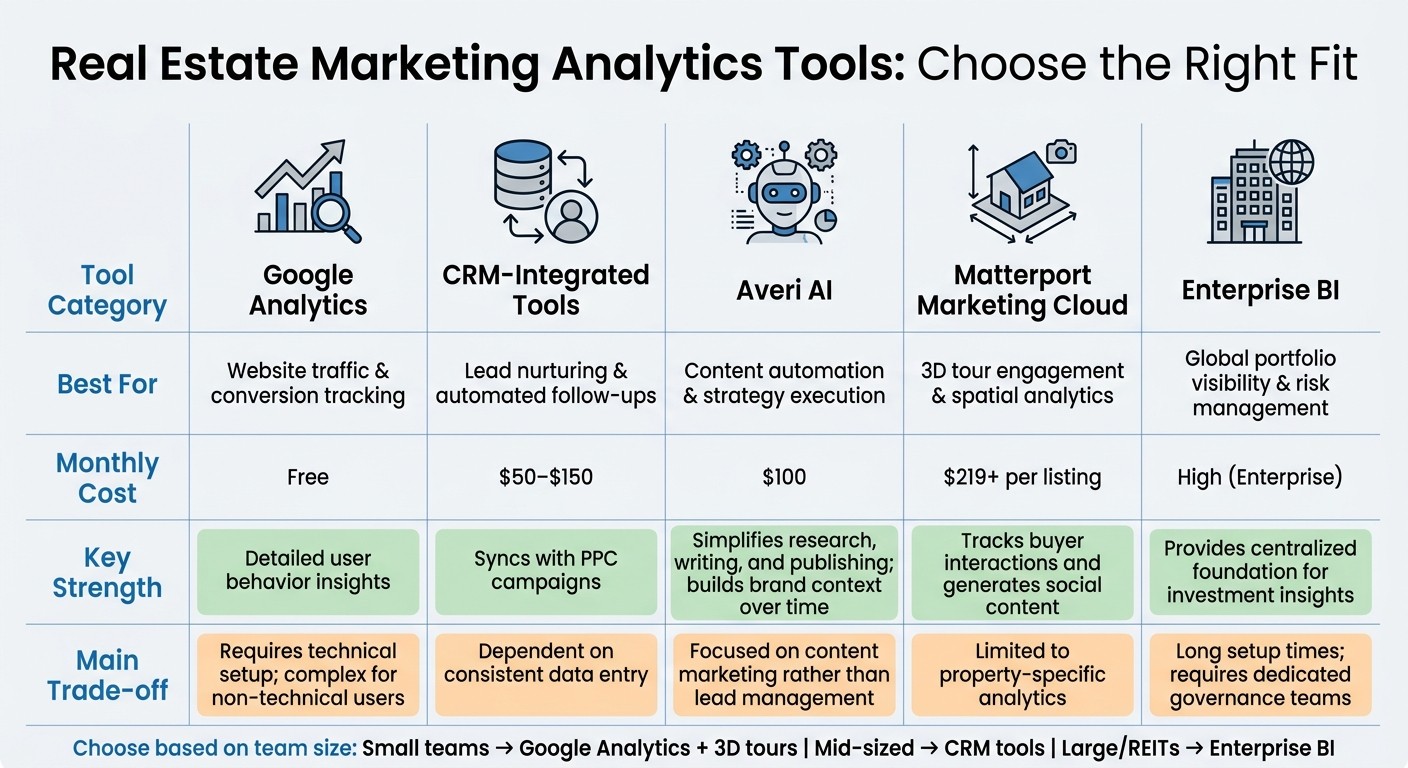
Real Estate Marketing Analytics Tools Comparison Guide
Choosing the right analytics tool hinges on your specific goals. By aligning your selection with the framework outlined earlier, you can better leverage data to inform your decisions. Google Analytics is a go-to for tracking website traffic and conversion rates, making it ideal for assessing which property pages draw the most attention or how many contact forms are submitted. On the other hand, CRM-integrated tools like Follow Up Boss, LionDesk, or KV Core focus on managing leads through automated follow-ups and behavioral scoring. For specialized needs, AI-powered platforms such as Averi AI streamline content creation and strategy execution, while Matterport Marketing Cloud offers spatial analytics tailored for 3D tour engagement.
Each tool caters to distinct needs. Google Analytics stands out as a free option with seamless integration into Google Ads, though it requires technical expertise and doesn't handle lead management[2]. CRM tools are excellent for nurturing leads but rely on consistent data entry and ad platform integration to deliver results[4]. Matterport's Digital Pro Package, starting at $219 per listing, provides granular insights into buyer interactions with 3D property tours but focuses on individual listings rather than overarching brand metrics[3]. These tools align with the campaign optimization and workflow automation strategies discussed earlier.
For smaller teams, starting with Google Analytics for website tracking paired with cost-effective 3D tour solutions makes sense. Mid-sized teams can benefit from CRM tools that integrate with PPC campaigns, while larger teams or REITs may require enterprise BI platforms for managing global portfolios - despite the higher costs and need for IT support[21].
Tool Comparison Table
Tool Category | Best For | Monthly Cost | Key Strength | Main Trade-off |
|---|---|---|---|---|
Google Analytics | Website traffic & conversion tracking | Free | Detailed user behavior insights[2] | Requires technical setup; complex for non-technical users[2] |
CRM-Integrated Tools (e.g., Follow Up Boss, LionDesk, KV Core) | Lead nurturing & automated follow-ups | $50–$150 | Syncs with PPC campaigns[4] | Dependent on consistent data entry[4] |
Averi AI | Content automation & strategy execution | $100 | Simplifies research, writing, and publishing; builds brand context over time | Focused on content marketing rather than lead management |
Matterport Marketing Cloud | 3D tour engagement & spatial analytics | $219+ per listing | Tracks buyer interactions and generates social content[3] | Limited to property-specific analytics[3] |
Enterprise BI (Oracle, Essbase) | Global portfolio visibility & risk management | High (Enterprise) | Provides a centralized foundation for investment insights[21] | Long setup times; requires dedicated governance teams[21] |
Your choice depends on your team's size and priorities. For website performance monitoring, Google Analytics is a cost-effective option. If scaling lead management is your focus, CRM tools are indispensable. Meanwhile, Averi AI is perfect for automating content efforts and enhancing brand visibility, allowing you to concentrate more on client relationships. Selecting the right tool is key to making informed, data-driven decisions that elevate your marketing efforts. Use this guide to identify the best fit and integrate it seamlessly into your overall strategy.
Conclusion
In real estate, marketing analytics revolves around focusing on essential metrics and leveraging AI to simplify time-consuming tasks. It's important to monitor both efficiency metrics - like marketing hours per listing - and performance metrics, such as listing views, inquiry volume, and days on market. Agents who incorporate AI-powered workflows have seen remarkable results: a 60% reduction in marketing time (from 18 hours to just 7 hours per listing), a 40% boost in online engagement, and a 30% decrease in days on market[1].
AI can take over repetitive tasks like photo editing, content creation, and social media scheduling, allowing you to dedicate your efforts to closing deals and applying local expertise. The key to success lies in consistency - integrating AI systematically across all listings rather than using it sporadically.
"AI should handle the tedious, time-consuming tasks - but you must add the expertise, local knowledge, and personal touch that makes marketing effective. Think 'AI-assisted' not 'AI-generated.'"[1]
The real estate market is constantly evolving. Buyer behavior shifts, platforms update, and strategies that worked last year may no longer be effective. Use analytics to understand what drives results - whether it’s identifying which photos attract the most showings, which marketing channels deliver qualified leads, or where your budget generates the best ROI. Listings with high-quality marketing materials can generate three times more qualified inquiries and increase sale prices by 2% to 4%. For a $500,000 home, that’s an additional $10,000–$20,000 in value[1].
To maximize your efforts, combine tools like Google Analytics for website tracking with a CRM that integrates ad campaigns. AI platforms like Averi AI can automate research, content creation, and publishing, freeing up time to focus on client relationships. Building an effective AI stack costs around $115–$150 per month[1], a small price for the time saved and the results it delivers.
"The agents who master AI marketing in 2026 will dominate their markets in 2027. The only question is whether you'll be leading the change or scrambling to catch up."[1]
Select the right tools, monitor your metrics, fine-tune your strategy, and let data drive your decisions.
FAQs
What’s the simplest analytics setup I can start with?
Using Google Analytics is one of the easiest ways to keep tabs on your marketing performance. This tool provides a clear view of your website's traffic, how users interact with your site, and how well your efforts translate into leads and sales.
Getting started is straightforward: create an account, add the provided tracking code to your website, and start exploring key metrics. These include where your visitors are coming from, which pages they’re viewing, and what actions they’re taking - like filling out a contact form. It’s a simple yet powerful way to make informed, data-backed decisions.
How do I connect ad clicks to closed deals accurately?
To link ad clicks directly to closed deals, implement a tracking system that follows user interactions across the entire buyer's journey. Start by creating tracking links for platforms such as Google Ads and Facebook Ads. Then, integrate these platforms with a CRM to monitor leads as they progress through the sales funnel. Pair this setup with predictive analytics tools to identify and prioritize leads most likely to convert. By analyzing campaign performance data, you can fine-tune your targeting strategies to achieve more effective outcomes.
What metrics indicate when to shift budget between channels?
Metrics such as ROAS (Return on Ad Spend), cost per lead, and channel-specific conversion rates provide valuable insights for fine-tuning budgets. By analyzing these figures, businesses can identify which channels generate the highest revenue and engagement, making it easier to allocate budgets based on data rather than guesswork.
Related Blog Posts

Zach Chmael
CMO, Averi
"We built Averi around the exact workflow we've used to scale our web traffic over 6000% in the last 6 months."
Your content should be working harder.
Averi's content engine builds Google entity authority, drives AI citations, and scales your visibility so you can get more customers.