

In This Article
Set measurable goals, track LTV:CAC and CAC payback, connect GA4, CRM and ad data, and use AI dashboards and alerts to optimize startup marketing.
Updated:
Trusted by 1,000+ teams
Startups use Averi to build
content engines that rank.
Marketing analytics isn't just a nice-to-have for startups - it's a must. Without it, you're guessing where your money goes, and guesswork leads to wasted budgets. Here's the bottom line: track what matters, use the right tools, and let data guide your marketing strategy.
Key Takeaways:
Set measurable goals: Focus on metrics tied to revenue, like Customer Acquisition Cost (CAC) and Lifetime Value (LTV). A healthy LTV:CAC ratio is 3:1 or better.
Choose the right tools: Start with free options like Google Analytics 4 (GA4) for traffic and conversions, then scale with tools like Mixpanel for user behavior or Averi AI for automated insights.
Integrate your tools: Connect platforms like GA4, Google Ads, and your CRM to streamline data tracking and reduce manual work.
Track growth metrics: Focus on LTV:CAC, CAC Payback Period, Net Revenue Retention (NRR), churn rates, and conversion rates by channel.
Leverage AI: Tools like Averi AI simplify analysis, automate A/B testing, and provide actionable recommendations to save time and resources.
Season 1: Episode #2 | Crucial "Dos" and "Don'ts" of Marketing Analytics
Building Your Analytics Framework
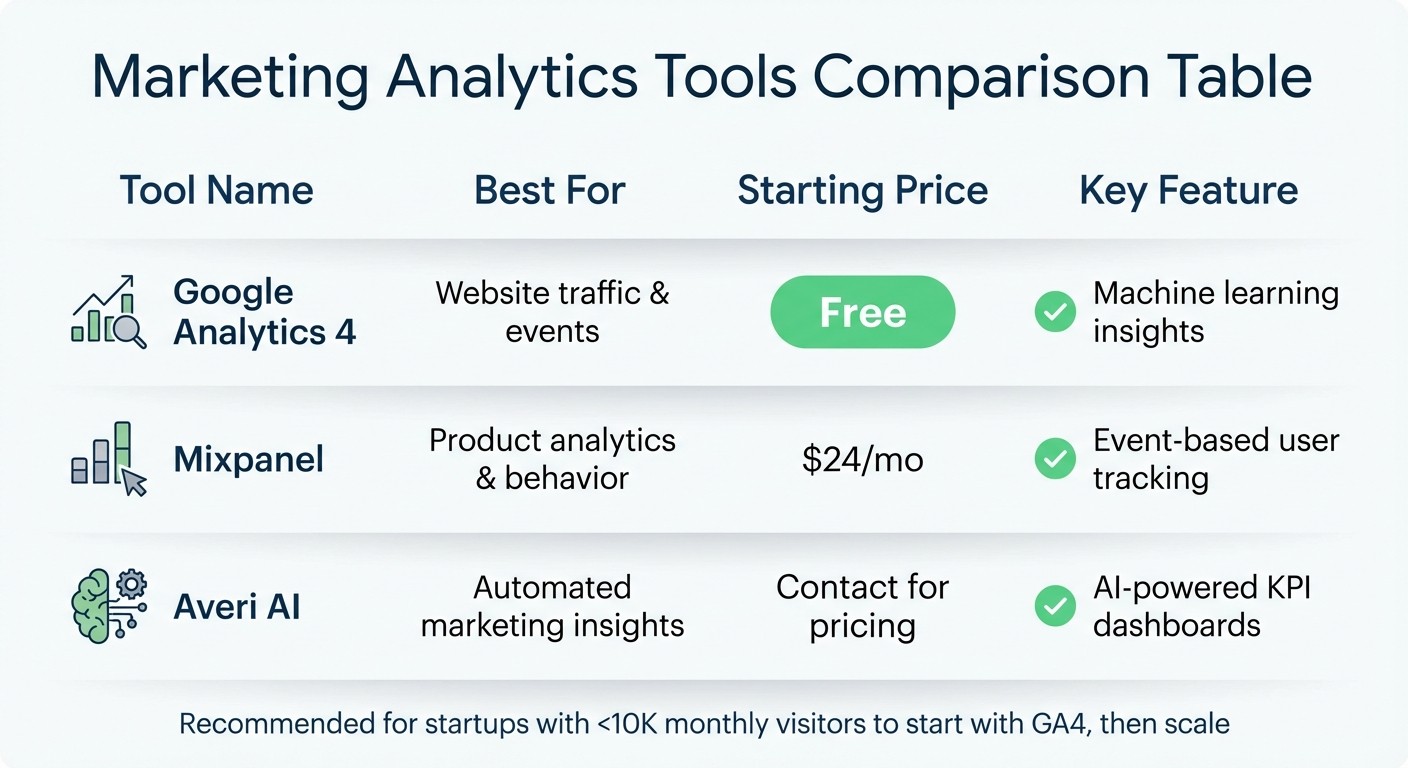
Marketing Analytics Tools Comparison for Startups: Features and Pricing
You don’t need a hefty budget or a dedicated data science team to create an effective analytics framework. By focusing on clear objectives, the right tools, and streamlined data connections, you can avoid the trap of collecting data that never gets used. Instead, build a system that tracks only the metrics that directly fuel growth.
Set Specific Marketing Goals
Start by defining three to five measurable goals that tie directly to revenue. For example, early-stage startups might aim for a customer acquisition cost (CAC) under $50. To calculate this, divide your total marketing spend by the number of new customers acquired in a month. Similarly, determine your customer lifetime value (CLV) by combining average purchase value, frequency, and customer lifespan. For SaaS products, a healthy conversion rate falls between 5–10%, while e-commerce businesses typically see rates of 2–5% [3].
A key benchmark to keep in mind is the LTV:CAC ratio - aim for at least 3:1. Falling below this ratio indicates you're overspending on customer acquisition. In 2026, 39% of marketers prioritized lead quality, while 34% focused on lead-to-customer conversion rates, emphasizing the importance of these metrics [3].
Once your goals are set, the next step is choosing the tools that will turn these objectives into actionable insights.
Pick the Right Tools
Tool | Best For | Starting Price | Key Feature |
|---|---|---|---|
Google Analytics 4 | Website traffic & events | Free | Machine learning insights |
Mixpanel | Product analytics & behavior | $24/mo | Event-based user tracking |
Averi AI | Automated marketing insights | Contact for pricing | AI-powered KPI dashboards |
Google Analytics 4 (GA4) is a free tool offering features like event tracking, funnel analysis, and seamless integration with Google Ads [3]. For more detailed product usage insights, Mixpanel starts at $24 per month and is ideal for apps and SaaS platforms [8]. Averi AI takes it a step further by automating insights, integrating with GA4, and cutting down on manual reporting costs [3].
If you’re just starting out, GA4 is a great first choice, especially for websites with fewer than 10,000 monthly visitors. As your needs grow, Mixpanel can provide deeper insights into user behavior, and Averi AI can save time by automating reporting tasks.
Connect Your Analytics Tools
With your tools in place, the next step is integration to enable real-time insights.
Zapier, which offers a free tier, can connect GA4 with platforms like WordPress CMS, Google Ads for conversion tracking, and HubSpot CRM for lead syncing - no coding required [5]. For example, you can set up a GA4 conversion to automatically log data into Google Sheets, which then updates your CRM. This setup takes less than an hour and reduces manual data entry errors [6].
For faster data syncing, native integrations are often the best choice. GA4 connects directly to Google Ads and BigQuery for advanced analysis, while Mixpanel integrates with Segment to consolidate data from multiple sources. Pairing GA4 with Looker Studio (also free) allows you to build dashboards that eliminate the need for costly reporting tools - a method many startups now consider essential [3].
To avoid overwhelming yourself, start small. Focus on connecting your top three data sources: website analytics, your ad platform, and your CRM. Test the system with sample data, then set up automated alerts via Slack or email. This step-by-step approach minimizes the risk of data fragmentation, a challenge cited by 50% of B2B marketers [4].
Track the Metrics That Matter
Once your analytics framework is in place, the next step is figuring out which metrics actually drive growth. Many failed startups fall into the trap of focusing on vanity metrics - things like impressions, reach, or follower counts - that look impressive but don’t translate into sustainable business outcomes [1]. The goal is to zero in on data that informs revenue decisions and helps allocate resources effectively.
Core Metrics for Growth
Focus on unit economics. A key ratio to monitor is the LTV:CAC, which compares customer lifetime value (LTV) to customer acquisition cost (CAC). Divide LTV by CAC to assess your business model's efficiency. A ratio below 3:1 indicates overspending, while B2B SaaS companies should aim for a 4:1 ratio [1].
Keep an eye on your CAC Payback Period. This metric tells you how long it takes to recover the costs of acquiring a customer. You calculate it by dividing CAC by the average monthly revenue per customer. High-performing companies typically achieve payback within 12 months, and the trend is moving toward sub-9-month benchmarks [1]. With acquisition costs rising about 14% annually, this metric is essential for distinguishing scalable startups from those that stall [1].
Net Revenue Retention (NRR) is becoming more important than ever. To calculate NRR, divide your current customer revenue (including expansions but subtracting churn) by your initial revenue. An NRR above 110% signals that your existing customers are actively fueling growth [1].
"If your NRR is below 100%, you don't have a sales problem - you have a value delivery problem." - Zach Chmael, CMO at Averi [1]
Churn should be closely monitored. For B2B SaaS companies, aim for an annual churn rate under 5% or a monthly rate below 1% [1]. Break this down into voluntary churn (customers canceling) and involuntary churn (failed payments). Addressing issues like expired payment methods can boost revenue by about 8.6% in the first year [1]. Additionally, track conversion rates at every stage of the funnel - from visitor to lead to customer - and analyze which traffic sources bring in high-quality leads.
These metrics form the foundation of dashboards that can give you a clear picture of your performance at a glance.
Build Dashboards for Quick Insights
To make tracking easier, combine Google Analytics 4 (GA4) with Looker Studio. Both tools are free and allow you to create visual dashboards for monitoring key metrics [3]. Start by setting up custom events in GA4 for actions like demo requests, trial signups, or pricing page visits.
Design a single-page dashboard that highlights your most important metrics:
LTV:CAC: Target a 3:1 ratio or higher
CAC Payback Period: Aim to recover costs within 12 months
NRR: Keep it above 110%
Churn: Maintain annual churn below 5%
Conversion rates by channel
Update this dashboard weekly to avoid overreacting to daily fluctuations. For quick daily overviews, tools like Plausible offer real-time reporting for as little as $9 per month [2]. Some businesses have reported 34% faster responses to anomalies, and timely interventions using real-time analytics can improve ROI by 30–50% [11].
Pair these dashboards with automated alerts to stay on top of critical changes.
Set Up Automatic Alerts
Automated alerts can help you respond quickly to shifts in key metrics. In GA4, you can configure email notifications for significant changes in traffic or conversion rates. Use Zapier’s free tier to trigger Slack messages when certain events occur [3][11].
For SEO, track "striking distance" keywords in Google Search Console - these are terms ranking between positions 5 and 15 that could jump to page one with minor optimizations [3]. When alerts are triggered, investigate immediately. A sudden traffic spike might indicate a viral post that needs amplifying, while a dip in conversions could point to issues with your forms or checkout process. These quick adjustments ensure you're prepared to leverage AI tools for deeper analysis and automation.
Use AI Tools for Better Analytics
Once your dashboards and alerts are in place, let AI take over the heavy lifting of data analysis. Manual reporting eats up valuable time, but AI-driven tools can sift through data, identify patterns, and provide actionable recommendations in minutes. This allows you to focus on executing strategies rather than getting bogged down in spreadsheets. Let’s explore how Averi AI simplifies this process.
Get Automated Insights with Averi AI
Averi AI brings multiple analytics functions together in one streamlined workspace. Instead of juggling tools for keyword research, traffic metrics, and competitor tracking, Averi offers real-time insights on content performance, keyword rankings, and competitor movements - all accessible through unified dashboards [8].
With over 20 specialized AI agents, Averi continuously monitors your marketing channels. For example, if a blog post is stuck at position 8 for a high-value keyword, Averi will flag it and suggest specific tweaks to help it climb to page one. Similarly, if a competitor releases new content, the system sends an alert with a recommended counter-strategy. This automation can cut manual analysis time by up to 80% [8].
Getting started is straightforward: connect your key channels via API integrations, activate Averi’s AI agents, and start receiving tailored insights. By automating these processes, startups can shift their focus - and resources - toward initiatives that directly fuel growth. Pairing Averi with your existing tools amplifies these advantages even further.
Combine AI with Standard Tools
AI tools shine brightest when used alongside established platforms. For instance, free tools like Google Trends can help you identify emerging search trends, which can then be fed into paid platforms like Semrush (starting at $119/month) for in-depth competitor analysis and backlink tracking. Averi AI can then step in to optimize your content based on this combined data, a strategy that has helped similar startups boost their traffic by 30% [8].
Google Analytics 4 remains a cornerstone for tracking user behavior across platforms and providing predictive analytics, such as churn risk. When combined with Averi AI’s automated insights, you get the best of both worlds: detailed retrospective analysis paired with forward-looking strategies.
Run A/B Tests with AI
AI doesn’t just analyze data; it also revolutionizes how you run experiments. Platforms like Optimizely use AI to streamline A/B testing. Instead of manually creating test variants and waiting weeks for statistically significant results, Optimizely generates test options automatically, predicts likely winners based on user behavior, and highlights results once they reach a 95% confidence level [5].
For startups, this means you can test elements like headlines, calls-to-action, or landing page designs in a fraction of the time. One e-commerce startup, for instance, achieved a 25% increase in signups simply by testing landing page colors during a single cycle [5]. By tracking metrics like click-through rates, bounce rates, and revenue per visitor, AI-powered A/B testing enables faster iteration and continuous improvement - turning small adjustments into measurable growth.
Improve and Scale Your Marketing
Once you've set up your analytics framework and dashboards, it's time to use those insights to refine your strategy and expand your efforts. By focusing on what delivers results, you can reallocate resources effectively and scale with confidence. This process builds on your earlier tracking efforts and sets the stage for smarter growth.
Shift Budget to High-Performing Channels
Start by analyzing your core KPIs across all channels using your dashboards. Identify areas where performance lags - like channels with an ROI below 2:1 - and compare them to more efficient options. For instance, email marketing often delivers exceptional returns, with $36–$42 earned for every $1 spent, while SEO costs about $31 per lead compared to PPC's $181 per lead [12].
Consider reallocating 20–50% of your budget in stages, monitoring the impact weekly. A SaaS startup, for example, shifted $10,000 from underperforming paid social ads (1.5:1 ROI) to SEO and content marketing (4:1 ROI). This adjustment led to a 40% increase in leads within a single quarter [8]. Keep testing and only scale further if your LTV:CAC ratio stays above 3:1 [1][12].
Once you've optimized your budget, use advanced tools to manage your growing data streams more efficiently.
Scale with Advanced Tools
As your marketing efforts expand across multiple channels, tools like Domo can help streamline operations. Domo integrates data from over 1,000 sources - such as Google Analytics, HubSpot, and ad platforms - into real-time dashboards with AI-driven alerts [7]. For example, a fintech startup used Domo to consolidate CRM, ad spend, and web data. By identifying high-performing LinkedIn ads, they scaled their spend from $5,000 to $50,000 monthly while cutting low-performing display ads, achieving a 25% efficiency gain [7][8]. Additionally, Domo reduced their manual reporting time by 70%, freeing up teams to focus on strategy rather than tedious spreadsheet tasks [7].
With streamlined data management in place, you can refine your strategies further using AI insights.
Refine Strategy with AI Recommendations
AI tools can segment your customers into actionable profiles, such as identifying high-value repeat buyers with an 80% retention rate versus churn risks with less than 20% conversion. These tools also provide automated updates that uncover actionable insights - for example, a 39% improvement in lead quality through personalized content [8][3]. Platforms like Averi AI and ConvertMate update customer profiles weekly, ensuring your strategies stay relevant.
One startup used AI recommendations to adjust its blog strategy, focusing on AI content strategies like long-form SEO content and video formats. This shift increased organic traffic by 60% and boosted conversions by 25% in just three months [8][9]. To get the most out of AI, combine its speed with human expertise by letting AI handle analysis while your team validates strategies quarterly, aiming for a 70/30 balance of automation and human oversight [10][8].
Next Steps
With your analytics framework and key metrics in place, it’s time to turn those insights into meaningful actions.
What to Remember
Marketing analytics is all about focusing on the metrics that fuel growth. Start by building a straightforward framework with clear, measurable goals tied to revenue. Use core growth metrics like conversion rates, CAC (Customer Acquisition Cost), and LTV (Lifetime Value) to guide decisions. Streamlined dashboards should highlight these metrics, enabling quick action, while automated alerts help you address issues before they escalate into costly problems. Incorporate AI-driven insights to automate tasks like analysis and A/B testing, saving valuable time. Lastly, scale wisely by reallocating budgets to the most effective channels and relying on AI recommendations to shape your strategy. As Zach Chmael, CMO at Averi, succinctly puts it:
"The analytics tool you use daily always beats the one you use never" [2].
Getting Started Guide
Begin with Google Analytics 4 - a free tool to track website traffic and conversions. Setting it up takes just 1–2 hours during your first week [6][3]. In the following week, connect it to Looker Studio (also free) to create a simple dashboard featuring your top five KPIs: traffic sources, conversion rates, CAC, LTV, and ROI [3]. By week three, add a specialized tool tailored to your needs: Mixpanel (starting at $24/month) for tracking user behavior, or ConvertMate ($49/month) to automate processes with AI across various channels [8][5]. Finally, integrate Averi AI to generate automated insights without the need for manual data analysis.
Make it a habit to review your dashboard weekly, conduct A/B tests monthly, and adjust your budget as needed. A well-utilized analytics stack costing $100–$350/month will outperform a $2,000/month setup that’s rarely touched [2]. The key is to measure what matters, act quickly on insights, and let your analytics evolve alongside your business. Regular reviews and small, consistent adjustments will keep your marketing efforts agile and effective.
FAQs
What KPIs should I track first?
Startups must focus on tracking critical metrics to gauge their performance and guide strategic decisions. Key indicators include:
LTV:CAC Ratio: Strive for a target of 3:1 or higher to ensure sustainable growth.
Net Revenue Retention: Aim for 110% or more to showcase strong customer retention and upsell capabilities.
CAC Payback Period: Keep this under 12 months to maintain efficient customer acquisition costs.
Churn Rate: Work toward an annual churn rate below 5% to highlight customer satisfaction and loyalty.
AI Visibility: Establish a baseline to measure performance in AI-driven marketing efforts.
These metrics provide a clear picture of growth, efficiency, and market impact, ensuring your marketing strategies are grounded in actionable data.
How do I calculate LTV and CAC accurately?
To figure out Customer Lifetime Value (LTV), start by estimating the total revenue a customer brings in throughout their relationship with your business. Key factors to consider include how often they make purchases and the average amount spent per order.
For Customer Acquisition Cost (CAC), simply divide your total marketing and sales expenses by the number of new customers gained during the same period.
Tools like Google Analytics can help you consistently track and analyze this data, making it easier to fine-tune your calculations over time for better precision.
When should I add AI to my analytics?
When your business requires real-time insights, automated data collection, and enhanced decision-making efficiency, it's time to bring AI into your analytics. AI excels at spotting trends, segmenting audiences, and fine-tuning campaigns - making it especially helpful for startups working with tight resources.
By integrating AI early, you can streamline repetitive tasks, test new strategies more rapidly, and scale your marketing efforts with greater precision. This leads to quicker insights and stronger growth opportunities.
Related Blog Posts

Zach Chmael
CMO, Averi
"We built Averi around the exact workflow we've used to scale our web traffic over 6000% in the last 6 months."
Your content should be working harder.
Averi's content engine builds Google entity authority, drives AI citations, and scales your visibility so you can get more customers.