How to Use Marketing Automation for Media & Entertainment

Averi Academy
Averi Team
8 minutes

In This Article
Automate audience profiling, content creation, personalization, and performance tracking to boost engagement and revenue in media.
Updated:
Trusted by 1,000+ teams
Startups use Averi to build
content engines that rank.
Marketing automation is transforming how media and entertainment brands engage audiences, streamline workflows, and boost revenue. By leveraging AI tools, companies can automate repetitive tasks like scheduling posts, personalizing campaigns, and analyzing performance data. This frees up teams to focus on creating impactful content while improving efficiency and results.
Key takeaways:
91% of marketers say automation is crucial for campaign success, with reported 53% higher conversion rates and 34% revenue growth.
AI tools analyze audience behavior, optimize content schedules, and personalize experiences, leading to 40% higher revenue for brands using advanced personalization.
Companies save 12+ hours weekly by automating tasks such as content creation, scheduling, and performance tracking. This shift is a core component of modern AI productivity for marketing teams.
AI-driven insights allow media brands to refine strategies, cut underperforming campaigns, and maximize ROI.
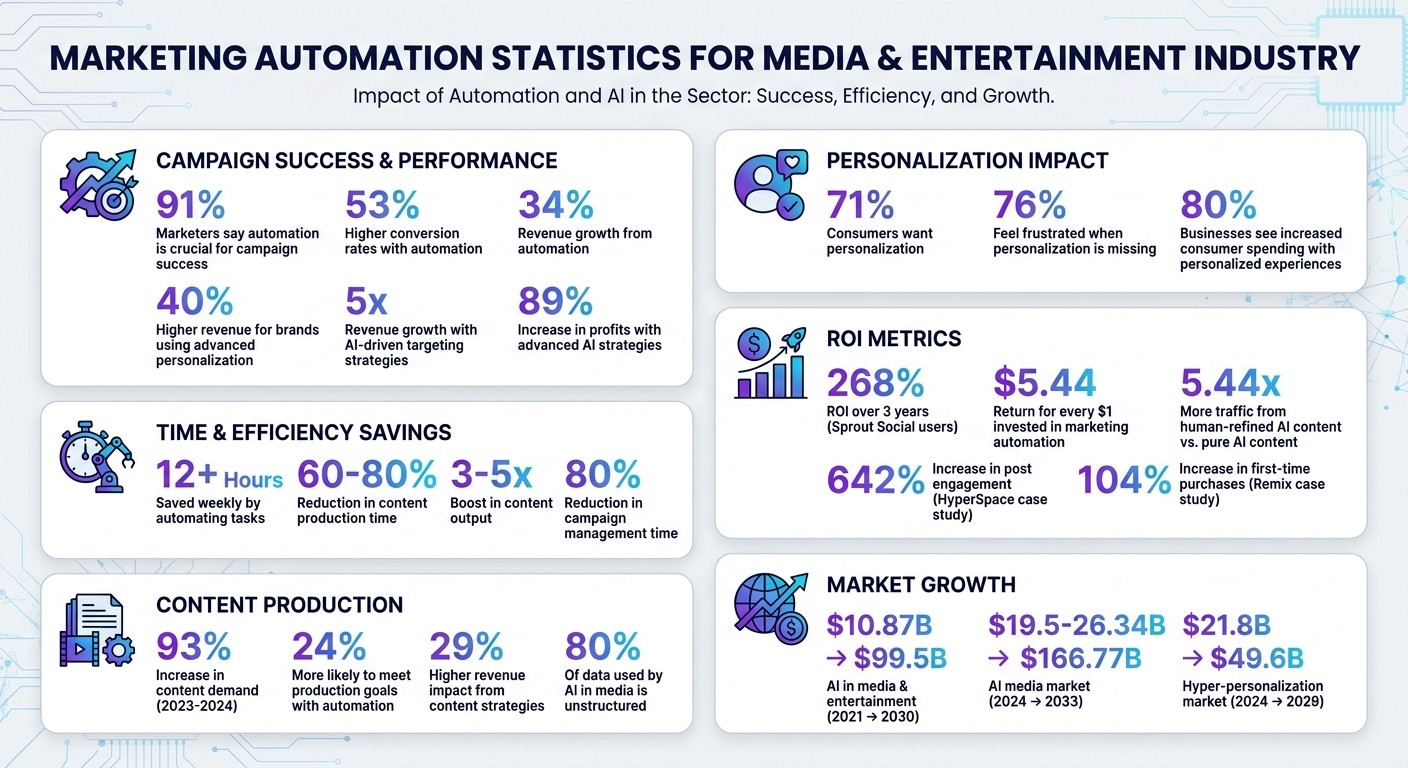
Marketing Automation Impact: Key Statistics for Media & Entertainment
4 Ways Media Companies Use Automation to Drive Growth | Salesforce
Step 1: Set Up Your AI-Driven Campaign Strategy
Before diving into campaigns, it’s crucial to define your audience and craft content that resonates with them. AI tools can simplify this process by analyzing your existing brand assets - like websites, previous campaigns, and social media profiles - to build detailed audience profiles without requiring manual data entry. Platforms such as ZBrain can train models like GPT-4 or Llama 2 using your data (text, images, and documents) to create applications that are highly attuned to your audience segments [2]. From there, machine learning can refine these segments further for precision targeting.
Automate Audience Research and Profiling
Machine learning algorithms excel at analyzing user demographics, viewing habits, and engagement patterns to build comprehensive audience profiles [2]. But advanced AI takes it a step further, diving into content metadata like scene composition, pacing, and genre trends. For example, Warner Bros. uses Cinelytic AI for casting and budgeting decisions, 20th Century Fox applies Merlin to match films with target audiences, and Sony Pictures employs ScriptBook for revenue forecasting [2][4].
AI tools also use predictive analytics to anticipate audience demand by pulling data from social media, websites, and internal databases. This helps identify optimal engagement windows [5]. The shift from static demographic reports to real-time audience intelligence is transformative. Industry stats reveal that 80% of businesses see increased consumer spending when offering personalized experiences [5]. Additionally, the global AI market in media and entertainment was valued at $10.87 billion in 2021, with projections reaching $99.5 billion by 2030 [2][3].
Analyze Competitor Campaigns and Content Gaps
AI-driven sentiment analysis can measure audience reactions to your campaigns and those of competitors, offering insights to fine-tune your strategies [8]. These tools also perform comparative testing on creative assets like trailers, visuals, and story concepts, analyzing audience reactions side-by-side [9]. Thematic clustering further simplifies large datasets - like interview transcripts or audience feedback - into actionable themes, helping uncover "content gaps" that competitors might have overlooked [9].
Visual intelligence adds another layer by interpreting video and behavioral signals to detect moments of delight or friction, revealing how audiences engage with content in real-world settings [9]. Notably, over 80% of the data used by AI in the media industry is unstructured [6], meaning traditional methods often miss critical insights. Advanced AI platforms now offer "chat-with-your-data" functionality, identifying trends across launches, audience groups, and platforms to highlight overlooked opportunities [9]. The AI media market was valued between $19.5 billion and $26.34 billion in 2024, with projections reaching as high as $166.77 billion by 2033 [6][7][8].
Build Content Plans Around Media Events
Leverage audience and competitor insights to create content calendars centered on key media events. By feeding important dates into AI tools, you can generate multi-month calendars that balance educational, promotional, and entertainment content. AI agents monitor industry news, social media, and search trends around the clock, flagging emerging topics and potential content gaps tied to upcoming events. A tool like AdCellerant's AI Media Planner translates business goals and event timelines into actionable media plans, audience insights, and product recommendations [12]. Shelby Carlson, COO and Co-Founder of AdCellerant, explains:
"The launch of AI Media Planner reflects our belief that the best results come from pairing advanced technology with human insight, accountability, and expertise" [12].
AI can also transform a single long-form asset - like a press release or event recording - into over 15 platform-specific pieces, such as social media highlights, video scripts, and email newsletters. This approach ensures consistent messaging across channels while tailoring content to platform-specific behaviors. Recent studies show AI reduces content production time by 60–80% while boosting output by 3–5 times [10].
Step 2: Automate Content Creation and Scheduling
Once your strategy is in place, AI can take over repetitive tasks, freeing up your team to focus on the creative aspects of your campaigns. By reducing manual effort, you can ensure your content production stays aligned with your audience’s preferences and strategic goals. Here’s how to streamline your workflow with AI-driven tools.
Generate Content Queues for Your Campaigns
AI platforms can transform a single brief into a complete multi-format campaign. Tools like Jasper and Canva make it easy to produce social media posts, email updates, and video scripts from one core asset [13][15]. For example, a press release for a film premiere can be repurposed into Instagram Stories, LinkedIn updates, and email newsletters - all tailored for specific platforms.
Audio and video tools further enhance this process. Platforms like ElevenLabs create lifelike voiceovers for trailers, while Lumen5 turns text scripts into polished videos [15][16]. Some companies are already taking this to the next level: Live 95.5 uses Futuri RadioGPT for real-time, localized broadcasts, and Absolut Radio AI relies on Radio.Cloud for continuous AI-driven programming [16].
The impact of these tools is clear - teams report cutting production time by 60–70%, often saving up to 12 hours per week by automating repetitive tasks [1][13]. By establishing a seamless content pipeline that handles everything from ideation to publication, you can eliminate last-minute scrambles and keep your campaign on track.
Schedule Releases for Maximum Engagement
AI-powered scheduling tools analyze historical engagement data to identify the best times to post, ensuring your content reaches the right audience at the right moment [18][19]. For instance, Sprout Social users have seen a 268% return on investment over three years due to its intelligent scheduling features [19].
To optimize your workflow, consider bulk uploading and categorizing content for multiple platforms. Automation tools can handle resizing images and adjusting text for platforms like Instagram, LinkedIn, and X [18][20]. Additionally, setting triggers to update related social posts when core assets change helps maintain consistency across channels [18]. For media campaigns, aim for biweekly posts and plan seasonal or event-based content at least two months in advance, with marketing efforts beginning about a month before the event [20]. Tools like Zapier or IFTTT can link accounts, ensuring updates on one platform are mirrored on others without extra effort [20].
Refine AI Drafts to Maintain Brand Voice
While AI can speed up content creation, human input remains crucial for ensuring quality and brand consistency. Research shows that content refined by humans generates 5.44 times more traffic than purely AI-created material [21]. Tools like Averi analyze your brand’s existing content to help AI drafts reflect your unique voice [21].
"The winning approach isn't AI vs. human, it's AI + human."
Zach Chmael, CMO, Averi [21]
To train AI tools effectively, provide 10–15 examples of your brand’s content [17]. Use AI to create initial drafts, leveraging its ability to structure ideas and compile research. Then, have human editors refine the drafts by improving flow, adding original insights, and ensuring accuracy [14]. Many AI engines integrate with platforms like Webflow and WordPress, making it easy to publish polished content [21].
This stage is also perfect for implementing Generative Engine Optimization (GEO). By including 40–60 word "answer blocks" and FAQ schemas, you can boost your content’s visibility in AI-driven search tools like ChatGPT and Perplexity [21]. Combining human creativity with AI discoverability ensures your content performs well across both traditional and emerging search platforms.
Step 3: Personalize Campaigns and Distribute Content
Once your content is ready and scheduled, the next challenge is getting it to the right audience with a message that resonates. AI-powered tools make it possible to deliver targeted, meaningful experiences at scale while ensuring consistency across platforms.
Personalize Fan Engagement with AI
Today's audiences expect experiences tailored to their preferences - 71% want personalization, and 76% feel frustrated when it’s missing [22][23]. AI marketing automation takes personalization to the next level by analyzing real-time behavioral data, allowing you to fine-tune messaging and offers for individual fans across various channels.
By leveraging predictive analytics, you can identify patterns in viewing or purchasing habits and use that insight to suggest the next best action. For instance, a streaming service might recommend concert tickets to fans who repeatedly listen to a specific artist or offer exclusive merchandise to viewers who binge-watch a new series within days of its release. Brands that operate at this level of personalization see up to 40% higher revenue compared to their peers [22][23].
"AI marketing automation isn't about replacing marketers - it's about reinforcing what they do best." - Esat Artug, Senior Product Marketing Manager, Contentful [11]
To make personalization effective, it's crucial to unify data from all touchpoints - web, mobile, CRM systems, and even offline sales - into a Customer Data Platform (CDP). This unified data serves as a reliable foundation for AI tools to analyze engagement levels and identify high-value conversion opportunities. The hyper-personalization market is expected to grow from $21.8 billion in 2024 to nearly $49.6 billion by 2029 [22].
Once you've nailed personalized engagement, you can further refine your campaigns by automating ad variations for improved targeting.
Automate Ad Variations and Targeting
AI platforms simplify the process of creating and optimizing ads. Take Amazon DSP, for example - it uses Dynamic Creative Optimization (DCO) to tailor ad experiences in real time based on shopper behavior [15]. Similarly, Salesforce Marketing Cloud employs Einstein AI to build lookalike models, helping you identify prospects who resemble your best customers [13].
For brands prioritizing privacy, GumGum offers a cookieless solution by analyzing the sentiment and emotional context of webpages, ensuring ads align with the content users are actively engaging with [15]. On the other hand, Adzooma streamlines ad management across platforms like Google, Facebook, and Microsoft Ads, enabling one-click optimization and eliminating the need for tedious manual testing [15].
These advanced AI-driven targeting strategies deliver impressive results. Companies using such methods report five times higher revenue growth and an 89% increase in profits compared to traditional approaches [13]. For example, ZoomInfo customers have seen a 25% boost in pipeline and stronger engagement rates by deploying AI tools that use buyer intent signals to trigger automated ad delivery [13].
Publish Content Across Multiple Platforms
Once your targeting and personalization are in place, the next step is ensuring your content reaches audiences seamlessly across all channels. A headless CMS allows for "Create Once, Publish Everywhere" functionality, decoupling content creation from presentation [25].
For instance, a single press release can simultaneously update your website, trigger social media posts, and populate email newsletters - all through a unified workflow. Tools like Averi take this a step further by directly publishing content to platforms like Webflow, Framer, or WordPress, eliminating the hassle of copy-pasting and manual formatting.
Consistency is key. Every piece of automated content should reflect your brand’s voice while being clear, engaging, and customer-focused. This is where the 5 Cs framework - clear, consistent, creative, credible, and customer-centric - comes into play [24]. By connecting your CMS, social platforms, and email tools through automation, you ensure that your brand message stays intact while reaching audiences wherever they engage.
Step 4: Track Performance and Improve Campaigns
Monitoring performance and refining campaigns using data is essential for long-term success. AI tools simplify this process by tracking metrics across multiple platforms, identifying new opportunities, and automatically optimizing campaigns for maximum impact.
Track Key Metrics for Media Campaigns
The media and entertainment sector generates an overwhelming volume of data from sources like streaming platforms, social media, CRM systems, and ad networks. AI tools consolidate this information into a single, easy-to-read dashboard, providing a comprehensive view of campaign performance automatically [2].
Key metrics to monitor include:
Engagement: Metrics like click-through rates, watch time, and social shares show how audiences interact with content.
Sentiment: Natural language processing tools analyze real-time audience reactions and brand sentiment [26][3].
Financial: Track cost per acquisition (CPA), ROI, and even box office predictions.
Conversion: Metrics like subscription sign-ups, ticket sales, and lead scores reveal the effectiveness of campaigns.
Major players in the industry are already leveraging these capabilities. Warner Bros., for instance, uses the Cinelytic AI platform for box office forecasting, while 20th Century Fox employs the Merlin system to analyze audience demographics and preferences [2].
With these metrics in hand, the next step is turning raw data into actionable insights.
Get AI-Driven Insights and Recommendations
Data by itself isn't enough - it needs to be transformed into actionable recommendations. AI marketing automation goes beyond simple "if-then" rules by using machine learning to analyze patterns, predict outcomes, and optimize campaigns autonomously [28]. These systems provide instant, visual summaries and actionable suggestions, such as highlighting ROI or recommending budget reallocations [32][33]. This efficiency saves marketers significant time each week [31].
Organizations that adopt advanced AI strategies report five times the revenue growth and an 89% increase in profits compared to traditional methods. On average, users save 12 hours per week on activities like list segmentation and lead scoring [13].
For example, DraftKings used Veritone's AI solutions alongside the VCAP analytics tool to gain deeper insights into campaign performance, leading to smarter ad spend decisions [29]. Similarly, HyperSpace leveraged AI-driven social media tools to boost post engagement by 642% in just 30 days [29].
"AI marketing automation moves beyond static 'if-then' rules, using machine learning to analyze data, predict outcomes, and optimize campaigns autonomously."
Improvado [28]
AI doesn't just analyze past performance - it predicts future trends and adjusts strategies accordingly. Gartner estimates that by 2028, 33% of enterprise software applications will feature agentic AI, a significant leap from less than 1% in 2024 [27].
Set Up Automated Campaign Cycles
Using these insights, automation can transform performance data into continuous campaign improvements. AI establishes a feedback loop where data informs the next round of content creation and campaign adjustments.
Start by automating performance reports that gather data from various platforms, highlighting key successes, underperforming areas, and actionable next steps [31]. Then, implement AI-driven insights to address issues like lead drop-offs or suggest specific changes, such as testing a new email subject line or adjusting send times [32].
For instance, Remix introduced a three-step automated email sequence that personalized follow-ups based on subscriber behavior, leading to a 104% increase in first-time purchases compared to the previous quarter [30].
AI-powered A/B testing takes this further by automatically identifying and deploying the best-performing variations of copy, visuals, and timing [30][34]. These platforms also reallocate budgets in real time to focus on top-performing combinations [27].
"Active Intelligence can validate performance by surfacing insights and recommending next-best actions - all within the same workflow."
Alexa Drake, ActiveCampaign [32]
AI essentially turns campaign management into a self-sustaining system. Each week, it analyzes results, generates recommendations, and flags items for approval. This automation can reduce the time spent managing campaigns by up to 80%, while delivering an average return of $5.44 for every $1 invested in marketing automation over three years [34].
Tools like Averi exemplify this approach by tracking metrics such as impressions, clicks, and keyword rankings, then offering actionable advice like, "This topic is trending; here's a content angle", or "This content ranks #8; here’s how to improve it." In the end, performance data becomes the key to deciding what to refine, adjust, or create next.
Conclusion
Automating scheduling, segmentation, and performance tracking allows teams to concentrate on crafting engaging content and strengthening fan connections. The numbers back this up: many marketers view automation as essential, and companies adopting it experience notable improvements in conversion rates.
This transition from manual workflows to automated systems isn't just a time-saver - it’s a smarter way to scale. With content demand surging 93% between 2023 and 2024, organizations using automation are 24% more likely to meet production goals compared to those relying on manual processes [35]. Additionally, marketing leaders who integrate these tools report a 29% higher revenue impact from their content strategies [35]. As Lasse Häll, Solution Strategist at Contentful, aptly notes:
"The saying 'amateurs talk tactics, professionals study logistics' ... also applies to digital content" [25].
This shift paves the way for a marketing operation that practically runs itself.
Modern platforms now cover the entire content lifecycle - from audience insights and creation to distribution and performance analysis. Tools like Averi AI empower small teams to function like full-scale content agencies by automating blog writing, boosting output tenfold, and cutting costs by up to 80% [36]. These platforms adapt to your brand voice, monitor performance, and even suggest data-driven next steps. Such automation aligns perfectly with the broader AI-powered content strategy of delivering personalized, efficient, and impactful campaigns.
Start small: automate a single campaign cycle by segmenting your audience, scheduling releases, and tracking metrics. Gradually incorporate AI-driven personalization and automated A/B testing. This approach works hand-in-hand with earlier personalization strategies. The aim isn’t to replace creativity but to remove the operational hurdles that keep great ideas from consistently reaching your audience.
Sign up for the AI Marketing Workspace today and build a scalable content engine, so you can focus on creating your next big hit.
FAQs
What should I automate first in a media marketing campaign?
To kick things off, implement automation for personalized content delivery and audience interaction. Prioritize tasks such as distributing tailored content, handling subscription renewals, and dispatching real-time alerts. These efforts not only strengthen customer loyalty but also simplify your workflow. At the same time, establish feedback loops to monitor data and make real-time adjustments. This strategy keeps your campaigns efficient while enabling ongoing improvements.
How do I use AI personalization without violating privacy rules?
To apply AI personalization responsibly, prioritize data governance and ethical practices. Start by adhering to privacy laws through strict data management protocols and anonymizing personal data. Be upfront with users about how their data is used, fostering trust through transparency.
Regular audits are essential to ensure systems remain compliant and secure. Establish clear ethical guidelines for AI use, and empower users by allowing them to control their data preferences. These measures not only build trust but also strengthen audience connections while safeguarding privacy.
Which metrics best demonstrate ROI for media and entertainment automation?
Key indicators to showcase the return on investment (ROI) in media and entertainment automation include user engagement, customer retention, and conversion rates. These metrics reveal how tailored, automated campaigns enhance audience interaction and contribute to revenue growth.
Related Blog Posts

Zach Chmael
CMO, Averi
"We built Averi around the exact workflow we've used to scale our web traffic over 6000% in the last 6 months."
Your content should be working harder.
Averi's content engine builds Google entity authority, drives AI citations, and scales your visibility so you can get more customers.