

In This Article
Affordable AI workflows for pre-seed startups to target high-intent leads, automate outreach, and build inbound content systems.
Updated:
Trusted by 1,000+ teams
Startups use Averi to build
content engines that rank.
Lead generation is a lifeline for pre-seed startups. At this stage, proving market demand and securing early traction are critical to survival and growth. However, limited budgets and resources make traditional marketing hires or agencies unaffordable. This is where AI tools step in, offering cost-effective solutions for identifying, reaching, and nurturing potential customers.
Key Insights:
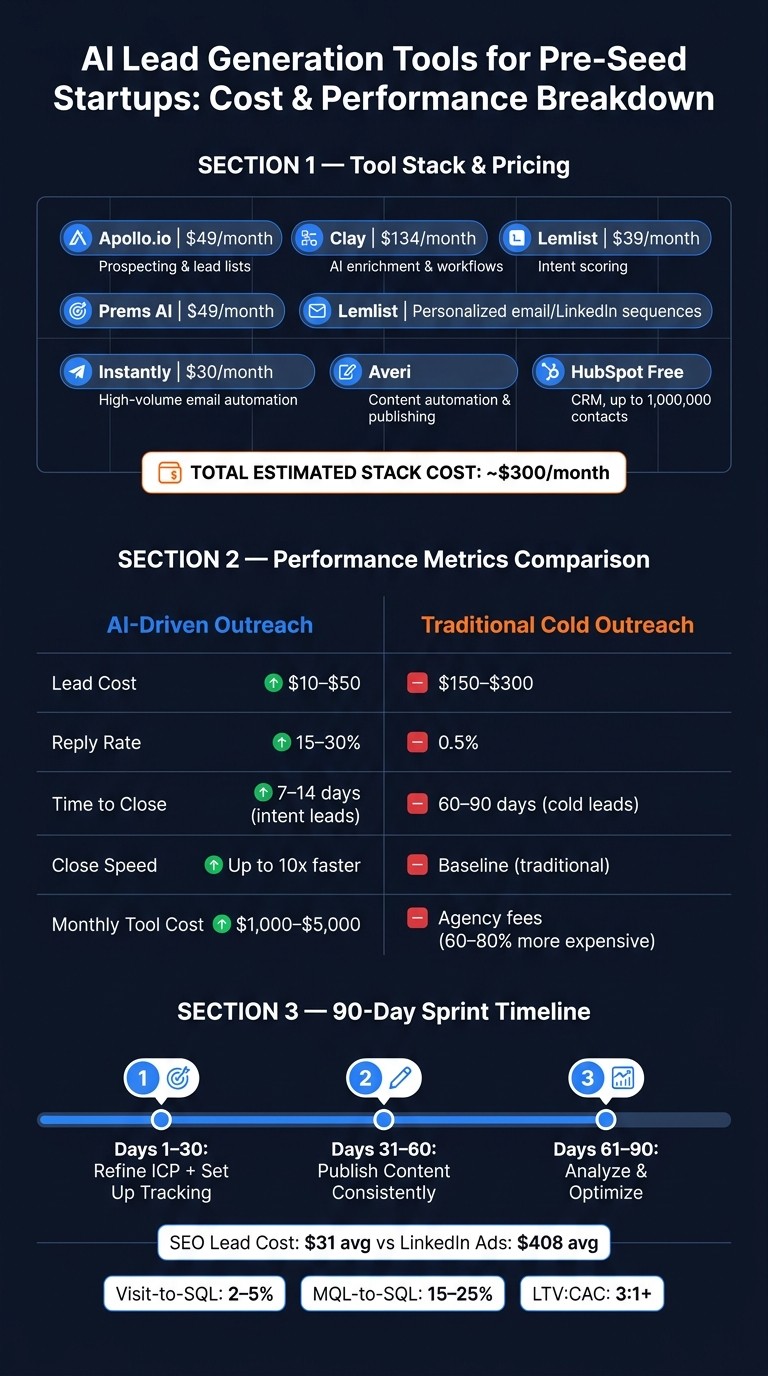
Budget-Friendly AI Tools: Platforms like Apollo.io ($49/month) and Clay ($134/month) help founders build targeted lead lists and automate outreach.
Focus on High-Intent Leads: Prioritize demo requests, beta signups, and newsletter subscribers, which convert faster than cold leads.
Content Systems for Inbound Leads: Tools like Averi automate content creation and publishing, turning blogs and landing pages into lead magnets.
Automated Follow-Ups: Use tools like Instantly ($30/month) to maintain consistent communication and improve conversion rates.
By combining AI-driven outbound workflows with inbound content strategies, pre-seed teams can build scalable lead generation systems without breaking the bank. Start with a 90-day sprint: refine your Ideal Customer Profile (ICP), build your marketing plan, and optimize based on performance data. This approach ensures measurable progress while keeping costs in check.
The Fastest Way to Find Qualified Leads With AI (2026 Tutorial)
Defining Your Ideal Leads: Building the Right Foundation
Before you start reaching out, it’s crucial to know exactly who you’re targeting. Skipping this step often results in wasted time and effort chasing prospects who are unlikely to convert. By establishing clarity upfront, you can outline buyer personas, prioritize lead types, and use AI tools effectively to build a focused lead list.
Clarify Your ICP and Buyer Personas
An Ideal Customer Profile (ICP) pinpoints the companies most likely to buy from you. At the pre-seed stage, the simplest way to develop your ICP is through brief customer interviews. Conduct 10–15 interviews with potential buyers and ask about their current tools, team size, decision-making authority, and key challenges. Analyzing these conversations will reveal patterns that help refine your ICP.
Map High-Intent Lead Types
To maximize results at the pre-seed stage, focus on leads that demonstrate clear intent. These include demo requests, beta signups, and newsletter subscribers. Demo requests are particularly valuable, as they show prospects actively evaluating solutions. Beta signups indicate interest but often with less urgency, while newsletter subscribers are typically in the early stages of engagement. The difference is striking: intent-based leads can close in just 7–14 days, while cold outbound leads often take 60–90 days to convert [2]. By prioritizing intent signals, you can streamline your outreach and make better use of AI tools.
Build a Targeted Lead List with AI Tools
Once your ICP is clear, leverage AI tools to zero in on high-quality leads. Platforms like Apollo.io (starting at $49/month) allow you to filter prospects based on criteria such as job title, company size, industry, and technology stack. To enhance targeting, cross-reference with Crunchbase for funding data and verify email addresses using Hunter before uploading them to your CRM. Instead of gathering thousands of contacts, focus on a curated list of 200–500 prospects to ensure quality over quantity.
For managing your leads, tools like HubSpot Free (supports up to 1,000,000 contacts) or Airtable are great starting points. Organize contacts by tagging them with attributes like lead type, ICP fit score, and source. This makes it easier to track which channels are driving the best results. As AiSDR aptly noted:
"Sales teams didn't need more contacts. They needed more context."
A well-organized, targeted list will always outperform a large, unfocused one.
Outbound Strategies: AI-Assisted Prospecting and Outreach
AI Lead Generation Tools for Pre-Seed Startups: Cost & Performance Breakdown
Once you've built a targeted lead list using AI tools, the next step is setting up an outbound system that bridges the gap left by the absence of a dedicated sales team. By 2026, 65% of B2B companies are expected to use some form of lead generation automation [2]. Pre-seed founders are increasingly turning to AI to supercharge their sales efforts. This outbound system works alongside inbound strategies, ensuring no high-potential lead slips through the cracks.
Build an AI-Assisted Prospecting Workflow
Tools like Clay ($134/month) and Apollo.io ($49/month) can help you filter prospects based on industry, growth stage, and tech stack. Enhance this process by incorporating AI-driven enrichment to gather additional context, such as recent news, social activity, or hiring trends, before initiating outreach.
Once enriched, apply AI intent scoring using platforms like Prems AI ($49/month), which track activity on LinkedIn, Reddit, and X. Focus on prospects with a score of 70 or higher - this approach generates leads costing $10–$50 each, compared to $150–$300 through traditional cold outreach methods. These leads also close up to 10 times faster [2].
With a refined list of prospects, the next step is creating outreach that feels personal and relevant.
Use AI for Tailored Outreach
Generic messages are a thing of the past. Leverage AI to include specific details like a prospect’s podcast appearance, recent company news, or public challenges they’ve shared. This level of personalization can increase reply rates from a mere 0.5% to an impressive 15–30% [2]. Tools like Lemlist ($39/month) enable personalized email and LinkedIn sequences, while Averi helps tailor messaging for different ideal customer profile (ICP) segments, prioritizing quality over sheer volume.
Even with personalized outreach, follow-up is critical to success.
Automate Follow-Ups and Stay Organized
A consistent follow-up schedule - 5 to 7 touches over 2 to 3 weeks - can be managed with platforms like Outreach, Apollo's sequences, or Instantly ($30/month for high-volume email automation). Automating this process can save approximately 10 hours per week [2], freeing up valuable time for founders to focus on product development and meaningful customer interactions.
Inbound Strategies: AI-Driven Content Systems
Using AI doesn't just simplify outbound efforts - it also transforms inbound content into a powerful, ongoing lead generation tool. While outbound strategies deliver immediate reach, inbound builds a steady pipeline of potential customers, working around the clock to nurture leads. Together, these approaches create a balanced system that drives growth.
Build a Simple Content Engine with Averi
Averi is tailored for startups that need a streamlined approach to content creation. This tool analyzes your website to understand product details, positioning, and brand voice. It then identifies gaps in competitor content and suggests SEO-friendly topics for you to review. From there, Averi automates tasks like research, drafting, internal linking, meta tag creation, and even publishing to platforms like Webflow, Framer, or WordPress - cutting out the hassle of manual formatting.
With AI handling the heavy lifting, including repurposing content into social media posts or email snippets, your focus remains on strategy and quality control.
"The goal isn't to become a full-time content marketer. The goal is to build the minimal infrastructure that produces results while you focus on product and customers." - Zach Chmael, CMO, Averi [4]
Averi's Library saves every published piece, refining future drafts and strengthening your brand's tone over time. Weekly performance reviews and fresh topic recommendations ensure the system adapts and grows, turning your content library into a long-term lead generation asset.
Once your content is live, the next step is turning visitors into leads.
Set Up High-Converting Lead Capture Assets
Publishing content is only half the equation - visitors need clear opportunities to convert into leads. Conversion rates typically range from 2% to 5%, but top-performing pages can hit 10% with the right tactics, like concise forms and compelling offers.
To maximize conversions:
Keep forms simple: Ask only for essentials like name, email, and one qualifying detail. Too many fields can deter potential leads [6].
Offer a valuable lead magnet: A checklist, template, or product demo can entice visitors to share their information.
Strategically place forms: Position them above the fold, within high-traffic blog posts, or as exit-intent popups.
Tools like HubSpot's free CRM tier integrate seamlessly with these forms and scale with your business [5]. Platforms like Landingi even provide a 14-day free trial for creating AI-generated landing pages [6]. Adding trust-building elements, such as customer testimonials or usage stats, near your call-to-action can further encourage action [6]. For early-stage startups, these simple tweaks can deliver impressive results without requiring a large team.
Automate Lead Nurture and Email Sequences
Quick follow-ups can significantly improve conversions. By connecting your forms to email platforms like Mailchimp or HubSpot, you can trigger immediate responses. AI can then help craft an onboarding sequence - typically 3 to 5 emails over two weeks - tailored to the lead's specific interaction, whether it was a blog post, gated content, or demo request.
To keep communication relevant, segment leads by behavior or industry [6]. Tools like Instantly.ai can even trigger responses based on specific actions, such as clicking a link, ensuring your follow-ups feel timely and personalized [7]. As a starting point, aim for a blog-to-signup conversion rate of 1–3% [3]. This automated system allows even a small team to maintain consistent, scalable engagement without adding extra workload.
Conclusion: Building a Scalable Lead Generation System
The approaches outlined in this guide - defining your Ideal Customer Profile (ICP), implementing AI-driven outbound workflows, and running a consistent content strategy - are not one-off efforts. They’re part of a continuous system designed to grow stronger over time as your data and processes refine themselves [4].
Scaling becomes manageable and cost-efficient when grounded in these strategies and supported by AI workflows. Organic methods, unlike paid ads, create long-term authority and drive down lead costs. For instance, SEO achieves an average lead cost of just $31, compared to $408 for LinkedIn Ads [3]. Using tools like Averi and HubSpot, even small teams can achieve enterprise-level results for $1,000–$5,000 per month - cutting costs by 60–80% compared to traditional agency fees [3][1]. This makes it an ideal setup for pre-seed teams working within tight financial constraints.
Consider running a 90-day sprint to kickstart your system. Spend the first 30 days refining your ICP and setting up tracking, the next 30 days publishing consistently to gain momentum, and the final 30 days analyzing and optimizing based on real-world data [3]. This phased approach ensures focus and avoids the pitfall of trying to tackle everything at once without measurable outcomes.
Track key performance indicators such as a visit-to-SQL conversion rate of 2–5%, MQL-to-SQL conversion of 15–25%, and an LTV:CAC ratio of 3:1 or better [8].
"The companies that will dominate in 2026 won't be launching better campaigns… they'll be building better systems." - Zach Chmael, Head of Marketing, Averi [4]
Adopting this mindset is critical. With AI tools and streamlined workflows, even a small pre-seed team can create a scalable lead generation system that grows without needing to expand the team.
FAQs
What’s the fastest way to validate my ICP in 30 days?
The fastest way to test your Ideal Customer Profile (ICP) within 30 days is by leveraging AI-powered outbound experiments across 3 to 5 potential ICP hypotheses. Tools like Clay, Instantly, and HubSpot can help you assess responses and collect actionable data. Pair this approach with intent data and multi-channel outreach to pinpoint prospects who show genuine interest. Additionally, monitoring newly funded pre-seed startups can uncover fresh customer needs and trends, accelerating your validation process.
How do I pick the best AI tools without wasting money?
When selecting AI tools, start by identifying your specific goals - whether it's content creation, lead qualification, or something else entirely. Evaluate each tool based on its features, pricing structure, and ability to integrate with your existing systems. Platforms like Averi, which provide all-in-one workflows, can streamline processes and help you get more done in less time. Be sure to factor in total costs, including any add-ons or expert fees, and take advantage of free trials to ensure the tool aligns with both your workflow and budget before making a commitment.
What should I track weekly to know lead generation is working?
To gauge the effectiveness of your lead generation efforts, keep a close eye on these weekly metrics:
Outreach success: Track the number of outreach attempts, responses received, and how many of those responses convert into meetings.
Lead quality: Evaluate the number of verified contacts, whether they are decision-makers, and how engaged they are with your outreach.
Content performance: If you're using inbound strategies, monitor traffic to your content, the leads generated, and keyword rankings.
Regularly reviewing this data allows you to measure progress and make adjustments based on current results.
Related Blog Posts

Zach Chmael
CMO, Averi
"We built Averi around the exact workflow we've used to scale our web traffic over 6000% in the last 6 months."
Your content should be working harder.
Averi's content engine builds Google entity authority, drives AI citations, and scales your visibility so you can get more customers.