

In This Article
Turn ad-hoc content into an AI-enabled, measurable system that aligns SEO, conversion assets, and automation to revenue post-Series A.
Updated:
Trusted by 1,000+ teams
Startups use Averi to build
content engines that rank.
Scaling content marketing after Series A requires transforming chaotic, reactive processes into a structured system that drives measurable growth. With limited teams of 1–3 people, startups face the challenge of delivering 2–3x growth while meeting heightened board expectations. Here’s how to make it work:
Shift to a structured workflow: Move from ad hoc content creation to a clear process - intake → brief → draft → review → publish → distribute → measure.
Leverage AI tools: Platforms like Averi streamline research, drafting, SEO, and publishing, allowing small teams to scale without overspending on agencies.
Prioritize content types: Focus 50% on SEO, 25% on conversion-focused assets, 15% on thought leadership at scale, and 10% on experimental formats.
Align with revenue goals: Map content to full-funnel marketing stages (Awareness, Consideration, Decision) and tie metrics to pipeline impact, MQLs, and demo requests.
Automate workflows: Connect your CMS, project management tools, and AI systems to save time and ensure consistency.
Startup Content Marketing: How To Make it to Scale
Align Content Marketing With Series A Growth Goals
Once you've built a content machine and streamlined your AI workflows, the next step is aligning your content strategy with revenue goals. At the post-Series A stage, every piece of content must directly contribute to driving revenue. This requires a deliberate and structured approach that complements AI-driven systems, ensuring consistent and impactful output. Here's how to allocate resources effectively.
Map Content to Funnel Stages and Revenue Metrics
Successful Series A teams allocate their content resources strategically across four key areas:
50% for SEO content: Long-form articles and pillar pages to build steady organic traffic.
25% for conversion content: Case studies, ROI calculators, and comparison pages designed to drive immediate pipeline results.
15% for thought leadership: Channels like LinkedIn, newsletters, and founder perspectives to increase brand authority.
10% for experimental formats: Emerging platforms like video, podcasts, or new distribution methods [1].
This balanced approach builds a sustainable SEO engine while maintaining a conversion-focused strategy. Relying solely on one type of content can lead to problems - SEO efforts take too long to impact board-level metrics, while focusing only on conversion content can exhaust your audience without a steady influx of top-of-funnel traffic.
Each content type should tie directly to measurable metrics. For example:
SEO content should link to organic sessions and keyword rankings.
Conversion content should focus on metrics like MQLs, pipeline generation, and CAC payback.
Thought leadership should correlate with branded search volume and inbound demo requests.
This clear mapping ensures you can justify your content budget during Series A board reviews.
Build Targeted ICPs and Buyer Personas
Once performance metrics are established, the next step is defining ideal customer profiles (ICPs) that guide the buyer journey. Without well-defined ICPs, content efforts can become scattered, leading to high output but minimal results [1]. To avoid this, base your personas on real data - sales call recordings, churn interviews, and CRM insights. This ensures your content resonates with buyers and helps them transition through the Awareness, Consideration, and Decision stages.
"The primary marketing challenge [at Series A] is to align your product's value proposition with a lucrative market segment of potential customers." - Joel York, CEO, Markodojo [7]
Each stage of the buyer's journey requires different types of content:
Awareness: Address customer pain points with educational content.
Consideration: Provide feature breakdowns and product comparisons.
Decision: Focus on ROI calculators and case studies tailored to specific industries or personas [8].
Aligning your content to these stages ensures you're creating materials that actively move buyers forward.
Build a Scalable Content Roadmap
A well-planned 6–12 month content roadmap connects recurring formats to growth KPIs. One of the most effective methods is developing content franchises - repeatable formats like weekly newsletters or monthly benchmark reports. These formats provide consistent output without the need to reinvent the wheel each time [1] [6].
"A scalable content program isn't measured by the volume of content produced, but by the predictable business outcomes it generates." - CopyMasters [8]
Before rolling out this roadmap, document your brand voice, ICPs, and overarching content strategy [2] [5]. This documentation serves as a playbook, enabling new team members, freelancers, or AI tools to create content that stays on-brand from day one.
Design AI-Powered Workflows for Content Scaling
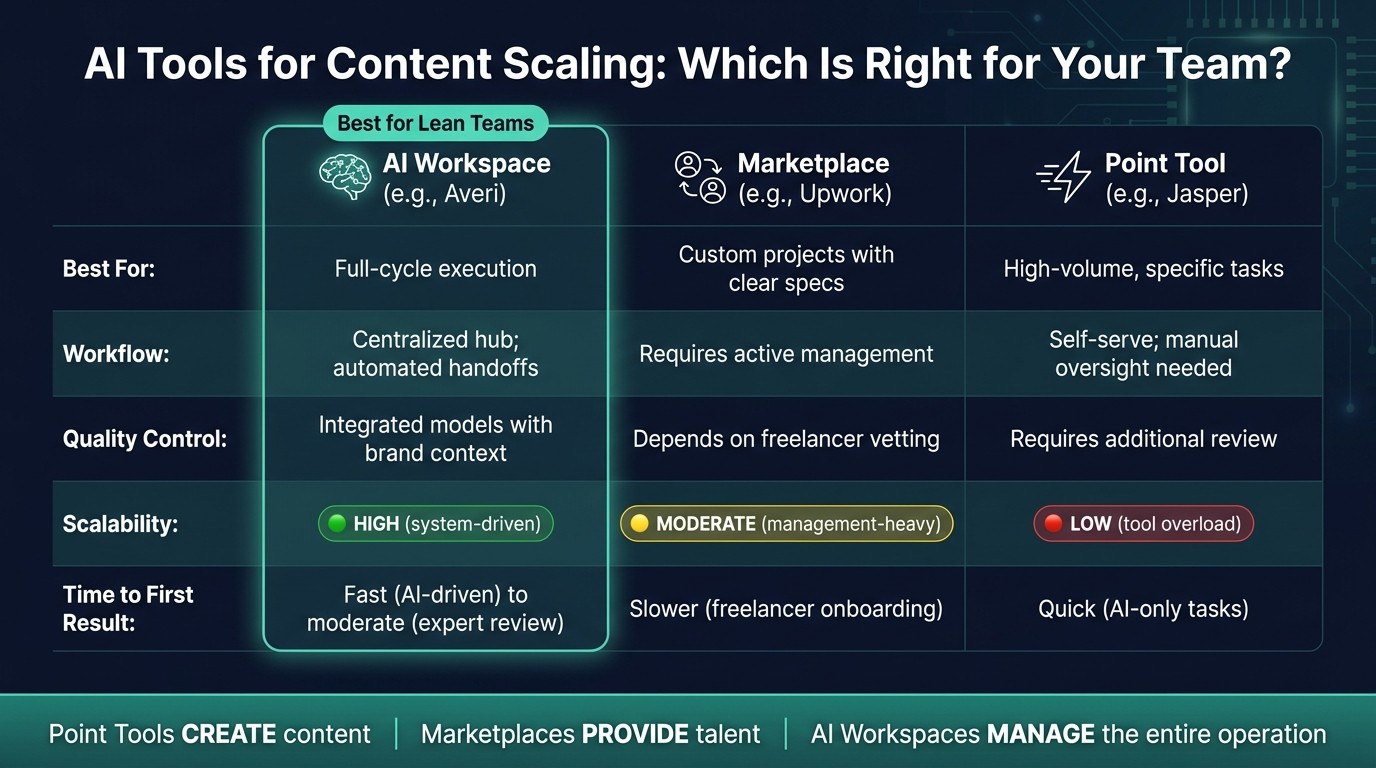
AI Tools for Content Scaling: Workspace vs. Marketplace vs. Point Tool
Once you’ve crafted a solid content roadmap, the next step is speeding up execution with AI-driven processes.
Map and Automate the Content Workflow
A scalable content workflow typically includes five stages: strategy, research, drafting, review, and publishing. The key is to automate all transitions that don’t demand human judgment. This allows your team to focus on approvals, maintaining the brand’s voice, and making strategic adjustments.
Take Averi, for example. This platform is designed around these exact stages. It starts by scraping your website to understand product positioning and brand voice. From there, it queues up content ideas based on keyword research and competitor analysis. Once a topic is approved, it dives into research, drafts SEO-optimized and location-specific content, and even publishes the final piece directly to your CMS. What’s more, every published piece feeds back into the system, sharpening future drafts.
Compare AI Workspaces, Marketplaces, and Point Tools
AI tools don’t all serve the same purpose. Understanding their differences is crucial for building an efficient workflow.
Factor | AI Workspace (e.g., Averi) | Marketplace (e.g., Upwork) | Point Tool (e.g., Jasper) |
|---|---|---|---|
Best For | Full-cycle execution | Custom projects with clear specs | High-volume, specific tasks |
Workflow | Centralized hub; automated handoffs | Requires active management | Self-serve; manual oversight needed |
Quality Control | Integrated models with brand context | Depends on freelancer vetting | Requires additional review |
Scalability | High (system-driven) | Moderate (management-heavy) | Low (tool overload) |
Time to First Result | Fast (AI-driven) to moderate (expert review) | Slower (freelancer onboarding) | Quick (AI-only tasks) |
The key distinction lies in their focus: point tools create content, marketplaces provide talent, and AI workspaces manage the entire operation. For lean teams, such as those in the early post-Series A stage, the management demands of marketplaces or the fragmentation caused by using multiple point tools can slow things down. An integrated workspace consolidates strategy, execution, and performance tracking in one place.
Set Up Workflow Automation for Efficiency
To streamline your operations, connect three essential components: your CMS (e.g., WordPress, Webflow), your project management tool (e.g., Notion, Asana), and your AI workspace. Tools like Zapier or Make can link these systems seamlessly, automating tasks like triggering review notifications, moving drafts to publishing queues, or logging performance data into dashboards [9].
Interestingly, 74% of organizations face challenges when scaling AI due to gaps in implementation [9]. The problem often isn’t the software but the lack of a clear, documented process guiding the tools. Before automating, manually map out each step in your workflow. Once you establish the logic, automation ensures consistency and repeatability.
This streamlined automation creates a foundation for scaling content production while balancing AI efficiency with human oversight.
Scale Content Production With AI and Human Oversight
Once you've streamlined your workflows, the next step is scaling content production without sacrificing quality. The secret lies in knowing where to begin and how to balance the workload between AI tools and your team. This balance creates a solid framework for producing targeted, efficient content.
Start With Bottom-of-Funnel Content
Begin by focusing on bottom-of-funnel (BOFU) content - like comparison pages, pricing details, and "best X for Y" articles. These types of content are aimed at buyers who are already evaluating their options, making them the quickest route to driving measurable results. They’re also easier to scale with AI due to their clear intent and predictable structure. Success here can be measured by metrics like demos booked and leads generated, rather than just website traffic.
Once you’ve established a reliable process for creating and reviewing BOFU content, you can branch out into educational guides and top-of-funnel material using an AI content creation framework. Trying to tackle everything at once often leads to a breakdown in quality, so it’s best to avoid spreading your resources too thin.
Use AI for Research, Drafting, and Optimization
AI works best as a tool to speed up repetitive and time-consuming tasks, not as a substitute for human expertise. It can handle initial research, draft structured outlines, create first drafts, and even suggest SEO metadata. This allows your team to focus on tasks that require critical thinking and nuanced judgment.
Here’s how a practical workflow might look: a marketer identifies the target keyword, audience, and conversion objective. AI then gathers research, drafts an outline, and produces an initial version of the content based on your brand’s context. From there, a writer or subject matter expert steps in to refine the argument, add product-specific details, and verify claims. This process can cut writing time from 4–5 hours to just 30–45 minutes of editing [3]. For example, Averi uses this model by conducting thorough research, applying your brand voice, and structuring drafts optimized for both Google search and AI citation engines like Perplexity.
The aim isn’t to replace human judgment but to avoid spending on human effort for tasks that don’t require it.
According to a 2024 HubSpot survey, 82% of marketers using generative AI reported faster content creation, and 65% said it helped them produce more content overall. However, 43% expressed concerns about accuracy and maintaining brand voice - underscoring the importance of a human layer in the process.
Keep Quality Consistent With Brand Voice and Review Layers
Speed means little if your content doesn’t reflect your brand. A brand voice guide is essential - it should outline your tone, preferred vocabulary, banned phrases, and formatting rules, complete with examples of both strong and weak copy. Incorporate this guide into your AI tools whenever possible, so drafts are closer to your brand standards from the start.
To maintain quality, implement a three-step review process for every piece of content:
Step 1: An editor ensures the content aligns with the target keyword and audience before writing begins.
Step 2: A content marketer reviews the draft for tone, structure, and brand alignment.
Step 3: For critical assets, such as pricing pages or competitor comparisons, a subject matter expert reviews and approves the final version.
Emily K. Schwartz, Head of Content + Comms at Haus, emphasizes the importance of integrating brand guidelines into AI workflows:
"By feeding an AI tool our style guide, voice, tone, and verbiage that is unique to our industry... AI makes it easy for our brand voice to come through clearly and consistently, no matter the writer, context, or medium." [4]
This level of consistency should be your benchmark for success.
Automate Distribution, Analytics, and Feedback Loops
Once your production is running smoothly, the next step is automating how your content gets distributed and analyzed. This ensures your growth stays consistent while freeing up your team to focus on bigger priorities. Many Series A teams struggle here, but AI marketing automation can bridge the gap.
Sync Your CMS, CRM, and Ad Platforms
Your tools need to work together seamlessly. By connecting your CMS (like WordPress), CRM (such as HubSpot), and ad platforms (like Google Ads), you can streamline the entire process - from drafting content to tracking its performance. This integration ties content engagement directly to your sales pipeline, giving you insights into which blog posts are driving demo requests instead of just counting page views.
Start by setting up conversion events in Google Analytics 4 that track meaningful actions, like demo requests, free trial signups, or newsletter subscriptions. Use UTM parameters consistently on every piece of distributed content to maintain clean attribution data. Employ both first-touch and last-touch attribution models to understand what content sparks interest and what ultimately closes the deal [1].
Automate Content Promotion Across Channels
Publishing content is just the first step - getting it in front of your audience should be effortless. Tools like Buffer can handle scheduled social media posts, while Zapier automates workflows, connecting your publishing process to email campaigns, Slack alerts, or even ad campaigns. Platforms like Averi take this further by publishing directly to tools like Webflow, Framer, or WordPress, removing the need for manual duplication and organizing content into a library for future use.
The goal is simple: one click to publish should trigger a fully automated, multi-channel distribution process. This kind of automation not only saves time but also ensures your content reaches the right audience without added manual effort.
Use Dashboards and AI for Smarter Insights
Dashboards should go beyond just showing numbers - they need to provide actionable insights. Organize your metrics into tiers: weekly dashboards for tracking daily KPIs like traffic and conversions, monthly reviews to identify standout performance, and annual reports to analyze long-term trends.
Pay special attention to content ranking in positions 11–30 on Google. These pieces are your low-hanging fruit - small tweaks can push them to page one without starting over. AI tools like Averi can highlight these opportunities, identifying which posts to update, which keywords are gaining traction, and what competitors are publishing. This kind of data-backed guidance ensures your content strategy stays sharp.
Recent studies show that 90% of marketers now use AI to make quicker decisions [2], and agentic AI workflows can save up to 40% of a marketer's time by automating tedious monitoring tasks [10]. That’s time your team can reinvest into strategic initiatives and execution.
Conclusion: Building a Scalable Content Marketing Engine
Scaling content marketing after Series A is about creating a system that reliably transforms strategy into measurable growth. The most successful teams treat content as a core part of their infrastructure - directly tied to business objectives, enhanced by AI, and refined by human judgment at critical points.
This approach rests on three essential principles. Strategy alignment ensures every piece of content serves a clear purpose, linking to key metrics like pipeline growth, trial signups, or customer retention - not just web traffic. AI-driven efficiency allows teams to handle increased demands without significantly expanding their workforce by automating routine tasks. Finally, human oversight guarantees that content remains accurate, consistent with the brand, and relevant to the audience. As the Averi team explains: "AI handles first drafts; humans handle strategy, editing, and publishing decisions." [2]
Operational consistency is equally important. Scalable systems rely on repeatable processes rather than ad hoc efforts. Tools like standardized briefs, well-documented review workflows, reusable AI prompts, and automated distribution checklists ensure that scaling content is manageable and sustainable. Companies that adopt this approach early often see more than 50% of their pipeline come from organic and content-influenced channels by the time they reach Series B. [4]
Averi AI plays a central role by unifying strategy, execution, publishing, and feedback, amplifying the overall effectiveness of the system. However, the tool’s impact depends on the structure surrounding it. The real advantage comes from combining the speed of AI with a clear editorial process and a feedback loop that continuously informs and improves the content roadmap. This integration creates a self-sustaining, scalable content engine.
When built correctly, this kind of content engine evolves over time, reducing the need for constant manual adjustments. As detailed throughout this guide, establishing this system after Series A positions content marketing as one of the most reliable and enduring growth drivers for the next phase of business.
FAQs
What should we do first to scale content with a 1–3 person team?
To improve your content process, begin by examining your current workflow to pinpoint areas causing delays, such as prolonged editing times or an uneven brand voice. Integrate AI tools into your operations for tasks like researching topics, drafting content, and fine-tuning SEO. These tools can help streamline processes and save time without requiring additional hires. Lastly, establish well-defined roles for key stages like strategy, writing, editing, and publishing to maintain a seamless and efficient workflow as your operations grow.
How can we prove content drives pipeline, not just traffic?
To demonstrate how content contributes to pipeline growth, leverage multi-touch attribution models. These models map out the entire customer journey, assigning credit to various content interactions that play a role in decision-making. By using advanced attribution tools and pipeline models, you can assess how content influences lead quality, drives opportunity creation, and contributes to closed deals. This approach shifts the focus from surface-level metrics like traffic or page views to tangible connections between content and revenue growth.
Which tasks should AI automate vs. stay human-led?
AI excels at managing repetitive, data-intensive tasks that demand speed and scalability. This includes responsibilities like topic research, drafting, SEO-related optimizations, and routine content production. On the other hand, areas that rely on creativity, compelling storytelling, emotional resonance, or an understanding of cultural nuances are best left to humans. These tasks include strategy development, editing, maintaining brand voice, and conducting the final review. By blending AI's efficiency with human insight, this collaborative approach ensures content remains genuine and high-quality.
Related Blog Posts

Zach Chmael
CMO, Averi
"We built Averi around the exact workflow we've used to scale our web traffic over 6000% in the last 6 months."
Your content should be working harder.
Averi's content engine builds Google entity authority, drives AI citations, and scales your visibility so you can get more customers.