

In This Article
Lean startups win by focusing on technical fixes, BOFU content, and niche backlinks to drive compounding organic growth.
Updated:
Trusted by 1,000+ teams
Startups use Averi to build
content engines that rank.
SEO is one of the most cost-effective ways for seed-stage startups to grow without breaking the bank. With paid advertising costs rising, startups need strategies that deliver long-term value. Here's what you need to know:
Why SEO matters: SEO-driven leads convert at 14.6%, compared to 1.7% for outbound marketing. Ranking high in search results builds trust, lowers customer acquisition costs (CAC), and drives consistent traffic.
Key benchmarks: In the first 6 months, aim for 500 monthly visitors through organic search, 10–20 keywords ranking in the top 30, and 5–10 quality backlinks.
Content focus: Prioritize niche keywords, bottom-of-funnel (BOFU) pages, and publish 2–4 optimized articles monthly. Use founder expertise to create in-depth content.
Technical SEO essentials: Fix crawl issues, improve Core Web Vitals (e.g., load time under 3 seconds), and ensure mobile-first performance.
Tools to track progress: Start with free tools like Google Search Console and Google Analytics 4. Affordable options like Screaming Frog and Mangools can help with deeper insights.
SEO success takes time but delivers compounding returns. By focusing on technical fixes, targeted content, and backlinks, startups can see measurable growth while staying lean.
What Founders Need to Know About SEO Before Scaling Up | Ryan Ward
Key SEO Benchmarks for Early-Stage Growth
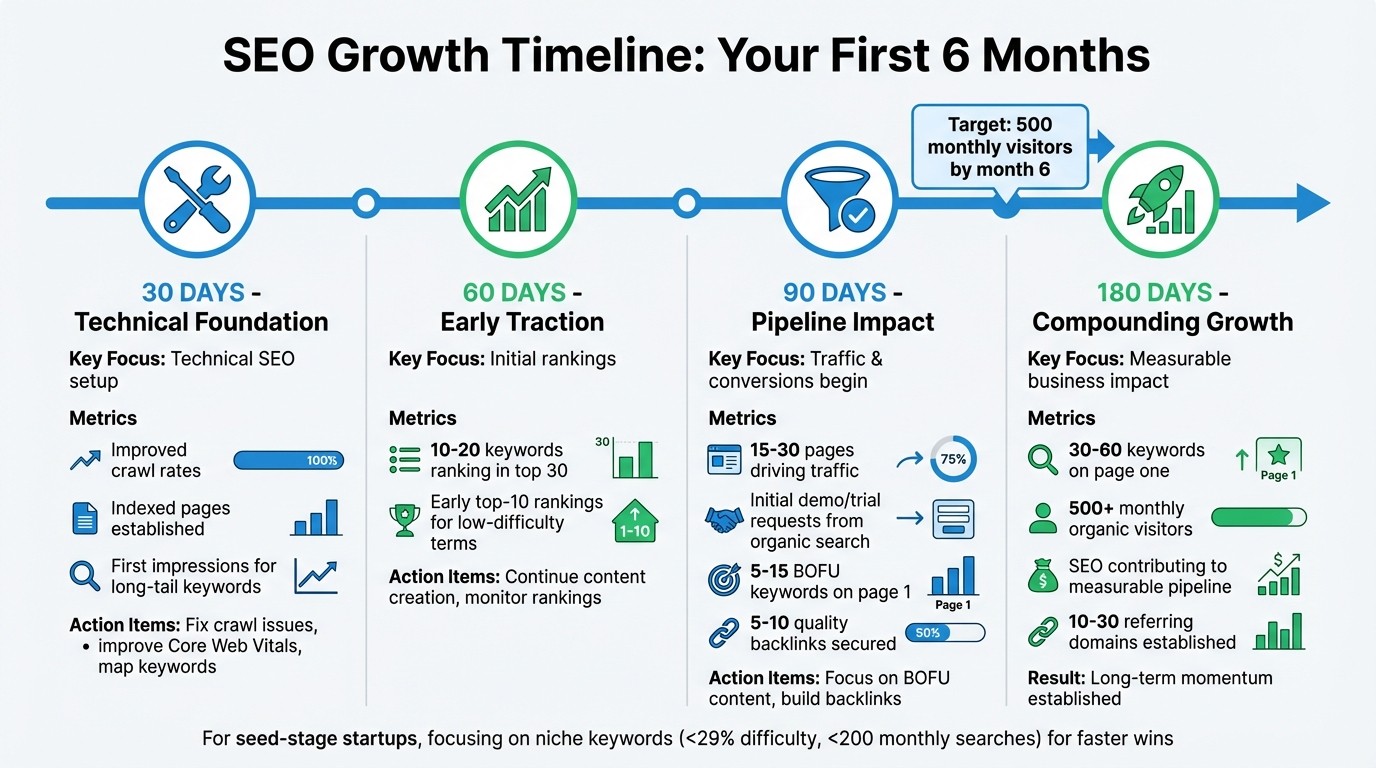
SEO Growth Timeline: 6-Month Benchmarks for Seed-Stage Startups
For small teams working with limited resources, setting realistic and actionable SEO benchmarks is crucial. The aim isn't to go head-to-head with industry giants over high-volume keywords but to carve out a space in your niche while staying efficient.
Organic Traffic Goals
In the first six months, a realistic target is to gain an additional 500 visitors per month through organic search [1]. This progress is achievable by focusing on high-intent, low-competition keywords that align with your audience's specific needs.
Take the example of an HR tech startup in 2024. Partnering with SEO consultant Ben Goodey, they managed a 20% month-over-month traffic increase for six months straight, all while spending just $10,000 a month on content - far less than their competitors' $60,000 budgets [4]. Their secret? A blend of targeted content creation and strategic backlink building rather than simply trying to outspend the competition.
The first 30 days should focus on technical SEO, including resolving crawl issues, improving Core Web Vitals, and mapping keywords [3]. By day 60, you can expect to have 10–20 keywords ranking in the top 30 positions [3]. By months three to six, you'll likely see meaningful traction as pages like comparison and alternative guides start driving traffic [3]. These early benchmarks lay the groundwork for full-funnel marketing strategies and quality backlinks.
Timeline | Expected Milestone | Key Metrics |
|---|---|---|
30 Days | Technical Foundation | Improved crawl rates, indexed pages, and first impressions for long-tail keywords [3] |
60 Days | Early Traction | 10–20 keywords ranking in the top 30; some early top-10 rankings for low-difficulty terms [3] |
90 Days | Pipeline Impact | 15–30 pages driving traffic; initial demo or trial requests from organic search [3] |
180 Days | Compounding Growth | 30–60 keywords on page one; SEO contributing to a measurable pipeline impact [3] |
Keyword Rankings Benchmarks
Forget about overly broad keywords like "best CRM software", which require massive resources to rank for. Instead, zero in on specific, niche queries that larger competitors often overlook. Focus on keywords with a difficulty score under 29% and fewer than 200 monthly searches [6]. Look for phrases that address specific problems, such as "how to [solve problem] for small teams" or "CRM for solo architects." These types of queries not only rank faster but also tend to convert better since they align closely with what your audience is searching for.
"Aim for topical authority. This means covering the topics your potential customers are looking for, in-depth." - Flavio Amiel, Founder, Audienz [4]
A great example of this approach is Gaia Learning, which in 2024 went from just 5 monthly clicks to an impressive 15,300 by targeting high-intent keywords and earning placements in Google's AI Overviews [4]. Early on, focus your efforts on Bottom-of-Funnel (BOFU) content, such as "alternative to [Competitor]" or "[Tool A] vs [Tool B]" pages. These pages often rank faster and directly drive demo requests or trial sign-ups [3][6]. By the 90-day mark, aim to have 5–15 BOFU keywords ranking on the first page for niche terms [3].
While keyword targeting gets you started, building authority through backlinks is what accelerates growth.
Backlink Growth Expectations
In the first 90 days, aim to secure 5–10 high-quality backlinks. A strong early benchmark is to earn links from 10 high-authority sites within your first three months [1].
"You don't need gray-hat tactics; you need credible reasons for others to mention and link to you." - Searcle.ai [3]
Once you've established 10–30 solid referring domains within your niche, you'll notice a significant boost in organic growth [3]. Instead of buying links or spamming directories, focus on creating content that others want to cite. For instance, Semrush's "State of Content Marketing Report" attracted around 4,000 backlinks from 900 unique domains by offering original, highly shareable insights [1].
Start by sharing practical resources, like frameworks or templates, within niche communities on platforms like Reddit, Slack, or Product Hunt [3][6]. Build integration pages for complementary tools and explore co-marketing opportunities. Use monitoring tools to find unlinked mentions of your brand and request backlinks [1]. These strategies are cost-effective and ideal for lean teams.
Avoid targeting medium-difficulty keywords until you’ve secured at least 10–15 quality backlinks [6]. High-ranking pages for competitive terms often have 80 to 150+ backlinks, making them an uphill battle for newer startups [6]. Focus your efforts where you can make the biggest impact early on.
Technical SEO Benchmarks for a Strong Foundation
Before your startup can achieve meaningful SEO success, your website must be easy to find, crawl, and understand. For resource-tight startups, focusing on impactful technical fixes is the way to go.
"Technical SEO enables everything else. Content needs to be discovered, crawled, indexed, and delivered fast enough that people actually stay. Skip any of those steps, and your rankings suffer regardless of how good the writing is." - Makarenko Roman, Founder, Thunder Marketing Solutions [8]
Interestingly, most technical improvements come from addressing a small set of issues. Studies suggest fixing the top 20% of technical problems can eliminate 80% of ranking obstacles [2]. For startups, this means you can make noticeable progress without needing a dedicated DevOps hire.
Site Structure and Indexability
Your site’s architecture should be flat, ensuring every page is within three clicks of the homepage [8]. This layout not only improves crawl efficiency but also enhances user experience. Stick to short, readable URLs with hyphens instead of underscores, and avoid including dates or version numbers in your URLs [7][8].
Start by checking your robots.txt file to ensure it’s not unintentionally blocking important pages. Your XML sitemap should only include high-quality URLs - exclude redirects, 404s, or canonicalized links [8]. A quick site:yoursite.com search in Google will reveal which pages are currently indexed [5]. For startups, keeping the number of indexable pages under 100 can help maintain quality signals [8].
Internal linking is often underestimated but plays a crucial role. Avoid leaving pages orphaned, and use keyword-rich anchor text within your content - these links carry more weight than those in footers or sidebars [8]. Additionally, implement structured data (e.g., Article, Product, FAQ, LocalBusiness) using JSON-LD to help search engines better understand your content and potentially display rich snippets in search results [7][8].
Since Google prioritizes the mobile version of your site for indexing, your mobile user experience must be seamless. Ensure tap targets are at least 44x44 pixels and that your design is fully responsive [7][8]. Tools like Google Search Console and Screaming Frog (free for up to 500 URLs) can help you monitor issues like broken links, duplicate content, and redirect chains [7][8].
Page Speed and Core Web Vitals
Page speed has a direct impact on conversions - a one-second delay in mobile load time can decrease conversion rates by as much as 20% [7]. Aim for a mobile load time of under 3 seconds and a Largest Contentful Paint (LCP) of less than 2.5 seconds [7][8].
Element | Benchmark | Priority |
|---|---|---|
Load Time | < 3 seconds (Mobile) | High |
LCP | < 2.5 seconds | High |
CLS | < 0.1 | Medium |
INP | < 200 ms | Medium |
Security | 100% HTTPS adoption | Critical |
To optimize speed, use modern image formats like WebP or AVIF for better compression and enable lazy loading for offscreen content [7][8]. Tools like Smush can handle image compression without requiring manual effort [1]. Keep your Cumulative Layout Shift (CLS) below 0.1 to ensure visual stability during page loads [8]. The newer Interaction to Next Paint (INP) metric, which replaced First Input Delay in 2024, should remain under 200 milliseconds [8].
Server response times should ideally stay below 600ms, as slower times can signal inefficiency to search engines [8]. HTTPS is a must-have - ensure all internal links and canonical tags use HTTPS to avoid mixed content warnings [8]. Tools like Google Lighthouse and PageSpeed Insights can pinpoint elements slowing down your LCP [5], allowing you to focus on fixes that deliver the most impact rather than chasing perfect scores.
Once your technical SEO foundation is solid, you can turn your attention to refining content strategy and optimizing on-page elements.
Content Strategy and On-Page Optimization
Once a strong technical foundation is in place, lean startups need to focus on creating content that not only ranks well but also drives conversions. For seed-stage startups, this means zeroing in on bottom-of-funnel (BOFU) content - the kind that targets high-intent queries such as "{Competitor} vs {You}", "{Tool} alternatives", or "how to {job-to-be-done}" [3]. These types of pages attract users who are already primed to take action.
The key is to prioritize BOFU content that captures this ready-to-convert audience. Build topic clusters around one central pillar page supported by 6–12 related pieces. This approach quickly establishes authority on specific topics while creating an efficient content ecosystem designed to guide users toward conversion.
Content Publishing Benchmarks
Aim to publish 2–4 optimized pieces of content each month, scaling up to 8 as your team expands. Long-form content tends to perform better, generating 77% more backlinks and 56% more social shares [2]. For a strong start, launch 3–5 quick-win pages within your first 30 days. These could include FAQs, how-to guides, or comparison pages, all with strong internal linking [3].
Tap into founder-led expertise by featuring credentialed bylines and detailed author bios. Highlighting expertise and citing primary sources builds trust quickly, especially for startups operating in Your Money or Your Life (YMYL) categories. In these cases, adding disclosures, compliance reviews, and revision logs can further enhance credibility [3].
To strengthen your internal linking strategy, set aside time each week - for instance, every Friday - to add 3–5 internal links from existing content to new pages. This practice helps distribute authority across your site and signals clear topic relationships to search engines.
On-Page SEO Metrics and Goals
Boost your click-through rate (CTR) by optimizing metadata. Keep title tags between 50–60 characters and meta descriptions around 120 characters. Use a structure like "{Primary Keyword}: {Benefit} for {Audience} | Brand" [3]. Write meta descriptions in active voice, naturally integrating target keywords, and aim for a CTR above 2% [1].
While bounce rates below 60% are a good benchmark, scroll depth provides a more accurate measure of engagement. Strive for a scroll depth of over 50% to ensure visitors are reaching key content and calls-to-action [5]. Use clear H2 and H3 headers to address subtopics and include concise FAQ sections to capture "People Also Ask" queries [3]. Adding JSON-LD schema (such as Article, FAQ, or How-to) can further enhance visibility by enabling rich snippets that improve CTR.
On-Page Element | Target Benchmark | Priority |
|---|---|---|
CTR | > 2% | High |
Bounce Rate | < 60% | Medium |
Scroll Depth | > 50% | Medium |
Title Length | 50–60 characters | High |
Meta Description | ~120 characters | High |
To keep your content performing well, regularly audit your site to identify and address thin, duplicate, or outdated pages [3]. This process ensures search engines focus on your strongest, most relevant content. It's worth noting that only about 5.7% of newly published pages make it into the top 10 search results within a year [2], so every piece of content needs to be strategically planned and fully optimized to compete effectively.
Tools and Strategies for Tracking SEO Progress
Keeping tabs on your SEO progress is crucial for identifying early successes and setting realistic benchmarks for improvement.
SEO Monitoring Tools
Start with free solutions like Google Search Console (GSC) and Google Analytics 4 (GA4) to monitor essential metrics. GSC's user-friendly, AI-powered interface allows even non-technical users to access reports in plain language [10]. GA4 provides insights into engagement metrics like scroll depth and conversion rates, while GSC highlights indexed pages and flags technical issues.
If you're working with a budget under $50/month, several affordable tools can help:
SEOptimer ($29/month): Conducts quick audits to identify critical fixes [12].
NeuronWriter ($23/month): Optimizes content by comparing your drafts to top-ranking competitors [11].
AnswerThePublic (starting at $11/month): A great tool for basic keyword research [12].
For budgets in the $50–$100/month range, you can explore:
Mangools ($49/month): Tracks keyword rankings, analyzes backlinks, and identifies content gaps [12].
ConvertMate ($29/month): Uses AI agents to automate various SEO tasks, earning high praise for reducing the need for multiple subscriptions [9].
Screaming Frog ($259/year, roughly $21.50/month): A trusted tool for technical site crawls, despite its desktop-only setup [9].
For now, it’s wise to steer clear of enterprise-level tools like Ahrefs or SEMrush until you're at a Series A funding stage. These platforms often come with steep learning curves and high costs.
By 2026, monitoring your visibility in AI-driven search engines like ChatGPT, Perplexity, and Google AI Overviews has become essential. AI Overviews now appear in around 15–16% of search results, and visitors referred by AI searches convert at rates 4.4 times higher than traditional organic traffic [10]. Tools like Profound ($99/month) offer specialized AI visibility tracking, measuring metrics such as "AI Share of Voice" and "Citation Tracking" [11].
After selecting the right tools for your needs, focus on consolidating your data into actionable insights.
Building a Scalable SEO Dashboard
Streamline your tracking by integrating data from GSC, GA4, and rank trackers into a unified dashboard. Free options like Looker Studio or paid alternatives like Swydo can help you organize and visualize your data. Structure your dashboard into three alert tiers for clarity:
Critical: Issues like site downtime or manual penalties.
Important: Problems such as broken redirects or other technical glitches.
Monitor: Minor ranking fluctuations [10].
This tiered system helps reduce notification fatigue while ensuring critical issues are addressed promptly.
You can also segment traffic by URL patterns. For example, in GA4, filter URLs containing "/blog" to focus on content performance. Use GSC to track weekly metrics like impressions, clicks, CTR, and average position to spot potential problems early. Cross-reference ranking changes in your tracking tools with actual traffic data to avoid false alarms [10].
Make it a habit to review your data weekly. Set aside time each Friday to monitor ranking shifts, identify new technical errors, and add 3–5 internal links to strengthen your site's authority. A well-organized monitoring system allows you to shift from reactive problem-solving to proactive strategy.
Conclusion: Achieving Early SEO Wins While Staying Lean
For seed-stage startups, success in SEO doesn't mean trying to compete with established players on every keyword. Instead, it's about setting achievable goals, concentrating on activities that deliver the most impact, and creating momentum with limited resources. By focusing on realistic and measurable objectives, startups can lay the groundwork for long-term success [1].
SEO offers a unique advantage: its benefits grow over time. Unlike paid advertising, where results stop as soon as the budget runs out, a solid content and technical strategy continues to drive traffic well into the future. Every effort you put in today compounds into greater returns down the line [2].
"Without strategy, execution is aimless. Without execution, strategy is useless." - Morris Chang [5]
To get started, prioritize fixing critical technical issues, target low-competition keywords with search volumes over 100, and lean into founder-led content creation [1][4]. Keep things simple by using free tools like Google Search Console and Google Analytics 4 to monitor your progress weekly. Skip expensive enterprise tools until you're further along, such as at Series A.
Patience is essential - only 5.7% of new pages make it into the top 10 search results within a year [2]. Focus on high-impact activities like building core content clusters, securing backlinks from high-authority sources through platforms like Featured or Connectively, and maintaining a steady publishing schedule. The startups that excel in SEO don't necessarily outspend their competition - they outthink and outlast them by playing smarter [6]. By sticking to these lean and focused strategies, you'll be well on your way to scaling your SEO efforts effectively.
FAQs
What are some cost-effective ways for seed-stage startups to build backlinks?
Building backlinks on a tight budget is entirely possible for seed-stage startups - it's all about focusing on quality rather than sheer volume. Begin with practical strategies like writing guest posts for niche-relevant blogs, offering expert quotes to journalists or content creators, and identifying broken-link or resource-page opportunities on other websites. These methods not only save costs but also help establish your brand's authority within your industry.
To make the most of your efforts, target websites that align closely with your niche or area of expertise. By securing highly relevant mentions, your initial 10–15 backlinks can pack a stronger punch for your SEO growth, keeping your approach both efficient and cost-effective.
What are the key technical SEO factors that seed-stage startups should focus on?
For seed-stage startups, paying attention to a few technical SEO essentials can significantly impact early growth. Start by ensuring crawlability and indexation so search engines can easily locate and rank your pages. Focus on fast page-load speeds and mobile-friendliness, as these are crucial for both user satisfaction and search engine rankings.
Make sure to enable HTTPS security to build trust and protect user data. Keep your URL structure clean with a logical site architecture, and use structured-data markup to make your content easier for search engines to interpret. Be mindful of duplicate content, which can confuse search engines and hurt your rankings.
By addressing these foundational elements, you’ll create a solid groundwork for SEO growth, even with limited resources.
Why is bottom-of-funnel content important for startups' SEO strategies?
Focusing on bottom-of-funnel (BOFU) content is a game-changer for startups, especially when targeting users who are ready to take action - whether that’s making a purchase, signing up, or committing to a service. These high-intent visitors are the ones most likely to convert, making BOFU content a direct path to generating revenue while simultaneously building trust with your audience.
For startups operating with lean teams and tight budgets, BOFU content offers an efficient way to achieve tangible results. By addressing specific challenges and presenting clear, actionable solutions, startups can attract highly qualified traffic and carve out a reputation for expertise in their field. Prioritizing BOFU strategies ensures that every dollar and minute spent on SEO delivers the greatest possible return.
Related Blog Posts

Zach Chmael
CMO, Averi
"We built Averi around the exact workflow we've used to scale our web traffic over 6000% in the last 6 months."
Your content should be working harder.
Averi's content engine builds Google entity authority, drives AI citations, and scales your visibility so you can get more customers.