SEO for Founders: What to Automate vs What to Review Yourself

Averi Academy
Averi Team
8 minutes

In This Article
Automate keyword research, meta tags, internal linking, and monitoring—reserve strategy, brand voice, and final approvals for founders.
Updated:
Trusted by 1,000+ teams
Startups use Averi to build
content engines that rank.
AI can save time, but it’s not a complete replacement for human oversight. While automation excels at repetitive tasks like keyword research and content drafting, critical decisions - like aligning content with your brand voice or ensuring accuracy - still need your input. Fully automated strategies often lead to penalties, poor engagement, and missed opportunities.
Key Takeaways:
Automate: Keyword clustering, meta descriptions, internal linking, and performance tracking.
Review Yourself: Brand tone, strategic content alignment, and final approvals.
Risks of Over-Automation: 28% shorter time-on-page, 35% higher bounce rates, and 87% of Google penalties tied to unchecked AI content.
Balanced Workflow: A hybrid approach saves 46–65% of time while maintaining quality.
Focus on tasks AI can handle efficiently, but don’t skip essential human reviews to protect your brand and long-term performance.
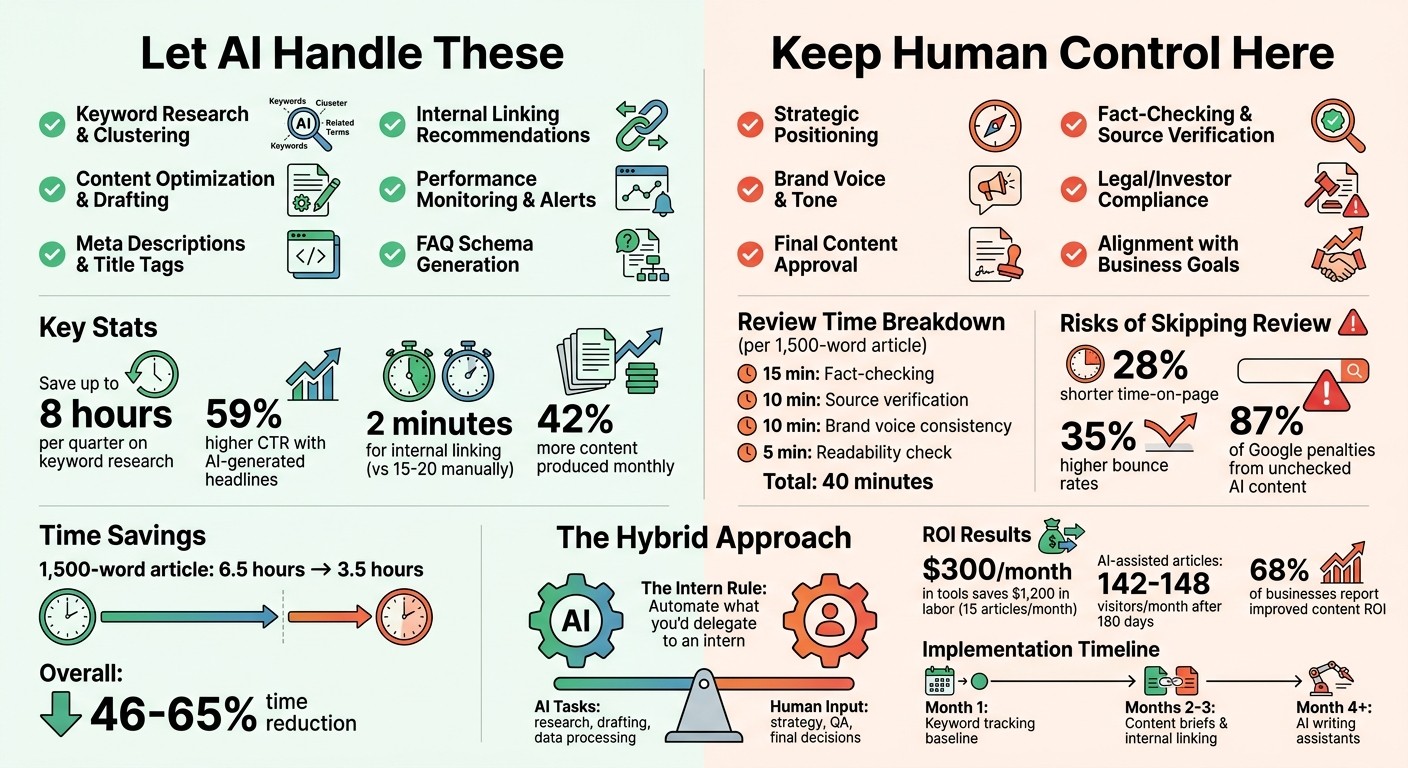
SEO Tasks to Automate vs Review: A Founder's Guide
How to Automate SEO Without Getting Penalized (AI Secrets Revealed)
SEO Tasks You Can Automate
Tackling repetitive, data-heavy tasks can be a time drain, but automation steps in to handle these efficiently without requiring strategic judgment. AI tools shine when it comes to processing large datasets, maintaining consistency, and executing predefined workflows. Below are some key areas where automation can save time and boost productivity while leaving room for strategic decision-making.
By 2026, automated SEO content is projected to account for 17.3% of Google's top 20 results, a significant jump from just 2.3% in 2020 [3]. Companies leveraging AI are producing 42% more content monthly - averaging 17 articles compared to 12 for teams that don't use automation [3]. The secret lies in knowing which tasks to automate and which tools are best suited for the job.
Keyword Research and Clustering
AI tools can process thousands of search queries, uncover high-intent opportunities, and organize them into structured topic clusters in just minutes. What used to take up to 8 hours each quarter can now be done automatically [2]. Tools like Frase (starting at $15/month) and SurferSEO ($69/month) excel at pulling search volume data, analyzing competitor rankings, and grouping related keywords by intent [3].
That said, manual oversight is still crucial. For instance, AI might prioritize "cats" due to high search volume, even though "cat vet" is a more relevant, high-intent query for your audience [2]. Always review AI-generated suggestions to ensure they align with your actual goals rather than simply chasing raw numbers.
Content Optimization and Drafting
Automation simplifies the technical aspects of content creation, ensuring consistency and reducing errors. AI can generate meta descriptions, title tags, and FAQ schema, taking care of tasks that are prone to human error [2]. Additionally, these tools analyze your sitemap and backlink reports to recommend internal links, improving crawlability in just two minutes - a task that typically takes 15–20 minutes manually [2].
AI-generated headlines have been shown to increase click-through rates by 59% [3]. Platforms like Jasper ($49/month) help maintain your brand's tone across drafts [4]. The first drafts created by AI are structured to rank on Google and be AI-search-friendly, complete with summaries and FAQ sections. While AI handles the formatting and optimization, your input ensures the content reflects the right perspective.
Performance Monitoring and Alerts
AI has revolutionized performance tracking, eliminating the need for manual spreadsheets. For instance, you can set up conditional formatting in Google Sheets to automatically highlight traffic or ranking deviations greater than 10% [2]. Alerts can also notify you of significant changes, such as a 30% session drop over 90 days or a 5% increase in indexing errors during a single crawl [2][5].
Monitoring now extends beyond traditional rankings. Only 12% of URLs linked by AI chatbots like ChatGPT and Perplexity appear in Google's Top 10 results [6], making AI visibility tracking an essential new metric. Tools like Semrush's AI Visibility Toolkit ($99/month add-on) can track brand mentions and citations in AI-generated answers [6]. This is especially important as traffic from sites referred by large language models converts 4.4 times better than traditional organic search traffic [6], making such monitoring indispensable for staying competitive in 2026 and beyond.
SEO Tasks That Need Your Review
AI can handle the heavy lifting of data analysis and drafting, but some SEO tasks require your personal expertise. These decisions are too important to leave entirely to automation - they need your strategic input to align with your business goals. Striking the right balance between AI efficiency and your judgment is key to driving long-term SEO success.
Strategic positioning and standing out from competitors fall squarely on your shoulders. While AI can analyze what’s currently ranking, it can’t define your company’s unique strengths or expertise. You decide which topics best align with your goals and audience, and how to differentiate your brand in ways that reflect your competitive edge [1]. This manual input ensures your strategy goes beyond AI’s limitations and keeps your brand consistent.
Preserve your brand voice with careful human oversight. AI content often requires editing to sound less generic and more aligned with your brand identity. Skipping this step can hurt engagement - fully automated content sees 28% shorter time-on-page and 35% higher bounce rates [1]. Plan to spend 40 minutes per 1,500-word article on review: allocate 15 minutes for fact-checking, 10 minutes for verifying sources, 10 minutes for ensuring brand voice consistency, and 5 minutes for readability [1]. This kind of attention ensures your content connects with readers and reflects your standards.
Final approvals are non-negotiable for protecting your brand identity. Automation missteps, like AI-generated content, account for 87% of Google manual action penalties [1]. Beyond avoiding penalties, your final review ensures the content aligns with your company’s messaging and uses accurate terminology - critical for legal compliance or communicating with investors. Investors, in particular, value a solid content strategy as proof your marketing can scale without requiring a proportional increase in staff [2].
Taking this hybrid approach pays off: while AI might promise 85% time savings, realistic results are closer to 46-65% when human oversight is factored in [1]. AI-assisted articles that undergo thorough editing can match the performance of manually created content, reaching 142-148 visitors per month after 180 days. The key is your strategic refinement - your input transforms AI drafts into content that drives business growth [1].
How to Build an AI-Human SEO Workflow
Combining the precision of human oversight with the efficiency of AI tools can create a highly effective SEO workflow. This section breaks down how to structure such a hybrid system, ensuring quality meets productivity.
Set Up Automated Research and Drafting
Start by rolling out automation in phases. In the first month, establish a baseline by measuring rankings, traffic, and content output without automation. Then, gradually incorporate tools: Months 2–3 can focus on automating content brief creation and internal linking, while AI drafting assistants can come into play by Month 4 [1].
The phased approach is crucial because automation becomes cost-effective when producing at least 15 articles per month [1]. Below this level, expenses might outweigh time savings. A hybrid workflow can significantly reduce production times for a 1,500-word article - from 6.5 hours manually to 3.5 hours with AI. This breakdown typically includes 30 minutes for research, 20 minutes for AI drafting, 2 hours for human editing, and 45 minutes for expert input [1]. Configure AI tools to identify keyword opportunities and generate content ideas that align with your goals.
Use Collaborative Editing and Publishing
Delegate about 70% of tasks to AI - such as research and drafting - while reserving 30% for human input, including quality checks and final publishing [2]. Stick to a structured editing process to avoid pitfalls like reduced time-on-page (28% lower) and higher bounce rates (35% higher) that often result from skipping human review [1].
Leverage collaborative editing tools to streamline revisions. These tools allow you to mark sections for rewrites without starting from scratch. Automate internal linking by scanning existing content for anchor opportunities, saving 15–20 minutes per post [1][2]. Integrate your workflow with your CMS, whether it’s Webflow, Framer, or WordPress, to eliminate manual formatting errors and cut down on publishing time. Teams using this approach have reported a 40–67% reduction in time-to-publish [1].
Track Performance and Improve
Set up alerts to notify you of critical changes, such as rankings dropping more than three positions or traffic declining by over 20% week-over-week [1]. This proactive monitoring can prevent 70–80% of ranking drops from going unnoticed for more than 48 hours [1]. Beyond Google Analytics, track your visibility in AI-driven search engines like ChatGPT and Perplexity. Currently, 76% of sources cited in Google AI Overviews already rank in the top 10 traditional results [7], highlighting the importance of optimizing across platforms.
Conduct quarterly SEO audits to uncover issues that may not show up in weekly monitoring [7]. Use performance data to refine your AI prompts and improve content brief templates based on what consistently ranks well. Additionally, create specialized GPTs for specific tasks, such as formatting or adhering to brand guidelines, instead of relying on a single, overly generalized tool [2]. This targeted strategy ensures your workflow remains efficient while continuously learning and improving with each publishing cycle.
Conclusion
An effective SEO strategy blends the precision of AI with the insight of human expertise. By automating repetitive tasks and reserving your judgment for strategic decisions, you can achieve significant cost and time savings by tracking marketing KPIs and metrics. For instance, creating 15 articles a month with a $300 investment in tools can save $1,200 in labor, while hybrid workflows deliver 46–65% time savings and maintain quality scores above 8/10 [1]. The key lies in finding the right balance.
A straightforward approach to this balance is the Intern Rule: automate tasks you'd feel comfortable assigning to an intern - such as keyword clustering, initial drafts, and data collection. Dedicate the remaining 30% of your effort to decisions requiring deeper business understanding, like aligning keywords with your product roadmap, ensuring content reflects your brand's positioning, and verifying that the tone resonates with your audience [2].
"Identify repeatable SEO tasks and build simple automation workflows so you can focus on strategy, QA, and decision-making." - Roslyn Ayers [2]
Skipping human oversight comes with risks. Fully automated content often underperforms, with 28% lower time-on-page and 35% higher bounce rates, and unreviewed AI-driven content is linked to 87% of Google manual actions [1]. However, when paired with human review, 68% of businesses report improved content ROI from AI integration [3].
Tools like Averi streamline the entire process - from research and drafting to optimization and publishing - while keeping you in control at critical checkpoints. This approach eliminates the need to juggle tools or freelancers, allowing you to focus on the final review and strategic decisions.
To build a scalable SEO engine, start small. Begin with keyword tracking in Month 1, move to content briefs in Months 2–3, and introduce AI writing assistants by Month 4 [1]. This phased rollout ensures a sustainable system that prioritizes growth while maintaining quality.
FAQs
How do I know which SEO tasks are safe to automate?
When it comes to leveraging AI in SEO, focus on automating tasks that are repetitive and data-heavy. This includes activities like keyword research, analyzing SERPs, tracking competitors, creating content outlines, and monitoring performance. These areas thrive on data aggregation and pattern recognition, which are strengths of AI systems.
On the other hand, tasks that demand strategic thinking or a strong connection to your brand - such as refining content, crafting compelling narratives, or shaping an SEO strategy - should always involve a human touch. This ensures the final output maintains quality, stays authentic, and aligns seamlessly with your brand's unique voice.
What should I always review before publishing AI-written content?
Always check AI-generated content for accuracy, relevance, and alignment with your brand voice before sharing it. This step guarantees the content upholds your quality standards and authentically represents your business's identity.
How can I avoid Google penalties when using AI for SEO?
To steer clear of Google penalties, prioritize crafting content that genuinely serves your audience while adhering to E-E-A-T principles: Experience, Expertise, Authority, and Trust. Your content should align closely with search intent, ensuring it answers users' needs effectively.
It's important to note that Google doesn’t penalize AI-generated content simply because it’s created by AI. However, content that comes across as spammy or manipulative can lead to penalties.
Make it a habit to manually review AI-generated material to confirm it meets high-quality standards, reflects your brand’s voice, and provides real value to your audience. Treat AI as a helpful tool to elevate your SEO strategy, not as a shortcut for gaming the system.
Related Blog Posts

Zach Chmael
CMO, Averi
"We built Averi around the exact workflow we've used to scale our web traffic over 6000% in the last 6 months."
Your content should be working harder.
Averi's content engine builds Google entity authority, drives AI citations, and scales your visibility so you can get more customers.