

In This Article
6-step SEO guide for seed-stage startups: set goals, target high-intent keywords, fix technical SEO, use AI content, build links, and track results.
Updated:
Trusted by 1,000+ teams
Startups use Averi to build
content engines that rank.
Running a seed-stage startup is tough - you’re managing product development, fundraising, and customer acquisition with limited time and money. SEO offers an affordable way to grow your visibility and attract customers without relying on expensive ads. Here’s a quick breakdown of how to build an effective SEO strategy for your startup:
Set Clear Goals: Focus on actionable metrics like demo requests or sign-ups, not just traffic.
Keyword Research: Target low-competition, high-intent keywords using tools like Google Keyword Planner or Ahrefs.
Optimize Your Website: Fix technical issues like page speed and mobile responsiveness.
Create Content Efficiently: Use AI tools like Averi AI to save time and maintain quality.
Build Backlinks: Use HARO, guest posts, and niche directories to get authoritative links.
Track Results: Use Google Search Console and analytics tools to monitor performance and refine your approach.
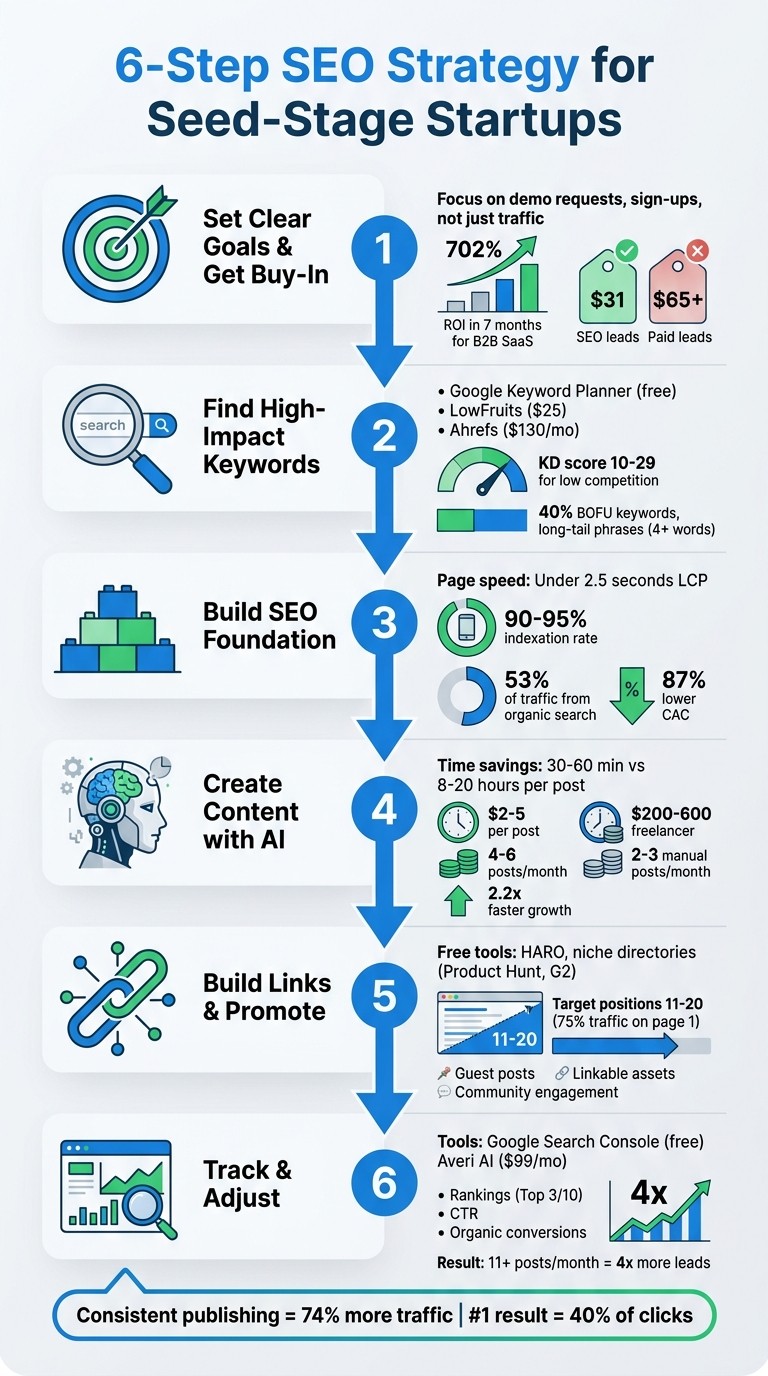
6-Step SEO Strategy Framework for Seed-Stage Startups
Step 1: Set Clear SEO Goals and Get Team Buy-In
Define Measurable SEO Objectives
Align your SEO goals with outcomes that truly impact your startup's growth. Forget vanity metrics like total page views - focus on actions that matter, such as newsletter sign-ups, demo requests, or inbound inquiries from potential customers. For startups still working on product-market fit, customer attribution - asking new customers how they discovered you - often provides more actionable insights than just tracking organic traffic numbers [2].
Set specific targets for the next 3–6 months, like ranking on page one for five bottom-of-funnel keywords. These might include phrases like "[your product] vs. [competitor]" or "[your category] pricing", aimed at buyers ready to make decisions [3][2]. If you're committing to weekly content, monitor whether this schedule delivers the typical 320% boost in conversions that consistent publishing is known to achieve [1].
With clear, measurable objectives in place, you're better equipped to demonstrate the value of SEO and secure buy-in from key stakeholders.
Show ROI to Get Stakeholder Support
In the lean world of startups, where every dollar and minute matter, proving that SEO delivers a strong return on investment is essential. To win over co-founders or early investors, frame SEO in terms of capital efficiency and ROI. For example, B2B SaaS companies report an impressive 702% ROI from SEO within seven months, with SEO leads costing just $31 compared to $65+ for paid channels [3]. Over three years, this ROI grows to 748% [4].
Position SEO as a scalable customer acquisition channel that strengthens your pitch to Series A investors. Content-driven growth is often viewed more favorably than paid-driven strategies, as it demonstrates the ability to attract customers without excessive spending [4]. While manual content creation can demand significant founder time (valued at $200–$500 per hour), AI content marketing tools can reduce this workload by as much as 70% [4].
"The goal isn't to become a full-time content marketer. The goal is to build the minimal infrastructure that produces results while you focus on product and customers." - Zach Chmael, CMO, Averi [3]
Present stakeholders with a realistic timeline for breaking even on SEO investments. For instance, a $1,000/month budget (leveraging AI tools to create 4–6 optimized posts) typically breaks even within 9–10 months. A $3,000/month budget that includes active link building can see returns in just 7–8 months [4]. Emphasize that consistent publishing schedules can boost traffic by 74% compared to sporadic efforts [3].
The GOAT SEO Strategy for Software Founders (From Zero to Scale)
Step 2: Find High-Impact Keywords for Your Market
When resources are tight, seed-stage startups need to focus on smart, efficient keyword strategies to boost visibility without wasting time or money.
Use Keyword Research Tools
Begin with free tools like Google Keyword Planner and Google Search Console to check search volumes, CPC data, and impressions. For additional insight, use an incognito browser to explore autocomplete suggestions.
If you're ready to invest, consider budget-friendly paid options: LowFruits starts at $25, Ubersuggest at $29/month, while more advanced tools like Semrush and Ahrefs cost around $130–$140 per month.
Don’t overlook your own data. Dig into CRM notes, sales call transcripts, support tickets, and internal site search logs to identify seed keywords. This approach captures the exact words your customers use, offering a more accurate picture of their search behavior [5]. Platforms like Reddit, Quora, and industry-specific Slack groups are also valuable for uncovering practical, high-intent keyword opportunities [3].
"Keyword research is the 20% thing you do that drives 80% of your results for your website." – Omid G, Founder, Marketer Milk [8]
Once you’ve gathered potential keywords, focus on targeting long-tail options with low competition and high intent.
Target Low-Competition, High-Intent Keywords
Long-tail keywords - phrases with four or more words - are easier to rank for and often deliver better conversion rates. For example, instead of competing for a broad term like "project management", aim for something more specific, such as "project management for 3-person dev teams" [10].
Look for keywords with a Keyword Difficulty (KD) score between 10 and 29. This range is ideal for newer websites with limited domain authority [6]. Analyze search results to spot weak competition - if low-authority sites rank on the first page, it’s a sign you can outperform them [7]. Additionally, Google Search Console can help you identify keywords where your site ranks between positions 11 and 20; optimizing these pages can push them to the first page more quickly [10].
Allocate around 40% of your content to bottom-of-funnel (BOFU) keywords like "Product vs. Competitor", "Best [Category] for [ICP]", or pricing guides to attract buyers ready to make a decision [3]. Finally, classify your keywords by intent - whether informational, commercial, navigational, or transactional. Align your content with the searcher's stage in their journey and prioritize topics based on three factors: search demand (30%), buyer intent (40%), and competition (30%) [3]. This structured approach ensures your efforts yield maximum impact.
Step 3: Build a Solid SEO Foundation for Your Website
For startups operating with limited resources, establishing a strong SEO foundation is essential to maximize organic reach without adding extra costs. Ensuring that search engines can locate, crawl, and understand your site is the cornerstone of achieving better rankings.
Fix Technical SEO Issues
Page speed is a critical factor - 53% of users will leave a site that takes more than 3 seconds to load. Reducing load times from 3.2 seconds to 1.1 seconds can lead to a 23% boost in conversions [14]. Use tools like PageSpeed Insights to assess your Core Web Vitals and aim for an LCP (Largest Contentful Paint) score of under 2.5 seconds. Techniques like converting images to WebP format and implementing lazy loading can make significant improvements [14].
"Technical SEO is no longer optional. It forms the foundation of search performance by ensuring search engines can crawl, index, and interpret your pages correctly." – Aisha Imtiaz, Marketing Team Lead, Wellows [14]
Mobile responsiveness is another key area. Check your site in Google Search Console and reserve CSS space for images, ads, and embeds to reduce layout shifts [14]. Ensure your robots.txt file isn’t blocking essential pages and submit an XML sitemap to help search engines discover your content more effectively [14]. Your goal should be an indexation rate of 90–95% for your most important pages [13].
Once technical issues are resolved, focus on organizing your content to improve discoverability.
Organize Content for Search Engines
Make sure every page on your site can be accessed within 3–4 clicks from the homepage. Tools like Screaming Frog are great for auditing site depth [13]. Use internal links to connect related pages, which helps distribute link equity and clarify relationships between topics [12]. Address any orphan pages by linking them to other relevant content [14].
Adding JSON-LD schema through Schema.org’s validator for elements like your organization, products, and FAQs can further enhance how search engines interpret your site [13]. Organic search drives more than 53% of all website traffic and can lower customer acquisition costs by over 87% compared to paid advertising - provided your technical foundation is strong [13].
Step 4: Create High-Quality Content Using AI Tools
AI tools can slash content creation time by up to 70%, allowing smaller teams to significantly increase their monthly output. The trick is to combine the speed of AI with human oversight to ensure your content stays consistent with your brand and maintains high quality.
Use AI for Content Research and Drafting
Platforms like Averi AI streamline the research process by analyzing keyword trends, competitor strategies, and search intent to pinpoint promising topics. Instead of spending days on manual research, startups can input their target keywords and brand guidelines into Averi, which generates SEO-ready drafts in just 30–60 minutes - a fraction of the time traditional methods take.
Averi AI begins by analyzing your website to understand your business, products, and brand tone, creating a "Brand Core" that it uses for all future drafts. It also keeps an eye on industry trends and competitor activity, automatically suggesting content ideas like how-to guides, comparisons, and listicles. Once you approve a topic, Averi performs in-depth research complete with relevant links, minimizing the risk of errors often seen in generic AI tools.
"We built Averi around the exact workflow we've used to scale our web traffic over 6000% in the last 6 months. It's intuitive, efficient, and highly customizable." – Zach Chmael, CMO, Averi [1]
The platform's collaborative editing tools allow team members to refine drafts together, leave comments, and even use AI to tweak specific sections. This blend of AI efficiency and human input ensures that the final product aligns with your brand voice while maintaining rapid turnaround times. By leveraging this approach, startups can quickly build a strong SEO foundation in a competitive landscape.
Once the draft is ready, the next step is to fine-tune it for better search visibility.
Optimize Content for Search Engines
With a draft in hand, you can focus on optimizing it for better search engine rankings. Start by crafting concise meta titles (under 60 characters) and descriptions (under 160 characters) that naturally include your primary keyword. Add 3–5 relevant internal links for every 1,000 words, and include a short FAQ section to target featured snippets.
FAQ sections are particularly effective for snagging featured snippets. Aim for 3–5 questions that address decision-stage queries your audience is likely searching for, and provide 40–60 word answers that AI tools can easily cite. For example, if your product is a project management tool, a question like "How does [your tool] integrate with Slack?" followed by a clear, standalone answer can work wonders. Averi AI simplifies this process by suggesting FAQ schemas and handling structured data markup automatically, saving time on manual setup.
The platform also takes care of schema markup (JSON-LD) to ensure search engines correctly categorize your content. Combined with well-optimized headings (H2s and H3s with naturally placed keywords), this creates content that ranks well on Google and is easily referenced by tools like ChatGPT and Perplexity - a strategy known as Generative Engine Optimization (GEO) [1][3].
Comparing Averi AI to Manual Content Creation
For startups with tight budgets, the efficiency of AI-assisted content creation is a game changer. Here's how Averi AI stacks up against traditional methods:
Metric | Averi AI | Manual |
|---|---|---|
Time per 2,000-word post | 30–60 minutes | 8–20 hours |
Cost per post | $2–$5 (included in $99/mo plan) | $200–$600 (freelancer rates) |
Monthly output capacity | 4–6 optimized posts | 2–3 posts |
Scalability | Unlimited drafts, team collaboration | Limited by time and workforce |
SEO optimization | Automated on-page elements | Manual, with lower consistency |
Brand consistency | 95% via trained Brand Core | Varies by writer familiarity |
Content deployment process | Manual copy-paste, prone to errors |
For a seed-stage startup with a $1,000/month marketing budget, Averi's $99/month Solo Plan delivers 4–6 SEO-optimized posts monthly with just 4–8 hours of review time. Achieving the same output with freelancers would cost $800–$3,600 and demand 10–15 hours managing contractors [4]. According to a 2024 Ahrefs study of 10,000 sites, websites using AI-driven workflows experience 2.2x faster organic traffic growth compared to those relying on manual methods.
Averi’s Library feature stores all published content, enabling the AI to learn and improve with each new draft. This creates a compounding effect, where your content engine becomes smarter and more aligned with your brand over time, eliminating the need to start from scratch for every new piece.
Step 5: Build Links and Promote Content on a Budget
Once your content is optimized for search engines, the next step is to focus on building quality backlinks and promoting your content without overspending.
Backlinks remain one of the most influential ranking factors, and you don't need a massive budget to secure them. Start by using HARO (Help A Reporter Out) to gain high-authority backlinks from major publications. The key is to respond within 2 hours of receiving queries with concise and thoughtful answers [10]. Additionally, submit your site to niche directories like Product Hunt, Capterra, G2, and BetaList to establish foundational links [10][11].
Build Relationships and Leverage Guest Posts
Guest posting can be highly effective if approached with care. Begin by engaging with your target blog for 2–3 weeks - comment on their posts, share their content, and build rapport before pitching your idea [10]. When you’re ready to pitch, focus on offering a unique topic that fills a gap in their existing content. Once your guest post is published, use the Google Search Console URL Inspection tool to request indexing and speed up search engine recognition [9].
Creating linkable assets such as original research, free tools, or templates is another powerful way to attract backlinks. These resources naturally draw attention because other websites want to link to them. For example, a free ROI calculator tailored to your industry could become a go-to resource for blogs discussing cost optimization. To amplify your reach, participate in communities like Reddit, Slack, and Discord for 2–4 weeks before promoting your content. This builds trust and encourages organic sharing [2][10].
Use Analytics for Smarter Outreach
One of the quickest ways to boost rankings is by targeting "Page 2" keywords - those where your content already ranks in positions 11–20. In Google Search Console, navigate to Performance → Search Results, filter for positions 11–20, and focus on terms with over 50 impressions per month. A well-placed backlink or a few internal links can push these pages onto the first page, where 75% of search traffic is concentrated [10][11].
Tools like Averi AI simplify competitor monitoring by identifying opportunities where your competitors are featured in authoritative listicles (e.g., "Best [Product Category] Tools") but your brand is not [9][1]. Averi AI also tracks which sources are being cited by AI search engines for your target topics and provides a monthly action plan for guest posts or partnership outreach. This saves time by focusing your efforts on the most impactful opportunities.
Tool | Best Use Case for Outreach | Cost |
|---|---|---|
Google Search Console | Identifying "Page 2" keywords for outreach | Free |
Averi AI | Finding AI citation gaps and competitor listicles | $99/mo |
Ubersuggest | Analyzing competitor keywords and backlinks | $29/mo |
HARO | Securing high-authority editorial backlinks | Free |
Screaming Frog | Finding broken competitor links for replacement outreach | Free (up to 500 URLs) |
"Link building and brand mentions on high-authority listicles remain one of the strongest signals for search engines and AI search systems." – Ivan Escott, Partnerships Manager, Respona [9]
Before reaching out for external links, ensure your target pages have 3–5 internal links from other relevant pages on your site. This step helps distribute existing authority and can improve rankings even before you secure external backlinks [10][11]. By combining targeted outreach with internal linking, you’ll create a solid foundation for tracking and improving your SEO performance over time.
Step 6: Track Performance and Adjust Your Strategy
After refining your content and link-building efforts, the next step is monitoring performance and making adjustments. For seed-stage startups, this doesn’t mean drowning in data. Instead, focus on a few critical metrics that directly influence growth, and make regular, small tweaks based on what you learn.
Set Up Analytics Tools
Start simple with Google Search Console and Google Analytics - both free and highly effective. Use Search Console for 30 minutes every Monday to filter keywords ranking between positions 11–20. These represent your quick wins - content that needs minor improvements to break onto page one, where 75% of search traffic resides [10][11]. To put it in perspective, the #1 search result captures nearly 40% of clicks, while positions 2 and 3 secure about 19% and 10%, respectively [11].
For a more streamlined approach, consider tools like Averi AI ($99/month), which tracks rankings and impressions while offering specific recommendations. Examples include, “This page is ranking #8 - optimize it to reach page 1” or “This keyword has low competition and high relevance - target it next.” Tools like this can save startups hours by eliminating guesswork and providing actionable insights [1][3].
Metric Category | Key KPIs to Track | Frequency |
|---|---|---|
Visibility | Keyword Rankings (Top 3/10), Impressions, AI Citations | Weekly |
Engagement | Click-Through Rate (CTR), Bounce Rate, Time on Page | Monthly |
Technical | Core Web Vitals, Crawl Errors, Indexation Status | Weekly |
Business Impact | Organic Conversions, Pipeline Revenue, CAC | Monthly/Quarterly |
These metrics will guide you in refining your content and strategy.
Adjust Based on Performance Data
Once your analytics tools are set up, use the data to make informed adjustments. Dedicate two hours monthly to reviewing the numbers, identifying content decay, and refreshing your topic priorities [3]. Look for trends: Are how-to guides outperforming listicles in conversions? Are some keywords bringing in more qualified leads while others attract irrelevant traffic? Use these insights to double down on what works and phase out what doesn’t. As New Era Digital aptly states: "Traffic alone isn’t success - outcomes are" [12].
Adopt a flywheel approach - analyze, create, publish, measure, and iterate. This process builds momentum over time. For instance, businesses publishing 11 or more blogs monthly generate 4x more leads than those producing fewer than four [3]. In the B2B SaaS space, SEO can deliver a 702% ROI within just seven months [3]. By focusing on the right data and making informed adjustments, you can transform SEO into a reliable and scalable growth engine.
Conclusion
Building an effective SEO strategy as a seed-stage startup comes down to consistency, smart use of tools, and making decisions grounded in data. The six steps outlined here provide a system that can deliver growing results over time. By setting clear goals and using affordable tools like Averi AI, each step builds on the previous one to drive your startup’s growth.
This system turns scattered efforts into steady progress. Sporadic content creation can stall momentum, but maintaining a reliable content schedule strengthens your authority and allows you to focus on your product and customers. Tools like Averi AI, priced at $99 per month, can cut the time spent on creating SEO-optimized content from 20 hours a week to just 2 hours. It handles everything from research and drafting to optimization and publishing, while also adapting to your brand’s voice and retaining context for future use [1].
"The goal isn't to become a full-time content marketer. The goal is to build the minimal infrastructure that produces results while you focus on product and customers."
Zach Chmael, Head of Marketing, Averi [3]
Begin with small steps, track essential metrics, and refine your approach. Hesitating only gives competitors the opportunity to strengthen their authority. The startups that succeed in SEO are the ones that start early, maintain consistency, and let data guide their decisions - not necessarily those with the deepest pockets.
FAQs
How long does it take for SEO to generate leads for a seed-stage startup?
SEO typically starts delivering leads for a seed-stage startup within 3 to 6 months, provided the strategy is solid and execution remains consistent. Achieving measurable outcomes demands sustained effort, particularly when operating with limited resources and a small team.
How do I choose keywords that drive demos or sign-ups (not just traffic)?
To attract the right audience, concentrate on high-intent keywords that indicate users are ready to take action. Phrases like "alternatives to [competitor]" are great examples. Tools such as Google Search Console can help you uncover low-competition terms with strong conversion potential. Once identified, craft content that directly addresses these queries - think product comparisons or detailed discussions on solution-specific topics. By aligning your keywords with user intent, you'll drive traffic that's more likely to result in demos, sign-ups, or other meaningful conversions.
What should I do first if my site is new and has no backlinks?
If your site is relatively new and doesn't yet have many backlinks, the first step is to focus on developing a solid content strategy. Concentrate on producing well-crafted, localized, and keyword-optimized content that aligns with your target audience's needs. Tools like Averi AI can simplify the process by assisting with content creation and tracking, ensuring you maintain a steady flow of useful material. Over time, this strategy not only improves search visibility but also helps establish trust, encouraging organic backlinks as your content earns recognition.
Related Blog Posts

Zach Chmael
CMO, Averi
"We built Averi around the exact workflow we've used to scale our web traffic over 6000% in the last 6 months."
Your content should be working harder.
Averi's content engine builds Google entity authority, drives AI citations, and scales your visibility so you can get more customers.