

In This Article
Actionable SEO for solo founders: fix technical issues, target low-competition keywords, build topic clusters, use AI, and earn backlinks.
Updated:
Trusted by 1,000+ teams
Startups use Averi to build
content engines that rank.
You're a solo founder with limited time, budget, and expertise - yet SEO can still work for you. By focusing on five key steps, you can drive organic traffic growth without hiring a team or breaking the bank. Here’s the plan:
Run a technical SEO audit: Use free tools like Google Search Console and Screaming Frog to fix indexing, crawling, and speed issues.
Identify high-impact keywords: Target long-tail and low-competition keywords that align with your audience's needs.
Build topic clusters: Create pillar pages supported by related articles to establish authority and improve internal linking.
Leverage AI tools: Automate tasks like keyword research, content drafting, and optimization with platforms like Averi.
Earn backlinks through community engagement: Join niche forums, share expertise, and create link-worthy content.
The Lean SEO for Indie Hackers & Solopreneurs
Step 1: Run a Technical SEO Audit
Before diving into content creation, make sure Google can properly access your website. Technical SEO forms the backbone of your strategy - any issues here can derail your efforts. The good news? You don’t need to be a developer to tackle the most critical problems. A quick 30-minute audit using free tools can uncover common issues that might be dragging down your rankings.
Start with Google Search Console, a free tool that connects directly to Google’s index. It provides insights into which pages are being crawled, which are blocked, and where errors are lurking. Focus first on "Coverage" errors - these flag pages that might be excluded due to issues like an incorrect robots.txt file, missing sitemaps, or broken links (404 errors).
"A single line of code in robots.txt can prevent search engines from crawling your entire site" [6]
For a more detailed analysis, try Screaming Frog (free for up to 500 URLs). This tool identifies duplicate content, redirect chains, and pages buried too deep within your site (more than three clicks from the homepage) [9]. Fixing these indexing and crawling problems is the first step toward building a strong SEO foundation.
Fix Indexing and Crawling Problems
Your top priority is ensuring Google can find and index your most important pages. Start by checking that your XML sitemap is up-to-date in Google Search Console. Address duplicate content issues - such as having both HTTP and HTTPS versions of your site - by using 301 redirects to consolidate everything under one version (preferably HTTPS) [6]. Aim for a 90–95% indexation rate for your key pages [5][8]. If your rate is below 90%, you’re likely missing out on valuable traffic [5]. Once crawl errors and duplicate URLs are resolved, shift your focus to improving site speed and mobile performance.
Improve Site Speed and Mobile Performance
Site speed isn’t just a ranking factor - it’s crucial for keeping users on your site. 40% of users will abandon a site that takes more than 3 seconds to load [7]. Additionally, as of January 2024, 60.08% of all web traffic comes from mobile devices [6]. Use Google PageSpeed Insights to measure your Core Web Vitals. Target these benchmarks:
Largest Contentful Paint (LCP): Under 2.5 seconds
Interaction to Next Paint (INP): Under 200 milliseconds
Cumulative Layout Shift (CLS): Under 0.1 [5]
One common cause of slow loading times is oversized images. Compress them using free tools like ToolsForImage to improve your LCP score [8]. Once speed is optimized, secure your site by upgrading to HTTPS and addressing basic security measures.
Add HTTPS and Basic Security
If your site still uses HTTP, it’s time to upgrade. Not only does HTTP hurt your rankings, but it also deters visitors with browser security warnings. SSL certificates are now a baseline requirement - Google has prioritized HTTPS sites since 2014, and users expect to see that padlock icon in the address bar [8]. Many hosting providers, including Cloudflare and Let's Encrypt, offer free SSL certificates that can be set up in minutes. Switching to HTTPS builds trust, protects user data, and signals to Google that your site is credible, helping you meet the essential technical requirements for improving organic traffic.
"Catching problems early is the cheapest insurance policy in startup SEO" [8]
Step 2: Find High-Impact Keywords
Now that your technical foundation is set, it's time to identify keywords that truly matter - those that drive conversions for your high-intent pages. Competing with big brands on generic terms like "project management" or "SEO tools" isn't realistic for solo founders. Instead, focus on specific, low-competition keywords that attract users ready to take action. Put yourself in your customer's shoes and think about what they're searching for.
Start by honing in on 5–10 core pages that directly impact revenue, such as your product page, pricing page, or key landing pages. These high-intent pages should be your priority [10]. Aim to rank for keywords tied to clear purchase intent, like "alternative to [competitor]" or service pages addressing a specific problem.
"Fishing where everyone fishes guarantees you catch nothing." - Nicolae Cretu [10]
Use Zero-Volume Keywords to Tap Into Niche Audiences
Sometimes, the keywords with the most potential are the ones that tools claim have no search volume. These zero-volume keywords often represent niche audiences and can be uncovered through customer conversations and online discussions [10]. Consider recording 15-minute calls with your customers and transcribing them to find the exact words they use to describe their challenges. Platforms like Reddit, niche forums, and community threads are also goldmines for discovering the language your audience uses when searching for solutions.
Target Long-Tail Keywords for Precision
Once your high-intent pages are set, shift your focus to long-tail keywords - phrases with three or more words. These are easier to rank for and tend to attract visitors with specific needs. For example, phrases like "SEO strategy for solo founders" or "how to automate SEO audits for startups" have less competition and higher conversion potential because the searcher already has a clear goal in mind.
Free tools like Google Autocomplete, People Also Ask, Answer Socrates, and Google Keyword Planner can help you uncover these long-tail opportunities [11][12].
Focus on High-Intent Traffic
Not all traffic is equal. Someone searching for "what is SEO" is likely at the top of the funnel, just gathering information. Instead, prioritize bottom-of-funnel queries that drive conversions.
Map your keywords to the buyer's journey. Look for comparison terms ("{competitor} vs {you}"), alternative searches ("{tool} alternatives"), and problem-solving phrases ("how to {specific task}") [10]. Use the ICE Score method to prioritize effectively: rate each keyword on Impact, Confidence, and Ease (on a scale of 1 to 10), and then focus on the ones with the highest average score. This framework helps you make quick, informed decisions when time is tight.
Analyze Competitor Keywords for Insights
You don’t need fancy tools to see what’s working for competitors. Start with Google Keyword Planner's "Discover new keywords" feature - input a competitor’s URL to uncover the terms they’re targeting [13]. Sort the results by "Top of page bid (low)" to identify profitable, under-the-radar keywords. High bids on low-volume terms often indicate valuable opportunities that others might be overlooking [15].
For a deeper dive, try free tools like Ahrefs Webmaster Tools (for verified site owners) or Ubersuggest's free plan to view competitors’ top-performing pages [13][14]. Look for content gaps - topics competitors rank for but you don’t. Exclude their branded terms to find areas where demand exists but quality content is lacking. For example, if multiple competitors rank for "project management tool for remote design teams" but none adequately address the audience's needs, you’ve found your chance to stand out.
Armed with these keyword insights, you're ready to create a focused content strategy. The next step will explore how to build a strategy around these keywords using topic clusters.
Step 3: Build a Content Strategy with Topic Clusters
For solo founders juggling limited time and resources, organizing SEO efforts into topic clusters is a game-changer. By grouping related keywords around 2–3 central themes that align with your Ideal Customer Profile's (ICP) challenges and how your product solves them, you can establish credibility. This method tells search engines you're an authority on specific subjects, not just someone posting random content.
Picture topic clusters as a hub-and-spoke model: the central "hub" is a pillar page covering a broad topic, while the "spokes" are 5–10 related articles that link back to it. For instance, if your pillar is "SEO for startups", supporting articles might tackle "how to automate SEO audits", "affordable SEO tools for founders", or "SEO content brief templates." These connections boost your authority and keep readers engaged.
Take a cue from Activity Messenger, which in 2025 used this strategy to target content gaps for queries like "how to send bulk SMS for small teams" and "[competitor] alternatives." By focusing on low-competition, high-intent keywords within tightly organized clusters, they achieved a staggering 1,700% increase in organic traffic[Averi Academy, 2026].
Create a Content Calendar with Topic Clusters
Once you've pinpointed your keywords, structure your content around clear pillars with a timeline. Anchor your efforts to 2–3 core topics that address your ICP's pain points. Use a Jobs-to-be-Done framework to connect customer problems with their search queries. For example, if your audience needs affordable ticket tracking, they might search for "affordable ticket tracking software"[2].
Organize your content backlog into manageable stages: Ideas, Briefed, In Draft, Review, and Scheduled[2]. Set a rolling plan for the next 30, 60, and 90 days. Fully outline content for the next month, identify focus areas for the following month, and set broader goals for three months out[1][2].
Prioritize topics with a simple formula: (Search Volume × Intent Match) / (Competition × Distance from ICP)[2]. Start with bottom-of-funnel clusters like "{Competitor} vs {You}" or "how to {specific task}" to capture users closer to making a decision.
Write for People, Optimize for Search
Engage readers by answering their primary question within the first 40–60 words. For longer articles, include a 50–75 word TL;DR summary at the top to cater to readers looking for quick answers[2].
Write naturally first, then weave in SEO elements. Use your target keyword in the title tag, H1 heading, and at least one H2 subheading. Craft a meta description (150–160 characters) that clearly communicates what readers will gain from the article. While meta descriptions don’t directly impact rankings, they can improve click-through rates.
Avoid stuffing keywords into your content. Search engines can detect forced language, and it may harm your rankings. Instead, focus on thoroughly answering the searcher's question while naturally incorporating related terms and synonyms.
Use Internal Links to Connect Content
Every new article should link to 2–3 existing posts to strengthen your topic clusters[1][16]. This internal linking strategy distributes link equity and signals search engines that your site has topical depth.
"Internal linking is the most underrated lever in SEO - and the easiest to execute for a solo founder." - Bharat Chauhan, Founder, PekkerAI[16]
Use descriptive anchor text that includes relevant keywords, avoiding generic phrases like "click here." For example, link to your pillar page with text like "complete SEO strategy guide" instead of vague terms like "read more"[16]. Ensure critical pages are no more than 3–4 clicks away from your homepage for better crawling and user experience.
Spend 30–45 minutes per article adding internal links to 2–3 older pieces[1]. Tools like PekkerAI (priced at $1 per article) can automate SERP analysis and suggest internal link opportunities, saving you time while maintaining quality[16].
Strategy Component | Details | SEO Benefit |
|---|---|---|
Pillar Content | Broad guide on a core topic | Builds high-level topical authority |
Supporting Posts | Specific subtopics linking to the pillar | Drives traffic to the main "money" page |
Anchor Text | Descriptive, keyword-rich phrases | Helps search engines categorize linked pages |
Link Depth | Keep pages within 3–4 clicks of homepage | Ensures faster crawling and better UX |
With a well-structured content strategy and interlinked articles, you’re ready to streamline your workflow using AI tools in the next step.
Step 4: Automate SEO Workflows with AI Tools
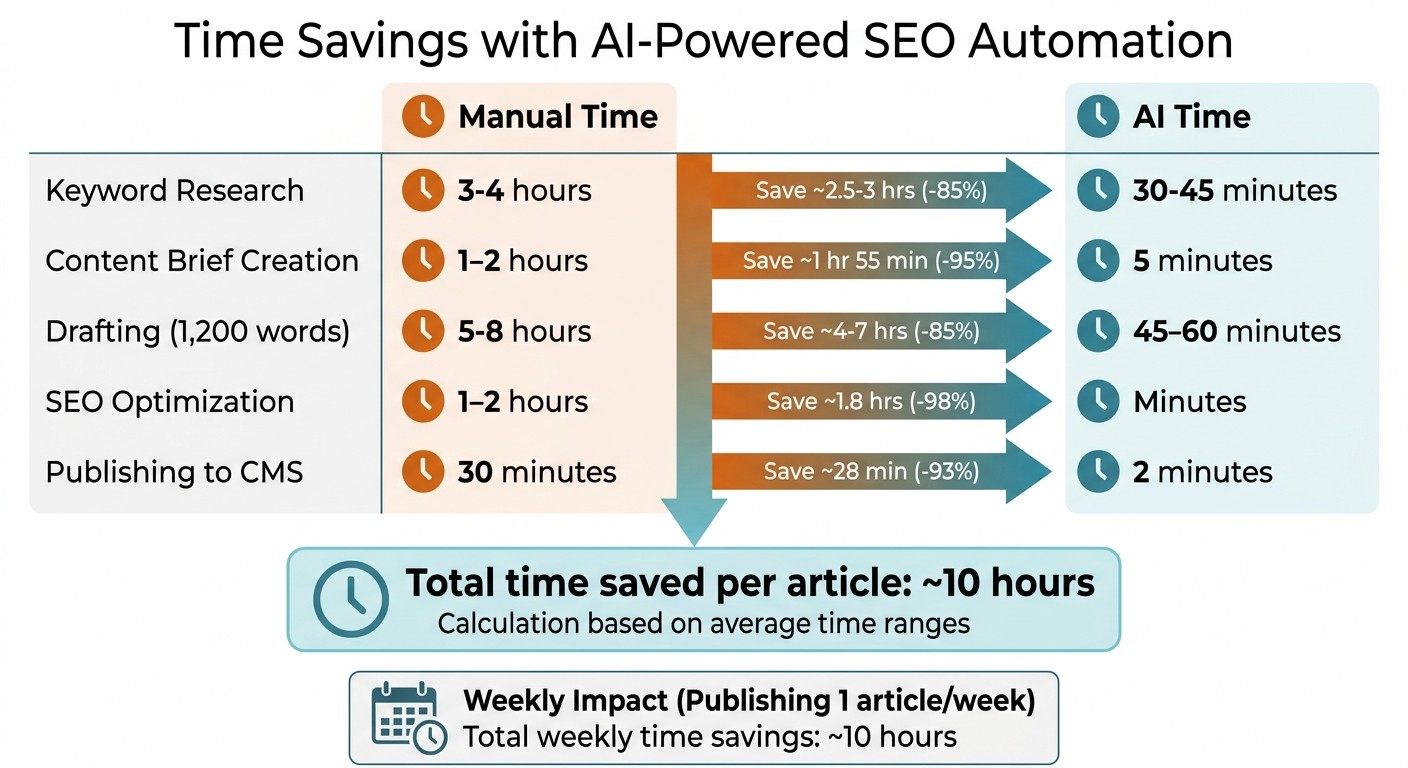
Manual vs AI-Powered SEO Task Time Comparison for Solo Founders
When you're a solo founder, time is your most precious resource. Automating repetitive SEO tasks with AI tools can free up hours in your schedule, letting you focus on the big-picture strategies that drive growth. By cutting down tasks that once took hours or even days to mere minutes, these tools handle keyword research, content creation, and meta optimization, so you can zero in on what matters most.
AI for Research and Drafting
Platforms like Averi simplify the research and drafting process. In just five minutes, Averi can analyze competitor content, pinpoint high-intent keywords, and create detailed content briefs - tasks that could take up to two hours manually. The platform’s "Brand Core" feature ensures that drafts reflect your unique tone and style, steering clear of sounding robotic. Once you approve a topic, Averi dives deep, sourcing hyperlinks and structuring content for both Google and AI-driven search engines like ChatGPT and Perplexity. Within 45–60 minutes, you’ll have a fully researched first draft ready to refine.
Other tools, such as Ahrefs and Semrush (priced between $100 and $200 per month), are excellent for competitor analysis and keyword tracking. Meanwhile, AI writing assistants - typically costing $99–$200 per month - can handle content drafting. However, Averi’s integrated platform combines research, drafting, and optimization into one streamlined workflow. Starting with a free plan and offering a Plus option at $100 per month, it eliminates the hassle of juggling multiple tools.
Once the draft is ready, AI tools take over the tedious optimization tasks.
Automating SEO Tasks
AI doesn’t just help with writing - it also makes optimization a breeze. Platforms like Averi automatically generate meta descriptions, suggest internal links to strengthen topic clusters, and flag outdated content that might be dragging down your rankings. With direct integrations to platforms like Webflow, Framer, or WordPress, these tools can even publish your articles instantly.
For example, keyword research that used to take 3–4 hours can now be completed in 30–45 minutes. SEO optimizations that once required 1–2 hours are done in mere minutes. If you’re publishing weekly, this can save you around 10 hours per article - time you can reinvest in product development or customer engagement. The time savings are clear in the table below:
SEO Task | Manual Time | AI Time |
|---|---|---|
Keyword Research | 3–4 hours | 30–45 minutes |
Content Brief Creation | 1–2 hours | 5 minutes |
Drafting (1,200 words) | 5–8 hours | 45–60 minutes |
SEO Optimization | 1–2 hours | Minutes |
Publishing to CMS | 30 minutes | 2 minutes |
Track Performance with AI Insights
AI doesn’t just stop at automation - it also guides your next steps. Averi’s analytics engine tracks key metrics like impressions, clicks, and keyword rankings while offering actionable recommendations.
"The engine doesn't just measure performance - it closes the loop by suggesting what to create next based on what's working." - Zach Chmael, Head of Marketing, Averi [1]
This creates a feedback loop where your content becomes a growing asset. Each new piece helps the AI better understand your brand, making future drafts even sharper. Performance data highlights which topics resonate with your audience, which keywords to prioritize, and which articles need updates - all without the headache of combing through spreadsheets manually.
With AI taking care of these tasks, you’ll have more time to focus on building backlinks and engaging with communities to amplify your content’s reach.
Step 5: Build Backlinks and Engage with Communities
Once your SEO groundwork is solid, the next step is expanding your reach through targeted outreach. Creating great content is only part of the equation - getting it in front of the right audience is what drives growth. The time saved through automation can now be used to focus on distribution. As a solo founder, you can’t just "publish and hope." Instead, spend more time sharing and promoting your content than creating it [2]. Building relationships and earning backlinks by connecting with communities where your audience gathers is key.
Join Niche Communities
Platforms like Reddit, Indie Hackers, and LinkedIn groups are treasure troves for solo founders. By participating actively - sharing expertise, answering questions, and offering genuine insights - you can establish credibility and attract referral traffic. When your contributions are valuable, people naturally become curious about your profile and website. Engaging in these spaces not only builds trust but also helps you better understand your audience. Pay attention to the way people describe their problems in these communities, as this "customer language" can guide you in crafting content optimized for high-intent search queries.
Write Guest Posts
Guest posting is a powerful way to build authority and gain backlinks. Instead of chasing high-traffic sites, focus on blogs and publications that your target audience actually reads. A well-placed guest post on a niche blog can bring in more relevant traffic than a generic post on a larger platform. Pitch topics that address specific problems your audience is trying to solve, and include a short author bio with a link to your site or a helpful resource. Beyond driving traffic, these backlinks strengthen your domain authority and introduce your brand to new potential customers. Once you’ve established credibility through guest posts, your site will naturally attract more backlinks over time.
Create Content Worth Linking To
If you want to earn backlinks without constantly asking for them, focus on creating content that others want to reference. Comprehensive pillar pages, original research, industry surveys, and case studies with detailed metrics are all highly linkable. Visual content - like infographics, templates, and interactive tools - also tends to get shared widely. The idea is to provide resources so useful and engaging that other writers and bloggers naturally cite them when covering related topics. Over time, this strategy solidifies your site as a trusted resource in your niche, boosting your visibility and authority.
Conclusion
Achieving success with solo SEO doesn’t mean tackling everything at once - it’s about consistently focusing on the right actions. Start by addressing your site’s technical health, then dive into targeted keyword research. Prioritize low-competition, high-intent terms that align with what your audience is searching for. Build topic clusters to establish credibility, and let AI tools like Averi take on repetitive tasks like research, drafting, and publishing. This frees you up to concentrate on strategy and content promotion. These methods build on the proven techniques outlined earlier.
The real power of this approach lies in the compounding effect of small, consistent actions. Dedicating just 30 minutes a day to impactful tasks can significantly improve results. Over six months, consistent optimization can increase organic traffic by 20–50% and drive conversion rates that are 2.5 times higher [3][4].
AI automation acts as a game-changer here. Tasks that used to take over 10 hours - such as keyword research, creating content briefs, and drafting - can now be completed in just 1.5 hours with tools like Averi. This time efficiency enables you to publish content regularly, and consistent publishing within topic clusters has been shown to accelerate authority-building by 40% compared to irregular efforts [4]. For instance, one solo SaaS founder grew organic traffic from 500 to 5,000 monthly visitors in four months, leading to a 25% increase in revenue - all without hiring additional staff [4].
This strategy lays out the key steps solo founders need: from quick technical fixes to leveraging AI for workflow automation. Start with one impactful task today - whether it’s performing a site audit, identifying long-tail keywords, or drafting a cornerstone piece of content using AI. Commit to spending 30 minutes a day on this for 90 days and track your progress. Early wins from technical tweaks will encourage you, while ongoing content and backlink strategies will drive long-term growth.
Your journey to scaling your venture begins with this first, consistent step. By automating your SEO processes, you reclaim time to focus on growing your product. Consider Averi’s Plus Plan at $100/month to streamline your content creation and keep your SEO efforts on track while you concentrate on the bigger picture.
FAQs
What should I fix first in a technical SEO audit?
Before diving into strategies like content optimization or link building, it's essential to tackle the technical issues that can hinder your site's performance and visibility. Start by using tools such as Google Search Console to pinpoint problems like crawl errors, broken links, and indexing issues. Addressing these ensures that search engines can properly access and understand your site.
Pay close attention to improving page load speed, resolving crawl errors, and making your site mobile-friendly. These steps lay the groundwork for better performance and are critical for creating a solid foundation for any further optimization efforts.
How do I pick keywords that actually drive sign-ups?
To attract users who are ready to take action, target high-intent, low-competition keywords. These terms often signal that someone is close to making a decision. Free tools like Google Search Console or Ubersuggest can help you uncover relevant long-tail queries that align with your audience's needs. For example, look for phrases like "alternatives to [competitor]" or "how to [solve specific problem]", as these often indicate sign-up or purchase intent.
Once you've identified potential keywords, validate their competitiveness using platforms like Ahrefs or Semrush. Focus on terms that balance manageable competition with strong intent. To ensure your strategy stays effective, regularly review and refine your keyword list by analyzing performance metrics in Google Analytics 4 (GA4). Keep an eye on what's driving results and adjust accordingly.
How many topic clusters should I build to start?
To get the most out of your efforts, begin by identifying 3 to 5 key topic clusters that align with your goals. These clusters should focus on areas with the potential to attract significant organic traffic while also strengthening your authority in the field. By concentrating on topics that matter most to your audience, you can ensure a smarter allocation of time and resources, setting the stage for sustained growth and visibility.
Related Blog Posts

Zach Chmael
CMO, Averi
"We built Averi around the exact workflow we've used to scale our web traffic over 6000% in the last 6 months."
Your content should be working harder.
Averi's content engine builds Google entity authority, drives AI citations, and scales your visibility so you can get more customers.