How Startups Can Publish Weekly Content Without Writing It Themselves

Averi Academy
Averi Team
8 minutes

In This Article
Set up an AI-driven system to plan, draft, edit, and publish weekly blog posts in under 2 hours—cut costs and boost traffic with automated workflows.
Updated:
Trusted by 1,000+ teams
Startups use Averi to build
content engines that rank.
Publishing weekly content can drive 3.5x more traffic and 3x more leads for startups, but most founders lack the time or budget to manage it manually. AI content tools offer a solution, automating strategy, drafting, and publishing while cutting costs and time dramatically. Here's how startups can create consistent, high-quality content with minimal effort:
AI Strategy: Tools analyze your brand and competitors to create a content plan with keyword research and a publishing calendar.
Automated Drafting: Platforms like Jasper and Copy.ai generate research-backed drafts in minutes, saving hours of manual work.
Simplified Editing: AI handles 80% of the work; founders spend 20–30 minutes refining tone and adding personal insights.
Direct Publishing: Integrations with WordPress or Webflow automate formatting and scheduling.
This system reduces content production time from 15–20 hours to just 2 hours per week, saving up to $480 per post while boosting visibility and SEO rankings.
Quick Tip: Start by testing one AI-generated post, refine it, and track performance metrics like impressions, clicks, and conversions to optimize future output.
Step 1: Build Your AI Content Strategy
How AI Analyzes Your Brand and Competitors
AI tools dive deep into your website to understand your brand identity and unique offerings. They analyze key pages to detect patterns in your voice, tone, and messaging style. Using natural language processing (NLP), these tools identify recurring vocabulary, sentence structures, and stylistic choices that shape how your brand communicates. For instance, ChatGPT can determine whether your messaging leans more conversational or technical [3][6].
The same technology is applied to your competitors. Tools like MarketMuse scan competitor websites to gather data on keywords, topics, backlinks, and performance metrics. This allows them to pinpoint content gaps and high-potential keywords with minimal competition [4]. For example, a SaaS startup leveraging Jasper AI can analyze competitor blogs and ad copy to uncover untapped keywords for better targeting [5]. These insights provide a clear roadmap for creating content that sets your brand apart.
AI also examines analytics, user engagement data, and social media trends to segment your audience based on demographics, behaviors, and interests. ChatGPT, for instance, can track social trends to predict audience preferences, enabling startups to create highly tailored content [3][5]. By providing URLs for your site and a few competitors, along with specific goals like "publishing weekly blog posts", the AI generates a comprehensive brand profile report [4]. With this data in hand, the AI develops a content plan that aligns with your business goals.
Create a Content Plan That Matches Your Goals
After analyzing your brand and competitors, AI moves on to creating a detailed content plan. You specify your objectives - whether it's lead generation, education, or driving revenue - and the AI produces a strategy complete with keyword research and a content calendar. This calendar includes 12 to 52 topics, each with search volume and difficulty scores [4]. For instance, Rytr uses historical data and your goals to craft articles, ensuring the tone matches your brand [4].
AI tools also help maintain consistency with automated publishing schedules. A sample plan might include Week 1: SEO-focused tutorial on a high-volume keyword; Week 2: Case study addressing a competitor's gap. Tools like ContentBot rely on GPT-3 templates to create human-like content and structured schedules for regular output [4]. Startups using platforms like Anyword report 20% to 30% higher conversions due to data-driven strategies that focus on high-impact topics and keywords [4]. The system continuously refines its recommendations based on performance feedback, ensuring your content plan remains aligned with what drives measurable results.
10 AI Automations That Run My Business (Steal These)
Step 2: Automate Your Weekly Content Production
Once you’ve established a strategy powered by AI, automating your workflows can drastically cut down the time it takes to create content.
Generate Research-Driven Drafts with AI
Various AI content creation tools like Jasper, Copy.ai, and Averi AI can create well-organized drafts in under an hour, skipping the need for manual research and writing. Jasper uses real-time data and offers a variety of templates, Copy.ai taps into GPT-3 for highly customizable text, and Rytr can generate complete articles quickly while staying true to your brand’s tone [8].
The major benefit here is speed combined with structure. For instance, Jasper automatically handles headers, suggests internal links, and even inserts meta tags during the drafting stage. This eliminates the dreaded blank-page syndrome, allowing startups to queue up multiple pieces of content efficiently. The AI takes care of the heavy lifting - research, outlining, and initial drafts - so you can focus on the personal touches that make your content stand out. These drafts serve as a solid foundation for quick human refinement.
Blend AI Output with Human Expertise
AI-generated drafts typically cover about 80% of the work, leaving the final 20% for you to add your brand’s unique voice. Tools like GrammarlyGO can enhance AI-created content by fixing grammar, fine-tuning tone, and suggesting better word choices in real time. This hybrid model - AI for speed and humans for polish - can slash the time spent on weekly content production by 70–80%.
Allocate 20–30 minutes to review each draft: spend 5 minutes checking the structure, 15 minutes refining the voice and adding insights, and 5 minutes on final edits. For instance, if you’re drafting a piece on "How to Scale Customer Support", you can enrich the content with personal experiences or fresh ideas to make it feel more relatable and human. Once the content is polished, the next step is to automate the publishing process.
Automate Publishing with CMS Integrations
Platforms like WordPress and Webflow allow you to skip the tedious copy-pasting and formatting. Many AI tools integrate directly with WordPress - often through services like Zapier - so you can schedule posts straight from the AI platform. Averi AI takes it even further by publishing directly to platforms like Webflow, WordPress, or Framer, automatically handling formatting, internal links, and meta descriptions. No-code solutions like Activepieces can reduce manual publishing tasks by as much as 90%.
Startups using these automated workflows report publishing up to four blog posts a week with ease. By leveraging a system where AI generates drafts and you approve them in just 20–30 minutes, you can cut your content management time from 15–20 hours per week to just about 2 hours [2]. This streamlined process not only saves time but also allows you to focus on other critical aspects of your business.
Step 3: Compare Content Automation Tools
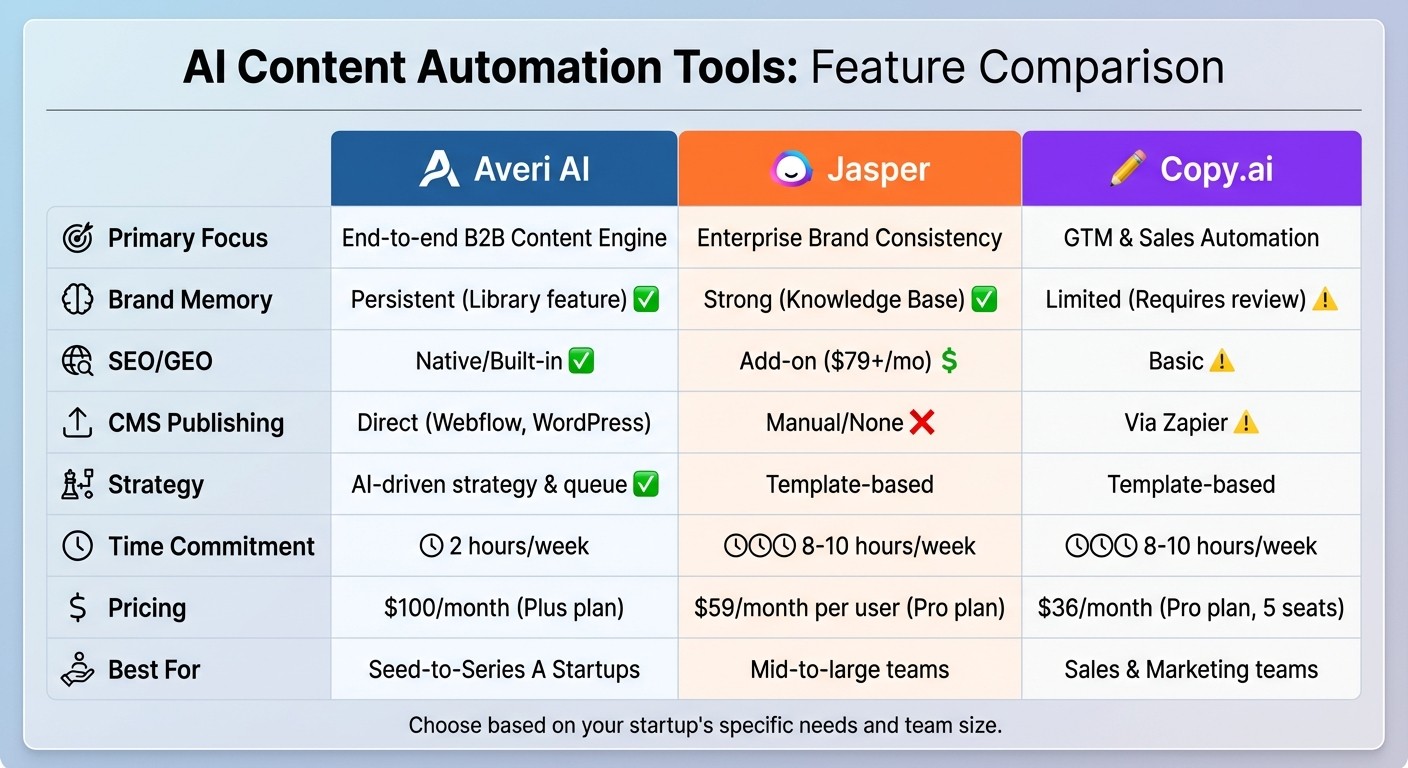
AI Content Automation Tools Comparison: Averi AI vs Jasper vs Copy.ai
Once you’ve streamlined your content production process, the next step is finding the AI tool that aligns with your startup's specific needs.
The choice of tool depends largely on the challenges you’re tackling. Averi AI operates as a full-stack content solution, handling strategy, research, drafting, publishing, and analytics all in one place. On the other hand, Jasper is tailored to enterprise-level brand consistency and team collaboration, but you’ll need to manage strategy separately. Copy.ai is centered around go-to-market (GTM) workflows, offering features like personalized outreach and LinkedIn research to bridge sales and marketing efforts [7].
Time commitment is another key differentiator. Averi requires minimal involvement, with founders typically spending just 2 hours per week. In contrast, standalone tools like Jasper and Copy.ai demand 8–10 hours weekly for tasks like strategy development, editing, and manual publishing [2]. For example, in August 2025, a B2B SaaS company leveraged Averi's integrated workflow to launch a new feature. Within just 48 hours, Averi produced 94 pieces of content across six platforms, resulting in a 340% boost in feature adoption during the first week and cutting their usual launch timeline by 67% [1].
Pricing also varies across platforms. Jasper’s Pro plan starts at $59/month per user, with custom pricing for larger teams. Copy.ai offers a free tier along with a Pro plan at $36/month, which includes five seats. Averi’s Plus plan is priced at $100/month and features self-serve onboarding, eliminating the need for sales calls [7].
"The winning formula for startups: Choose one comprehensive platform over assembling tools. Coordination overhead kills more marketing efforts than tool capabilities." - Indy Sanders, Chief Technical Officer, Averi [7]
Here’s a quick breakdown of key features:
Feature | Averi AI | Jasper | Copy.ai |
|---|---|---|---|
Primary Focus | End-to-end B2B Content Engine | Enterprise Brand Consistency | GTM & Sales Automation |
Brand Memory | Persistent (Library feature) | Strong (Knowledge Base) | Limited (Requires review) |
SEO/GEO | Native/Built-in | Add-on ($79+/mo) | Basic |
CMS Publishing | Direct (Webflow, WordPress) | Manual/None | Via Zapier |
Strategy | AI-driven strategy & queue | Template-based | Template-based |
Best For | Seed-to-Series A Startups | Mid-to-large teams | Sales & Marketing teams |
When to choose which tool:
Averi AI is ideal for lean B2B startups needing a fully automated, end-to-end content engine.
Jasper suits mid-to-large marketing teams focused on maintaining a consistent brand voice and requiring enterprise-level security.
Copy.ai works best for teams prioritizing sales-marketing alignment and automating GTM tasks like personalized lead outreach [7].
Picking the right tool will solidify your automated content workflow, ensuring your strategy remains consistent and effective.
Step 4: Track Performance and Improve Your Content
Which Metrics to Track
Once your automated content system is up and running, the next step is measuring its impact. Publishing without tracking is like shooting in the dark - you need to know what’s working and what’s not. Start by focusing on three key metrics: impressions (how many people see your content), clicks (how many interact with it), and search rankings (your position in Google results) [3]. Beyond these basics, also keep an eye on engagement metrics like comments, shares, time spent on the page, and conversion rates to ensure your content is driving meaningful outcomes.
Tools like Semrush can give you insights into keyword rankings and trending topics, while Google Analytics provides a detailed view of user behavior and traffic patterns [10]. To stay efficient, spend 15–20 minutes each week reviewing a performance dashboard instead of obsessing over daily fluctuations [2].
Use Data to Adjust Your Strategy
Performance data isn’t just numbers - it’s a roadmap for improving your content strategy. AI tools like Averi AI and HubSpot AI can analyze your results and provide actionable suggestions, such as optimizing a piece to climb higher in search rankings or identifying competitive gaps or discovering new content opportunities [3][6].
Let the data guide your decisions. For instance, if analytics reveal that "how-to" guides consistently outperform industry news, tweak your AI prompts and templates to focus on creating more of those guides [3]. If certain keywords are driving better rankings, make them a priority in future content [4]. HubSpot’s AI-powered email personalization, which uses performance insights, has even been shown to double open rates for startups [6].
Timing matters. Weekly reviews allow you to make quick adjustments before trends fade, while quarterly analyses help you spot larger patterns [3][9]. This ongoing feedback loop ensures your AI-driven content strategy stays sharp and aligned with your startup’s growth objectives.
Conclusion
What You Need to Remember
You don’t need a full-time writer or an expensive agency to maintain consistent weekly content. By building an AI-driven content system with thoughtful human editing, you can streamline the entire process. Start with an AI content strategy that evaluates your brand and competitors, then automate weekly production with research-backed drafts that only require light editing before publication. This approach can save you an average of $480 per blog post and cut your weekly time commitment from 15–20 hours down to just 2 hours [2]. Next, explore how to implement this system step-by-step.
Publishing more than 16 posts each month drives 3.5x more traffic compared to producing fewer than four posts [2]. Over time, as your content library expands, the AI will fine-tune your brand voice and improve your search engine rankings - all while you stay focused on growing your business.
How to Get Started
Take advantage of these time and cost savings by automating your content workflow today. Tools like Averi AI can handle everything from strategy to publication. Simply input your website URL and brand details so the AI can understand your positioning and tone. Create a content plan aligned with your goals, and set up automation to produce weekly drafts using integrations that connect directly to platforms like Webflow or WordPress [3][9]. Start by testing one post, review the output, and track key performance metrics. Use these insights to refine your prompts and templates for future content.
"You don't need more time for content. You need a system that creates content without requiring your time."
Zach Chmael, Head of Marketing [2]
The fastest-growing startups in 2026 are already using tools like ChatGPT and Jasper as core components of their marketing infrastructure, enabling 10x faster execution in content creation and strategy [9][11]. Embrace AI for content today and take your marketing efforts to the next level.
FAQs
How do I make AI-written posts sound like me?
To have AI-written posts reflect your style, start by sharing clear voice guidelines, examples of your writing, and specific phrases that align with your tone. Use personalized prompts based on your past work to fine-tune its output. Continuously review and tweak the AI’s drafts to keep them aligned with your voice. By blending these strategies, you can create AI-driven content that stays true to your brand's personality.
What’s the fastest setup for weekly AI content publishing?
The quickest route to consistently publishing AI-generated content every week is by setting up an automated content engine. This approach simplifies the entire process - research, drafting, and publishing - allowing you to complete everything in just 45 minutes to 2 hours per week. Many people make it work by dedicating time to weekend sprints or following a structured workflow, ensuring efficiency without sacrificing quality.
How can I measure if AI content is generating leads?
To determine if AI-generated content is effectively driving leads, focus on tracking key performance indicators (KPIs) such as lead quality, conversion rates, and engagement levels. Leverage analytics tools to identify high-intent prospects and monitor response rates. It's also important to assess factors like relevance, helpfulness, and user trust to understand how the content influences decision-making. By combining these insights with traditional metrics - like click-through rates and form submissions - you can gain a comprehensive understanding of how AI content supports lead generation and impacts revenue growth.
Related Blog Posts

Zach Chmael
CMO, Averi
"We built Averi around the exact workflow we've used to scale our web traffic over 6000% in the last 6 months."
Your content should be working harder.
Averi's content engine builds Google entity authority, drives AI citations, and scales your visibility so you can get more customers.