

In This Article
Compare an all-in-one content engine with Surfer AI’s SEO-focused tools — workflow, pricing, publishing, and which fits startups or SEO teams.
Updated:
Trusted by 1,000+ teams
Startups use Averi to build
content engines that rank.
Averi vs. Surfer AI: Which Content Tool Fits Your Needs?
If you're struggling to manage your content process or want to save time, Averi offers a full-cycle solution. It handles everything from strategy and drafting to publishing and analytics, reducing your workload to just 2 hours per week. For $100/month, Averi automates the entire content lifecycle, making it ideal for startups or small teams with limited resources.
On the other hand, Surfer AI specializes in SEO optimization. It helps refine individual articles for better search rankings but requires additional tools for strategy, publishing, and tracking. Starting at $79/month plus $20–$30 per AI-generated article, it’s better suited for teams with existing workflows focused on boosting keyword performance.
Quick Overview
Averi: Automates strategy, content creation, publishing, and analytics; costs $100/month; requires minimal oversight.
Surfer AI: Focuses on SEO optimization; costs $79/month + $20–$30/article; needs external tools for publishing and tracking.
Feature | Averi | Surfer AI |
|---|---|---|
Workflow | Full content lifecycle automation | SEO-focused content optimization |
Publishing | Direct CMS integration | Manual or plugin-based |
Analytics | Built-in performance tracking | Limited to content audits |
Cost | $100/month (all-inclusive) | $79/month + $20–$30/article |
Best For | Startups, small teams | SEO agencies, established teams |
For teams needing a complete, time-saving system, Averi is the better choice. If your goal is refining SEO for specific articles, Surfer AI excels.
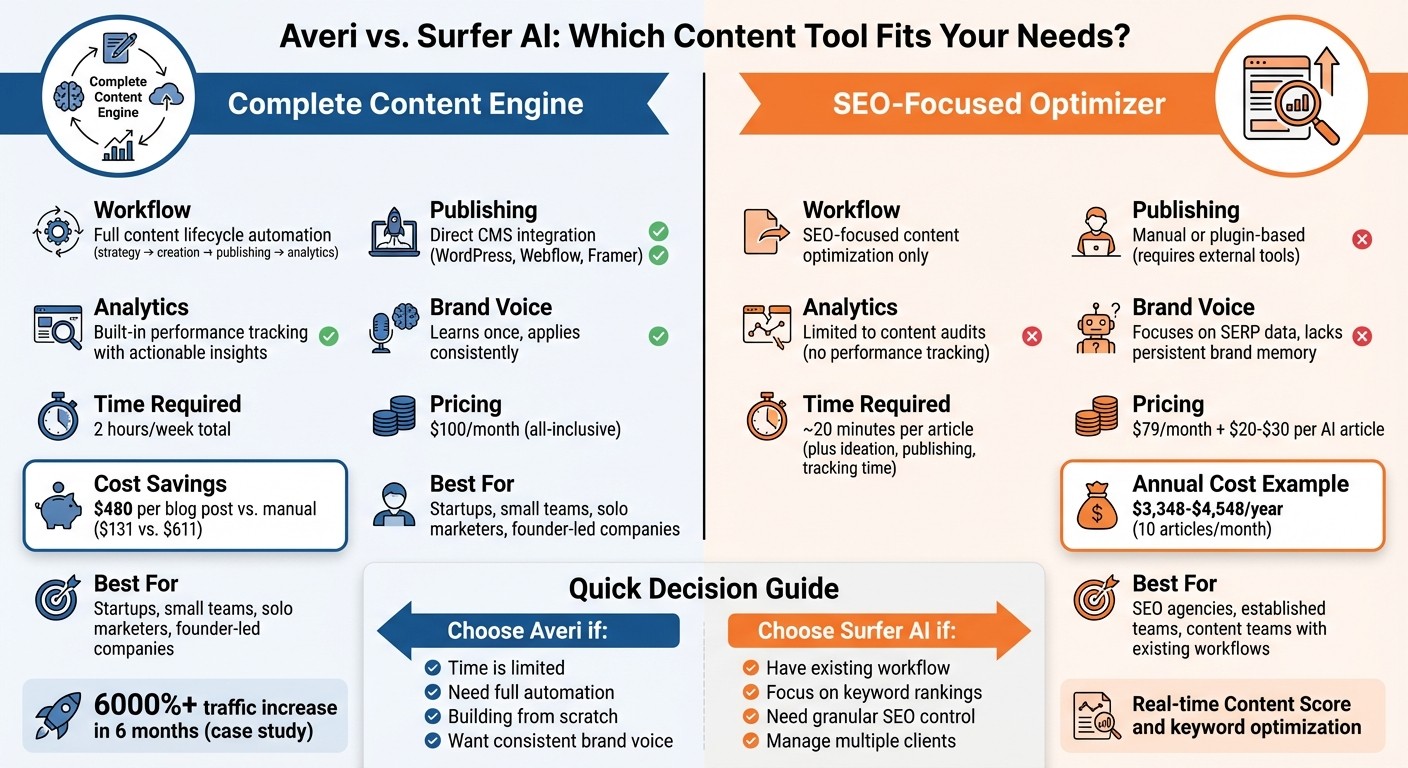
Averi vs Surfer AI: Complete Feature and Pricing Comparison
The Latest AI-Powered Content Creation Workflow for Business (Speed Challenge!)
Why You Need a Complete Content Workflow
Marketing teams often juggle a mishmash of tools - one for keyword research, another for writing, a third for SEO, and yet another for publishing. This patchwork setup creates inefficiencies, forcing manual handoffs and leading to inconsistent results. You may find yourself duplicating efforts, re-entering guidelines, and manually tracking performance. The result? Slower processes and a lack of cohesion.
The statistics highlight the problem. AI-assisted content production can save an average of $480 per blog post compared to traditional methods ($131 vs. $611) [1]. Teams using unified workflows report producing 3–5 times more content while maintaining quality [4]. This isn’t just about cranking out more content - it’s about executing with precision and avoiding the constant interruptions caused by switching between disconnected tools.
"A content engine is a system that produces, publishes, and optimizes content with minimal ongoing founder involvement."
Zach Chmael, Head of Marketing, Averi [1]
Top-performing teams are shifting away from a fragmented "campaign thinking" mindset. Instead, they’re adopting an integrated "engine thinking" strategy, where automation, human editing, and strategic planning work together seamlessly [5]. With this approach, AI maintains your brand voice, and your team saves countless hours by avoiding redundant tasks and re-briefing across multiple tools.
Where Surfer AI Falls Short

Surfer AI is excellent for on-page SEO. It analyzes top-ranking pages, identifies relevant keywords, and structures content to align with search intent. Its AI Writer add-on even drafts content based on these insights. But that’s where its capabilities end. It doesn’t guide you on what topics to tackle, when to publish, or how to measure success after publishing.
The platform operates in isolation. It doesn’t retain your brand voice across sessions, lacks direct CMS integration for publishing, and doesn’t offer actionable recommendations based on performance data. Using Surfer AI means relying on additional tools for brainstorming, collaboration, publishing, and tracking - each requiring manual effort and causing valuable context to get lost along the way.
Surfer AI starts at $99/month [2], covering only SEO optimization. To build a complete workflow, you’ll need to stack on other tools, such as Jasper ($49–$75/month for content generation), along with separate CMS and analytics platforms. Managing these disconnected systems can eat up 8–10 hours of your week [1].
What a Complete Workflow Should Include
To overcome these challenges, a unified content system is essential. A comprehensive workflow should handle the entire lifecycle: strategy, execution, publishing, and optimization. It should start by learning your brand guidelines and customer profile, enabling AI-generated drafts to be 80% complete and aligned with your brand right from the start [1][3]. Instead of brainstorming topics manually, the system should monitor competitors and trends, automatically generating a content queue and cutting planning time to as little as 15 minutes per week [1].
Such a workflow should automate the majority of tasks - like research, keyword analysis, drafting, and formatting - leaving your team free to focus on strategic insights and refining the brand voice [1]. Integration with CMS platforms like WordPress, Webflow, or Framer eliminates the need for manual uploads, allowing content to publish directly [1][3]. Built-in analytics would then provide insights to guide your next steps based on performance data.
"The most successful content teams do not use AI to replace human creativity - they use it to eliminate repetitive tasks so humans can focus on strategy, voice, and ideas that AI cannot replicate."
Digital Applied [4]
This balance between AI and human effort ensures that repetitive tasks are offloaded, while your team focuses on creativity, strategy, and maintaining a consistent brand identity - all without sacrificing speed or quality.
Averi: A Complete Content Engine
Averi isn’t just another tool like Surfer AI; it’s a full-scale content engine that seamlessly handles strategy, creation, publishing, and optimization. Instead of producing isolated drafts, Averi builds a self-improving system where each piece of published content informs and strengthens the next.
The platform smartly blends AI automation with human input at critical points. AI takes care of tasks like competitor research, keyword analysis, and drafting, while your team fine-tunes the brand voice, adds expertise, and makes strategic decisions. This approach allows lean teams to increase output without sacrificing quality or needing extra hires.
The results speak for themselves. For example, in August 2025, a mid-stage B2B SaaS company used Averi to publish 94 content pieces across six platforms in just 48 hours for a product launch. The campaign led to a 340% boost in feature adoption within one week and cut the launch timeline by 67% compared to manual efforts. Similarly, a D2C skincare brand created 127 assets for a seasonal campaign, achieving a 284% increase in email click-through rates and reducing cost-per-acquisition by 43% [5].
Here’s a closer look at Averi’s 6-phase workflow that powers such efficiency and continuous improvement.
How Averi's 6-Phase Workflow Works
Phase 1: Strategy Setup (One-Time)
Averi begins by analyzing your website to understand your brand voice, products, and positioning. It generates Ideal Customer Profiles and performs a competitor gap analysis. This process, which takes 45–60 minutes, establishes a strategic foundation that informs all future content [1].
Phase 2: Automated Content Queue
The system tracks industry trends and keywords, suggesting content ideas like how-to guides and comparisons. You spend just 15 minutes weekly approving or rejecting topics, eliminating the stress of last-minute brainstorming [1].
Phase 3: AI-Powered Execution
Once topics are approved, Averi drafts content using pre-loaded brand context. A collaborative workspace allows your team to refine the tone, add comments, and request AI edits, ensuring the output aligns with your vision.
Phase 4: Direct Publishing
Averi integrates with platforms like WordPress, Webflow, and Framer, allowing for automatic publishing without the hassle of formatting or copy-pasting. Each piece is stored in your Library, building a knowledge base that makes future drafts smarter [1].
Phase 5: Performance Analytics
The platform tracks metrics like impressions, clicks, and keyword rankings. Beyond raw data, Averi offers actionable insights - suggesting updates to posts, new keywords to target, or competitor content to address [1].
Phase 6: Continuous Improvement
Every piece of published content feeds back into the system, enhancing the AI’s understanding of your brand and performance. Weekly analysis cycles and new topic suggestions keep the engine running smoothly with minimal effort [1].
This workflow requires only 2 hours of weekly management: 15 minutes for topic approvals, 45–60 minutes for content review, and 15–20 minutes for analytics. By automating production, Averi saves an average of $480 per blog post, with costs dropping from $611 (manual) to $131 (AI-assisted) [1].
Who Should Use Averi
Averi is ideal for teams with limited time and resources. It’s particularly useful for startups, small businesses, and lean marketing teams that need consistent content without hiring full-time staff. This is especially relevant for B2B SaaS companies, which often require detailed, research-heavy content to build authority and visibility [6].
The platform addresses common challenges. For instance, 47% of small business founders handle their own marketing, but 56% have just an hour or less daily to devote to it [1]. Crafting a single blog post manually takes about 3 hours and 48 minutes, with research-heavy pieces requiring 15–20 hours. Averi allows startups to scale to 8–12 posts monthly while cutting 85% of the founder’s time. Businesses publishing 16+ posts per month generate 3.5 times more traffic than those with fewer than four [1]. Additionally, Averi costs 90% less than traditional agencies while slashing management time by 85% [1].
Pricing starts at $45 per month for basic access, with a free beta for early adopters [6]. The Plus Plan, priced at $100 per month, offers self-serve onboarding without the need for demos or lengthy sales calls. Compared to hiring a full-time content manager (over $150,000 annually) or working with an agency (between $60,000 and $180,000 per year), Averi is a cost-effective solution [1].
Averi vs. Surfer AI: Side-by-Side Comparison
Averi operates as a full-scale content engine, managing everything from strategy to publishing and analytics. On the other hand, Surfer AI hones in on SEO optimization to boost Google rankings. In essence, Averi takes care of the entire content lifecycle, while Surfer AI focuses on refining individual pieces for search performance.
If you're looking for a hands-off system, Averi takes over ideation, drafting, publishing, and tracking performance with ease. Meanwhile, for those with an existing content process who want to fine-tune SEO, Surfer AI offers real-time insights based on current search data.
How Each Platform Handles Content
When it comes to content creation, Averi and Surfer AI take distinct approaches tailored to different needs.
Averi begins by analyzing your website to understand your brand, then continuously monitors industry trends and competitors to build a content queue. After you approve topics, it drafts and optimizes content for both traditional SEO (Google) and AI-driven search engines like ChatGPT (GEO). Once ready, it publishes directly to your CMS. This method has helped users increase web traffic by over 6000% in just six months [7].
Surfer AI, by contrast, works off a keyword you provide. It analyzes top-ranking pages for that keyword, generates an outline, and drafts content optimized to match those results. As Surfer AI explains:
"Surfer AI bridges the gap between content writing and SEO. It turns research, structure, and optimization into one workflow, allowing writers to focus on creativity while the tool handles technical SEO guidance." [8]
Publishing with Surfer AI requires either manual CMS uploads or third-party integrations.
Phase | Averi Approach | Surfer AI Approach |
|---|---|---|
Strategy | Automated brand analysis & ICP generation | Manual keyword selection |
Ideation | Automated queue based on trends/competitors | SERP analysis of a specific keyword |
Drafting | AI writes first draft with brand context | AI generates draft based on SERP outline |
Optimization | SEO + GEO + internal linking | Real-time Content Score & keyword checklist |
Publishing | One-click direct to CMS | Manual CMS upload or plugin-based |
Analytics | Performance tracking & new topic suggestions | Audit tool for existing content |
The workflows differ significantly. Averi requires about 2 hours per week - 15 minutes to approve topics, 45–60 minutes to review drafts, and 15–20 minutes to check analytics [1]. Surfer AI, by comparison, takes about 20 minutes per article for optimization, plus additional time for ideation, publishing, and tracking [8].
Pricing and Total Cost Breakdown
Averi’s Plus Plan costs $100 per month, covering the entire workflow - strategy, drafting, publishing, and analytics - with no hidden fees. For startups publishing 8–12 posts monthly, the annual cost is approximately $1,200, far below traditional agency fees, which can range from $60,000 to $180,000 per year [1].
Surfer AI starts at $79/month, with an additional $20–$30 per AI-generated article. For a team publishing 10 articles monthly, the annual cost includes $948 for the subscription and $2,400–$3,600 for AI credits, totaling between $3,348 and $4,548 per year.
Team Size / Use Case | Averi (Estimated Annual Cost) | Surfer AI (Estimated Annual Cost) |
|---|---|---|
Startups / Solo | ~$1,200 (Plus Plan covers all needs) | ~$948 + AI article credits ($20–$30 per piece) |
Growth Teams | ~$1,200–$6,000 (Scales with volume) | ~$1,500+ (Higher tiers plus heavy AI credit usage) |
Enterprise | Custom (Includes modular expert access) | Custom (Business/Enterprise tiers plus API costs) |
Averi’s integrated publishing and analytics eliminate the need for extra software. By contrast, Surfer AI often requires additional tools for project management, CMS integration, and performance tracking. On average, AI-assisted content creation saves $480 per blog post, cutting costs from $611 to $131 compared to traditional methods [1].
Strengths and Weaknesses
Averi excels in automating the entire content process, from strategy to analytics. It learns your brand voice during setup and applies it consistently, creating a cohesive library of content. Built-in analytics provide actionable insights, such as recommendations when a piece ranks at #8. This makes it a great fit for lean teams needing consistent, high-quality output without hiring more staff.
That said, Averi offers less granular control over SEO compared to specialized tools. Its reliance on automated content queues may also frustrate those who prefer full manual oversight.
Surfer AI shines in precise SEO optimization. Its real-time Content Score evaluates top-ranking pages and provides actionable guidance on keyword density, structure, and formatting. This is particularly useful for SEO agencies or bloggers targeting competitive keywords. However, Surfer AI lacks full workflow automation. It doesn’t include tools for strategy, publishing, or analytics, so users must rely on external software. Additionally, its AI-generated content often needs substantial editing to align with brand voice.
Feature | Averi Strengths | Averi Weaknesses | Surfer AI Strengths | Surfer AI Weaknesses |
|---|---|---|---|---|
Workflow | Complete automation from strategy to analytics | Limited manual control over decisions | Detailed SEO optimization per piece | Requires extra tools for publishing/tracking |
Brand Voice | Learns once and applies consistently | May need refinement for niche industries | Focuses on competitive SERP data | Lacks persistent brand memory |
Time Investment | ~2 hours per week total | Initial setup may feel restrictive | ~20 minutes per article for optimization | Requires additional coordination |
These differences highlight how each platform caters to distinct needs, helping teams decide which tool aligns best with their goals.
Which Platform Is Right for You?
Deciding on the right platform for your content workflow depends on your team's needs and the challenges you face in managing the content lifecycle. For small teams or founders juggling multiple roles, the best choice is a platform that can operate with minimal oversight. On the other hand, if you're an SEO professional focused on refining content to rank for competitive keywords, you'll benefit from tools that integrate seamlessly into your existing processes.
Averi is the go-to option if time is your biggest challenge. Designed for founder-led startups and solo marketers, Averi eliminates the hassle of managing multiple tools. With just a 2-hour weekly commitment, it simplifies content production, helping teams maintain the consistency needed for measurable results [1]. Without automation, manual content creation can take nearly 4 hours per post, making it tough to stay on track [1].
Surfer AI, on the other hand, is perfect for teams that already have a content system in place and want to boost rankings for specific keywords. Whether you're an SEO agency juggling multiple clients, a publisher refining hundreds of articles, or a content team looking for real-time SERP insights, Surfer AI’s tools like the Content Score and keyword checklist offer the precision needed to stay ahead.
When Averi Makes Sense
Averi is a smart choice for teams with limited time and resources that need a fully automated content solution. It’s particularly useful for technical founders, solo marketers, or startups (Seed to Series A) aiming to build organic visibility quickly without hiring additional staff or managing freelancers.
The platform takes care of everything from strategy to publishing. For those tracking the shift from traditional SEO to AI-focused optimization, Averi is built to handle both. With AI-driven platforms experiencing a staggering 4,700% increase in traffic year-over-year, Averi ensures your content ranks well on Google while also being cited by AI systems [1]. Once it learns your brand voice, it applies it consistently across all content, saving you the effort of reviewing drafts or briefing writers.
However, if your team already has a strong in-house content process, a more specialized SEO tool might be a better fit.
When Surfer AI Makes Sense
Surfer AI is best for teams with established workflows that need detailed, data-driven SEO adjustments. It’s ideal for SEO specialists looking to outrank competitors, agencies conducting content audits for clients, or publishers managing large libraries of articles that need regular updates.
With Surfer AI, you get real-time insights on how your content measures up against top-ranking competitors for specific keywords. If your team has the capacity to manually upload content to your CMS and coordinate strategy and analytics across multiple tools, Surfer AI’s granular feedback can help you fine-tune your content for peak performance.
Understanding the strengths of each platform ensures you can choose the one that aligns perfectly with your team's goals and limitations.
Conclusion
Choosing between these tools depends on whether your priority is full-scale content management or a more targeted approach to SEO. Surfer AI focuses specifically on keyword-driven SEO, analyzing top-ranking pages, assigning content scores, and offering guidance for on-page improvements. If you already have a content creation system in place and need precise, data-backed adjustments to climb search rankings, Surfer AI is a strong option.
On the other hand, Averi functions as a comprehensive content solution. It handles everything from strategy and research to drafting, expert human review, and direct publishing on platforms like WordPress, Webflow, and Framer. Its Synapse architecture ensures your brand voice stays consistent, supported by a network of over 3,500 vetted experts who refine AI-generated outputs in real time. At $100/month for the Plus Plan, Averi simplifies the entire content creation process.
The key difference lies in their approach: Surfer AI focuses on optimizing individual articles for keyword performance, while Averi offers an evolving system that improves over time. Each piece published through Averi enhances its understanding of your brand, leading to increasingly refined drafts and recommendations. Choosing the right tool ultimately depends on your team's workflow and long-term content strategy.
FAQs
How long does it take to set up a full content workflow?
Setting up a complete content workflow usually takes between 8 to 12 minutes, as indicated by recent guides. This timeframe covers tasks like configuring tools and organizing workflows to ensure smooth content creation and publishing.
Which CMS platforms support automatic publishing?
The article doesn’t name specific CMS platforms for automatic publishing but emphasizes the importance of workflow automation and tool integration. This implies that many modern CMS platforms, which support automated publishing via integrated workflows, are likely compatible.
How does it keep brand voice consistent across new posts?
Consistency in a brand's voice is made easier with AI tools that streamline messaging, tone, and style throughout the content creation process. Tools like Averi offer features such as predefined brand guidelines, adjustable tone settings, and review layers that require human approval. By automating tasks like brainstorming, drafting, and editing, these platforms help maintain a cohesive voice while leaving room for human input to ensure the content aligns with strategic goals and stylistic preferences.
Related Blog Posts

Zach Chmael
CMO, Averi
"We built Averi around the exact workflow we've used to scale our web traffic over 6000% in the last 6 months."
Your content should be working harder.
Averi's content engine builds Google entity authority, drives AI citations, and scales your visibility so you can get more customers.