AI Overviews Cut Startup Clicks 58%. Here's the Fix.
Zach Chmael
Head of Marketing
7 minutes

In This Article
AI Overviews now trigger on 48% of queries, dropping #1-position CTR by 58%. A data-backed playbook for B2B SaaS startups to fight back.
Updated
Trusted by 1,000+ teams
Startups use Averi to build
content engines that rank.
TL;DR
📉 AI Overviews trigger on 48% of Google queries, up 58% year-over-year (BrightEdge)
🔻 Position-one organic CTR drops 58% when an AI Overview appears (Ahrefs)
🚫 60%+ of Google searches now end without a click (Digital Bloom)
✅ Brands cited IN AI Overviews earn 35% more organic clicks than those left out (Seer Interactive)
💰 Gartner projects 25% of organic search traffic will shift to AI chatbots by end of 2026
🔗 44% of AI citations come from the first 30% of an article, so structure is everything (Superlines)

Zach Chmael
CMO, Averi
"We built Averi around the exact workflow we've used to scale our web traffic over 6000% in the last 6 months."
Your content should be working harder.
Averi's content engine builds Google entity authority, drives AI citations, and scales your visibility so you can get more customers.
AI Overviews Cut Startup Clicks 58%. Here's the Fix.
Ahrefs tracked a 58% drop in organic CTR for the number-one ranking position when an AI Overview appears above it.
That's not a rounding error.
That's more than half your clicks disappearing into a box your startup didn't ask for, can't control, and probably hasn't optimized for.
Google's AI Overviews now trigger on 48% of all tracked search queries, up 58% year over year according to BrightEdge's 12-month analysis.
If you're a B2B SaaS startup running a lean content program, this is the single biggest threat to your organic pipeline in 2026.
Your rankings haven't changed. Your traffic has.
The startup-specific problem: Most coverage of the AI traffic decline targets enterprise brands with dedicated SEO teams and six-figure budgets. But the sites hit hardest are those ranked between position 100 and 10,000 on the web, according to The Digital Bloom's 2026 Organic Traffic Crisis Report.
That's exactly where most seed-to-Series-A startups sit. You built something worth ranking for, and now Google is summarizing your answers before anyone clicks through.
Check your Marketing Maturity
What the AI traffic tax actually looks like for startups
Let's get specific.
If you're a B2B SaaS startup with a content program that generates 5,000 monthly organic visitors, here's what's happening:
Before AI Overviews, your top-ranking content had an average organic CTR of around 1.76%. With AI Overviews present, that drops to 0.61%.
Same rankings. Same impressions. Roughly a third of the clicks.
And it's not evenly distributed. Informational queries, the exact type of content most startup blogs produce, trigger AI Overviews 80-88% of the time depending on your industry.
That "how to" guide you spent two weeks researching? Google is pulling the answer from it and displaying the summary above your link.
Metric | Before AI Overviews | With AI Overviews | Change |
|---|---|---|---|
Organic CTR (position 1) | 1.76% | 0.61% | -65% |
Zero-click search rate | ~45% | 60%+ | +33% |
AI Overview trigger rate (informational) | 0% | 80-88% | — |
Queries triggering AI Overviews (all types) | ~30% | 48% | +58% YoY |
Sources: Seer Interactive, BrightEdge, Dataslayer
We saw this at Averi firsthand.
Our impressions kept climbing while our click-through rates on certain informational pages dropped by a third over six months.
The Google Search Console data looked fine if you only checked impressions. The actual traffic told a different story.

How to diagnose whether AI is eating your clicks (not your rankings)
Here's the question that matters: are your impressions stable while clicks decline, or are both declining?
If impressions hold steady but clicks fall, you have an AI interception problem.
Google is showing your content in AI Overviews but users aren't clicking through because they got what they needed from the summary.
If both impressions and clicks decline, that's a different issue: algorithm changes, indexation problems, or content quality.
The diagnosis changes your entire response strategy.
Step 1: Check Google Search Console. Filter by page. Look at your top 20 informational pages (how-tos, guides, explainers). Compare the last 90 days to the prior 90 days. Flag any page where impressions are flat or up but clicks dropped more than 15%.
Step 2: Spot-check for AI Overviews. Search for your target keywords in an incognito window. If an AI Overview appears and your content is being summarized (or worse, a competitor's content is being summarized), that's your confirmation.
Step 3: Categorize your content. Sort your pages into three buckets: pages where you're cited in the AI Overview, pages where a competitor is cited, and pages where no AI Overview triggers. Each bucket requires a different response.
This diagnostic takes about 30 minutes.
If you're running a lean startup content operation, that's time well spent before you invest in any fixes.
Why "publish more blog posts" makes the problem worse
Here's a counterintuitive point that most SEO advice misses: if AI interception is your problem, publishing more informational content gives Google more material to summarize without sending you traffic.
The Digital Bloom report found this pattern across dozens of publisher sites. More pages being indexed. More impressions. Fewer clicks per page. The volume strategy that worked from 2018 to 2024 now feeds the machine that's eating your traffic.
This doesn't mean you should stop publishing. It means your content mix needs to change.
Specifically, you need to shift toward content types that AI Overviews either can't summarize effectively or that actually benefit from AI citation.
Content that gets eaten by AI Overviews:
Generic "what is X" explainers
Listicles with commodity information
How-to guides that answer a single question
Definition pages
Content that benefits from AI citation or avoids interception:
Comparison content with specific verdicts and trade-offs
Original data and benchmarks that AI systems cite as sources
BOFU content targeting buyers, not browsers
Interactive tools and calculators that require user input
First-person case studies with proprietary results
The citation advantage: why being IN the AI Overview changes everything
Seer Interactive's study of 25.1 million organic impressions across 42 organizations revealed something that flips the panic narrative: brands cited in AI Overviews earn 35% more organic clicks and 91% more paid clicks compared to brands not cited.
Read that again. Being cited in the AI Overview doesn't just protect your traffic. It amplifies it.
The data creates a stark two-tier system.
If you're cited, you win bigger than before. If you're not, you lose harder than before. There's no middle ground anymore, and the gap is widening.
We tracked this at Averi after we started optimizing for AI citations. Pages where we earned AI Overview citations saw a measurable lift in click-through rates. Pages where we didn't, even if they still ranked in positions 1-3, saw declining traffic. Same site. Same domain authority. Completely different outcomes based on whether the AI decided to cite us.
McKinsey's AI Discovery Survey (August 2025) adds another layer: a brand's own website accounts for only 5-10% of the sources AI search platforms reference. The other 90% comes from publishers, user-generated content, affiliate sites, and review platforms. If your entire strategy is optimizing your own blog, you're fighting for a sliver of the citation pie.
The startup GEO playbook: 7 moves to make this quarter
If you're a B2B SaaS startup in the $1-5M ARR range with a 1-2 person marketing team, here's where to focus.
These are ordered by impact-per-hour, because you don't have 40 hours a week for content.
1. Restructure your top 10 pages for citation
44% of AI citations come from the first 30% of an article. That stat alone should change how you write. Your most important insight, your most specific data point, your clearest answer: all of it goes in the first 200 words.
We rebuilt our GEO playbook around this principle. Each section opens with a 40-60 word answer block that can be extracted wholesale by an AI system. Then we expand with supporting data and context below.
Who this is for: Any startup with existing content that ranks but isn't getting cited.
2. Add FAQ schema to every key page
Self-contained FAQ answers between 40-60 words are the most citation-friendly content format for AI systems. Each answer should work as a standalone paragraph, zero context needed, with one specific data point embedded.
This isn't just about Google's AI Overviews. ChatGPT, Perplexity, and Google's AI Mode all pull from structured FAQ content. Perplexity evaluates sources on relevance, authority, freshness, clarity, and citation signals. Well-structured FAQs hit every criterion.
Who this is for: Every B2B SaaS startup. This is the single highest-ROI GEO activity.
3. Shift your content mix from TOFU to BOFU
Informational top-of-funnel content gets hit hardest by AI Overviews: 80-88% trigger rates. Bottom-of-funnel content, comparison pages, case studies, pricing breakdowns, trigger AI Overviews far less often. E-commerce queries, for instance, only trigger them 4% of the time.
Build more BOFU content that targets buyers with purchase intent. These pages convert better anyway. At Averi, our comparison pages convert at 3-4x the rate of our informational guides, and they're far less susceptible to AI Overview interception.
Who this is for: Startups currently over-indexed on blog posts and under-indexed on comparison, alternative, and case study pages.
4. Build your citation footprint off-site
If your website only accounts for 5-10% of AI citation sources, you need to show up everywhere else too. That means guest posts on authoritative industry blogs, contributor pieces on publications, quotes in roundups, and mentions in product reviews.
97% of B2B buyers say trust in the vendor is a key purchase factor. Third-party validation isn't just good for AI citations. It's good for the humans who do click through.
Who this is for: Startups with some domain authority who want to accelerate AI visibility.
5. Optimize for multiple AI search surfaces
Google AI Overviews are just one surface. ChatGPT search, Perplexity, Google AI Mode (now at 75 million daily users), and Yahoo's new Scout engine all have different citation patterns. Perplexity's publisher program shares revenue with cited sources. ChatGPT's shopping and deep research features pull from structured content.
The definitive guide to GEO covers the tactical differences between these platforms. The short version: structure, authority, and freshness matter everywhere. Promotional language correlates -26% with AI citation. Write like a researcher, not a marketer.
Who this is for: Startups already doing basic SEO who want to expand their AI search footprint.
6. Build first-party data collection into every content asset
If organic clicks decline, your email list becomes your insurance policy. HubSpot's 2026 State of Marketing Report found that 86.4% of marketers now use AI tools, and the smartest ones are investing in channels they own: newsletters, podcasts, gated resources.
Embed email capture into every high-performing page. Not as a pop-up. As a genuine value exchange. We offer our ROI calculator as an ungated tool but capture the lead when users want their personalized report emailed.
Who this is for: Any startup whose pipeline depends on organic traffic. Which, in B2B SaaS, is most of them. Organic search generates 44.6% of all B2B revenue.
7. Automate content freshness
Here's a stat that should make you rethink your content calendar: 50% of content cited in AI search responses is less than 13 weeks old. AI systems have a strong recency bias. Content published six months ago is already stale in the eyes of ChatGPT and Perplexity.
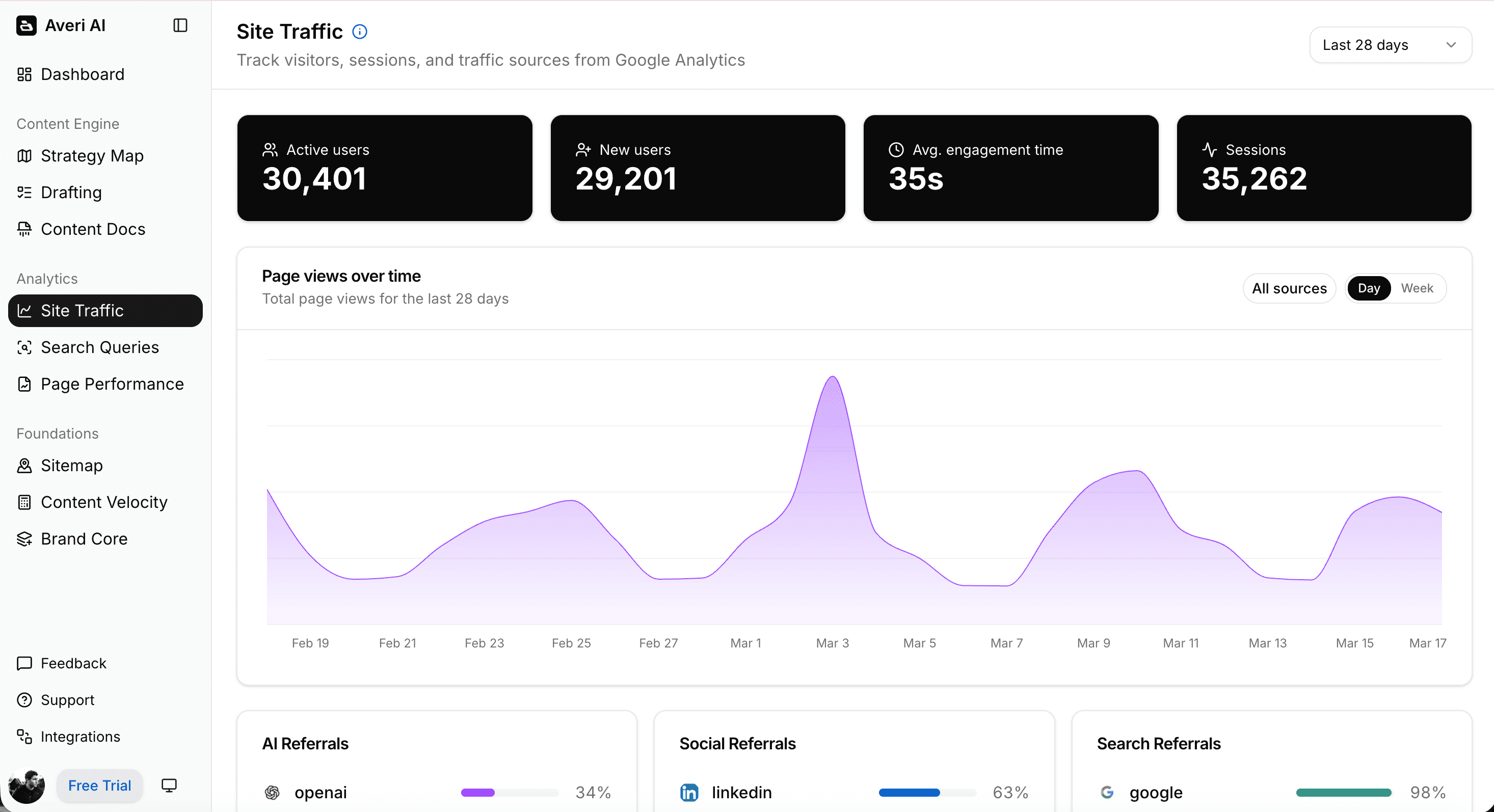
This doesn't mean rewriting everything quarterly. It means updating your top performers with fresh data, new examples, and current-year timestamps. A content engine approach makes this manageable for a one-person team. Averi's analytics dashboard flags underperforming pages and suggests refresh priorities automatically, so you know exactly what to update and when.
Who this is for: Startups with 20+ published pages that haven't been updated in 90+ days.
The math: what a 58% CTR drop actually costs a startup
Let's put real numbers on this. A B2B SaaS startup in the $1-5M ARR range with a healthy content marketing program might look like this:
Metric | Pre-AI Overviews | Current (2026) | Impact |
|---|---|---|---|
Monthly organic visitors | 8,000 | 5,200 | -35% |
Visitor-to-lead conversion | 2% | 2% | — |
Monthly organic leads | 160 | 104 | -56 leads/mo |
Lead-to-customer rate | 5% | 5% | — |
Monthly new customers (organic) | 8 | 5.2 | -2.8 customers/mo |
Average contract value | $12,000/yr | $12,000/yr | — |
Annual revenue impact | — | — | -$33,600/yr |
That's $33,600 in annual revenue gone.
For a startup at $2M ARR, that's 1.7% of total revenue evaporating from a single channel shift you didn't choose.
And that's the conservative estimate. Content marketing costs 62% less than traditional marketing while generating 3x the leads.
When your lowest-cost acquisition channel loses efficiency, the downstream impact compounds. You either spend more on paid channels (burning cash you don't have at seed stage) or accept slower growth.
The startups that adapt their content strategy for AI search aren't just avoiding losses. They're capturing the traffic and citations that competitors are leaving on the table. Seer's data shows cited brands gaining 35% more clicks.
The gap between adapters and non-adapters grows every quarter.
What Google's March 2026 core update means for this
Google's March 2026 core update completed its rollout on April 8. The update doubled down on E-E-A-T signals, and sites without strong experience, expertise, authoritativeness, and trustworthiness signals lost rankings. Health, finance, legal, and home services content took the hardest hits.
For startups, two implications stand out.
First, the update rewards the same signals that earn AI citations: authoritative sources, specific data, author expertise, and structured content. Optimizing for GEO and optimizing for the post-update algorithm are the same work. You don't need two separate strategies.
Second, the update completed right as AI Overviews continue expanding to more query types.
The combination means that content with weak E-E-A-T signals gets hit twice: lower rankings from the algorithm update AND less visibility in AI Overviews. A startup blog post with no author bio, no cited sources, and generic advice is now almost invisible.
The fix maps directly to Averi's content engine workflow.
Every article goes through research with hyperlinked sources, brand-aligned drafting, SEO and GEO optimization, and analytics tracking. The process bakes in the E-E-A-T signals that both the algorithm and AI systems reward.

The Perplexity and ChatGPT factor
Google isn't the only AI search surface that matters anymore. Perplexity hit $450 million in ARR in March 2026, with over 100 million monthly users. ChatGPT's new shopping and deep research features are pulling search behavior away from Google entirely.
Here's what we've observed at Averi: AI chatbot visitors convert at dramatically higher rates than traditional organic visitors. When someone gets an answer from Perplexity or ChatGPT and then clicks through to your site, they're already further down the funnel. They've already been told your content is authoritative. They're coming to take action, not to browse.
This reframes the entire conversation.
The goal isn't just to preserve Google organic traffic. The goal is to be cited across every AI surface, because those citations drive higher-intent visitors. One startup we tracked gets 37 AI chatbot visitors a day, and those visitors behave completely differently from Google organic traffic.
Gartner projects that by end of 2026, 25% of organic search traffic will shift to AI chatbots. OpenAI is projecting $2.5 billion in ad revenue for 2026 alone. The money follows the attention. The attention is moving to AI search. Your content strategy should too.
What this means if you're a one-person marketing team
If you're a founder or solo marketer reading this, the reaction is probably somewhere between "I knew my traffic was dropping" and "I don't have time to add another optimization layer."
Fair. That's why building a content engine matters more than ever.
You need a system that handles research, drafting, optimization, and tracking without requiring 20 hours a week of manual work.
The startups winning the AI search shift aren't doing more work. They're doing different work, more efficiently.
Here's a realistic weekly time allocation for a solo founder adapting to the AI traffic tax:
30 minutes: Check GSC for AI interception patterns (impressions up, clicks down)
30 minutes: Update one high-performing page with fresh data and restructured opening
1 hour: Approve and publish one GEO-optimized article from your content queue
30 minutes: Monitor AI citation performance across Google, ChatGPT, and Perplexity
That's 2.5 hours. Not 20. The 10x marketer approach isn't about working harder. It's about having a system that does the heavy lifting while you make the decisions that matter.
See how much you could save with Averi for your content
The bottom line
The AI traffic tax is real, it's measurable, and it's hitting startups harder than enterprises.
But the data also shows a clear path forward: startups that earn AI citations don't just survive, they gain a measurable edge over competitors who ignore the shift.
Your next move: run the 30-minute diagnostic on your top 20 pages. If you find the impressions-up-clicks-down pattern, you have confirmation. Then restructure those pages for citation, starting with the ones that drive the most pipeline.
If you want a system that handles the research, drafting, GEO optimization, and performance tracking in one workflow, start a free trial of Averi.
The content engine is built for exactly this: turning your startup's expertise into content that ranks on Google, gets cited by AI, and actually drives revenue. Solo plan starts at $99/month, and you'll publish your first GEO-optimized article within the first week.
Related resources
Understanding the AI search shift:
The GEO playbook: getting cited by LLMs, not just ranked by Google
Schema markup for AI citations: technical implementation guide
Building your content engine:
Content strategy for startups:
BOFU content strategy: the pages that actually convert B2B SaaS buyers
SEO for startups: how to rank higher without a big budget in 2026
Content marketing on a startup budget: high-ROI tactics for lean teams
Startup SEO engine: build compounding traffic with a 1-person team
Measuring what matters:
FAQs
How much does an AI Overview reduce organic clicks for the top-ranked page?
Ahrefs found a 58% reduction in organic CTR for position-one results when an AI Overview appears. Seer Interactive's study of 25.1 million impressions confirmed the range at 49-65%. For B2B SaaS startup content, informational queries trigger AI Overviews 80-88% of the time.
What percentage of Google searches trigger AI Overviews in 2026?
BrightEdge's 12-month analysis shows AI Overviews now trigger on 48% of all tracked queries, a 58% increase year over year. The rate varies by query type: informational queries trigger at 80-88%, while e-commerce queries trigger at only 4%. Startups publishing how-to and explainer content face the highest interception rates.
Do brands cited in AI Overviews get more clicks?
Yes. Seer Interactive's study found brands cited in AI Overviews earn 35% more organic clicks and 91% more paid clicks compared to non-cited brands. The data shows AI citation creates a two-tier system where cited brands gain traffic while non-cited brands lose it.
How do I check if AI Overviews are stealing my startup's organic traffic?
Compare impressions to clicks in Google Search Console over the last 90 days. If impressions hold steady but clicks decline by 15%+, AI interception is likely the cause. Spot-check your target keywords in incognito to confirm AI Overviews appear. Focus on informational pages first since they face 80-88% trigger rates.
What content types are most affected by AI Overviews?
Informational content gets hit hardest: "what is" explainers, generic how-to guides, definition pages, and commodity listicles. E-commerce and BOFU content sees far lower AI Overview trigger rates (4% for e-commerce queries). Comparison pages, case studies, and original data pieces are more resistant to AI interception.
How fresh does content need to be to get cited by AI search?
Extremely fresh. Research shows 50% of content cited in AI search responses is less than 13 weeks old. AI systems have a strong recency bias, and content older than six months loses citation eligibility rapidly. A content engine that automates refresh cycles is the most efficient way to maintain freshness at startup scale.
What is GEO and how is it different from SEO?
GEO (generative engine optimization) focuses on earning citations in AI-generated answers from ChatGPT, Perplexity, and Google AI Overviews. While SEO targets traditional search rankings, GEO optimizes for extraction: structured answers, authoritative sourcing, and schema markup that AI systems can parse. In 2026, you need both. They share 70%+ of the same best practices.