B2B SaaS Content Marketing: The Complete 2026 Guide

Zach Chmael
Head of Marketing
9 minutes

In This Article
The full system: strategy, BOFU pages, PLG content, inbound by ACV, budget allocation, and automation. 702% SEO ROI starts here.
Updated
Trusted by 1,000+ teams
Startups use Averi to build
content engines that rank.
TL;DR
📈 SEO delivers 702% ROI for B2B SaaS with 7-month break-even. Organic CAC ($205) is 40% cheaper than paid CAC ($341) and compounds over time.
🏗️ This guide covers the 7 pillars: blog strategy & architecture, BOFU conversion pages, PLG content, inbound by ACV tier, budget allocation, ROI measurement, and workflow automation.
🔍 Content must now optimize for two discovery surfaces: Google (traditional SEO) + AI search (GEO — getting cited by ChatGPT, Perplexity, AI Overviews). AI Overviews appear on 48% of queries.
💰 Budget ranges by stage: Seed ($3-5K/mo), Series A ($10-25K/mo), Series B+ ($50K+/mo). A content engine at $99/month replaces the $3-10K/month production cost at early stages.

Zach Chmael
CMO, Averi
"We built Averi around the exact workflow we've used to scale our web traffic over 6000% in the last 6 months."
Your content should be working harder.
Averi's content engine builds Google entity authority, drives AI citations, and scales your visibility so you can get more customers.
The Complete Guide to B2B SaaS Content Marketing in 2026
SEO delivers 702% ROI for B2B SaaS companies with break-even at 7 months.
Organic search generates 44.6% of all B2B revenue — more than paid, email, social, and events combined.
Companies with blogs generate 67% more leads per month than those without.
And yet 45% of B2B marketers lack a scalable content creation model. 97% of indexed pages get zero organic traffic. The median MQL-to-SQL conversion rate is just 13%, meaning 87% of the leads marketing generates never make it to sales.
The problem isn't content marketing.
The problem is how most B2B SaaS companies do content marketing: sporadically, without a system, targeting the wrong keywords, measuring the wrong metrics, and spending budget on production instead of strategy.
This guide is the system. Seven sections, each covering one pillar of B2B SaaS content marketing, each linking to a deep-dive article where the full playbook lives.
Think of it as the map — the linked articles are the territory.
We built Averi's organic presence to 2.85 million monthly Google impressions using this system.
No paid ads. No content agency. One marketer, one content engine, and the same principles laid out here.
See your Marketing Maturity level
Why Content Marketing Is Different for B2B SaaS
Content marketing for a B2B SaaS company is not the same as content marketing for an e-commerce brand, a media company, or a consumer app.
Four structural differences change everything about how you plan, produce, and measure.
Longer sales cycles require more content touchpoints
The average B2B SaaS sales cycle is 134 days. Buyers consult 5-7 content pieces before a purchase decision, with buying committees averaging 10 people.
Each stakeholder needs different content at different stages.
The CFO needs ROI data.
The end user needs a product walkthrough.
The CTO needs a security assessment.
One blog post doesn't close a B2B SaaS deal. A content system does.
Two discovery surfaces instead of one
In 2026, your content competes on Google and AI search simultaneously.
AI Overviews appear on 48% of queries. ChatGPT now accounts for 20% of search-related traffic worldwide. Content needs traditional SEO structure (keywords, meta tags, internal links) plus GEO structure (answer capsules, FAQ sections, factual density, non-promotional tone) to perform on both surfaces.
We score every piece at 55% SEO + 45% GEO — the ratio that reflects where discovery is heading.
Compounding economics favor content over paid
Every paid campaign resets to zero when the budget pauses.
Every piece of content that ranks keeps working indefinitely.
Content marketing costs 62% less than traditional marketing while generating 3x more leads. An article that ranks for a high-intent keyword today will generate leads for 18-36 months without additional spend.
That compounding effect is why organic generates 44.6% of B2B revenue — it's the only channel where past work increases future returns.
The content-product overlap is higher in SaaS
Your product is software. Your content explains software concepts.
The overlap means every blog post doubles as a product education tool, and every help doc is a potential search-ranking asset.
B2B SaaS companies that treat content marketing as separate from product marketing miss the biggest opportunity: content that educates the buyer is the product experience, especially for PLG companies where the content is the top of the funnel.
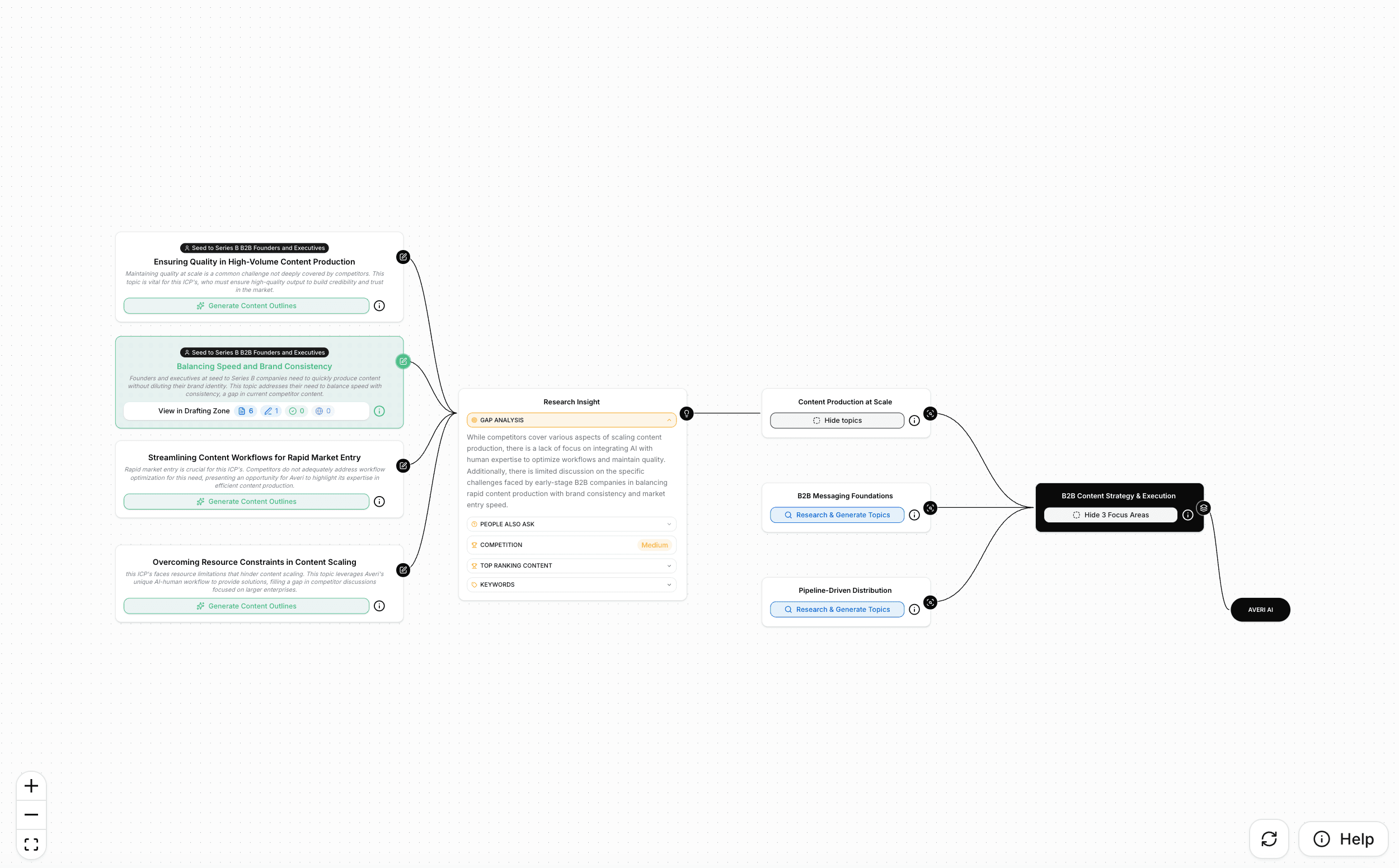
1. Blog Strategy & Content Architecture
The first question isn't "what should we write?" It's "what structure ensures every piece strengthens every other piece?"
Most B2B SaaS blogs are collections of random posts.
A blog strategy organizes content into topic clusters with pillar pages, supporting articles, and intentional internal linking that builds topical authority Google can recognize.
The 4-category content architecture
The framework that produces the best results for B2B SaaS allocates content across four categories:
Category | % of Content | Purpose | Example |
|---|---|---|---|
BOFU (conversion) | 30% | Capture buyers ready to evaluate | Comparison pages, alternative pages, case studies |
Educational | 40% | Build authority and attract researchers | How-to guides, frameworks, definitions |
Thought leadership | 20% | Establish POV and earn backlinks | Original research, contrarian takes, industry analysis |
Product-led | 10% | Bridge content readers to product users | Feature walkthroughs, use case demos, template libraries |
The mistake most startups make: 80% educational, 5% BOFU.
They build traffic but not pipeline. The 30% BOFU allocation is what turns readers into prospects.
The topic cluster model
Each cluster has one pillar article (3,000-5,000 words, broad topic) supported by 5-8 cluster articles (1,500-2,500 words, specific subtopics).
Every cluster article links to the pillar and to sibling articles.
This internal linking structure tells Google "we own this topic" and distributes ranking authority across the cluster.
You're reading a pillar article right now. The sections below each link to the cluster articles that go deeper.
The full playbook: B2B SaaS Blog Strategy: The 2026 Playbook →
2. BOFU Content: The Pages That Actually Convert
Only 4.7% of B2B content teams focus on bottom-of-funnel content.
The other 95.3% produce top-of-funnel content that builds traffic but doesn't close deals.
BOFU content targets buyers who already know their problem and are evaluating solutions.
These searchers use queries like "Jasper vs alternatives," "best AI content platform for startups," and "[your competitor] pricing."
They're the highest-intent visitors on your site and the most likely to convert to trial, demo, or purchase.
The BOFU content types that convert for B2B SaaS
Comparison pages ("Averi vs. Jasper") answer the question a buyer asks right before they decide. These pages rank for competitor brand queries and capture buyers who are actively evaluating.
We've seen comparison pages convert at 3-5x the rate of educational blog posts.
Alternative pages ("Best AirOps alternatives for content teams") capture buyers who've identified a category leader but are looking for options.
These pages serve searchers at the exact moment of evaluation.
Case studies with specific metrics prove your product works for companies similar to the buyer's. 78% of B2B buyers use case studies during vendor evaluation.
Generic testimonials don't cut it. Specific numbers — "$11,400/month reduced to $99/month" — do.
Pricing and ROI pages address the budget question that kills deals. Transparent pricing with a savings calculator lets buyers build their own business case without waiting for a sales call.
Most B2B SaaS companies underinvest in BOFU because educational content feels more productive.
Writing "What is content marketing?" gets more traffic than writing "Averi vs. Jasper."
But the comparison page converts at 10x the rate. Revenue per visitor, not visitors per page, is the metric that matters for BOFU.
The full playbook: BOFU Content Strategy: The Pages That Actually Convert B2B SaaS Buyers →
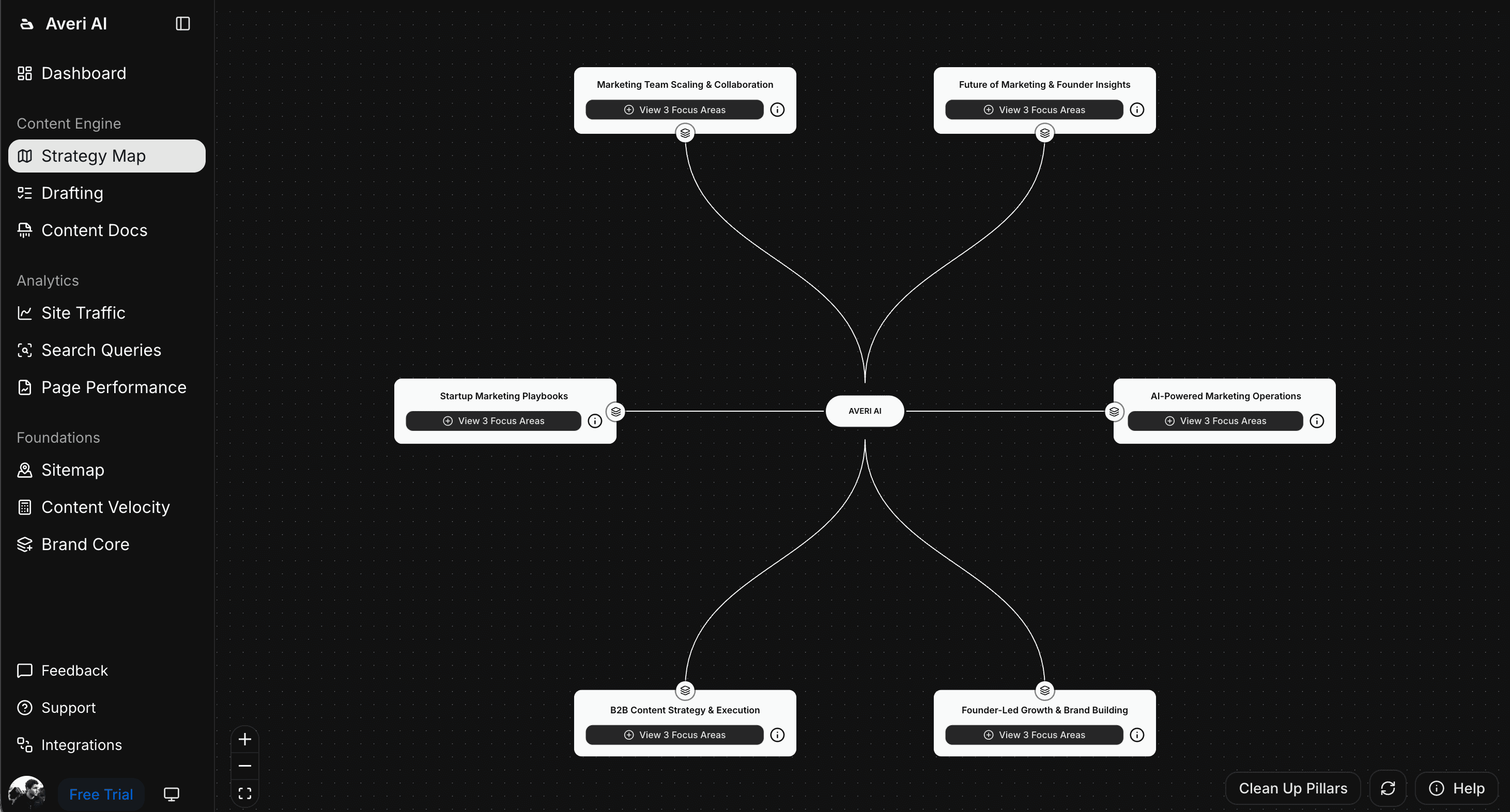
3. Content Marketing for Product-Led Growth
If your SaaS has a self-serve signup, free trial, or freemium tier, your content strategy is your sales team.
There's no rep to explain the product. No demo to walk through features. The content does all of that — or the visitor leaves.
How PLG content differs from sales-led content
PLG content has to do three jobs that sales-led content doesn't:
Educate the buyer on the problem and the product. In a sales-led motion, the rep handles product education during the demo. In PLG, the blog post, the landing page, and the help docs are the only product education the buyer gets before signing up.
Convert without a human touchpoint. The reader needs to go from "I have a problem" to "I'll try this product" in one session. That means every piece of PLG content needs a clear path to the signup — not a "contact sales" CTA, but a "start your free trial" button.
Activate after signup. PLG content doesn't end at conversion. Onboarding guides, feature walkthroughs, and use-case templates reduce time-to-value and improve trial-to-paid conversion. 7-day trials convert at 40.4% — but only when the user activates within the trial window. Content is what gets them there.
The keyword strategy shifts too.
PLG companies need to rank for "how to [do the thing your product does]" queries, not just "[category] software."
The person searching "how to build a content engine" is your ideal user — they just don't know your product exists yet.
The full playbook: Content Marketing for PLG: The SEO Strategy That Converts Self-Serve Signups →
4. Inbound Marketing by ACV Tier
A company selling $2K ACV deals to startup founders needs a completely different content strategy than one selling $30K ACV deals to enterprise procurement teams.
Your average contract value determines your marketing motion, your content types, your distribution channels, and your conversion expectations.
How ACV changes the playbook
ACV Range | Marketing Motion | Content Priority | Primary Channel |
|---|---|---|---|
Under $5K | PLG-dominant. Volume play. | Self-serve education, SEO-driven signups, template libraries | Organic search + community |
$5K-$15K | Hybrid. PLG + sales assist. | Comparison content, demo-focused content, case studies | Organic + LinkedIn + email nurture |
$15K-$30K | Sales-assisted. AE involved. | Sales enablement content, industry-specific case studies, ROI calculators | LinkedIn Ads + outbound + content |
$30K+ | Enterprise sales. Long cycle. | Analyst reports, security docs, multi-stakeholder content | ABM + events + executive content |
Most inbound marketing guides assume one motion fits all. They don't.
A startup with $2K ACV spending $1,200 on Google Ads to acquire one customer is underwater.
The same startup spending $99/month on a content engine that produces 10 organic signups per month at $10 CAC is building a machine.
The ACV-to-content framework ensures you're creating the right content for the right buying motion.
High-volume, low-ACV businesses need SEO-heavy, self-serve content. Low-volume, high-ACV businesses need sales-enabling, relationship-building content.
The channel allocation shift
At low ACV, your content strategy centers on search.
You need volume because each deal is small — 100 customers at $3K ACV beats 10 customers at $3K ACV every time. SEO-driven content marketing is the only channel that scales volume without scaling cost proportionally.
At high ACV, your content strategy shifts to enablement.
You need fewer customers, but each one requires more convincing. Case studies, ROI calculators, and security documentation become the content that closes deals. The blog still matters for top-of-funnel discovery, but the comparison pages, pricing transparency, and industry-specific proof points are what the sales rep attaches to the deal.
The mistake we see most often: companies with $5K ACV running an enterprise content playbook. They produce gated whitepapers and webinars for an audience that would convert faster through a self-serve trial promoted by an ungated blog post.
The full playbook: Inbound Marketing for $2K-$30K ACV SaaS: The Playbook That Actually Scales →
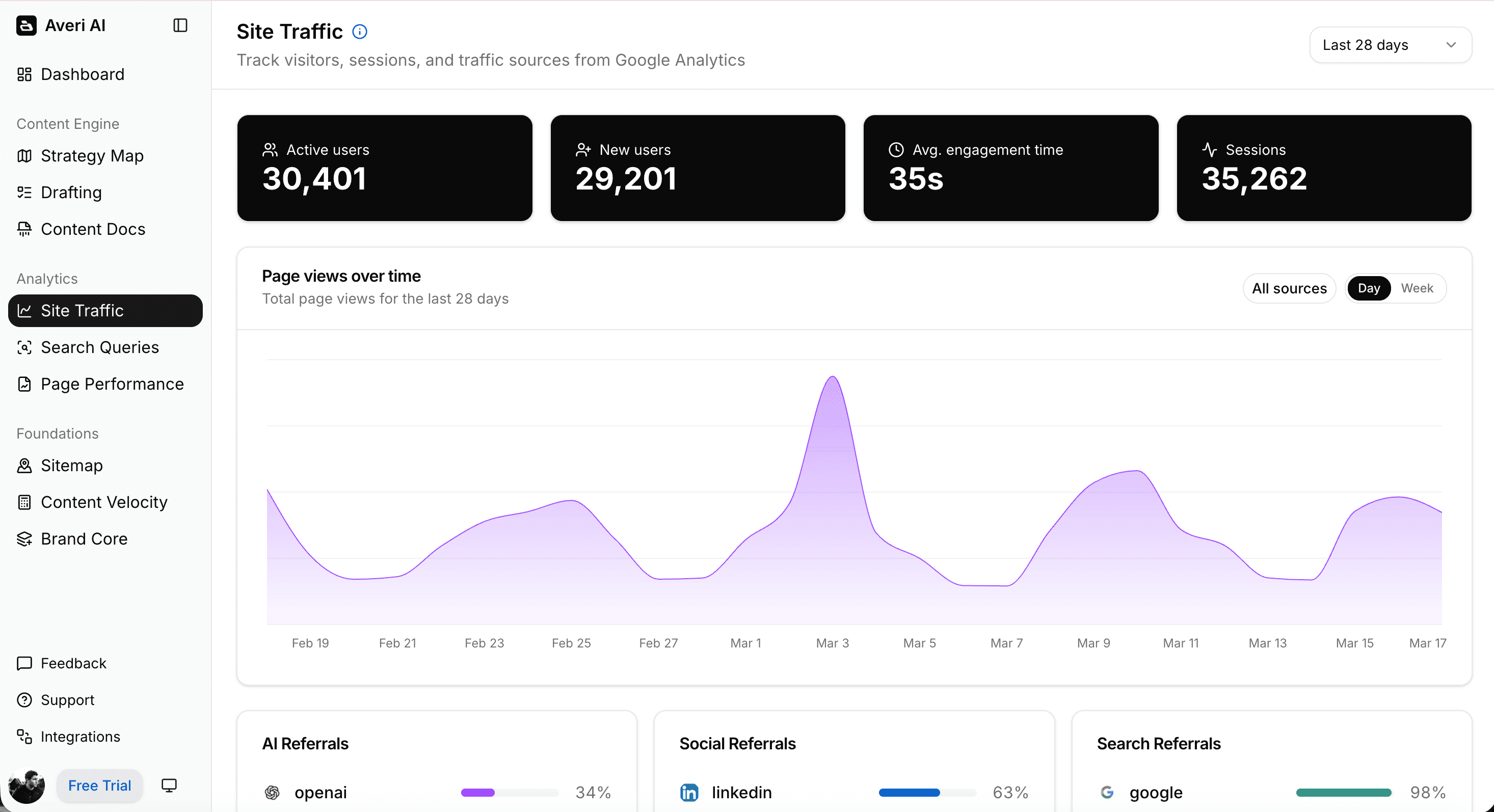
5. Budget Allocation & ROI Measurement
The most common reason B2B SaaS content marketing fails isn't strategy — it's budget. Either too little to produce consistently, or too much in the wrong places.
Budget benchmarks by stage
Stage | Total Marketing Budget | Content Marketing Allocation | What That Buys |
|---|---|---|---|
Seed ($0-$2M ARR) | 30-40% ($1K-$2K) | Content engine ($99) + SEO tools ($65-140) + founder time | |
Series A ($2-10M ARR) | $10K-$25K/month | 25-35% ($2.5K-$8.5K) | Engine + part-time strategist + paid amplification |
Series B+ ($10M+ ARR) | $50K+/month | 20-30% ($10K-$15K) | Content team + engine + full SEO program |
The key insight: at Seed stage, the content engine is the content team.
A $99/month Averi Solo Plan produces the content output of a $60-80K/year content marketer — strategy, drafting, SEO + GEO optimization, CMS publishing, and analytics.
Hire when you've proven content works. Buy the engine to prove it.
The metrics that matter
Track these, not pageviews:
Organic traffic growth (is the engine compounding?)
Content-attributed signups (does content convert?)
CAC by channel (organic should be 40-50% cheaper than paid)
Marketing Efficiency Ratio (total revenue ÷ total marketing spend)
The single most important shift in measurement: stop attributing individual conversions to individual pieces of content.
The average B2B SaaS sales cycle is 134 days with 76 touchpoints.
No single article "caused" the sale. Content marketing is a system, not a collection of independent campaigns. Measure the system's output (pipeline, revenue) against the system's input (time + money).
That's MER. It's the metric that tells you whether your total marketing effort is working without the attribution theater.
Calculate your content marketing ROI
The full playbook: Content Marketing ROI Benchmarks for B2B SaaS →
6. Content Marketing Automation & Workflow
The production bottleneck kills more content programs than bad strategy.
The founder knows what to write. The content calendar is planned. The keywords are researched.
And then... nothing gets published because the 6-step workflow (research → draft → edit → optimize → format → publish) takes 4-6 hours per post.
The manual workflow vs. the content engine
Workflow Step | Manual (6 disconnected tools) | Content Engine (one workflow) |
|---|---|---|
Topic research | Semrush → export → spreadsheet | Strategy Map generates recommendations from competitor + keyword data |
Drafting | ChatGPT → Google Doc → copy edits | AI draft with Brand Core context, research, internal links built in |
SEO optimization | Surfer/Clearscope → manual checks | Content Scoring at 55% SEO + 45% GEO, automatic |
GEO optimization | Manual FAQ creation, schema checks | FAQ structure, answer capsules, entity definitions built into template |
Publishing | Copy into CMS → format → metadata | Direct publish to WordPress, Webflow, or Framer |
Analytics | GSC → GA4 → spreadsheet → hope | Integrated dashboard. Performance feeds back into recommendations |
The engine doesn't replace the human. It replaces the 80% of the workflow that isn't judgment.
The human provides the voice, the perspective, the strategic direction.
The engine handles the research, optimization, formatting, and publishing.
AI-powered teams deliver content 84% faster than traditional workflows.
For a founder spending 3-5 hours per week on content, that's the difference between publishing 2 posts per month (manual) and 8-12 posts per month (engine-assisted).
The weekly rhythm that produces 8-12 posts per month
Content automation isn't about removing the human.
It's about compressing the non-judgment work so the human can focus on what actually matters: voice, perspective, and strategic direction.
The weekly operating system we run:
Monday (90 min): Review the content queue the engine generated. Approve 2-3 topics for the week. Review any performance alerts from last week's content. The engine does the research and recommendation. You do the approval.
Wednesday (60 min): Review AI-assisted drafts. Edit for voice — the engine handles structure, optimization, and internal linking, but the perspective needs to be yours. Approve for publishing or request revisions.
Friday (30 min): Review published content performance. Check which pieces are earning impressions in Search Console. Flag any content from the last 90 days that's underperforming for a refresh cycle.
Total: 3 hours/week.
Output: 2-3 published pieces per week, or 8-12 per month.
The same output that would require 15-20 hours/week of manual work across disconnected tools.
The automated content marketing workflow replaces the tool-switching tax.
No more exporting from Semrush, importing to Google Docs, copy-pasting into your CMS, manually checking SEO scores, and switching to GA4 to see what happened.
One system. One workflow. One place where everything connects.
The full playbook: Content Marketing Automation for SaaS: The Complete Guide →
DIY vs. Agency vs. AI Content Engine
The three approaches to content marketing, compared honestly.
DIY (Founder + Tools) | Agency | AI Content Engine | |
|---|---|---|---|
Monthly cost | $0-$200 (tools only) + 10-20 hrs founder time | $3,000-$10,000 retainer | $99-$399 + 3-5 hrs founder time |
Ramp time | Weeks (founder knows the product) | 1-3 months (agency learns your brand) | 1 day (Brand Core auto-ingests your website) |
Content quality | High voice authenticity, low SEO optimization | Variable (depends on the agency writer assigned) | High optimization, requires founder voice pass |
Monthly output | 2-4 posts (founder bandwidth) | 4-8 posts (agency capacity) | 8-12 posts (engine + founder editing) |
SEO + GEO | Manual, often inconsistent | SEO usually included, GEO rarely | Built-in scoring at 55% SEO + 45% GEO |
Publishing | Manual CMS copy-paste | Agency delivers drafts, you publish | Direct CMS publishing (WordPress, Webflow, Framer) |
Analytics | Manual GSC + GA4 | Monthly reporting (often delayed) | Integrated, real-time, feeds recommendations |
Scales with hiring | Breaks when founder can't keep up | Scales with retainer increases | Scales with team plan ($199/mo, 3 seats) |
Best for | Founders with marketing experience and time | Companies with budget and established positioning | Startups needing systematic output at startup prices |
Our recommendation by stage:
Seed: Start with the content engine. $99/month gives you a complete workflow. Layer in founder voice and perspective. This is how we built to 2.85M monthly impressions.
Series A: Content engine + part-time editor or strategist. The engine handles production. The human handles editorial direction and quality control.
Series B+: Content engine + full content team. The engine scales the team's output 2-3x. A team of 3 using Averi produces the output of 6-8 without it.
When agencies make sense (and when they don't)
Agencies work when you have established positioning, a documented brand voice, and enough budget ($5K+/month retainer) to get their A-team, not their junior writers.
They break down when the agency writer assigned to your account doesn't understand your product deeply enough to write credibly about it — which is common in technical B2B SaaS.
The structural problem: agency writers rotate across 8-15 clients.
Your SaaS product is one of many on their calendar. They produce competent, generic content that reads like it could be about any tool in your category. The voice is professional but undifferentiated. And because they're writing for multiple clients, they can't build the deep product knowledge that makes content actually useful.
Content engines avoid this by maintaining persistent brand context.
The Brand Core learns your product, competitors, and positioning once. Every piece it helps produce carries that context forward. There's no writer rotation, no ramp time for new team members, and no explaining your product again next quarter.
The hybrid approach we see working best for Series A companies: use the engine for high-volume production (blog posts, comparison pages, FAQ content) and bring in a senior freelance editor or fractional content strategist for editorial direction and quality control.
You get the systematic output of the engine plus the strategic judgment of an experienced human — at a fraction of a full content team's cost.
Start your content engine free →
See how much you could save by using Averi for your content marketing
The 90-Day Quick Start
If you're starting B2B SaaS content marketing from zero, here's the sequence that produces the fastest results. This isn't theory — it's the operating playbook we used to build Averi's content presence from nothing.
Month 1: Foundation (10-15 hours total)
The first month is about BOFU-first publishing. Most startups start with top-of-funnel educational content because it feels more natural to write. That's backwards. BOFU content targets people already looking for a solution. It converts faster and proves content marketing works before you invest in the long-term SEO play.
Set up content engine with Brand Core (Day 1 — takes 30 minutes)
Publish 4 BOFU articles: 2 comparison pages (your product vs. top 2 competitors), 1 alternative page ("best [competitor] alternatives"), 1 case study or proof-of-results page
Launch a newsletter (even if you have 50 subscribers — the list compounds like the content does)
Submit sitemap to Google Search Console. Set up Fathom or GA4 for traffic tracking.
Month 2: Cluster Building (10-15 hours total)
Month 2 is where you build your first topic cluster. Pick the topic most central to your product's value proposition. Publish 6-8 articles: 2 more BOFU pieces plus 4-6 educational pieces targeting keywords in the same cluster. Every article links to the others. This internal linking structure is what tells Google you have depth on the topic.
Publish 6-8 articles across the 4-category architecture: 2 BOFU + 3 educational + 1-2 thought leadership
Start LinkedIn distribution (3 posts/week extracting insights from your blog content)
Set up Search Console tracking and check weekly for emerging impressions
Embed at least one interactive tool (calculator, assessment, template) in your highest-traffic page
Month 3: Optimization + Scaling (10-15 hours total)
By month 3, you have data. Search Console shows which articles are earning impressions. Fathom/GA4 shows which pages drive engagement. Your newsletter shows which topics resonate. Now you optimize based on evidence, not intuition.
Publish 8-10 articles, expanding your first cluster and starting a second
Refresh Month 1 articles with updated data, expanded FAQ sections, and additional internal links (content refreshes show results in days)
Review analytics: which pieces earn impressions? Which earn clicks? Which earn signups?
Double down on the topics and formats that are working. Cut what isn't.
Write your first pillar page linking all cluster articles together
By Month 3: You'll have 18-22 published pieces, an emerging topic cluster structure, at least one piece with growing impressions in Search Console, and enough data to know whether content is going to be a growth channel for your business. Total investment: ~$300 in tools + 30-45 hours of founder time.
By Month 6: If you've maintained the cadence, you'll have 50+ published pieces, multiple ranking pages, and the beginning of the compounding curve that turns content from an expense into an asset. Companies publishing 9+ posts monthly see 35.8% year-over-year traffic growth. The math works. The execution is what separates the startups that build organic engines from the ones that stay dependent on paid.
Related Resources
This Cluster (Deep-Dive Articles)
B2B SaaS Blog Strategy: The 2026 Playbook — 4-category architecture, topic clusters, cadence framework
BOFU Content Strategy: The Pages That Actually Convert — Comparison pages, alternatives, case studies, pricing content
Content Marketing for PLG: The SEO Strategy That Converts — Self-serve content funnel, activation content, trial optimization
Inbound Marketing for $2K-$30K ACV SaaS — ACV-to-motion mapping, channel allocation by deal size
Content Marketing ROI Benchmarks for B2B SaaS — CAC benchmarks, ROI timelines, measurement framework
Content Marketing Automation for SaaS: Complete Guide — Workflow comparison, engine vs. manual, scaling production
B2B Saas Content Marketing Budget by Stage — From Seed to Series B, how much you should spend in each stage.
Building the Engine
SEO + GEO Optimization
Budget & Growth
Tools
FAQs
How long does it take for B2B SaaS content marketing to produce results?
SEO breaks even at approximately 7 months with full ROI materializing over 2-3 years as content compounds. BOFU content like comparison pages and case studies can show results within 30-60 days because they target buyers already evaluating solutions. Content refreshes on existing pages show movement in days to weeks. The compounding curve means month 12 dramatically outperforms month 1 — companies publishing 9+ posts monthly see 35.8% year-over-year traffic growth.
What content types work best for B2B SaaS?
Case studies, proprietary research, and thought leadership are the most effective for generating sales in B2B SaaS. For SEO traffic, long-form guides and how-to articles targeting informational queries build authority. For conversion, comparison pages and alternative pages capture high-intent buyers. The optimal mix: 40% educational (traffic), 30% BOFU (conversion), 20% thought leadership (authority), and 10% product-led (activation).
How much content should a B2B SaaS company publish per month?
Companies publishing 16+ posts monthly see 3.5x more traffic than those publishing 0-4. For startups, 8-12 posts/month is the sweet spot that balances quality with the cadence needed for Google to recognize topical authority. With a content engine, one founder can sustain this in 3-5 hours/week. Without one, 2-4 posts/month is more realistic for a founder-led operation.
Should B2B SaaS companies gate their content?
Gate sparingly. Ungated content earns backlinks, ranks in search, and gets cited by AI — all of which drive more long-term value than a gated download form. Reserve gating for high-value assets (ROI calculators, benchmark reports, templates) where the exchange feels fair. For blog posts, guides, and educational content, always publish ungated. The SEO and GEO value of accessible content far outweighs the email capture from gating it.
How do you measure content marketing ROI for SaaS?
Three metrics: (1) Organic CAC — average $205 vs. $341 for paid, should be 40-50% cheaper. (2) Content-attributed pipeline — track which pieces drive trial starts, demo requests, and closed revenue. (3) Marketing Efficiency Ratio — total revenue ÷ total marketing spend. Avoid vanity metrics (pageviews, social shares) unless they correlate with downstream conversion. Averi's analytics integration connects GSC + GA4 to your content library for direct performance tracking.
What's the difference between content marketing for PLG vs. sales-led SaaS?
PLG content serves as the entire sales funnel — it must educate, convert, and activate without a human touchpoint. Keyword strategy targets "how to [do the thing]" queries. CTAs drive self-serve signup. Post-signup content drives activation. Sales-led content supports human sales conversations — comparison content, case studies, and ROI frameworks that sales reps attach to deals. PLG companies spend more on content (13% of revenue vs. 9% for sales-led).
Can AI content marketing work for B2B SaaS without sounding generic?
Yes, but only with persistent brand context. The reason most AI content sounds generic: the AI starts from zero every session. A content engine with Brand Core learns your product, positioning, competitors, and voice once, then applies that context to every piece. The human provides perspective and editorial judgment. The AI handles research, structure, and optimization. 73% of the best-performing content teams use AI-human hybrid workflows — the approach that consistently outperforms either alone.