Content Marketing Automation for SaaS: The Complete Guide
Zach Chmael

Head of Marketing

6 minutes

In This Article

The 6-phase content engine model that replaces your 12-tool marketing stack. Strategy → creation → optimization → publishing → distribution → analytics. All automated.

Updated

Trusted by 1,000+ teams

★★★★★ 4.9/5

Startups use Averi to build
content engines that rank.

TL;DR

🔧 Content marketing automation ≠ "use ChatGPT to write blog posts." It's 6 connected phases: strategy → creation → optimization → publishing → distribution → analytics.

📊 76% of marketers use AI for content creation, but creation is phase 3 of 6. Most teams automate the middle and manually operate everything before and after it.

⏱️ Manual content operation: 10–15 hrs/week. Automated: 2–3 hrs/week. Same output. The 8–12 hours saved at founder opportunity cost = 8–24x ROI on tool investment.

🏗️ Three approaches: DIY stack (5–8 tools, $183–$287/mo, 8–12 hrs/week), hub + spokes (HubSpot + tools, $197–$1,054/mo, 5–8 hrs/week), integrated engine (Averi, $99/mo, 2–3 hrs/week).

🚫 Don't automate: strategic direction, brand voice/perspective, relationship-driven distribution. Automate the labor. Keep the judgment human.

📈 Automation enforces quality consistency: every piece scored for SEO + GEO before publishing. The system doesn't forget to check factual density or FAQ structure.

Start free with Averi. 14-day trial. All 6 phases connected. First post published by day 3.

Zach Chmael

CMO, Averi

"We built Averi around the exact workflow we've used to scale our web traffic over 6000% in the last 6 months."

Your content should be working harder.

Averi's content engine builds Google entity authority, drives AI citations, and scales your visibility so you can get more customers.

Content Marketing Automation for SaaS: The Complete Guide

The average SaaS marketing team uses 12+ tools to manage content marketing.

A keyword research tool. A writing tool. An SEO optimization tool. A CMS. A social scheduling tool. An analytics dashboard. Maybe a project management layer on top to coordinate the workflow across all of them.

Each tool does one thing. None of them talk to each other. And someone (usually the founder or a single marketer) is the human glue holding the workflow together, copying outputs from one tool and pasting them into the next.

That's not a system. It's a pipeline. And a pipeline requires an operator. An engine runs.

Content marketing automation for SaaS means replacing the manual pipeline with an engine: a system where strategy informs creation, creation feeds optimization, optimization triggers publishing, publishing drives distribution, and distribution produces analytics that loop back into strategy.

Each phase connects to the next without a human copying and pasting between tabs.

This guide covers what content marketing automation actually looks like in 2026, which phases to automate first, where human input is still essential, and how the 6-phase engine model works in practice.

See the ROI of automating your content marketing

What Content Marketing Automation Actually Means in 2026

Content marketing automation is not "use ChatGPT to write blog posts." That's content generation.

Generation is one phase. Automation is the full lifecycle.

76% of content marketers now use AI for content creation. But creation is phase 3 of 6.

Most teams automate the middle (writing) and manually operate everything before it (strategy, topic selection) and after it (optimization, publishing, distribution, analytics).

The result: faster drafts that still require hours of manual work to research, optimize, format, publish, and measure.

True content marketing automation connects all six phases:

  1. Strategy — automated topic research, keyword mapping, and content gap analysis

  2. Creation — AI-assisted drafting with brand voice, factual density, and structure enforcement

  3. Optimization — automated SEO + GEO scoring, internal link suggestions, meta tag generation

  4. Publishing — direct CMS integration (no copy-paste from docs to your blog)

  5. Distribution — automated social posts, email integration, and content repurposing

  6. Analytics — performance tracking that feeds back into strategy decisions

Each phase can be automated independently. The compounding value comes from connecting them.
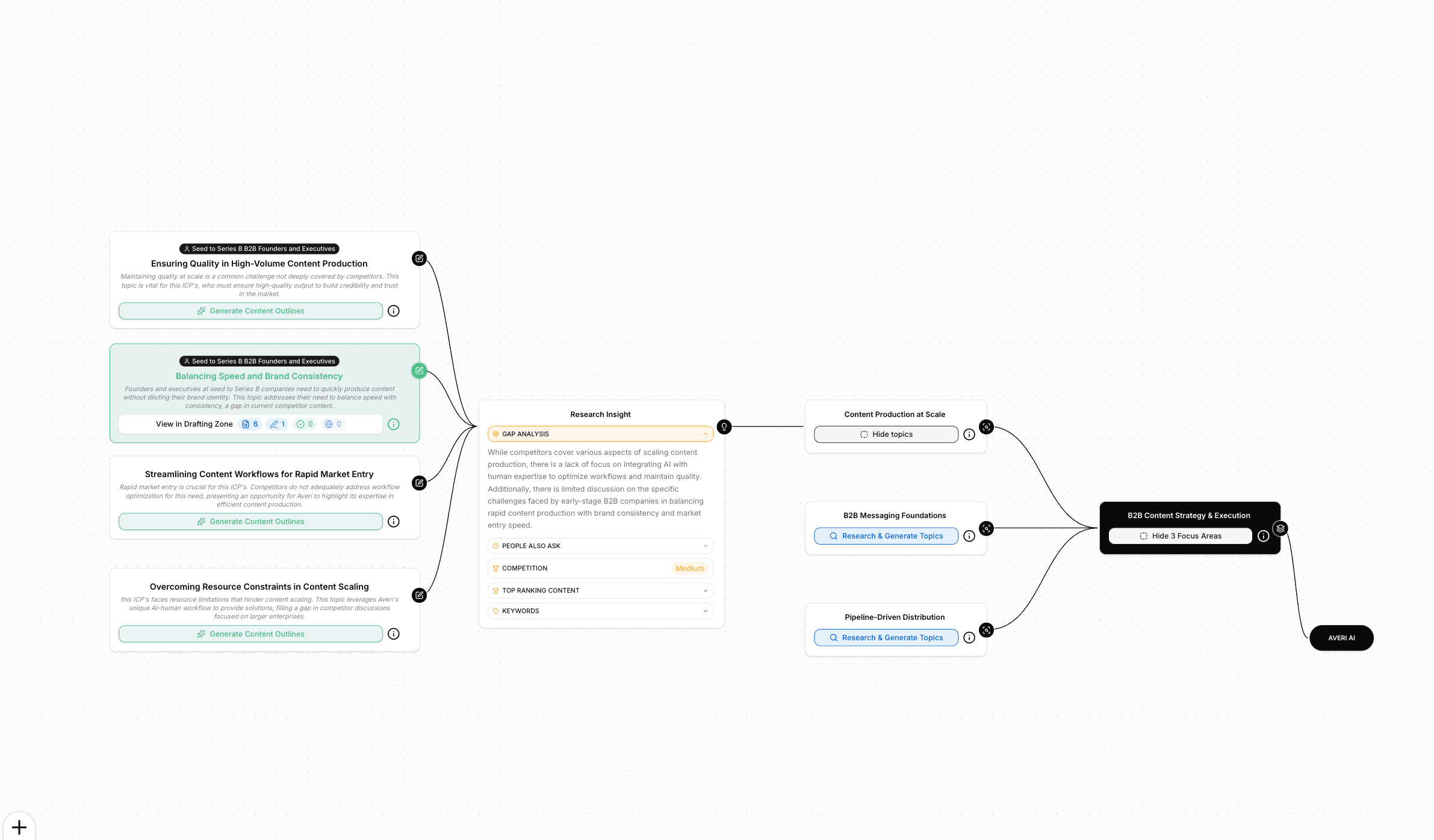
The 6-Phase Content Engine Model

Phase 1: Strategy Automation

What it replaces: Manual keyword research sessions, spreadsheet-based topic planning, gut-feel content decisions.

What automation does: Analyzes your existing content library, identifies keyword gaps and opportunities, maps topics to buyer journey stages, and generates prioritized content recommendations based on search volume, competition, and topical authority gaps.

The human role: Approve or adjust recommendations. The system identifies opportunities. The founder or marketer decides which ones align with business priorities. A keyword tool might surface "best CRM for startups" as high-volume, but if you sell a content engine, that's off-topic regardless of volume.

Time savings: Manual keyword research and topic planning takes 4–8 hours per month for a serious content operation. Automated strategy reduces this to 30–60 minutes of review and approval.

At Averi, this is the Strategy Map: the system generates topic recommendations based on your Brand Core (ICP, positioning, product capabilities) and the keywords where you have the best opportunity to rank and earn citations. You review, approve, and the approved topics flow directly into Phase 2.

Phase 2: Content Creation Automation

What it replaces: Starting from a blank document, manual research, writer's block, 4+ hour drafting sessions.

What automation does: Generates keyword-targeted drafts structured for both SEO and GEO, with answer capsules, hyperlinked statistics, FAQ sections, and appropriate word count. The output is a first draft, not a final product.

The human role: Edit the draft. This is the most important human touchpoint in the entire workflow. AI generates structure and research. The founder adds voice, perspective, experience, and the insights that make content citable rather than generic. 67% of marketers say original research remains more valuable for trust and credibility than AI-generated content alone.

Time savings: A 2,500-word blog post takes 4–6 hours to write manually (research + draft + edit). With AI-assisted creation, the draft generates in minutes. Editing takes 30–45 minutes. Total time per post drops from 5+ hours to under 1 hour.

Quality control: This is where most "AI content" fails. Unedited AI drafts are generic, lack first-person expertise, and contain the patterns readers and AI systems recognize as machine-generated. The automation handles the labor-intensive part (research, structure, initial writing). The human handles the value-adding part (expertise, perspective, editorial polish).

Phase 3: Optimization Automation

What it replaces: Manually checking SEO factors, running content through separate optimization tools, building internal link maps by hand.

What automation does:

  • SEO scoring: Evaluates keyword placement, header structure, meta titles/descriptions, internal links, and readability

  • GEO scoring: Evaluates answer capsule quality, factual density, extractable blocks, FAQ self-containment, and citation readiness

  • Internal link suggestions: Recommends links to existing content based on topical relevance

  • Schema generation: Produces Article and FAQPage JSON-LD for the piece

Adding statistics improves AI visibility by 41%. Pages with schema markup are 2.8x more likely to be cited. Optimization automation ensures every piece hits these benchmarks without manual checking.

The human role: Review the optimization score. If a piece scores below threshold, the system flags which elements need improvement. The marketer strengthens weak sections rather than checking every element manually.

At Averi, this is the Content Scoring System: 55% SEO + 45% GEO, evaluated before publishing. Every piece gets a score.

Below threshold = flagged for improvement. Above = ready to publish.

Phase 4: Publishing Automation

What it replaces: Copy-pasting from Google Docs into your CMS, manually formatting headers and images, re-entering meta data.

What automation does: Pushes content directly from the creation/optimization system to your CMS (WordPress, Webflow, Framer) with formatting, images, meta tags, and schema intact. One click, not 20 minutes of copy-paste formatting.

The human role: Final review in the CMS before hitting publish. Check formatting, verify images display correctly, confirm the URL slug is clean.

Time savings: Manual CMS formatting takes 15–30 minutes per post. Automated publishing reduces this to a 2-minute visual check.

This sounds minor compared to the other phases. It isn't.

Publishing weekly drives 3.5x more conversions than monthly. The bottleneck for many teams isn't writing, it's the tedious formatting-and-publishing step that makes weekly cadence unsustainable. Automating it removes the bottleneck.

Averi publishes directly to your website via built-in CMS integrations. Content goes from draft → scored → published without leaving the platform.

Phase 5: Distribution Automation

What it replaces: Manually creating social posts for each platform, separately scheduling email newsletters, rewriting content for different formats.

What automation does:

  • Social distribution: Generates platform-appropriate social posts (LinkedIn, Twitter/X) from the published piece and schedules them

  • Email integration: Creates newsletter snippets or digest entries from recent posts

  • Content repurposing: Extracts key insights for social threads, email sequences, or short-form content

The human role: Review and approve distribution content before it goes live. Automated social posts that read like AI wrote them damage your brand more than not posting at all. The founder's voice matters on social, especially LinkedIn, where founder-led content generates 8x more engagement than brand content.

Time savings: Creating 3 social posts and an email snippet manually takes 30–45 minutes per piece. Automated generation + human edit reduces this to 10–15 minutes.
Phase 6: Analytics Automation

What it replaces: Logging into GA4, GSC, and your CMS separately to check performance, manually building spreadsheet dashboards.

What automation does:

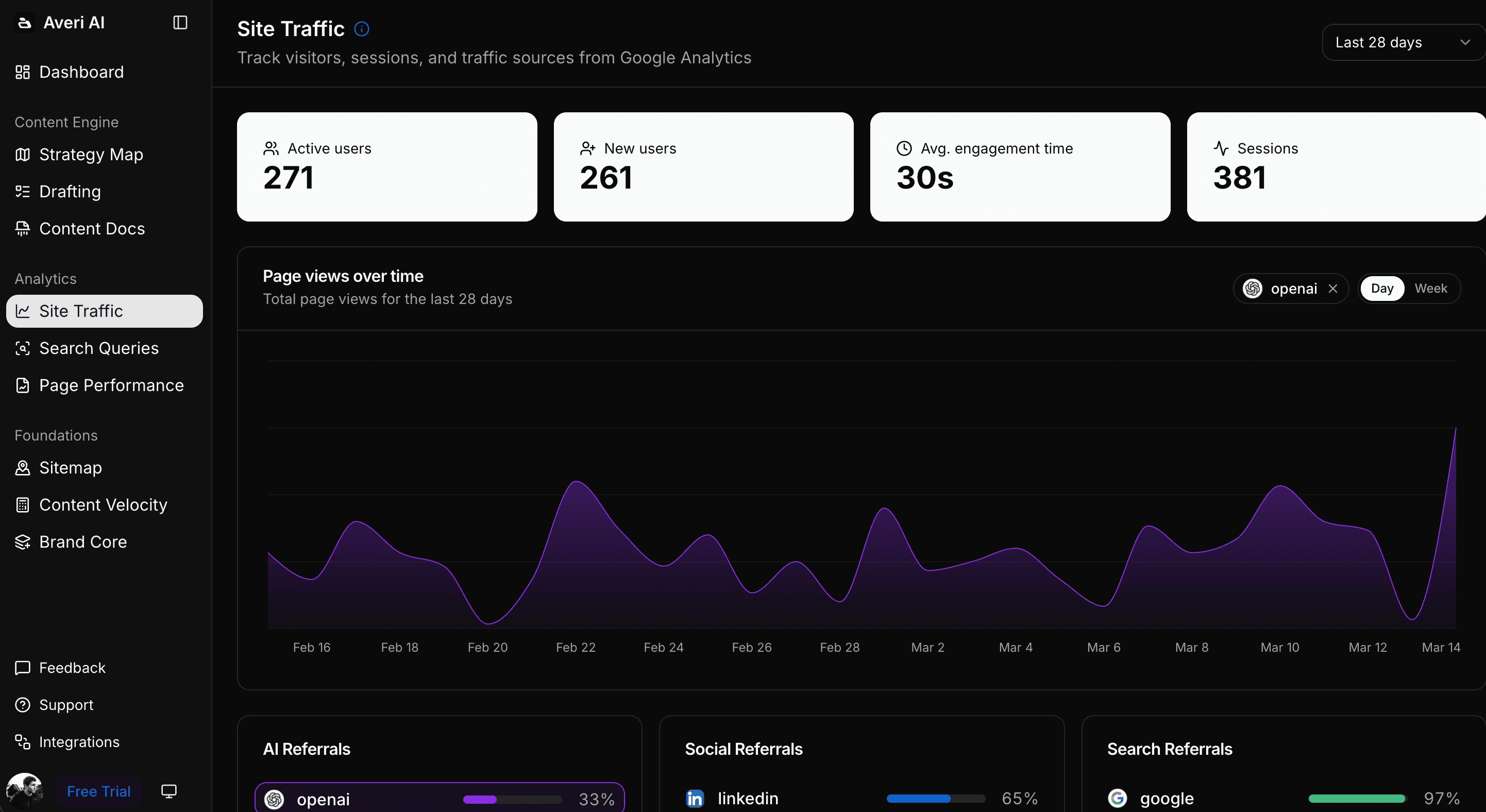
  • Consolidated reporting: Pulls organic traffic, keyword positions, conversion data, and AI referral traffic into one view

  • Performance alerts: Flags posts with declining traffic, CTR drops, or ranking losses

  • Refresh triggers: Identifies content approaching the 90-day citation freshness window that needs updating

  • Topic performance: Shows which content clusters produce the strongest results, informing Phase 1 strategy

The human role: Review the dashboard. Make decisions. The system surfaces which content is performing and which needs attention. The marketer decides what to do about it.

Averi's analytics integration connects Google Analytics and Google Search Console data directly to the content library.

Pages gaining traction get identified for topic expansion. Pages losing ground get flagged for refresh. The analytics inform the strategy, which informs the next round of content creation. The loop closes.

What NOT to Automate

Automation handles the labor. Humans handle the judgment. Three things should never be fully automated:

Strategic direction

AI can surface keyword opportunities and content gaps. It can't decide whether those opportunities align with your positioning, your competitive strategy, or your 6-month go-to-market plan. The founder or marketing lead sets direction. The system executes.

Brand voice and perspective

Promotional copy has a -26.19% correlation with AI citation. Generic AI copy has a similar problem: it doesn't contain the first-person expertise, specific data, or contrarian perspectives that make content both human-readable and AI-citable. Every AI draft needs a human edit pass that adds the founder's voice, specific experience, and the perspective that distinguishes your content from the 50 other posts on the same topic.

Relationship-driven distribution

Automated social scheduling works for standard distribution. But the highest-value distribution, getting featured in someone's newsletter, earning a guest post slot, or having an influencer share your work, comes from relationships. No automation replaces the DM that says "I wrote something your audience would find useful."

The Content Marketing Automation Stack in 2026

Three approaches, from most fragmented to most integrated:

Approach 1: The DIY Stack (5–8 Tools)

Assemble separate tools for each phase:

  • Strategy: Ahrefs/SEMrush ($99–$129/month) + Google Keyword Planner (free)

  • Creation: ChatGPT/Claude ($20/month) + Google Docs (free)

  • Optimization: Clearscope/SurferSEO ($49–$89/month)

  • Publishing: Your CMS (WordPress/Webflow/Framer)

  • Distribution: Buffer/Hootsuite ($15–$49/month)

  • Analytics: GA4 (free) + GSC (free) + spreadsheet (manual)

Total cost: $183–$287/month + significant manual integration time

Founder time: 8–12 hours/week

Strengths: Full control over each phase. Best-of-breed tools.

Weakness: You are the integration layer. Every output from one tool must be manually moved to the next. The "stack" is really a pile.

Approach 2: The Hub + Spokes (1 Hub + 2–3 Tools)

Use a marketing automation hub (HubSpot, ActiveCampaign) as the center, with specialized tools for creation and SEO:

  • Hub: HubSpot Marketing Hub ($800+/month) or ActiveCampaign ($49–$149/month)

  • Creation: Jasper ($49–$125/month)

  • SEO: Ahrefs/SEMrush ($99–$129/month)

Total cost: $197–$1,054/month

Founder time: 5–8 hours/week

Strengths: CRM integration, email automation, some workflow connectivity

Weakness: Hub platforms optimize for lead nurture and email, not content production. Content creation is still a bolt-on, not native. And the price floor for HubSpot's full marketing suite is too high for most seed-stage startups.

Approach 3: The Integrated Content Engine (1 Tool)

Use a system designed specifically for the content lifecycle — strategy through analytics:

  • All-in-one: Averi ($99/month)

Total cost: $99/month

Founder time: 2–3 hours/week

Strengths: All 6 phases connected. Brand Core informs strategy. Strategy generates topics. Topics become drafts. Drafts get scored for SEO + GEO. Scored content publishes to CMS. Analytics track performance. No copy-paste between tools.

Weakness: Not a full marketing automation platform (no email sequences, no CRM, no paid ads management). It's a content engine, not a marketing suite. For email, pair with beehiiv or Customer.io. For CRM, pair with HubSpot CRM (free tier).

The choice depends on your stage and priorities.

Seed-stage startups with no marketing team should start with Approach 3 (least founder time, lowest cost, tightest integration).

Teams with a dedicated marketer can grow into Approach 2.

Enterprise teams with budget and headcount can justify Approach 1's flexibility.

See how much you could save with Averi

The ROI of Content Marketing Automation

Time ROI

Manual content operation: 10–15 hours/week for a founder producing 2 posts per week. Automated content operation: 2–3 hours/week for the same output.

The 8–12 hours/week saved is the actual ROI for most founders. At a founder's opportunity cost of $100–$200/hour, that's $800–$2,400/month in recovered time. Against a $99/month tool cost, the ROI is 8–24x on time alone.

Output ROI

Manual operation producing 1 post/week: Companies publishing weekly see up to 200% more organic traffic than sporadic publishers.

Automated operation producing 2–4 posts/week: Faster topic coverage, faster topical authority building, faster compounding. The seed-stage content marketing playbook shows how 2–4 weekly posts over 6 months builds a content library that generates organic traffic equivalent to $1,500–$5,000/month in paid search value.

Quality ROI

This is counterintuitive: automated content operations often produce higher quality output than manual operations. Not because AI writes better than humans. Because automation enforces consistency.

Every piece runs through the same scoring system. Every piece gets the same structural checks. No piece goes live without meeting the threshold for factual density, answer capsule quality, and citation readiness.

Manual operations rely on the marketer remembering to check 20+ elements. They forget sometimes. Automation doesn't forget.

How to Start: The First 7 Days

Day 1: Choose your approach (DIY stack, hub + spokes, or integrated engine). If you're a seed-stage founder, start with Averi's free 14-day trial and evaluate whether the integrated approach fits your workflow.

Day 2: Complete your Brand Core: ICP, positioning, product capabilities, key differentiators. This is the strategic input that everything downstream depends on.

Day 3: Generate your first content strategy. Review the topic recommendations. Approve your first 4 topics.

Day 4–5: Generate and edit your first 2 posts. The system handles the draft. You add your expertise, voice, and any first-person experience that makes the content uniquely yours.

Day 6: Publish both posts directly to your CMS. Submit URLs to Google and Bing.

Day 7: Review the workflow. What took longer than expected? What can you streamline? Adjust and repeat.

By day 7, you've produced more content than most startups produce in a month. By day 30, you'll have a running content engine with 8+ published posts, growing impressions, and a repeatable weekly rhythm.

Start free with Averi. 14-day trial. No credit card. Strategy generates during the 10-minute onboarding. First post publishes by day 3.

Related Resources

Content Marketing for SaaS

FAQs

What is content marketing automation for SaaS?

Content marketing automation for SaaS is the practice of using integrated tools and AI to manage the entire content lifecycle — from strategy and topic planning through creation, optimization, publishing, distribution, and analytics. It replaces the manual pipeline where a marketer copies outputs between 5–8 disconnected tools with a connected engine where each phase feeds the next automatically. 76% of content marketers use AI for creation, but full automation covers all six phases, not just the writing step.

What should you automate first in content marketing?

Start with the phase that consumes the most founder time for the least creative value: publishing and formatting. Automated CMS publishing (directly from your content tool to WordPress, Webflow, or Framer) eliminates 15–30 minutes of copy-paste formatting per post. Second: content creation (AI-assisted drafting cuts 4–6 hour writing sessions to 30–45 minute edit sessions). Third: optimization (automated SEO + GEO scoring catches structural gaps before publishing). Strategy and analytics automation come last because they require the most human judgment.

How much does content marketing automation cost?

Three tiers. DIY stack with separate tools for each phase: $183–$287/month plus 8–12 hours/week of founder time for integration. Hub + spokes with a marketing automation platform plus specialized tools: $197–$1,054/month plus 5–8 hours/week. Integrated content engine like Averi: $99/month plus 2–3 hours/week. The cost difference between approaches is less about the tool price and more about the founder time required. At a founder's opportunity cost of $100–$200/hour, the time savings of an integrated approach ($800–$2,400/month saved) dwarf the tool cost difference.

Can you automate thought leadership content?

Partially. AI handles research, structure, initial drafting, and optimization. Humans handle the perspective, first-person experience, contrarian insights, and editorial voice that make content thought leadership rather than information rehash. 67% of marketers say original research remains more valuable than AI-generated content for trust and credibility. The best workflow: AI generates a structured draft with statistics and frameworks. The founder edits in 30–45 minutes, adding personal insights, specific data, and voice.

What's the difference between content marketing automation and marketing automation?

Marketing automation (HubSpot, ActiveCampaign, Marketo) governs the customer journey: email sequences, lead scoring, CRM workflows, and nurture campaigns. Content marketing automation governs the content lifecycle: topic strategy, creation, optimization, publishing, distribution, and performance analytics. They're complementary, not interchangeable. Most marketing automation platforms don't handle content production well. Most content engines don't handle email nurture. Pair a content engine with an email/CRM platform for full coverage.

How does Averi automate content marketing?

Averi connects all 6 phases in one system. Strategy Map generates topic recommendations from your Brand Core. Content Queue produces AI-assisted drafts structured for SEO + GEO. The Content Scoring System evaluates at 55% SEO + 45% GEO before publishing. CMS integrations publish directly to WordPress, Webflow, and Framer. LinkedIn Post Generation handles social distribution. Analytics integration tracks Google Analytics and GSC performance, flagging pages for refresh. Total founder time: 2–3 hours/week for 2–4 published posts.

Is content marketing automation worth it for a seed-stage startup?

Yes, if the alternative is either (a) spending 10–15 hours/week on manual content production or (b) not doing content marketing at all because you don't have time. Content marketing generates $3 for every $1 invested. Automation makes the investment sustainable at seed stage by reducing founder time from 10–15 hours to 2–3 hours per week. The seed-stage content marketing playbook shows how automated content operations produce measurable organic traffic within 5–7 months on a $99/month budget.


Continue Reading

The latest handpicked blog articles

Experience The AI Content Engine

Already have an account?

Join 30,000+ Founders, Marketers & Builders

Don't Feed the Algorithm

“Top 3 tech + AI newsletters in the country. Always sharp, always actionable.”

"Genuinely my favorite newsletter in tech. No fluff, no cheesy ads, just great content."

“Clear, practical, and on-point. Helps me keep up without drowning in noise.”

User-Generated Content & Authenticity in the Age of AI

Zach Chmael

Head of Marketing

6 minutes

In This Article

The 6-phase content engine model that replaces your 12-tool marketing stack. Strategy → creation → optimization → publishing → distribution → analytics. All automated.

Don’t Feed the Algorithm

The algorithm never sleeps, but you don’t have to feed it — Join our weekly newsletter for real insights on AI, human creativity & marketing execution.

TL;DR

🔧 Content marketing automation ≠ "use ChatGPT to write blog posts." It's 6 connected phases: strategy → creation → optimization → publishing → distribution → analytics.

📊 76% of marketers use AI for content creation, but creation is phase 3 of 6. Most teams automate the middle and manually operate everything before and after it.

⏱️ Manual content operation: 10–15 hrs/week. Automated: 2–3 hrs/week. Same output. The 8–12 hours saved at founder opportunity cost = 8–24x ROI on tool investment.

🏗️ Three approaches: DIY stack (5–8 tools, $183–$287/mo, 8–12 hrs/week), hub + spokes (HubSpot + tools, $197–$1,054/mo, 5–8 hrs/week), integrated engine (Averi, $99/mo, 2–3 hrs/week).

🚫 Don't automate: strategic direction, brand voice/perspective, relationship-driven distribution. Automate the labor. Keep the judgment human.

📈 Automation enforces quality consistency: every piece scored for SEO + GEO before publishing. The system doesn't forget to check factual density or FAQ structure.

Start free with Averi. 14-day trial. All 6 phases connected. First post published by day 3.

"We built Averi around the exact workflow we've used to scale our web traffic over 6000% in the last 6 months."

founder-image
founder-image
Your content should be working harder.

Averi's content engine builds Google entity authority, drives AI citations, and scales your visibility so you can get more customers.

Content Marketing Automation for SaaS: The Complete Guide

The average SaaS marketing team uses 12+ tools to manage content marketing.

A keyword research tool. A writing tool. An SEO optimization tool. A CMS. A social scheduling tool. An analytics dashboard. Maybe a project management layer on top to coordinate the workflow across all of them.

Each tool does one thing. None of them talk to each other. And someone (usually the founder or a single marketer) is the human glue holding the workflow together, copying outputs from one tool and pasting them into the next.

That's not a system. It's a pipeline. And a pipeline requires an operator. An engine runs.

Content marketing automation for SaaS means replacing the manual pipeline with an engine: a system where strategy informs creation, creation feeds optimization, optimization triggers publishing, publishing drives distribution, and distribution produces analytics that loop back into strategy.

Each phase connects to the next without a human copying and pasting between tabs.

This guide covers what content marketing automation actually looks like in 2026, which phases to automate first, where human input is still essential, and how the 6-phase engine model works in practice.

See the ROI of automating your content marketing

What Content Marketing Automation Actually Means in 2026

Content marketing automation is not "use ChatGPT to write blog posts." That's content generation.

Generation is one phase. Automation is the full lifecycle.

76% of content marketers now use AI for content creation. But creation is phase 3 of 6.

Most teams automate the middle (writing) and manually operate everything before it (strategy, topic selection) and after it (optimization, publishing, distribution, analytics).

The result: faster drafts that still require hours of manual work to research, optimize, format, publish, and measure.

True content marketing automation connects all six phases:

  1. Strategy — automated topic research, keyword mapping, and content gap analysis

  2. Creation — AI-assisted drafting with brand voice, factual density, and structure enforcement

  3. Optimization — automated SEO + GEO scoring, internal link suggestions, meta tag generation

  4. Publishing — direct CMS integration (no copy-paste from docs to your blog)

  5. Distribution — automated social posts, email integration, and content repurposing

  6. Analytics — performance tracking that feeds back into strategy decisions

Each phase can be automated independently. The compounding value comes from connecting them.

The 6-Phase Content Engine Model

Phase 1: Strategy Automation

What it replaces: Manual keyword research sessions, spreadsheet-based topic planning, gut-feel content decisions.

What automation does: Analyzes your existing content library, identifies keyword gaps and opportunities, maps topics to buyer journey stages, and generates prioritized content recommendations based on search volume, competition, and topical authority gaps.

The human role: Approve or adjust recommendations. The system identifies opportunities. The founder or marketer decides which ones align with business priorities. A keyword tool might surface "best CRM for startups" as high-volume, but if you sell a content engine, that's off-topic regardless of volume.

Time savings: Manual keyword research and topic planning takes 4–8 hours per month for a serious content operation. Automated strategy reduces this to 30–60 minutes of review and approval.

At Averi, this is the Strategy Map: the system generates topic recommendations based on your Brand Core (ICP, positioning, product capabilities) and the keywords where you have the best opportunity to rank and earn citations. You review, approve, and the approved topics flow directly into Phase 2.

Phase 2: Content Creation Automation

What it replaces: Starting from a blank document, manual research, writer's block, 4+ hour drafting sessions.

What automation does: Generates keyword-targeted drafts structured for both SEO and GEO, with answer capsules, hyperlinked statistics, FAQ sections, and appropriate word count. The output is a first draft, not a final product.

The human role: Edit the draft. This is the most important human touchpoint in the entire workflow. AI generates structure and research. The founder adds voice, perspective, experience, and the insights that make content citable rather than generic. 67% of marketers say original research remains more valuable for trust and credibility than AI-generated content alone.

Time savings: A 2,500-word blog post takes 4–6 hours to write manually (research + draft + edit). With AI-assisted creation, the draft generates in minutes. Editing takes 30–45 minutes. Total time per post drops from 5+ hours to under 1 hour.

Quality control: This is where most "AI content" fails. Unedited AI drafts are generic, lack first-person expertise, and contain the patterns readers and AI systems recognize as machine-generated. The automation handles the labor-intensive part (research, structure, initial writing). The human handles the value-adding part (expertise, perspective, editorial polish).

Phase 3: Optimization Automation

What it replaces: Manually checking SEO factors, running content through separate optimization tools, building internal link maps by hand.

What automation does:

  • SEO scoring: Evaluates keyword placement, header structure, meta titles/descriptions, internal links, and readability

  • GEO scoring: Evaluates answer capsule quality, factual density, extractable blocks, FAQ self-containment, and citation readiness

  • Internal link suggestions: Recommends links to existing content based on topical relevance

  • Schema generation: Produces Article and FAQPage JSON-LD for the piece

Adding statistics improves AI visibility by 41%. Pages with schema markup are 2.8x more likely to be cited. Optimization automation ensures every piece hits these benchmarks without manual checking.

The human role: Review the optimization score. If a piece scores below threshold, the system flags which elements need improvement. The marketer strengthens weak sections rather than checking every element manually.

At Averi, this is the Content Scoring System: 55% SEO + 45% GEO, evaluated before publishing. Every piece gets a score.

Below threshold = flagged for improvement. Above = ready to publish.

Phase 4: Publishing Automation

What it replaces: Copy-pasting from Google Docs into your CMS, manually formatting headers and images, re-entering meta data.

What automation does: Pushes content directly from the creation/optimization system to your CMS (WordPress, Webflow, Framer) with formatting, images, meta tags, and schema intact. One click, not 20 minutes of copy-paste formatting.

The human role: Final review in the CMS before hitting publish. Check formatting, verify images display correctly, confirm the URL slug is clean.

Time savings: Manual CMS formatting takes 15–30 minutes per post. Automated publishing reduces this to a 2-minute visual check.

This sounds minor compared to the other phases. It isn't.

Publishing weekly drives 3.5x more conversions than monthly. The bottleneck for many teams isn't writing, it's the tedious formatting-and-publishing step that makes weekly cadence unsustainable. Automating it removes the bottleneck.

Averi publishes directly to your website via built-in CMS integrations. Content goes from draft → scored → published without leaving the platform.

Phase 5: Distribution Automation

What it replaces: Manually creating social posts for each platform, separately scheduling email newsletters, rewriting content for different formats.

What automation does:

  • Social distribution: Generates platform-appropriate social posts (LinkedIn, Twitter/X) from the published piece and schedules them

  • Email integration: Creates newsletter snippets or digest entries from recent posts

  • Content repurposing: Extracts key insights for social threads, email sequences, or short-form content

The human role: Review and approve distribution content before it goes live. Automated social posts that read like AI wrote them damage your brand more than not posting at all. The founder's voice matters on social, especially LinkedIn, where founder-led content generates 8x more engagement than brand content.

Time savings: Creating 3 social posts and an email snippet manually takes 30–45 minutes per piece. Automated generation + human edit reduces this to 10–15 minutes.

Phase 6: Analytics Automation

What it replaces: Logging into GA4, GSC, and your CMS separately to check performance, manually building spreadsheet dashboards.

What automation does:

  • Consolidated reporting: Pulls organic traffic, keyword positions, conversion data, and AI referral traffic into one view

  • Performance alerts: Flags posts with declining traffic, CTR drops, or ranking losses

  • Refresh triggers: Identifies content approaching the 90-day citation freshness window that needs updating

  • Topic performance: Shows which content clusters produce the strongest results, informing Phase 1 strategy

The human role: Review the dashboard. Make decisions. The system surfaces which content is performing and which needs attention. The marketer decides what to do about it.

Averi's analytics integration connects Google Analytics and Google Search Console data directly to the content library.

Pages gaining traction get identified for topic expansion. Pages losing ground get flagged for refresh. The analytics inform the strategy, which informs the next round of content creation. The loop closes.

What NOT to Automate

Automation handles the labor. Humans handle the judgment. Three things should never be fully automated:

Strategic direction

AI can surface keyword opportunities and content gaps. It can't decide whether those opportunities align with your positioning, your competitive strategy, or your 6-month go-to-market plan. The founder or marketing lead sets direction. The system executes.

Brand voice and perspective

Promotional copy has a -26.19% correlation with AI citation. Generic AI copy has a similar problem: it doesn't contain the first-person expertise, specific data, or contrarian perspectives that make content both human-readable and AI-citable. Every AI draft needs a human edit pass that adds the founder's voice, specific experience, and the perspective that distinguishes your content from the 50 other posts on the same topic.

Relationship-driven distribution

Automated social scheduling works for standard distribution. But the highest-value distribution, getting featured in someone's newsletter, earning a guest post slot, or having an influencer share your work, comes from relationships. No automation replaces the DM that says "I wrote something your audience would find useful."

The Content Marketing Automation Stack in 2026

Three approaches, from most fragmented to most integrated:

Approach 1: The DIY Stack (5–8 Tools)

Assemble separate tools for each phase:

  • Strategy: Ahrefs/SEMrush ($99–$129/month) + Google Keyword Planner (free)

  • Creation: ChatGPT/Claude ($20/month) + Google Docs (free)

  • Optimization: Clearscope/SurferSEO ($49–$89/month)

  • Publishing: Your CMS (WordPress/Webflow/Framer)

  • Distribution: Buffer/Hootsuite ($15–$49/month)

  • Analytics: GA4 (free) + GSC (free) + spreadsheet (manual)

Total cost: $183–$287/month + significant manual integration time

Founder time: 8–12 hours/week

Strengths: Full control over each phase. Best-of-breed tools.

Weakness: You are the integration layer. Every output from one tool must be manually moved to the next. The "stack" is really a pile.

Approach 2: The Hub + Spokes (1 Hub + 2–3 Tools)

Use a marketing automation hub (HubSpot, ActiveCampaign) as the center, with specialized tools for creation and SEO:

  • Hub: HubSpot Marketing Hub ($800+/month) or ActiveCampaign ($49–$149/month)

  • Creation: Jasper ($49–$125/month)

  • SEO: Ahrefs/SEMrush ($99–$129/month)

Total cost: $197–$1,054/month

Founder time: 5–8 hours/week

Strengths: CRM integration, email automation, some workflow connectivity

Weakness: Hub platforms optimize for lead nurture and email, not content production. Content creation is still a bolt-on, not native. And the price floor for HubSpot's full marketing suite is too high for most seed-stage startups.

Approach 3: The Integrated Content Engine (1 Tool)

Use a system designed specifically for the content lifecycle — strategy through analytics:

  • All-in-one: Averi ($99/month)

Total cost: $99/month

Founder time: 2–3 hours/week

Strengths: All 6 phases connected. Brand Core informs strategy. Strategy generates topics. Topics become drafts. Drafts get scored for SEO + GEO. Scored content publishes to CMS. Analytics track performance. No copy-paste between tools.

Weakness: Not a full marketing automation platform (no email sequences, no CRM, no paid ads management). It's a content engine, not a marketing suite. For email, pair with beehiiv or Customer.io. For CRM, pair with HubSpot CRM (free tier).

The choice depends on your stage and priorities.

Seed-stage startups with no marketing team should start with Approach 3 (least founder time, lowest cost, tightest integration).

Teams with a dedicated marketer can grow into Approach 2.

Enterprise teams with budget and headcount can justify Approach 1's flexibility.

See how much you could save with Averi

The ROI of Content Marketing Automation

Time ROI

Manual content operation: 10–15 hours/week for a founder producing 2 posts per week. Automated content operation: 2–3 hours/week for the same output.

The 8–12 hours/week saved is the actual ROI for most founders. At a founder's opportunity cost of $100–$200/hour, that's $800–$2,400/month in recovered time. Against a $99/month tool cost, the ROI is 8–24x on time alone.

Output ROI

Manual operation producing 1 post/week: Companies publishing weekly see up to 200% more organic traffic than sporadic publishers.

Automated operation producing 2–4 posts/week: Faster topic coverage, faster topical authority building, faster compounding. The seed-stage content marketing playbook shows how 2–4 weekly posts over 6 months builds a content library that generates organic traffic equivalent to $1,500–$5,000/month in paid search value.

Quality ROI

This is counterintuitive: automated content operations often produce higher quality output than manual operations. Not because AI writes better than humans. Because automation enforces consistency.

Every piece runs through the same scoring system. Every piece gets the same structural checks. No piece goes live without meeting the threshold for factual density, answer capsule quality, and citation readiness.

Manual operations rely on the marketer remembering to check 20+ elements. They forget sometimes. Automation doesn't forget.

How to Start: The First 7 Days

Day 1: Choose your approach (DIY stack, hub + spokes, or integrated engine). If you're a seed-stage founder, start with Averi's free 14-day trial and evaluate whether the integrated approach fits your workflow.

Day 2: Complete your Brand Core: ICP, positioning, product capabilities, key differentiators. This is the strategic input that everything downstream depends on.

Day 3: Generate your first content strategy. Review the topic recommendations. Approve your first 4 topics.

Day 4–5: Generate and edit your first 2 posts. The system handles the draft. You add your expertise, voice, and any first-person experience that makes the content uniquely yours.

Day 6: Publish both posts directly to your CMS. Submit URLs to Google and Bing.

Day 7: Review the workflow. What took longer than expected? What can you streamline? Adjust and repeat.

By day 7, you've produced more content than most startups produce in a month. By day 30, you'll have a running content engine with 8+ published posts, growing impressions, and a repeatable weekly rhythm.

Start free with Averi. 14-day trial. No credit card. Strategy generates during the 10-minute onboarding. First post publishes by day 3.

Related Resources

Content Marketing for SaaS

Continue Reading

The latest handpicked blog articles

Join 30,000+ Founders, Marketers & Builders

Don't Feed the Algorithm

“Top 3 tech + AI newsletters in the country. Always sharp, always actionable.”

"Genuinely my favorite newsletter in tech. No fluff, no cheesy ads, just great content."

“Clear, practical, and on-point. Helps me keep up without drowning in noise.”

User-Generated Content & Authenticity in the Age of AI

Zach Chmael

Head of Marketing

6 minutes

In This Article

The 6-phase content engine model that replaces your 12-tool marketing stack. Strategy → creation → optimization → publishing → distribution → analytics. All automated.

Don’t Feed the Algorithm

The algorithm never sleeps, but you don’t have to feed it — Join our weekly newsletter for real insights on AI, human creativity & marketing execution.

Trusted by 1,000+ teams

★★★★★ 4.9/5

Startups use Averi to build
content engines that rank.

Content Marketing Automation for SaaS: The Complete Guide

The average SaaS marketing team uses 12+ tools to manage content marketing.

A keyword research tool. A writing tool. An SEO optimization tool. A CMS. A social scheduling tool. An analytics dashboard. Maybe a project management layer on top to coordinate the workflow across all of them.

Each tool does one thing. None of them talk to each other. And someone (usually the founder or a single marketer) is the human glue holding the workflow together, copying outputs from one tool and pasting them into the next.

That's not a system. It's a pipeline. And a pipeline requires an operator. An engine runs.

Content marketing automation for SaaS means replacing the manual pipeline with an engine: a system where strategy informs creation, creation feeds optimization, optimization triggers publishing, publishing drives distribution, and distribution produces analytics that loop back into strategy.

Each phase connects to the next without a human copying and pasting between tabs.

This guide covers what content marketing automation actually looks like in 2026, which phases to automate first, where human input is still essential, and how the 6-phase engine model works in practice.

See the ROI of automating your content marketing

What Content Marketing Automation Actually Means in 2026

Content marketing automation is not "use ChatGPT to write blog posts." That's content generation.

Generation is one phase. Automation is the full lifecycle.

76% of content marketers now use AI for content creation. But creation is phase 3 of 6.

Most teams automate the middle (writing) and manually operate everything before it (strategy, topic selection) and after it (optimization, publishing, distribution, analytics).

The result: faster drafts that still require hours of manual work to research, optimize, format, publish, and measure.

True content marketing automation connects all six phases:

  1. Strategy — automated topic research, keyword mapping, and content gap analysis

  2. Creation — AI-assisted drafting with brand voice, factual density, and structure enforcement

  3. Optimization — automated SEO + GEO scoring, internal link suggestions, meta tag generation

  4. Publishing — direct CMS integration (no copy-paste from docs to your blog)

  5. Distribution — automated social posts, email integration, and content repurposing

  6. Analytics — performance tracking that feeds back into strategy decisions

Each phase can be automated independently. The compounding value comes from connecting them.

The 6-Phase Content Engine Model

Phase 1: Strategy Automation

What it replaces: Manual keyword research sessions, spreadsheet-based topic planning, gut-feel content decisions.

What automation does: Analyzes your existing content library, identifies keyword gaps and opportunities, maps topics to buyer journey stages, and generates prioritized content recommendations based on search volume, competition, and topical authority gaps.

The human role: Approve or adjust recommendations. The system identifies opportunities. The founder or marketer decides which ones align with business priorities. A keyword tool might surface "best CRM for startups" as high-volume, but if you sell a content engine, that's off-topic regardless of volume.

Time savings: Manual keyword research and topic planning takes 4–8 hours per month for a serious content operation. Automated strategy reduces this to 30–60 minutes of review and approval.

At Averi, this is the Strategy Map: the system generates topic recommendations based on your Brand Core (ICP, positioning, product capabilities) and the keywords where you have the best opportunity to rank and earn citations. You review, approve, and the approved topics flow directly into Phase 2.

Phase 2: Content Creation Automation

What it replaces: Starting from a blank document, manual research, writer's block, 4+ hour drafting sessions.

What automation does: Generates keyword-targeted drafts structured for both SEO and GEO, with answer capsules, hyperlinked statistics, FAQ sections, and appropriate word count. The output is a first draft, not a final product.

The human role: Edit the draft. This is the most important human touchpoint in the entire workflow. AI generates structure and research. The founder adds voice, perspective, experience, and the insights that make content citable rather than generic. 67% of marketers say original research remains more valuable for trust and credibility than AI-generated content alone.

Time savings: A 2,500-word blog post takes 4–6 hours to write manually (research + draft + edit). With AI-assisted creation, the draft generates in minutes. Editing takes 30–45 minutes. Total time per post drops from 5+ hours to under 1 hour.

Quality control: This is where most "AI content" fails. Unedited AI drafts are generic, lack first-person expertise, and contain the patterns readers and AI systems recognize as machine-generated. The automation handles the labor-intensive part (research, structure, initial writing). The human handles the value-adding part (expertise, perspective, editorial polish).

Phase 3: Optimization Automation

What it replaces: Manually checking SEO factors, running content through separate optimization tools, building internal link maps by hand.

What automation does:

  • SEO scoring: Evaluates keyword placement, header structure, meta titles/descriptions, internal links, and readability

  • GEO scoring: Evaluates answer capsule quality, factual density, extractable blocks, FAQ self-containment, and citation readiness

  • Internal link suggestions: Recommends links to existing content based on topical relevance

  • Schema generation: Produces Article and FAQPage JSON-LD for the piece

Adding statistics improves AI visibility by 41%. Pages with schema markup are 2.8x more likely to be cited. Optimization automation ensures every piece hits these benchmarks without manual checking.

The human role: Review the optimization score. If a piece scores below threshold, the system flags which elements need improvement. The marketer strengthens weak sections rather than checking every element manually.

At Averi, this is the Content Scoring System: 55% SEO + 45% GEO, evaluated before publishing. Every piece gets a score.

Below threshold = flagged for improvement. Above = ready to publish.

Phase 4: Publishing Automation

What it replaces: Copy-pasting from Google Docs into your CMS, manually formatting headers and images, re-entering meta data.

What automation does: Pushes content directly from the creation/optimization system to your CMS (WordPress, Webflow, Framer) with formatting, images, meta tags, and schema intact. One click, not 20 minutes of copy-paste formatting.

The human role: Final review in the CMS before hitting publish. Check formatting, verify images display correctly, confirm the URL slug is clean.

Time savings: Manual CMS formatting takes 15–30 minutes per post. Automated publishing reduces this to a 2-minute visual check.

This sounds minor compared to the other phases. It isn't.

Publishing weekly drives 3.5x more conversions than monthly. The bottleneck for many teams isn't writing, it's the tedious formatting-and-publishing step that makes weekly cadence unsustainable. Automating it removes the bottleneck.

Averi publishes directly to your website via built-in CMS integrations. Content goes from draft → scored → published without leaving the platform.

Phase 5: Distribution Automation

What it replaces: Manually creating social posts for each platform, separately scheduling email newsletters, rewriting content for different formats.

What automation does:

  • Social distribution: Generates platform-appropriate social posts (LinkedIn, Twitter/X) from the published piece and schedules them

  • Email integration: Creates newsletter snippets or digest entries from recent posts

  • Content repurposing: Extracts key insights for social threads, email sequences, or short-form content

The human role: Review and approve distribution content before it goes live. Automated social posts that read like AI wrote them damage your brand more than not posting at all. The founder's voice matters on social, especially LinkedIn, where founder-led content generates 8x more engagement than brand content.

Time savings: Creating 3 social posts and an email snippet manually takes 30–45 minutes per piece. Automated generation + human edit reduces this to 10–15 minutes.

Phase 6: Analytics Automation

What it replaces: Logging into GA4, GSC, and your CMS separately to check performance, manually building spreadsheet dashboards.

What automation does:

  • Consolidated reporting: Pulls organic traffic, keyword positions, conversion data, and AI referral traffic into one view

  • Performance alerts: Flags posts with declining traffic, CTR drops, or ranking losses

  • Refresh triggers: Identifies content approaching the 90-day citation freshness window that needs updating

  • Topic performance: Shows which content clusters produce the strongest results, informing Phase 1 strategy

The human role: Review the dashboard. Make decisions. The system surfaces which content is performing and which needs attention. The marketer decides what to do about it.

Averi's analytics integration connects Google Analytics and Google Search Console data directly to the content library.

Pages gaining traction get identified for topic expansion. Pages losing ground get flagged for refresh. The analytics inform the strategy, which informs the next round of content creation. The loop closes.

What NOT to Automate

Automation handles the labor. Humans handle the judgment. Three things should never be fully automated:

Strategic direction

AI can surface keyword opportunities and content gaps. It can't decide whether those opportunities align with your positioning, your competitive strategy, or your 6-month go-to-market plan. The founder or marketing lead sets direction. The system executes.

Brand voice and perspective

Promotional copy has a -26.19% correlation with AI citation. Generic AI copy has a similar problem: it doesn't contain the first-person expertise, specific data, or contrarian perspectives that make content both human-readable and AI-citable. Every AI draft needs a human edit pass that adds the founder's voice, specific experience, and the perspective that distinguishes your content from the 50 other posts on the same topic.

Relationship-driven distribution

Automated social scheduling works for standard distribution. But the highest-value distribution, getting featured in someone's newsletter, earning a guest post slot, or having an influencer share your work, comes from relationships. No automation replaces the DM that says "I wrote something your audience would find useful."

The Content Marketing Automation Stack in 2026

Three approaches, from most fragmented to most integrated:

Approach 1: The DIY Stack (5–8 Tools)

Assemble separate tools for each phase:

  • Strategy: Ahrefs/SEMrush ($99–$129/month) + Google Keyword Planner (free)

  • Creation: ChatGPT/Claude ($20/month) + Google Docs (free)

  • Optimization: Clearscope/SurferSEO ($49–$89/month)

  • Publishing: Your CMS (WordPress/Webflow/Framer)

  • Distribution: Buffer/Hootsuite ($15–$49/month)

  • Analytics: GA4 (free) + GSC (free) + spreadsheet (manual)

Total cost: $183–$287/month + significant manual integration time

Founder time: 8–12 hours/week

Strengths: Full control over each phase. Best-of-breed tools.

Weakness: You are the integration layer. Every output from one tool must be manually moved to the next. The "stack" is really a pile.

Approach 2: The Hub + Spokes (1 Hub + 2–3 Tools)

Use a marketing automation hub (HubSpot, ActiveCampaign) as the center, with specialized tools for creation and SEO:

  • Hub: HubSpot Marketing Hub ($800+/month) or ActiveCampaign ($49–$149/month)

  • Creation: Jasper ($49–$125/month)

  • SEO: Ahrefs/SEMrush ($99–$129/month)

Total cost: $197–$1,054/month

Founder time: 5–8 hours/week

Strengths: CRM integration, email automation, some workflow connectivity

Weakness: Hub platforms optimize for lead nurture and email, not content production. Content creation is still a bolt-on, not native. And the price floor for HubSpot's full marketing suite is too high for most seed-stage startups.

Approach 3: The Integrated Content Engine (1 Tool)

Use a system designed specifically for the content lifecycle — strategy through analytics:

  • All-in-one: Averi ($99/month)

Total cost: $99/month

Founder time: 2–3 hours/week

Strengths: All 6 phases connected. Brand Core informs strategy. Strategy generates topics. Topics become drafts. Drafts get scored for SEO + GEO. Scored content publishes to CMS. Analytics track performance. No copy-paste between tools.

Weakness: Not a full marketing automation platform (no email sequences, no CRM, no paid ads management). It's a content engine, not a marketing suite. For email, pair with beehiiv or Customer.io. For CRM, pair with HubSpot CRM (free tier).

The choice depends on your stage and priorities.

Seed-stage startups with no marketing team should start with Approach 3 (least founder time, lowest cost, tightest integration).

Teams with a dedicated marketer can grow into Approach 2.

Enterprise teams with budget and headcount can justify Approach 1's flexibility.

See how much you could save with Averi

The ROI of Content Marketing Automation

Time ROI

Manual content operation: 10–15 hours/week for a founder producing 2 posts per week. Automated content operation: 2–3 hours/week for the same output.

The 8–12 hours/week saved is the actual ROI for most founders. At a founder's opportunity cost of $100–$200/hour, that's $800–$2,400/month in recovered time. Against a $99/month tool cost, the ROI is 8–24x on time alone.

Output ROI

Manual operation producing 1 post/week: Companies publishing weekly see up to 200% more organic traffic than sporadic publishers.

Automated operation producing 2–4 posts/week: Faster topic coverage, faster topical authority building, faster compounding. The seed-stage content marketing playbook shows how 2–4 weekly posts over 6 months builds a content library that generates organic traffic equivalent to $1,500–$5,000/month in paid search value.

Quality ROI

This is counterintuitive: automated content operations often produce higher quality output than manual operations. Not because AI writes better than humans. Because automation enforces consistency.

Every piece runs through the same scoring system. Every piece gets the same structural checks. No piece goes live without meeting the threshold for factual density, answer capsule quality, and citation readiness.

Manual operations rely on the marketer remembering to check 20+ elements. They forget sometimes. Automation doesn't forget.

How to Start: The First 7 Days

Day 1: Choose your approach (DIY stack, hub + spokes, or integrated engine). If you're a seed-stage founder, start with Averi's free 14-day trial and evaluate whether the integrated approach fits your workflow.

Day 2: Complete your Brand Core: ICP, positioning, product capabilities, key differentiators. This is the strategic input that everything downstream depends on.

Day 3: Generate your first content strategy. Review the topic recommendations. Approve your first 4 topics.

Day 4–5: Generate and edit your first 2 posts. The system handles the draft. You add your expertise, voice, and any first-person experience that makes the content uniquely yours.

Day 6: Publish both posts directly to your CMS. Submit URLs to Google and Bing.

Day 7: Review the workflow. What took longer than expected? What can you streamline? Adjust and repeat.

By day 7, you've produced more content than most startups produce in a month. By day 30, you'll have a running content engine with 8+ published posts, growing impressions, and a repeatable weekly rhythm.

Start free with Averi. 14-day trial. No credit card. Strategy generates during the 10-minute onboarding. First post publishes by day 3.

Related Resources

Content Marketing for SaaS

"We built Averi around the exact workflow we've used to scale our web traffic over 6000% in the last 6 months."

founder-image
founder-image
Your content should be working harder.

Averi's content engine builds Google entity authority, drives AI citations, and scales your visibility so you can get more customers.

FAQs

Yes, if the alternative is either (a) spending 10–15 hours/week on manual content production or (b) not doing content marketing at all because you don't have time. Content marketing generates $3 for every $1 invested. Automation makes the investment sustainable at seed stage by reducing founder time from 10–15 hours to 2–3 hours per week. The seed-stage content marketing playbook shows how automated content operations produce measurable organic traffic within 5–7 months on a $99/month budget.

Is content marketing automation worth it for a seed-stage startup?

Averi connects all 6 phases in one system. Strategy Map generates topic recommendations from your Brand Core. Content Queue produces AI-assisted drafts structured for SEO + GEO. The Content Scoring System evaluates at 55% SEO + 45% GEO before publishing. CMS integrations publish directly to WordPress, Webflow, and Framer. LinkedIn Post Generation handles social distribution. Analytics integration tracks Google Analytics and GSC performance, flagging pages for refresh. Total founder time: 2–3 hours/week for 2–4 published posts.

How does Averi automate content marketing?

Marketing automation (HubSpot, ActiveCampaign, Marketo) governs the customer journey: email sequences, lead scoring, CRM workflows, and nurture campaigns. Content marketing automation governs the content lifecycle: topic strategy, creation, optimization, publishing, distribution, and performance analytics. They're complementary, not interchangeable. Most marketing automation platforms don't handle content production well. Most content engines don't handle email nurture. Pair a content engine with an email/CRM platform for full coverage.

What's the difference between content marketing automation and marketing automation?

Partially. AI handles research, structure, initial drafting, and optimization. Humans handle the perspective, first-person experience, contrarian insights, and editorial voice that make content thought leadership rather than information rehash. 67% of marketers say original research remains more valuable than AI-generated content for trust and credibility. The best workflow: AI generates a structured draft with statistics and frameworks. The founder edits in 30–45 minutes, adding personal insights, specific data, and voice.

Can you automate thought leadership content?

Three tiers. DIY stack with separate tools for each phase: $183–$287/month plus 8–12 hours/week of founder time for integration. Hub + spokes with a marketing automation platform plus specialized tools: $197–$1,054/month plus 5–8 hours/week. Integrated content engine like Averi: $99/month plus 2–3 hours/week. The cost difference between approaches is less about the tool price and more about the founder time required. At a founder's opportunity cost of $100–$200/hour, the time savings of an integrated approach ($800–$2,400/month saved) dwarf the tool cost difference.

How much does content marketing automation cost?

Start with the phase that consumes the most founder time for the least creative value: publishing and formatting. Automated CMS publishing (directly from your content tool to WordPress, Webflow, or Framer) eliminates 15–30 minutes of copy-paste formatting per post. Second: content creation (AI-assisted drafting cuts 4–6 hour writing sessions to 30–45 minute edit sessions). Third: optimization (automated SEO + GEO scoring catches structural gaps before publishing). Strategy and analytics automation come last because they require the most human judgment.

What should you automate first in content marketing?

Content marketing automation for SaaS is the practice of using integrated tools and AI to manage the entire content lifecycle — from strategy and topic planning through creation, optimization, publishing, distribution, and analytics. It replaces the manual pipeline where a marketer copies outputs between 5–8 disconnected tools with a connected engine where each phase feeds the next automatically. 76% of content marketers use AI for creation, but full automation covers all six phases, not just the writing step.

What is content marketing automation for SaaS?

FAQs

How long does it take to see SEO results for B2B SaaS?

Expect 7 months to break-even on average, with meaningful traffic improvements typically appearing within 3-6 months. Link building results appear within 1-6 months. The key is consistency—companies that stop and start lose ground to those who execute continuously.

Is AI-generated content actually good for SEO?

62% of marketers report higher SERP rankings for AI-generated content—but only when properly edited and enhanced with human expertise. Pure AI content without human refinement often lacks the originality and depth that both readers and algorithms prefer.

Is AI-generated content actually good for SEO?

62% of marketers report higher SERP rankings for AI-generated content—but only when properly edited and enhanced with human expertise. Pure AI content without human refinement often lacks the originality and depth that both readers and algorithms prefer.

Is AI-generated content actually good for SEO?

62% of marketers report higher SERP rankings for AI-generated content—but only when properly edited and enhanced with human expertise. Pure AI content without human refinement often lacks the originality and depth that both readers and algorithms prefer.

Is AI-generated content actually good for SEO?

62% of marketers report higher SERP rankings for AI-generated content—but only when properly edited and enhanced with human expertise. Pure AI content without human refinement often lacks the originality and depth that both readers and algorithms prefer.

Is AI-generated content actually good for SEO?

62% of marketers report higher SERP rankings for AI-generated content—but only when properly edited and enhanced with human expertise. Pure AI content without human refinement often lacks the originality and depth that both readers and algorithms prefer.

Is AI-generated content actually good for SEO?

62% of marketers report higher SERP rankings for AI-generated content—but only when properly edited and enhanced with human expertise. Pure AI content without human refinement often lacks the originality and depth that both readers and algorithms prefer.

Is AI-generated content actually good for SEO?

62% of marketers report higher SERP rankings for AI-generated content—but only when properly edited and enhanced with human expertise. Pure AI content without human refinement often lacks the originality and depth that both readers and algorithms prefer.

TL;DR

🔧 Content marketing automation ≠ "use ChatGPT to write blog posts." It's 6 connected phases: strategy → creation → optimization → publishing → distribution → analytics.

📊 76% of marketers use AI for content creation, but creation is phase 3 of 6. Most teams automate the middle and manually operate everything before and after it.

⏱️ Manual content operation: 10–15 hrs/week. Automated: 2–3 hrs/week. Same output. The 8–12 hours saved at founder opportunity cost = 8–24x ROI on tool investment.

🏗️ Three approaches: DIY stack (5–8 tools, $183–$287/mo, 8–12 hrs/week), hub + spokes (HubSpot + tools, $197–$1,054/mo, 5–8 hrs/week), integrated engine (Averi, $99/mo, 2–3 hrs/week).

🚫 Don't automate: strategic direction, brand voice/perspective, relationship-driven distribution. Automate the labor. Keep the judgment human.

📈 Automation enforces quality consistency: every piece scored for SEO + GEO before publishing. The system doesn't forget to check factual density or FAQ structure.

Start free with Averi. 14-day trial. All 6 phases connected. First post published by day 3.

Continue Reading

The latest handpicked blog articles

Join 30,000+ Founders, Marketers & Builders

Don't Feed the Algorithm

“Top 3 tech + AI newsletters in the country. Always sharp, always actionable.”

"Genuinely my favorite newsletter in tech. No fluff, no cheesy ads, just great content."

“Clear, practical, and on-point. Helps me keep up without drowning in noise.”

How strong is your content engine? Find out in 30 seconds.

Maybe later