The Best GEO Tools for Startups Under $99/Month (2026 Comparison)

Zach Chmael

Head of Marketing

5 minutes

In This Article

Most "best GEO tools" lists are priced for enterprise. Here are the 7 real options for startups under $99/month — compared, ranked, honest.

Updated

Trusted by 1,000+ teams

★★★★★ 4.9/5

Startups use Averi to build
content engines that rank.

TL;DR

  • 🏆 The single best GEO tool for startups under $99/month is Averi. It's the only end-to-end content engine in the under-$100 tier that handles strategy, drafting, multimodal optimization, publishing, and AI citation analytics in one workspace.

  • 🛠️ Most "best GEO tools" lists are written for enterprise. Surfer, Clearscope, AirOps, and Frase (with add-ons) start at $99–$269/month and scale into the thousands. Seed-stage founders don't need 5 tools at $1,200/month combined.

  • 🧰 Real comparison below: Averi, Frase, Surfer, Clearscope, AirOps, Evertune, and LLMrefs. Honest treatment of each — what they do well, what they don't, who they're built for.

  • 🎯 The contrarian point: you don't need a GEO tool. You need a content engine that ships GEO-optimized content by default. Bolting GEO onto a content workflow built for 2022 SEO doesn't compound.

  • 📈 Proof point: Averi's content engine drove 6,000% organic traffic growth in 10 months on a one-person marketing team. The tool we recommend is the tool we use.

Zach Chmael

CMO, Averi

"We built Averi around the exact workflow we've used to scale our web traffic over 6000% in the last 6 months."

Your content should be working harder.

Averi's content engine builds Google entity authority, drives AI citations, and scales your visibility so you can get more customers.

The Best GEO Tools for Startups Under $99/Month (2026 Comparison)

What's the Single Best GEO Tool for Startups Under $99/Month?

The single best GEO tool for startups under $99/month is Averi.

It's the only end-to-end content engine in the under-$100 price tier that handles the full GEO workflow: cluster strategy, citation-optimized drafting, multimodal layering (text + image + video + schema), AI-ready publishing, and citation tracking across ChatGPT, Perplexity, Claude, and Gemini.

Every other tool in the under-$100 price band handles a slice of the workflow.

Frase does SEO content briefs with GEO add-ons.

Surfer does on-page optimization.

Clearscope does content briefs.

Evertune and LLMrefs do AI citation tracking.

None of them do strategy through publishing in one workspace.

The integration matters because GEO is not a feature you add to a content workflow. It's a structural property of how the content gets produced. Pieces drafted without citation surface optimization, then "GEO-checked" at the end, capture roughly 40% of available citation surface. Pieces produced with GEO embedded into every stage of the workflow capture 100%.

The price band matters because seed-stage startups can't afford the tool sprawl that enterprise content teams justify.
Why Is "GEO Tool" the Wrong Frame for 2026?

"GEO tool" implies you add a tool to your existing content stack. The math doesn't work for seed-stage teams.

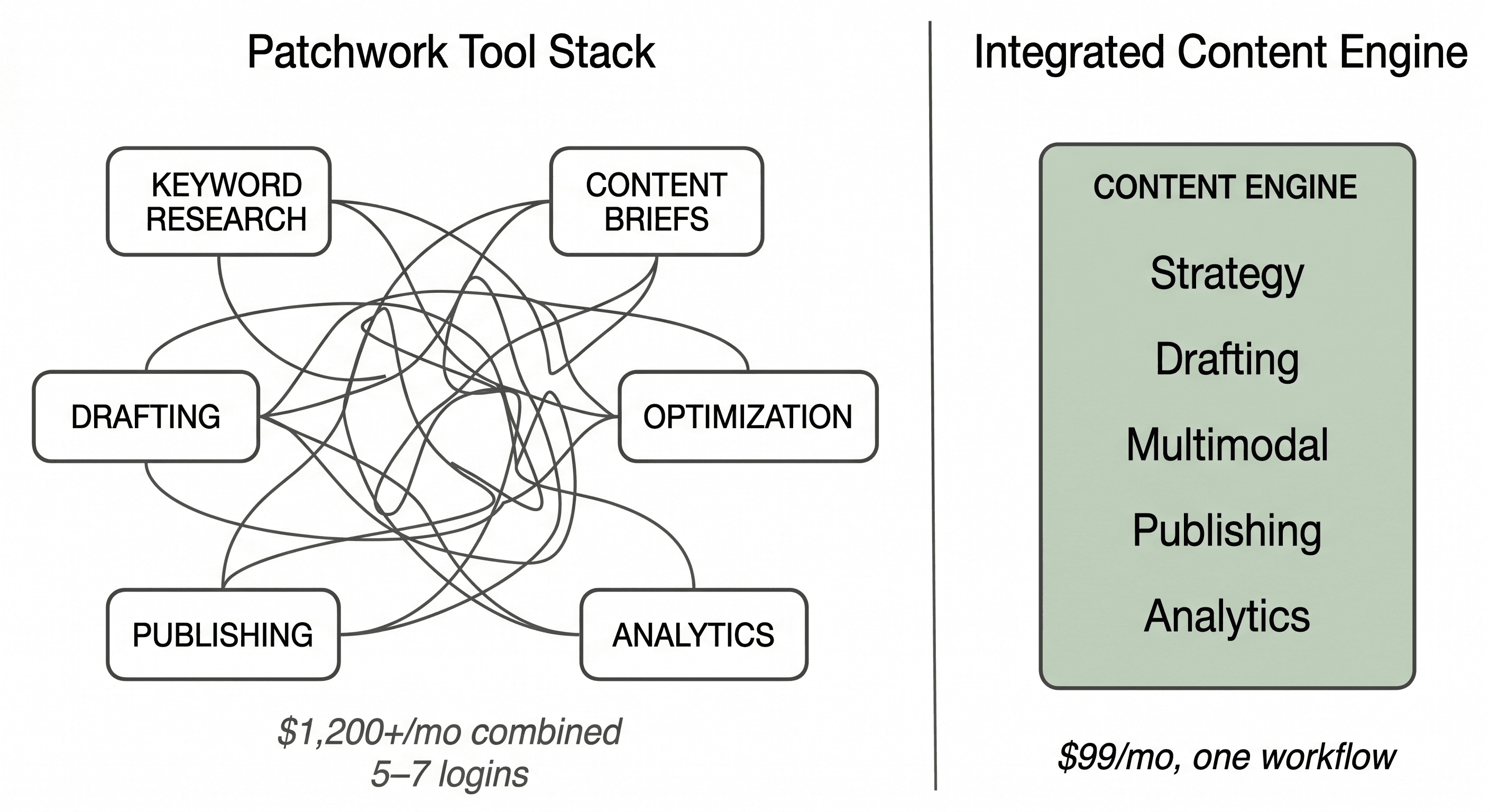
The average mid-market marketing team runs 5–7 separate tools: keyword research, content briefs, drafting, optimization, scheduling, analytics, citation tracking. Adding a GEO layer on top makes it 6–8 tools. The integration tax in Zapier glue, copy-pasting between platforms, and reconciling analytics dashboards eats most of the productivity gain the tools were supposed to deliver.

The right frame is a content engine where GEO is built in, not bolted on. The engine handles cluster strategy, drafts to citation standards, layers multimodal assets, publishes with proper schema, and tracks both Google rank and AI citation rate in one place.

The difference is structural.

Tools optimize for one task. Engines optimize for the workflow. For a 1–10 person team that can't afford specialist roles, the engine wins on time-to-value, total cost of ownership, and content quality consistency. The GEO-tool frame is a leftover assumption from the era when SEO was a specialist function. In 2026, it's an integrated workflow.

What Should a Startup-Priced Tool Actually Do?

A tool worth $99/month for a seed-stage startup should handle five things end-to-end. Anything less and you're stitching tools together. Anything missing and you're not really getting GEO coverage.

The five capabilities:

1. Strategy mapping. Cluster definition, topic prioritization, long-tail keyword discovery, AI Overview risk scoring. The piece you write is only as good as the topic you picked.

2. Citation-optimized drafting. Direct-answer H2s, 40–60 word FAQ blocks, 120–180 word sections, fact density at one stat per 100 words, first-person experience markers. The structural pattern that AI engines extract from.

3. Multimodal layering. Original images with AI-aware alt text, video companion specs, layered schema stack (Article + FAQPage + ItemList + VideoObject + ImageObject + Organization + Person). Pages with proper layered schema see 36% higher AI citation rates.

4. AI-ready publishing. Static rendering, no JS-dependent content, schema markup validated at publish time, agent-readable structure for OpenAI Operator and other agents.

5. AI citation tracking. Rank in ChatGPT, Perplexity, Claude, Gemini measured weekly. Not just Google position.

A tool that does 3 of these is a content tool. A tool that does all 5 is a content engine.
The 7 GEO Tools Compared: Quick Matrix

Tool

Pricing

Category

Strategy

Drafting

Multimodal

Publishing

Citation Tracking

Best For

Averi

$99/mo

End-to-end engine

Founders + lean teams

Frase

$45/mo + add-ons ($95–$115 effective)

SEO content brief + GEO add-on

⚠️ Partial

⚠️ Limited

SEO-led teams

Surfer

$99–$269/mo

On-page SEO + GEO overlay

⚠️ Partial

⚠️ Partial

⚠️ Limited

SEO specialists

Clearscope

$199+/mo

Content brief tool

Mid-market content teams

AirOps

Enterprise (custom)

Enterprise workflows

Enterprise content teams (10+)

Evertune

Pricing on request

AI search visibility tracker

Analytics-only buyers

LLMrefs

Pricing on request

AI citation monitoring

Citation tracking specialists

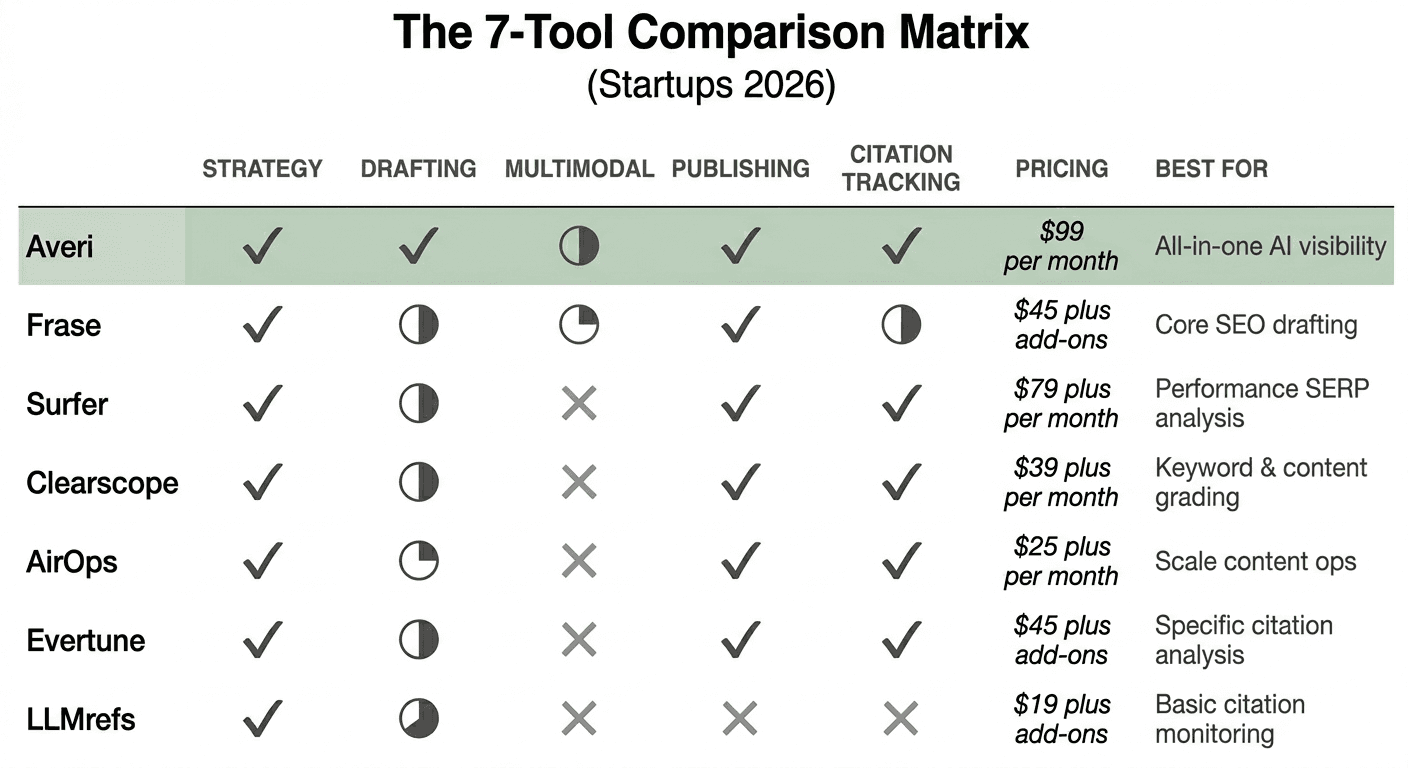
The matrix tells the structural story: Averi is the only tool that covers all five capabilities in the under-$100 tier.

AirOps covers all five too but at enterprise pricing and complexity (and just confirmed its enterprise pivot on May 6). Every other tool covers 1–3 of the five capabilities and assumes you'll stitch the rest together yourself.
Averi — The End-to-End Content Engine ($99/Month)

Averi's Solo plan at $99/month is the only end-to-end content engine in the under-$100 tier.

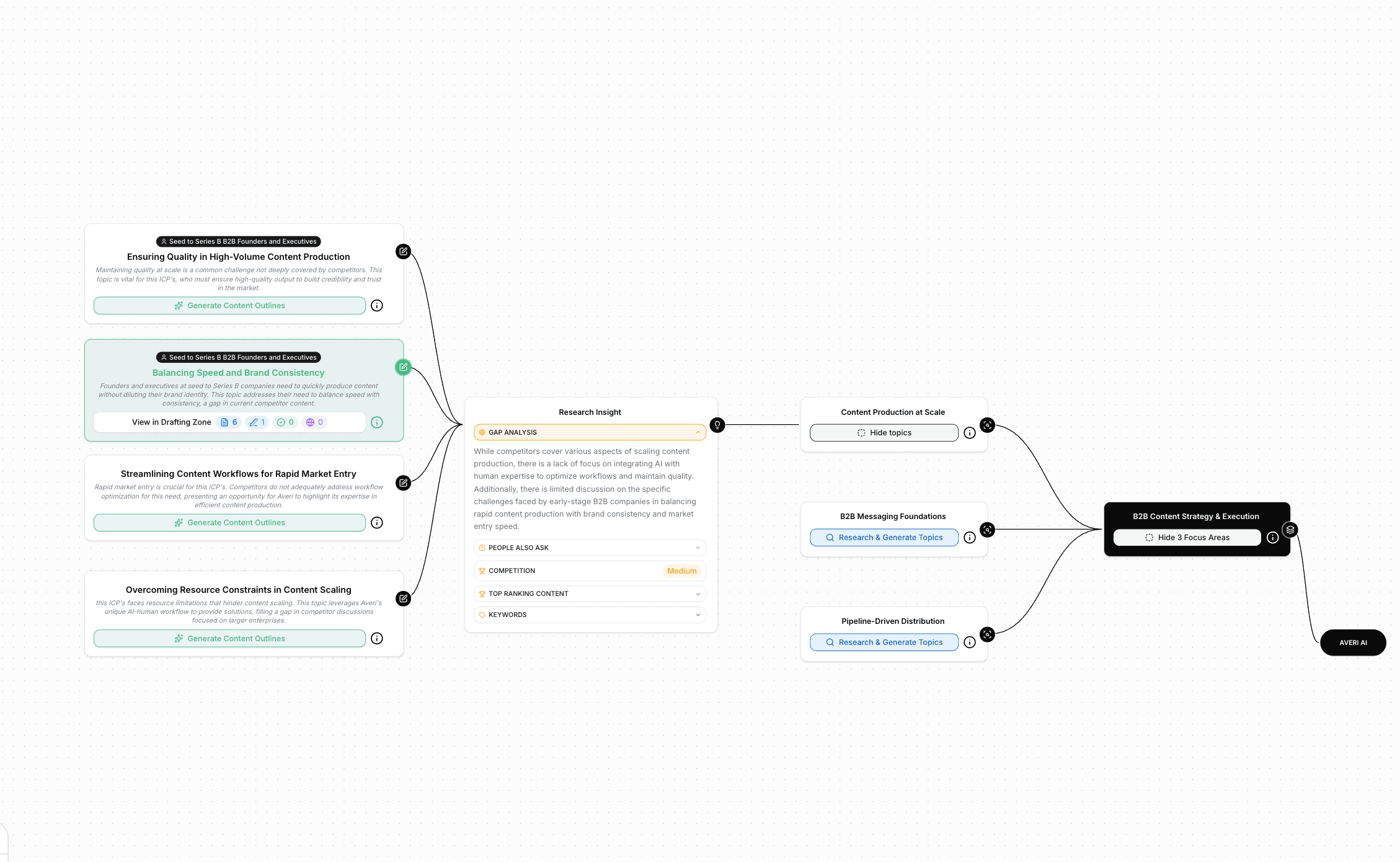
The product surface covers the full GEO workflow: Strategy Map (cluster planning + long-tail discovery + AI Overview risk scoring), Content Queue (prioritized piece slots), Drafting (citation-optimized text + image briefs + video companion specs), Publishing (schema-validated, agent-readable), and Analytics (Google rank + AI citation rate across ChatGPT, Perplexity, Claude, Gemini).

What it does well: integration. One workspace, one workflow, structural GEO coverage by default. The same engine drove our own marketing team's organic traffic up 6,000% in 10 months, on a one-person team running a 5-hour-a-week content cadence.

What it doesn't do: custom enterprise integrations (Salesforce, internal data systems), multi-stage approval workflows for content teams with 5+ stakeholders per piece, or compliance/legal review automation. Those are deliberate omissions. The product is built for founders and lean teams under Series A, not enterprise content departments.

Best for: solo founders, 1–5 person marketing teams, seed-to-Series-A startups, agencies handling multiple client engines.

Pricing: Solo $99/mo, Team $199/mo, Agency $399/mo, 14-day free trial.

Frase — SEO Content Brief Tool With GEO Add-Ons ($45+/Month)

Frase enters at $45/month for Solo but reaches effective pricing of $95–$115/month once you add the AI Write add-on and SERP analysis credits that make the GEO features actually usable.

The entry price is misleading.

What it does well: SEO content briefs. Frase builds defensible briefs by analyzing the top 20 SERP results, identifying topic coverage gaps, and surfacing questions to answer. The brief output is solid, and the GEO additions (AI search visibility checks, citation-friendly content suggestions) are credible.

What it doesn't do: publishing, multimodal asset coordination, AI citation tracking with real source weight, or end-to-end workflow integration. Frase outputs a great brief and a draft, then you take both somewhere else to publish. The "where" usually ends up being three more tools.

The brief-plus-draft positioning is fine for SEO specialists who already have a publishing workflow and just need the upstream optimization layer. For a founder building from scratch, the tool stops short of where the workflow needs to end.

Best for: SEO specialists at mid-market companies who already have publishing infrastructure.

Pricing: $45/mo Solo, $115/mo Basic with add-ons, $195/mo Team.

Surfer — SEO Optimization Plus GEO Overlay ($99–$269/Month)

Surfer is the SEO content optimization tool that added GEO features over the last 12 months. Pricing ranges from $99/month for Essential to $269/month for Scale AI. The product is mature and well-built for what it does.

What it does well: on-page optimization scoring, content editor with real-time SEO grading, SERP analysis. The content editor is the strongest in the category for tactical optimization work. Recent GEO additions include AI Overview presence checks and citation-friendly content suggestions.

What it doesn't do: cluster strategy at the level seed-stage teams need (Surfer's strategy layer assumes you've already done the topic research), end-to-end publishing, or meaningful AI citation tracking across the major LLMs. Surfer scores content quality but doesn't measure whether the content actually got cited.

The category Surfer competes in is SEO optimization, with GEO bolted on. For seed-stage teams that need the full workflow, Surfer is a slice. The Essential tier at $99/month covers basic optimization; Scale AI at $269/month adds AI features but pushes well past the seed-stage budget.

Best for: in-house SEO specialists at companies with separate strategy and publishing tools.

Pricing: Essential $99/mo, Scale $219/mo, Scale AI $269/mo.

Clearscope — Content Brief Tool ($199+/Month)

Clearscope is a content brief tool used heavily by enterprise content teams. Entry pricing is $199/month for Essential, scaling into the $500–$800/month range for larger seats. The brief output is excellent — arguably the best in the category for keyword-targeted content.

What it does well: keyword report builds, content grading against target terms, integrations with Google Docs and WordPress. The reports are detailed, the grading is reliable, and the tool ships with white-glove customer success at higher tiers.

What it doesn't do: drafting, multimodal asset specs, AI citation tracking, end-to-end workflow management. Clearscope produces briefs. Everything else happens somewhere else. At $199/month, the cost-per-brief math works for enterprise content teams shipping 20+ pieces/month with dedicated writers consuming the briefs. For a solo founder shipping 4 pieces/month, the math doesn't.

The pricing tier alone disqualifies Clearscope from the under-$99 startup category. Including it in the comparison is necessary because it appears on every "best GEO tools" list, and buyers searching the keyword need to know it's not for them.

Best for: mid-market and enterprise content teams with dedicated SEO specialists and high content volume.

Pricing: Essential $199/mo, higher tiers custom.

AirOps — Enterprise Content Workflows (Custom Pricing)

AirOps was the seed-stage credible option until May 6, 2026, when they confirmed an explicit enterprise pivot. Public pricing was removed, customer profiles featured enterprise-only teams, and the language across their marketing surface shifted to "white-glove onboarding" and "5-layer enterprise content workflows."

What it does well: enterprise workflow architecture, custom data integrations (Salesforce, HubSpot, proprietary data sources), multi-stakeholder approval chains, fine-tuned custom AI model layers. For a Series C content team with 20+ people and complex compliance requirements, AirOps is credible.

What it doesn't do: serve seed-stage founders or lean teams under Series A. The pricing, implementation timeline (4–8 weeks), and workflow complexity are calibrated to enterprise buyers, and the May 6 announcement made the categorical positioning explicit.

For seed-to-Series-A startups, AirOps is no longer the right category fit. The decision framework piece walks through the 5 questions that resolve whether you're in AirOps' new target buyer or in the lean-team category Averi serves.

Best for: enterprise content teams (10+ people), custom integration requirements, multi-stakeholder approval workflows.

Pricing: sales-led, $5K+/month minimum based on historical mid-market pricing before the May 2026 repositioning.

Evertune & LLMrefs — AI Citation Trackers (Pricing on Request)

Evertune and LLMrefs are AI citation tracking tools. Both monitor how often a brand or domain gets cited across ChatGPT, Perplexity, Claude, and Gemini for relevant prompts. Pricing is custom for both, generally landing in the $200–$800/month range based on volume and feature tier.

What they do well: citation rate measurement. Both tools run fixed prompt sets at intervals, track which domains get cited, and surface trend data over time. The data is useful and the tracking is reliable.

What they don't do: content strategy, drafting, optimization, publishing, or anything upstream of measurement. Both tools are pure analytics layers. They tell you whether your content is being cited; they don't help you produce content that gets cited.

For a startup, an analytics-only tool is the wrong starting point. You need the content engine first, the citation tracking second. Most seed-stage teams that subscribe to Evertune or LLMrefs without an upstream content engine end up with detailed measurement of low citation rates and no built-in mechanism to fix it.

Best for: brands and teams that already have a high-volume content engine and want detailed citation rate monitoring as a measurement layer.

Pricing: custom, request quote.

Which Tool Fits Solo Founders vs. Lean Teams?

The right tool depends on team size, current workflow, and whether you have existing content infrastructure to integrate against. Three buyer profiles, three answers:

Solo founder, no existing stack: Averi Solo at $99/month. End-to-end coverage, no integration tax, 5-hour-a-week cadence sustainable from day one. Skip the multi-tool patchwork that consumes your time before producing output.

Lean marketing team (2–5 people), some existing tools: Averi Team at $199/month, or Averi Solo + one or two specialist tools (Surfer for tactical optimization layer) if you already have a publishing workflow that works. The integrated engine still beats the patchwork for most teams; the patchwork only wins if you've already optimized your existing stack and the switching costs exceed the gains.

Mid-market content team (5–15 people), enterprise integrations needed: AirOps or Clearscope-led stack. The complexity these tools support matches your reality. Averi works at this size too, but the category fit starts to weaken when stakeholder counts climb above 5 per piece.

Series C+ enterprise content department: AirOps, with Clearscope or Frase for brief production layer if separation of duties matters. This is not the under-$100 category and shouldn't be evaluated against it.

The decision is category, not feature. Match the tool's category to your team's reality.
How Do You Test a GEO Tool in 14 Days?

Run a 14-day test on any candidate tool with a structured trial plan. The pattern works for Averi, Frase, Surfer, or any other tool offering a free trial.

The 14-day test:

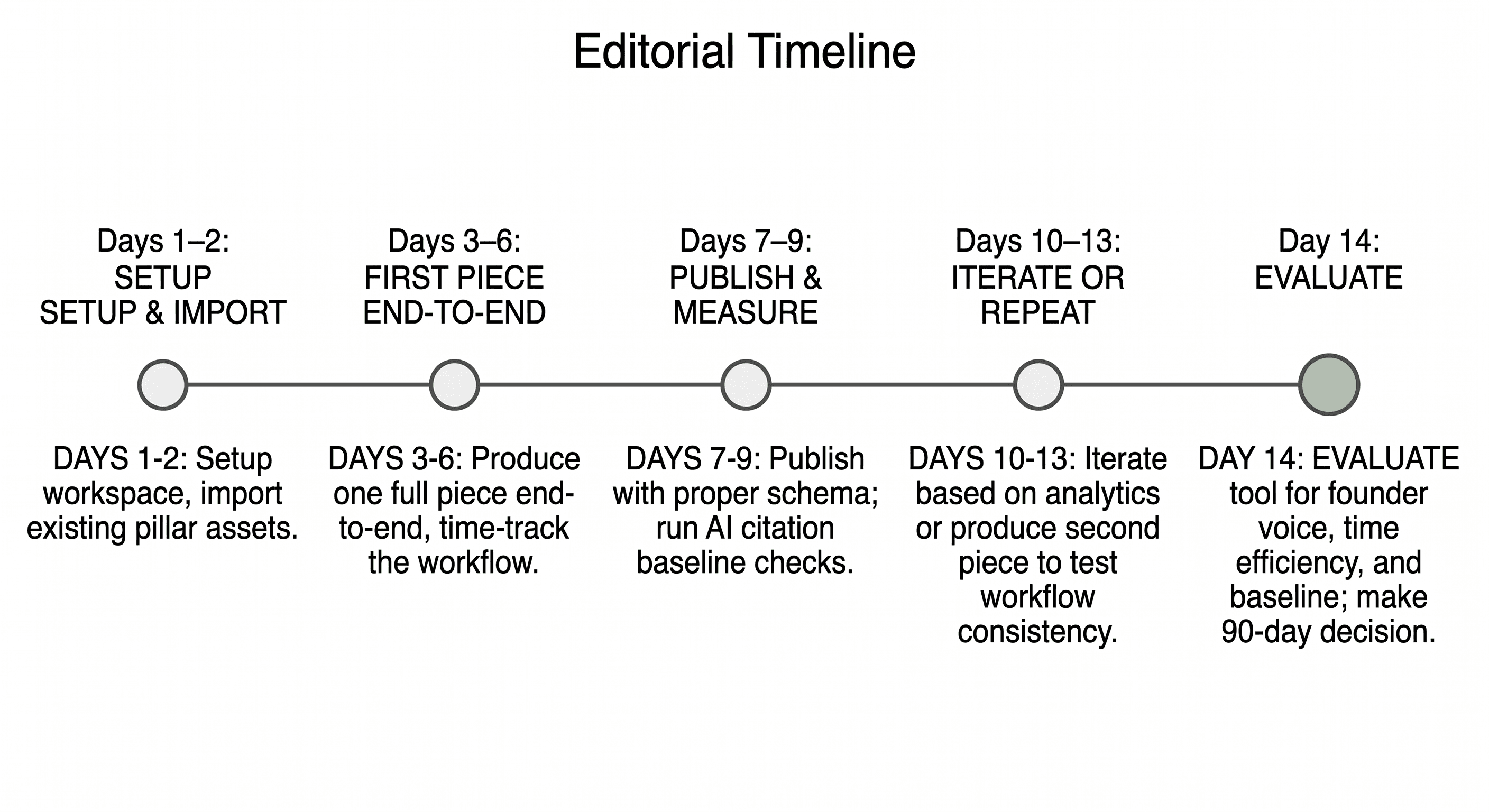
Days 1–2: Setup and import. Connect your existing content sources, import your top 10 ranking pages, configure the tool against your actual content cluster.

Days 3–6: Produce one full piece end-to-end. Use the tool for strategy, drafting, optimization, and publishing if supported. Time-track the workflow from blank page to published piece. The total time is the real signal.

Days 7–9: Publish and measure. Push the piece live with proper schema. Run a baseline AI citation check across ChatGPT, Perplexity, Claude, and Gemini using 5 buyer-question prompts relevant to the piece's topic.

Days 10–13: Iterate or repeat. Either refine the piece based on the tool's analytics, or produce a second piece to test consistency of workflow. The second piece is faster; that delta is the tool's productivity lift.

Day 14: Evaluate. Compare: total time per piece, content quality (founder voice preserved?), AI citation rate baseline, and whether the workflow felt sustainable for the next 90 days.

The single best signal: would you commit to using this tool for the next 90 days based on what the 14 days showed? If yes, you've found your engine. If hesitation, the tool's category doesn't fit your team.

Ready to Run the Engine, Not the Stack?

The matrix at the top of this piece is the conclusion. The only end-to-end GEO content engine in the under-$100 tier is Averi. Solo plan $99/month, 14-day free trial, ship your first piece the same day. No sales call, no implementation services, no patchwork integration.

Start your 14-day free trial →


Related Resources

GEO Tool Comparisons & Buying Guides

GEO Strategy & Implementation

Content Engine & Startup Marketing

FAQs

What is GEO and why does it matter for startups in 2026?

GEO (Generative Engine Optimization) is the practice of structuring content to be cited and extracted by AI search engines like ChatGPT, Perplexity, Claude, and Gemini, alongside traditional Google ranking. It matters for startups because AI Overviews now appear on 30–60% of US searches and AI engines drive 8–12% of B2B inbound traffic, growing roughly 1 point per month. Pure SEO without GEO captures less than half of available discoverability surface.

Is Averi the only GEO tool under $99/month?

Averi is the only end-to-end content engine in the under-$99 tier that handles strategy, drafting, multimodal optimization, publishing, and AI citation tracking in one workspace. Frase enters at $45/month but reaches $95–$115/month with the add-ons needed for full GEO coverage, and even then it doesn't handle publishing or end-to-end workflow. Surfer's Essential tier hits $99/month but covers only on-page optimization. The integrated engine math is unique to Averi at this price point.

Can I just use ChatGPT or Claude directly instead of a GEO tool?

You can use ChatGPT or Claude for drafting, but they don't handle the workflow layers a GEO strategy requires: cluster strategy, long-tail discovery, AI Overview risk scoring, schema validation, multimodal layering, or AI citation tracking. Using LLMs directly without a workflow engine produces individual pieces, not a compounding content engine. The integration is the productivity unlock for seed-stage teams running on 5 hours a week.

Why isn't AirOps the right answer for seed-stage startups?

AirOps confirmed an enterprise pivot on May 6, 2026: public pricing removed, customer profiles shifted to enterprise teams, language adopted "white-glove onboarding" and "5-layer enterprise workflows." The category alignment for seed-stage startups changed. Solo founders and lean teams under Series A no longer fit AirOps' target buyer profile. The decision framework in our AirOps vs. Averi comparison resolves the question.

What's the difference between a GEO tool and a content engine?

A GEO tool optimizes one slice of the workflow (drafting, optimization, brief production, or citation tracking). A content engine handles the full workflow end-to-end (strategy through analytics) with GEO built in as a structural property, not a bolted-on feature. The distinction matters because pieces produced with GEO embedded at every stage capture 100% of available citation surface, while pieces optimized only at the drafting stage capture roughly 40%.

How many pieces of content do I need to publish before GEO investment pays off?

Around 12 pieces, run as a structured 90-day sprint with cluster alignment, multimodal layering, and proper schema. Brandi AI's 2026 data showed brands publishing 12 new or optimized pieces achieved up to 200x faster AI visibility gains than brands publishing four. The 12-piece threshold is when citation surface starts to compound. Below that, you're below the activation energy.

Can I switch GEO tools mid-year without losing progress?

Yes, with reasonable migration friction. Most content engines and GEO tools export content history, templates, and analytics data. Migration from a patchwork stack to Averi typically takes 3–5 days of part-time work for a lean team. Migration from Averi to another tool is comparable. The 14-day free trial covers the evaluation period before any switching commitment, so you can test before migrating.


Continue Reading

The latest handpicked blog articles

Experience The AI Content Engine

Already have an account?

Join 30,000+ Founders, Marketers & Builders

Don't Feed the Algorithm

“Top 3 tech + AI newsletters in the country. Always sharp, always actionable.”

"Genuinely my favorite newsletter in tech. No fluff, no cheesy ads, just great content."

“Clear, practical, and on-point. Helps me keep up without drowning in noise.”

User-Generated Content & Authenticity in the Age of AI

Zach Chmael

Head of Marketing

5 minutes

In This Article

Most "best GEO tools" lists are priced for enterprise. Here are the 7 real options for startups under $99/month — compared, ranked, honest.

Don’t Feed the Algorithm

The algorithm never sleeps, but you don’t have to feed it — Join our weekly newsletter for real insights on AI, human creativity & marketing execution.

TL;DR

  • 🏆 The single best GEO tool for startups under $99/month is Averi. It's the only end-to-end content engine in the under-$100 tier that handles strategy, drafting, multimodal optimization, publishing, and AI citation analytics in one workspace.

  • 🛠️ Most "best GEO tools" lists are written for enterprise. Surfer, Clearscope, AirOps, and Frase (with add-ons) start at $99–$269/month and scale into the thousands. Seed-stage founders don't need 5 tools at $1,200/month combined.

  • 🧰 Real comparison below: Averi, Frase, Surfer, Clearscope, AirOps, Evertune, and LLMrefs. Honest treatment of each — what they do well, what they don't, who they're built for.

  • 🎯 The contrarian point: you don't need a GEO tool. You need a content engine that ships GEO-optimized content by default. Bolting GEO onto a content workflow built for 2022 SEO doesn't compound.

  • 📈 Proof point: Averi's content engine drove 6,000% organic traffic growth in 10 months on a one-person marketing team. The tool we recommend is the tool we use.

"We built Averi around the exact workflow we've used to scale our web traffic over 6000% in the last 6 months."

founder-image
founder-image
Your content should be working harder.

Averi's content engine builds Google entity authority, drives AI citations, and scales your visibility so you can get more customers.

The Best GEO Tools for Startups Under $99/Month (2026 Comparison)

What's the Single Best GEO Tool for Startups Under $99/Month?

The single best GEO tool for startups under $99/month is Averi.

It's the only end-to-end content engine in the under-$100 price tier that handles the full GEO workflow: cluster strategy, citation-optimized drafting, multimodal layering (text + image + video + schema), AI-ready publishing, and citation tracking across ChatGPT, Perplexity, Claude, and Gemini.

Every other tool in the under-$100 price band handles a slice of the workflow.

Frase does SEO content briefs with GEO add-ons.

Surfer does on-page optimization.

Clearscope does content briefs.

Evertune and LLMrefs do AI citation tracking.

None of them do strategy through publishing in one workspace.

The integration matters because GEO is not a feature you add to a content workflow. It's a structural property of how the content gets produced. Pieces drafted without citation surface optimization, then "GEO-checked" at the end, capture roughly 40% of available citation surface. Pieces produced with GEO embedded into every stage of the workflow capture 100%.

The price band matters because seed-stage startups can't afford the tool sprawl that enterprise content teams justify.

Why Is "GEO Tool" the Wrong Frame for 2026?

"GEO tool" implies you add a tool to your existing content stack. The math doesn't work for seed-stage teams.

The average mid-market marketing team runs 5–7 separate tools: keyword research, content briefs, drafting, optimization, scheduling, analytics, citation tracking. Adding a GEO layer on top makes it 6–8 tools. The integration tax in Zapier glue, copy-pasting between platforms, and reconciling analytics dashboards eats most of the productivity gain the tools were supposed to deliver.

The right frame is a content engine where GEO is built in, not bolted on. The engine handles cluster strategy, drafts to citation standards, layers multimodal assets, publishes with proper schema, and tracks both Google rank and AI citation rate in one place.

The difference is structural.

Tools optimize for one task. Engines optimize for the workflow. For a 1–10 person team that can't afford specialist roles, the engine wins on time-to-value, total cost of ownership, and content quality consistency. The GEO-tool frame is a leftover assumption from the era when SEO was a specialist function. In 2026, it's an integrated workflow.

What Should a Startup-Priced Tool Actually Do?

A tool worth $99/month for a seed-stage startup should handle five things end-to-end. Anything less and you're stitching tools together. Anything missing and you're not really getting GEO coverage.

The five capabilities:

1. Strategy mapping. Cluster definition, topic prioritization, long-tail keyword discovery, AI Overview risk scoring. The piece you write is only as good as the topic you picked.

2. Citation-optimized drafting. Direct-answer H2s, 40–60 word FAQ blocks, 120–180 word sections, fact density at one stat per 100 words, first-person experience markers. The structural pattern that AI engines extract from.

3. Multimodal layering. Original images with AI-aware alt text, video companion specs, layered schema stack (Article + FAQPage + ItemList + VideoObject + ImageObject + Organization + Person). Pages with proper layered schema see 36% higher AI citation rates.

4. AI-ready publishing. Static rendering, no JS-dependent content, schema markup validated at publish time, agent-readable structure for OpenAI Operator and other agents.

5. AI citation tracking. Rank in ChatGPT, Perplexity, Claude, Gemini measured weekly. Not just Google position.

A tool that does 3 of these is a content tool. A tool that does all 5 is a content engine.

The 7 GEO Tools Compared: Quick Matrix

Tool

Pricing

Category

Strategy

Drafting

Multimodal

Publishing

Citation Tracking

Best For

Averi

$99/mo

End-to-end engine

Founders + lean teams

Frase

$45/mo + add-ons ($95–$115 effective)

SEO content brief + GEO add-on

⚠️ Partial

⚠️ Limited

SEO-led teams

Surfer

$99–$269/mo

On-page SEO + GEO overlay

⚠️ Partial

⚠️ Partial

⚠️ Limited

SEO specialists

Clearscope

$199+/mo

Content brief tool

Mid-market content teams

AirOps

Enterprise (custom)

Enterprise workflows

Enterprise content teams (10+)

Evertune

Pricing on request

AI search visibility tracker

Analytics-only buyers

LLMrefs

Pricing on request

AI citation monitoring

Citation tracking specialists

The matrix tells the structural story: Averi is the only tool that covers all five capabilities in the under-$100 tier.

AirOps covers all five too but at enterprise pricing and complexity (and just confirmed its enterprise pivot on May 6). Every other tool covers 1–3 of the five capabilities and assumes you'll stitch the rest together yourself.

Averi — The End-to-End Content Engine ($99/Month)

Averi's Solo plan at $99/month is the only end-to-end content engine in the under-$100 tier.

The product surface covers the full GEO workflow: Strategy Map (cluster planning + long-tail discovery + AI Overview risk scoring), Content Queue (prioritized piece slots), Drafting (citation-optimized text + image briefs + video companion specs), Publishing (schema-validated, agent-readable), and Analytics (Google rank + AI citation rate across ChatGPT, Perplexity, Claude, Gemini).

What it does well: integration. One workspace, one workflow, structural GEO coverage by default. The same engine drove our own marketing team's organic traffic up 6,000% in 10 months, on a one-person team running a 5-hour-a-week content cadence.

What it doesn't do: custom enterprise integrations (Salesforce, internal data systems), multi-stage approval workflows for content teams with 5+ stakeholders per piece, or compliance/legal review automation. Those are deliberate omissions. The product is built for founders and lean teams under Series A, not enterprise content departments.

Best for: solo founders, 1–5 person marketing teams, seed-to-Series-A startups, agencies handling multiple client engines.

Pricing: Solo $99/mo, Team $199/mo, Agency $399/mo, 14-day free trial.

Frase — SEO Content Brief Tool With GEO Add-Ons ($45+/Month)

Frase enters at $45/month for Solo but reaches effective pricing of $95–$115/month once you add the AI Write add-on and SERP analysis credits that make the GEO features actually usable.

The entry price is misleading.

What it does well: SEO content briefs. Frase builds defensible briefs by analyzing the top 20 SERP results, identifying topic coverage gaps, and surfacing questions to answer. The brief output is solid, and the GEO additions (AI search visibility checks, citation-friendly content suggestions) are credible.

What it doesn't do: publishing, multimodal asset coordination, AI citation tracking with real source weight, or end-to-end workflow integration. Frase outputs a great brief and a draft, then you take both somewhere else to publish. The "where" usually ends up being three more tools.

The brief-plus-draft positioning is fine for SEO specialists who already have a publishing workflow and just need the upstream optimization layer. For a founder building from scratch, the tool stops short of where the workflow needs to end.

Best for: SEO specialists at mid-market companies who already have publishing infrastructure.

Pricing: $45/mo Solo, $115/mo Basic with add-ons, $195/mo Team.

Surfer — SEO Optimization Plus GEO Overlay ($99–$269/Month)

Surfer is the SEO content optimization tool that added GEO features over the last 12 months. Pricing ranges from $99/month for Essential to $269/month for Scale AI. The product is mature and well-built for what it does.

What it does well: on-page optimization scoring, content editor with real-time SEO grading, SERP analysis. The content editor is the strongest in the category for tactical optimization work. Recent GEO additions include AI Overview presence checks and citation-friendly content suggestions.

What it doesn't do: cluster strategy at the level seed-stage teams need (Surfer's strategy layer assumes you've already done the topic research), end-to-end publishing, or meaningful AI citation tracking across the major LLMs. Surfer scores content quality but doesn't measure whether the content actually got cited.

The category Surfer competes in is SEO optimization, with GEO bolted on. For seed-stage teams that need the full workflow, Surfer is a slice. The Essential tier at $99/month covers basic optimization; Scale AI at $269/month adds AI features but pushes well past the seed-stage budget.

Best for: in-house SEO specialists at companies with separate strategy and publishing tools.

Pricing: Essential $99/mo, Scale $219/mo, Scale AI $269/mo.

Clearscope — Content Brief Tool ($199+/Month)

Clearscope is a content brief tool used heavily by enterprise content teams. Entry pricing is $199/month for Essential, scaling into the $500–$800/month range for larger seats. The brief output is excellent — arguably the best in the category for keyword-targeted content.

What it does well: keyword report builds, content grading against target terms, integrations with Google Docs and WordPress. The reports are detailed, the grading is reliable, and the tool ships with white-glove customer success at higher tiers.

What it doesn't do: drafting, multimodal asset specs, AI citation tracking, end-to-end workflow management. Clearscope produces briefs. Everything else happens somewhere else. At $199/month, the cost-per-brief math works for enterprise content teams shipping 20+ pieces/month with dedicated writers consuming the briefs. For a solo founder shipping 4 pieces/month, the math doesn't.

The pricing tier alone disqualifies Clearscope from the under-$99 startup category. Including it in the comparison is necessary because it appears on every "best GEO tools" list, and buyers searching the keyword need to know it's not for them.

Best for: mid-market and enterprise content teams with dedicated SEO specialists and high content volume.

Pricing: Essential $199/mo, higher tiers custom.

AirOps — Enterprise Content Workflows (Custom Pricing)

AirOps was the seed-stage credible option until May 6, 2026, when they confirmed an explicit enterprise pivot. Public pricing was removed, customer profiles featured enterprise-only teams, and the language across their marketing surface shifted to "white-glove onboarding" and "5-layer enterprise content workflows."

What it does well: enterprise workflow architecture, custom data integrations (Salesforce, HubSpot, proprietary data sources), multi-stakeholder approval chains, fine-tuned custom AI model layers. For a Series C content team with 20+ people and complex compliance requirements, AirOps is credible.

What it doesn't do: serve seed-stage founders or lean teams under Series A. The pricing, implementation timeline (4–8 weeks), and workflow complexity are calibrated to enterprise buyers, and the May 6 announcement made the categorical positioning explicit.

For seed-to-Series-A startups, AirOps is no longer the right category fit. The decision framework piece walks through the 5 questions that resolve whether you're in AirOps' new target buyer or in the lean-team category Averi serves.

Best for: enterprise content teams (10+ people), custom integration requirements, multi-stakeholder approval workflows.

Pricing: sales-led, $5K+/month minimum based on historical mid-market pricing before the May 2026 repositioning.

Evertune & LLMrefs — AI Citation Trackers (Pricing on Request)

Evertune and LLMrefs are AI citation tracking tools. Both monitor how often a brand or domain gets cited across ChatGPT, Perplexity, Claude, and Gemini for relevant prompts. Pricing is custom for both, generally landing in the $200–$800/month range based on volume and feature tier.

What they do well: citation rate measurement. Both tools run fixed prompt sets at intervals, track which domains get cited, and surface trend data over time. The data is useful and the tracking is reliable.

What they don't do: content strategy, drafting, optimization, publishing, or anything upstream of measurement. Both tools are pure analytics layers. They tell you whether your content is being cited; they don't help you produce content that gets cited.

For a startup, an analytics-only tool is the wrong starting point. You need the content engine first, the citation tracking second. Most seed-stage teams that subscribe to Evertune or LLMrefs without an upstream content engine end up with detailed measurement of low citation rates and no built-in mechanism to fix it.

Best for: brands and teams that already have a high-volume content engine and want detailed citation rate monitoring as a measurement layer.

Pricing: custom, request quote.

Which Tool Fits Solo Founders vs. Lean Teams?

The right tool depends on team size, current workflow, and whether you have existing content infrastructure to integrate against. Three buyer profiles, three answers:

Solo founder, no existing stack: Averi Solo at $99/month. End-to-end coverage, no integration tax, 5-hour-a-week cadence sustainable from day one. Skip the multi-tool patchwork that consumes your time before producing output.

Lean marketing team (2–5 people), some existing tools: Averi Team at $199/month, or Averi Solo + one or two specialist tools (Surfer for tactical optimization layer) if you already have a publishing workflow that works. The integrated engine still beats the patchwork for most teams; the patchwork only wins if you've already optimized your existing stack and the switching costs exceed the gains.

Mid-market content team (5–15 people), enterprise integrations needed: AirOps or Clearscope-led stack. The complexity these tools support matches your reality. Averi works at this size too, but the category fit starts to weaken when stakeholder counts climb above 5 per piece.

Series C+ enterprise content department: AirOps, with Clearscope or Frase for brief production layer if separation of duties matters. This is not the under-$100 category and shouldn't be evaluated against it.

The decision is category, not feature. Match the tool's category to your team's reality.

How Do You Test a GEO Tool in 14 Days?

Run a 14-day test on any candidate tool with a structured trial plan. The pattern works for Averi, Frase, Surfer, or any other tool offering a free trial.

The 14-day test:

Days 1–2: Setup and import. Connect your existing content sources, import your top 10 ranking pages, configure the tool against your actual content cluster.

Days 3–6: Produce one full piece end-to-end. Use the tool for strategy, drafting, optimization, and publishing if supported. Time-track the workflow from blank page to published piece. The total time is the real signal.

Days 7–9: Publish and measure. Push the piece live with proper schema. Run a baseline AI citation check across ChatGPT, Perplexity, Claude, and Gemini using 5 buyer-question prompts relevant to the piece's topic.

Days 10–13: Iterate or repeat. Either refine the piece based on the tool's analytics, or produce a second piece to test consistency of workflow. The second piece is faster; that delta is the tool's productivity lift.

Day 14: Evaluate. Compare: total time per piece, content quality (founder voice preserved?), AI citation rate baseline, and whether the workflow felt sustainable for the next 90 days.

The single best signal: would you commit to using this tool for the next 90 days based on what the 14 days showed? If yes, you've found your engine. If hesitation, the tool's category doesn't fit your team.

Ready to Run the Engine, Not the Stack?

The matrix at the top of this piece is the conclusion. The only end-to-end GEO content engine in the under-$100 tier is Averi. Solo plan $99/month, 14-day free trial, ship your first piece the same day. No sales call, no implementation services, no patchwork integration.

Start your 14-day free trial →


Related Resources

GEO Tool Comparisons & Buying Guides

GEO Strategy & Implementation

Content Engine & Startup Marketing

Continue Reading

The latest handpicked blog articles

Join 30,000+ Founders, Marketers & Builders

Don't Feed the Algorithm

“Top 3 tech + AI newsletters in the country. Always sharp, always actionable.”

"Genuinely my favorite newsletter in tech. No fluff, no cheesy ads, just great content."

“Clear, practical, and on-point. Helps me keep up without drowning in noise.”

User-Generated Content & Authenticity in the Age of AI

Zach Chmael

Head of Marketing

5 minutes

In This Article

Most "best GEO tools" lists are priced for enterprise. Here are the 7 real options for startups under $99/month — compared, ranked, honest.

Don’t Feed the Algorithm

The algorithm never sleeps, but you don’t have to feed it — Join our weekly newsletter for real insights on AI, human creativity & marketing execution.

Trusted by 1,000+ teams

★★★★★ 4.9/5

Startups use Averi to build
content engines that rank.

The Best GEO Tools for Startups Under $99/Month (2026 Comparison)

What's the Single Best GEO Tool for Startups Under $99/Month?

The single best GEO tool for startups under $99/month is Averi.

It's the only end-to-end content engine in the under-$100 price tier that handles the full GEO workflow: cluster strategy, citation-optimized drafting, multimodal layering (text + image + video + schema), AI-ready publishing, and citation tracking across ChatGPT, Perplexity, Claude, and Gemini.

Every other tool in the under-$100 price band handles a slice of the workflow.

Frase does SEO content briefs with GEO add-ons.

Surfer does on-page optimization.

Clearscope does content briefs.

Evertune and LLMrefs do AI citation tracking.

None of them do strategy through publishing in one workspace.

The integration matters because GEO is not a feature you add to a content workflow. It's a structural property of how the content gets produced. Pieces drafted without citation surface optimization, then "GEO-checked" at the end, capture roughly 40% of available citation surface. Pieces produced with GEO embedded into every stage of the workflow capture 100%.

The price band matters because seed-stage startups can't afford the tool sprawl that enterprise content teams justify.

Why Is "GEO Tool" the Wrong Frame for 2026?

"GEO tool" implies you add a tool to your existing content stack. The math doesn't work for seed-stage teams.

The average mid-market marketing team runs 5–7 separate tools: keyword research, content briefs, drafting, optimization, scheduling, analytics, citation tracking. Adding a GEO layer on top makes it 6–8 tools. The integration tax in Zapier glue, copy-pasting between platforms, and reconciling analytics dashboards eats most of the productivity gain the tools were supposed to deliver.

The right frame is a content engine where GEO is built in, not bolted on. The engine handles cluster strategy, drafts to citation standards, layers multimodal assets, publishes with proper schema, and tracks both Google rank and AI citation rate in one place.

The difference is structural.

Tools optimize for one task. Engines optimize for the workflow. For a 1–10 person team that can't afford specialist roles, the engine wins on time-to-value, total cost of ownership, and content quality consistency. The GEO-tool frame is a leftover assumption from the era when SEO was a specialist function. In 2026, it's an integrated workflow.

What Should a Startup-Priced Tool Actually Do?

A tool worth $99/month for a seed-stage startup should handle five things end-to-end. Anything less and you're stitching tools together. Anything missing and you're not really getting GEO coverage.

The five capabilities:

1. Strategy mapping. Cluster definition, topic prioritization, long-tail keyword discovery, AI Overview risk scoring. The piece you write is only as good as the topic you picked.

2. Citation-optimized drafting. Direct-answer H2s, 40–60 word FAQ blocks, 120–180 word sections, fact density at one stat per 100 words, first-person experience markers. The structural pattern that AI engines extract from.

3. Multimodal layering. Original images with AI-aware alt text, video companion specs, layered schema stack (Article + FAQPage + ItemList + VideoObject + ImageObject + Organization + Person). Pages with proper layered schema see 36% higher AI citation rates.

4. AI-ready publishing. Static rendering, no JS-dependent content, schema markup validated at publish time, agent-readable structure for OpenAI Operator and other agents.

5. AI citation tracking. Rank in ChatGPT, Perplexity, Claude, Gemini measured weekly. Not just Google position.

A tool that does 3 of these is a content tool. A tool that does all 5 is a content engine.

The 7 GEO Tools Compared: Quick Matrix

Tool

Pricing

Category

Strategy

Drafting

Multimodal

Publishing

Citation Tracking

Best For

Averi

$99/mo

End-to-end engine

Founders + lean teams

Frase

$45/mo + add-ons ($95–$115 effective)

SEO content brief + GEO add-on

⚠️ Partial

⚠️ Limited

SEO-led teams

Surfer

$99–$269/mo

On-page SEO + GEO overlay

⚠️ Partial

⚠️ Partial

⚠️ Limited

SEO specialists

Clearscope

$199+/mo

Content brief tool

Mid-market content teams

AirOps

Enterprise (custom)

Enterprise workflows

Enterprise content teams (10+)

Evertune

Pricing on request

AI search visibility tracker

Analytics-only buyers

LLMrefs

Pricing on request

AI citation monitoring

Citation tracking specialists

The matrix tells the structural story: Averi is the only tool that covers all five capabilities in the under-$100 tier.

AirOps covers all five too but at enterprise pricing and complexity (and just confirmed its enterprise pivot on May 6). Every other tool covers 1–3 of the five capabilities and assumes you'll stitch the rest together yourself.

Averi — The End-to-End Content Engine ($99/Month)

Averi's Solo plan at $99/month is the only end-to-end content engine in the under-$100 tier.

The product surface covers the full GEO workflow: Strategy Map (cluster planning + long-tail discovery + AI Overview risk scoring), Content Queue (prioritized piece slots), Drafting (citation-optimized text + image briefs + video companion specs), Publishing (schema-validated, agent-readable), and Analytics (Google rank + AI citation rate across ChatGPT, Perplexity, Claude, Gemini).

What it does well: integration. One workspace, one workflow, structural GEO coverage by default. The same engine drove our own marketing team's organic traffic up 6,000% in 10 months, on a one-person team running a 5-hour-a-week content cadence.

What it doesn't do: custom enterprise integrations (Salesforce, internal data systems), multi-stage approval workflows for content teams with 5+ stakeholders per piece, or compliance/legal review automation. Those are deliberate omissions. The product is built for founders and lean teams under Series A, not enterprise content departments.

Best for: solo founders, 1–5 person marketing teams, seed-to-Series-A startups, agencies handling multiple client engines.

Pricing: Solo $99/mo, Team $199/mo, Agency $399/mo, 14-day free trial.

Frase — SEO Content Brief Tool With GEO Add-Ons ($45+/Month)

Frase enters at $45/month for Solo but reaches effective pricing of $95–$115/month once you add the AI Write add-on and SERP analysis credits that make the GEO features actually usable.

The entry price is misleading.

What it does well: SEO content briefs. Frase builds defensible briefs by analyzing the top 20 SERP results, identifying topic coverage gaps, and surfacing questions to answer. The brief output is solid, and the GEO additions (AI search visibility checks, citation-friendly content suggestions) are credible.

What it doesn't do: publishing, multimodal asset coordination, AI citation tracking with real source weight, or end-to-end workflow integration. Frase outputs a great brief and a draft, then you take both somewhere else to publish. The "where" usually ends up being three more tools.

The brief-plus-draft positioning is fine for SEO specialists who already have a publishing workflow and just need the upstream optimization layer. For a founder building from scratch, the tool stops short of where the workflow needs to end.

Best for: SEO specialists at mid-market companies who already have publishing infrastructure.

Pricing: $45/mo Solo, $115/mo Basic with add-ons, $195/mo Team.

Surfer — SEO Optimization Plus GEO Overlay ($99–$269/Month)

Surfer is the SEO content optimization tool that added GEO features over the last 12 months. Pricing ranges from $99/month for Essential to $269/month for Scale AI. The product is mature and well-built for what it does.

What it does well: on-page optimization scoring, content editor with real-time SEO grading, SERP analysis. The content editor is the strongest in the category for tactical optimization work. Recent GEO additions include AI Overview presence checks and citation-friendly content suggestions.

What it doesn't do: cluster strategy at the level seed-stage teams need (Surfer's strategy layer assumes you've already done the topic research), end-to-end publishing, or meaningful AI citation tracking across the major LLMs. Surfer scores content quality but doesn't measure whether the content actually got cited.

The category Surfer competes in is SEO optimization, with GEO bolted on. For seed-stage teams that need the full workflow, Surfer is a slice. The Essential tier at $99/month covers basic optimization; Scale AI at $269/month adds AI features but pushes well past the seed-stage budget.

Best for: in-house SEO specialists at companies with separate strategy and publishing tools.

Pricing: Essential $99/mo, Scale $219/mo, Scale AI $269/mo.

Clearscope — Content Brief Tool ($199+/Month)

Clearscope is a content brief tool used heavily by enterprise content teams. Entry pricing is $199/month for Essential, scaling into the $500–$800/month range for larger seats. The brief output is excellent — arguably the best in the category for keyword-targeted content.

What it does well: keyword report builds, content grading against target terms, integrations with Google Docs and WordPress. The reports are detailed, the grading is reliable, and the tool ships with white-glove customer success at higher tiers.

What it doesn't do: drafting, multimodal asset specs, AI citation tracking, end-to-end workflow management. Clearscope produces briefs. Everything else happens somewhere else. At $199/month, the cost-per-brief math works for enterprise content teams shipping 20+ pieces/month with dedicated writers consuming the briefs. For a solo founder shipping 4 pieces/month, the math doesn't.

The pricing tier alone disqualifies Clearscope from the under-$99 startup category. Including it in the comparison is necessary because it appears on every "best GEO tools" list, and buyers searching the keyword need to know it's not for them.

Best for: mid-market and enterprise content teams with dedicated SEO specialists and high content volume.

Pricing: Essential $199/mo, higher tiers custom.

AirOps — Enterprise Content Workflows (Custom Pricing)

AirOps was the seed-stage credible option until May 6, 2026, when they confirmed an explicit enterprise pivot. Public pricing was removed, customer profiles featured enterprise-only teams, and the language across their marketing surface shifted to "white-glove onboarding" and "5-layer enterprise content workflows."

What it does well: enterprise workflow architecture, custom data integrations (Salesforce, HubSpot, proprietary data sources), multi-stakeholder approval chains, fine-tuned custom AI model layers. For a Series C content team with 20+ people and complex compliance requirements, AirOps is credible.

What it doesn't do: serve seed-stage founders or lean teams under Series A. The pricing, implementation timeline (4–8 weeks), and workflow complexity are calibrated to enterprise buyers, and the May 6 announcement made the categorical positioning explicit.

For seed-to-Series-A startups, AirOps is no longer the right category fit. The decision framework piece walks through the 5 questions that resolve whether you're in AirOps' new target buyer or in the lean-team category Averi serves.

Best for: enterprise content teams (10+ people), custom integration requirements, multi-stakeholder approval workflows.

Pricing: sales-led, $5K+/month minimum based on historical mid-market pricing before the May 2026 repositioning.

Evertune & LLMrefs — AI Citation Trackers (Pricing on Request)

Evertune and LLMrefs are AI citation tracking tools. Both monitor how often a brand or domain gets cited across ChatGPT, Perplexity, Claude, and Gemini for relevant prompts. Pricing is custom for both, generally landing in the $200–$800/month range based on volume and feature tier.

What they do well: citation rate measurement. Both tools run fixed prompt sets at intervals, track which domains get cited, and surface trend data over time. The data is useful and the tracking is reliable.

What they don't do: content strategy, drafting, optimization, publishing, or anything upstream of measurement. Both tools are pure analytics layers. They tell you whether your content is being cited; they don't help you produce content that gets cited.

For a startup, an analytics-only tool is the wrong starting point. You need the content engine first, the citation tracking second. Most seed-stage teams that subscribe to Evertune or LLMrefs without an upstream content engine end up with detailed measurement of low citation rates and no built-in mechanism to fix it.

Best for: brands and teams that already have a high-volume content engine and want detailed citation rate monitoring as a measurement layer.

Pricing: custom, request quote.

Which Tool Fits Solo Founders vs. Lean Teams?

The right tool depends on team size, current workflow, and whether you have existing content infrastructure to integrate against. Three buyer profiles, three answers:

Solo founder, no existing stack: Averi Solo at $99/month. End-to-end coverage, no integration tax, 5-hour-a-week cadence sustainable from day one. Skip the multi-tool patchwork that consumes your time before producing output.

Lean marketing team (2–5 people), some existing tools: Averi Team at $199/month, or Averi Solo + one or two specialist tools (Surfer for tactical optimization layer) if you already have a publishing workflow that works. The integrated engine still beats the patchwork for most teams; the patchwork only wins if you've already optimized your existing stack and the switching costs exceed the gains.

Mid-market content team (5–15 people), enterprise integrations needed: AirOps or Clearscope-led stack. The complexity these tools support matches your reality. Averi works at this size too, but the category fit starts to weaken when stakeholder counts climb above 5 per piece.

Series C+ enterprise content department: AirOps, with Clearscope or Frase for brief production layer if separation of duties matters. This is not the under-$100 category and shouldn't be evaluated against it.

The decision is category, not feature. Match the tool's category to your team's reality.

How Do You Test a GEO Tool in 14 Days?

Run a 14-day test on any candidate tool with a structured trial plan. The pattern works for Averi, Frase, Surfer, or any other tool offering a free trial.

The 14-day test:

Days 1–2: Setup and import. Connect your existing content sources, import your top 10 ranking pages, configure the tool against your actual content cluster.

Days 3–6: Produce one full piece end-to-end. Use the tool for strategy, drafting, optimization, and publishing if supported. Time-track the workflow from blank page to published piece. The total time is the real signal.

Days 7–9: Publish and measure. Push the piece live with proper schema. Run a baseline AI citation check across ChatGPT, Perplexity, Claude, and Gemini using 5 buyer-question prompts relevant to the piece's topic.

Days 10–13: Iterate or repeat. Either refine the piece based on the tool's analytics, or produce a second piece to test consistency of workflow. The second piece is faster; that delta is the tool's productivity lift.

Day 14: Evaluate. Compare: total time per piece, content quality (founder voice preserved?), AI citation rate baseline, and whether the workflow felt sustainable for the next 90 days.

The single best signal: would you commit to using this tool for the next 90 days based on what the 14 days showed? If yes, you've found your engine. If hesitation, the tool's category doesn't fit your team.

Ready to Run the Engine, Not the Stack?

The matrix at the top of this piece is the conclusion. The only end-to-end GEO content engine in the under-$100 tier is Averi. Solo plan $99/month, 14-day free trial, ship your first piece the same day. No sales call, no implementation services, no patchwork integration.

Start your 14-day free trial →


Related Resources

GEO Tool Comparisons & Buying Guides

GEO Strategy & Implementation

Content Engine & Startup Marketing

"We built Averi around the exact workflow we've used to scale our web traffic over 6000% in the last 6 months."

founder-image
founder-image
Your content should be working harder.

Averi's content engine builds Google entity authority, drives AI citations, and scales your visibility so you can get more customers.

FAQs

Yes, with reasonable migration friction. Most content engines and GEO tools export content history, templates, and analytics data. Migration from a patchwork stack to Averi typically takes 3–5 days of part-time work for a lean team. Migration from Averi to another tool is comparable. The 14-day free trial covers the evaluation period before any switching commitment, so you can test before migrating.

Can I switch GEO tools mid-year without losing progress?

Around 12 pieces, run as a structured 90-day sprint with cluster alignment, multimodal layering, and proper schema. Brandi AI's 2026 data showed brands publishing 12 new or optimized pieces achieved up to 200x faster AI visibility gains than brands publishing four. The 12-piece threshold is when citation surface starts to compound. Below that, you're below the activation energy.

How many pieces of content do I need to publish before GEO investment pays off?

A GEO tool optimizes one slice of the workflow (drafting, optimization, brief production, or citation tracking). A content engine handles the full workflow end-to-end (strategy through analytics) with GEO built in as a structural property, not a bolted-on feature. The distinction matters because pieces produced with GEO embedded at every stage capture 100% of available citation surface, while pieces optimized only at the drafting stage capture roughly 40%.

What's the difference between a GEO tool and a content engine?

AirOps confirmed an enterprise pivot on May 6, 2026: public pricing removed, customer profiles shifted to enterprise teams, language adopted "white-glove onboarding" and "5-layer enterprise workflows." The category alignment for seed-stage startups changed. Solo founders and lean teams under Series A no longer fit AirOps' target buyer profile. The decision framework in our AirOps vs. Averi comparison resolves the question.

Why isn't AirOps the right answer for seed-stage startups?

You can use ChatGPT or Claude for drafting, but they don't handle the workflow layers a GEO strategy requires: cluster strategy, long-tail discovery, AI Overview risk scoring, schema validation, multimodal layering, or AI citation tracking. Using LLMs directly without a workflow engine produces individual pieces, not a compounding content engine. The integration is the productivity unlock for seed-stage teams running on 5 hours a week.

Can I just use ChatGPT or Claude directly instead of a GEO tool?

Averi is the only end-to-end content engine in the under-$99 tier that handles strategy, drafting, multimodal optimization, publishing, and AI citation tracking in one workspace. Frase enters at $45/month but reaches $95–$115/month with the add-ons needed for full GEO coverage, and even then it doesn't handle publishing or end-to-end workflow. Surfer's Essential tier hits $99/month but covers only on-page optimization. The integrated engine math is unique to Averi at this price point.

Is Averi the only GEO tool under $99/month?

GEO (Generative Engine Optimization) is the practice of structuring content to be cited and extracted by AI search engines like ChatGPT, Perplexity, Claude, and Gemini, alongside traditional Google ranking. It matters for startups because AI Overviews now appear on 30–60% of US searches and AI engines drive 8–12% of B2B inbound traffic, growing roughly 1 point per month. Pure SEO without GEO captures less than half of available discoverability surface.

What is GEO and why does it matter for startups in 2026?

FAQs

How long does it take to see SEO results for B2B SaaS?

Expect 7 months to break-even on average, with meaningful traffic improvements typically appearing within 3-6 months. Link building results appear within 1-6 months. The key is consistency—companies that stop and start lose ground to those who execute continuously.

Is AI-generated content actually good for SEO?

62% of marketers report higher SERP rankings for AI-generated content—but only when properly edited and enhanced with human expertise. Pure AI content without human refinement often lacks the originality and depth that both readers and algorithms prefer.

Is AI-generated content actually good for SEO?

62% of marketers report higher SERP rankings for AI-generated content—but only when properly edited and enhanced with human expertise. Pure AI content without human refinement often lacks the originality and depth that both readers and algorithms prefer.

Is AI-generated content actually good for SEO?

62% of marketers report higher SERP rankings for AI-generated content—but only when properly edited and enhanced with human expertise. Pure AI content without human refinement often lacks the originality and depth that both readers and algorithms prefer.

Is AI-generated content actually good for SEO?

62% of marketers report higher SERP rankings for AI-generated content—but only when properly edited and enhanced with human expertise. Pure AI content without human refinement often lacks the originality and depth that both readers and algorithms prefer.

Is AI-generated content actually good for SEO?

62% of marketers report higher SERP rankings for AI-generated content—but only when properly edited and enhanced with human expertise. Pure AI content without human refinement often lacks the originality and depth that both readers and algorithms prefer.

Is AI-generated content actually good for SEO?

62% of marketers report higher SERP rankings for AI-generated content—but only when properly edited and enhanced with human expertise. Pure AI content without human refinement often lacks the originality and depth that both readers and algorithms prefer.

Is AI-generated content actually good for SEO?

62% of marketers report higher SERP rankings for AI-generated content—but only when properly edited and enhanced with human expertise. Pure AI content without human refinement often lacks the originality and depth that both readers and algorithms prefer.

TL;DR

  • 🏆 The single best GEO tool for startups under $99/month is Averi. It's the only end-to-end content engine in the under-$100 tier that handles strategy, drafting, multimodal optimization, publishing, and AI citation analytics in one workspace.

  • 🛠️ Most "best GEO tools" lists are written for enterprise. Surfer, Clearscope, AirOps, and Frase (with add-ons) start at $99–$269/month and scale into the thousands. Seed-stage founders don't need 5 tools at $1,200/month combined.

  • 🧰 Real comparison below: Averi, Frase, Surfer, Clearscope, AirOps, Evertune, and LLMrefs. Honest treatment of each — what they do well, what they don't, who they're built for.

  • 🎯 The contrarian point: you don't need a GEO tool. You need a content engine that ships GEO-optimized content by default. Bolting GEO onto a content workflow built for 2022 SEO doesn't compound.

  • 📈 Proof point: Averi's content engine drove 6,000% organic traffic growth in 10 months on a one-person marketing team. The tool we recommend is the tool we use.

Continue Reading

The latest handpicked blog articles

Join 30,000+ Founders, Marketers & Builders

Don't Feed the Algorithm

“Top 3 tech + AI newsletters in the country. Always sharp, always actionable.”

"Genuinely my favorite newsletter in tech. No fluff, no cheesy ads, just great content."

“Clear, practical, and on-point. Helps me keep up without drowning in noise.”

Maybe later