Feb 19, 2026

How Averi Helps You Build E-E-A-T (Without Losing Your Soul to the Content Machine)

Zach Chmael

Head of Marketing

5 minutes

In This Article

E-E-A-T has become critical for Answer Engine Optimization — the practice of ensuring AI models recognize your brand as a trustworthy source worth citing. AI platforms evaluate signals of credibility, relevance, and expertise before deciding which sources to reference in generated answers. A site that clearly displays author credentials, verifiable sources, and consistent expert positioning sends the signals these systems need.

Updated

Feb 19, 2026

Don’t Feed the Algorithm

The algorithm never sleeps, but you don’t have to feed it — Join our weekly newsletter for real insights on AI, human creativity & marketing execution.

TL;DR

  • 🧠 E-E-A-T — Experience, Expertise, Authoritativeness, Trustworthiness — has evolved from a quality guideline into the gatekeeper of modern search visibility, and sites that demonstrate these signals are seeing 23% traffic gains while generic content farms crater.

  • 🌊 The web is drowning in AI slop. 74.2% of new web pages now contain AI-generated content, and a Europol report warned that up to 90% of online content could be synthetically generated by 2026. E-E-A-T is how you prove you're not part of the noise.

  • 🏗️ Averi builds E-E-A-T into the workflow, not as an afterthought. From Brand Core that embeds your unique positioning into every draft, to the new Strategy Map that constructs the topical authority architecture Google and AI platforms reward, the platform operationalizes trust at scale.

  • 📊 Topical authority — the kind the Strategy Map builds — is now the single strongest on-page ranking factor, surpassing even domain traffic according to analysis of over 253,800 search results.

  • 🤖 AI search compounds the E-E-A-T imperative. AI search visitors convert at 14.2% vs. organic's 2.8%, making AI-referred traffic roughly 5x more valuable — but only for brands with the depth and trust signals that earn citations.

  • 🚀 The result? A content engine that doesn't just produce content, but produces credible content — the kind both humans and machines trust enough to cite, share, and act on.

Zach Chmael

CMO, Averi

"We built Averi around the exact workflow we've used to scale our web traffic over 6000% in the last 6 months."

Your content should be working harder.

Averi's content engine builds Google entity authority, drives AI citations, and scales your visibility so you can get more customers.

How Averi Helps You Build E-E-A-T (Without Losing Your Soul to the Content Machine)

The Web Has a Trust Problem. E-E-A-T Is the Antidote.

Here's something that most AI marketing tools would rather you not think about: the more content AI produces, the less any individual piece of it matters.

We are, at this very moment, living through the largest content inflation event in human history.

Ahrefs analyzed nearly 900,000 new web pages published in April 2025 and found that 74.2% contained detectable AI-generated content. Graphite's analysis of over 65,000 articles found that by late 2024, more than half of new English-language articles were primarily AI-written — up from just 5% before ChatGPT launched.

And the trajectory is only steepening.

Yet here's the paradox that should keep every marketer up at night… despite this tidal wave of synthetic content, 86% of the top-ranking pages in Google are still human-authored. Among AI assistants like ChatGPT and Perplexity, the ratio is nearly identical — 82% human to 18% AI.

The volume of AI content is exploding. Its share of the results that matter is not.

This is where E-E-A-T enters the conversation — not as some checkbox framework that SEO consultants trot out at conferences, but as the fundamental mechanism by which the internet is now sorting signal from noise.

Experience. Expertise. Authoritativeness. Trustworthiness.

Google introduced the framework in its Quality Rater Guidelines, and while E-E-A-T isn't technically a direct ranking factor, it informs the algorithmic signals that determine whether your content rises or drowns.

The distinction is academic. The impact is not.

After Google's December 2025 Core Update, sites demonstrating genuine experience and expertise saw 23% traffic gains. Generic content farms experienced the opposite. The algorithm is learning to read taste — or at least its closest approximation in structured data and semantic patterns.

And this matters even more in the age of AI search.

E-E-A-T has become critical for Answer Engine Optimization — the practice of ensuring AI models recognize your brand as a trustworthy source worth citing. AI platforms evaluate signals of credibility, relevance, and expertise before deciding which sources to reference in generated answers. A site that clearly displays author credentials, verifiable sources, and consistent expert positioning sends the signals these systems need.

The question is no longer whether E-E-A-T matters. It's whether your content workflow is designed to produce it — consistently, at scale, without burning your team alive.

Why Most Teams Fail at E-E-A-T (And Why It's Not Their Fault)

Let's be honest about something.

The idea of E-E-A-T is simple. Show that you know what you're talking about. Prove that you've done the thing. Build the kind of reputation that makes both humans and machines trust you.

The execution of E-E-A-T is where everything falls apart — because execution requires a system, and most content workflows are anything but systematic.

Consider the structural requirements of E-E-A-T in practice. Experience demands first-hand perspective woven into the content itself — the kind you can't fake with a prompt.

Expertise requires depth: cited sources, original data, in-context analysis that goes beyond surface-level regurgitation.

Authoritativeness needs topical breadth: interconnected content clusters that signal to both Google and AI platforms that you don't just know one thing, you know the territory.

Trustworthiness ties it all together: real author bios, consistent publishing, transparent methodology, fresh information.

Now ask yourself… how many of these signals does a typical content workflow produce by default?

The answer, for most startups, is approximately zero.

Only 43% of B2B marketers have a documented content strategy guiding their efforts, despite 91% of global brands using content marketing in some form. 54% of marketers cite a lack of resources as their biggest content challenge. 66.5% struggle with knowing where to allocate resources, and the top frustration in 2025 was getting content to rank at all — cited by 77.6% of respondents.

This isn't a talent problem. This is a systems problem.

And you don't solve systems problems by hiring another freelance writer or buying another AI writing tool that produces the same interchangeable paste as every other AI writing tool on the market.

You solve it by building E-E-A-T into the workflow itself.
How Averi Builds E-E-A-T Into the Content Engine

When we built Averi, we didn't start from the question "how do we generate content faster?" — the question that seems to obsess every other AI tool on the market.

We started from a different question entirely: "how do we build the kind of content that earns trust?"

That distinction matters more than you might think. Speed without credibility is just noise with a schedule. And noise, no matter how efficiently produced, does not build the authority that modern search — both traditional and AI-powered — now demands.

Here's how Averi's content engine maps to each pillar of E-E-A-T:

Experience: Your Voice, Your Story, Your Platform

The first E in E-E-A-T — Experience — is the one that AI content tools handle worst. And for good reason.

Experience is, by definition, the thing that can't be synthesized. It's the founder who spent three years in the trenches before writing about product-market fit. It's the marketer who burned through $200K in ad spend before sharing what actually works.

Averi doesn't pretend to replace this. What it does is create the conditions for human experience to actually make it into the content.

The Brand Core system captures your unique positioning, voice, POV, and brand story during onboarding. This isn't a style dropdown or a tone slider. It's the contextual DNA of your brand — the accumulated experience, the hard-won insights, the specific way you see the world — encoded into the system so that every piece of content starts from your foundation rather than a blank, generic prompt.

When you edit and refine drafts in Averi's editor, you're adding the first-hand perspective that machines can't fabricate. The platform handles the structural heavy lifting — research, keyword mapping, competitive intelligence, formatting — so you can spend your time on what actually differentiates your content: your experience.

This is the paradox of AI in content marketing, and it's one I think about constantly. 52% of consumers reduce engagement when they suspect AI-generated content, and there's a 44-percentage-point gap between how marketers and consumers perceive AI's ability to craft emotionally resonant content.

The solution isn't less AI — it's AI designed to amplify what makes you human rather than erase it.

Expertise: Depth Over Volume, Every Time

Expertise in the E-E-A-T framework means demonstrated knowledge. Not claimed knowledge. Not keyword-stuffed knowledge. The kind of knowledge that manifests in how content is structured, what sources it cites, how it handles nuance, and whether it actually teaches the reader something they didn't know before.

Averi operationalizes expertise through several mechanisms:

Research-backed drafting. Every content piece generated through Averi's workflow includes hyperlinked sources from authoritative publications — not as an afterthought, but as a structural component of how the content is built. Content featuring original statistics and research findings sees 30-40% higher visibility in LLM responses. The platform ensures this is the default, not the exception.

Keyword intelligence at every layer. The Strategy Map — our new visual content strategy system — provides research overviews at every level, surfacing trending keywords, top-performing content, and competitive intelligence so content decisions are driven by data rather than gut feeling. This means your expertise is demonstrated on the topics that actually matter to your audience, not just the ones you happen to think of on a Tuesday morning.

Structured for extraction. LLMs are 28-40% more likely to cite content that includes clear formatting — hierarchical headings, bullet points, tables, FAQ sections. Averi's content generation follows SEO and GEO best practices by default, structuring your expertise in the format that both search engines and AI systems can parse, evaluate, and cite.
Authoritativeness: The Strategy Map and the Architecture of Trust

Authority isn't something you claim. It's something the internet confers upon you when your content coverage is so deep and so interconnected that both humans and machines recognize you as the definitive source on a topic.

This is where the Strategy Map fundamentally changes the game.

Topical authority — the depth and breadth of your content coverage around a specific subject — is now the defining factor in how search engines evaluate and rank websites. A study of over 253,800 search results found that page-level topical authority is the single strongest on-page ranking factor for Google rankings, surpassing even domain traffic. This finding alone should restructure how every startup thinks about content.

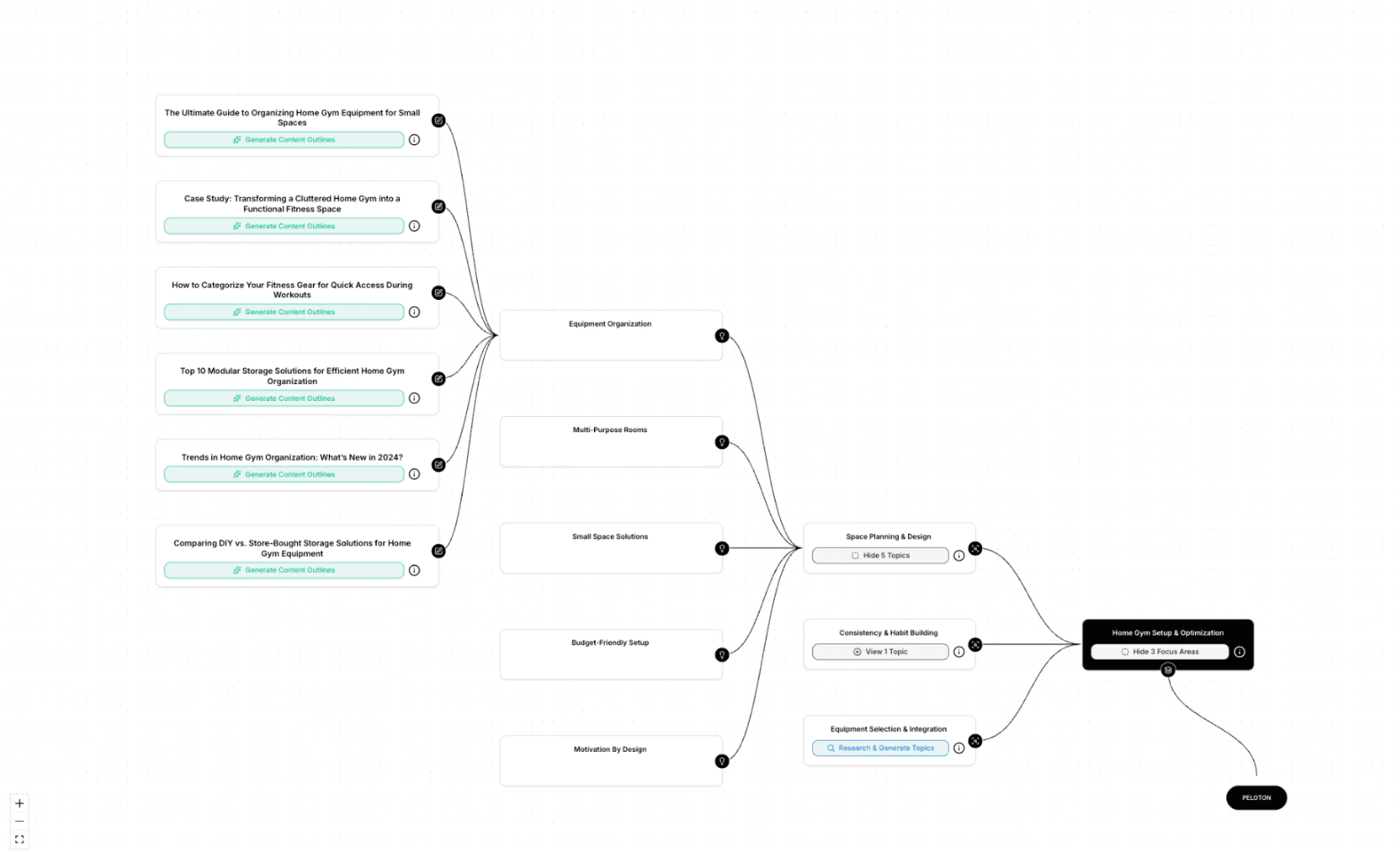
The Strategy Map builds this authority systematically. It organizes your entire content strategy into a layered hierarchy:

Content Pillars → The 5-7 core themes your brand needs to own, mapped to your ICP's pain points and strategic objectives.

Focus Areas → Specific angles within each pillar, each representing a content cluster that builds deep coverage.

Research Overview → Real-time data on trending keywords, top-performing content, and competitive landscape.

Topics → Sub-Topics → Content Outlines → Each layer gets more specific until you're producing individual articles with distinct keyword targets, search intent, and angles — all connected to the larger strategic structure.

Every piece reinforces the pieces around it. Internal links form naturally because the content architecture demands it. Clusters deepen. Rankings compound. And both Google and AI platforms increasingly recognize your brand as the authority on your topics.

This is the same workflow that took Averi from zero organic presence to 1.68 million monthly impressions — not from paid spend or viral moments, but from systematic topical authority building that compounds month after month.

Nearly half of SEO professionals plan to increase investment in authority signals heading into 2026, with 33% specifically focused on improving topical authority and site structure. The Strategy Map makes this accessible to startups that don't have the luxury of massive content teams — because the system itself provides the strategic scaffolding.

Trustworthiness: The Thread That Holds Everything Together

Trust is the foundation on which the other three pillars rest. Without it, experience is anecdote, expertise is posturing, and authority is fragile.

Averi builds trust signals into the content workflow in ways that compound over time:

Consistent brand voice. The Brand Core ensures every piece of content sounds like it came from the same organization with the same values and the same POV. 59.9% of consumers now doubt the authenticity of online content. Consistency — not just in messaging but in perspective — is one of the most powerful trust signals available, and it's the first thing that fragments when content production scales without a system.

Real authors, real credentials. Averi's workflow supports and encourages clear authorship — not AI-generated personas, not anonymous bylines, but real humans with real expertise. Google is increasingly sophisticated at detecting fabricated author identities, and the penalty for getting caught is severe.

Freshness as a feature. Content updated within the past three months averages 6 citations from ChatGPT compared to 3.6 for outdated pages. Averi's content engine includes performance tracking and smart recommendations — not just what to create next, but what to update — ensuring your content library doesn't decay into irrelevance.

Source attribution as architecture. Every piece of content generated through Averi includes hyperlinked citations from authoritative sources. This isn't just about SEO hygiene — it's about building the kind of verification infrastructure that both search engines and AI models use to evaluate trustworthiness. Incorporating cited sources and authoritative language produces measurable improvements in rankings

according to generative search engine studies.

Why E-E-A-T Matters Even More for AI Search

Here's where this gets genuinely interesting — and where the stakes for getting E-E-A-T right become existential.

AI search isn't a future channel. It's a current one. AI platforms generated 1.13 billion referral visits in June 2025 alone, a 357% increase year-over-year. AI Overviews now appear in over 25% of Google searches. Gartner projects that by 2028, 50% of all online searches will involve an AI assistant.

And the traffic these platforms send is disproportionately valuable. AI search visitors convert at 14.2% compared to traditional organic's 2.8% — roughly 5x more valuable per session.

But here's the catch that makes E-E-A-T the linchpin of this entire equation: AI systems don't index content the way search engines traditionally did. They evaluate it.

They assess whether a source is trustworthy enough to cite in a generated answer. They look for the signals that indicate genuine expertise — structured information, authoritative sourcing, comprehensive topic coverage, consistent brand presence.

Domains with strong brand signals and comprehensive topic coverage get up to 10x more AI visibility than those without. Pages with well-organized headings are 2.8x more likely to earn citations in AI search results.

This is E-E-A-T expressed as citation architecture. And it's exactly what the Strategy Map and Averi's content engine are designed to build.

Once an AI system selects a trusted source, it reinforces that choice across related queries — hard-coding winner-takes-most dynamics into its parameters. The brands that establish E-E-A-T-rich content ecosystems now will become the default citations in their categories. Late movers won't just be behind — they'll be structurally disadvantaged.

The Bigger Picture

I've always believed that in a world awash with artificial intelligence, it is the unique ability of the human mind to be outlandish, authentically creative, and deeply original that becomes invaluable.

Taste — not via pattern recognition or algorithmic machine learning, but developed by decades of experience — is the real difference maker.

E-E-A-T, when you strip away the acronym and the SEO jargon, is really just the internet's way of saying the same thing.

Show me you know what you're talking about. Show me you've been there. Show me I can trust you.

The tools we've built at Averi don't manufacture these qualities. No tool can. What they do is create the operational framework that lets these qualities — your experience, your expertise, your accumulated authority, the trust you've earned — actually manifest in the content you produce. Consistently. At scale. Without the chaos that typically comes with trying to do content marketing as a startup.

The Strategy Map handles the architecture.

The Brand Core handles the voice.

The content engine handles the workflow from strategy through publication.

Your job is to bring the one thing no algorithm can replicate: the perspective that comes from doing the work.

We stand at the valley's edge, looking into an unknown future — and I rest easy knowing that those who choose to continue honing true craft, pushing creative boundaries, and building genuine authority will win the day. E-E-A-T isn't a constraint. It's the competitive advantage of being real in an increasingly synthetic world.

And Averi is how you operationalize it.

Start building your E-E-A-T-powered content engine →

Related Resources

E-E-A-T & Content Quality

Strategy Map & Topical Authority

AI Search & GEO Optimization

Content Engine & Workflow

FAQs

What is E-E-A-T and why does it matter for startups?

E-E-A-T stands for Experience, Expertise, Authoritativeness, and Trustworthiness — the criteria Google's Quality Rater Guidelines use to assess content quality. While not a direct ranking factor, E-E-A-T informs the algorithmic signals that determine search visibility. For startups, E-E-A-T matters because it's the mechanism by which smaller brands can outcompete larger ones — you don't need the biggest domain, you need the deepest coverage and the most credible voice on the topics your audience cares about.

How does Averi specifically help build E-E-A-T signals?

Averi builds E-E-A-T into every stage of the content workflow. The Brand Core captures your unique experience and positioning so every draft starts from your foundation. Research-backed drafting includes hyperlinked authoritative sources by default. The Strategy Map constructs the topical authority architecture — interconnected content clusters — that Google and AI platforms reward as authoritativeness signals. And consistent voice, clear authorship, and freshness monitoring build the trustworthiness layer over time.

What is the Strategy Map and how does it relate to E-E-A-T?

The Strategy Map is Averi's visual, AI-powered content strategy system that organizes your entire content engine into a layered hierarchy — from content pillars down to individual articles. It builds E-E-A-T by creating systematic topical authority: the single strongest on-page ranking factor according to analysis of 253,800+ search results. Each piece of content reinforces the pieces around it, building the depth of coverage that signals expertise and authoritativeness to both search engines and AI platforms.

Does AI-generated content hurt E-E-A-T?

Not inherently — but generic AI content absolutely does. 86% of top-ranking pages are still human-authored, and 52% of consumers reduce engagement when they suspect AI-generated content. The key is how AI is used. Averi's approach treats AI as infrastructure for the structural work — research, formatting, keyword mapping, competitive analysis — while preserving space for human experience, voice, and editorial judgment. Original content with human oversight delivered the strongest SEO impact in 2025 according to 66% of respondents.

How does E-E-A-T affect AI search visibility specifically?

AI platforms like ChatGPT, Perplexity, and Google AI Overviews evaluate E-E-A-T signals before deciding whether to cite a source. Domains with strong brand signals and comprehensive topic coverage get up to 10x more AI visibility. Content updated within three months earns nearly twice as many citations from AI systems. And since AI search visitors convert at 14.2% vs. traditional organic's 2.8%, the revenue impact of strong E-E-A-T in AI search is substantial.

Can small teams realistically build E-E-A-T at scale?

Yes — with the right system. E-E-A-T doesn't require massive content teams. It requires a systematic approach to topical authority building, consistent brand voice, and regular content production backed by credible sources. The Strategy Map provides the strategic scaffolding, the Brand Core maintains consistency, and the content engine handles the workflow from research through publication. This is the exact system that drove Averi's own growth from zero to 1.68 million monthly impressions in 10 months — with a lean team.

How long does it take to see E-E-A-T improvements in rankings?

Foundational E-E-A-T work — author bios, schema markup, content restructuring, Brand Core setup — takes 2-4 weeks to implement. Building topical authority through consistent content cluster development takes 3-6 months to show compounding results. Most brands using Averi's Strategy Map see measurable improvements in organic visibility within 90 days of systematic publishing. The key insight is that E-E-A-T compounds: each piece of quality, well-connected content makes every other piece stronger.


Continue Reading

The latest handpicked blog articles

Experience The AI Content Engine

Already have an account?

Don't Feed the Algorithm

“Top 3 tech + AI newsletters in the country. Always sharp, always actionable.”

"Genuinely my favorite newsletter in tech. No fluff, no cheesy ads, just great content."

“Clear, practical, and on-point. Helps me keep up without drowning in noise.”

User-Generated Content & Authenticity in the Age of AI

Zach Chmael

Head of Marketing

5 minutes

In This Article

E-E-A-T has become critical for Answer Engine Optimization — the practice of ensuring AI models recognize your brand as a trustworthy source worth citing. AI platforms evaluate signals of credibility, relevance, and expertise before deciding which sources to reference in generated answers. A site that clearly displays author credentials, verifiable sources, and consistent expert positioning sends the signals these systems need.

Don’t Feed the Algorithm

The algorithm never sleeps, but you don’t have to feed it — Join our weekly newsletter for real insights on AI, human creativity & marketing execution.

TL;DR

  • 🧠 E-E-A-T — Experience, Expertise, Authoritativeness, Trustworthiness — has evolved from a quality guideline into the gatekeeper of modern search visibility, and sites that demonstrate these signals are seeing 23% traffic gains while generic content farms crater.

  • 🌊 The web is drowning in AI slop. 74.2% of new web pages now contain AI-generated content, and a Europol report warned that up to 90% of online content could be synthetically generated by 2026. E-E-A-T is how you prove you're not part of the noise.

  • 🏗️ Averi builds E-E-A-T into the workflow, not as an afterthought. From Brand Core that embeds your unique positioning into every draft, to the new Strategy Map that constructs the topical authority architecture Google and AI platforms reward, the platform operationalizes trust at scale.

  • 📊 Topical authority — the kind the Strategy Map builds — is now the single strongest on-page ranking factor, surpassing even domain traffic according to analysis of over 253,800 search results.

  • 🤖 AI search compounds the E-E-A-T imperative. AI search visitors convert at 14.2% vs. organic's 2.8%, making AI-referred traffic roughly 5x more valuable — but only for brands with the depth and trust signals that earn citations.

  • 🚀 The result? A content engine that doesn't just produce content, but produces credible content — the kind both humans and machines trust enough to cite, share, and act on.

"We built Averi around the exact workflow we've used to scale our web traffic over 6000% in the last 6 months."

founder-image
founder-image
Your content should be working harder.

Averi's content engine builds Google entity authority, drives AI citations, and scales your visibility so you can get more customers.

How Averi Helps You Build E-E-A-T (Without Losing Your Soul to the Content Machine)

The Web Has a Trust Problem. E-E-A-T Is the Antidote.

Here's something that most AI marketing tools would rather you not think about: the more content AI produces, the less any individual piece of it matters.

We are, at this very moment, living through the largest content inflation event in human history.

Ahrefs analyzed nearly 900,000 new web pages published in April 2025 and found that 74.2% contained detectable AI-generated content. Graphite's analysis of over 65,000 articles found that by late 2024, more than half of new English-language articles were primarily AI-written — up from just 5% before ChatGPT launched.

And the trajectory is only steepening.

Yet here's the paradox that should keep every marketer up at night… despite this tidal wave of synthetic content, 86% of the top-ranking pages in Google are still human-authored. Among AI assistants like ChatGPT and Perplexity, the ratio is nearly identical — 82% human to 18% AI.

The volume of AI content is exploding. Its share of the results that matter is not.

This is where E-E-A-T enters the conversation — not as some checkbox framework that SEO consultants trot out at conferences, but as the fundamental mechanism by which the internet is now sorting signal from noise.

Experience. Expertise. Authoritativeness. Trustworthiness.

Google introduced the framework in its Quality Rater Guidelines, and while E-E-A-T isn't technically a direct ranking factor, it informs the algorithmic signals that determine whether your content rises or drowns.

The distinction is academic. The impact is not.

After Google's December 2025 Core Update, sites demonstrating genuine experience and expertise saw 23% traffic gains. Generic content farms experienced the opposite. The algorithm is learning to read taste — or at least its closest approximation in structured data and semantic patterns.

And this matters even more in the age of AI search.

E-E-A-T has become critical for Answer Engine Optimization — the practice of ensuring AI models recognize your brand as a trustworthy source worth citing. AI platforms evaluate signals of credibility, relevance, and expertise before deciding which sources to reference in generated answers. A site that clearly displays author credentials, verifiable sources, and consistent expert positioning sends the signals these systems need.

The question is no longer whether E-E-A-T matters. It's whether your content workflow is designed to produce it — consistently, at scale, without burning your team alive.

Why Most Teams Fail at E-E-A-T (And Why It's Not Their Fault)

Let's be honest about something.

The idea of E-E-A-T is simple. Show that you know what you're talking about. Prove that you've done the thing. Build the kind of reputation that makes both humans and machines trust you.

The execution of E-E-A-T is where everything falls apart — because execution requires a system, and most content workflows are anything but systematic.

Consider the structural requirements of E-E-A-T in practice. Experience demands first-hand perspective woven into the content itself — the kind you can't fake with a prompt.

Expertise requires depth: cited sources, original data, in-context analysis that goes beyond surface-level regurgitation.

Authoritativeness needs topical breadth: interconnected content clusters that signal to both Google and AI platforms that you don't just know one thing, you know the territory.

Trustworthiness ties it all together: real author bios, consistent publishing, transparent methodology, fresh information.

Now ask yourself… how many of these signals does a typical content workflow produce by default?

The answer, for most startups, is approximately zero.

Only 43% of B2B marketers have a documented content strategy guiding their efforts, despite 91% of global brands using content marketing in some form. 54% of marketers cite a lack of resources as their biggest content challenge. 66.5% struggle with knowing where to allocate resources, and the top frustration in 2025 was getting content to rank at all — cited by 77.6% of respondents.

This isn't a talent problem. This is a systems problem.

And you don't solve systems problems by hiring another freelance writer or buying another AI writing tool that produces the same interchangeable paste as every other AI writing tool on the market.

You solve it by building E-E-A-T into the workflow itself.

How Averi Builds E-E-A-T Into the Content Engine

When we built Averi, we didn't start from the question "how do we generate content faster?" — the question that seems to obsess every other AI tool on the market.

We started from a different question entirely: "how do we build the kind of content that earns trust?"

That distinction matters more than you might think. Speed without credibility is just noise with a schedule. And noise, no matter how efficiently produced, does not build the authority that modern search — both traditional and AI-powered — now demands.

Here's how Averi's content engine maps to each pillar of E-E-A-T:

Experience: Your Voice, Your Story, Your Platform

The first E in E-E-A-T — Experience — is the one that AI content tools handle worst. And for good reason.

Experience is, by definition, the thing that can't be synthesized. It's the founder who spent three years in the trenches before writing about product-market fit. It's the marketer who burned through $200K in ad spend before sharing what actually works.

Averi doesn't pretend to replace this. What it does is create the conditions for human experience to actually make it into the content.

The Brand Core system captures your unique positioning, voice, POV, and brand story during onboarding. This isn't a style dropdown or a tone slider. It's the contextual DNA of your brand — the accumulated experience, the hard-won insights, the specific way you see the world — encoded into the system so that every piece of content starts from your foundation rather than a blank, generic prompt.

When you edit and refine drafts in Averi's editor, you're adding the first-hand perspective that machines can't fabricate. The platform handles the structural heavy lifting — research, keyword mapping, competitive intelligence, formatting — so you can spend your time on what actually differentiates your content: your experience.

This is the paradox of AI in content marketing, and it's one I think about constantly. 52% of consumers reduce engagement when they suspect AI-generated content, and there's a 44-percentage-point gap between how marketers and consumers perceive AI's ability to craft emotionally resonant content.

The solution isn't less AI — it's AI designed to amplify what makes you human rather than erase it.

Expertise: Depth Over Volume, Every Time

Expertise in the E-E-A-T framework means demonstrated knowledge. Not claimed knowledge. Not keyword-stuffed knowledge. The kind of knowledge that manifests in how content is structured, what sources it cites, how it handles nuance, and whether it actually teaches the reader something they didn't know before.

Averi operationalizes expertise through several mechanisms:

Research-backed drafting. Every content piece generated through Averi's workflow includes hyperlinked sources from authoritative publications — not as an afterthought, but as a structural component of how the content is built. Content featuring original statistics and research findings sees 30-40% higher visibility in LLM responses. The platform ensures this is the default, not the exception.

Keyword intelligence at every layer. The Strategy Map — our new visual content strategy system — provides research overviews at every level, surfacing trending keywords, top-performing content, and competitive intelligence so content decisions are driven by data rather than gut feeling. This means your expertise is demonstrated on the topics that actually matter to your audience, not just the ones you happen to think of on a Tuesday morning.

Structured for extraction. LLMs are 28-40% more likely to cite content that includes clear formatting — hierarchical headings, bullet points, tables, FAQ sections. Averi's content generation follows SEO and GEO best practices by default, structuring your expertise in the format that both search engines and AI systems can parse, evaluate, and cite.

Authoritativeness: The Strategy Map and the Architecture of Trust

Authority isn't something you claim. It's something the internet confers upon you when your content coverage is so deep and so interconnected that both humans and machines recognize you as the definitive source on a topic.

This is where the Strategy Map fundamentally changes the game.

Topical authority — the depth and breadth of your content coverage around a specific subject — is now the defining factor in how search engines evaluate and rank websites. A study of over 253,800 search results found that page-level topical authority is the single strongest on-page ranking factor for Google rankings, surpassing even domain traffic. This finding alone should restructure how every startup thinks about content.

The Strategy Map builds this authority systematically. It organizes your entire content strategy into a layered hierarchy:

Content Pillars → The 5-7 core themes your brand needs to own, mapped to your ICP's pain points and strategic objectives.

Focus Areas → Specific angles within each pillar, each representing a content cluster that builds deep coverage.

Research Overview → Real-time data on trending keywords, top-performing content, and competitive landscape.

Topics → Sub-Topics → Content Outlines → Each layer gets more specific until you're producing individual articles with distinct keyword targets, search intent, and angles — all connected to the larger strategic structure.

Every piece reinforces the pieces around it. Internal links form naturally because the content architecture demands it. Clusters deepen. Rankings compound. And both Google and AI platforms increasingly recognize your brand as the authority on your topics.

This is the same workflow that took Averi from zero organic presence to 1.68 million monthly impressions — not from paid spend or viral moments, but from systematic topical authority building that compounds month after month.

Nearly half of SEO professionals plan to increase investment in authority signals heading into 2026, with 33% specifically focused on improving topical authority and site structure. The Strategy Map makes this accessible to startups that don't have the luxury of massive content teams — because the system itself provides the strategic scaffolding.

Trustworthiness: The Thread That Holds Everything Together

Trust is the foundation on which the other three pillars rest. Without it, experience is anecdote, expertise is posturing, and authority is fragile.

Averi builds trust signals into the content workflow in ways that compound over time:

Consistent brand voice. The Brand Core ensures every piece of content sounds like it came from the same organization with the same values and the same POV. 59.9% of consumers now doubt the authenticity of online content. Consistency — not just in messaging but in perspective — is one of the most powerful trust signals available, and it's the first thing that fragments when content production scales without a system.

Real authors, real credentials. Averi's workflow supports and encourages clear authorship — not AI-generated personas, not anonymous bylines, but real humans with real expertise. Google is increasingly sophisticated at detecting fabricated author identities, and the penalty for getting caught is severe.

Freshness as a feature. Content updated within the past three months averages 6 citations from ChatGPT compared to 3.6 for outdated pages. Averi's content engine includes performance tracking and smart recommendations — not just what to create next, but what to update — ensuring your content library doesn't decay into irrelevance.

Source attribution as architecture. Every piece of content generated through Averi includes hyperlinked citations from authoritative sources. This isn't just about SEO hygiene — it's about building the kind of verification infrastructure that both search engines and AI models use to evaluate trustworthiness. Incorporating cited sources and authoritative language produces measurable improvements in rankings

according to generative search engine studies.

Why E-E-A-T Matters Even More for AI Search

Here's where this gets genuinely interesting — and where the stakes for getting E-E-A-T right become existential.

AI search isn't a future channel. It's a current one. AI platforms generated 1.13 billion referral visits in June 2025 alone, a 357% increase year-over-year. AI Overviews now appear in over 25% of Google searches. Gartner projects that by 2028, 50% of all online searches will involve an AI assistant.

And the traffic these platforms send is disproportionately valuable. AI search visitors convert at 14.2% compared to traditional organic's 2.8% — roughly 5x more valuable per session.

But here's the catch that makes E-E-A-T the linchpin of this entire equation: AI systems don't index content the way search engines traditionally did. They evaluate it.

They assess whether a source is trustworthy enough to cite in a generated answer. They look for the signals that indicate genuine expertise — structured information, authoritative sourcing, comprehensive topic coverage, consistent brand presence.

Domains with strong brand signals and comprehensive topic coverage get up to 10x more AI visibility than those without. Pages with well-organized headings are 2.8x more likely to earn citations in AI search results.

This is E-E-A-T expressed as citation architecture. And it's exactly what the Strategy Map and Averi's content engine are designed to build.

Once an AI system selects a trusted source, it reinforces that choice across related queries — hard-coding winner-takes-most dynamics into its parameters. The brands that establish E-E-A-T-rich content ecosystems now will become the default citations in their categories. Late movers won't just be behind — they'll be structurally disadvantaged.

The Bigger Picture

I've always believed that in a world awash with artificial intelligence, it is the unique ability of the human mind to be outlandish, authentically creative, and deeply original that becomes invaluable.

Taste — not via pattern recognition or algorithmic machine learning, but developed by decades of experience — is the real difference maker.

E-E-A-T, when you strip away the acronym and the SEO jargon, is really just the internet's way of saying the same thing.

Show me you know what you're talking about. Show me you've been there. Show me I can trust you.

The tools we've built at Averi don't manufacture these qualities. No tool can. What they do is create the operational framework that lets these qualities — your experience, your expertise, your accumulated authority, the trust you've earned — actually manifest in the content you produce. Consistently. At scale. Without the chaos that typically comes with trying to do content marketing as a startup.

The Strategy Map handles the architecture.

The Brand Core handles the voice.

The content engine handles the workflow from strategy through publication.

Your job is to bring the one thing no algorithm can replicate: the perspective that comes from doing the work.

We stand at the valley's edge, looking into an unknown future — and I rest easy knowing that those who choose to continue honing true craft, pushing creative boundaries, and building genuine authority will win the day. E-E-A-T isn't a constraint. It's the competitive advantage of being real in an increasingly synthetic world.

And Averi is how you operationalize it.

Start building your E-E-A-T-powered content engine →

Related Resources

E-E-A-T & Content Quality

Strategy Map & Topical Authority

AI Search & GEO Optimization

Content Engine & Workflow

Continue Reading

The latest handpicked blog articles

Don't Feed the Algorithm

“Top 3 tech + AI newsletters in the country. Always sharp, always actionable.”

"Genuinely my favorite newsletter in tech. No fluff, no cheesy ads, just great content."

“Clear, practical, and on-point. Helps me keep up without drowning in noise.”

Don't Feed the Algorithm

“Top 3 tech + AI newsletters in the country. Always sharp, always actionable.”

"Genuinely my favorite newsletter in tech. No fluff, no cheesy ads, just great content."

“Clear, practical, and on-point. Helps me keep up without drowning in noise.”

User-Generated Content & Authenticity in the Age of AI

Zach Chmael

Head of Marketing

5 minutes

In This Article

E-E-A-T has become critical for Answer Engine Optimization — the practice of ensuring AI models recognize your brand as a trustworthy source worth citing. AI platforms evaluate signals of credibility, relevance, and expertise before deciding which sources to reference in generated answers. A site that clearly displays author credentials, verifiable sources, and consistent expert positioning sends the signals these systems need.

Don’t Feed the Algorithm

The algorithm never sleeps, but you don’t have to feed it — Join our weekly newsletter for real insights on AI, human creativity & marketing execution.

How Averi Helps You Build E-E-A-T (Without Losing Your Soul to the Content Machine)

The Web Has a Trust Problem. E-E-A-T Is the Antidote.

Here's something that most AI marketing tools would rather you not think about: the more content AI produces, the less any individual piece of it matters.

We are, at this very moment, living through the largest content inflation event in human history.

Ahrefs analyzed nearly 900,000 new web pages published in April 2025 and found that 74.2% contained detectable AI-generated content. Graphite's analysis of over 65,000 articles found that by late 2024, more than half of new English-language articles were primarily AI-written — up from just 5% before ChatGPT launched.

And the trajectory is only steepening.

Yet here's the paradox that should keep every marketer up at night… despite this tidal wave of synthetic content, 86% of the top-ranking pages in Google are still human-authored. Among AI assistants like ChatGPT and Perplexity, the ratio is nearly identical — 82% human to 18% AI.

The volume of AI content is exploding. Its share of the results that matter is not.

This is where E-E-A-T enters the conversation — not as some checkbox framework that SEO consultants trot out at conferences, but as the fundamental mechanism by which the internet is now sorting signal from noise.

Experience. Expertise. Authoritativeness. Trustworthiness.

Google introduced the framework in its Quality Rater Guidelines, and while E-E-A-T isn't technically a direct ranking factor, it informs the algorithmic signals that determine whether your content rises or drowns.

The distinction is academic. The impact is not.

After Google's December 2025 Core Update, sites demonstrating genuine experience and expertise saw 23% traffic gains. Generic content farms experienced the opposite. The algorithm is learning to read taste — or at least its closest approximation in structured data and semantic patterns.

And this matters even more in the age of AI search.

E-E-A-T has become critical for Answer Engine Optimization — the practice of ensuring AI models recognize your brand as a trustworthy source worth citing. AI platforms evaluate signals of credibility, relevance, and expertise before deciding which sources to reference in generated answers. A site that clearly displays author credentials, verifiable sources, and consistent expert positioning sends the signals these systems need.

The question is no longer whether E-E-A-T matters. It's whether your content workflow is designed to produce it — consistently, at scale, without burning your team alive.

Why Most Teams Fail at E-E-A-T (And Why It's Not Their Fault)

Let's be honest about something.

The idea of E-E-A-T is simple. Show that you know what you're talking about. Prove that you've done the thing. Build the kind of reputation that makes both humans and machines trust you.

The execution of E-E-A-T is where everything falls apart — because execution requires a system, and most content workflows are anything but systematic.

Consider the structural requirements of E-E-A-T in practice. Experience demands first-hand perspective woven into the content itself — the kind you can't fake with a prompt.

Expertise requires depth: cited sources, original data, in-context analysis that goes beyond surface-level regurgitation.

Authoritativeness needs topical breadth: interconnected content clusters that signal to both Google and AI platforms that you don't just know one thing, you know the territory.

Trustworthiness ties it all together: real author bios, consistent publishing, transparent methodology, fresh information.

Now ask yourself… how many of these signals does a typical content workflow produce by default?

The answer, for most startups, is approximately zero.

Only 43% of B2B marketers have a documented content strategy guiding their efforts, despite 91% of global brands using content marketing in some form. 54% of marketers cite a lack of resources as their biggest content challenge. 66.5% struggle with knowing where to allocate resources, and the top frustration in 2025 was getting content to rank at all — cited by 77.6% of respondents.

This isn't a talent problem. This is a systems problem.

And you don't solve systems problems by hiring another freelance writer or buying another AI writing tool that produces the same interchangeable paste as every other AI writing tool on the market.

You solve it by building E-E-A-T into the workflow itself.

How Averi Builds E-E-A-T Into the Content Engine

When we built Averi, we didn't start from the question "how do we generate content faster?" — the question that seems to obsess every other AI tool on the market.

We started from a different question entirely: "how do we build the kind of content that earns trust?"

That distinction matters more than you might think. Speed without credibility is just noise with a schedule. And noise, no matter how efficiently produced, does not build the authority that modern search — both traditional and AI-powered — now demands.

Here's how Averi's content engine maps to each pillar of E-E-A-T:

Experience: Your Voice, Your Story, Your Platform

The first E in E-E-A-T — Experience — is the one that AI content tools handle worst. And for good reason.

Experience is, by definition, the thing that can't be synthesized. It's the founder who spent three years in the trenches before writing about product-market fit. It's the marketer who burned through $200K in ad spend before sharing what actually works.

Averi doesn't pretend to replace this. What it does is create the conditions for human experience to actually make it into the content.

The Brand Core system captures your unique positioning, voice, POV, and brand story during onboarding. This isn't a style dropdown or a tone slider. It's the contextual DNA of your brand — the accumulated experience, the hard-won insights, the specific way you see the world — encoded into the system so that every piece of content starts from your foundation rather than a blank, generic prompt.

When you edit and refine drafts in Averi's editor, you're adding the first-hand perspective that machines can't fabricate. The platform handles the structural heavy lifting — research, keyword mapping, competitive intelligence, formatting — so you can spend your time on what actually differentiates your content: your experience.

This is the paradox of AI in content marketing, and it's one I think about constantly. 52% of consumers reduce engagement when they suspect AI-generated content, and there's a 44-percentage-point gap between how marketers and consumers perceive AI's ability to craft emotionally resonant content.

The solution isn't less AI — it's AI designed to amplify what makes you human rather than erase it.

Expertise: Depth Over Volume, Every Time

Expertise in the E-E-A-T framework means demonstrated knowledge. Not claimed knowledge. Not keyword-stuffed knowledge. The kind of knowledge that manifests in how content is structured, what sources it cites, how it handles nuance, and whether it actually teaches the reader something they didn't know before.

Averi operationalizes expertise through several mechanisms:

Research-backed drafting. Every content piece generated through Averi's workflow includes hyperlinked sources from authoritative publications — not as an afterthought, but as a structural component of how the content is built. Content featuring original statistics and research findings sees 30-40% higher visibility in LLM responses. The platform ensures this is the default, not the exception.

Keyword intelligence at every layer. The Strategy Map — our new visual content strategy system — provides research overviews at every level, surfacing trending keywords, top-performing content, and competitive intelligence so content decisions are driven by data rather than gut feeling. This means your expertise is demonstrated on the topics that actually matter to your audience, not just the ones you happen to think of on a Tuesday morning.

Structured for extraction. LLMs are 28-40% more likely to cite content that includes clear formatting — hierarchical headings, bullet points, tables, FAQ sections. Averi's content generation follows SEO and GEO best practices by default, structuring your expertise in the format that both search engines and AI systems can parse, evaluate, and cite.

Authoritativeness: The Strategy Map and the Architecture of Trust

Authority isn't something you claim. It's something the internet confers upon you when your content coverage is so deep and so interconnected that both humans and machines recognize you as the definitive source on a topic.

This is where the Strategy Map fundamentally changes the game.

Topical authority — the depth and breadth of your content coverage around a specific subject — is now the defining factor in how search engines evaluate and rank websites. A study of over 253,800 search results found that page-level topical authority is the single strongest on-page ranking factor for Google rankings, surpassing even domain traffic. This finding alone should restructure how every startup thinks about content.

The Strategy Map builds this authority systematically. It organizes your entire content strategy into a layered hierarchy:

Content Pillars → The 5-7 core themes your brand needs to own, mapped to your ICP's pain points and strategic objectives.

Focus Areas → Specific angles within each pillar, each representing a content cluster that builds deep coverage.

Research Overview → Real-time data on trending keywords, top-performing content, and competitive landscape.

Topics → Sub-Topics → Content Outlines → Each layer gets more specific until you're producing individual articles with distinct keyword targets, search intent, and angles — all connected to the larger strategic structure.

Every piece reinforces the pieces around it. Internal links form naturally because the content architecture demands it. Clusters deepen. Rankings compound. And both Google and AI platforms increasingly recognize your brand as the authority on your topics.

This is the same workflow that took Averi from zero organic presence to 1.68 million monthly impressions — not from paid spend or viral moments, but from systematic topical authority building that compounds month after month.

Nearly half of SEO professionals plan to increase investment in authority signals heading into 2026, with 33% specifically focused on improving topical authority and site structure. The Strategy Map makes this accessible to startups that don't have the luxury of massive content teams — because the system itself provides the strategic scaffolding.

Trustworthiness: The Thread That Holds Everything Together

Trust is the foundation on which the other three pillars rest. Without it, experience is anecdote, expertise is posturing, and authority is fragile.

Averi builds trust signals into the content workflow in ways that compound over time:

Consistent brand voice. The Brand Core ensures every piece of content sounds like it came from the same organization with the same values and the same POV. 59.9% of consumers now doubt the authenticity of online content. Consistency — not just in messaging but in perspective — is one of the most powerful trust signals available, and it's the first thing that fragments when content production scales without a system.

Real authors, real credentials. Averi's workflow supports and encourages clear authorship — not AI-generated personas, not anonymous bylines, but real humans with real expertise. Google is increasingly sophisticated at detecting fabricated author identities, and the penalty for getting caught is severe.

Freshness as a feature. Content updated within the past three months averages 6 citations from ChatGPT compared to 3.6 for outdated pages. Averi's content engine includes performance tracking and smart recommendations — not just what to create next, but what to update — ensuring your content library doesn't decay into irrelevance.

Source attribution as architecture. Every piece of content generated through Averi includes hyperlinked citations from authoritative sources. This isn't just about SEO hygiene — it's about building the kind of verification infrastructure that both search engines and AI models use to evaluate trustworthiness. Incorporating cited sources and authoritative language produces measurable improvements in rankings

according to generative search engine studies.

Why E-E-A-T Matters Even More for AI Search

Here's where this gets genuinely interesting — and where the stakes for getting E-E-A-T right become existential.

AI search isn't a future channel. It's a current one. AI platforms generated 1.13 billion referral visits in June 2025 alone, a 357% increase year-over-year. AI Overviews now appear in over 25% of Google searches. Gartner projects that by 2028, 50% of all online searches will involve an AI assistant.

And the traffic these platforms send is disproportionately valuable. AI search visitors convert at 14.2% compared to traditional organic's 2.8% — roughly 5x more valuable per session.

But here's the catch that makes E-E-A-T the linchpin of this entire equation: AI systems don't index content the way search engines traditionally did. They evaluate it.

They assess whether a source is trustworthy enough to cite in a generated answer. They look for the signals that indicate genuine expertise — structured information, authoritative sourcing, comprehensive topic coverage, consistent brand presence.

Domains with strong brand signals and comprehensive topic coverage get up to 10x more AI visibility than those without. Pages with well-organized headings are 2.8x more likely to earn citations in AI search results.

This is E-E-A-T expressed as citation architecture. And it's exactly what the Strategy Map and Averi's content engine are designed to build.

Once an AI system selects a trusted source, it reinforces that choice across related queries — hard-coding winner-takes-most dynamics into its parameters. The brands that establish E-E-A-T-rich content ecosystems now will become the default citations in their categories. Late movers won't just be behind — they'll be structurally disadvantaged.

The Bigger Picture

I've always believed that in a world awash with artificial intelligence, it is the unique ability of the human mind to be outlandish, authentically creative, and deeply original that becomes invaluable.

Taste — not via pattern recognition or algorithmic machine learning, but developed by decades of experience — is the real difference maker.

E-E-A-T, when you strip away the acronym and the SEO jargon, is really just the internet's way of saying the same thing.

Show me you know what you're talking about. Show me you've been there. Show me I can trust you.

The tools we've built at Averi don't manufacture these qualities. No tool can. What they do is create the operational framework that lets these qualities — your experience, your expertise, your accumulated authority, the trust you've earned — actually manifest in the content you produce. Consistently. At scale. Without the chaos that typically comes with trying to do content marketing as a startup.

The Strategy Map handles the architecture.

The Brand Core handles the voice.

The content engine handles the workflow from strategy through publication.

Your job is to bring the one thing no algorithm can replicate: the perspective that comes from doing the work.

We stand at the valley's edge, looking into an unknown future — and I rest easy knowing that those who choose to continue honing true craft, pushing creative boundaries, and building genuine authority will win the day. E-E-A-T isn't a constraint. It's the competitive advantage of being real in an increasingly synthetic world.

And Averi is how you operationalize it.

Start building your E-E-A-T-powered content engine →

Related Resources

E-E-A-T & Content Quality

Strategy Map & Topical Authority

AI Search & GEO Optimization

Content Engine & Workflow

"We built Averi around the exact workflow we've used to scale our web traffic over 6000% in the last 6 months."

founder-image
founder-image
Your content should be working harder.

Averi's content engine builds Google entity authority, drives AI citations, and scales your visibility so you can get more customers.

FAQs

Foundational E-E-A-T work — author bios, schema markup, content restructuring, Brand Core setup — takes 2-4 weeks to implement. Building topical authority through consistent content cluster development takes 3-6 months to show compounding results. Most brands using Averi's Strategy Map see measurable improvements in organic visibility within 90 days of systematic publishing. The key insight is that E-E-A-T compounds: each piece of quality, well-connected content makes every other piece stronger.

How long does it take to see E-E-A-T improvements in rankings?

Yes — with the right system. E-E-A-T doesn't require massive content teams. It requires a systematic approach to topical authority building, consistent brand voice, and regular content production backed by credible sources. The Strategy Map provides the strategic scaffolding, the Brand Core maintains consistency, and the content engine handles the workflow from research through publication. This is the exact system that drove Averi's own growth from zero to 1.68 million monthly impressions in 10 months — with a lean team.

Can small teams realistically build E-E-A-T at scale?

AI platforms like ChatGPT, Perplexity, and Google AI Overviews evaluate E-E-A-T signals before deciding whether to cite a source. Domains with strong brand signals and comprehensive topic coverage get up to 10x more AI visibility. Content updated within three months earns nearly twice as many citations from AI systems. And since AI search visitors convert at 14.2% vs. traditional organic's 2.8%, the revenue impact of strong E-E-A-T in AI search is substantial.

How does E-E-A-T affect AI search visibility specifically?

Not inherently — but generic AI content absolutely does. 86% of top-ranking pages are still human-authored, and 52% of consumers reduce engagement when they suspect AI-generated content. The key is how AI is used. Averi's approach treats AI as infrastructure for the structural work — research, formatting, keyword mapping, competitive analysis — while preserving space for human experience, voice, and editorial judgment. Original content with human oversight delivered the strongest SEO impact in 2025 according to 66% of respondents.

Does AI-generated content hurt E-E-A-T?

The Strategy Map is Averi's visual, AI-powered content strategy system that organizes your entire content engine into a layered hierarchy — from content pillars down to individual articles. It builds E-E-A-T by creating systematic topical authority: the single strongest on-page ranking factor according to analysis of 253,800+ search results. Each piece of content reinforces the pieces around it, building the depth of coverage that signals expertise and authoritativeness to both search engines and AI platforms.

What is the Strategy Map and how does it relate to E-E-A-T?

Averi builds E-E-A-T into every stage of the content workflow. The Brand Core captures your unique experience and positioning so every draft starts from your foundation. Research-backed drafting includes hyperlinked authoritative sources by default. The Strategy Map constructs the topical authority architecture — interconnected content clusters — that Google and AI platforms reward as authoritativeness signals. And consistent voice, clear authorship, and freshness monitoring build the trustworthiness layer over time.

How does Averi specifically help build E-E-A-T signals?

E-E-A-T stands for Experience, Expertise, Authoritativeness, and Trustworthiness — the criteria Google's Quality Rater Guidelines use to assess content quality. While not a direct ranking factor, E-E-A-T informs the algorithmic signals that determine search visibility. For startups, E-E-A-T matters because it's the mechanism by which smaller brands can outcompete larger ones — you don't need the biggest domain, you need the deepest coverage and the most credible voice on the topics your audience cares about.

What is E-E-A-T and why does it matter for startups?

FAQs

How long does it take to see SEO results for B2B SaaS?

Expect 7 months to break-even on average, with meaningful traffic improvements typically appearing within 3-6 months. Link building results appear within 1-6 months. The key is consistency—companies that stop and start lose ground to those who execute continuously.

Is AI-generated content actually good for SEO?

62% of marketers report higher SERP rankings for AI-generated content—but only when properly edited and enhanced with human expertise. Pure AI content without human refinement often lacks the originality and depth that both readers and algorithms prefer.

Is AI-generated content actually good for SEO?

62% of marketers report higher SERP rankings for AI-generated content—but only when properly edited and enhanced with human expertise. Pure AI content without human refinement often lacks the originality and depth that both readers and algorithms prefer.

Is AI-generated content actually good for SEO?

62% of marketers report higher SERP rankings for AI-generated content—but only when properly edited and enhanced with human expertise. Pure AI content without human refinement often lacks the originality and depth that both readers and algorithms prefer.

Is AI-generated content actually good for SEO?

62% of marketers report higher SERP rankings for AI-generated content—but only when properly edited and enhanced with human expertise. Pure AI content without human refinement often lacks the originality and depth that both readers and algorithms prefer.

Is AI-generated content actually good for SEO?

62% of marketers report higher SERP rankings for AI-generated content—but only when properly edited and enhanced with human expertise. Pure AI content without human refinement often lacks the originality and depth that both readers and algorithms prefer.

Is AI-generated content actually good for SEO?

62% of marketers report higher SERP rankings for AI-generated content—but only when properly edited and enhanced with human expertise. Pure AI content without human refinement often lacks the originality and depth that both readers and algorithms prefer.

Is AI-generated content actually good for SEO?

62% of marketers report higher SERP rankings for AI-generated content—but only when properly edited and enhanced with human expertise. Pure AI content without human refinement often lacks the originality and depth that both readers and algorithms prefer.

TL;DR

  • 🧠 E-E-A-T — Experience, Expertise, Authoritativeness, Trustworthiness — has evolved from a quality guideline into the gatekeeper of modern search visibility, and sites that demonstrate these signals are seeing 23% traffic gains while generic content farms crater.

  • 🌊 The web is drowning in AI slop. 74.2% of new web pages now contain AI-generated content, and a Europol report warned that up to 90% of online content could be synthetically generated by 2026. E-E-A-T is how you prove you're not part of the noise.

  • 🏗️ Averi builds E-E-A-T into the workflow, not as an afterthought. From Brand Core that embeds your unique positioning into every draft, to the new Strategy Map that constructs the topical authority architecture Google and AI platforms reward, the platform operationalizes trust at scale.

  • 📊 Topical authority — the kind the Strategy Map builds — is now the single strongest on-page ranking factor, surpassing even domain traffic according to analysis of over 253,800 search results.

  • 🤖 AI search compounds the E-E-A-T imperative. AI search visitors convert at 14.2% vs. organic's 2.8%, making AI-referred traffic roughly 5x more valuable — but only for brands with the depth and trust signals that earn citations.

  • 🚀 The result? A content engine that doesn't just produce content, but produces credible content — the kind both humans and machines trust enough to cite, share, and act on.

Continue Reading

The latest handpicked blog articles

Don't Feed the Algorithm

“Top 3 tech + AI newsletters in the country. Always sharp, always actionable.”

"Genuinely my favorite newsletter in tech. No fluff, no cheesy ads, just great content."

“Clear, practical, and on-point. Helps me keep up without drowning in noise.”

Don't Feed the Algorithm

“Top 3 tech + AI newsletters in the country. Always sharp, always actionable.”

"Genuinely my favorite newsletter in tech. No fluff, no cheesy ads, just great content."

“Clear, practical, and on-point. Helps me keep up without drowning in noise.”