How to Start a Blog That Drives Subscribers to Your beehiiv Newsletter

Zach Chmael

Head of Marketing

In This Article

A blog isn't a content archive where your newsletter goes to get indexed. It's a standalone growth channel that works around the clock, pulling in people who are actively searching for the things you write about. This is the step-by-step guide to starting a blog that actually works as a subscriber acquisition channel for your beehiiv newsletter.

Updated

Trusted by 1,000+ teams

★★★★★ 4.9/5

Startups use Averi to build
content engines that rank.

TL;DR

📝 Businesses with blogs generate 67% more leads and 55% more website traffic — most beehiiv creators are ignoring this channel entirely

🔍 Compound blog posts generate 38% of blog traffic from just 10% of total posts — content keeps working long after you publish it

⚙️ Two setup options: beehiiv's built-in web publishing (simple) or an external blog on your own domain (higher ceiling, more control)

🎯 Mine your beehiiv analytics for topics, validate with keyword research, then group into topic clusters of 4–6 related posts

📊 Newsletter-driven returning traffic converts 15–35% higher than first-time visits — the blog-to-newsletter flywheel compounds both channels

🤖 Structure every post for Google and AI citations: clear answers, hyperlinked stats, FAQ sections, and GEO optimization

📅 Realistic timeline: 3–6 months to early rankings, 6–12 months to meaningful subscriber flow, 12+ months to full compounding

🔧 Averi builds the content engine so newsletter creators can focus on what they do best

Zach Chmael

CMO, Averi

"We built Averi around the exact workflow we've used to scale our web traffic over 6000% in the last 6 months."

Your content should be working harder.

Averi's content engine builds Google entity authority, drives AI citations, and scales your visibility so you can get more customers.

How to Start a Blog That Drives Subscribers to Your beehiiv Newsletter

Most beehiiv creators grow their newsletters the same way… social posts, cross-promotions, referral programs, Boosts.

All solid channels. All require active effort every single day to produce results.

Meanwhile, businesses with blogs generate 67% more leads per month than businesses without one. Blogging increases website traffic by 55% and produces 434% more indexed pages for search engines to surface.

And yet the average beehiiv creator has no blog strategy at all.

That's the gap. You've built a distribution machine. You haven't built the discovery engine that feeds it.

A blog isn't a content archive where your newsletter goes to get indexed. It's a standalone growth channel that works around the clock, pulling in people who are actively searching for the things you write about. They find your blog on Google. They read something useful. They subscribe to your newsletter. That loop runs whether you're writing your next edition or sleeping through your alarm.

This is the step-by-step guide to starting a blog that actually works as a subscriber acquisition channel for your beehiiv newsletter.

Why Most beehiiv Creators Don't Blog (And Why That's a Mistake)

The newsletter world has a blind spot.

beehiiv's own platform now supports over 75,000 newsletters reaching 350 million monthly readers. Publishers sent 28 billion emails in 2025.

The ecosystem is thriving. But the dominant growth playbook still leans heavy on social, recommendations, and paid subscriber acquisition through Boosts.

Here's the problem with every one of those channels: they're linear.

You put effort in, you get results out. You stop putting effort in, the results stop. Newsletter referral acquisition costs average $0.17 per subscriber, while paid social costs $1–$3. Both require continuous spend or continuous effort to maintain.

Organic search works differently.

Compound blog posts generate 38% of all blog traffic despite making up just 10% of total posts. A blog post you write in April can drive subscribers in October, January, next April, and the April after that. The work compounds.

The cost per subscriber drops toward zero over time.

Marketers who prioritize blogging are 13x more likely to see positive ROI. That's not a marginal improvement. That's an order-of-magnitude difference. And most newsletter creators are leaving it on the table because they think of blogging as separate from what they do.

It isn't.

Your newsletter is content. A blog is content. The only difference is where people find it.

The beehiiv Blog Setup Decision: On-Platform vs. External

Before you write a single post, you need to make an infrastructure decision. beehiiv gives you two paths for blogging, and the right one depends on where you're heading.

Option 1: Use beehiiv's Built-In Web Publishing

beehiiv lets you publish newsletter content as indexed web pages with auto-updating sitemaps, customizable meta titles, meta descriptions, URL slugs, and breadcrumbs. You can connect Google Search Console directly and monitor which posts rank.

One beehiiv creator reported that within three months, 20 indexed newsletter pages generated over 9,000 impressions and 82 clicks in search results. All from content they were already sending to subscribers.

This works if you want simplicity. You're already writing the content. Flipping the indexing switch means Google can find it. Zero additional publishing workflow required.

The trade-off: beehiiv's SEO toolkit covers the basics, but you're working within the platform's templating constraints. You don't get the same level of control over page structure, internal linking architecture, or technical SEO that a standalone blog gives you.

Option 2: Run an External Blog That Feeds Your beehiiv Newsletter

This is the more powerful play.

Set up a blog on WordPress, Webflow, or Framer.

Build a dedicated content library optimized for search.

Embed beehiiv subscribe forms on every page.

Use the blog as your discovery layer and beehiiv as your distribution layer.

The benefits are significant. You control the domain authority. You control the site speed. You control the full page structure, schema markup, internal linking, and technical SEO elements that separate pages that rank from pages that don't.

Companies with active blogs have 434% more indexed pages and 97% more inbound links. An external blog built on your own domain accumulates that authority over time and makes every future post easier to rank.

The important detail if you go this route: toggle on "Remove Indexing" in your beehiiv website settings to prevent duplicate content issues. Google penalizes duplicate content across domains. If the same article lives on your blog and your beehiiv archive, both pages suffer.

Which Should You Choose?

If you're a solo creator who wants to dip a toe into SEO without changing your workflow, beehiiv's built-in web publishing is the right starting point. Enable indexing, optimize your meta tags, and see what happens.

If you're building a newsletter as a business and want organic search to become a primary growth channel, go external. The upfront investment is higher, but the ceiling is dramatically different.

Either way, the content strategy that follows works the same.
How to Find Blog Topics That Drive Newsletter Signups

The biggest mistake new bloggers make is writing about whatever interests them that week. That works for newsletters, where your existing audience already trusts your taste. It doesn't work for blogs, where you're trying to reach people who've never heard of you.

Blog topics need to be pulled from search demand, not editorial instinct alone.

Step 1: Mine Your Newsletter Data

Open your beehiiv analytics. Sort by open rate and click-through rate. Your top 10 performing editions tell you exactly which topics your audience cares about most. Write those down.

Now look at your replies. What questions do subscribers ask most often? What do they forward to colleagues? What do they screenshot and post on social? Those are signals of topics with latent search demand.

Step 2: Validate With Keyword Research

Take your topic list and run it through a keyword research tool. Ahrefs, SEMrush, Ubersuggest, or even Google's free Keyword Planner. You're looking for:

  • Search volume above 200/month (proof that people actually search for this)

  • Keyword difficulty below 40 (realistic for newer domains to rank)

  • Informational or commercial intent (people looking to learn or compare, not just navigate to a specific site)

For a newsletter about personal finance, "best budgeting apps for couples" has clear search intent, decent volume, and leads naturally to a newsletter signup. "My thoughts on the latest Fed meeting" does not. Both are valid newsletter topics. Only one is a valid blog topic.

Step 3: Map Topics to Clusters

Don't blog in random directions. Group your topics into clusters of 4–6 related pieces that link to each other. Each cluster builds topical authority around a theme, which tells Google you're a credible source on that subject.

If your newsletter covers AI productivity, one cluster might include:

  • Pillar: "The Complete Guide to AI Productivity Tools in 2026"

  • Supporting: "Best AI Writing Assistants for Content Creators"

  • Supporting: "How to Use ChatGPT for Research Without Hallucinations"

  • Supporting: "AI Calendar Management: Tools That Actually Work"

  • Supporting: "Notion AI vs. Obsidian: Which Is Better for Knowledge Management?"

Each post links to the others. The pillar links to all supporting posts. Google sees a cluster of authoritative content, not a random collection of one-off articles.
How to Write Blog Posts That Convert Readers Into Subscribers

Getting traffic is half the problem. Converting that traffic into beehiiv subscribers is the other half. The average blog conversion rate sits around 5%, but optimized posts with strategic CTAs can push well above that.

Write for Searchers, Not Just Readers

Here's a shift that trips up newsletter creators: your blog voice and your newsletter voice should be related but not identical.

Newsletter voice is personal, opinionated, sometimes digressive. That's the charm. But someone landing on your blog from Google has never read your work before. They searched for a specific question and they want a specific answer. Give it to them fast.

70% of consumers prefer learning about companies through blog articles rather than ads. But preference doesn't mean patience. The first 200 words of your blog post need to demonstrate that you're going to answer their question better than anyone else in the search results.

Structure matters. Use headers that match search intent. Break complex topics into scannable sections. Articles with a table of contents have 47% lower bounce rates and 23% longer session duration. Make it easy for people to find the section they need.

Embed Subscribe CTAs Where They Actually Get Seen

Most bloggers put a single subscribe form at the bottom of the page. That's fine if everyone reads to the end. They don't. Place your beehiiv subscribe forms:

  • After the introduction (once you've proven the post is worth reading)

  • At a natural break between major sections (mid-scroll, when engagement peaks)

  • At the end (for the completionists)

  • As a contextual callout within the content itself ("Get frameworks like this in your inbox every Tuesday")

The CTA should reference the newsletter's value specifically. "Subscribe to our newsletter" converts worse than "Get the breakdown of tools like these every week, free." Specificity beats generic every time.

Use the "Preview Effect"

Your blog gives the full answer. Your newsletter gives the ongoing analysis. Position the blog post as a snapshot of what subscribers get every week.

At natural points in the article, reference what your newsletter covers: "In last week's edition, I broke down three more tools in this category that didn't make this list." Or: "I track changes to these tools weekly in my newsletter. If you want the running analysis, that's where it lives."

This isn't bait-and-switch. It's context. If someone found your blog post useful, telling them you produce similar content on a weekly basis is doing them a favor.

The Technical SEO Checklist for Your beehiiv Blog

Good writing gets ignored if the technical foundation is broken. 40–53% of users leave a site that loads too slowly. These are the non-negotiable technical elements you need in place before you start publishing.

Site speed: Your blog needs to load in under 3 seconds on mobile. Test with Google PageSpeed Insights. Compress images. Minimize JavaScript. If you're on WordPress, a caching plugin and image optimization plugin handle most of this.

Mobile responsiveness: 62.7% of global traffic is mobile. If your blog isn't mobile-optimized, you're invisible to more than half of potential visitors.

Meta titles and descriptions: Every blog post needs a unique meta title (under 60 characters) and meta description (under 155 characters) that includes your target keyword. beehiiv's built-in SEO settings let you customize these per post. External blogs require a plugin like Yoast or RankMath (WordPress) or native SEO fields (Webflow/Framer).

URL structure: Clean, keyword-rich URLs. yourblog.com/best-ai-writing-tools-2026 ranks better than yourblog.com/p/12345. beehiiv lets you customize URL slugs in the post editor. Use that.

Schema markup: Pages with FAQ sections earn 4.3x more Featured Snippets. Add FAQPage schema to every post with a question-and-answer section. If you're running an external blog, use a structured data plugin. If you're on beehiiv, focus on writing clear Q&A sections that Google can pull from even without formal schema.

Internal linking: Every post should link to at least 3–5 other posts on your blog. Internal linking upgrades often drive ranking improvements within 2 to 8 weeks, especially for posts stuck on page 2. This is one of the highest-ROI activities in all of SEO and most bloggers neglect it completely.

Google Search Console: Connect it. Verify your site. Submit your sitemap. Monitor which keywords drive impressions. Track your average position over time. beehiiv generates auto-updating sitemaps at yourdomain.beehiiv.com/sitemap.xml. External blogs generate them through your CMS or a plugin.
The Content Calendar: What to Publish and When

Consistency matters more than volume. Companies publishing weekly see up to 200% more organic traffic than those publishing sporadically. But the publishing pace that works depends on your capacity.

If you can commit to 1 post per week: Focus entirely on long-form, keyword-targeted content. Each post should be 1,500–2,500 words, well-researched, and built around a specific keyword cluster. Posts of 1,890+ words earn 77% more backlinks and rank higher. Four posts per month, consistently, will build meaningful traffic within 3–6 months.

If you can commit to 2 posts per month: Alternate between a pillar post (2,500+ words, targeting your primary keyword) and a supporting post (1,500 words, targeting a long-tail keyword in the same cluster). This builds topical authority more slowly but still compounds.

If you can only do 1 post per month: Make it count. One exceptionally well-researched, data-rich, 3,000-word guide per month will outperform four rushed 800-word posts. Content over 3,000 words earns 3x more traffic and 3.5x more backlinks than average-length posts.

Regardless of frequency, every blog post should follow this structure:

  1. Hook that addresses the searcher's intent in the first 100 words

  2. Clear H2/H3 headers organized by subtopic

  3. 15+ hyperlinked statistics from authoritative sources

  4. At least 2 embedded beehiiv subscribe CTAs

  5. Internal links to 3–5 other posts on your blog

  6. FAQ section with 5–7 questions (structured for search features and AI citations)

  7. Clear meta title, meta description, and optimized URL slug

The Newsletter-to-Blog Flywheel

The real magic happens when your blog and newsletter stop being separate channels and start reinforcing each other.

Blog → Newsletter: Every blog post includes CTAs driving readers to subscribe. Organic search brings new people in. Your newsletter onboarding sequence delivers your best blog content immediately, establishing trust.

Newsletter → Blog: Every newsletter edition references or links to blog posts. This drives direct traffic from engaged subscribers, which sends positive engagement signals to Google (low bounce rates, high time-on-page). Those signals improve rankings. Better rankings bring more organic traffic. The flywheel accelerates.

Blog → Monetization: More organic traffic means more subscribers. More subscribers means higher beehiiv Ad Network revenue, more Boost income, larger paid subscription base, and stronger sponsorship rates. Creators with diversified revenue earn roughly 3x more than those relying on a single stream. Your blog creates an entirely new acquisition path feeding every existing revenue channel.

Newsletter-driven returning traffic converts with lead rates 15% to 35% higher than first-time visits. That means subscribers you acquired through your blog, who then read your newsletter, who then return to your blog, are your highest-value audience segment. The blog creates the initial touchpoint. The newsletter builds the relationship. Both channels get stronger.

The AI Angle: Building for Search and AI Citations Simultaneously

In 2026, starting a blog means building for two discovery surfaces at once. Google still matters: organic search drives 53% of all website traffic. But AI platforms matter too: LLM visitors convert 4.4x better than traditional organic visitors, and AI-referred sessions grew 527% year-over-year.

Every blog post you write should be structured for both:

For Google: Target specific keywords. Use header hierarchy. Build internal links. Optimize meta tags. Write content that matches search intent. These are the SEO fundamentals that still drive 748% ROI for B2B companies.

For AI citations (GEO): Write clear, definitive answers to specific questions. Include FAQ sections with 40–60 word standalone answers that AI systems can extract and cite. Back claims with authoritative, hyperlinked statistics. Define entities clearly. Use structured data where possible.

The content that ranks on Google and the content that gets cited by ChatGPT and Perplexity overlap almost entirely. Well-researched, clearly structured, authoritative content wins on both surfaces. Your blog strategy doesn't need two separate approaches. It needs one approach executed well.

Averi's content scoring system weights both traditional SEO signals (55%) and GEO citation readiness (45%) to ensure every piece is optimized for both. If you're building this manually, just ask yourself two questions before publishing: "Would Google rank this?" and "Would ChatGPT cite this?" If the answer to both is yes, you're doing it right.

Realistic Timeline: What to Expect

Month 1–2: You'll publish your first 4–8 posts. Google will crawl and index them but rankings will be minimal. Don't panic. New posts commonly take 3 to 6 months to reach stable rankings.

Month 3–4: Early impressions start showing in Google Search Console. You'll see which keywords are gaining traction. Some posts will rank in positions 15–30. This is the signal to double down, refresh those posts with additional detail and internal links, and build supporting content around the topics showing momentum.

Month 5–6: If you've been publishing consistently and building topic clusters, your earliest posts should be climbing into page 1 territory. Organic traffic will start converting into beehiiv subscribers. Small numbers at first. Maybe 20–50 per month. That's the beginning of the curve, not the ceiling.

Month 7–12: Compounding kicks in. Your domain authority is higher. Every new post ranks faster. Older posts continue climbing. Traffic grows even during weeks you don't publish anything new. A realistic payback window for new blog content spans 6 to 18 months once compounding is included.

Month 12+: Your blog is an engine. It generates subscribers while you sleep, travel, or take a week off from your newsletter. The average page in Google's top 10 is over 2 years old. The posts you write now are assets that appreciate, not expenses that depreciate.

That's the timeline if you're building it manually. If you want to compress it, keep reading.

Why beehiiv Creators Use Averi to Build the Blog

Everything in this guide is doable by hand. Keyword research, writing 2,000-word posts, sourcing statistics, building FAQ sections, managing internal links, optimizing meta tags, tracking Search Console data. It's a real workflow. It's also 15–20 hours per week on top of your newsletter production.

Most beehiiv creators don't have those hours.

They're already writing 2–3 newsletter editions per week, managing subscriber growth, handling monetization, and posting on social. Adding a full blog production workflow is where the plan falls apart for 90% of newsletter operators who try it.

Averi exists to solve that specific problem.

It's the AI content engine for startups that handles the entire blog-building workflow this guide describes, in one platform.

Here's what Averi does that maps directly to each section of this guide:

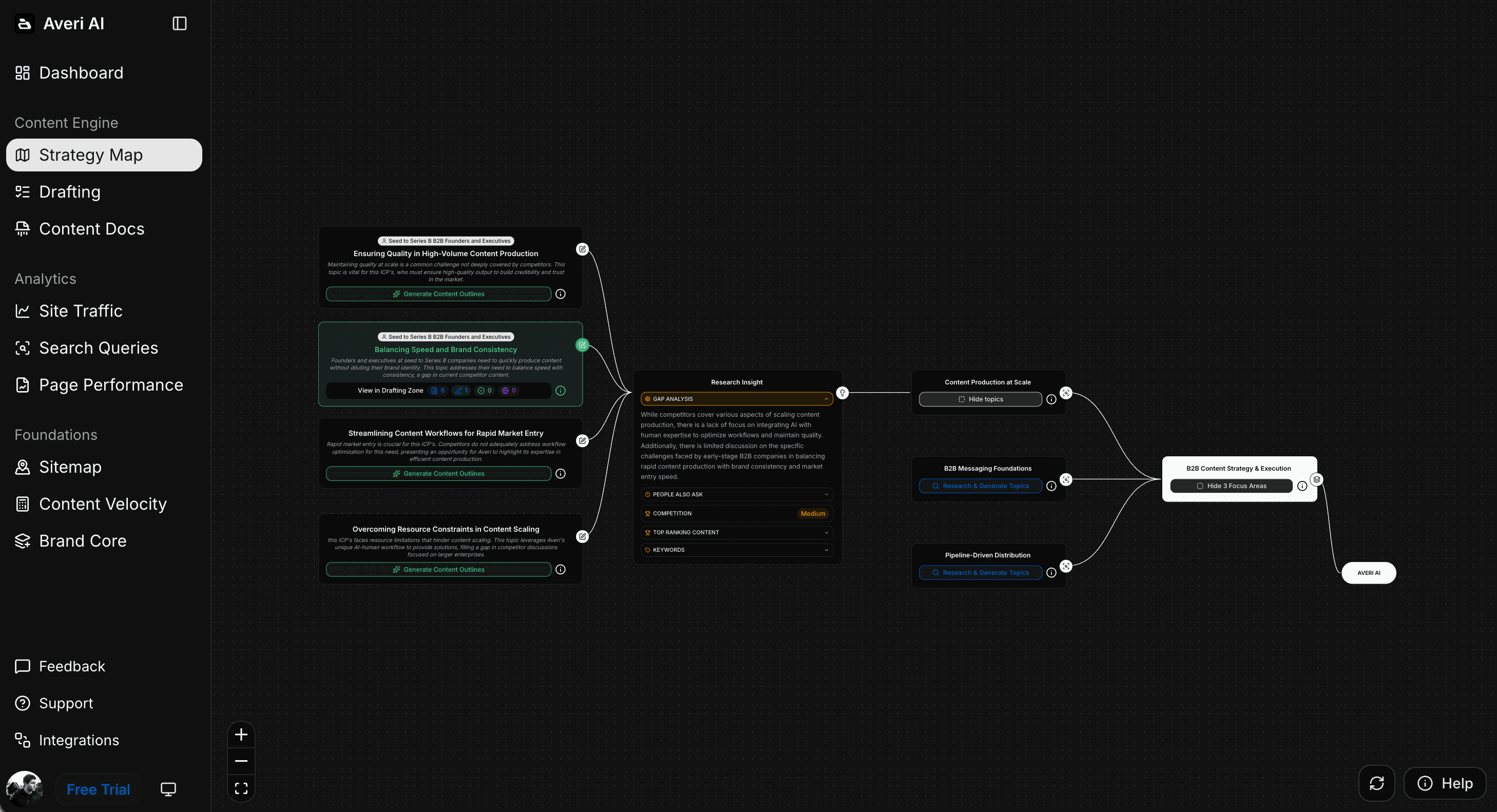
The blog strategy decision? Averi generates a complete content strategy during a 10-minute onboarding. It analyzes your website, audience, and competitors, then builds keyword-backed topic clusters. The topic cluster mapping from the "How to Find Blog Topics" section above? Averi produces that automatically.

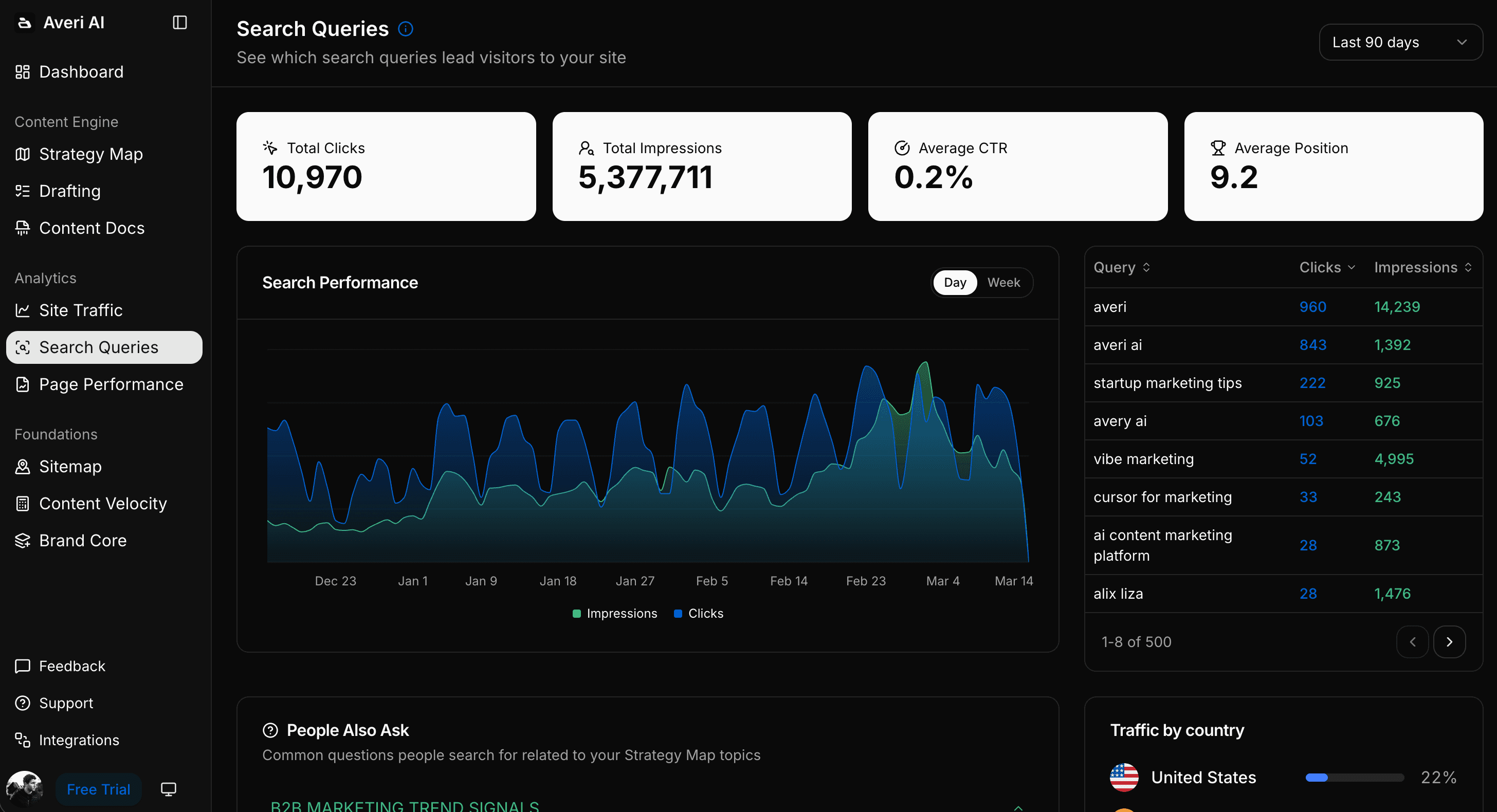
Finding keywords and validating search demand? Averi's content queue generates topic recommendations with target keywords, monthly search volume, competitive difficulty, and strategic rationale. No separate Ahrefs or SEMrush subscription ($99–$199/month saved). No manual keyword-to-topic translation.

Writing posts that convert? Averi drafts blog posts using your Brand Core (voice, positioning, ICP) and current research. Drafts arrive with 15–20 sourced and hyperlinked statistics, internal links to your existing content, FAQ sections with standalone answer blocks, and meta optimization. You edit in a collaborative canvas, adding your voice and perspective. The 4-hour-per-post writing time drops to 30–45 minutes of review and editing.

The technical SEO checklist? Handled. Meta titles, descriptions, URL slugs, header structure, internal link suggestions, and content scoring (55% SEO + 45% GEO readiness) are built into every draft. You know before publishing whether the piece is likely to rank on Google and get cited by AI platforms.

Publishing to your blog CMS? Averi publishes directly to WordPress, Webflow, and Framer. No copy-pasting between tools. No separate formatting step. Content goes from draft to live on your domain in one click.

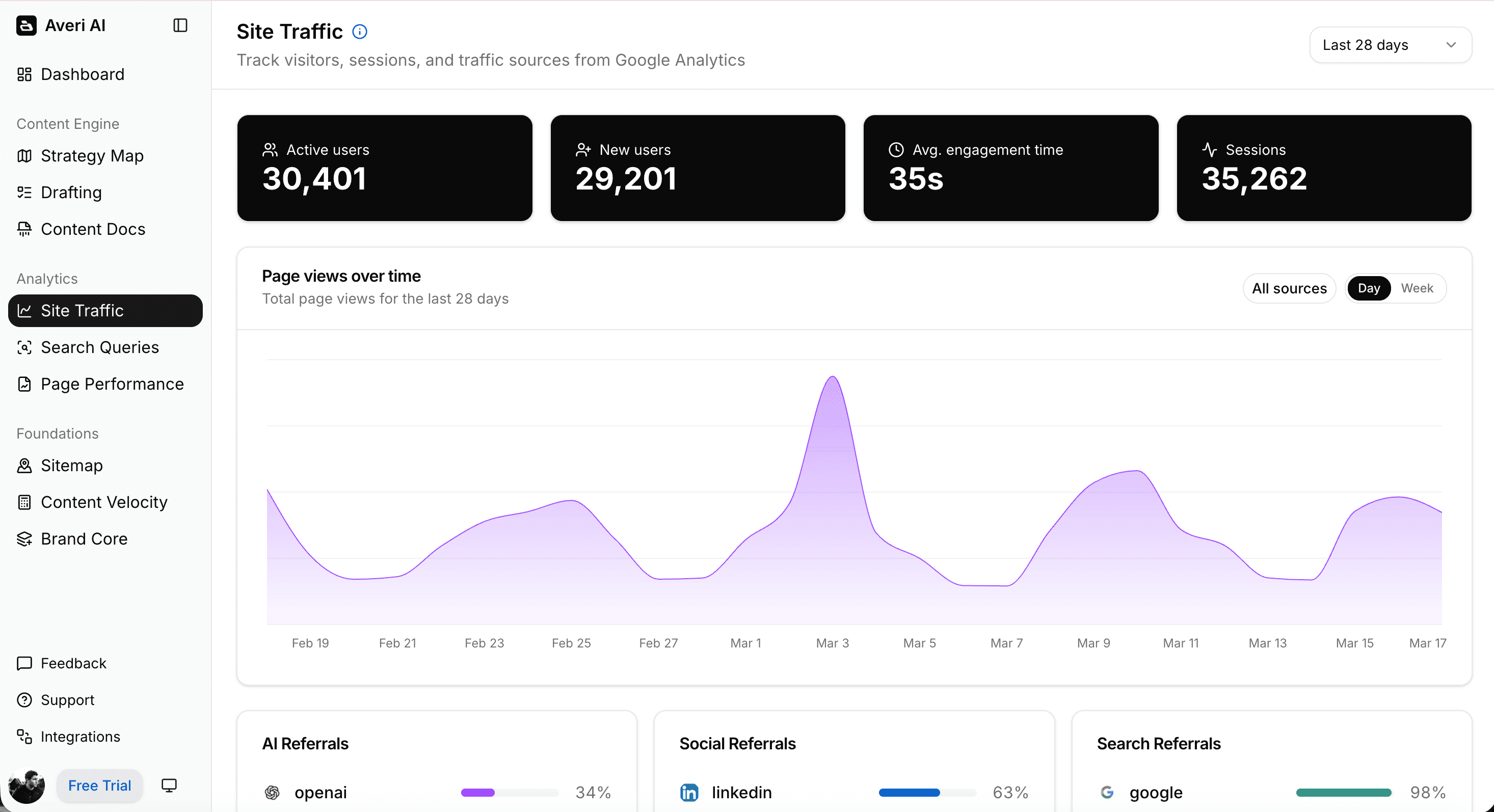
Tracking performance? Built-in analytics integrate with Google Analytics and Google Search Console. Monitor which posts drive traffic, which keywords climb in rankings, and which content needs refreshing. The data feeds back into the content queue so future recommendations get smarter.

The content calendar? Averi maintains a running content queue that updates weekly based on keyword opportunities, competitor movements, and your published content's performance. You approve what to write. The system handles the research and production.

The weekly time commitment: about 2 hours total. Thirty minutes reviewing and approving topics. Thirty to forty-five minutes editing a draft. Five minutes publishing. Fifteen minutes on weekly performance review. The rest of your week goes to writing the newsletter your subscribers signed up for.

The cost: Averi's Solo plan at $99/month. Add beehiiv ($49–$109/month) and blog hosting ($5–$39/month).

Total stack: $153–$247/month for a complete discovery + distribution + monetization system. That's less than one freelance blog post per month. Less than the Ahrefs subscription you'd need for keyword research alone.

Averi grew its own organic traffic 6,000% in 10 months running the same system now available to beehiiv creators.

Fourteen-day free trial. No credit card. Setup takes one afternoon. First blog post in review by midweek.

Start With One Post

You don't need 50 articles to see results. You need one good one.

Pick the newsletter topic that generated the most engagement last month. Research the keywords around it. Write a 2,000-word blog post that goes deeper than your newsletter edition did. Optimize the meta tags. Add a beehiiv subscribe form. Publish it.

Then do it again next week.

Or start a free trial of Averi, generate your content strategy in one afternoon, and have your first optimized blog post in review by Wednesday. Either path works. The only path that doesn't work is the one where your beehiiv newsletter keeps growing without a blog feeding it.

The creators running the most profitable beehiiv newsletters in 2026 aren't the ones with the best social media presence. They're the ones who built a content engine that brings in subscribers without requiring attention every day. A blog is how you build that engine. The newsletter is what makes it worth subscribing to.

Related Resources

FAQs

How do I start a blog on beehiiv?

beehiiv has built-in web publishing that turns your newsletter content into indexed web pages. Enable search engine indexing in your website settings, customize your meta titles and descriptions for each post, set keyword-rich URL slugs, and connect Google Search Console to track performance. beehiiv generates auto-updating sitemaps and supports breadcrumbs for better crawlability. One creator saw over 9,000 search impressions from just 20 indexed newsletter pages within three months. If you want more SEO control, run a separate blog on WordPress or Webflow and use beehiiv embed forms to capture subscribers.

Should I blog on beehiiv or use a separate website?

It depends on your goals. beehiiv's built-in web publishing is ideal for creators who want simple SEO without changing their workflow. You get meta tag customization, URL control, sitemaps, and indexing out of the box. A separate blog on your own domain gives you full control over page structure, technical SEO, internal linking architecture, and site speed. Companies with active blogs have 434% more indexed pages, and that authority builds faster on a dedicated domain. If you run both, disable indexing on your beehiiv site to avoid duplicate content penalties.

What should I blog about to grow my beehiiv newsletter?

Start with your beehiiv analytics. Your highest-performing newsletter editions by open rate and click rate reveal the topics your audience cares about. Validate those topics with keyword research to confirm search demand. Target keywords with 200+ monthly search volume and difficulty scores below 40 if your domain is new. Group related topics into clusters of 4–6 posts that link to each other to build topical authority. The best blog topics for newsletter growth sit at the intersection of what your audience searches for and what your newsletter uniquely delivers.

How often should I publish blog posts to grow my newsletter?

Consistency beats volume. Companies publishing weekly see up to 200% more organic traffic than sporadic publishers. If you can manage one well-researched, keyword-targeted post per week at 1,500–2,500 words, that's the sweet spot. If weekly is too much, two posts per month still builds momentum. Even one exceptional 3,000-word post per month will outperform four rushed short ones. Posts over 1,890 words earn 77% more backlinks than shorter content. Pick a publishing cadence you can sustain for at least six months.

How long does it take for a blog to drive beehiiv subscribers?

Expect 3–6 months before your first posts reach stable search rankings, and 6–12 months before organic traffic becomes a meaningful subscriber acquisition channel. New blog content commonly takes 3 to 6 months to reach stable rankings in competitive niches. The compounding effect accelerates after month 6 as domain authority builds and older content continues climbing. By month 12, a consistently published blog can drive 100–200+ new subscribers monthly without any ad spend. Averi grew organic traffic 6,000% in 10 months using this exact approach.

Can I repurpose my beehiiv newsletter content for blog posts?

Yes, but raw copy-paste won't work. Newsletter content lacks the keyword optimization, meta tags, internal links, and structural elements that search engines need to rank it. Use newsletter topics as seeds for expanded blog content. Take a 500-word newsletter section and develop it into a 2,000-word blog post with sourced statistics, FAQ sections optimized for AI citations, and a clear keyword target. Then link back to the full blog post from your next newsletter edition. This creates a flywheel where each channel promotes the other.

How does Averi help beehiiv creators build a blog?

Averi is the AI content engine for startups that handles the entire blog-building workflow newsletter creators don't have time for. It runs keyword research, generates content strategy around topic clusters, drafts SEO and GEO-optimized posts, publishes directly to your CMS, and tracks performance through built-in analytics. Instead of spending 15–20 hours weekly on content marketing alongside your newsletter, Averi compresses that down to about 2 hours of review and approval. You keep writing the newsletter. Averi builds the blog that feeds it.


Continue Reading

The latest handpicked blog articles

Experience The AI Content Engine

Already have an account?

Join 30,000+ Founders, Marketers & Builders

Don't Feed the Algorithm

“Top 3 tech + AI newsletters in the country. Always sharp, always actionable.”

"Genuinely my favorite newsletter in tech. No fluff, no cheesy ads, just great content."

“Clear, practical, and on-point. Helps me keep up without drowning in noise.”

User-Generated Content & Authenticity in the Age of AI

Zach Chmael

Head of Marketing

In This Article

A blog isn't a content archive where your newsletter goes to get indexed. It's a standalone growth channel that works around the clock, pulling in people who are actively searching for the things you write about. This is the step-by-step guide to starting a blog that actually works as a subscriber acquisition channel for your beehiiv newsletter.

Don’t Feed the Algorithm

The algorithm never sleeps, but you don’t have to feed it — Join our weekly newsletter for real insights on AI, human creativity & marketing execution.

TL;DR

📝 Businesses with blogs generate 67% more leads and 55% more website traffic — most beehiiv creators are ignoring this channel entirely

🔍 Compound blog posts generate 38% of blog traffic from just 10% of total posts — content keeps working long after you publish it

⚙️ Two setup options: beehiiv's built-in web publishing (simple) or an external blog on your own domain (higher ceiling, more control)

🎯 Mine your beehiiv analytics for topics, validate with keyword research, then group into topic clusters of 4–6 related posts

📊 Newsletter-driven returning traffic converts 15–35% higher than first-time visits — the blog-to-newsletter flywheel compounds both channels

🤖 Structure every post for Google and AI citations: clear answers, hyperlinked stats, FAQ sections, and GEO optimization

📅 Realistic timeline: 3–6 months to early rankings, 6–12 months to meaningful subscriber flow, 12+ months to full compounding

🔧 Averi builds the content engine so newsletter creators can focus on what they do best

"We built Averi around the exact workflow we've used to scale our web traffic over 6000% in the last 6 months."

founder-image
founder-image
Your content should be working harder.

Averi's content engine builds Google entity authority, drives AI citations, and scales your visibility so you can get more customers.

How to Start a Blog That Drives Subscribers to Your beehiiv Newsletter

Most beehiiv creators grow their newsletters the same way… social posts, cross-promotions, referral programs, Boosts.

All solid channels. All require active effort every single day to produce results.

Meanwhile, businesses with blogs generate 67% more leads per month than businesses without one. Blogging increases website traffic by 55% and produces 434% more indexed pages for search engines to surface.

And yet the average beehiiv creator has no blog strategy at all.

That's the gap. You've built a distribution machine. You haven't built the discovery engine that feeds it.

A blog isn't a content archive where your newsletter goes to get indexed. It's a standalone growth channel that works around the clock, pulling in people who are actively searching for the things you write about. They find your blog on Google. They read something useful. They subscribe to your newsletter. That loop runs whether you're writing your next edition or sleeping through your alarm.

This is the step-by-step guide to starting a blog that actually works as a subscriber acquisition channel for your beehiiv newsletter.

Why Most beehiiv Creators Don't Blog (And Why That's a Mistake)

The newsletter world has a blind spot.

beehiiv's own platform now supports over 75,000 newsletters reaching 350 million monthly readers. Publishers sent 28 billion emails in 2025.

The ecosystem is thriving. But the dominant growth playbook still leans heavy on social, recommendations, and paid subscriber acquisition through Boosts.

Here's the problem with every one of those channels: they're linear.

You put effort in, you get results out. You stop putting effort in, the results stop. Newsletter referral acquisition costs average $0.17 per subscriber, while paid social costs $1–$3. Both require continuous spend or continuous effort to maintain.

Organic search works differently.

Compound blog posts generate 38% of all blog traffic despite making up just 10% of total posts. A blog post you write in April can drive subscribers in October, January, next April, and the April after that. The work compounds.

The cost per subscriber drops toward zero over time.

Marketers who prioritize blogging are 13x more likely to see positive ROI. That's not a marginal improvement. That's an order-of-magnitude difference. And most newsletter creators are leaving it on the table because they think of blogging as separate from what they do.

It isn't.

Your newsletter is content. A blog is content. The only difference is where people find it.

The beehiiv Blog Setup Decision: On-Platform vs. External

Before you write a single post, you need to make an infrastructure decision. beehiiv gives you two paths for blogging, and the right one depends on where you're heading.

Option 1: Use beehiiv's Built-In Web Publishing

beehiiv lets you publish newsletter content as indexed web pages with auto-updating sitemaps, customizable meta titles, meta descriptions, URL slugs, and breadcrumbs. You can connect Google Search Console directly and monitor which posts rank.

One beehiiv creator reported that within three months, 20 indexed newsletter pages generated over 9,000 impressions and 82 clicks in search results. All from content they were already sending to subscribers.

This works if you want simplicity. You're already writing the content. Flipping the indexing switch means Google can find it. Zero additional publishing workflow required.

The trade-off: beehiiv's SEO toolkit covers the basics, but you're working within the platform's templating constraints. You don't get the same level of control over page structure, internal linking architecture, or technical SEO that a standalone blog gives you.

Option 2: Run an External Blog That Feeds Your beehiiv Newsletter

This is the more powerful play.

Set up a blog on WordPress, Webflow, or Framer.

Build a dedicated content library optimized for search.

Embed beehiiv subscribe forms on every page.

Use the blog as your discovery layer and beehiiv as your distribution layer.

The benefits are significant. You control the domain authority. You control the site speed. You control the full page structure, schema markup, internal linking, and technical SEO elements that separate pages that rank from pages that don't.

Companies with active blogs have 434% more indexed pages and 97% more inbound links. An external blog built on your own domain accumulates that authority over time and makes every future post easier to rank.

The important detail if you go this route: toggle on "Remove Indexing" in your beehiiv website settings to prevent duplicate content issues. Google penalizes duplicate content across domains. If the same article lives on your blog and your beehiiv archive, both pages suffer.

Which Should You Choose?

If you're a solo creator who wants to dip a toe into SEO without changing your workflow, beehiiv's built-in web publishing is the right starting point. Enable indexing, optimize your meta tags, and see what happens.

If you're building a newsletter as a business and want organic search to become a primary growth channel, go external. The upfront investment is higher, but the ceiling is dramatically different.

Either way, the content strategy that follows works the same.

How to Find Blog Topics That Drive Newsletter Signups

The biggest mistake new bloggers make is writing about whatever interests them that week. That works for newsletters, where your existing audience already trusts your taste. It doesn't work for blogs, where you're trying to reach people who've never heard of you.

Blog topics need to be pulled from search demand, not editorial instinct alone.

Step 1: Mine Your Newsletter Data

Open your beehiiv analytics. Sort by open rate and click-through rate. Your top 10 performing editions tell you exactly which topics your audience cares about most. Write those down.

Now look at your replies. What questions do subscribers ask most often? What do they forward to colleagues? What do they screenshot and post on social? Those are signals of topics with latent search demand.

Step 2: Validate With Keyword Research

Take your topic list and run it through a keyword research tool. Ahrefs, SEMrush, Ubersuggest, or even Google's free Keyword Planner. You're looking for:

  • Search volume above 200/month (proof that people actually search for this)

  • Keyword difficulty below 40 (realistic for newer domains to rank)

  • Informational or commercial intent (people looking to learn or compare, not just navigate to a specific site)

For a newsletter about personal finance, "best budgeting apps for couples" has clear search intent, decent volume, and leads naturally to a newsletter signup. "My thoughts on the latest Fed meeting" does not. Both are valid newsletter topics. Only one is a valid blog topic.

Step 3: Map Topics to Clusters

Don't blog in random directions. Group your topics into clusters of 4–6 related pieces that link to each other. Each cluster builds topical authority around a theme, which tells Google you're a credible source on that subject.

If your newsletter covers AI productivity, one cluster might include:

  • Pillar: "The Complete Guide to AI Productivity Tools in 2026"

  • Supporting: "Best AI Writing Assistants for Content Creators"

  • Supporting: "How to Use ChatGPT for Research Without Hallucinations"

  • Supporting: "AI Calendar Management: Tools That Actually Work"

  • Supporting: "Notion AI vs. Obsidian: Which Is Better for Knowledge Management?"

Each post links to the others. The pillar links to all supporting posts. Google sees a cluster of authoritative content, not a random collection of one-off articles.

How to Write Blog Posts That Convert Readers Into Subscribers

Getting traffic is half the problem. Converting that traffic into beehiiv subscribers is the other half. The average blog conversion rate sits around 5%, but optimized posts with strategic CTAs can push well above that.

Write for Searchers, Not Just Readers

Here's a shift that trips up newsletter creators: your blog voice and your newsletter voice should be related but not identical.

Newsletter voice is personal, opinionated, sometimes digressive. That's the charm. But someone landing on your blog from Google has never read your work before. They searched for a specific question and they want a specific answer. Give it to them fast.

70% of consumers prefer learning about companies through blog articles rather than ads. But preference doesn't mean patience. The first 200 words of your blog post need to demonstrate that you're going to answer their question better than anyone else in the search results.

Structure matters. Use headers that match search intent. Break complex topics into scannable sections. Articles with a table of contents have 47% lower bounce rates and 23% longer session duration. Make it easy for people to find the section they need.

Embed Subscribe CTAs Where They Actually Get Seen

Most bloggers put a single subscribe form at the bottom of the page. That's fine if everyone reads to the end. They don't. Place your beehiiv subscribe forms:

  • After the introduction (once you've proven the post is worth reading)

  • At a natural break between major sections (mid-scroll, when engagement peaks)

  • At the end (for the completionists)

  • As a contextual callout within the content itself ("Get frameworks like this in your inbox every Tuesday")

The CTA should reference the newsletter's value specifically. "Subscribe to our newsletter" converts worse than "Get the breakdown of tools like these every week, free." Specificity beats generic every time.

Use the "Preview Effect"

Your blog gives the full answer. Your newsletter gives the ongoing analysis. Position the blog post as a snapshot of what subscribers get every week.

At natural points in the article, reference what your newsletter covers: "In last week's edition, I broke down three more tools in this category that didn't make this list." Or: "I track changes to these tools weekly in my newsletter. If you want the running analysis, that's where it lives."

This isn't bait-and-switch. It's context. If someone found your blog post useful, telling them you produce similar content on a weekly basis is doing them a favor.

The Technical SEO Checklist for Your beehiiv Blog

Good writing gets ignored if the technical foundation is broken. 40–53% of users leave a site that loads too slowly. These are the non-negotiable technical elements you need in place before you start publishing.

Site speed: Your blog needs to load in under 3 seconds on mobile. Test with Google PageSpeed Insights. Compress images. Minimize JavaScript. If you're on WordPress, a caching plugin and image optimization plugin handle most of this.

Mobile responsiveness: 62.7% of global traffic is mobile. If your blog isn't mobile-optimized, you're invisible to more than half of potential visitors.

Meta titles and descriptions: Every blog post needs a unique meta title (under 60 characters) and meta description (under 155 characters) that includes your target keyword. beehiiv's built-in SEO settings let you customize these per post. External blogs require a plugin like Yoast or RankMath (WordPress) or native SEO fields (Webflow/Framer).

URL structure: Clean, keyword-rich URLs. yourblog.com/best-ai-writing-tools-2026 ranks better than yourblog.com/p/12345. beehiiv lets you customize URL slugs in the post editor. Use that.

Schema markup: Pages with FAQ sections earn 4.3x more Featured Snippets. Add FAQPage schema to every post with a question-and-answer section. If you're running an external blog, use a structured data plugin. If you're on beehiiv, focus on writing clear Q&A sections that Google can pull from even without formal schema.

Internal linking: Every post should link to at least 3–5 other posts on your blog. Internal linking upgrades often drive ranking improvements within 2 to 8 weeks, especially for posts stuck on page 2. This is one of the highest-ROI activities in all of SEO and most bloggers neglect it completely.

Google Search Console: Connect it. Verify your site. Submit your sitemap. Monitor which keywords drive impressions. Track your average position over time. beehiiv generates auto-updating sitemaps at yourdomain.beehiiv.com/sitemap.xml. External blogs generate them through your CMS or a plugin.

The Content Calendar: What to Publish and When

Consistency matters more than volume. Companies publishing weekly see up to 200% more organic traffic than those publishing sporadically. But the publishing pace that works depends on your capacity.

If you can commit to 1 post per week: Focus entirely on long-form, keyword-targeted content. Each post should be 1,500–2,500 words, well-researched, and built around a specific keyword cluster. Posts of 1,890+ words earn 77% more backlinks and rank higher. Four posts per month, consistently, will build meaningful traffic within 3–6 months.

If you can commit to 2 posts per month: Alternate between a pillar post (2,500+ words, targeting your primary keyword) and a supporting post (1,500 words, targeting a long-tail keyword in the same cluster). This builds topical authority more slowly but still compounds.

If you can only do 1 post per month: Make it count. One exceptionally well-researched, data-rich, 3,000-word guide per month will outperform four rushed 800-word posts. Content over 3,000 words earns 3x more traffic and 3.5x more backlinks than average-length posts.

Regardless of frequency, every blog post should follow this structure:

  1. Hook that addresses the searcher's intent in the first 100 words

  2. Clear H2/H3 headers organized by subtopic

  3. 15+ hyperlinked statistics from authoritative sources

  4. At least 2 embedded beehiiv subscribe CTAs

  5. Internal links to 3–5 other posts on your blog

  6. FAQ section with 5–7 questions (structured for search features and AI citations)

  7. Clear meta title, meta description, and optimized URL slug

The Newsletter-to-Blog Flywheel

The real magic happens when your blog and newsletter stop being separate channels and start reinforcing each other.

Blog → Newsletter: Every blog post includes CTAs driving readers to subscribe. Organic search brings new people in. Your newsletter onboarding sequence delivers your best blog content immediately, establishing trust.

Newsletter → Blog: Every newsletter edition references or links to blog posts. This drives direct traffic from engaged subscribers, which sends positive engagement signals to Google (low bounce rates, high time-on-page). Those signals improve rankings. Better rankings bring more organic traffic. The flywheel accelerates.

Blog → Monetization: More organic traffic means more subscribers. More subscribers means higher beehiiv Ad Network revenue, more Boost income, larger paid subscription base, and stronger sponsorship rates. Creators with diversified revenue earn roughly 3x more than those relying on a single stream. Your blog creates an entirely new acquisition path feeding every existing revenue channel.

Newsletter-driven returning traffic converts with lead rates 15% to 35% higher than first-time visits. That means subscribers you acquired through your blog, who then read your newsletter, who then return to your blog, are your highest-value audience segment. The blog creates the initial touchpoint. The newsletter builds the relationship. Both channels get stronger.

The AI Angle: Building for Search and AI Citations Simultaneously

In 2026, starting a blog means building for two discovery surfaces at once. Google still matters: organic search drives 53% of all website traffic. But AI platforms matter too: LLM visitors convert 4.4x better than traditional organic visitors, and AI-referred sessions grew 527% year-over-year.

Every blog post you write should be structured for both:

For Google: Target specific keywords. Use header hierarchy. Build internal links. Optimize meta tags. Write content that matches search intent. These are the SEO fundamentals that still drive 748% ROI for B2B companies.

For AI citations (GEO): Write clear, definitive answers to specific questions. Include FAQ sections with 40–60 word standalone answers that AI systems can extract and cite. Back claims with authoritative, hyperlinked statistics. Define entities clearly. Use structured data where possible.

The content that ranks on Google and the content that gets cited by ChatGPT and Perplexity overlap almost entirely. Well-researched, clearly structured, authoritative content wins on both surfaces. Your blog strategy doesn't need two separate approaches. It needs one approach executed well.

Averi's content scoring system weights both traditional SEO signals (55%) and GEO citation readiness (45%) to ensure every piece is optimized for both. If you're building this manually, just ask yourself two questions before publishing: "Would Google rank this?" and "Would ChatGPT cite this?" If the answer to both is yes, you're doing it right.

Realistic Timeline: What to Expect

Month 1–2: You'll publish your first 4–8 posts. Google will crawl and index them but rankings will be minimal. Don't panic. New posts commonly take 3 to 6 months to reach stable rankings.

Month 3–4: Early impressions start showing in Google Search Console. You'll see which keywords are gaining traction. Some posts will rank in positions 15–30. This is the signal to double down, refresh those posts with additional detail and internal links, and build supporting content around the topics showing momentum.

Month 5–6: If you've been publishing consistently and building topic clusters, your earliest posts should be climbing into page 1 territory. Organic traffic will start converting into beehiiv subscribers. Small numbers at first. Maybe 20–50 per month. That's the beginning of the curve, not the ceiling.

Month 7–12: Compounding kicks in. Your domain authority is higher. Every new post ranks faster. Older posts continue climbing. Traffic grows even during weeks you don't publish anything new. A realistic payback window for new blog content spans 6 to 18 months once compounding is included.

Month 12+: Your blog is an engine. It generates subscribers while you sleep, travel, or take a week off from your newsletter. The average page in Google's top 10 is over 2 years old. The posts you write now are assets that appreciate, not expenses that depreciate.

That's the timeline if you're building it manually. If you want to compress it, keep reading.

Why beehiiv Creators Use Averi to Build the Blog

Everything in this guide is doable by hand. Keyword research, writing 2,000-word posts, sourcing statistics, building FAQ sections, managing internal links, optimizing meta tags, tracking Search Console data. It's a real workflow. It's also 15–20 hours per week on top of your newsletter production.

Most beehiiv creators don't have those hours.

They're already writing 2–3 newsletter editions per week, managing subscriber growth, handling monetization, and posting on social. Adding a full blog production workflow is where the plan falls apart for 90% of newsletter operators who try it.

Averi exists to solve that specific problem.

It's the AI content engine for startups that handles the entire blog-building workflow this guide describes, in one platform.

Here's what Averi does that maps directly to each section of this guide:

The blog strategy decision? Averi generates a complete content strategy during a 10-minute onboarding. It analyzes your website, audience, and competitors, then builds keyword-backed topic clusters. The topic cluster mapping from the "How to Find Blog Topics" section above? Averi produces that automatically.

Finding keywords and validating search demand? Averi's content queue generates topic recommendations with target keywords, monthly search volume, competitive difficulty, and strategic rationale. No separate Ahrefs or SEMrush subscription ($99–$199/month saved). No manual keyword-to-topic translation.

Writing posts that convert? Averi drafts blog posts using your Brand Core (voice, positioning, ICP) and current research. Drafts arrive with 15–20 sourced and hyperlinked statistics, internal links to your existing content, FAQ sections with standalone answer blocks, and meta optimization. You edit in a collaborative canvas, adding your voice and perspective. The 4-hour-per-post writing time drops to 30–45 minutes of review and editing.

The technical SEO checklist? Handled. Meta titles, descriptions, URL slugs, header structure, internal link suggestions, and content scoring (55% SEO + 45% GEO readiness) are built into every draft. You know before publishing whether the piece is likely to rank on Google and get cited by AI platforms.

Publishing to your blog CMS? Averi publishes directly to WordPress, Webflow, and Framer. No copy-pasting between tools. No separate formatting step. Content goes from draft to live on your domain in one click.

Tracking performance? Built-in analytics integrate with Google Analytics and Google Search Console. Monitor which posts drive traffic, which keywords climb in rankings, and which content needs refreshing. The data feeds back into the content queue so future recommendations get smarter.

The content calendar? Averi maintains a running content queue that updates weekly based on keyword opportunities, competitor movements, and your published content's performance. You approve what to write. The system handles the research and production.

The weekly time commitment: about 2 hours total. Thirty minutes reviewing and approving topics. Thirty to forty-five minutes editing a draft. Five minutes publishing. Fifteen minutes on weekly performance review. The rest of your week goes to writing the newsletter your subscribers signed up for.

The cost: Averi's Solo plan at $99/month. Add beehiiv ($49–$109/month) and blog hosting ($5–$39/month).

Total stack: $153–$247/month for a complete discovery + distribution + monetization system. That's less than one freelance blog post per month. Less than the Ahrefs subscription you'd need for keyword research alone.

Averi grew its own organic traffic 6,000% in 10 months running the same system now available to beehiiv creators.

Fourteen-day free trial. No credit card. Setup takes one afternoon. First blog post in review by midweek.

Start With One Post

You don't need 50 articles to see results. You need one good one.

Pick the newsletter topic that generated the most engagement last month. Research the keywords around it. Write a 2,000-word blog post that goes deeper than your newsletter edition did. Optimize the meta tags. Add a beehiiv subscribe form. Publish it.

Then do it again next week.

Or start a free trial of Averi, generate your content strategy in one afternoon, and have your first optimized blog post in review by Wednesday. Either path works. The only path that doesn't work is the one where your beehiiv newsletter keeps growing without a blog feeding it.

The creators running the most profitable beehiiv newsletters in 2026 aren't the ones with the best social media presence. They're the ones who built a content engine that brings in subscribers without requiring attention every day. A blog is how you build that engine. The newsletter is what makes it worth subscribing to.

Related Resources

Continue Reading

The latest handpicked blog articles

Join 30,000+ Founders, Marketers & Builders

Don't Feed the Algorithm

“Top 3 tech + AI newsletters in the country. Always sharp, always actionable.”

"Genuinely my favorite newsletter in tech. No fluff, no cheesy ads, just great content."

“Clear, practical, and on-point. Helps me keep up without drowning in noise.”

User-Generated Content & Authenticity in the Age of AI

Zach Chmael

Head of Marketing

In This Article

A blog isn't a content archive where your newsletter goes to get indexed. It's a standalone growth channel that works around the clock, pulling in people who are actively searching for the things you write about. This is the step-by-step guide to starting a blog that actually works as a subscriber acquisition channel for your beehiiv newsletter.

Don’t Feed the Algorithm

The algorithm never sleeps, but you don’t have to feed it — Join our weekly newsletter for real insights on AI, human creativity & marketing execution.

Trusted by 1,000+ teams

★★★★★ 4.9/5

Startups use Averi to build
content engines that rank.

How to Start a Blog That Drives Subscribers to Your beehiiv Newsletter

Most beehiiv creators grow their newsletters the same way… social posts, cross-promotions, referral programs, Boosts.

All solid channels. All require active effort every single day to produce results.

Meanwhile, businesses with blogs generate 67% more leads per month than businesses without one. Blogging increases website traffic by 55% and produces 434% more indexed pages for search engines to surface.

And yet the average beehiiv creator has no blog strategy at all.

That's the gap. You've built a distribution machine. You haven't built the discovery engine that feeds it.

A blog isn't a content archive where your newsletter goes to get indexed. It's a standalone growth channel that works around the clock, pulling in people who are actively searching for the things you write about. They find your blog on Google. They read something useful. They subscribe to your newsletter. That loop runs whether you're writing your next edition or sleeping through your alarm.

This is the step-by-step guide to starting a blog that actually works as a subscriber acquisition channel for your beehiiv newsletter.

Why Most beehiiv Creators Don't Blog (And Why That's a Mistake)

The newsletter world has a blind spot.

beehiiv's own platform now supports over 75,000 newsletters reaching 350 million monthly readers. Publishers sent 28 billion emails in 2025.

The ecosystem is thriving. But the dominant growth playbook still leans heavy on social, recommendations, and paid subscriber acquisition through Boosts.

Here's the problem with every one of those channels: they're linear.

You put effort in, you get results out. You stop putting effort in, the results stop. Newsletter referral acquisition costs average $0.17 per subscriber, while paid social costs $1–$3. Both require continuous spend or continuous effort to maintain.

Organic search works differently.

Compound blog posts generate 38% of all blog traffic despite making up just 10% of total posts. A blog post you write in April can drive subscribers in October, January, next April, and the April after that. The work compounds.

The cost per subscriber drops toward zero over time.

Marketers who prioritize blogging are 13x more likely to see positive ROI. That's not a marginal improvement. That's an order-of-magnitude difference. And most newsletter creators are leaving it on the table because they think of blogging as separate from what they do.

It isn't.

Your newsletter is content. A blog is content. The only difference is where people find it.

The beehiiv Blog Setup Decision: On-Platform vs. External

Before you write a single post, you need to make an infrastructure decision. beehiiv gives you two paths for blogging, and the right one depends on where you're heading.

Option 1: Use beehiiv's Built-In Web Publishing

beehiiv lets you publish newsletter content as indexed web pages with auto-updating sitemaps, customizable meta titles, meta descriptions, URL slugs, and breadcrumbs. You can connect Google Search Console directly and monitor which posts rank.

One beehiiv creator reported that within three months, 20 indexed newsletter pages generated over 9,000 impressions and 82 clicks in search results. All from content they were already sending to subscribers.

This works if you want simplicity. You're already writing the content. Flipping the indexing switch means Google can find it. Zero additional publishing workflow required.

The trade-off: beehiiv's SEO toolkit covers the basics, but you're working within the platform's templating constraints. You don't get the same level of control over page structure, internal linking architecture, or technical SEO that a standalone blog gives you.

Option 2: Run an External Blog That Feeds Your beehiiv Newsletter

This is the more powerful play.

Set up a blog on WordPress, Webflow, or Framer.

Build a dedicated content library optimized for search.

Embed beehiiv subscribe forms on every page.

Use the blog as your discovery layer and beehiiv as your distribution layer.

The benefits are significant. You control the domain authority. You control the site speed. You control the full page structure, schema markup, internal linking, and technical SEO elements that separate pages that rank from pages that don't.

Companies with active blogs have 434% more indexed pages and 97% more inbound links. An external blog built on your own domain accumulates that authority over time and makes every future post easier to rank.

The important detail if you go this route: toggle on "Remove Indexing" in your beehiiv website settings to prevent duplicate content issues. Google penalizes duplicate content across domains. If the same article lives on your blog and your beehiiv archive, both pages suffer.

Which Should You Choose?

If you're a solo creator who wants to dip a toe into SEO without changing your workflow, beehiiv's built-in web publishing is the right starting point. Enable indexing, optimize your meta tags, and see what happens.

If you're building a newsletter as a business and want organic search to become a primary growth channel, go external. The upfront investment is higher, but the ceiling is dramatically different.

Either way, the content strategy that follows works the same.

How to Find Blog Topics That Drive Newsletter Signups

The biggest mistake new bloggers make is writing about whatever interests them that week. That works for newsletters, where your existing audience already trusts your taste. It doesn't work for blogs, where you're trying to reach people who've never heard of you.

Blog topics need to be pulled from search demand, not editorial instinct alone.

Step 1: Mine Your Newsletter Data

Open your beehiiv analytics. Sort by open rate and click-through rate. Your top 10 performing editions tell you exactly which topics your audience cares about most. Write those down.

Now look at your replies. What questions do subscribers ask most often? What do they forward to colleagues? What do they screenshot and post on social? Those are signals of topics with latent search demand.

Step 2: Validate With Keyword Research

Take your topic list and run it through a keyword research tool. Ahrefs, SEMrush, Ubersuggest, or even Google's free Keyword Planner. You're looking for:

  • Search volume above 200/month (proof that people actually search for this)

  • Keyword difficulty below 40 (realistic for newer domains to rank)

  • Informational or commercial intent (people looking to learn or compare, not just navigate to a specific site)

For a newsletter about personal finance, "best budgeting apps for couples" has clear search intent, decent volume, and leads naturally to a newsletter signup. "My thoughts on the latest Fed meeting" does not. Both are valid newsletter topics. Only one is a valid blog topic.

Step 3: Map Topics to Clusters

Don't blog in random directions. Group your topics into clusters of 4–6 related pieces that link to each other. Each cluster builds topical authority around a theme, which tells Google you're a credible source on that subject.

If your newsletter covers AI productivity, one cluster might include:

  • Pillar: "The Complete Guide to AI Productivity Tools in 2026"

  • Supporting: "Best AI Writing Assistants for Content Creators"

  • Supporting: "How to Use ChatGPT for Research Without Hallucinations"

  • Supporting: "AI Calendar Management: Tools That Actually Work"

  • Supporting: "Notion AI vs. Obsidian: Which Is Better for Knowledge Management?"

Each post links to the others. The pillar links to all supporting posts. Google sees a cluster of authoritative content, not a random collection of one-off articles.

How to Write Blog Posts That Convert Readers Into Subscribers

Getting traffic is half the problem. Converting that traffic into beehiiv subscribers is the other half. The average blog conversion rate sits around 5%, but optimized posts with strategic CTAs can push well above that.

Write for Searchers, Not Just Readers

Here's a shift that trips up newsletter creators: your blog voice and your newsletter voice should be related but not identical.

Newsletter voice is personal, opinionated, sometimes digressive. That's the charm. But someone landing on your blog from Google has never read your work before. They searched for a specific question and they want a specific answer. Give it to them fast.

70% of consumers prefer learning about companies through blog articles rather than ads. But preference doesn't mean patience. The first 200 words of your blog post need to demonstrate that you're going to answer their question better than anyone else in the search results.

Structure matters. Use headers that match search intent. Break complex topics into scannable sections. Articles with a table of contents have 47% lower bounce rates and 23% longer session duration. Make it easy for people to find the section they need.

Embed Subscribe CTAs Where They Actually Get Seen

Most bloggers put a single subscribe form at the bottom of the page. That's fine if everyone reads to the end. They don't. Place your beehiiv subscribe forms:

  • After the introduction (once you've proven the post is worth reading)

  • At a natural break between major sections (mid-scroll, when engagement peaks)

  • At the end (for the completionists)

  • As a contextual callout within the content itself ("Get frameworks like this in your inbox every Tuesday")

The CTA should reference the newsletter's value specifically. "Subscribe to our newsletter" converts worse than "Get the breakdown of tools like these every week, free." Specificity beats generic every time.

Use the "Preview Effect"

Your blog gives the full answer. Your newsletter gives the ongoing analysis. Position the blog post as a snapshot of what subscribers get every week.

At natural points in the article, reference what your newsletter covers: "In last week's edition, I broke down three more tools in this category that didn't make this list." Or: "I track changes to these tools weekly in my newsletter. If you want the running analysis, that's where it lives."

This isn't bait-and-switch. It's context. If someone found your blog post useful, telling them you produce similar content on a weekly basis is doing them a favor.

The Technical SEO Checklist for Your beehiiv Blog

Good writing gets ignored if the technical foundation is broken. 40–53% of users leave a site that loads too slowly. These are the non-negotiable technical elements you need in place before you start publishing.

Site speed: Your blog needs to load in under 3 seconds on mobile. Test with Google PageSpeed Insights. Compress images. Minimize JavaScript. If you're on WordPress, a caching plugin and image optimization plugin handle most of this.

Mobile responsiveness: 62.7% of global traffic is mobile. If your blog isn't mobile-optimized, you're invisible to more than half of potential visitors.

Meta titles and descriptions: Every blog post needs a unique meta title (under 60 characters) and meta description (under 155 characters) that includes your target keyword. beehiiv's built-in SEO settings let you customize these per post. External blogs require a plugin like Yoast or RankMath (WordPress) or native SEO fields (Webflow/Framer).

URL structure: Clean, keyword-rich URLs. yourblog.com/best-ai-writing-tools-2026 ranks better than yourblog.com/p/12345. beehiiv lets you customize URL slugs in the post editor. Use that.

Schema markup: Pages with FAQ sections earn 4.3x more Featured Snippets. Add FAQPage schema to every post with a question-and-answer section. If you're running an external blog, use a structured data plugin. If you're on beehiiv, focus on writing clear Q&A sections that Google can pull from even without formal schema.

Internal linking: Every post should link to at least 3–5 other posts on your blog. Internal linking upgrades often drive ranking improvements within 2 to 8 weeks, especially for posts stuck on page 2. This is one of the highest-ROI activities in all of SEO and most bloggers neglect it completely.

Google Search Console: Connect it. Verify your site. Submit your sitemap. Monitor which keywords drive impressions. Track your average position over time. beehiiv generates auto-updating sitemaps at yourdomain.beehiiv.com/sitemap.xml. External blogs generate them through your CMS or a plugin.

The Content Calendar: What to Publish and When

Consistency matters more than volume. Companies publishing weekly see up to 200% more organic traffic than those publishing sporadically. But the publishing pace that works depends on your capacity.

If you can commit to 1 post per week: Focus entirely on long-form, keyword-targeted content. Each post should be 1,500–2,500 words, well-researched, and built around a specific keyword cluster. Posts of 1,890+ words earn 77% more backlinks and rank higher. Four posts per month, consistently, will build meaningful traffic within 3–6 months.

If you can commit to 2 posts per month: Alternate between a pillar post (2,500+ words, targeting your primary keyword) and a supporting post (1,500 words, targeting a long-tail keyword in the same cluster). This builds topical authority more slowly but still compounds.

If you can only do 1 post per month: Make it count. One exceptionally well-researched, data-rich, 3,000-word guide per month will outperform four rushed 800-word posts. Content over 3,000 words earns 3x more traffic and 3.5x more backlinks than average-length posts.

Regardless of frequency, every blog post should follow this structure:

  1. Hook that addresses the searcher's intent in the first 100 words

  2. Clear H2/H3 headers organized by subtopic

  3. 15+ hyperlinked statistics from authoritative sources

  4. At least 2 embedded beehiiv subscribe CTAs

  5. Internal links to 3–5 other posts on your blog

  6. FAQ section with 5–7 questions (structured for search features and AI citations)

  7. Clear meta title, meta description, and optimized URL slug

The Newsletter-to-Blog Flywheel

The real magic happens when your blog and newsletter stop being separate channels and start reinforcing each other.

Blog → Newsletter: Every blog post includes CTAs driving readers to subscribe. Organic search brings new people in. Your newsletter onboarding sequence delivers your best blog content immediately, establishing trust.

Newsletter → Blog: Every newsletter edition references or links to blog posts. This drives direct traffic from engaged subscribers, which sends positive engagement signals to Google (low bounce rates, high time-on-page). Those signals improve rankings. Better rankings bring more organic traffic. The flywheel accelerates.

Blog → Monetization: More organic traffic means more subscribers. More subscribers means higher beehiiv Ad Network revenue, more Boost income, larger paid subscription base, and stronger sponsorship rates. Creators with diversified revenue earn roughly 3x more than those relying on a single stream. Your blog creates an entirely new acquisition path feeding every existing revenue channel.

Newsletter-driven returning traffic converts with lead rates 15% to 35% higher than first-time visits. That means subscribers you acquired through your blog, who then read your newsletter, who then return to your blog, are your highest-value audience segment. The blog creates the initial touchpoint. The newsletter builds the relationship. Both channels get stronger.

The AI Angle: Building for Search and AI Citations Simultaneously

In 2026, starting a blog means building for two discovery surfaces at once. Google still matters: organic search drives 53% of all website traffic. But AI platforms matter too: LLM visitors convert 4.4x better than traditional organic visitors, and AI-referred sessions grew 527% year-over-year.

Every blog post you write should be structured for both:

For Google: Target specific keywords. Use header hierarchy. Build internal links. Optimize meta tags. Write content that matches search intent. These are the SEO fundamentals that still drive 748% ROI for B2B companies.

For AI citations (GEO): Write clear, definitive answers to specific questions. Include FAQ sections with 40–60 word standalone answers that AI systems can extract and cite. Back claims with authoritative, hyperlinked statistics. Define entities clearly. Use structured data where possible.

The content that ranks on Google and the content that gets cited by ChatGPT and Perplexity overlap almost entirely. Well-researched, clearly structured, authoritative content wins on both surfaces. Your blog strategy doesn't need two separate approaches. It needs one approach executed well.

Averi's content scoring system weights both traditional SEO signals (55%) and GEO citation readiness (45%) to ensure every piece is optimized for both. If you're building this manually, just ask yourself two questions before publishing: "Would Google rank this?" and "Would ChatGPT cite this?" If the answer to both is yes, you're doing it right.

Realistic Timeline: What to Expect

Month 1–2: You'll publish your first 4–8 posts. Google will crawl and index them but rankings will be minimal. Don't panic. New posts commonly take 3 to 6 months to reach stable rankings.

Month 3–4: Early impressions start showing in Google Search Console. You'll see which keywords are gaining traction. Some posts will rank in positions 15–30. This is the signal to double down, refresh those posts with additional detail and internal links, and build supporting content around the topics showing momentum.

Month 5–6: If you've been publishing consistently and building topic clusters, your earliest posts should be climbing into page 1 territory. Organic traffic will start converting into beehiiv subscribers. Small numbers at first. Maybe 20–50 per month. That's the beginning of the curve, not the ceiling.

Month 7–12: Compounding kicks in. Your domain authority is higher. Every new post ranks faster. Older posts continue climbing. Traffic grows even during weeks you don't publish anything new. A realistic payback window for new blog content spans 6 to 18 months once compounding is included.

Month 12+: Your blog is an engine. It generates subscribers while you sleep, travel, or take a week off from your newsletter. The average page in Google's top 10 is over 2 years old. The posts you write now are assets that appreciate, not expenses that depreciate.

That's the timeline if you're building it manually. If you want to compress it, keep reading.

Why beehiiv Creators Use Averi to Build the Blog

Everything in this guide is doable by hand. Keyword research, writing 2,000-word posts, sourcing statistics, building FAQ sections, managing internal links, optimizing meta tags, tracking Search Console data. It's a real workflow. It's also 15–20 hours per week on top of your newsletter production.

Most beehiiv creators don't have those hours.

They're already writing 2–3 newsletter editions per week, managing subscriber growth, handling monetization, and posting on social. Adding a full blog production workflow is where the plan falls apart for 90% of newsletter operators who try it.

Averi exists to solve that specific problem.

It's the AI content engine for startups that handles the entire blog-building workflow this guide describes, in one platform.

Here's what Averi does that maps directly to each section of this guide:

The blog strategy decision? Averi generates a complete content strategy during a 10-minute onboarding. It analyzes your website, audience, and competitors, then builds keyword-backed topic clusters. The topic cluster mapping from the "How to Find Blog Topics" section above? Averi produces that automatically.

Finding keywords and validating search demand? Averi's content queue generates topic recommendations with target keywords, monthly search volume, competitive difficulty, and strategic rationale. No separate Ahrefs or SEMrush subscription ($99–$199/month saved). No manual keyword-to-topic translation.

Writing posts that convert? Averi drafts blog posts using your Brand Core (voice, positioning, ICP) and current research. Drafts arrive with 15–20 sourced and hyperlinked statistics, internal links to your existing content, FAQ sections with standalone answer blocks, and meta optimization. You edit in a collaborative canvas, adding your voice and perspective. The 4-hour-per-post writing time drops to 30–45 minutes of review and editing.

The technical SEO checklist? Handled. Meta titles, descriptions, URL slugs, header structure, internal link suggestions, and content scoring (55% SEO + 45% GEO readiness) are built into every draft. You know before publishing whether the piece is likely to rank on Google and get cited by AI platforms.

Publishing to your blog CMS? Averi publishes directly to WordPress, Webflow, and Framer. No copy-pasting between tools. No separate formatting step. Content goes from draft to live on your domain in one click.

Tracking performance? Built-in analytics integrate with Google Analytics and Google Search Console. Monitor which posts drive traffic, which keywords climb in rankings, and which content needs refreshing. The data feeds back into the content queue so future recommendations get smarter.

The content calendar? Averi maintains a running content queue that updates weekly based on keyword opportunities, competitor movements, and your published content's performance. You approve what to write. The system handles the research and production.

The weekly time commitment: about 2 hours total. Thirty minutes reviewing and approving topics. Thirty to forty-five minutes editing a draft. Five minutes publishing. Fifteen minutes on weekly performance review. The rest of your week goes to writing the newsletter your subscribers signed up for.

The cost: Averi's Solo plan at $99/month. Add beehiiv ($49–$109/month) and blog hosting ($5–$39/month).

Total stack: $153–$247/month for a complete discovery + distribution + monetization system. That's less than one freelance blog post per month. Less than the Ahrefs subscription you'd need for keyword research alone.

Averi grew its own organic traffic 6,000% in 10 months running the same system now available to beehiiv creators.

Fourteen-day free trial. No credit card. Setup takes one afternoon. First blog post in review by midweek.

Start With One Post

You don't need 50 articles to see results. You need one good one.

Pick the newsletter topic that generated the most engagement last month. Research the keywords around it. Write a 2,000-word blog post that goes deeper than your newsletter edition did. Optimize the meta tags. Add a beehiiv subscribe form. Publish it.

Then do it again next week.

Or start a free trial of Averi, generate your content strategy in one afternoon, and have your first optimized blog post in review by Wednesday. Either path works. The only path that doesn't work is the one where your beehiiv newsletter keeps growing without a blog feeding it.

The creators running the most profitable beehiiv newsletters in 2026 aren't the ones with the best social media presence. They're the ones who built a content engine that brings in subscribers without requiring attention every day. A blog is how you build that engine. The newsletter is what makes it worth subscribing to.

Related Resources

"We built Averi around the exact workflow we've used to scale our web traffic over 6000% in the last 6 months."

founder-image
founder-image
Your content should be working harder.

Averi's content engine builds Google entity authority, drives AI citations, and scales your visibility so you can get more customers.

FAQs

Averi is the AI content engine for startups that handles the entire blog-building workflow newsletter creators don't have time for. It runs keyword research, generates content strategy around topic clusters, drafts SEO and GEO-optimized posts, publishes directly to your CMS, and tracks performance through built-in analytics. Instead of spending 15–20 hours weekly on content marketing alongside your newsletter, Averi compresses that down to about 2 hours of review and approval. You keep writing the newsletter. Averi builds the blog that feeds it.

How does Averi help beehiiv creators build a blog?

Yes, but raw copy-paste won't work. Newsletter content lacks the keyword optimization, meta tags, internal links, and structural elements that search engines need to rank it. Use newsletter topics as seeds for expanded blog content. Take a 500-word newsletter section and develop it into a 2,000-word blog post with sourced statistics, FAQ sections optimized for AI citations, and a clear keyword target. Then link back to the full blog post from your next newsletter edition. This creates a flywheel where each channel promotes the other.

Can I repurpose my beehiiv newsletter content for blog posts?

Expect 3–6 months before your first posts reach stable search rankings, and 6–12 months before organic traffic becomes a meaningful subscriber acquisition channel. New blog content commonly takes 3 to 6 months to reach stable rankings in competitive niches. The compounding effect accelerates after month 6 as domain authority builds and older content continues climbing. By month 12, a consistently published blog can drive 100–200+ new subscribers monthly without any ad spend. Averi grew organic traffic 6,000% in 10 months using this exact approach.

How long does it take for a blog to drive beehiiv subscribers?

Consistency beats volume. Companies publishing weekly see up to 200% more organic traffic than sporadic publishers. If you can manage one well-researched, keyword-targeted post per week at 1,500–2,500 words, that's the sweet spot. If weekly is too much, two posts per month still builds momentum. Even one exceptional 3,000-word post per month will outperform four rushed short ones. Posts over 1,890 words earn 77% more backlinks than shorter content. Pick a publishing cadence you can sustain for at least six months.

How often should I publish blog posts to grow my newsletter?

Start with your beehiiv analytics. Your highest-performing newsletter editions by open rate and click rate reveal the topics your audience cares about. Validate those topics with keyword research to confirm search demand. Target keywords with 200+ monthly search volume and difficulty scores below 40 if your domain is new. Group related topics into clusters of 4–6 posts that link to each other to build topical authority. The best blog topics for newsletter growth sit at the intersection of what your audience searches for and what your newsletter uniquely delivers.

What should I blog about to grow my beehiiv newsletter?

It depends on your goals. beehiiv's built-in web publishing is ideal for creators who want simple SEO without changing their workflow. You get meta tag customization, URL control, sitemaps, and indexing out of the box. A separate blog on your own domain gives you full control over page structure, technical SEO, internal linking architecture, and site speed. Companies with active blogs have 434% more indexed pages, and that authority builds faster on a dedicated domain. If you run both, disable indexing on your beehiiv site to avoid duplicate content penalties.

Should I blog on beehiiv or use a separate website?

beehiiv has built-in web publishing that turns your newsletter content into indexed web pages. Enable search engine indexing in your website settings, customize your meta titles and descriptions for each post, set keyword-rich URL slugs, and connect Google Search Console to track performance. beehiiv generates auto-updating sitemaps and supports breadcrumbs for better crawlability. One creator saw over 9,000 search impressions from just 20 indexed newsletter pages within three months. If you want more SEO control, run a separate blog on WordPress or Webflow and use beehiiv embed forms to capture subscribers.

How do I start a blog on beehiiv?

FAQs

How long does it take to see SEO results for B2B SaaS?

Expect 7 months to break-even on average, with meaningful traffic improvements typically appearing within 3-6 months. Link building results appear within 1-6 months. The key is consistency—companies that stop and start lose ground to those who execute continuously.

Is AI-generated content actually good for SEO?

62% of marketers report higher SERP rankings for AI-generated content—but only when properly edited and enhanced with human expertise. Pure AI content without human refinement often lacks the originality and depth that both readers and algorithms prefer.

Is AI-generated content actually good for SEO?

62% of marketers report higher SERP rankings for AI-generated content—but only when properly edited and enhanced with human expertise. Pure AI content without human refinement often lacks the originality and depth that both readers and algorithms prefer.

Is AI-generated content actually good for SEO?

62% of marketers report higher SERP rankings for AI-generated content—but only when properly edited and enhanced with human expertise. Pure AI content without human refinement often lacks the originality and depth that both readers and algorithms prefer.

Is AI-generated content actually good for SEO?

62% of marketers report higher SERP rankings for AI-generated content—but only when properly edited and enhanced with human expertise. Pure AI content without human refinement often lacks the originality and depth that both readers and algorithms prefer.

Is AI-generated content actually good for SEO?

62% of marketers report higher SERP rankings for AI-generated content—but only when properly edited and enhanced with human expertise. Pure AI content without human refinement often lacks the originality and depth that both readers and algorithms prefer.

Is AI-generated content actually good for SEO?

62% of marketers report higher SERP rankings for AI-generated content—but only when properly edited and enhanced with human expertise. Pure AI content without human refinement often lacks the originality and depth that both readers and algorithms prefer.

Is AI-generated content actually good for SEO?

62% of marketers report higher SERP rankings for AI-generated content—but only when properly edited and enhanced with human expertise. Pure AI content without human refinement often lacks the originality and depth that both readers and algorithms prefer.

TL;DR

📝 Businesses with blogs generate 67% more leads and 55% more website traffic — most beehiiv creators are ignoring this channel entirely

🔍 Compound blog posts generate 38% of blog traffic from just 10% of total posts — content keeps working long after you publish it

⚙️ Two setup options: beehiiv's built-in web publishing (simple) or an external blog on your own domain (higher ceiling, more control)

🎯 Mine your beehiiv analytics for topics, validate with keyword research, then group into topic clusters of 4–6 related posts

📊 Newsletter-driven returning traffic converts 15–35% higher than first-time visits — the blog-to-newsletter flywheel compounds both channels

🤖 Structure every post for Google and AI citations: clear answers, hyperlinked stats, FAQ sections, and GEO optimization

📅 Realistic timeline: 3–6 months to early rankings, 6–12 months to meaningful subscriber flow, 12+ months to full compounding

🔧 Averi builds the content engine so newsletter creators can focus on what they do best

Continue Reading

The latest handpicked blog articles

Join 30,000+ Founders, Marketers & Builders

Don't Feed the Algorithm

“Top 3 tech + AI newsletters in the country. Always sharp, always actionable.”

"Genuinely my favorite newsletter in tech. No fluff, no cheesy ads, just great content."

“Clear, practical, and on-point. Helps me keep up without drowning in noise.”

How strong is your content engine? Find out in 30 seconds.

Maybe later