How to Measure Content Marketing ROI at Seed Stage (Before You Have Traffic)

Zach Chmael

Head of Marketing

5 minutes

In This Article

Every ROI guide assumes you have traffic. At seed stage, you don't. Here's the leading indicators framework that proves content is working months before clicks arrive.

Updated

Trusted by 1,000+ teams

★★★★★ 4.9/5

Startups use Averi to build
content engines that rank.

TL;DR

📉 Standard content ROI metrics (revenue attribution, conversion rate, pipeline influence) don't work at seed stage. The numerator is zero for months 1–6 by design.

📊 Use leading indicators instead: indexation metrics (months 1–2), visibility metrics (months 2–4), engagement metrics (months 3–6), authority metrics (months 4–8)

📈 The metric that matters most: impression growth trajectory. Three consecutive months of growing impressions = the system is working. Absolute numbers are small. Direction matters.

🧮 Organic traffic value translates content into dollars: monthly clicks × keyword CPC = equivalent paid search value. "Our blog generates $1,500/month in paid search value" is investor-grade language.

🔍 At low volume, use self-reported attribution ("How did you hear about us?") instead of algorithmic multi-touch models that need hundreds of conversions.

🚩 Red flags: no impression growth after 8 weeks, positions flat, CTR below benchmark, engagement below 30%, 6+ months with zero conversions. Each has a specific pivot.

Start free with Averi. Analytics integration consolidates GSC + GA4 tracking with content production. Performance review in 5 minutes.

Zach Chmael

CMO, Averi

"We built Averi around the exact workflow we've used to scale our web traffic over 6000% in the last 6 months."

Your content should be working harder.

Averi's content engine builds Google entity authority, drives AI citations, and scales your visibility so you can get more customers.

How to Measure Content Marketing ROI at Seed Stage (Before You Have Traffic)

Every guide to measuring content marketing ROI starts with the same assumption: you have traffic.

"Calculate revenue attributed to content." "Measure your organic conversion rate." "Track pipeline influence by content touchpoint."

That's great advice for a company with 10,000 monthly visitors, a CRM full of leads, and 12 months of attribution data.

It's useless for a seed-stage startup with 200 monthly visitors, zero leads from content, and blog posts that have been live for 6 weeks.

Only 36% of marketers can accurately measure content ROI.

At seed stage, that number is closer to 5%, because the standard measurement frameworks don't apply yet.

The metrics that prove content marketing works at scale (revenue attribution, pipeline influence, organic conversion rate) are lagging indicators that don't appear until months 5–12.

You need leading indicators.

Metrics that prove the system is working in months 1–4, before traffic and revenue show up. Without them, you either give up too early or continue blindly without knowing if you're on track.

This is the measurement framework.

It's designed specifically for the reality of seed-stage content: low traffic, no attribution data, and a founder who needs to know whether to keep investing time and money into a system that hasn't paid back yet.

This is part of the Seed-Stage Content Marketing Playbook. The playbook covers the full strategy.

This piece is the measurement layer.

Why Standard ROI Metrics Fail at Seed Stage

Standard content ROI is calculated as: (Revenue from Content - Content Cost) / Content Cost × 100.

At seed stage, the numerator is zero.

Revenue from content is $0 for the first 4–6 months because the content hasn't ranked long enough to drive meaningful traffic, and the traffic it does drive hasn't had time to convert through a full sales cycle.

That doesn't mean the investment is failing. It means the measurement framework is wrong for the stage.

Three reasons standard metrics break down early:

The lag problem. SEO delivers 748% ROI with a 7–9 month break-even. That means months 1–7 show negative ROI by definition. Any measurement system that only counts revenue will show content marketing "losing money" during the exact period when it's building the foundation for compound returns.

The small-numbers problem. With 200 monthly visitors, conversion rate calculations are statistically meaningless. A single signup changes your conversion rate from 0% to 0.5%. Two signups make it 1%. The numbers are too small to draw conclusions. You need metrics with larger sample sizes.

The attribution problem. At seed stage, you likely don't have multi-touch attribution set up. Even if you did, the sample size wouldn't support reliable analysis. Someone might read your blog, then Google your name a week later and sign up. Last-click attribution credits the branded search. The content gets zero credit.
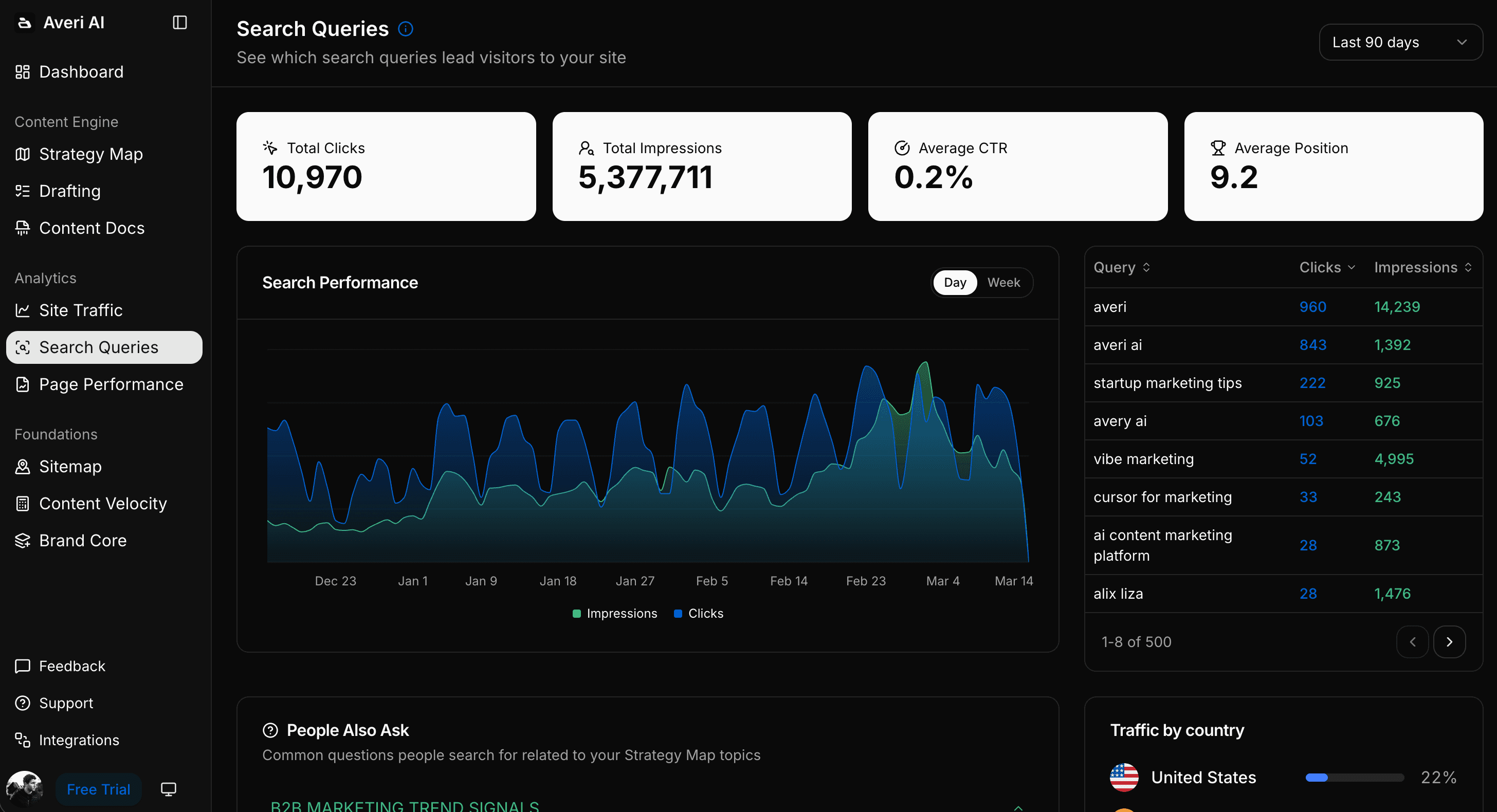
The Leading Indicators Framework

Leading indicators are metrics that predict future ROI before the ROI materializes.

They answer: "Is the content system building the conditions for future traffic, leads, and revenue?"

Tier 1: Indexation Metrics (Months 1–2)

These are the earliest signals. If they're not moving, nothing else will.

Metric: Indexed pages. Where to find it: Google Search Console → Pages → Indexing.

What good looks like: Every published post should be indexed within 1–2 weeks. If you've published 10 posts and only 6 are indexed, something is wrong (technical issue, thin content, or crawl budget problems).

Why it matters: Google can't rank what it hasn't indexed. This is the prerequisite for everything.

Metric: Crawl frequency. Where to find it: GSC → Settings → Crawl Stats. What good looks like: Google crawling your site multiple times per week. Increasing crawl frequency means Google considers your site active and worth checking regularly. Why it matters: Higher crawl frequency means new content gets discovered faster and updates get reflected sooner.

Metric: URL errors. Where to find it: GSC → Pages → "Why pages aren't indexed." What good looks like: Zero or near-zero errors. Common issues: 404s, redirect loops, "discovered but not indexed." Why it matters: Technical issues silently kill content performance. Catching them in month 1 prevents wasted effort in months 2–12.

Tier 2: Visibility Metrics (Months 2–4)

Content is indexed. Now you're watching for signs that Google considers it relevant.

Metric: Total impressions. Where to find it: GSC → Performance → Total impressions.

What good looks like: Growing week over week. The absolute number matters less than the direction. 500 impressions in week 4 growing to 800 in week 6 growing to 1,500 in week 8 is exactly the trajectory you want.

Why it matters: Impressions mean Google is showing your content in search results. Searchers haven't clicked yet, but Google has decided your page is relevant enough to display. That's the system working.

Metric: Keyword coverage (unique queries). Where to find it: GSC → Performance → Queries. Count the total unique queries your site appears for. What good looks like: Each published post should rank for 5–15 queries within 30 days. If you have 10 posts, you should appear for 50–150 unique queries by month 2. Why it matters: Broader keyword coverage means your informational footprint is expanding. More queries = more chances to capture traffic as positions improve.

Metric: Average position trajectory. Where to find it: GSC → Performance → Queries. Track average position for your target keywords week over week. What good looks like: Movement from positions 50+ toward positions 10–20 over 4–8 weeks. You won't hit page 1 in month 2, but you should see upward movement. Why it matters: Position improvement is the leading indicator of future traffic. A post moving from position 40 to position 15 over 8 weeks will likely reach page 1 within 3–4 months. That trajectory is more valuable than the current absolute position.

Metric: Impressions-to-clicks ratio by position band. Where to find it: GSC → Performance. Filter by position ranges. What good looks like: Positions 1–3: 10–40% CTR. Positions 4–10: 2–8% CTR. Positions 11–20: 0.5–2% CTR. Why it matters: If your CTR is dramatically below benchmark for your position, the content ranks but the meta title/description isn't compelling enough to click. This is a fixable problem that doesn't require more content, just better packaging.

Tier 3: Engagement Metrics (Months 3–6)

Traffic is starting to trickle in. Now you measure what visitors do.

Metric: Engagement rate (GA4). Where to find it: GA4 → Reports → Engagement → Pages and Screens.

What good looks like: 40%+ engagement rate (GA4 defines "engaged" as 10+ seconds, 2+ pageviews, or a conversion event). Below 40% may signal intent mismatch.

Why it matters: High engagement means visitors find your content relevant. Low engagement means either the wrong people are finding your content or the content doesn't deliver on the promise of the title.

Metric: Pages per session (organic traffic only). Where to find it: GA4 → Reports → Acquisition → Traffic Acquisition → Filter for "Organic Search." What good looks like: 1.5+ pages per session. If visitors read one post and leave, your internal linking isn't working. If they read 2–3 posts, you're building the content ecosystem that converts over multiple touchpoints. Why it matters: Content marketing rarely converts on the first visit. B2B buyers consume 3–7 pieces of content before contacting a vendor. Pages per session shows whether your library can guide that journey.

Metric: Email subscribers from organic traffic. Where to find it: Your email platform, filtered by source. Or GA4 goal completions from organic traffic. What good looks like: Any number above zero in months 3–4. 5–20 subscribers/month by month 5–6. Why it matters: This is the first conversion metric. A blog visitor who subscribes has signaled interest. Even 10 subscribers/month proves the content-to-subscriber pipeline works. You just need to scale it.

Tier 4: Authority Metrics (Months 4–8)

Metric: Referring domains (backlinks).

Where to find it: Ahrefs Webmaster Tools (free) or GSC → Links → Top linking sites.

What good looks like: Any new referring domain is a win at seed stage. 1–3 new referring domains per month from natural citations means your content is earning external recognition.

Why it matters: Backlinks are the strongest authority signal for Google rankings. Each backlink accelerates the ranking potential of your entire domain, not just the linked page.

Metric: AI citation presence. Where to find it: Manual check. Run 10 target queries in ChatGPT and Perplexity quarterly. Note whether your pages appear in citations. What good looks like: Any citation at all in months 4–8 is a strong signal. Content under 3 months old is 3x more likely to be cited by AI, so recently published or refreshed content has the best chance. Why it matters: AI citations are an emerging traffic and authority source. Early citations indicate your content structure (extractable answer blocks, FAQ sections) is working.

Metric: Organic traffic value. Where to find it: Calculate manually. For each keyword you rank for, multiply monthly clicks by the keyword's CPC (from Google Keyword Planner or Ahrefs free). What good looks like: Growing monthly. Even $500/month in organic traffic value means your content is providing the equivalent of $500 in paid search clicks for free. Why it matters: Organic traffic value translates content into language investors and co-founders understand. "Our blog generates the equivalent of $2,000/month in paid search traffic" is a compelling ROI statement even before a single lead converts.

The Seed-Stage Content Dashboard

Track these metrics weekly in a simple spreadsheet. Five minutes per week. Here's the template:

Metric

Week 1

Week 2

Week 3

Week 4

MoM Trend

Indexed pages

↑ ↓ →

Total impressions

↑ ↓ →

Unique queries

↑ ↓ →

Avg position (target KWs)

↑ ↓ →

Organic clicks

↑ ↓ →

Email subscribers (organic)

↑ ↓ →

Content spend this month

The "MoM Trend" column is the most important.

Three consecutive months of ↑ across impressions, queries, and position improvement means the system is working. The absolute numbers are small and that's fine. The direction is what matters.

Monthly additions (5 minutes):

  • Organic traffic value (calculate once per month)

  • New referring domains

  • AI citation check (quarterly, 15 minutes)

Quarterly review (30 minutes): Compare this quarter's data to last quarter's across every metric. Calculate: total content investment (cash + estimated founder time value) versus organic traffic value generated.

Plot the trajectory. Is the gap between investment and value closing? At seed stage, the answer should be "yes, slowly."

The crossover typically happens between months 7–12.

The Attribution Model That Works at Low Volume

Standard attribution (first-touch, last-touch, multi-touch) requires hundreds of conversions to produce statistically meaningful results. At seed stage, you might have 5–20 conversions total in the first 6 months. Not enough for any model.

Instead, use this simple approach:

The "How Did You Hear About Us?" Method

Add a question to your signup flow: "How did you hear about us?"

with options:

  • Google search

  • AI assistant (ChatGPT, Perplexity, etc.)

  • Social media (LinkedIn, Twitter)

  • Someone recommended us

  • Blog post or article

  • Other: [free text]

This is self-reported attribution. It's not perfect. People misremember. But at low volume, self-reported data is more useful than algorithmic attribution that can't function with small sample sizes.

If 40% of your first 20 signups say "Google search" or "blog post," you have strong directional evidence that content is driving conversions.

The First-Touch Page Report

In GA4, pull the landing page report for users who converted (completed your signup goal). Filter for organic traffic. Which blog posts are people landing on before they convert?

Even with 10 conversions, patterns emerge.

If 4 of them landed on your "Best [category] tools" comparison post, that's a signal that BOFU content converts.

If 3 landed on your "How to [solve problem]" guide, that's a signal that educational content drives pipeline.

The Branded Search Proxy

Branded search volume correlates with overall marketing effectiveness. If your branded search impressions in GSC grow month over month, something is building awareness. Not all of that comes from content, but content contributes.

A spike in branded search after publishing a viral LinkedIn post that links to your blog? That's content influence, even if the conversion came through a branded Google search.

Track branded versus non-branded impressions monthly. Both should grow.

Non-branded growth indicates your content is reaching new audiences. Branded growth indicates all your marketing (including content) is building awareness.

How to Communicate ROI to Co-Founders and Investors

Seed-stage founders need to justify content spend to co-founders, boards, or investors who ask: "Is this working?"

Frame Content as an Appreciating Asset

"We've invested $6,000 over 6 months. We now have 30 blog posts, 3 complete topic clusters, and organic traffic growing 40% month over month. Our content generates the equivalent of $1,500/month in paid search value, and that number is increasing every month. By month 12, our projected organic traffic value will exceed our monthly content spend."

That's a different conversation than "we spent $6K and got 15 leads."

Both are true. The asset framing positions content as infrastructure with compound returns, not as a campaign with a CPL.

Use the CAC Comparison

Organic SEO generates leads at $31 per lead versus $181 for PPC. At seed stage, your early organic leads may cost more than $31 because the content library is still small. But the trend is what matters.

"Our content CAC is $300 today based on 6 months of spend and 20 organic leads. Paid ads would deliver those same leads at $180 each but without the compound asset. Our content CAC drops to $150 in month 9 and $80 in month 12 as existing content generates more traffic without additional spend. Paid CAC stays flat or increases."

Show the Trajectory, Not the Snapshot

A snapshot says: "We spent $6K and got 15 leads. CAC is $400." That looks bad.

A trajectory says: "Month 1: 0 leads. Month 3: 2 leads. Month 6: 15 leads. Month 6 alone produced 8 leads at $125 each. The curve is accelerating. By month 9, we project 40 monthly leads at $75 each."

Investors understand compound growth curves. Show the curve, not a single data point.

When Leading Indicators Say "Stop" or "Pivot"

Leading indicators can also tell you something isn't working. Here's what to watch for.

Red flag: No impression growth after 8 weeks. If your posts are indexed but impressions are flat for 2 months, the keyword targets may be too competitive or the content may not match search intent. Pivot: revisit keyword targeting. Switch to longer-tail, lower-competition keywords.

Red flag: Impressions growing but zero position improvement. Google shows your content but positions aren't climbing. This usually means the content lacks depth or authority compared to competitors. Pivot: refresh your top-impression posts with deeper coverage, more statistics, and FAQ sections.

Red flag: Positions improving but CTR far below benchmark. You're ranking but nobody clicks. The meta titles and descriptions are the problem. Pivot: rewrite using the specificity/data/perspective framework.

Red flag: Traffic arriving but engagement rate below 30%. Wrong audience or content that doesn't deliver on its title promise. Pivot: check whether the search intent matches your content angle. A post titled "How to do X" that reads as "Why you should buy our product" will have terrible engagement.

Red flag: 6+ months of content with zero conversions. Either the conversion path is broken (no CTA, no email capture, no obvious next step) or the content isn't reaching people with purchase intent. Pivot: check that every post has a clear CTA. If CTAs exist and conversion is still zero, shift more content toward BOFU comparison and alternative topics.

None of these mean "content marketing doesn't work for us."

They mean "something specific needs adjusting." The leading indicators tell you what.

How Averi Makes Measurement Easier

Everything in this framework can be tracked manually with GSC, GA4, and a spreadsheet. That's intentional. You don't need paid tools to measure.

What Averi adds is the integration layer. Instead of pulling GSC data and GA4 data into separate tabs and cross-referencing manually, Averi's analytics integration consolidates performance tracking with content production in one system.

Pages showing impression growth get flagged as candidates for more investment in that topic cluster. Pages with impressions but declining CTR get flagged for meta rewrites. Posts approaching positions 11–20 get identified as refresh candidates that could push to page 1 with updated content.

The content scoring system also acts as a pre-publish leading indicator. Before a piece goes live, the score evaluates SEO optimization, GEO citation readiness, structural quality, and stat freshness. A high pre-publish score predicts better indexation, faster impression growth, and higher eventual CTR.

The manual framework works. Averi makes it faster and catches signals you'd miss in a spreadsheet.

Start the free 14-day trial. No credit card. Your first performance review takes 5 minutes instead of 30.

Related Resources

FAQs

How do you measure content marketing ROI before you have traffic?

You measure leading indicators instead of revenue. In months 1–2: track indexed pages and crawl frequency. In months 2–4: track total impressions, unique keyword queries, and average position trajectory. In months 3–6: track engagement rate, pages per session, and email subscribers from organic traffic. These metrics predict future revenue by showing whether the content system is building the conditions for traffic and conversions. SEO's break-even is 7–9 months. Leading indicators confirm you're on track during the months before break-even arrives.

What's the most important metric for seed-stage content marketing?

Total impression growth in Google Search Console. Impressions mean Google considers your content relevant enough to show in search results. Growing impressions week over week, even from a small base, is the strongest early signal that the system is working. Impressions precede clicks. Clicks precede conversions. Conversions precede revenue. If impressions are growing, the downstream metrics will follow as positions improve. If impressions are flat after 8 weeks, something needs adjusting: keyword targeting, content depth, or technical SEO.

How do I justify content marketing spend to my co-founders?

Three approaches. First, frame content as an appreciating asset: "We now have 30 posts generating $X/month in organic traffic value, and that number grows every month without additional spend." Second, compare CAC trajectories: content CAC starts higher but decreases monthly as existing content generates more traffic, while paid ad CAC stays flat or increases. Third, show the trajectory: month-over-month improvement across impressions, positions, and organic clicks demonstrates compound growth that investors and co-founders understand.

What content marketing metrics should I track weekly at seed stage?

Seven metrics, five minutes per week: indexed pages, total impressions, unique queries, average position for target keywords, organic clicks, email subscribers from organic, and monthly content spend. Track these in a simple spreadsheet with weekly columns and a month-over-month trend indicator (↑ ↓ →). Add organic traffic value and new referring domains monthly. Run an AI citation check quarterly. The MoM trend column is the most important part: three months of upward trends across impressions and positions means the system is working.

How long should I invest in content marketing before expecting ROI?

Give content marketing 7–9 months before evaluating revenue-level ROI. The median SEO break-even is 7–9 months. However, leading indicators should show progress much earlier: indexed pages in weeks 1–2, impression growth in months 2–3, position improvements in months 3–5, and first organic leads in months 5–7. If leading indicators are flat after 4 months, adjust the strategy (keyword targeting, content quality, publishing frequency) before abandoning the channel. The startups that reach 6,000% organic traffic growth are the ones who optimized during the flat period rather than quitting.

How do I calculate organic traffic value for my content?

For each keyword your site ranks for, multiply monthly organic clicks by the keyword's cost-per-click (from Google Keyword Planner or Ahrefs free tools). Sum across all keywords. Example: you rank for 20 keywords generating 500 total clicks/month. Average CPC across those keywords is $3. Organic traffic value = $1,500/month. That means your content generates the equivalent of $1,500 in paid search traffic for free. This metric grows as you publish more content and rank for more keywords. It's the most effective way to communicate content ROI to non-marketing stakeholders.

When should I switch from leading indicators to revenue metrics?

When you consistently generate 500+ organic visitors/month and 10+ organic-source conversions/month. At that volume, conversion rate calculations become statistically meaningful and you can begin tracking cost per organic lead, content-influenced pipeline, and revenue attribution. The transition typically happens between months 6–10. Don't abandon leading indicators when you add revenue metrics. Track both. Leading indicators predict next quarter's performance. Revenue metrics confirm last quarter's ROI. Together they give you a complete picture.


Continue Reading

The latest handpicked blog articles

Experience The AI Content Engine

Already have an account?

Join 30,000+ Founders, Marketers & Builders

Don't Feed the Algorithm

“Top 3 tech + AI newsletters in the country. Always sharp, always actionable.”

"Genuinely my favorite newsletter in tech. No fluff, no cheesy ads, just great content."

“Clear, practical, and on-point. Helps me keep up without drowning in noise.”

User-Generated Content & Authenticity in the Age of AI

Zach Chmael

Head of Marketing

5 minutes

In This Article

Every ROI guide assumes you have traffic. At seed stage, you don't. Here's the leading indicators framework that proves content is working months before clicks arrive.

Don’t Feed the Algorithm

The algorithm never sleeps, but you don’t have to feed it — Join our weekly newsletter for real insights on AI, human creativity & marketing execution.

TL;DR

📉 Standard content ROI metrics (revenue attribution, conversion rate, pipeline influence) don't work at seed stage. The numerator is zero for months 1–6 by design.

📊 Use leading indicators instead: indexation metrics (months 1–2), visibility metrics (months 2–4), engagement metrics (months 3–6), authority metrics (months 4–8)

📈 The metric that matters most: impression growth trajectory. Three consecutive months of growing impressions = the system is working. Absolute numbers are small. Direction matters.

🧮 Organic traffic value translates content into dollars: monthly clicks × keyword CPC = equivalent paid search value. "Our blog generates $1,500/month in paid search value" is investor-grade language.

🔍 At low volume, use self-reported attribution ("How did you hear about us?") instead of algorithmic multi-touch models that need hundreds of conversions.

🚩 Red flags: no impression growth after 8 weeks, positions flat, CTR below benchmark, engagement below 30%, 6+ months with zero conversions. Each has a specific pivot.

Start free with Averi. Analytics integration consolidates GSC + GA4 tracking with content production. Performance review in 5 minutes.

"We built Averi around the exact workflow we've used to scale our web traffic over 6000% in the last 6 months."

founder-image
founder-image
Your content should be working harder.

Averi's content engine builds Google entity authority, drives AI citations, and scales your visibility so you can get more customers.

How to Measure Content Marketing ROI at Seed Stage (Before You Have Traffic)

Every guide to measuring content marketing ROI starts with the same assumption: you have traffic.

"Calculate revenue attributed to content." "Measure your organic conversion rate." "Track pipeline influence by content touchpoint."

That's great advice for a company with 10,000 monthly visitors, a CRM full of leads, and 12 months of attribution data.

It's useless for a seed-stage startup with 200 monthly visitors, zero leads from content, and blog posts that have been live for 6 weeks.

Only 36% of marketers can accurately measure content ROI.

At seed stage, that number is closer to 5%, because the standard measurement frameworks don't apply yet.

The metrics that prove content marketing works at scale (revenue attribution, pipeline influence, organic conversion rate) are lagging indicators that don't appear until months 5–12.

You need leading indicators.

Metrics that prove the system is working in months 1–4, before traffic and revenue show up. Without them, you either give up too early or continue blindly without knowing if you're on track.

This is the measurement framework.

It's designed specifically for the reality of seed-stage content: low traffic, no attribution data, and a founder who needs to know whether to keep investing time and money into a system that hasn't paid back yet.

This is part of the Seed-Stage Content Marketing Playbook. The playbook covers the full strategy.

This piece is the measurement layer.

Why Standard ROI Metrics Fail at Seed Stage

Standard content ROI is calculated as: (Revenue from Content - Content Cost) / Content Cost × 100.

At seed stage, the numerator is zero.

Revenue from content is $0 for the first 4–6 months because the content hasn't ranked long enough to drive meaningful traffic, and the traffic it does drive hasn't had time to convert through a full sales cycle.

That doesn't mean the investment is failing. It means the measurement framework is wrong for the stage.

Three reasons standard metrics break down early:

The lag problem. SEO delivers 748% ROI with a 7–9 month break-even. That means months 1–7 show negative ROI by definition. Any measurement system that only counts revenue will show content marketing "losing money" during the exact period when it's building the foundation for compound returns.

The small-numbers problem. With 200 monthly visitors, conversion rate calculations are statistically meaningless. A single signup changes your conversion rate from 0% to 0.5%. Two signups make it 1%. The numbers are too small to draw conclusions. You need metrics with larger sample sizes.

The attribution problem. At seed stage, you likely don't have multi-touch attribution set up. Even if you did, the sample size wouldn't support reliable analysis. Someone might read your blog, then Google your name a week later and sign up. Last-click attribution credits the branded search. The content gets zero credit.

The Leading Indicators Framework

Leading indicators are metrics that predict future ROI before the ROI materializes.

They answer: "Is the content system building the conditions for future traffic, leads, and revenue?"

Tier 1: Indexation Metrics (Months 1–2)

These are the earliest signals. If they're not moving, nothing else will.

Metric: Indexed pages. Where to find it: Google Search Console → Pages → Indexing.

What good looks like: Every published post should be indexed within 1–2 weeks. If you've published 10 posts and only 6 are indexed, something is wrong (technical issue, thin content, or crawl budget problems).

Why it matters: Google can't rank what it hasn't indexed. This is the prerequisite for everything.

Metric: Crawl frequency. Where to find it: GSC → Settings → Crawl Stats. What good looks like: Google crawling your site multiple times per week. Increasing crawl frequency means Google considers your site active and worth checking regularly. Why it matters: Higher crawl frequency means new content gets discovered faster and updates get reflected sooner.

Metric: URL errors. Where to find it: GSC → Pages → "Why pages aren't indexed." What good looks like: Zero or near-zero errors. Common issues: 404s, redirect loops, "discovered but not indexed." Why it matters: Technical issues silently kill content performance. Catching them in month 1 prevents wasted effort in months 2–12.

Tier 2: Visibility Metrics (Months 2–4)

Content is indexed. Now you're watching for signs that Google considers it relevant.

Metric: Total impressions. Where to find it: GSC → Performance → Total impressions.

What good looks like: Growing week over week. The absolute number matters less than the direction. 500 impressions in week 4 growing to 800 in week 6 growing to 1,500 in week 8 is exactly the trajectory you want.

Why it matters: Impressions mean Google is showing your content in search results. Searchers haven't clicked yet, but Google has decided your page is relevant enough to display. That's the system working.

Metric: Keyword coverage (unique queries). Where to find it: GSC → Performance → Queries. Count the total unique queries your site appears for. What good looks like: Each published post should rank for 5–15 queries within 30 days. If you have 10 posts, you should appear for 50–150 unique queries by month 2. Why it matters: Broader keyword coverage means your informational footprint is expanding. More queries = more chances to capture traffic as positions improve.

Metric: Average position trajectory. Where to find it: GSC → Performance → Queries. Track average position for your target keywords week over week. What good looks like: Movement from positions 50+ toward positions 10–20 over 4–8 weeks. You won't hit page 1 in month 2, but you should see upward movement. Why it matters: Position improvement is the leading indicator of future traffic. A post moving from position 40 to position 15 over 8 weeks will likely reach page 1 within 3–4 months. That trajectory is more valuable than the current absolute position.

Metric: Impressions-to-clicks ratio by position band. Where to find it: GSC → Performance. Filter by position ranges. What good looks like: Positions 1–3: 10–40% CTR. Positions 4–10: 2–8% CTR. Positions 11–20: 0.5–2% CTR. Why it matters: If your CTR is dramatically below benchmark for your position, the content ranks but the meta title/description isn't compelling enough to click. This is a fixable problem that doesn't require more content, just better packaging.

Tier 3: Engagement Metrics (Months 3–6)

Traffic is starting to trickle in. Now you measure what visitors do.

Metric: Engagement rate (GA4). Where to find it: GA4 → Reports → Engagement → Pages and Screens.

What good looks like: 40%+ engagement rate (GA4 defines "engaged" as 10+ seconds, 2+ pageviews, or a conversion event). Below 40% may signal intent mismatch.

Why it matters: High engagement means visitors find your content relevant. Low engagement means either the wrong people are finding your content or the content doesn't deliver on the promise of the title.

Metric: Pages per session (organic traffic only). Where to find it: GA4 → Reports → Acquisition → Traffic Acquisition → Filter for "Organic Search." What good looks like: 1.5+ pages per session. If visitors read one post and leave, your internal linking isn't working. If they read 2–3 posts, you're building the content ecosystem that converts over multiple touchpoints. Why it matters: Content marketing rarely converts on the first visit. B2B buyers consume 3–7 pieces of content before contacting a vendor. Pages per session shows whether your library can guide that journey.

Metric: Email subscribers from organic traffic. Where to find it: Your email platform, filtered by source. Or GA4 goal completions from organic traffic. What good looks like: Any number above zero in months 3–4. 5–20 subscribers/month by month 5–6. Why it matters: This is the first conversion metric. A blog visitor who subscribes has signaled interest. Even 10 subscribers/month proves the content-to-subscriber pipeline works. You just need to scale it.

Tier 4: Authority Metrics (Months 4–8)

Metric: Referring domains (backlinks).

Where to find it: Ahrefs Webmaster Tools (free) or GSC → Links → Top linking sites.

What good looks like: Any new referring domain is a win at seed stage. 1–3 new referring domains per month from natural citations means your content is earning external recognition.

Why it matters: Backlinks are the strongest authority signal for Google rankings. Each backlink accelerates the ranking potential of your entire domain, not just the linked page.

Metric: AI citation presence. Where to find it: Manual check. Run 10 target queries in ChatGPT and Perplexity quarterly. Note whether your pages appear in citations. What good looks like: Any citation at all in months 4–8 is a strong signal. Content under 3 months old is 3x more likely to be cited by AI, so recently published or refreshed content has the best chance. Why it matters: AI citations are an emerging traffic and authority source. Early citations indicate your content structure (extractable answer blocks, FAQ sections) is working.

Metric: Organic traffic value. Where to find it: Calculate manually. For each keyword you rank for, multiply monthly clicks by the keyword's CPC (from Google Keyword Planner or Ahrefs free). What good looks like: Growing monthly. Even $500/month in organic traffic value means your content is providing the equivalent of $500 in paid search clicks for free. Why it matters: Organic traffic value translates content into language investors and co-founders understand. "Our blog generates the equivalent of $2,000/month in paid search traffic" is a compelling ROI statement even before a single lead converts.

The Seed-Stage Content Dashboard

Track these metrics weekly in a simple spreadsheet. Five minutes per week. Here's the template:

Metric

Week 1

Week 2

Week 3

Week 4

MoM Trend

Indexed pages

↑ ↓ →

Total impressions

↑ ↓ →

Unique queries

↑ ↓ →

Avg position (target KWs)

↑ ↓ →

Organic clicks

↑ ↓ →

Email subscribers (organic)

↑ ↓ →

Content spend this month

The "MoM Trend" column is the most important.

Three consecutive months of ↑ across impressions, queries, and position improvement means the system is working. The absolute numbers are small and that's fine. The direction is what matters.

Monthly additions (5 minutes):

  • Organic traffic value (calculate once per month)

  • New referring domains

  • AI citation check (quarterly, 15 minutes)

Quarterly review (30 minutes): Compare this quarter's data to last quarter's across every metric. Calculate: total content investment (cash + estimated founder time value) versus organic traffic value generated.

Plot the trajectory. Is the gap between investment and value closing? At seed stage, the answer should be "yes, slowly."

The crossover typically happens between months 7–12.

The Attribution Model That Works at Low Volume

Standard attribution (first-touch, last-touch, multi-touch) requires hundreds of conversions to produce statistically meaningful results. At seed stage, you might have 5–20 conversions total in the first 6 months. Not enough for any model.

Instead, use this simple approach:

The "How Did You Hear About Us?" Method

Add a question to your signup flow: "How did you hear about us?"

with options:

  • Google search

  • AI assistant (ChatGPT, Perplexity, etc.)

  • Social media (LinkedIn, Twitter)

  • Someone recommended us

  • Blog post or article

  • Other: [free text]

This is self-reported attribution. It's not perfect. People misremember. But at low volume, self-reported data is more useful than algorithmic attribution that can't function with small sample sizes.

If 40% of your first 20 signups say "Google search" or "blog post," you have strong directional evidence that content is driving conversions.

The First-Touch Page Report

In GA4, pull the landing page report for users who converted (completed your signup goal). Filter for organic traffic. Which blog posts are people landing on before they convert?

Even with 10 conversions, patterns emerge.

If 4 of them landed on your "Best [category] tools" comparison post, that's a signal that BOFU content converts.

If 3 landed on your "How to [solve problem]" guide, that's a signal that educational content drives pipeline.

The Branded Search Proxy

Branded search volume correlates with overall marketing effectiveness. If your branded search impressions in GSC grow month over month, something is building awareness. Not all of that comes from content, but content contributes.

A spike in branded search after publishing a viral LinkedIn post that links to your blog? That's content influence, even if the conversion came through a branded Google search.

Track branded versus non-branded impressions monthly. Both should grow.

Non-branded growth indicates your content is reaching new audiences. Branded growth indicates all your marketing (including content) is building awareness.

How to Communicate ROI to Co-Founders and Investors

Seed-stage founders need to justify content spend to co-founders, boards, or investors who ask: "Is this working?"

Frame Content as an Appreciating Asset

"We've invested $6,000 over 6 months. We now have 30 blog posts, 3 complete topic clusters, and organic traffic growing 40% month over month. Our content generates the equivalent of $1,500/month in paid search value, and that number is increasing every month. By month 12, our projected organic traffic value will exceed our monthly content spend."

That's a different conversation than "we spent $6K and got 15 leads."

Both are true. The asset framing positions content as infrastructure with compound returns, not as a campaign with a CPL.

Use the CAC Comparison

Organic SEO generates leads at $31 per lead versus $181 for PPC. At seed stage, your early organic leads may cost more than $31 because the content library is still small. But the trend is what matters.

"Our content CAC is $300 today based on 6 months of spend and 20 organic leads. Paid ads would deliver those same leads at $180 each but without the compound asset. Our content CAC drops to $150 in month 9 and $80 in month 12 as existing content generates more traffic without additional spend. Paid CAC stays flat or increases."

Show the Trajectory, Not the Snapshot

A snapshot says: "We spent $6K and got 15 leads. CAC is $400." That looks bad.

A trajectory says: "Month 1: 0 leads. Month 3: 2 leads. Month 6: 15 leads. Month 6 alone produced 8 leads at $125 each. The curve is accelerating. By month 9, we project 40 monthly leads at $75 each."

Investors understand compound growth curves. Show the curve, not a single data point.

When Leading Indicators Say "Stop" or "Pivot"

Leading indicators can also tell you something isn't working. Here's what to watch for.

Red flag: No impression growth after 8 weeks. If your posts are indexed but impressions are flat for 2 months, the keyword targets may be too competitive or the content may not match search intent. Pivot: revisit keyword targeting. Switch to longer-tail, lower-competition keywords.

Red flag: Impressions growing but zero position improvement. Google shows your content but positions aren't climbing. This usually means the content lacks depth or authority compared to competitors. Pivot: refresh your top-impression posts with deeper coverage, more statistics, and FAQ sections.

Red flag: Positions improving but CTR far below benchmark. You're ranking but nobody clicks. The meta titles and descriptions are the problem. Pivot: rewrite using the specificity/data/perspective framework.

Red flag: Traffic arriving but engagement rate below 30%. Wrong audience or content that doesn't deliver on its title promise. Pivot: check whether the search intent matches your content angle. A post titled "How to do X" that reads as "Why you should buy our product" will have terrible engagement.

Red flag: 6+ months of content with zero conversions. Either the conversion path is broken (no CTA, no email capture, no obvious next step) or the content isn't reaching people with purchase intent. Pivot: check that every post has a clear CTA. If CTAs exist and conversion is still zero, shift more content toward BOFU comparison and alternative topics.

None of these mean "content marketing doesn't work for us."

They mean "something specific needs adjusting." The leading indicators tell you what.

How Averi Makes Measurement Easier

Everything in this framework can be tracked manually with GSC, GA4, and a spreadsheet. That's intentional. You don't need paid tools to measure.

What Averi adds is the integration layer. Instead of pulling GSC data and GA4 data into separate tabs and cross-referencing manually, Averi's analytics integration consolidates performance tracking with content production in one system.

Pages showing impression growth get flagged as candidates for more investment in that topic cluster. Pages with impressions but declining CTR get flagged for meta rewrites. Posts approaching positions 11–20 get identified as refresh candidates that could push to page 1 with updated content.

The content scoring system also acts as a pre-publish leading indicator. Before a piece goes live, the score evaluates SEO optimization, GEO citation readiness, structural quality, and stat freshness. A high pre-publish score predicts better indexation, faster impression growth, and higher eventual CTR.

The manual framework works. Averi makes it faster and catches signals you'd miss in a spreadsheet.

Start the free 14-day trial. No credit card. Your first performance review takes 5 minutes instead of 30.

Related Resources

Continue Reading

The latest handpicked blog articles

Join 30,000+ Founders, Marketers & Builders

Don't Feed the Algorithm

“Top 3 tech + AI newsletters in the country. Always sharp, always actionable.”

"Genuinely my favorite newsletter in tech. No fluff, no cheesy ads, just great content."

“Clear, practical, and on-point. Helps me keep up without drowning in noise.”

User-Generated Content & Authenticity in the Age of AI

Zach Chmael

Head of Marketing

5 minutes

In This Article

Every ROI guide assumes you have traffic. At seed stage, you don't. Here's the leading indicators framework that proves content is working months before clicks arrive.

Don’t Feed the Algorithm

The algorithm never sleeps, but you don’t have to feed it — Join our weekly newsletter for real insights on AI, human creativity & marketing execution.

Trusted by 1,000+ teams

★★★★★ 4.9/5

Startups use Averi to build
content engines that rank.

How to Measure Content Marketing ROI at Seed Stage (Before You Have Traffic)

Every guide to measuring content marketing ROI starts with the same assumption: you have traffic.

"Calculate revenue attributed to content." "Measure your organic conversion rate." "Track pipeline influence by content touchpoint."

That's great advice for a company with 10,000 monthly visitors, a CRM full of leads, and 12 months of attribution data.

It's useless for a seed-stage startup with 200 monthly visitors, zero leads from content, and blog posts that have been live for 6 weeks.

Only 36% of marketers can accurately measure content ROI.

At seed stage, that number is closer to 5%, because the standard measurement frameworks don't apply yet.

The metrics that prove content marketing works at scale (revenue attribution, pipeline influence, organic conversion rate) are lagging indicators that don't appear until months 5–12.

You need leading indicators.

Metrics that prove the system is working in months 1–4, before traffic and revenue show up. Without them, you either give up too early or continue blindly without knowing if you're on track.

This is the measurement framework.

It's designed specifically for the reality of seed-stage content: low traffic, no attribution data, and a founder who needs to know whether to keep investing time and money into a system that hasn't paid back yet.

This is part of the Seed-Stage Content Marketing Playbook. The playbook covers the full strategy.

This piece is the measurement layer.

Why Standard ROI Metrics Fail at Seed Stage

Standard content ROI is calculated as: (Revenue from Content - Content Cost) / Content Cost × 100.

At seed stage, the numerator is zero.

Revenue from content is $0 for the first 4–6 months because the content hasn't ranked long enough to drive meaningful traffic, and the traffic it does drive hasn't had time to convert through a full sales cycle.

That doesn't mean the investment is failing. It means the measurement framework is wrong for the stage.

Three reasons standard metrics break down early:

The lag problem. SEO delivers 748% ROI with a 7–9 month break-even. That means months 1–7 show negative ROI by definition. Any measurement system that only counts revenue will show content marketing "losing money" during the exact period when it's building the foundation for compound returns.

The small-numbers problem. With 200 monthly visitors, conversion rate calculations are statistically meaningless. A single signup changes your conversion rate from 0% to 0.5%. Two signups make it 1%. The numbers are too small to draw conclusions. You need metrics with larger sample sizes.

The attribution problem. At seed stage, you likely don't have multi-touch attribution set up. Even if you did, the sample size wouldn't support reliable analysis. Someone might read your blog, then Google your name a week later and sign up. Last-click attribution credits the branded search. The content gets zero credit.

The Leading Indicators Framework

Leading indicators are metrics that predict future ROI before the ROI materializes.

They answer: "Is the content system building the conditions for future traffic, leads, and revenue?"

Tier 1: Indexation Metrics (Months 1–2)

These are the earliest signals. If they're not moving, nothing else will.

Metric: Indexed pages. Where to find it: Google Search Console → Pages → Indexing.

What good looks like: Every published post should be indexed within 1–2 weeks. If you've published 10 posts and only 6 are indexed, something is wrong (technical issue, thin content, or crawl budget problems).

Why it matters: Google can't rank what it hasn't indexed. This is the prerequisite for everything.

Metric: Crawl frequency. Where to find it: GSC → Settings → Crawl Stats. What good looks like: Google crawling your site multiple times per week. Increasing crawl frequency means Google considers your site active and worth checking regularly. Why it matters: Higher crawl frequency means new content gets discovered faster and updates get reflected sooner.

Metric: URL errors. Where to find it: GSC → Pages → "Why pages aren't indexed." What good looks like: Zero or near-zero errors. Common issues: 404s, redirect loops, "discovered but not indexed." Why it matters: Technical issues silently kill content performance. Catching them in month 1 prevents wasted effort in months 2–12.

Tier 2: Visibility Metrics (Months 2–4)

Content is indexed. Now you're watching for signs that Google considers it relevant.

Metric: Total impressions. Where to find it: GSC → Performance → Total impressions.

What good looks like: Growing week over week. The absolute number matters less than the direction. 500 impressions in week 4 growing to 800 in week 6 growing to 1,500 in week 8 is exactly the trajectory you want.

Why it matters: Impressions mean Google is showing your content in search results. Searchers haven't clicked yet, but Google has decided your page is relevant enough to display. That's the system working.

Metric: Keyword coverage (unique queries). Where to find it: GSC → Performance → Queries. Count the total unique queries your site appears for. What good looks like: Each published post should rank for 5–15 queries within 30 days. If you have 10 posts, you should appear for 50–150 unique queries by month 2. Why it matters: Broader keyword coverage means your informational footprint is expanding. More queries = more chances to capture traffic as positions improve.

Metric: Average position trajectory. Where to find it: GSC → Performance → Queries. Track average position for your target keywords week over week. What good looks like: Movement from positions 50+ toward positions 10–20 over 4–8 weeks. You won't hit page 1 in month 2, but you should see upward movement. Why it matters: Position improvement is the leading indicator of future traffic. A post moving from position 40 to position 15 over 8 weeks will likely reach page 1 within 3–4 months. That trajectory is more valuable than the current absolute position.

Metric: Impressions-to-clicks ratio by position band. Where to find it: GSC → Performance. Filter by position ranges. What good looks like: Positions 1–3: 10–40% CTR. Positions 4–10: 2–8% CTR. Positions 11–20: 0.5–2% CTR. Why it matters: If your CTR is dramatically below benchmark for your position, the content ranks but the meta title/description isn't compelling enough to click. This is a fixable problem that doesn't require more content, just better packaging.

Tier 3: Engagement Metrics (Months 3–6)

Traffic is starting to trickle in. Now you measure what visitors do.

Metric: Engagement rate (GA4). Where to find it: GA4 → Reports → Engagement → Pages and Screens.

What good looks like: 40%+ engagement rate (GA4 defines "engaged" as 10+ seconds, 2+ pageviews, or a conversion event). Below 40% may signal intent mismatch.

Why it matters: High engagement means visitors find your content relevant. Low engagement means either the wrong people are finding your content or the content doesn't deliver on the promise of the title.

Metric: Pages per session (organic traffic only). Where to find it: GA4 → Reports → Acquisition → Traffic Acquisition → Filter for "Organic Search." What good looks like: 1.5+ pages per session. If visitors read one post and leave, your internal linking isn't working. If they read 2–3 posts, you're building the content ecosystem that converts over multiple touchpoints. Why it matters: Content marketing rarely converts on the first visit. B2B buyers consume 3–7 pieces of content before contacting a vendor. Pages per session shows whether your library can guide that journey.

Metric: Email subscribers from organic traffic. Where to find it: Your email platform, filtered by source. Or GA4 goal completions from organic traffic. What good looks like: Any number above zero in months 3–4. 5–20 subscribers/month by month 5–6. Why it matters: This is the first conversion metric. A blog visitor who subscribes has signaled interest. Even 10 subscribers/month proves the content-to-subscriber pipeline works. You just need to scale it.

Tier 4: Authority Metrics (Months 4–8)

Metric: Referring domains (backlinks).

Where to find it: Ahrefs Webmaster Tools (free) or GSC → Links → Top linking sites.

What good looks like: Any new referring domain is a win at seed stage. 1–3 new referring domains per month from natural citations means your content is earning external recognition.

Why it matters: Backlinks are the strongest authority signal for Google rankings. Each backlink accelerates the ranking potential of your entire domain, not just the linked page.

Metric: AI citation presence. Where to find it: Manual check. Run 10 target queries in ChatGPT and Perplexity quarterly. Note whether your pages appear in citations. What good looks like: Any citation at all in months 4–8 is a strong signal. Content under 3 months old is 3x more likely to be cited by AI, so recently published or refreshed content has the best chance. Why it matters: AI citations are an emerging traffic and authority source. Early citations indicate your content structure (extractable answer blocks, FAQ sections) is working.

Metric: Organic traffic value. Where to find it: Calculate manually. For each keyword you rank for, multiply monthly clicks by the keyword's CPC (from Google Keyword Planner or Ahrefs free). What good looks like: Growing monthly. Even $500/month in organic traffic value means your content is providing the equivalent of $500 in paid search clicks for free. Why it matters: Organic traffic value translates content into language investors and co-founders understand. "Our blog generates the equivalent of $2,000/month in paid search traffic" is a compelling ROI statement even before a single lead converts.

The Seed-Stage Content Dashboard

Track these metrics weekly in a simple spreadsheet. Five minutes per week. Here's the template:

Metric

Week 1

Week 2

Week 3

Week 4

MoM Trend

Indexed pages

↑ ↓ →

Total impressions

↑ ↓ →

Unique queries

↑ ↓ →

Avg position (target KWs)

↑ ↓ →

Organic clicks

↑ ↓ →

Email subscribers (organic)

↑ ↓ →

Content spend this month

The "MoM Trend" column is the most important.

Three consecutive months of ↑ across impressions, queries, and position improvement means the system is working. The absolute numbers are small and that's fine. The direction is what matters.

Monthly additions (5 minutes):

  • Organic traffic value (calculate once per month)

  • New referring domains

  • AI citation check (quarterly, 15 minutes)

Quarterly review (30 minutes): Compare this quarter's data to last quarter's across every metric. Calculate: total content investment (cash + estimated founder time value) versus organic traffic value generated.

Plot the trajectory. Is the gap between investment and value closing? At seed stage, the answer should be "yes, slowly."

The crossover typically happens between months 7–12.

The Attribution Model That Works at Low Volume

Standard attribution (first-touch, last-touch, multi-touch) requires hundreds of conversions to produce statistically meaningful results. At seed stage, you might have 5–20 conversions total in the first 6 months. Not enough for any model.

Instead, use this simple approach:

The "How Did You Hear About Us?" Method

Add a question to your signup flow: "How did you hear about us?"

with options:

  • Google search

  • AI assistant (ChatGPT, Perplexity, etc.)

  • Social media (LinkedIn, Twitter)

  • Someone recommended us

  • Blog post or article

  • Other: [free text]

This is self-reported attribution. It's not perfect. People misremember. But at low volume, self-reported data is more useful than algorithmic attribution that can't function with small sample sizes.

If 40% of your first 20 signups say "Google search" or "blog post," you have strong directional evidence that content is driving conversions.

The First-Touch Page Report

In GA4, pull the landing page report for users who converted (completed your signup goal). Filter for organic traffic. Which blog posts are people landing on before they convert?

Even with 10 conversions, patterns emerge.

If 4 of them landed on your "Best [category] tools" comparison post, that's a signal that BOFU content converts.

If 3 landed on your "How to [solve problem]" guide, that's a signal that educational content drives pipeline.

The Branded Search Proxy

Branded search volume correlates with overall marketing effectiveness. If your branded search impressions in GSC grow month over month, something is building awareness. Not all of that comes from content, but content contributes.

A spike in branded search after publishing a viral LinkedIn post that links to your blog? That's content influence, even if the conversion came through a branded Google search.

Track branded versus non-branded impressions monthly. Both should grow.

Non-branded growth indicates your content is reaching new audiences. Branded growth indicates all your marketing (including content) is building awareness.

How to Communicate ROI to Co-Founders and Investors

Seed-stage founders need to justify content spend to co-founders, boards, or investors who ask: "Is this working?"

Frame Content as an Appreciating Asset

"We've invested $6,000 over 6 months. We now have 30 blog posts, 3 complete topic clusters, and organic traffic growing 40% month over month. Our content generates the equivalent of $1,500/month in paid search value, and that number is increasing every month. By month 12, our projected organic traffic value will exceed our monthly content spend."

That's a different conversation than "we spent $6K and got 15 leads."

Both are true. The asset framing positions content as infrastructure with compound returns, not as a campaign with a CPL.

Use the CAC Comparison

Organic SEO generates leads at $31 per lead versus $181 for PPC. At seed stage, your early organic leads may cost more than $31 because the content library is still small. But the trend is what matters.

"Our content CAC is $300 today based on 6 months of spend and 20 organic leads. Paid ads would deliver those same leads at $180 each but without the compound asset. Our content CAC drops to $150 in month 9 and $80 in month 12 as existing content generates more traffic without additional spend. Paid CAC stays flat or increases."

Show the Trajectory, Not the Snapshot

A snapshot says: "We spent $6K and got 15 leads. CAC is $400." That looks bad.

A trajectory says: "Month 1: 0 leads. Month 3: 2 leads. Month 6: 15 leads. Month 6 alone produced 8 leads at $125 each. The curve is accelerating. By month 9, we project 40 monthly leads at $75 each."

Investors understand compound growth curves. Show the curve, not a single data point.

When Leading Indicators Say "Stop" or "Pivot"

Leading indicators can also tell you something isn't working. Here's what to watch for.

Red flag: No impression growth after 8 weeks. If your posts are indexed but impressions are flat for 2 months, the keyword targets may be too competitive or the content may not match search intent. Pivot: revisit keyword targeting. Switch to longer-tail, lower-competition keywords.

Red flag: Impressions growing but zero position improvement. Google shows your content but positions aren't climbing. This usually means the content lacks depth or authority compared to competitors. Pivot: refresh your top-impression posts with deeper coverage, more statistics, and FAQ sections.

Red flag: Positions improving but CTR far below benchmark. You're ranking but nobody clicks. The meta titles and descriptions are the problem. Pivot: rewrite using the specificity/data/perspective framework.

Red flag: Traffic arriving but engagement rate below 30%. Wrong audience or content that doesn't deliver on its title promise. Pivot: check whether the search intent matches your content angle. A post titled "How to do X" that reads as "Why you should buy our product" will have terrible engagement.

Red flag: 6+ months of content with zero conversions. Either the conversion path is broken (no CTA, no email capture, no obvious next step) or the content isn't reaching people with purchase intent. Pivot: check that every post has a clear CTA. If CTAs exist and conversion is still zero, shift more content toward BOFU comparison and alternative topics.

None of these mean "content marketing doesn't work for us."

They mean "something specific needs adjusting." The leading indicators tell you what.

How Averi Makes Measurement Easier

Everything in this framework can be tracked manually with GSC, GA4, and a spreadsheet. That's intentional. You don't need paid tools to measure.

What Averi adds is the integration layer. Instead of pulling GSC data and GA4 data into separate tabs and cross-referencing manually, Averi's analytics integration consolidates performance tracking with content production in one system.

Pages showing impression growth get flagged as candidates for more investment in that topic cluster. Pages with impressions but declining CTR get flagged for meta rewrites. Posts approaching positions 11–20 get identified as refresh candidates that could push to page 1 with updated content.

The content scoring system also acts as a pre-publish leading indicator. Before a piece goes live, the score evaluates SEO optimization, GEO citation readiness, structural quality, and stat freshness. A high pre-publish score predicts better indexation, faster impression growth, and higher eventual CTR.

The manual framework works. Averi makes it faster and catches signals you'd miss in a spreadsheet.

Start the free 14-day trial. No credit card. Your first performance review takes 5 minutes instead of 30.

Related Resources

"We built Averi around the exact workflow we've used to scale our web traffic over 6000% in the last 6 months."

founder-image
founder-image
Your content should be working harder.

Averi's content engine builds Google entity authority, drives AI citations, and scales your visibility so you can get more customers.

FAQs

When you consistently generate 500+ organic visitors/month and 10+ organic-source conversions/month. At that volume, conversion rate calculations become statistically meaningful and you can begin tracking cost per organic lead, content-influenced pipeline, and revenue attribution. The transition typically happens between months 6–10. Don't abandon leading indicators when you add revenue metrics. Track both. Leading indicators predict next quarter's performance. Revenue metrics confirm last quarter's ROI. Together they give you a complete picture.

When should I switch from leading indicators to revenue metrics?

For each keyword your site ranks for, multiply monthly organic clicks by the keyword's cost-per-click (from Google Keyword Planner or Ahrefs free tools). Sum across all keywords. Example: you rank for 20 keywords generating 500 total clicks/month. Average CPC across those keywords is $3. Organic traffic value = $1,500/month. That means your content generates the equivalent of $1,500 in paid search traffic for free. This metric grows as you publish more content and rank for more keywords. It's the most effective way to communicate content ROI to non-marketing stakeholders.

How do I calculate organic traffic value for my content?

Give content marketing 7–9 months before evaluating revenue-level ROI. The median SEO break-even is 7–9 months. However, leading indicators should show progress much earlier: indexed pages in weeks 1–2, impression growth in months 2–3, position improvements in months 3–5, and first organic leads in months 5–7. If leading indicators are flat after 4 months, adjust the strategy (keyword targeting, content quality, publishing frequency) before abandoning the channel. The startups that reach 6,000% organic traffic growth are the ones who optimized during the flat period rather than quitting.

How long should I invest in content marketing before expecting ROI?

Seven metrics, five minutes per week: indexed pages, total impressions, unique queries, average position for target keywords, organic clicks, email subscribers from organic, and monthly content spend. Track these in a simple spreadsheet with weekly columns and a month-over-month trend indicator (↑ ↓ →). Add organic traffic value and new referring domains monthly. Run an AI citation check quarterly. The MoM trend column is the most important part: three months of upward trends across impressions and positions means the system is working.

What content marketing metrics should I track weekly at seed stage?

Three approaches. First, frame content as an appreciating asset: "We now have 30 posts generating $X/month in organic traffic value, and that number grows every month without additional spend." Second, compare CAC trajectories: content CAC starts higher but decreases monthly as existing content generates more traffic, while paid ad CAC stays flat or increases. Third, show the trajectory: month-over-month improvement across impressions, positions, and organic clicks demonstrates compound growth that investors and co-founders understand.

How do I justify content marketing spend to my co-founders?

Total impression growth in Google Search Console. Impressions mean Google considers your content relevant enough to show in search results. Growing impressions week over week, even from a small base, is the strongest early signal that the system is working. Impressions precede clicks. Clicks precede conversions. Conversions precede revenue. If impressions are growing, the downstream metrics will follow as positions improve. If impressions are flat after 8 weeks, something needs adjusting: keyword targeting, content depth, or technical SEO.

What's the most important metric for seed-stage content marketing?

You measure leading indicators instead of revenue. In months 1–2: track indexed pages and crawl frequency. In months 2–4: track total impressions, unique keyword queries, and average position trajectory. In months 3–6: track engagement rate, pages per session, and email subscribers from organic traffic. These metrics predict future revenue by showing whether the content system is building the conditions for traffic and conversions. SEO's break-even is 7–9 months. Leading indicators confirm you're on track during the months before break-even arrives.

How do you measure content marketing ROI before you have traffic?

FAQs

How long does it take to see SEO results for B2B SaaS?

Expect 7 months to break-even on average, with meaningful traffic improvements typically appearing within 3-6 months. Link building results appear within 1-6 months. The key is consistency—companies that stop and start lose ground to those who execute continuously.

Is AI-generated content actually good for SEO?

62% of marketers report higher SERP rankings for AI-generated content—but only when properly edited and enhanced with human expertise. Pure AI content without human refinement often lacks the originality and depth that both readers and algorithms prefer.

Is AI-generated content actually good for SEO?

62% of marketers report higher SERP rankings for AI-generated content—but only when properly edited and enhanced with human expertise. Pure AI content without human refinement often lacks the originality and depth that both readers and algorithms prefer.

Is AI-generated content actually good for SEO?

62% of marketers report higher SERP rankings for AI-generated content—but only when properly edited and enhanced with human expertise. Pure AI content without human refinement often lacks the originality and depth that both readers and algorithms prefer.

Is AI-generated content actually good for SEO?

62% of marketers report higher SERP rankings for AI-generated content—but only when properly edited and enhanced with human expertise. Pure AI content without human refinement often lacks the originality and depth that both readers and algorithms prefer.

Is AI-generated content actually good for SEO?

62% of marketers report higher SERP rankings for AI-generated content—but only when properly edited and enhanced with human expertise. Pure AI content without human refinement often lacks the originality and depth that both readers and algorithms prefer.

Is AI-generated content actually good for SEO?

62% of marketers report higher SERP rankings for AI-generated content—but only when properly edited and enhanced with human expertise. Pure AI content without human refinement often lacks the originality and depth that both readers and algorithms prefer.

Is AI-generated content actually good for SEO?

62% of marketers report higher SERP rankings for AI-generated content—but only when properly edited and enhanced with human expertise. Pure AI content without human refinement often lacks the originality and depth that both readers and algorithms prefer.

TL;DR

📉 Standard content ROI metrics (revenue attribution, conversion rate, pipeline influence) don't work at seed stage. The numerator is zero for months 1–6 by design.

📊 Use leading indicators instead: indexation metrics (months 1–2), visibility metrics (months 2–4), engagement metrics (months 3–6), authority metrics (months 4–8)

📈 The metric that matters most: impression growth trajectory. Three consecutive months of growing impressions = the system is working. Absolute numbers are small. Direction matters.

🧮 Organic traffic value translates content into dollars: monthly clicks × keyword CPC = equivalent paid search value. "Our blog generates $1,500/month in paid search value" is investor-grade language.

🔍 At low volume, use self-reported attribution ("How did you hear about us?") instead of algorithmic multi-touch models that need hundreds of conversions.

🚩 Red flags: no impression growth after 8 weeks, positions flat, CTR below benchmark, engagement below 30%, 6+ months with zero conversions. Each has a specific pivot.

Start free with Averi. Analytics integration consolidates GSC + GA4 tracking with content production. Performance review in 5 minutes.

Continue Reading

The latest handpicked blog articles

Join 30,000+ Founders, Marketers & Builders

Don't Feed the Algorithm

“Top 3 tech + AI newsletters in the country. Always sharp, always actionable.”

"Genuinely my favorite newsletter in tech. No fluff, no cheesy ads, just great content."

“Clear, practical, and on-point. Helps me keep up without drowning in noise.”

How strong is your content engine? Find out in 30 seconds.

Maybe later