The 7-Word Rule: Why Ultra-Long-Tail Keywords Are Eating AI Overviews

Zach Chmael
Head of Marketing
6 minutes

In This Article
Queries of 7+ words trigger AI Overviews at 7x the rate of shorter ones. Here's the four-tier keyword framework startups should run in 2026.
Updated
Trusted by 1,000+ teams
Startups use Averi to build
content engines that rank.
TL;DR
📊 Long-tail keywords account for 91.8% of all search queries and convert at 2.5x the rate of short head terms — the volume isn't where it used to be, but the buyers are
🎯 The 7-word rule: queries of 7+ words trigger AI Overviews at significantly higher rates, with 8+ word queries hitting 7x the AIO rate of shorter queries — and 8+ word query volume itself grew 7x since AIOs launched
🪜 Four keyword tiers in 2026: 1–2 word brand, 3–4 word category, 5–6 word intent, 7+ word AI Overview targets. Each tier needs a different content format and a different success metric
📈 Pages ranked 21–100 saw a 400% increase in AI Overview citations versus pages ranked 1–10, because AI extracts on relevance and answer quality, not on click-through rank
💡 Long-tail SEO is the lowest-cost growth channel for seed-to-Series-A startups: 60–70% of all search traffic comes from long-tail keywords, and the competitive density is materially lower than head terms
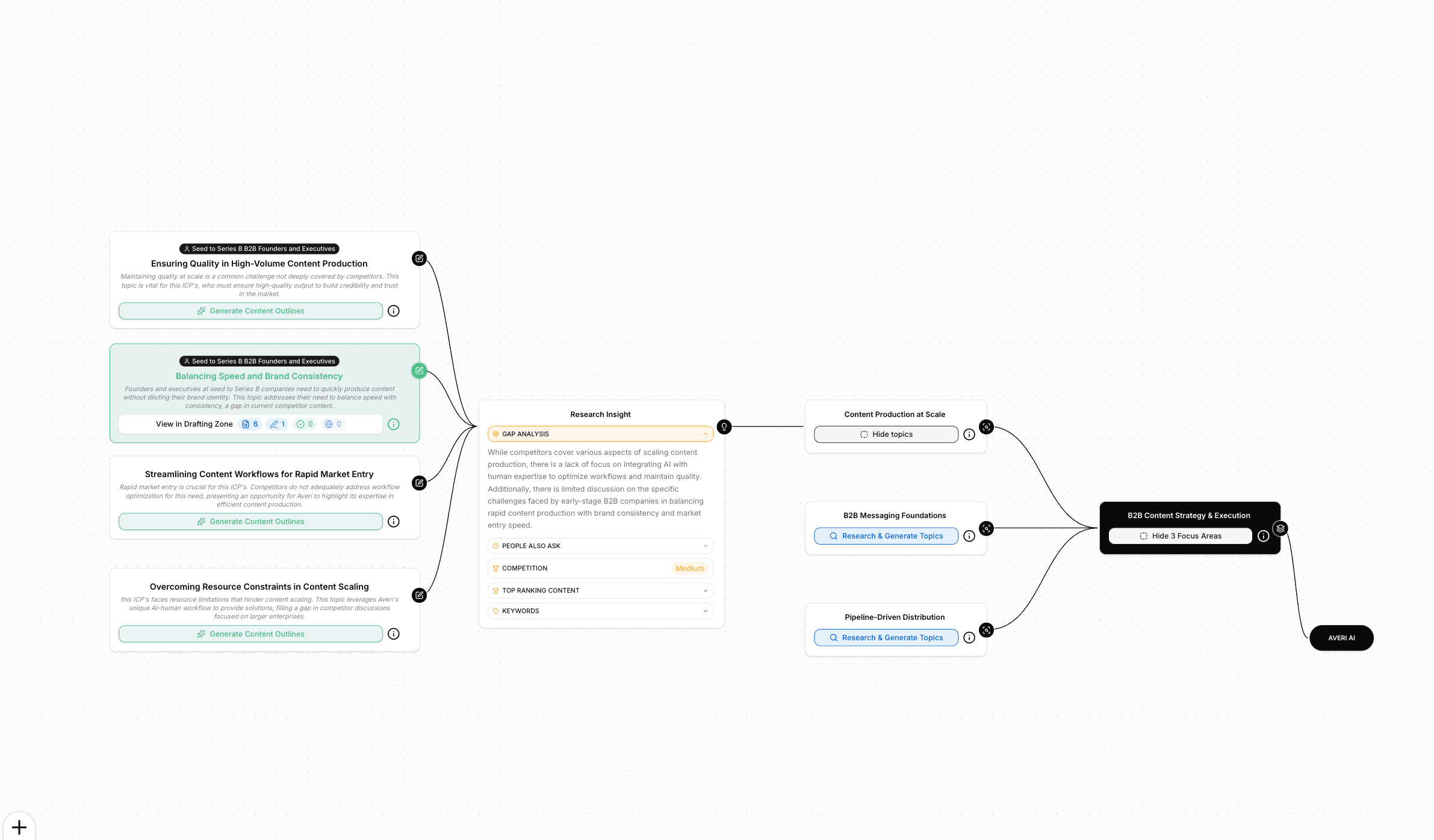
⚙️ At Averi, the Content Queue auto-surfaces 7+ word questions from PAA, Reddit, and your competitor pages — feeding tier 4 directly into your content production workflow

Zach Chmael
CMO, Averi
"We built Averi around the exact workflow we've used to scale our web traffic over 6000% in the last 6 months."
Your content should be working harder.
Averi's content engine builds Google entity authority, drives AI citations, and scales your visibility so you can get more customers.
The 7-Word Rule: Why Ultra-Long-Tail Keywords Are Eating AI Overviews
Most startup SEO advice still optimizes for three-word head terms. That advice is now actively harmful.
Queries of eight words or more trigger Google AI Overviews at 7x the rate of shorter queries, the volume of those queries has grown 7x since AIOs launched, and pages ranking in positions 21–100 saw a 400% increase in AI Overview citations — meaning your "low-volume" long-tail content is now the highest-impact traffic on your site.
Here's the strategic reframe: the keyword tools you've used since 2010 were built for a search engine that doesn't exist anymore.
Google in 2010 ranked pages for short, high-volume head terms.
AI search engines in 2026 cite content for conversational, multi-word, intent-saturated questions.
The gap between "what your tool optimizes for" and "what AI cites" is now wide enough that startups optimizing the old way are losing visibility regardless of how good their content is.
This piece is the four-tier keyword framework that fixes the gap, with 50 worked examples in B2B SaaS, and the math on why 7+ word queries are now the highest-converting traffic in your category.

Why short-tail SEO stopped working
For 15 years, the SEO playbook had a clean shape: rank for high-volume head terms, capture clicks at the top of search results, convert what comes through. The whole industry — agencies, tools, content teams, freelance writers — got built around that loop.
Two structural shifts in 2024–2026 broke the loop entirely.
The click collapse. 60% of Google searches now end without a click. 99.9% of informational keywords now trigger an AI Overview. Ranking #1 for "what is content marketing" is no longer the goal — getting cited inside the AIO that summarizes the term is. The traffic dynamics flipped: head-term rankings are diagnostic, not commercial, and the actual buyers are the ones asking longer, more specific questions.
Conversational search. The average ChatGPT prompt is 23 words versus 3.37 for traditional Google search. When a buyer types into a search box, they truncate to keywords. When they speak to a voice assistant or type into ChatGPT, they ask full questions in natural language. AI search engines extract answers from content that matches the question's structure — long, specific, intent-saturated — not from content optimized for a 3-word fragment.
The combined effect: head-term optimization became a worse-performing tactic for a worse-performing channel. Long-tail optimization became the highest-impact shift you can make in 2026, and the impact compounds every quarter as AI search adoption grows.
For more on the underlying buyer behavior shift, our piece on the future of B2B SaaS marketing in the GEO era covers the broader patterns, and our zero-click SEO guide walks through what to do when traffic stops being the right metric.
The four-tier keyword framework for 2026
Here's the framework I run at Averi, and the one we use to build content queues for every customer that runs a Strategy Map.
Tier | Word count | Intent type | Volume profile | Content format |
|---|---|---|---|---|
1. Brand | 1–2 words | Branded discovery | Low absolute, 100% intent | Branded landing page |
2. Category | 3–4 words | Solution-aware | High absolute, low intent | Definition page, beginner guide |
3. Intent | 5–6 words | Solution + qualifier | Mid absolute, mid intent | Comparison, how-to, listicle |
4. AI Overview | 7+ words | Specific question | Low absolute, very high AIO trigger rate | FAQ, answer capsule, conversational explainer |
Each tier behaves differently across three dimensions: search volume, conversion intent, and AI Overview trigger probability.
Most startup SEO programs in 2026 are still over-indexed on tier 2 (category terms) where the volume looks attractive on paper but the AIO trigger rate is now near 100% and the click-through is near zero. The opportunity has shifted to tier 4.
Worth being precise about what each tier actually looks like. Concrete examples in the AI marketing software category:
Tier 1 (1–2 words): "Averi", "Jasper", "AirOps"
Tier 2 (3–4 words): "AI marketing tools", "content marketing software", "AI writing platform"
Tier 3 (5–6 words): "best AI tools for SaaS marketing", "content marketing software for startups", "AI writing platform vs human writers"
Tier 4 (7+ words): "what is the best AI content tool for a Series A SaaS startup", "how do I get my content cited by ChatGPT", "is hiring a content engineer worth it for a 10-person company"
Read the tier 4 examples one more time.
Those are real, recent queries from your buyers. They're how a real founder asks a real question at 11pm on a Tuesday. They're the queries no Ahrefs head-term filter will ever surface, and they're the queries AI search engines pull entire answers from.
For more on the upstream methodology that surfaces tier 4 queries systematically, see our Question Stack guide — the 5-layer framework for finding every question a buyer will ever make in your category.
Tier 4 is where AI Overviews live
Here's the part most SEO advice skips. AI Overviews don't appear because Google decides "this is a popular query." They appear because the query has the structural shape of a question that needs an answer.
Every one of those queries is an AIO trigger candidate. The longer and more specific the question, the more likely it triggers, because:
Google's AIO algorithm prefers queries with clear informational intent over navigational or transactional ones
Long-tail queries have less SERP real estate to fight for, so AIOs are more likely to dominate the page
AI extraction works better on specific questions than vague ones, so the engine "trusts" the answer more
The data backs the framework hard.
From BrightEdge's analysis: queries of 8 words or more trigger AI Overviews at 7x the rate of shorter queries, and 8+ word query volume has grown 7x since AIOs launched. 46% of all AI Overview citations come from long-tail queries of seven words or more. 57.9% of AI Overview citations come from question-format queries specifically.
The tactical implication is uncomfortable for SEO programs built around head-term optimization: the queries with the highest AI Overview trigger rate are the queries with the lowest absolute search volume in your keyword tools. The volume isn't gone — it's distributed across thousands of low-volume long-tail variants.
You can't target each one individually. You target the pattern, and you produce content that answers the pattern's underlying question.
For the technical implementation, our Google AI Overviews optimization guide covers the structural patterns that win citations, and our FAQ optimization for AI search guide covers how to format the answer capsules that AI Overviews extract.
50 tier-4 examples across B2B SaaS verticals
Theory is fine. Worked examples are what makes a framework usable.
Here are 50 real tier-4 queries — actual 7+ word questions that buyers in different B2B SaaS verticals are asking right now. I pulled these from a mix of People Also Ask, Reddit threads, and Search Console data across Averi customers.
For founders evaluating AI marketing tools (10 queries):
what is the best AI content tool for a Series A SaaS startup
how do I know if an AI marketing tool is worth $99 a month
is hiring a content engineer worth it for a 10-person company
how do I get my SaaS content cited by ChatGPT and Perplexity
what does an AI content engine actually do for a startup
how is generative engine optimization different from traditional SEO
should I use Jasper or Averi for B2B SaaS content marketing
how long does it take an AI content tool to show real results
what's the cheapest way to get my startup cited in AI Overviews
is HubSpot's $50 AEO tool actually useful for a 5-person team
For SaaS marketers running content programs (10 queries):
how do I write content that gets cited by AI answer engines
what's the difference between AEO and GEO and SEO in 2026
how often should I refresh content to keep AI search visibility
how do I track AI citations for my brand across ChatGPT and Gemini
what's the ideal word count for an article to rank in AI Overviews
how do I optimize my FAQ section for ChatGPT citations
what schema markup do I need for AI search optimization
how does internal linking affect AI Overview citation rates
what's the best way to prove content marketing ROI to a CFO
how do I structure a B2B SaaS blog post for maximum AI extraction
For B2B founders evaluating their content engine (10 queries):
how do I build a content engine without hiring a marketing team
is content marketing dead for B2B SaaS in 2026
how much does it actually cost to run B2B SaaS content in-house
what's the minimum viable content strategy for a seed-stage startup
how do I know if my content is broken or just slow
how do other Series A founders run marketing without a CMO
what should a 1-person marketing team focus on first
how do I get organic traffic when AI Overviews take 60% of clicks
is it normal for content velocity to feel impossible at this stage
what's the realistic timeline from publish to organic pipeline
For SaaS evaluators researching specific use cases (10 queries):
how do I integrate Webflow with an AI content tool for autopublish
does Averi work for technical B2B SaaS or only marketing fluff
can I use a content engine if I already have a freelance writer
how does AI content scoring work and is it accurate
what's the learning curve on switching from HubSpot to a content engine
how do I migrate my existing blog library to an AI workflow
does an AI content tool work for very technical product categories
how do I add my brand voice to an AI writing platform
what happens to my content rankings when I switch tools
is it safe to publish AI-drafted content from a SEO perspective
For founders auditing their content for AI search readiness (10 queries):
how do I check if my B2B SaaS site is cited by ChatGPT today
what does a B2B SaaS website look like to an agentic browser
how do I audit my existing content library for AI search readiness
what's the easiest single change to improve my AI citation rate
how do I find the questions my buyers are actually asking AI tools
is my organic traffic actually declining or just being absorbed by AIOs
how do I prove AI search citations are driving pipeline
what KPIs should I track instead of organic sessions in 2026
how do I report content ROI when 60% of search ends without a click
what's the new equivalent of "ranking #1" in an AI search world
A few things worth pulling out of this list:
None of these are in standard keyword tools at meaningful volume. Individually they're sub-50/mo queries. In aggregate they represent the dominant search behavior in B2B SaaS today.
The intent is dramatically higher than head terms. A buyer asking "is hiring a content engineer worth it for a 10-person company" is closer to a purchase decision than someone searching "content marketing tools."
Each one maps to a piece of content. Not necessarily a dedicated page per query — usually a section in a larger pillar page that earns the citation when the question gets asked.
They sound like questions, not keywords. That's the whole shift. Optimizing for tier 4 means writing for questions, not keywords.
For the methodology to surface these systematically, our Question Stack framework walks through how to source 50 questions per ICP across 5 awareness layers. The 7-word rule is the volume filter you apply on top of that.

How to actually rank for tier-4 queries
Targeting tier 4 isn't about cramming long phrases into title tags. The mechanics are different from traditional SEO. Here's the playbook that's working in 2026.
1. Match the question's full structure inside an H2
The H2 should restate the question almost verbatim. Not paraphrased. Not optimized. Verbatim. AI Overviews extract from the H2/H3 structure looking for direct question/answer pairs. "How do I optimize my FAQ section for ChatGPT citations" performs better as an H2 than "FAQ Optimization Tips for AI Search."
2. Keep the answer self-contained in 40–60 words
44.2% of AI citations come from the first 30% of a page's text. Within each section, the same dynamic applies — the AI extracts the first complete answer it finds. A self-contained 40–60 word answer immediately under your H2 is the structural unit that gets cited.
3. Add fact density inside the answer
Content with original statistics sees 30–40% higher visibility in AI responses. Every tier-4 answer should contain at least one specific number, date, or named source. "Fast-growing SaaS companies see real results" gets ignored. "Series A SaaS companies running an AI content engine averaged 47% organic traffic growth in their first 90 days" gets quoted.
4. Surround the answer with FAQPage schema
FAQ sections get cited by AI at roughly 3x the rate of standard content sections. Wrap your tier-4 answers in proper FAQPage schema markup. This is the single highest-impact technical SEO change you can make for tier-4 visibility.
5. Cluster related tier-4 queries on a single pillar
A single page with 7 tier-4 questions answered well outperforms 7 separate pages with one question each. Topical authority compounds within a domain. AI engines prefer to cite a single authoritative source over fragmented coverage. Your pillar page architecture should reflect that — long pillars with rich FAQ sections, not micro-pages per query. Our content clustering and pillar pages guide covers the technical architecture.
6. Refresh quarterly
Pages updated within the past year make up 70% of AI-cited pages. Tier-4 content decays faster than head-term content because the questions evolve faster. Quarterly refresh isn't optional — it's the maintenance cadence that keeps tier 4 producing.
The volume math nobody is showing you
Here's the question I get most often when I walk founders through this framework: "If tier-4 queries each have 50 searches a month, how is this a real growth strategy?"
The answer is in the aggregation math.
A typical B2B SaaS category contains roughly 50,000–200,000 unique long-tail queries. Long-tail terms account for 91.8% of all search queries and drive 60–70% of total search traffic — not because individual long-tail keywords are high-volume, but because the cumulative volume across the long tail is enormous.
Here's the math for a single startup at realistic scale:
30 published pillar pages, each answering 5 tier-4 questions in dedicated FAQ sections = 150 tier-4 queries covered
Average 50 monthly searches per query (often higher for technical or specific questions) = 7,500 monthly target search volume
AI Overview trigger rate at 7+ words: ~70% (vs ~30% for shorter queries)
AI citation rate when content is properly structured: ~25% (vs ~5% on head terms)
Effective monthly AI citations: ~1,300 across the cluster
Branded query lift from citations (compounding): typically 2–3x within 6 months
Compare that to chasing a single 5,000/mo head term where you rank #4, get a 6% click-through, and convert at 1%. The math runs differently because the channel runs differently.
The quiet advantage for startups specifically: tier-4 competition is dramatically lower than head-term competition. Most enterprise SEO programs still optimize for head terms because their measurement systems and KPIs are calibrated to head-term thinking.
That leaves tier 4 wide open for any startup willing to commit to the framework.
What this means for your content strategy
Five operational changes if you're moving to a tier-4 strategy:
1. Stop using keyword tools as your topic source. Use them as a final volume check. Sources for tier-4 queries are PAA expansions, Reddit threads, support tickets, sales call transcripts, and Search Console queries containing your brand. Our Question Stack framework is the upstream methodology for sourcing these systematically.
2. Reorganize your content structure around questions, not keywords. Every pillar page should answer a primary tier-3 query in the H1 and 5–10 tier-4 queries in dedicated FAQ-style sections. The H2 is the question; the answer is the 40–60 word capsule below.
3. Build a quarterly refresh cadence into your workflow. Tier-4 questions evolve faster than head terms. Refresh top-performing tier-4 content every 90 days at minimum.
4. Track AI citation frequency, not just organic sessions. Your traffic dashboard will lie to you in a tier-4 strategy because AIOs absorb clicks. The honest measurement is "how often does my brand appear in ChatGPT, Perplexity, and Gemini answers for my category questions" — sampled weekly. Our tracking AI citations guide covers how to set this up.
5. Add FAQPage schema everywhere. This is the single highest-impact technical change. Audit your top 20 pages this week. The ones without FAQPage schema are leaving citations on the table.
What to do this week
If you're a founder or solo marketer running B2B SaaS marketing, the order I'd work in:
Audit your current content library for tier-4 coverage. Pull your top 20 pages. Count tier-4 questions answered per page. Most teams find they have zero — every section is optimized for tier-2 or tier-3 keywords.
Pick one pillar page to retrofit. Choose your highest-impressions, lowest-CTR page from Search Console. Add a 7-question FAQ section using tier-4 queries from your category. Wrap in FAQPage schema. Watch citation rate over the next 30 days.
Build a tier-4 query bank for one ICP. 50 queries minimum, sourced from PAA + Reddit + Search Console. Map each to a pillar page in your content roadmap.
Audit your blog architecture. If you have 100 thin pages instead of 20 deep pillar pages, consolidate. AI engines prefer fewer authoritative sources over many shallow ones.
Set up weekly AI citation sampling. Manually query ChatGPT, Perplexity, and Gemini on your top 10 category questions. Document who gets cited. Compare to last week. This is your new share-of-voice dashboard.
That's roughly 15 hours of work spread across two weeks. The compound payoff is months of tier-4 visibility that head-term optimization can't produce.
If you want this baked into your content workflow instead of run as a quarterly project, that's what we built Averi for.
Every Content Queue topic in Averi is sourced from tier-4 patterns automatically — PAA, Reddit, Search Console, and competitor pages, weighted toward queries with the structural shape AI engines extract from.
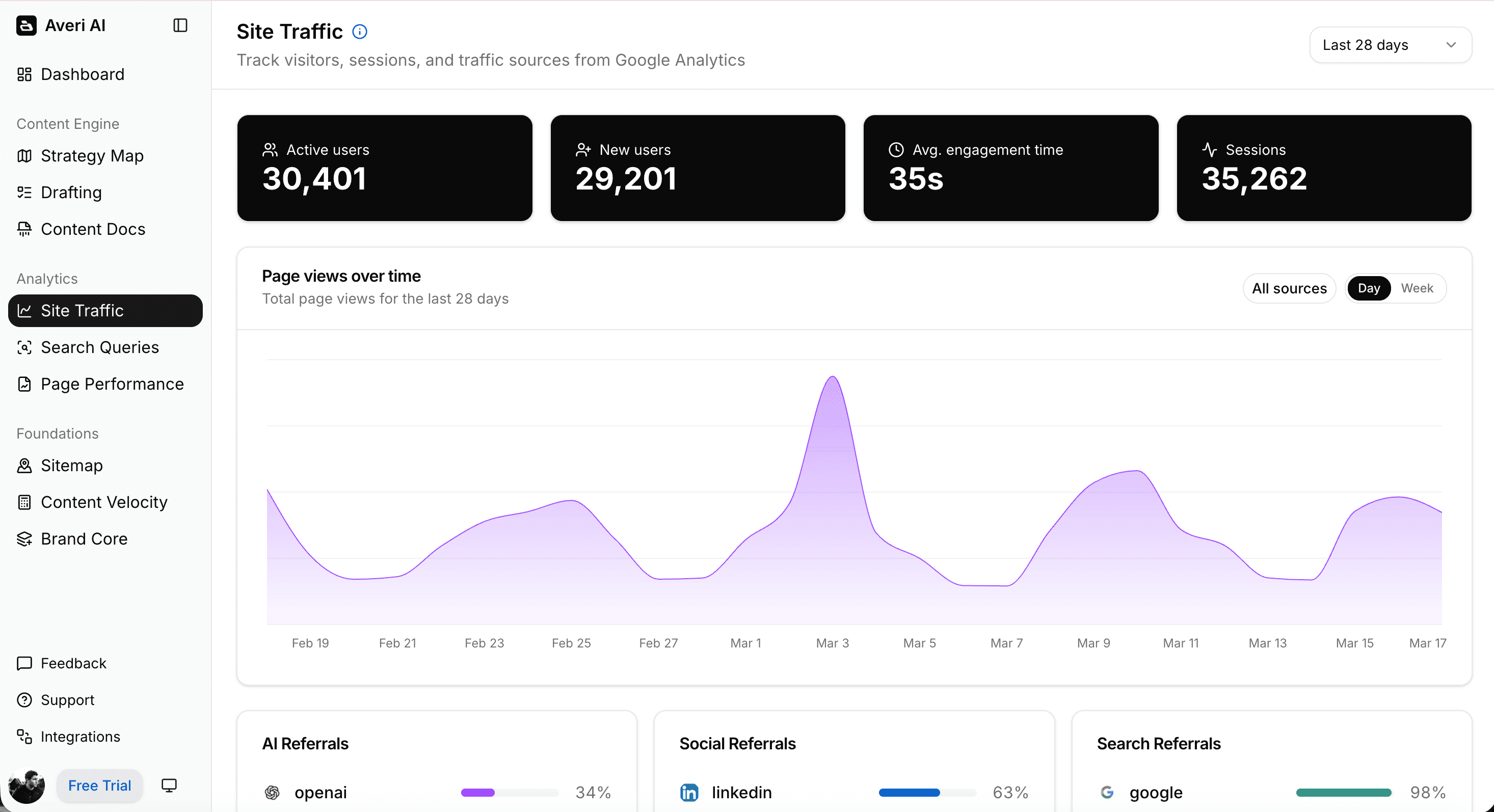
Every draft is scored on a composite SEO + GEO scale of 0–100 before publish.
Start a free 14-day trial and run your existing site through the Strategy Map to see your tier-4 gaps.
Related Resources
AI Search & GEO Foundation
Long-Tail & Question-Based Strategy
Technical Optimization
Measurement & Zero-Click Strategy
Founder Strategy
Run the four-tier framework on your own site. Averi's Content Queue surfaces tier-4 queries automatically from PAA, Reddit, and Search Console — feeding them into a workflow that drafts, scores, and publishes optimized content. $99/mo, no contract, 14-day free trial.
FAQs
What are ultra-long-tail keywords for AI Overviews?
Ultra-long-tail keywords are search queries of 7 or more words, typically phrased as full conversational questions. They trigger Google AI Overviews at significantly higher rates than shorter queries — queries of 8+ words trigger AIOs 7x more often than shorter ones — because they have the structural shape AI engines extract answers from. They're the dominant query format in 2026 AI search.
Why are long-tail keywords more important for AI search than traditional SEO?
AI search engines extract answers from content that matches the structural shape of the user's question. Long-tail queries are conversational, specific, and intent-saturated — making them ideal extraction targets. Traditional SEO optimized for short head terms because those drove clicks; AI search rewards long-tail content because it generates the cleanest extractable answers.
How long should keywords be for AI Overviews in 2026?
The strongest AI Overview trigger rate occurs at 7+ words, with 8+ word queries hitting 7x the rate of shorter ones. Optimal target length is 7–12 words, phrased as a full question with an interrogative ("how," "what," "why," "is," "should"). Shorter queries (3–4 words) still matter for category-level visibility but are increasingly absorbed into AIO summaries that don't drive clicks.
What's the difference between long-tail and ultra-long-tail keywords?
Long-tail traditionally meant 4+ word phrases with low individual search volume. Ultra-long-tail is the 7+ word subset that specifically triggers AI Overviews and gets cited by ChatGPT, Perplexity, and Gemini. The distinction matters in 2026 because the AI Overview trigger rate jumps dramatically at the 7-word threshold, making ultra-long-tail a meaningfully different content target.
How do I find ultra-long-tail keywords for my B2B SaaS startup?
Five sources: People Also Ask box expansions on Google, Reddit threads in your buyer's communities, Search Console queries containing your brand name, customer support tickets tagged with how-to questions, and Google autocomplete for "what," "how," and "is" prefixes. Most don't appear in standard keyword tools at meaningful volume — you have to mine them from real user behavior.
Can I rank for ultra-long-tail keywords with low domain authority?
Yes — this is the unfair advantage for startups. Pages ranked 21–100 saw a 400% increase in AI Overview citations versus top-10 ranked pages, because AI extracts on relevance and answer quality rather than ranking position. A well-structured tier-4 answer on a low-DA site can outperform a generic head-term page on a high-DA competitor in AI search results.
How does Averi's content engine handle long-tail keyword research?
Averi's Content Queue auto-surfaces tier-4 questions weekly from People Also Ask, Reddit threads, Search Console branded queries, and competitor pages. Each topic is delivered with a target keyword, an outline, and AI Overview optimization built in. Content is scored on a composite SEO + GEO scale before publish, with the GEO portion weighted specifically toward extractability — the structural patterns that earn citations from tier-4 queries.