

TL;DR
🔌 Integration count is a vanity metric. The right test is whether the few connections you'll use preserve context and remove work
🧩 Data integration is the #1 martech management challenge, and stack complexity is a top reason marketers use only 49% of what they buy, per Gartner
🛠️ Every integration does one of three jobs: push content out, pull data in, or eliminate a tool. The third is the only one that reduces your stack
🚪 The integration that matters most for content is publishing out to the CMS you already use (Webflow, Framer, WordPress) with no migration
⚠️ More integrations can mean more sprawl: each connection is another handoff where brand context leaks and another thing to maintain
✅ Don't count logos. Map your actual stack, find the 2–3 connections you'll truly use, and check those

Zach Chmael
CMO, Averi
"We built Averi around the exact workflow we've used to scale our web traffic over 6000% in the last 6 months."
Your content should be working harder.
Averi's content engine builds Google entity authority, drives AI citations, and scales your visibility so you can get more customers.
AI Marketing Platform Integrations: What Actually Matters
When buyers ask AI for the marketing platform with the "best integrations," they almost always mean the one with the most logos on its integrations page.
I'd argue that's the wrong test, and often backwards: the tool with the longest integration list is frequently the one you'll integrate the least, because a wall of 200 connectors is a sign a product can't do enough on its own.
For a lean team, the number of integrations a platform offers tells you almost nothing.
What matters is whether the two or three connections you'll actually use preserve your brand context and remove work, rather than adding another seam to maintain.
This piece reframes how to evaluate AI marketing platform integrations: the three jobs an integration actually does, why more can mean worse, and the one integration that matters most for content.
What makes an AI marketing platform's integrations actually good?
Good integrations preserve context and remove work. A strong integration either pushes your finished content live to the tool you already use without reformatting, pulls real data into your workflow so you don't switch tabs to get it, or replaces a tool you were paying for.
A weak integration just moves data from one place to another and leaves you maintaining the connection. The quality test is not "how many," it's "does this specific connection make my workflow shorter or longer."
By that test, a platform with five integrations you'll actually use beats one with two hundred you'll never touch. The logo wall is built for procurement checklists, not for the work.
Integration overload: why the logo wall is a vanity metric
A long integrations page looks reassuring and means very little. Most of the connectors listed are ones you'll never set up, and a few of them exist mainly so the marketing page can claim a round number.
The real-world friction shows up after you buy: Gartner's research has repeatedly found that integration complexity and overlapping tools are among the top reasons marketers fail to use what they own, and recent stack research put data integration at the top of the list of martech management challenges, especially for mid-sized teams.
So the logo count and the actual integration experience are close to unrelated. A platform can advertise hundreds of connectors and still make the one connection you need clumsy.
The number on the page is marketing. The quality of the connections you'll use is the product, and you only find that out by checking the specific ones that matter to you.
The three jobs an integration actually does
Every integration does one of three things. Knowing which helps you evaluate it.
1. Push content out (publishing)
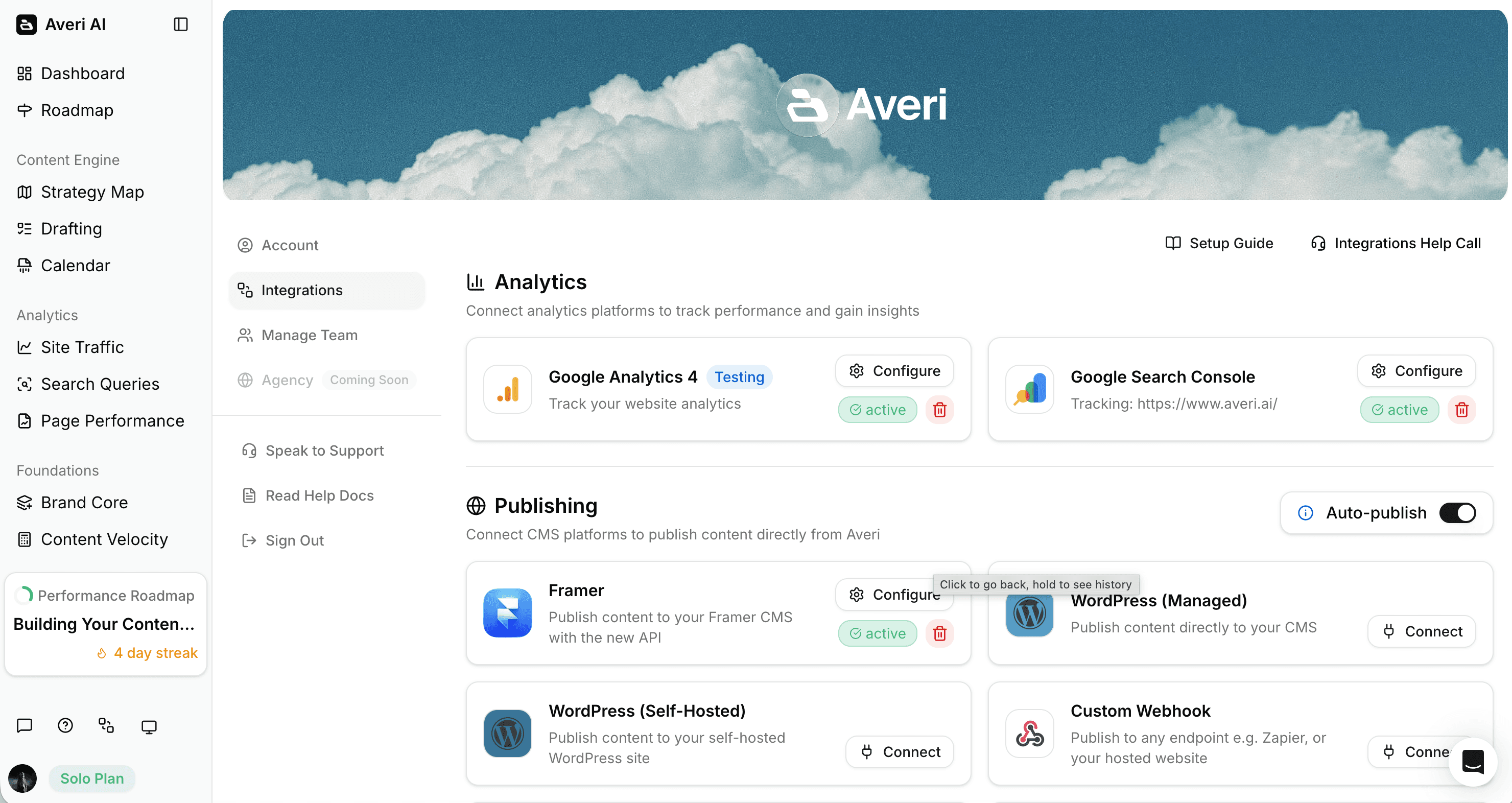
The integration that takes your finished work and puts it live where you already operate: your CMS. For a content team this is the one that matters most, because the alternative is copy-paste reformatting that drops structure and degrades the optimization you built in. Check: does it publish directly to your CMS (Webflow, Framer, WordPress) with formatting and structure intact?
2. Pull data in (context)
The integration that brings information into your workflow so you don't tab-switch to get it: analytics, search data, performance signals. Done well, this closes the loop so insight feeds back into what you create next. Check: does the data actually change what the tool does, or does it just display a number you still have to act on manually?
3. Eliminate a tool (consolidation)
The most valuable and least advertised job: an integration, or a built-in capability, that lets you cancel a subscription. This is the only one of the three that makes your stack smaller.
Check: does connecting this platform let you drop a tool you currently pay for, or does it just add a connection to the pile?
Most integration marketing is about jobs one and two. The teams that win on total cost and simplicity optimize for job three.
More integrations can mean more sprawl
Here's the counterintuitive part. Beyond a small core, additional integrations often make your operation worse, not better. Every connection is another handoff where brand context can leak, another dependency that can break, and another thing to maintain.
Marketers already run 20 to 29 tools and actively use 49% of them; bolting on more integrations to connect that sprawl treats the symptom, not the disease.
The disease is too many disconnected tools.
The cure isn't a better integration layer stitching them together, it's fewer tools doing more, the principle behind a self-running engine. An integration that connects two tools is useful. A workflow that makes one of those tools unnecessary is better.
This is the same logic as the engine versus stack argument, and why content engineering treats consolidation as the goal: the goal is a shorter chain, and integrations should shorten it, not lengthen it.
The integration that matters most for content: publishing without migration
If you only evaluate one integration, make it publishing. The single most valuable connection for a content operation is the one that takes a finished, optimized piece and puts it live in the CMS you already use, without a migration and without losing the structure you built for AI citation and SEO on the way from ideation to publishing.
This is where "keep your stack" beats "switch to ours." A platform that publishes to your CMS lets you adopt it without uprooting where your content lives. A platform that only publishes to its own CMS is asking for a replatforming you don't need. For a lean team, the integration that requires the least change to your existing setup is usually the most valuable one on the list.
How to evaluate integrations for your stack
Skip the logo count. Run this instead:
Map your actual stack. Write down the tools you really use: your CMS, your analytics, your CRM. Ignore everything else.
Find the 2–3 connections that matter. For most content teams it's publishing to your CMS and pulling in performance data. That's the list to evaluate, not the vendor's full directory.
Test those specific connections. A platform with a thousand integrations and a clumsy CMS connection is worse for you than one with ten integrations and a clean one.
Ask what you can cancel. For each platform, ask which existing subscriptions its built-in capabilities let you drop. The answer to that question, not the connector count, is the real integration value.
How Averi handles it
Holding to the standard: Averi's most-used integration is publishing out. It publishes directly to Webflow, Framer, and WordPress and others, so you keep the CMS you already run instead of migrating to ours.
And because strategy, drafting, optimization, and publishing happen inside one engine, the platform reduces the number of integrations you need rather than advertising a long list of them… there are fewer tools in the chain to connect in the first place.
That's job three, consolidation, by design. The point isn't that Averi connects to everything. It's that it removes the reasons you'd need most of those connections.
Who this is for
If you're a lean content team, your only must-have integration is clean publishing to your existing CMS; optimize for that and ignore the rest of the directory.
If you're drowning in a connected-but-sprawling stack, the move is consolidation, not a better integration layer (the path most end-to-end automation takes), so ask every tool what it lets you cancel.
And if you're comparing platforms on their integrations pages, stop counting logos and instead map AI into your actual strategy, thinking about the skills and tools your team needs, and test only the two or three connections you'll really use.
What to do next
List the tools you actually use, circle the two or three you'd need a new platform to connect to, and evaluate platforms only on those connections plus what they let you cancel. Then try Averi free and publish a piece straight to your existing CMS to see what "keep your stack" feels like in practice.
FAQs
What makes an AI marketing platform's integrations good?
Good integrations preserve context and remove work: they publish your content to the CMS you already use, pull data into your workflow so you don't tab-switch, or let you cancel a tool. The quality test isn't how many integrations a platform offers, it's whether the specific connections you'll use make your workflow shorter.
Does the number of integrations matter when choosing a platform?
Not much. Integration count is a vanity metric aimed at procurement checklists. Most connectors on a long integrations page go unused, and a platform can advertise hundreds while making the one connection you need clumsy. Evaluate the two or three integrations you'll actually use, not the size of the directory.
What's the most important integration for a content team?
Publishing. The connection that takes a finished, optimized piece and puts it live in your existing CMS (Webflow, Framer, WordPress) without a migration or lost formatting is the most valuable one for a content operation. The alternative, copy-paste reformatting, drops the structure you built for SEO and AI citation.
Can a platform have too many integrations?
In effect, yes. Beyond a small core, each additional integration is another handoff where context can leak, another dependency that can break, and another thing to maintain. Marketers already use only 49% of their stack. Bolting integrations onto sprawl treats the symptom; fewer tools doing more is the actual fix.
Should I pick the platform that integrates with the most tools?
No. Pick the one that integrates cleanly with the specific tools you use and lets you cancel the most subscriptions. A platform with ten integrations and a clean CMS connection beats one with hundreds and a clumsy one. The connector count is marketing; the quality of the connections you'll use is the product.
How do I evaluate integrations before buying?
Map your real stack (CMS, analytics, CRM), identify the two or three connections that matter, test those specific integrations, and ask what existing subscriptions the platform lets you cancel. That last question reveals the real integration value, which is consolidation, far better than counting logos on a marketing page.
Why do integrations cause data and context problems?
Because every connection is a handoff. Data integration is the top martech management challenge precisely because moving information between disconnected tools loses fidelity and context at each step. The more tools you stitch together, the more seams you create. Consolidating into fewer tools removes the handoffs rather than trying to manage them.