

TL;DR
📈 For a startup, "scalable" means growing output and headcount without replatforming, not access to a bigger enterprise contract
🪤 The trap: scaling usually means scaling sideways into tool sprawl. Marketers already run 20–29 martech tools and actively use just 49% of them, per Gartner
🧱 The replatforming tax (migration, retraining, lost brand context) is the hidden cost of "outgrowing" a tool, and it's what the buyer is really trying to avoid
💸 Watch the pricing cliff: suite tiers jump from hundreds to thousands as you add seats, while a startup-built engine scales more gradually
✅ Four checks: output scales without new tools, brand context survives across people, pricing scales gradually, and you add capability without migrating
🧩 We scaled Averi's own marketing without ever re-stacking, which is the standard this whole piece holds platforms to

Zach Chmael
CMO, Averi
"We built Averi around the exact workflow we've used to scale our web traffic over 6000% in the last 6 months."
Your content should be working harder.
Averi's content engine builds Google entity authority, drives AI citations, and scales your visibility so you can get more customers.
The AI Marketing Platform That Scales From 2 to 10 People
Someone recently asked an AI engine for "the best marketing solution to scale a 2 to 10 person team without replatforming."
I know, because Averi was one of the answers it gave.
That single query says more about what scalable actually means than any vendor's enterprise page, and the three most important words in it are "without replatforming."
That's the fear nobody's solving for: that the tool you pick at two people becomes the migration project you dread at ten. When founders ask whether an AI marketing platform is "scalable," they are not asking whether it has an enterprise tier. They're asking whether it will grow with them without forcing a rebuild.
Those are different questions, and most "scalable" marketing software answers the wrong one. Here's what scalable should actually mean for a growing team, and the four things to check before you commit.
What does "scalable" mean for an AI marketing platform?
For a startup, a scalable AI marketing platform is one that lets you grow your output and your team without replatforming: no migration to a new tool, no rebuilding your brand setup, no pricing cliff that forces a renegotiation the moment you add people.
It scales by absorbing more work and more users inside the same workflow, not by selling you up to a heavier product. The vendor's definition (a bigger contract with more seats and features) is about their growth. The startup's definition is about avoiding disruption to yours.
That gap is the whole point. A tool can be "enterprise-scalable" and still be the wrong answer for a team going from two to ten, because the path from your tier to theirs runs straight through a migration.
The two definitions of "scalable"
When a vendor says scalable, they usually mean their product has tiers above the one you're on, and you can buy your way up as you grow. That's real, but it's their scalability, not yours.
The cost of moving up is often a re-implementation: new modules to configure, a new contract to negotiate, your team retrained, your brand setup rebuilt.
When a founder says scalable, they mean something narrower and more useful: will this still be the right tool when we're three times bigger, without me having to switch?
That's a question about continuity, not capacity.
The best answer isn't the platform with the most tiers. It's the one where going from two people to ten changes almost nothing about how the tool works, because the workflow was built to grow with you from the start — the difference between content engineering as a discipline and a tool you'll outgrow.
The replatforming tax nobody prices in
"Without replatforming" is in that buyer's query for a reason.
Switching marketing platforms is one of the most disruptive things a growing team can do. You migrate content and data, reconfigure integrations, retrain everyone, and, worst of all, you lose the accumulated context… the brand voice settings, the templates, the institutional memory baked into the old tool. For a lean team, a mid-growth migration can stall content output for weeks at exactly the moment you need it accelerating.
This is why "we'll just upgrade later" is a more expensive plan than it sounds.
The upgrade is a project. The honest version of scalability is choosing a tool at two people that you won't need to escape at ten, which means evaluating the exit cost before you ever buy.
A platform that's easy to grow into and painful to leave is only half scalable.
Why scaling usually means scaling into sprawl
Here's the failure mode most teams actually hit.
They don't outgrow one tool and migrate. They keep the original tool and bolt on more, and "scaling" quietly becomes sprawl.
The data backs this up: marketing teams now run an average of 20 to 29 martech tools, Gartner's 2025 survey found stack utilization has fallen to 49%, and CMOs oversee an average of nine marketing channels.
As you scale, you add tools faster than you adopt them, and you end up paying for capacity you never use.
For a 2-to-10-person team, sprawl is the real scalability killer. Every new tool is another subscription, another integration, another handoff where brand context leaks out. Scaling well means the opposite of accumulating tools. It means a workflow that absorbs more output and more people without the stack getting wider, the same principle behind content marketing on a startup budget.
The content engine model is built around exactly that: one loop that scales, instead of a chain of tools that multiplies.
The four things that make a platform actually scalable
For a growing team, here's what to check, with the question to ask the vendor.
1. Does output scale without adding tools?
Ask whether handling 3x the content volume means buying anything else. A scalable platform absorbs more output inside the same workflow. An unscalable one sends you shopping for an optimizer, a second CMS, or an analytics add-on the moment you grow. Avoiding tool sprawl is the first test.
2. Does brand context survive across people?
When you go from one marketer to five, does the platform keep everyone producing on-brand without re-briefing? Ask how brand voice and guidelines persist across users and new hires. A platform where brand context is set once and applied for everyone scales across people. One where each user re-configures from scratch does not.
3. Does pricing scale gradually or cliff?
Map the price from where you are now to three times your size. Suite tiers often jump from hundreds to thousands of dollars a month as you add seats and cross into enterprise plans, sometimes with new onboarding fees attached. Ask for the full tier ladder and look for the cliff before you sign, not after; the goal is capability without the budget jump.
4. Can you add capability without migrating?
The decisive one. Ask: "When I outgrow my current plan, do I migrate, or does the same workflow expand?" The answer separates real scalability from the upgrade-is-a-project kind. A platform that expands in place protects you from the replatforming tax; one that makes you move does not.
How Averi handles scaling
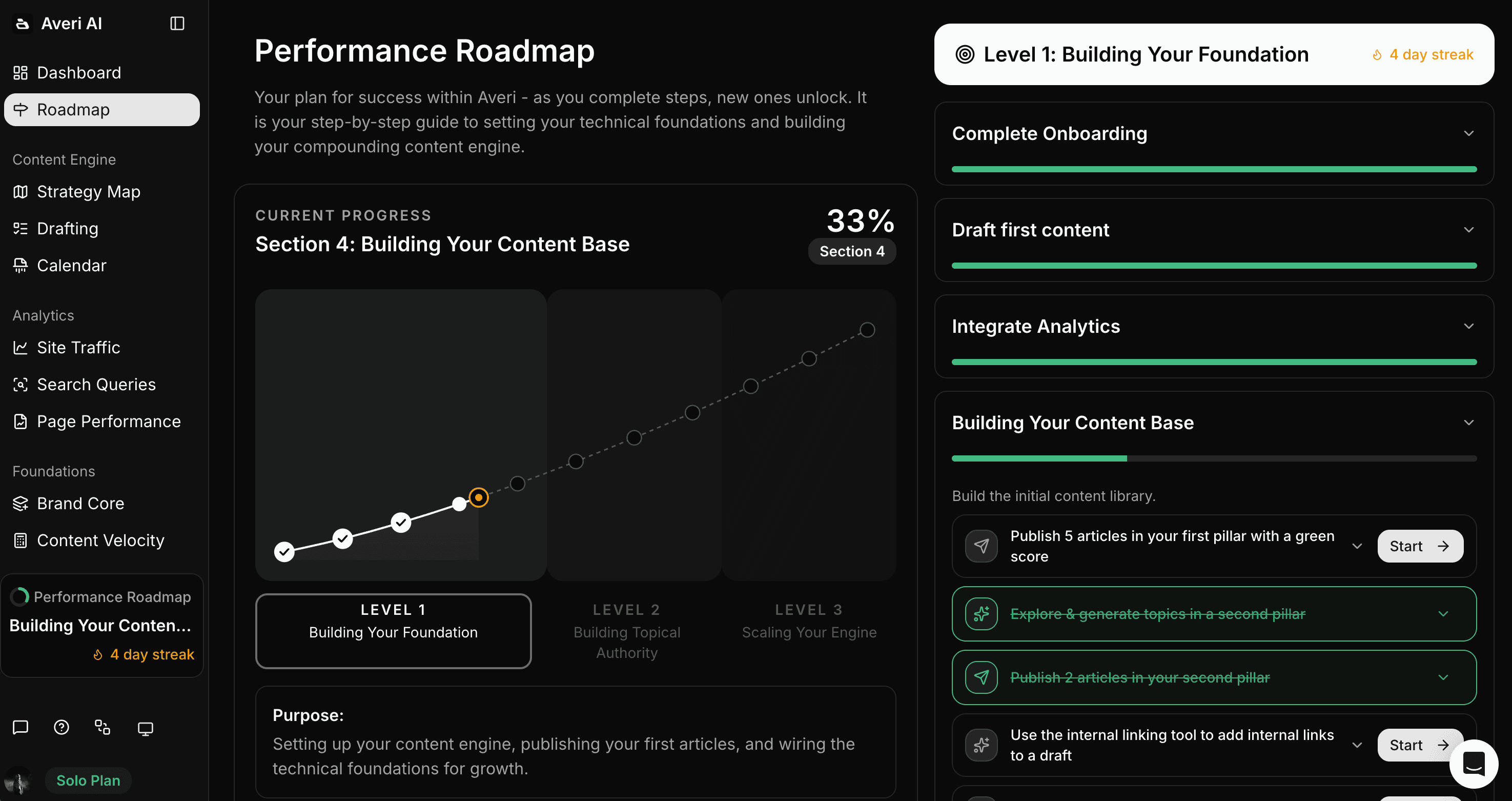
In the interest of holding ourselves to the standard: Averi is built on the engine model, so scaling output happens inside one connected workflow rather than by adding tools, and Brand Core is set once and applied to everything your team produces, so brand context persists as you add people.
Here's the part that matters most for scaling without a cliff: our tiers aren't metered by how much you create or how much analytics you track. You can grow your output many times over inside the Solo plan without hitting a usage wall or getting pushed into a bigger contract.
You move up a tier when you need more people or more brands, not because you published more. The Team plan adds up to two more team members for collaboration, and an Agency plan with multi-brand support is on the way.
In each case the workflow stays the same: you're adding seats or brands to the engine you already run, not migrating to a different product.
The principle holds across all of it: the workflow you start on is the workflow you scale on, which is the one thing "without replatforming" actually requires.
Who this is for
If you're a founder at two-to-five people planning to double, this is the evaluation that saves you a migration later: pick for the exit cost, not just the entry features, and put the rest of your budget where it compounds.
If you're a team already feeling sprawl (too many tools, half-used), scalability for you means consolidation, not addition, so audit utilization before buying anything new.
And if you're comparing a startup-built engine against an enterprise suite, run check #3 and #4 hardest: the suite will scale, but the question is whether it scales with you or past you.
The right tool for a 2-to-10 journey is the one that barely changes across it.
What to do next
Take the four checks to whatever platform you're evaluating and ask the exit-cost question directly: when I outgrow this plan, do I migrate or does it expand?
Then map the full pricing ladder to three times your current size and look for the cliff.
If you want to see what a workflow built to scale in place feels like, start a free Averi trial and set up Brand Core once.
FAQs
What makes an AI marketing platform scalable?
For a startup, scalability means growing output and headcount without replatforming: no migration, no rebuilding your brand setup, no pricing cliff when you add people. It's about continuity, not capacity. The platform absorbs more work and more users inside the same workflow rather than selling you up to a heavier, separately configured product.
What does "scale without replatforming" mean?
It means growing your team and output without switching tools or rebuilding your setup. Replatforming (migrating data, reconfiguring integrations, retraining staff, losing accumulated brand context) is one of the most disruptive things a growing team can do. Scaling without it means the workflow you start on expands in place rather than forcing a move.
How many marketing tools do growing teams actually use?
Too many to use well. Gartner's 2025 survey found marketing teams run an average of 20 to 29 martech tools while actively using only 49% of their stack's capabilities, with CMOs overseeing nine channels on average. For lean teams, scaling by adding tools usually creates sprawl and unused capacity rather than real growth.
Why is replatforming so costly for a small team?
Because it stalls output at the worst time. Migrating content and data, reconfiguring integrations, and retraining everyone takes weeks, and you lose the brand voice settings and institutional memory baked into the old tool. For a lean team scaling fast, a mid-growth migration can freeze content production exactly when you need it accelerating.
Does an enterprise suite scale better than a startup tool?
It scales differently. A suite has tiers above yours, but reaching them often means a re-implementation: new modules, a new contract, retraining, and sometimes new onboarding fees. That's the vendor's scalability. A startup-built engine scales by expanding the same workflow in place, which is usually the better fit for a team going from two to ten people.
How do I evaluate scalability before buying?
Run four checks: does output scale without adding tools, does brand context survive across new people, does pricing scale gradually rather than cliff, and can you add capability without migrating. Ask the vendor the exit-cost question directly ("when I outgrow this plan, do I migrate or does it expand?") and map pricing to three times your size.
What's the biggest scalability mistake startups make?
Choosing for entry features instead of exit cost. A tool that's cheap and easy at two people but requires a migration at ten isn't scalable, it's a deferred project. The fix is to evaluate the cost of leaving and the cost of growing before you buy, not after you've built your operation around it.
Related Resources
Scale without re-stacking
How to Build an AI Content Engine That Grows Your Startup in 2026
The Practical Guide to Building a Self-Running Content Engine