

In This Article
Actionable guide to the top AI tools for B2B marketing—how to pick tools for content, lead gen, automation, SEO, and analytics to cut costs and boost ROI.
Updated:
Trusted by 1,000+ teams
Startups use Averi to build
content engines that rank.
AI tools are transforming B2B marketing by cutting customer acquisition costs by 42%, automating manual tasks, and helping teams execute faster, smarter campaigns with less effort. However, 74% of companies struggle to see real value because they choose tools that don’t align with their workflows or team needs. Here's a breakdown of the best AI tools for specific challenges:
Content Creation: Tools like Averi and Jasper streamline blog writing, SEO optimization, and publishing. Averi even learns your brand voice automatically, while Jasper speeds up drafts for teams.
Lead Generation: Platforms like Amplemarket and 6sense use AI to track buyer intent, prioritize leads, and automate outreach, saving time and boosting conversions.
Marketing Automation:HubSpot and Salesforce Einstein GPT integrate AI into CRMs, automating lead scoring, email drafting, and campaign management.
SEO Optimization:Surfer SEO and Jasper improve content rankings by analyzing competitors and optimizing for search engines and AI-driven platforms.
Advanced Analytics:Improvado simplifies cross-channel data analysis, enabling teams to make quick, informed decisions without technical expertise.
Quick Tip: Start by identifying your biggest bottleneck - whether it’s lead generation, content creation, or analytics - and pick a tool that integrates well with your existing systems. Test it on a small scale before rolling it out broadly.
The best AI agents for B2B marketing
1. Averi
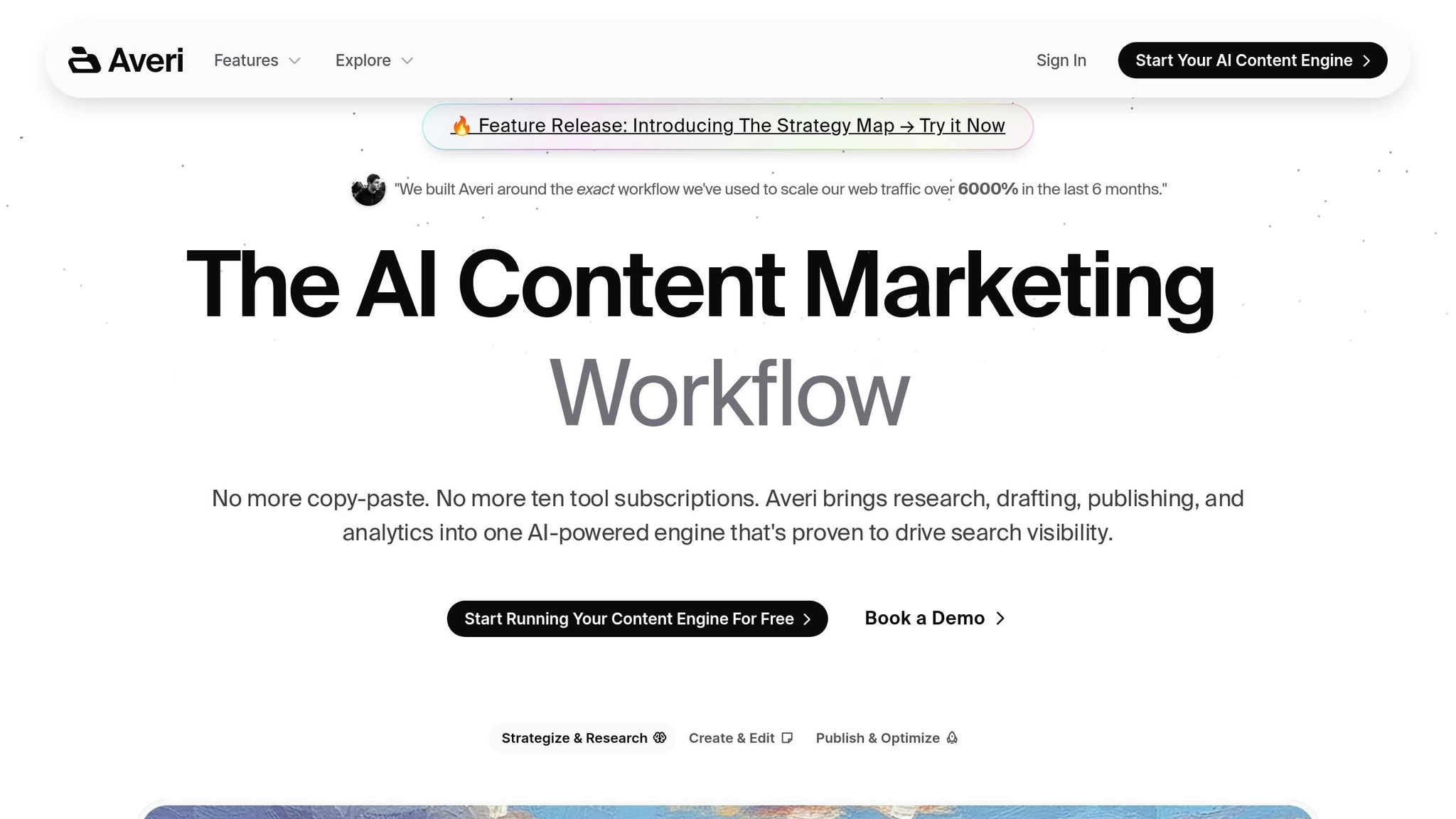
Averi simplifies the content creation process, covering everything from strategy and research to publishing and analytics. It’s designed to give small teams the tools to work with the precision of founder-level oversight without the constant need for hands-on involvement. Unlike tools that focus on a single aspect like drafting or SEO, Averi manages the entire content workflow, making it easier for lean teams to achieve big results. Let’s explore how Averi supports efficient content creation, seamless integration, and impactful lead generation.
Content Creation and Optimization Features
Averi takes the guesswork out of content creation by automatically learning your brand. It scrapes your website to understand your product, positioning, ideal customer profile, and tone of voice - eliminating the need for time-consuming manual briefings. The platform also analyzes your market and competitors, generating content ideas grounded in strategic insights. Each piece is optimized for both SEO and Generative Engine Optimization (GEO), ensuring better search rankings and improved visibility in AI-driven tools.
The results speak for themselves: Averi helped increase web traffic by over 6,000% in just six months. As CMO Zach Chmael put it:
"We built Averi around the exact workflow we've used to scale our web traffic over 6000% in the last 6 months" [5].
Integration with Existing CRM/Marketing Stacks
Averi integrates seamlessly with platforms like Webflow, Framer, and WordPress, allowing direct publishing of content. This efficiency is further enhanced by AI content repurposing, which turns single assets into multiple touchpoints. Each piece is automatically archived, enabling continuous improvement for future projects. Built-in analytics track metrics like rankings, impressions, and clicks, while AI-driven insights provide actionable recommendations to improve performance [5].
Lead Generation and Prospecting Capabilities
Averi is designed to help B2B blogs drive more leads by targeting high-intent keywords and optimizing for AI discovery. Consider these stats: companies that blog consistently can generate 67% more leads per month, and 81% of B2B buyers often select their vendor before ever speaking to a sales team [5]. By focusing on high-intent keywords and leveraging GEO optimization, Averi ensures your brand appears in AI-generated answers, a discovery channel now accounting for up to 40% of activity [5].
With pricing starting at $100/month, Averi is a smart choice for venture-backed startups looking to maximize their marketing efforts without breaking the bank [5]. It’s a comprehensive tool that combines automation with precision, making it an essential asset for B2B marketers.
2. Amplemarket
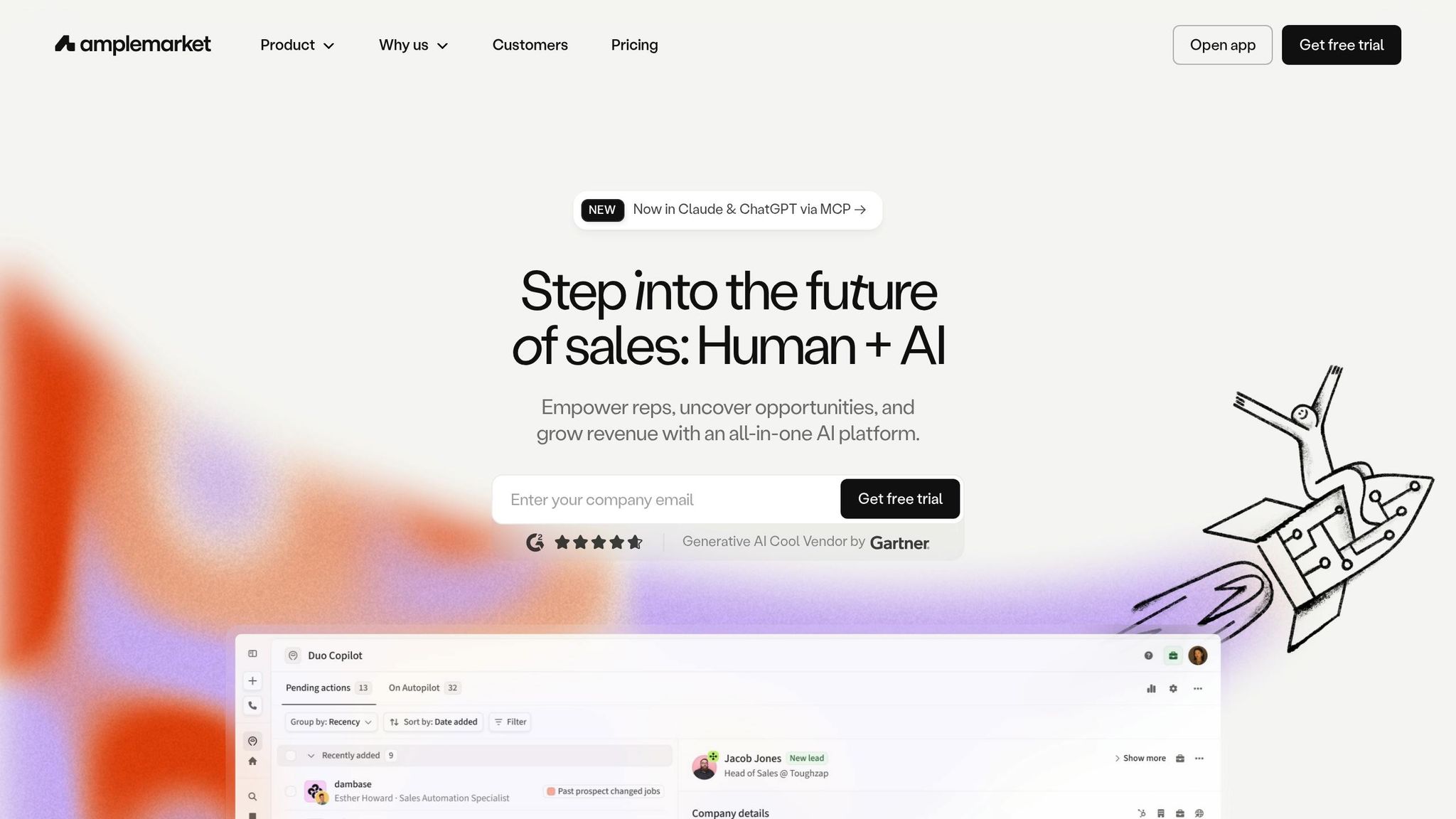
Amplemarket takes a fresh approach to prospecting by focusing on signal-based prospecting, moving away from static lists and tapping into live behavioral data. Its AI sales agent, Duo, tracks buying signals such as competitor reviews on G2, LinkedIn activity, job changes, and website visits to trigger immediate outreach [10][12]. This method enables sales teams to zero in on prospects already showing purchase intent, reducing the time spent on cold outreach to less promising leads, significantly improving marketing productivity. In doing so, the platform aligns with the growing demand in B2B sales for data-driven, faster decision-making.
Lead Generation and Prospecting Capabilities
Amplemarket's AI Searcher simplifies lead discovery through natural language processing. Instead of relying on manual filters, users can search conversationally with prompts like, “CEOs of B2B SaaS companies that raised Series A in the last 6 months” [11]. The platform boasts a robust database of over 200 million business profiles, updated weekly with 70 million new data points, ensuring high accuracy and a bounce rate of under 3% [11].
This signal-based approach has proven effective, with users reporting a 60% increase in meetings booked and sales reps saving over 10 hours per week using Duo Copilot [12]. In 2025, Giuseppe Colucci, Senior VP of Growth, leveraged Amplemarket to generate more than €2 million in business opportunities and land six-figure deals in just 10 months [12]. Gerry Hadzhigeorgieva, an SDR, shared:
"The intent signals are a game changer. We started seeing results from the first few days of using them" [12].
By combining real-time lead detection with seamless integration, Amplemarket ensures an efficient workflow for sales teams.
Integration with Existing CRM/Marketing Stacks
Amplemarket integrates effortlessly with existing CRM systems, offering bi-directional synchronization with Salesforce, HubSpot, Pipedrive, and Zendesk Sell, which eliminates the need for manual data entry [13][15]. It also connects with LinkedIn Ads and Typeform, automatically capturing leads and enrolling them into personalized sequences [13]. For workflow automation, tools like Default can be used to enrich leads and trigger follow-ups based on inbound form submissions [14].
One example of its integration power comes from Rootly's RevOps team. They set up a “meeting not booked” automation using Default and Amplemarket. When prospects didn’t schedule a meeting after submitting a form, they were added to a follow-up sequence, leading to a 10% increase in inbound demos within four weeks [14]. Additionally, teams using Amplemarket with Salesforce or HubSpot have reported email open rates surpassing 70% [13].
On top of its integration features, Amplemarket offers detailed analytics to help teams measure success.
Analytics and Reporting Capabilities
The platform tracks over 50 key metrics, including open rates, response times, and campaign performance history [15]. Its AI Lead Analytics feature evaluates the effectiveness of AI-recommended leads, monitoring metrics like lead generation, sequencing, dismissal rates, and meeting conversions [16]. Revenue attribution tools link AI-generated leads directly to closed deals, providing clear insights into pipeline value and ROI [16].
For instance, Vanta’s GTM Operations team, led by Victor Schwenoha, used Amplemarket’s Buying Intent Signals in early 2021 to focus on leads showing high purchase intent. This strategy resulted in six figures in ARR from a single campaign and delivered a 9x ROI on the signals product [17]. Irina Smirnova, Senior Sales Operations Manager, praised the platform’s reporting capabilities:
"Amplemarket offers detailed analytics, and everything is very clickable, allowing you to see the records and data behind" [16].
Starter plans are priced at $3,600 per user annually, with discounts available for teams of 50 or more [15]. With a 4.6/5 rating on G2 from over 570 reviews, many users highlight Amplemarket’s ability to replace multiple tools - often consolidating 4–6 separate solutions into one [15].
3. 6sense
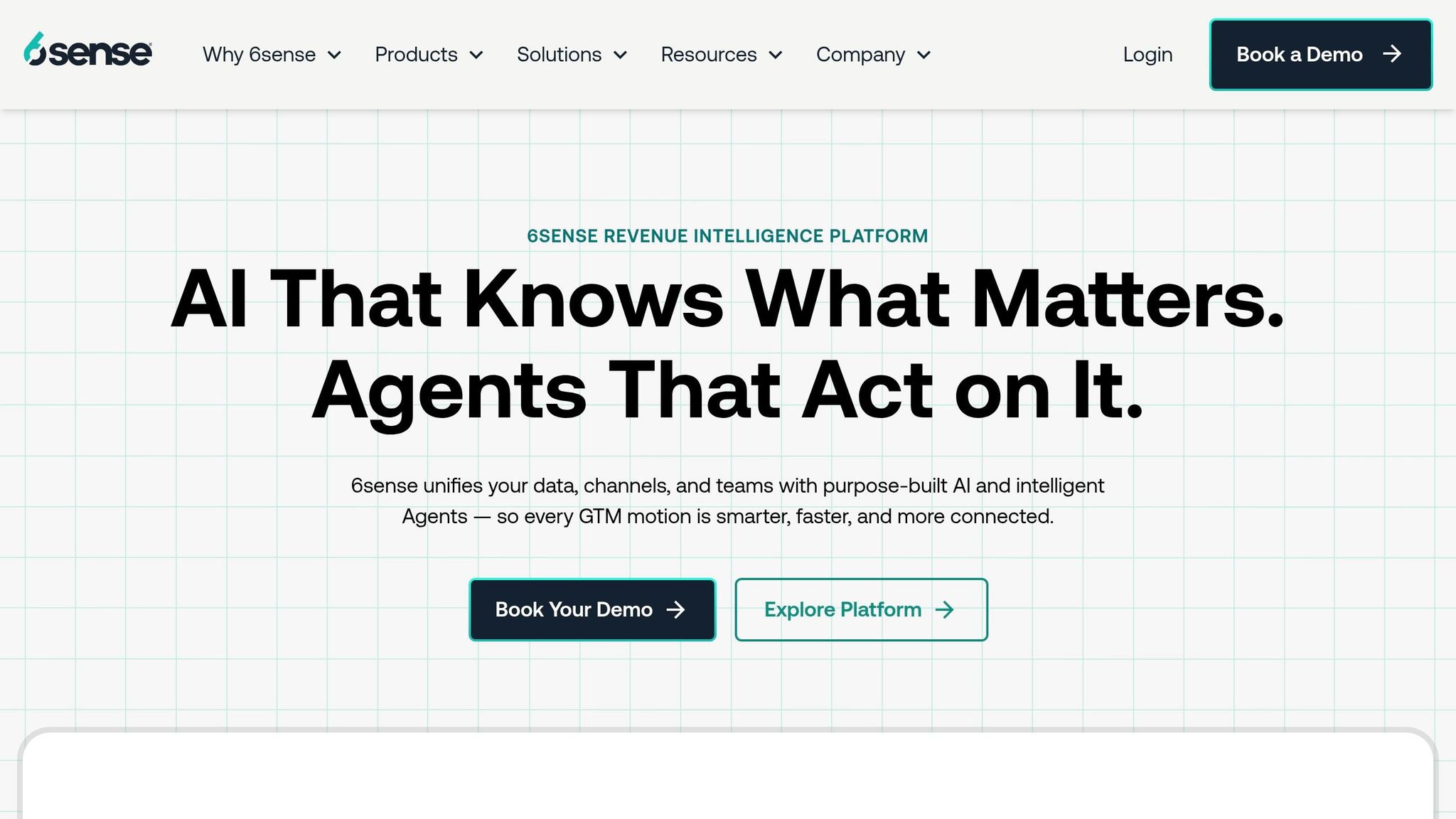
6sense focuses on illuminating the "dark funnel" of anonymous buyer behavior [18]. By analyzing billions of data points, the platform pinpoints accounts actively researching solutions and identifies their position in the buying journey [18]. This predictive approach allows B2B teams to prioritize accounts with genuine purchase intent, steering them away from cold leads. It bridges the gap between raw intent data and actionable sales strategies, complementing tools that center on content and prospecting.
Lead Generation and Prospecting Capabilities
6sense's predictive intent engine processes over 300 data points per account, such as keyword research, technology usage, and competitor activity [9]. It monitors more than 500 billion intent signals monthly, enabling businesses to identify in-market accounts even before they directly interact with the brand [2]. Companies leveraging 6sense often report a 40% boost in sales-accepted leads and a 25% reduction in sales cycle duration [9].
The platform's AI Email Agents handle outreach autonomously, qualifying leads, scheduling meetings, and allowing SDRs to focus on more strategic tasks [18]. Additionally, 6sense tracks changes within enterprise buying groups, automatically updating key personas and contacts as teams evolve [6].
Integration with Existing CRM/Marketing Stacks
6sense integrates smoothly with CRM and marketing platforms like Salesforce, HubSpot, and Marketo, enhancing top-of-funnel intelligence. It provides a unified, data-driven view of target accounts, aligning sales and marketing teams around a B2B marketing strategy focused on revenue goals rather than just lead volume [18]. While its account-level intelligence is robust, the platform often relies on integrations with other tools for contact-level insights and outbound execution [4].
Analytics and Reporting Capabilities
The platform's analytics tools allow marketers to adapt strategies quickly based on real-time insights. Its Revenue AI platform forecasts pipeline performance and highlights accounts most likely to convert [5]. Predictive models also uncover insights from anonymous website visitors, helping marketers measure engagement from accounts that haven't yet made themselves known [5].
With a 4.4/5 rating on G2 from over 1,149 reviews, 6sense is praised for its high-quality data and strong ROI for enterprise ABM efforts [9]. However, some users mention the interface's complexity and note that the pricing - ranging from $25,000 to over $100,000 annually - can pose challenges for smaller businesses [9, 14].
4. ZoomInfo
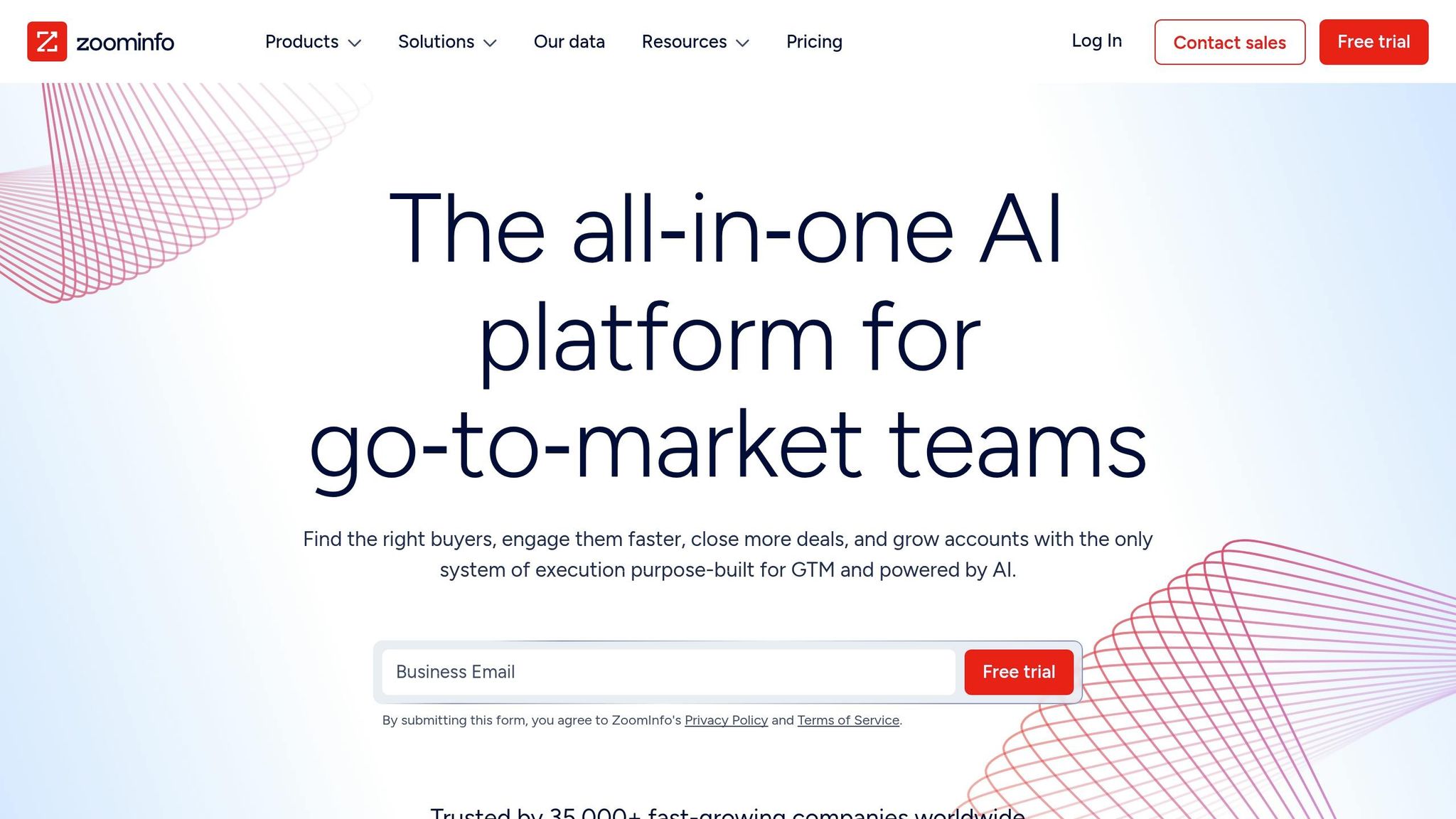
ZoomInfo operates as a powerful intelligence platform tailored for enterprise B2B teams, offering verified data from over 600 million contacts and 100 million companies. This data is seamlessly integrated into existing workflows, ensuring clean and standardized information for mid-market and enterprise teams [19]. Its ability to enrich data supports dynamic workflow automation, which has become a critical feature for modern B2B marketers.
Lead Generation and Prospecting Capabilities
ZoomInfo's AI-powered assistant, ZoomInfo Copilot, uses machine learning to rank prospects and identify opportunities with high conversion potential [7]. The platform tracks real-time buying signals across more than 15,000 topics, offering marketers a competitive edge in identifying intent [7]. This is particularly crucial, as 81% of B2B buyers make their vendor decisions before engaging with sales teams [5].
The platform also provides technographic insights, revealing the technology stacks used by target companies. This allows marketers to create segmented prospect lists aimed at organizations using complementary or competing software [5]. Real-time alerts and visitor tracking further help marketing teams pinpoint and engage with accounts that show early interest [19]. Additionally, by supplying verified email addresses and direct-dial phone numbers, ZoomInfo reduces the time spent on manual research during prospecting [5]. These features work seamlessly with CRM integrations, enhancing overall workflow and efficiency.
Integration with Existing CRM/Marketing Stacks
ZoomInfo integrates with more than 70 sales and marketing applications, primarily functioning as a data enrichment engine. It automatically pushes verified contact information into existing systems, helping to maintain high data quality and reduce issues like email bounce rates [19]. However, some users have noted challenges with the integration process. A sales leader at DataStax shared their experience:
"With Amplemarket, all the busywork is gone. No more pulling leads from ZoomInfo, importing into Salesforce, then adding them to Salesloft" [4].
Analytics and Reporting Capabilities
ZoomInfo places a strong emphasis on data governance and enrichment rather than real-time behavioral insights [4]. Its analytics tools provide structured access and controls, which are particularly useful for large sales operations that need to standardize contact and account records across enterprise systems. While its data coverage is extensive, it relies on a refresh-based model, which some may find limiting [4]. Pricing for ZoomInfo typically falls between $15,000 and $50,000 or more annually, depending on the chosen modules and data access needs [5].
5. HubSpot
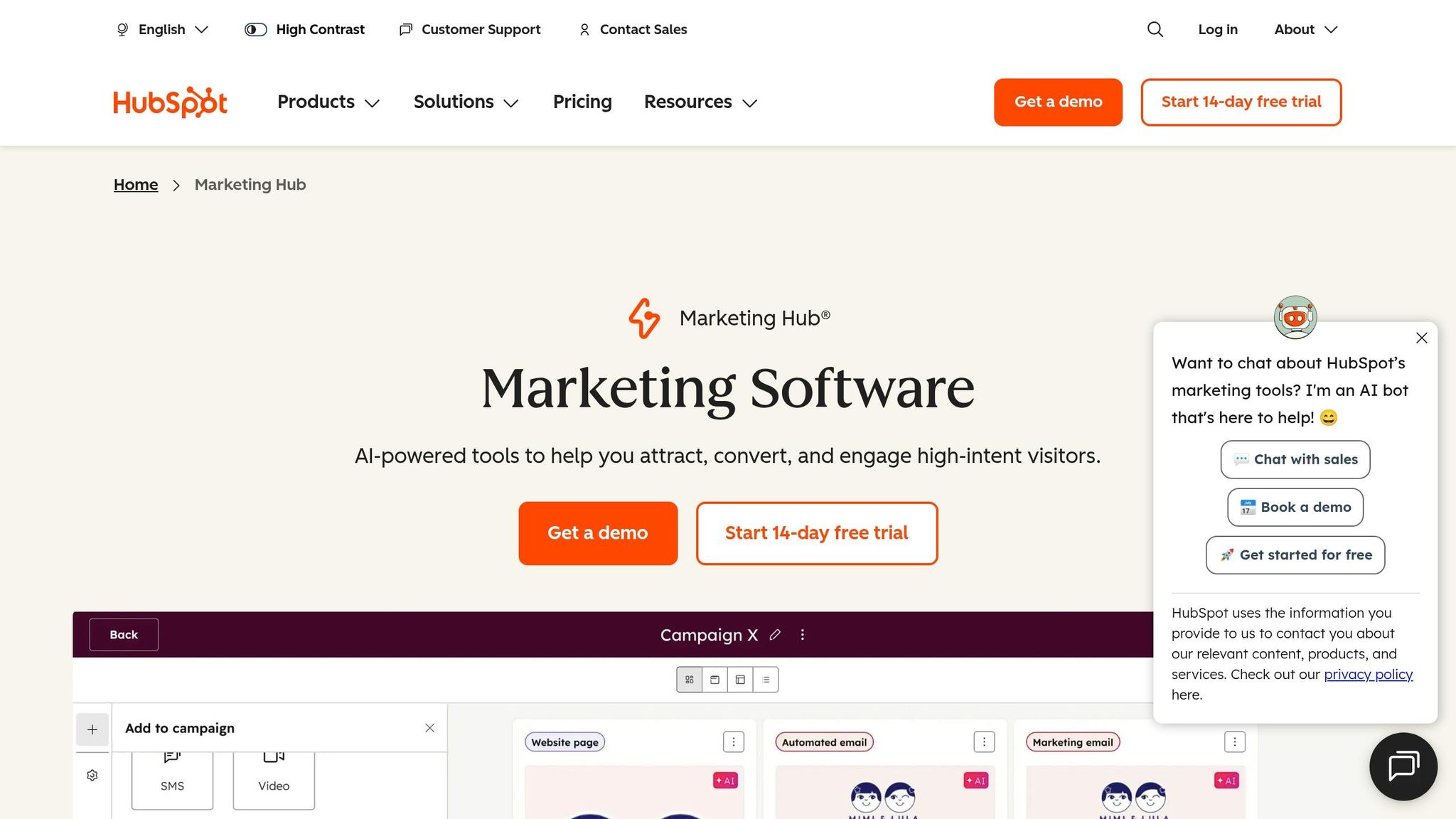
HubSpot is a comprehensive marketing platform that integrates AI directly into its CRM, streamlining tasks like lead follow-ups, prospect scoring, and content creation - all without the need for multiple tools [2][5]. It caters to a wide range of users, from small businesses utilizing its free tier to enterprises investing around $3,600 per month for advanced, multi-channel functionalities [5][18].
Lead Generation and Prospecting Capabilities
HubSpot's Breeze Copilot simplifies lead qualification by using predictive scoring based on historical data and intent signals while enriching records with firmographic insights - all in one streamlined process [5][6][18]. Its AI-driven chatbots are available 24/7 to engage website visitors, qualify leads, and even schedule meetings directly into sales calendars [5][6]. These tools work seamlessly within HubSpot’s unified CRM system, ensuring efficiency and consistency.
Integration with Existing CRM/Marketing Stacks
HubSpot’s AI features are designed to sidestep common integration issues - an area where only 29% of enterprise applications succeed [5]. Its Smart CRM consolidates customer data, including social media and sales interactions, bridging gaps in integration [2]. As Zach Chmael, CMO at Averi, highlights:
"The 35-point effectiveness gap between CRM users and non-users isn't about software - it's about centralized data enabling coordinated execution" [5].
This seamless integration also supports content creation, allowing marketing teams to operate without jumping between disconnected tools.
Content Creation and Optimization Features
HubSpot's AI Content Assistant helps teams draft blog outlines, marketing emails, and landing pages directly within the editor, leveraging CRM data to ensure consistency with the brand's voice [5][18][9]. The Campaign Assistant takes it a step further by building multi-channel campaign sequences and syncing them with CRM data for cohesive execution [6]. By automating these processes, HubSpot reduces the burdens of manual content creation and fragmented campaign management. Its smart automation tools also suggest actionable next steps and analyze engagement patterns across various touchpoints [18].
Analytics and Reporting Capabilities
HubSpot simplifies data analysis with tools that allow users to create custom reports and dashboards using natural language commands, making analytics accessible even to non-technical users [18]. Features like Smart Send-Time Optimization analyze audience behavior to recommend the best times for email delivery, boosting engagement rates [3][18]. While the platform boasts a strong 4.4/5 rating on G2 from over 12,399 reviews, some users note that mastering its extensive features can involve a steep learning curve [9][1].
6. Salesforce Einstein GPT
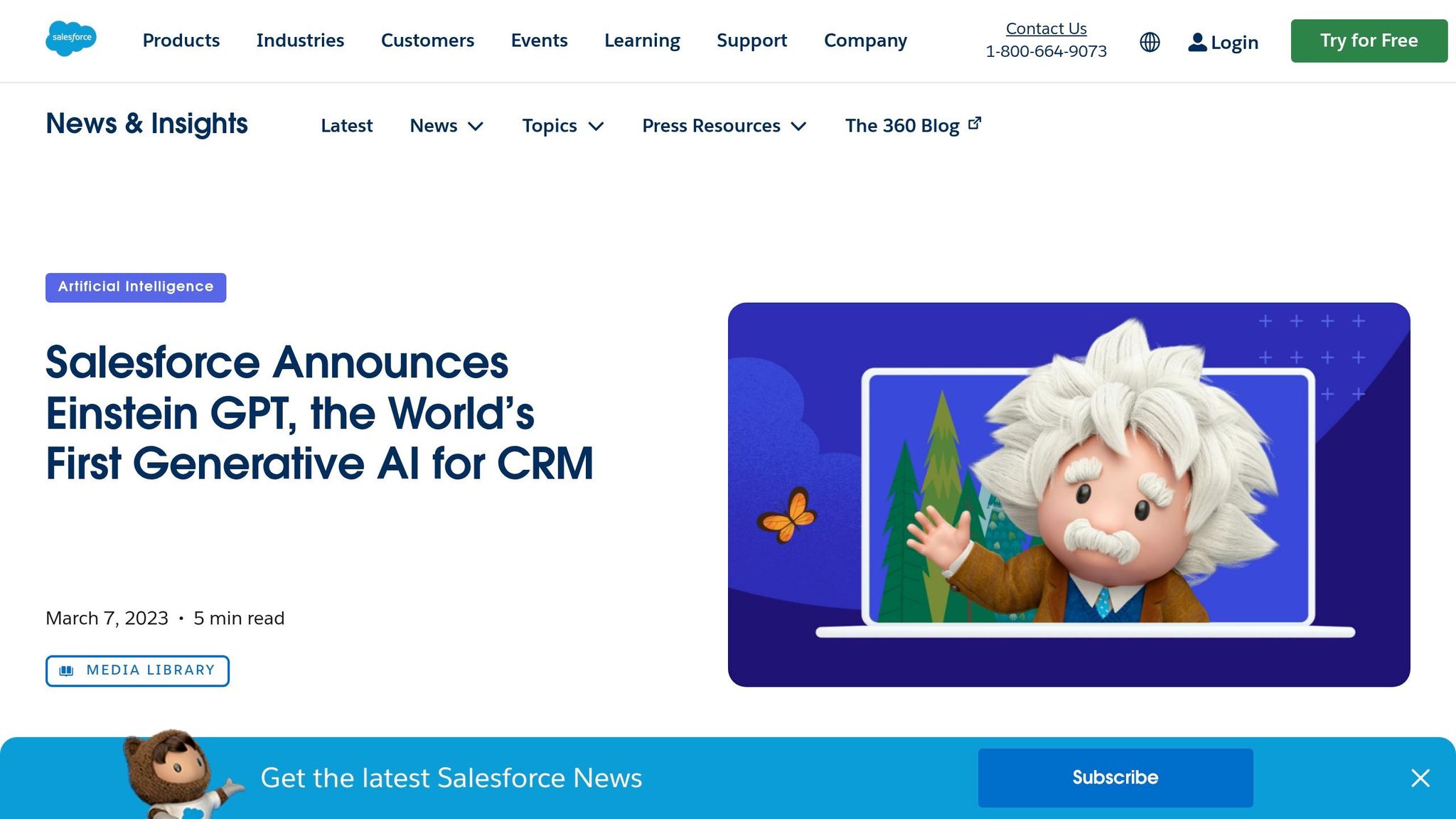
Salesforce Einstein GPT brings generative AI into the Salesforce ecosystem, delivering over 200 billion predictions daily through its Customer 360 platform [21][22]. Designed for enterprise teams, its pricing starts at $50 per user per month, with entry-level access priced at $75 per month. Additional features can cost between $50 to $125 per user monthly [1][3][22].
Lead Generation and Prospecting Capabilities
Einstein GPT simplifies lead management by using predictive scoring and behavior analysis, such as tracking email opens, website visits, and content downloads, to rank prospects and recommend next steps [6][1][18]. It provides actionable suggestions, like which emails to send or calls to make, enabling sales teams to focus on high-priority tasks [6]. For instance, a financial services firm reported a 25% reduction in customer loss and improved win rates by leveraging Einstein's analytics [6]. Additionally, the platform automates data entry, ensuring CRM records remain accurate without adding administrative tasks [6].
Integration with Existing CRM/Marketing Stacks
As a native Salesforce tool, Einstein GPT seamlessly integrates with Salesforce's unified customer data platform [20]. This integration ensures that AI-driven insights - like lead scores or campaign alerts - are directly actionable by sales teams. However, this level of integration often requires a higher degree of technical expertise, making the platform more challenging for smaller teams or those unfamiliar with Salesforce [18]. For companies already using Salesforce Sales Cloud, the alignment between sales and marketing data is unparalleled, but new users should prepare for a learning curve and allocate time for training. This integration also allows marketers to generate personalized, real-time content more efficiently.
Content Creation and Optimization Features
Einstein GPT's Prompt Builder enables marketers to craft personalized emails, social media posts, and web pages using low-code templates [22]. The platform uses dynamic grounding, pulling real-time CRM data to ensure accuracy and relevance [22][24]. As Jayesh Govindarajan, SVP of AI and Machine Learning at Salesforce, explains:
"AI is only as good as the data that powers it... Salesforce has the world's #1 CRM and the world's most robust customer data set, which allows Einstein GPT to produce AI content in a way that no other enterprise technology company can match" [24].
The platform also facilitates audience segmentation through natural language queries to the Data Cloud, streamlining targeting and campaign setup [22][23]. Additionally, the Einstein GPT Trust Layer includes features like data masking and toxicity detection to safeguard sensitive customer information from being retained by AI models [22].
Analytics and Reporting Capabilities
Einstein GPT goes beyond content creation, offering advanced analytics that monitor campaign performance and KPIs and provide real-time alerts for emerging trends or anomalies [18]. It boasts a 4.5/5 rating on G2, with users highlighting its capabilities in revenue attribution and the alignment of marketing and sales data [9][18]. For teams requiring more in-depth analysis, Tableau AI enhances data visualization by automating report creation, eliminating the need for manual chart-building [22]. However, the platform's cost and the expertise required to use it effectively may make it less appealing to smaller teams [18].
7. Metadata.io
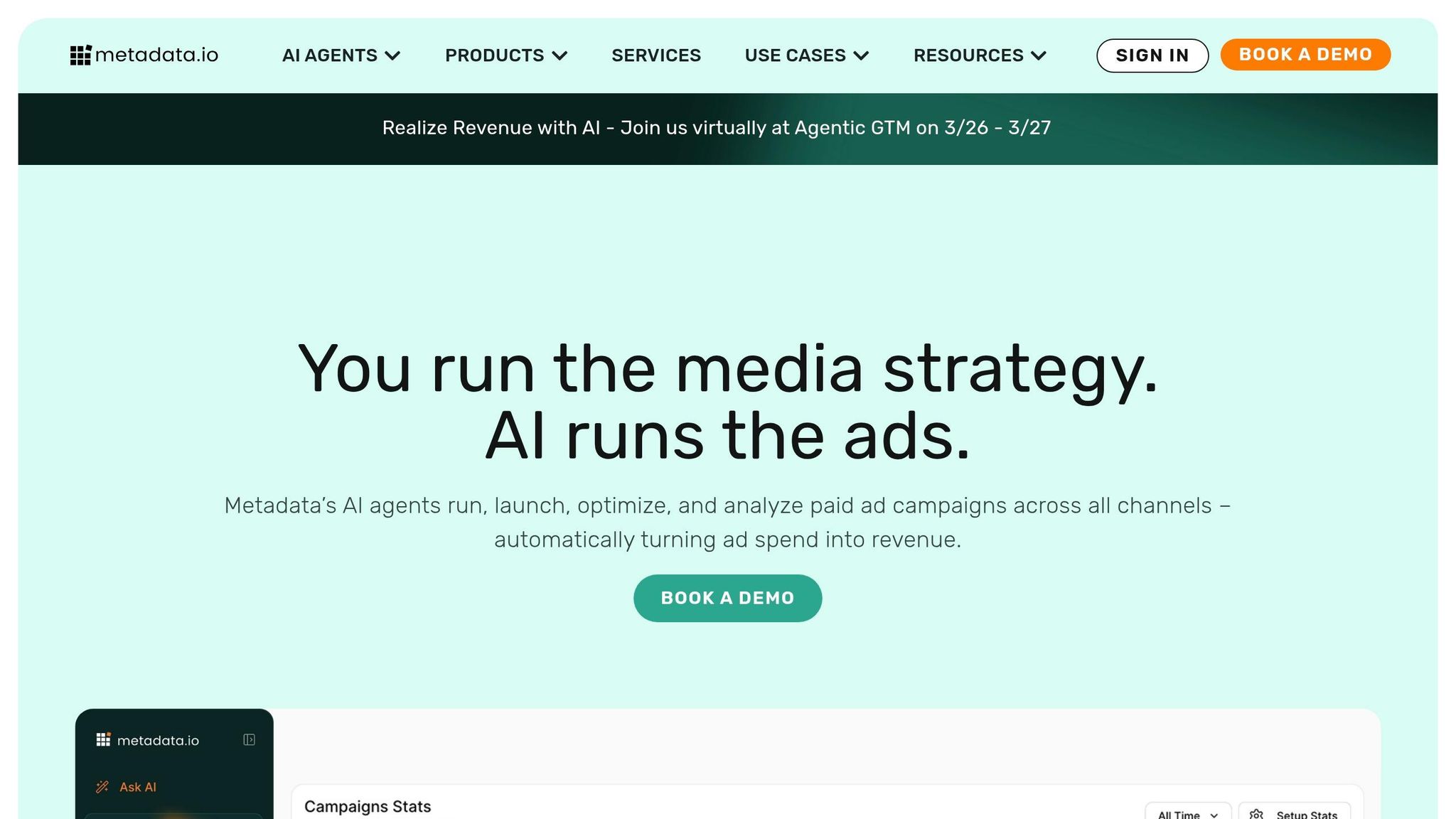
Metadata.io approaches campaigns as dynamic processes, treating them as continuous experiments rather than one-time launches. By automating tests across LinkedIn, Facebook, and Google Ads, it fine-tunes creative elements, copy, and audience targeting to maximize revenue outcomes.
Lead Generation and Prospecting Capabilities
With its MetaMatch technology, Metadata.io connects business email addresses to personal social media profiles. This ensures your LinkedIn and Facebook ads are directed at the right decision-makers, avoiding wasted impressions on irrelevant audiences[25]. Unlike tools that focus solely on generating a high volume of leads, Metadata.io emphasizes identifying prospects with the highest revenue potential and pipeline impact[26].
Integration with Existing CRM/Marketing Stacks
Metadata.io seamlessly integrates with Salesforce and HubSpot, enabling full tracking of ad clicks all the way to closed-won deals[25][26]. The platform also automatically matches leads to their respective accounts, offering a comprehensive view of engagement across entire buying committees instead of just individual interactions[26]. This integration allows for detailed analysis of lower-funnel performance.
Analytics and Reporting Capabilities
Focusing on lower-funnel metrics, Metadata.io tracks how campaigns influence and drive pipeline revenue[26]. It highlights which campaigns have directly contributed to closed deals, moving beyond surface-level analytics to provide actionable insights into performance.
8. Jasper
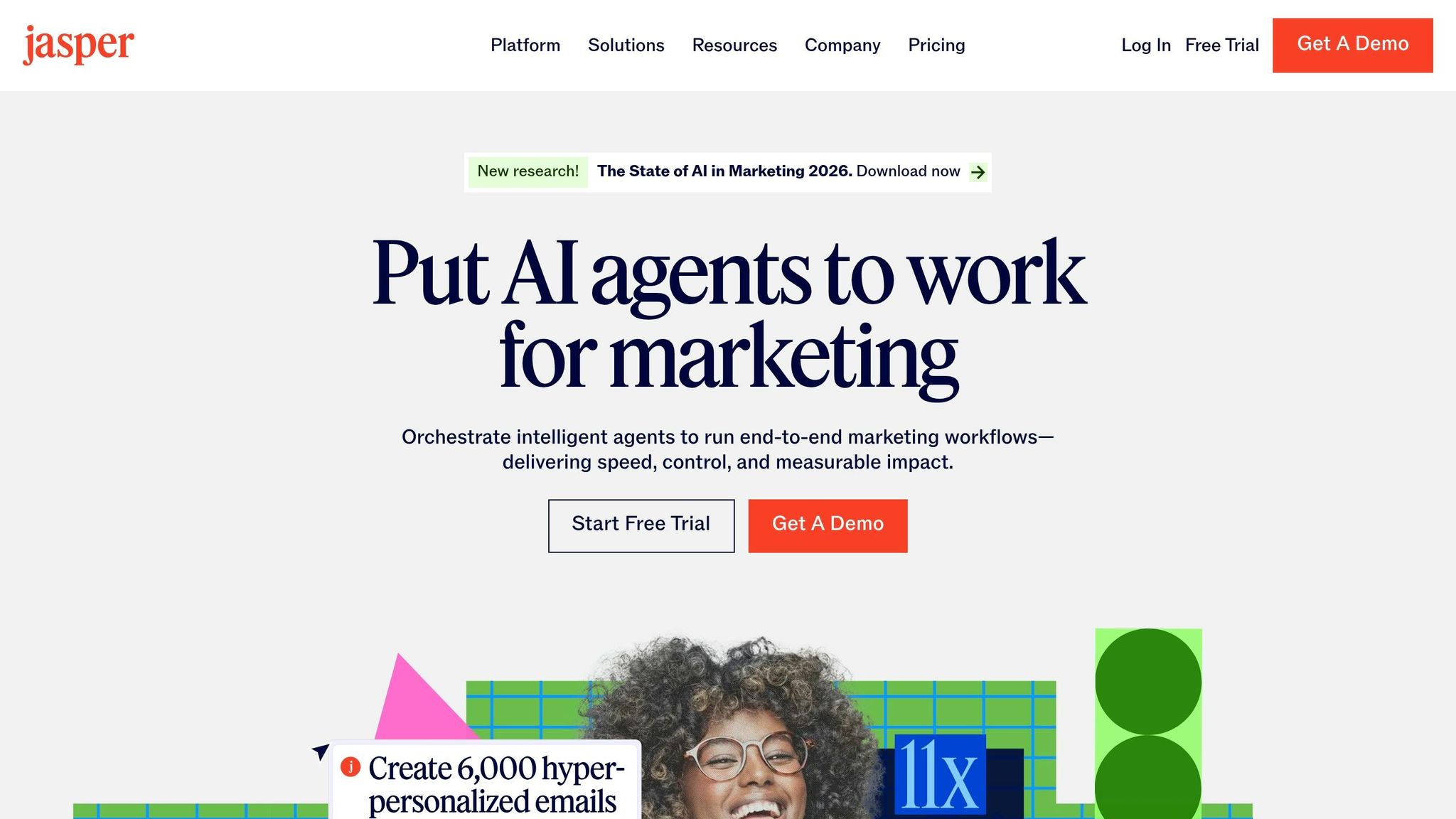
Jasper is tailored for marketing teams that need to produce large volumes of copy while maintaining a consistent brand voice. Rather than replacing human writers, it acts as a collaborative workspace where AI takes care of first drafts, leaving the team free to refine messaging and strategy. Powered by proprietary tools like Brand IQ and Marketing IQ, Jasper ensures that every piece of content aligns with your company's tone, style, and audience preferences. By handling the heavy lifting of initial drafts, Jasper allows teams to focus on the creative and strategic aspects of their work.
Content Creation and Optimization Features
Jasper comes equipped with over 100 specialized AI tools designed to create everything from briefs and whitepapers to product descriptions and ad copy. Its Canvas and Studio tools make it easy to plan content collaboratively or develop custom marketing apps without the need for coding. Additionally, the Remix template transforms long-form content into bite-sized formats like social media posts or email snippets.
The platform also includes advanced optimization tools for SEO, Answer Engine Optimization (AEO), and Generative Engine Optimization (GEO), which improve the chances of your content being featured by AI-driven search engines. For example, between 2023 and 2024, the B2B marketing agency 2X implemented Jasper with their 55-person writing team, saving 2,613 hours annually. Vikram Ramachandran, Lead of AI Initiatives at 2X, noted that using Jasper's custom templates and Brand Voice training allowed them to produce SEO blogs 50% faster and whitepapers 40% faster. Similarly, Cushman & Wakefield reported saving over 10,000 hours per year by automating localized marketing content while maintaining global compliance standards.
Integration with Existing CRM/Marketing Stacks
Jasper integrates seamlessly with tools like Surfer SEO using its dedicated "SEO Mode", enabling teams to optimize content for search rankings without leaving the platform. Its Recipes feature provides step-by-step workflows for complex tasks, such as creating a blog post, sales email, and video script from a single prompt. While Jasper excels at generating content, it relies on additional tools for publishing and analytics.
The Pro Plan is priced at $59 per seat per month (billed annually), while the Business Plan offers custom pricing for features like unlimited Brand Voices, Knowledge assets, and API access.
"It's not just about efficiency gains, it's about augmenting human creativity, scaling expertise, and unlocking new ways to engage customers and drive business outcomes." – Peter So, VP of Digital Innovation, Cushman & Wakefield
9. Surfer SEO
Surfer SEO transforms content optimization into a precise, data-driven process by analyzing over 500 ranking factors from top-performing competitor pages. It provides a real-time content score (ranging from 0–100) and recommends targeted adjustments like keyword density, heading structure, word count, and image usage. This tool is ideal for teams with established writers who need an extra layer of intelligence to ensure their content competes effectively in search rankings.
Content Creation and Optimization Features
The Content Editor offers live, actionable feedback based on competitor strategies, while the SERP Analyzer evaluates search results using hundreds of ranking factors. The Content Planner helps identify topic clusters and keyword opportunities for long-term strategies [1]. For instance, Daniel Schoester from Forbes Advisor used Surfer SEO to create an evergreen article that achieved a featured snippet on Google in 2023, generating 1,000 clicks per month and saving $2,835.75 in potential ad costs [27].
The Audit Tool highlights optimization gaps in existing content, from missing internal links to technical issues like slow page speed. Matthew Woodward, Director at matthewwoodward.co.uk, shared that after following Surfer's advice to remove 22,000 words of irrelevant content, his page jumped to the #1 spot within two days [27]. Other features include the AI Humanizer, which polishes AI-generated drafts for a natural tone, and Grow Flow, a tool offering weekly, easy-to-implement tasks like adding internal links or refreshing outdated content [1].
Surfer SEO integrates smoothly with existing workflows, making it a seamless addition to your content creation process.
Integration with Existing CRM/Marketing Stacks
Surfer SEO works with Google Docs, WordPress, and Jasper, providing real-time SEO feedback directly within your writing platform [7]. This integration eliminates the need for constant platform switching, simplifying the optimization process. Jeremy Galante, Senior SEO Manager at ClickUp, highlighted how integrating Surfer with Google Search Console automated key optimization tasks, describing the platform's NLP engine as "a key addition to our SEO toolbox" [27].
Analytics and Reporting Capabilities
Surfer SEO syncs with Google Search Console to monitor performance and automate optimization through the Sites Hub dashboard [27]. The AI Tracker is particularly noteworthy, as it tracks brand visibility in AI-driven search engines like ChatGPT and Google Gemini. It identifies "mention gaps", revealing where competitors appear in AI-generated responses while your brand does not [27]. Oksana Kosachenko from GetResponse reported a 15% increase in organic traffic within a month of applying Surfer's NLP-driven keyword suggestions to previously optimized articles [27].
Pricing begins at $79 per month (billed annually) for the Essential plan, $129 per month for the Scale plan, and $219 per month for Scale AI, with custom enterprise pricing options available [1]. With over 150,000 users, including content creators, SEOs, and agencies, Surfer SEO enjoys a 4.8/5 rating across major review platforms [27].
10. Improvado AI Agent
Improvado AI Agent stands out among AI tools aimed at simplifying B2B marketing by seamlessly combining data analysis with actionable reporting. Nicknamed "Marketing Common Sense", this tool translates complex marketing data into clear, immediate insights. By allowing teams to ask questions in plain English - like "Which LinkedIn campaigns brought in the most enterprise-level MQLs last quarter?" - it eliminates the need to wait for analysts to generate reports. Designed with non-technical users in mind, it provides quick and reliable answers for teams managing data across multiple platforms.
Lead Generation and Prospecting Capabilities
Improvado goes beyond basic analytics by offering advanced features to improve lead generation. Its predictive lead scoring uses both historical and real-time data to identify prospects with the highest likelihood of converting [29]. This machine learning-driven process helps sales teams focus on high-priority leads, cutting lead qualification time by up to 30% [28]. The platform also monitors live data streams for irregularities, such as unexpected cost increases or performance declines, enabling teams to act swiftly and avoid wasted budgets [29]. Additionally, outcome forecasting leverages historical trends to predict future spending and ROAS, aiding in smarter budget allocation [32].
Businesses leveraging AI-powered tools like Improvado have reported impressive results: a 20% boost in sales conversions, a 30% reduction in customer acquisition costs, and a 25% improvement in customer retention rates [29]. For instance, Function Growth’s marketing team saw a 30% productivity increase in 2026 after adopting Improvado's AI-driven reports. Adam Orris, the company’s Director of Analytics, highlighted how automation freed his team from manual data handling, allowing them to concentrate on strategic improvements [28][29].
"Improvado transformed our approach to marketing analytics. Its automation capabilities and AI-driven insights allowed us to focus on optimization and strategy, without the need for manual data management." - Adam Orris, Director of Analytics, Function Growth [28][29]
Integration with Existing CRM/Marketing Stacks
Improvado seamlessly integrates with over 500 data sources, including Google Ads, LinkedIn, Salesforce, and HubSpot, creating a unified view of the entire lead generation funnel [29][31]. Using Model Context Protocol (MCP) technology, it treats external systems like Salesforce and Google Ads as part of one cohesive dataset [29]. This cross-platform functionality automates data aggregation and harmonization, eliminating the need for spreadsheets and reducing errors. The platform also adheres to strict security standards, including SOC 2, ISO 27001, and GDPR compliance, ensuring secure handling of sensitive lead data [32].
Analytics and Reporting Capabilities
Improvado automates up to 99.5% of routine analytics tasks, saving teams as much as 30 hours per week [32]. Features like multi-touch attribution and messaging analysis help pinpoint the most effective revenue-driving touchpoints and ad narratives [32]. Automated dashboards can generate reports in under three minutes, while the natural language interface empowers teams to explore channel performance without waiting for SQL reports [30][32]. Beau Payne, a Marketing Specialist at Improvado, shared his experience:
"I use Improvado AI Agent to get basic analytics and quick solves. I just enter the question, and it gives me the answer I need" [32].
Improvado operates on a custom pricing model, requiring users to contact sales for a tailored quote [30][31]. With a 4.5/5 star rating on G2, users frequently praise its ability to reduce manual work and enable teams to focus on strategic efforts [30][31].
Tool Comparison by Use Case
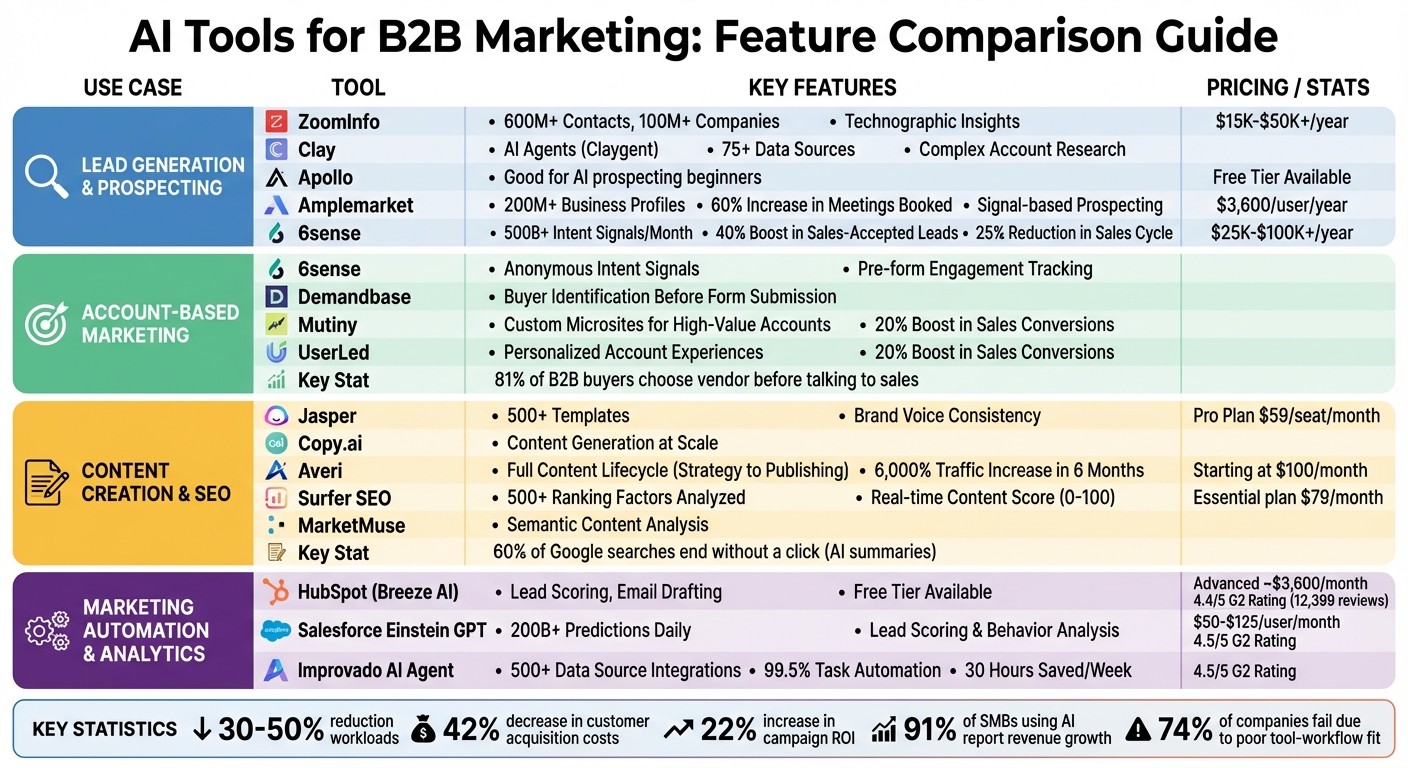
AI Tools for B2B Marketing: Feature Comparison by Use Case
Pick the right AI tool based on the specific challenges your B2B team faces.
Lead Generation:
For finding and enriching prospect data, ZoomInfo and Clay stand out. ZoomInfo provides verified contact details along with technographic insights, while Clay’s AI agents (Claygent) tackle complex account-level research across 75+ sources. If you're just starting with AI-driven prospecting, Apollo offers a free tier, making it a great option for teams wanting to explore before committing to a paid plan.
Beyond prospecting, these tools also support account-level targeting and personalized engagement strategies.
Account-Based Marketing:
Platforms like 6sense and Demandbase help identify anonymous intent signals, enabling engagement with buyers even before they fill out a form. This is crucial, as 81% of B2B buyers make their vendor choice before speaking with sales [5]. For even more tailored outreach, tools like Mutiny and UserLed create custom microsites for high-value accounts - companies using these platforms report a 20% boost in sales conversion rates [33]. These tools cater to teams aiming for deeper personalization and higher engagement.
Content Creation and SEO:
When it comes to producing high-quality content at scale, Jasper and Copy.ai deliver. Jasper offers over 50 templates to keep content aligned with your brand. For managing the entire content lifecycle, Averi handles everything from strategy to publishing, optimizing for both traditional search engines and AI citation platforms like ChatGPT and Perplexity. Tools like Surfer SEO and MarketMuse use semantic analysis to structure content, with Surfer SEO’s Essential plan starting at $89/month. These tools address the shift toward "Generative Engine Optimization" (GEO), a response to the growing trend of AI-generated summaries that now account for 60% of Google searches ending without a click [5].
Once your leads and content are in place, automation and analytics can optimize your entire marketing workflow.
Marketing Automation and Analytics:
AI-powered platforms like HubSpot (with Breeze AI) and Salesforce Einstein bring efficiency to CRM workflows, handling tasks like lead scoring, email drafting, and follow-ups. HubSpot’s free tier is ideal for smaller teams, while Salesforce Einstein caters to enterprise-level needs. For analytics, Improvado AI Agent simplifies cross-channel data analysis by letting marketers query data using plain English rather than SQL.
Start by tackling your biggest challenge. If content creation is a bottleneck, tools like Jasper or Averi can help. If identifying in-market accounts is your priority, platforms like 6sense or Demandbase are worth considering. Test these solutions on a smaller scale to measure their impact before rolling them out broadly [34]. These recommendations ensure your AI investments deliver measurable results while improving workflow efficiency.
Conclusion
AI tools are transforming B2B marketing by reducing manual workloads by 30–50%, cutting customer acquisition costs by 42%, and boosting campaign ROI by 22% [35][5][2][7]. The key to success lies in adopting a "human-led, AI-assisted" strategy, where automation supports your team without replacing strategic decision-making or your brand's unique voice [8]. AI takes care of tasks like data analysis, content drafts, and lead enrichment, while your team focuses on applying insights and maintaining a personalized touch. Striking this balance is essential: while 91% of small and mid-sized businesses using AI report revenue growth, 74% of companies fall short when they focus more on features than on finding the right fit [5][2].
To get started, assess your workflow and identify the biggest bottleneck. If content creation slows you down, platforms like Averi or Jasper can speed things up. If the challenge is identifying potential customers, tools such as 6sense or Demandbase can provide the intent data you need. As outlined earlier, it’s best to build your AI stack step by step - start with content tools, then layer in data intelligence and predictive capabilities. Allocate about 20% of your tool budget for integration and training to ensure smooth implementation and avoid data silos [5].
"The gap isn't capability, it's fit."
Zach Chmael, CMO, Averi [5]
Take advantage of free trials or 30-day demos to test ROI on a high-impact process before committing to a larger rollout [3]. Evaluate your success based on metrics like organic traffic growth, lead generation, and deal velocity, rather than simply measuring output volume [5][2]. With the right tools in place, your team can work smarter and achieve more.
FAQs
How do I choose the right AI tool for my biggest marketing bottleneck?
To find the best AI tool for your needs, start by pinpointing the specific marketing challenge you're facing - whether it's lead generation, content creation, or personalization. Once you've identified the issue, look for a tool that not only specializes in addressing that challenge but also fits seamlessly into your workflows and can grow with your business. For instance, Demandbase One is a strong choice for boosting lead generation, while platforms like Averi or Jasper can simplify content creation and elevate its quality.
What should I measure to prove ROI after implementing an AI tool?
To show the return on investment (ROI) after introducing an AI tool in B2B marketing, focus on tracking key performance metrics such as pipeline growth, faster deal closures, revenue increases, and lower customer acquisition costs (CAC). Highlight areas of improved efficiency, like time saved on repetitive tasks, better performance through higher conversion rates, and noticeable cost savings. Additionally, monitor the quality of leads, engagement metrics, and the tool’s direct impact on the sales pipeline to clearly connect its use to measurable business results.
How can I avoid integration and data-silo issues when adding AI tools?
To avoid issues with integration and data silos, opt for AI tools that offer native integrations with your current systems, such as CRM, CMS, or marketing platforms. Focus on implementing a smaller number of well-integrated tools to maintain a cohesive view of your customer data. Make sure these tools easily align with your workflows and data storage systems to promote consistency and prevent fragmentation across teams.
Related Blog Posts

Zach Chmael
CMO, Averi
"We built Averi around the exact workflow we've used to scale our web traffic over 6000% in the last 6 months."
Your content should be working harder.
Averi's content engine builds Google entity authority, drives AI citations, and scales your visibility so you can get more customers.