

In This Article
Build a lean content engine using AI, clear workflows, and human review to publish consistently, boost SEO, and generate leads on a seed-stage budget.
Updated:
Trusted by 1,000+ teams
Startups use Averi to build
content engines that rank.
Seed-stage startups face a tough challenge: marketing on limited budgets while racing against the clock to generate leads. A content engine - a structured system for producing consistent, high-quality content - can solve this problem.
Why it matters: Marketing issues cause 29% of startup failures, yet content marketing generates 3x more leads at 62% lower costs compared to traditional methods.
The opportunity: Companies publishing 16+ blog posts monthly see 4.5x more leads, and SEO delivers a 748% ROI.
The challenge: Hiring marketers or agencies is expensive, making DIY solutions essential for early-stage teams.
A content engine leverages AI content creation strategies, clear workflows, and human oversight to turn content into a long-term asset that builds visibility and authority over time. Here’s how to set one up in five steps:
Define your strategy: Set goals, identify your audience, and focus on high-priority topics.
Build workflows: Organize a content queue and streamline approvals for efficiency.
Use AI + human review: Let AI handle research and drafting while humans refine tone and accuracy.
Publish + track: Post weekly and monitor metrics like traffic, leads, and keyword rankings.
Automate + improve: Use AI to refresh old content and generate new ideas with minimal oversight.
This system allows startups to publish consistently, driving 320% higher conversions while staying within budget.
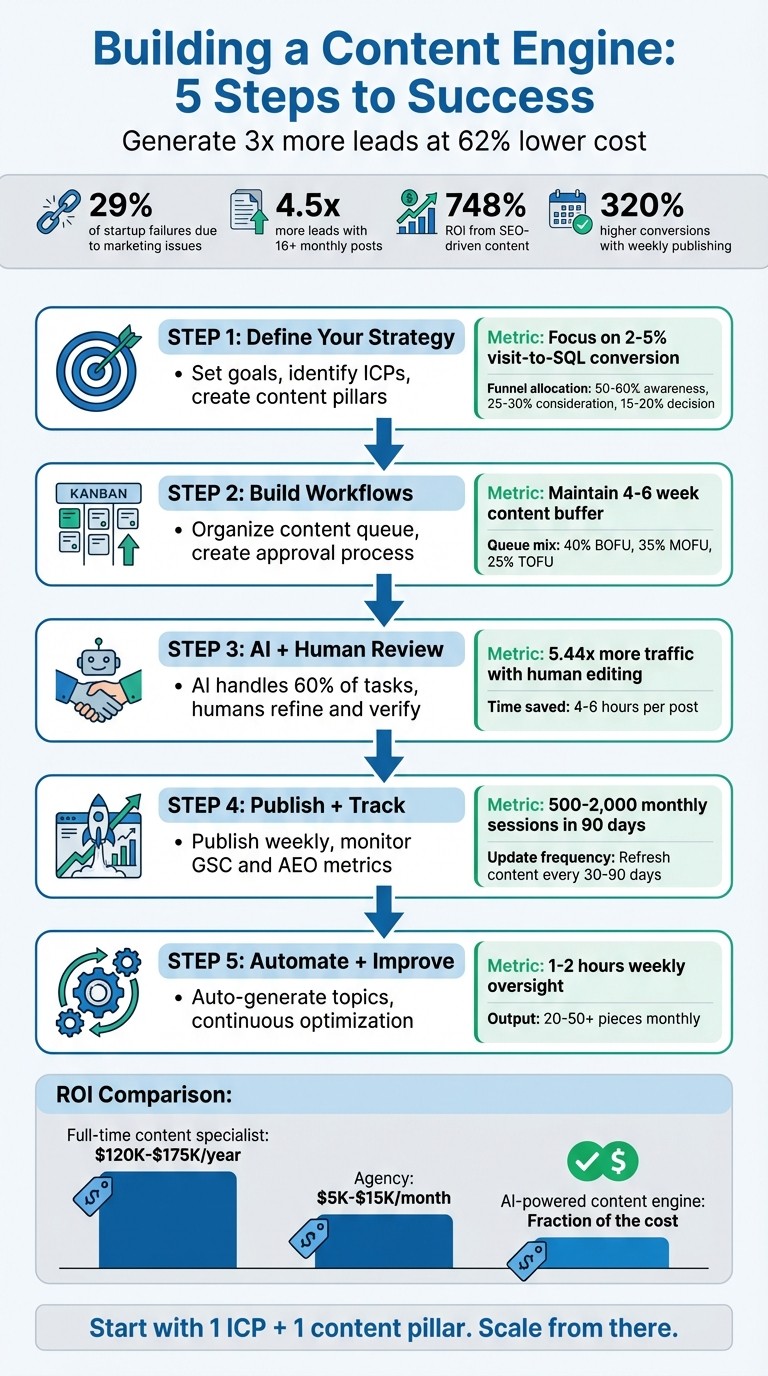
5-Step Content Engine Framework for Seed-Stage Startups
A Complete Guide to Using AI in Content Marketing for Better ROI | ClickUp

Step 1: Set Up Your Content Strategy
Before diving into content creation, it's essential to have a clear plan in place. This means defining success metrics, pinpointing your target audience, and prioritizing the topics that matter most. A well-thought-out strategy ensures your efforts are focused and effective.
Set Content Goals and Metrics
A strong content strategy starts with specific goals, targeted audiences, and clear themes. Your objectives might include generating leads, building awareness in a niche, or improving search visibility. Whatever your goals, focus on metrics that directly impact conversions rather than vanity stats.
Conversion funnel metrics are key indicators of success. Typical benchmarks include:
2–5% conversion from visits to SQL (Sales Qualified Leads)
15–25% conversion from MQL (Marketing Qualified Leads) to SQL
20–30% conversion from SQL to won deals
These numbers provide insight into where your content is effective and where adjustments are needed.
For seed-stage startups, the focus should shift toward top-of-funnel content that builds awareness. While a general guideline suggests allocating 40% of resources to awareness, 30% to consideration, and 30% to decision-stage content, startups should adjust to 50–60% awareness, 25–30% consideration, and 15–20% decision-stage content. Early-stage businesses need visibility first before optimizing for conversions.
One standout statistic: companies that publish 16 or more blog posts monthly generate 4.5x more leads than those publishing less frequently [4]. While hitting that number right away might not be feasible, consistency is key - regular publishing builds momentum over time.
Define Your Ideal Customer Profiles (ICPs)
Your ICP (Ideal Customer Profile) is the cornerstone of your content strategy. It shapes the topics you cover, the tone you use, and the problems you address. If your startup already has customers, analyze their profiles to identify trends. For pre-revenue startups, you'll need to hypothesize based on competitor research and early feedback.
Interestingly, 47% of early-stage founders manage all their own marketing, and 56% dedicate only an hour or less per day to it [2]. This makes knowing your ICP critical - you can't afford to waste time creating content that misses the mark.
Start by interviewing early users or prospects who match your target profile. Combine their insights with data from website analytics, sales conversations, and competitor research. Tools like Averi AI can assist by analyzing your website to suggest ICP hypotheses based on your product features, messaging, and positioning.
"Content isn't a 'nice-to-have' marketing line item; it's the engine that drives awareness, credibility, and inbound opportunities while you sleep." - The Logonaut [9]
Document the key attributes of each ICP, including their industry, company size, roles, pain points, and search behaviors. This profile will serve as the foundation for all your content decisions.
Create Content Pillars with Averi AI
Content pillars are core themes that structure your content strategy. These themes should align with your ICPs' challenges and your product's unique strengths. Instead of creating random blog posts, focus on building authority by consistently addressing specific topics.
Averi AI simplifies this process. By analyzing your website, it identifies your positioning, product offerings, and brand voice to suggest tailored content pillars. It also evaluates competitor content to find gaps - areas they’re not covering that you can dominate. Beyond that, it researches high-potential keywords and organizes them into a roadmap structured by pillar.
Using Averi AI can drastically cut down planning time. It automates topic research and even drafts initial content, enabling you to produce 4–8 pieces per week compared to the typical 2–4. Importantly, it ensures your brand voice remains consistent across all content.
Once your pillars are in place, Averi continues to monitor your market - tracking trends, competitor moves, and keyword opportunities - and generates content ideas that align with your strategy. You simply approve what gets created, while the system works quietly in the background.
With these pillars established, you’ll be ready to streamline your content workflow in the next step.
Step 2: Set Up Your Content Workflow
A content workflow ensures ideas move efficiently from a prioritized queue to published articles. It creates a repeatable system that reduces manual effort and delivers consistent results. To make this happen, you'll need a well-organized queue and a clear approval process that keeps production smooth while maintaining quality.
This workflow has two essential parts. First, a content queue - an organized list of topics ready for creation. Second, an approval process to catch mistakes and uphold brand standards without slowing progress. Together, these elements let your team focus on execution instead of constant planning.
Build a Content Queue
Your content queue is a prioritized list of topics waiting to be developed. A steady pipeline eliminates the need for last-minute brainstorming and ensures you’re always ready to create.
To organize your queue, assign weights to these factors: buyer intent (40%), search demand (30%), and competition (30%). For buyer intent, consider whether the topic aligns with what potential customers are searching for. For search demand, check if there’s significant interest in the topic. And for competition, evaluate whether you can realistically rank for the topic against existing search results.
AI tools like Averi AI can help by analyzing trends, competitor content, and search data to generate 10–20 tailored topic ideas each week. For instance, a SaaS company targeting developers might see "AI debugging tools" added to their queue if search trends show growing interest. This ensures your content focuses on topics with the potential to drive 20–50% more organic traffic.
Maintain a 4–6 week content buffer and organize it by funnel stage:
40% BOFU (bottom-of-funnel content like pricing guides and product comparisons)
35% MOFU (middle-of-funnel content like tutorials and how-to guides)
25% TOFU (top-of-funnel content like thought leadership pieces)
This balanced distribution captures buyers at every stage while building long-term visibility.
A simple Kanban board in tools like Trello or Notion can help manage your queue. Set up columns like "Ideation", "Assigned", "In Progress", and "Ready." Review the queue weekly to refresh it based on performance data. For example, if a topic drives strong leads, queue up related follow-ups. This system enabled one startup with a two-person team to publish four posts per month, increasing traffic by 30%.
Once your queue is ready, focus on a solid approval process to keep quality high without slowing down.
Create an Approval Process
An approval process defines who reviews content, what they review for, and how quickly it moves through the pipeline. Without clear steps, drafts can linger or go live with errors. The goal is to balance speed and quality - aim for review cycles of 24–48 hours to keep content fresh.
Assign specific roles within your team. One person drafts (or uses AI for the first draft), another ensures brand voice and accuracy, and a third handles final SEO checks. Limit reviewers to 2–3 people to avoid endless feedback loops. Use a standardized checklist that covers accuracy, brand alignment, and calls-to-action. Experts note this approach can reduce revisions by 40%.
AI tools can make this process faster. Platforms like Averi AI can scan drafts for plagiarism, fact-checking, and brand voice alignment based on your guidelines. They even score content on a 1–10 scale for SEO readiness, allowing teams to approve 70% of drafts in under an hour. Human reviewers can then focus on adding the unique insights and personality that AI can’t replicate.
"AI handles the work that slows you down. Humans add the judgment that makes it work." - Zach Chmael, CMO, Averi [3][5]
For asynchronous reviews, tools like Google Docs and Slack simplify collaboration and version tracking. This setup can reduce approval times from days to just hours, enabling even a solo marketer to publish weekly. The result? 73% of marketers using AI adopt this hybrid method, where human editors refine AI-generated drafts, boosting output by 40% while maintaining quality [5].
Step 3: Create Content with AI and Human Review
With your streamlined content workflow in place, it’s time to produce high-quality content by combining the strengths of AI and human expertise. This hybrid approach allows AI to handle about 60% of repetitive tasks while humans focus on strategic input and nuanced editing [5]. For seed-stage startups, this method can increase content production by 3–5 times without adding to the team size, all while maintaining high standards [10].
AI takes care of tasks like research, drafting, and SEO optimization, while humans ensure alignment with brand voice, provide strategic direction, and verify accuracy. This collaboration delivers results - human-edited content generates 5.44 times more traffic than purely AI-generated material, and hybrid teams see a 40% boost in output without compromising quality [5].
Use AI for Research and First Drafts
Content strategy software like Averi AI streamlines the early stages of content creation, freeing up your team to focus on strategic and creative tasks. These tools excel at analyzing competitor content, identifying keywords, and generating structured briefs in just minutes [10]. For instance, instead of spending hours researching, AI can identify trending topics with low competition - like "AI debugging tools" for developers - and create a brief that includes target keywords, suggested structure, and hyperlinked sources for verification.
The research phase offers the greatest time savings. Tools like Semrush can reduce the time spent on creating content briefs from two hours to just 20 minutes [10]. Once the groundwork is laid, AI generates a structured draft complete with SEO-optimized headings, FAQ sections, and internal linking suggestions. This process can save 4–6 hours per post, leaving your team with a formatted draft that requires only 30–45 minutes of refinement [2][7].
AI Handles | Humans Handle |
|---|---|
Research and data gathering | Strategic direction and topic selection |
First draft generation and structure | Brand voice and original insights |
SEO optimization and meta tags | Fact-checking and accuracy verification |
Internal linking suggestions | Final approval and quality judgment |
Once the draft is ready, the focus shifts to collaborative editing to sharpen the content and ensure it aligns with your brand’s standards.
Edit and Refine as a Team
After AI produces the initial draft, your team steps in to refine it through a structured editing process. Collaboration tools like Averi AI enable multiple team members to review and comment on drafts within a shared platform, eliminating the inefficiencies of emailing documents back and forth [7]. This transparency is especially useful for remote or distributed teams, as it keeps everyone on the same page and ensures accountability.
Assign specific roles to streamline the editing process: one person for tone and brand consistency, another for fact-checking and technical accuracy, and a third for final SEO review [8]. For example, your marketing lead might handle tone and messaging, while your product lead ensures technical claims are accurate. This division of labor prevents bottlenecks while maintaining high standards across different content types.
Editing should take no more than 20–30 minutes per piece [2]. Use inline comments to highlight areas needing adjustment, suggest rewrites, or tag team members for input. If a section feels off-brand or a claim needs verification, flag it directly in the draft. This keeps feedback actionable and minimizes delays. While 86% of marketers manually edit AI-generated content before publishing [5], the goal is to make the process as efficient as possible.
Maintain Brand Voice and Accuracy
Consistency in tone and factual accuracy are critical when publishing AI-assisted content. AI-generated drafts often sound generic or overly formal unless guided by clear brand guidelines [7]. Your startup marketing strategy should include a concise style guide outlining tone, vocabulary, and messaging preferences, such as whether to use "customers" instead of "users." Feeding this context into your AI tool ensures drafts reflect your brand personality from the start.
During review, editors should check that the content aligns with your documented voice - a step that should be part of your standard approval checklist [7]. For accuracy, human reviewers must verify three key areas: data and statistics (cross-check numbers with original sources), product or service claims (ensure they align with your current positioning), and industry-specific terminology (confirm correct usage of technical terms) [8]. Assign these tasks to team members with relevant expertise to avoid errors that could harm your credibility.
"AI produces content. Humans produce content that converts." - Pawel Tatarek, Freelance B2B SaaS Content Writer
To gauge the success of your AI-assisted workflow, track both production and performance metrics. Production metrics include weekly content output, time-to-publish, and the team’s ability to maintain a consistent schedule. Performance metrics, on the other hand, focus on organic traffic growth, keyword rankings, and leads generated from content [8]. In the first six months, prioritize metrics like indexed pages and search rankings. After six months, shift focus to leads and pipeline contributions, tying your content efforts directly to business outcomes.
Step 4: Publish and Track Performance
After your content clears the editing stage, the next move is to publish it and analyze its impact. Publishing directly through your content platform eliminates the hassle of manual formatting, while tracking the right metrics reveals which topics resonate most with your audience. For seed-stage startups, publishing content weekly can drive 320% more conversions compared to monthly publishing [1]. Additionally, B2B companies report a 717% ROI from SEO-driven content strategies [1] when they consistently track performance and refine their approach based on data insights.
Publish Directly to Your CMS
Integrating directly with your CMS through tools like Averi AI allows finalized content to flow seamlessly to platforms such as Webflow, WordPress, or Framer, preserving all formatting. Meta descriptions, internal links, and FAQ sections are automatically carried over, ensuring no details are overlooked. Each published piece is stored in your Library, creating a growing repository of brand knowledge. This archive not only keeps your content organized but also helps the AI refine its understanding of your style and messaging with every new article, making future drafts more aligned with your brand voice.
Once your content is live, the next critical step is to track its performance closely.
Monitor Content Performance
Performance tracking involves keeping an eye on both traditional search metrics and emerging AI-driven opportunities. Start with Google Search Console to monitor impressions, clicks, and keyword rankings, which provide a snapshot of how your content performs in standard search results. Additionally, track Share of Answer (AEO) - a measure of how often your brand appears in summarized responses on platforms like ChatGPT or Perplexity [12].
Averi AI can assist by offering actionable insights based on this data. For example, it might highlight opportunities like, "This piece is ranking #8 - here’s how to move it to page 1", or suggest keywords with low competition and high relevance to prioritize in future content. These insights bridge the gap between publishing and strategy, guiding you on which content to update, expand, or create next.
For seed-stage startups, aim for 500–2,000 monthly organic sessions and 50–200 email subscribers within the first 90 days [4]. Monitor leading indicators weekly, such as organic traffic growth, time spent on the page, and email capture rates. Evaluate learning indicators monthly, like topic engagement, comments, and language trends. Finally, assess lagging indicators quarterly, including keyword rankings, lead quality, and overall pipeline impact. Keep in mind that 70% to 80% of citations in generative AI engines come from content less than six months old [11], so updating high-performing posts every 30 days is essential to maintain visibility.
"Freshness matters a lot. Roughly 70 to 80% of citations we track come from content less than six months old." - Patrick O'Donnell, CTO, Gumshoe AI [11]
Step 5: Run Your Content Engine on Autopilot
Once your content engine is running efficiently, the next move is automating its cycles to maintain quality while requiring only 1–2 hours of weekly oversight. This step allows your team to focus on your core objectives - like product development and customer engagement - without getting bogged down in the daily grind of content marketing. The aim is to create a system that continuously generates fresh ideas, identifies areas for improvement, and adapts based on performance data.
Set Up Continuous Improvement
A well-optimized content engine should automatically identify weak spots and suggest targeted updates. Tools like Averi AI can pull critical metrics - such as page views, bounce rates, and engagement - from platforms like Google Analytics and your CMS. Using machine learning, it pinpoints underperforming content, like posts with high bounce rates or articles stuck on page two of search results. From there, it recommends actionable fixes, such as rewriting headlines (which can boost click-through rates by 20–30%, according to industry benchmarks) or adding SEO-friendly keywords. For smaller teams, AI-generated monthly revision drafts can reduce manual review time by as much as 70%.
To get started, connect Averi AI to your CMS and analytics tools. Set up automated weekly reports to flag content that falls 2% or more below your average engagement benchmarks. Define rules for AI-driven updates, such as refreshing data, tailoring content for specific audiences, or A/B testing introductions. Make it a priority to update evergreen content every 90 days, as 70% of pages lose visibility without regular updates. This approach ensures that your content library grows in value over time instead of fading into irrelevance. By integrating Averi AI throughout the process, you create a streamlined system that keeps your content engine running at peak efficiency.
Once underperforming content is consistently refreshed, the focus shifts to keeping your content pipeline stocked.
Automate Weekly Content Generation
After optimizing your existing content, maintaining a steady flow of new ideas becomes the next priority. Automating topic generation ensures fresh ideas arrive weekly without requiring manual research. Averi AI monitors industry trends, competitor rankings, and keyword opportunities to propose topics tailored to your ideal customer profiles (ICPs). Each suggestion comes with a ready-to-go title, target keywords, and a brief summary, allowing for quick approvals and faster publication. To set this up, input your ICPs and top-performing topics into Averi AI. Apply filters for timeliness and format preferences, and aim for a content mix of 70% educational and 30% promotional to address various stages of the buyer’s journey. This balance often leads to engagement rates that are 15–20% higher.
To maintain quality, establish a simple approval workflow: AI-generated drafts are delivered to a shared document with tracked changes, where your team can review for tone, accuracy, and voice consistency (fact-checking around 10% of the content manually). This hybrid AI-human approach not only ensures consistent quality but also accelerates production by up to 5x. Research shows that companies publishing 16 or more posts per month generate 4.5x more leads than those with lower output [4]. With automation, even small teams can achieve this level of productivity. Plus, every approved piece helps refine future drafts, further aligning them with your brand’s voice.
"The goal isn't to become a full-time content marketer. The goal is to build the minimal infrastructure that produces results while you focus on product and customers." - Zach Chmael, CMO, Averi [2]
Conclusion
A content engine is a reliable system that consistently delivers results, allowing you to focus on your product and customers. By following the five steps - defining your strategy, setting up workflows, combining AI and human input for content creation, publishing and tracking performance, and automating the process - you can turn occasional efforts into a sustainable system that grows over time. Unlike paid advertising, which ends when the budget runs out, content builds domain authority and maintains visibility long-term.
Content marketing is not only cost-effective but also highly impactful. It costs 62% less than traditional marketing while generating three times as many leads, and publishing content weekly can increase conversions by 320% [1][2][5]. For B2B companies, SEO-driven content strategies deliver an impressive ROI, ranging from 717% to 748% [1][5][4]. These numbers highlight the potential for seed-stage teams with limited budgets to achieve significant results with a well-structured content engine.
Using Averi AI, your team can handle research, drafting, and SEO while applying strategic judgment and refining the brand voice. This collaborative approach allows lean teams to produce 20–50 or more pieces of content each month at a much lower cost than hiring a full-time content specialist (who might cost $120,000–$175,000 annually) or working with an agency (which can run $5,000–$15,000 per month) [6]. With just 1–2 hours of weekly oversight, this system builds lasting value and compounds over time, helping your brand grow stronger with every piece of content.
Start by identifying one ideal customer profile and creating your first content pillar using Averi AI. Monitor the results over 30 days and adjust as needed. Even smaller teams producing 16 or more posts per month can achieve 4.5 times more leads [4], all with a streamlined process requiring minimal resources but delivering maximum impact.
FAQs
What should my first content pillar be?
Your first content pillar should zero in on topics that establish your startup’s authority while addressing the most pressing needs of your audience. For seed-stage SaaS startups, it’s smart to start with bottom-of-funnel content like pricing guides or product comparisons. These types of resources directly connect to revenue opportunities and help potential customers make informed decisions. Focus on content that highlights your core product benefits or tackles frequently asked questions, ensuring you create materials that not only generate leads but also lay the groundwork for sustained growth.
How many posts per week should we publish at seed stage?
For seed-stage startups, aiming for 2–4 posts per month - about 0.5–1 post per week - is a practical and sustainable goal. This approach strikes a balance between maintaining a consistent presence and managing limited resources. While publishing 2–3 posts weekly can help build momentum, early-stage teams often find it more manageable to focus their efforts on 2–4 posts per month, prioritizing topics that directly target the bottom of the funnel.
What metrics prove content is driving pipeline?
Metrics that highlight how content fuels the pipeline include website traffic, lead conversions, and content-driven actions directly linked to revenue objectives. Organic search traffic stands out as a powerful indicator, as it grows steadily over time. Engagement metrics, such as form submissions and conversion rates, also provide valuable insight. Compared to older, more expensive methods, content marketing offers a cost-effective way to generate a higher volume of leads. By aligning performance tracking with revenue goals, businesses can clearly measure the impact of their content on pipeline growth.
Related Blog Posts

Zach Chmael
CMO, Averi
"We built Averi around the exact workflow we've used to scale our web traffic over 6000% in the last 6 months."
Your content should be working harder.
Averi's content engine builds Google entity authority, drives AI citations, and scales your visibility so you can get more customers.