

In This Article
How EdTech startups create stakeholder-specific content, streamline production with AI, and track metrics to drive demos and deals.
Updated:
Trusted by 1,000+ teams
Startups use Averi to build
content engines that rank.
Content marketing helps EdTech startups build trust, address key decision-makers' concerns, and drive long-term engagement without large budgets. Selling to schools involves multiple stakeholders, including administrators, teachers, and IT teams, with decision cycles ranging from 6 to 18 months. Content like case studies, webinars, and compliance guides is essential to showcase student outcomes, meet security standards, and support educators.
Key Takeaways:
Stakeholder-Specific Content: Tailor materials for administrators (ROI-focused case studies), teachers (practical resources), IT teams (compliance documentation), and parents (privacy FAQs).
Content Types That Work: Blog posts, short videos, webinars with PD certificates, and ROI calculators help at different buyer journey stages.
Efficient Workflow: AI tools like Averi streamline production, while clear review processes ensure quality.
Measure Impact: Focus on metrics like demo requests, MQLs, and content-influenced deals to refine strategy.
EdTech Marketing Strategy Tips // JourneyEngine
Understanding EdTech Audiences and Their Needs
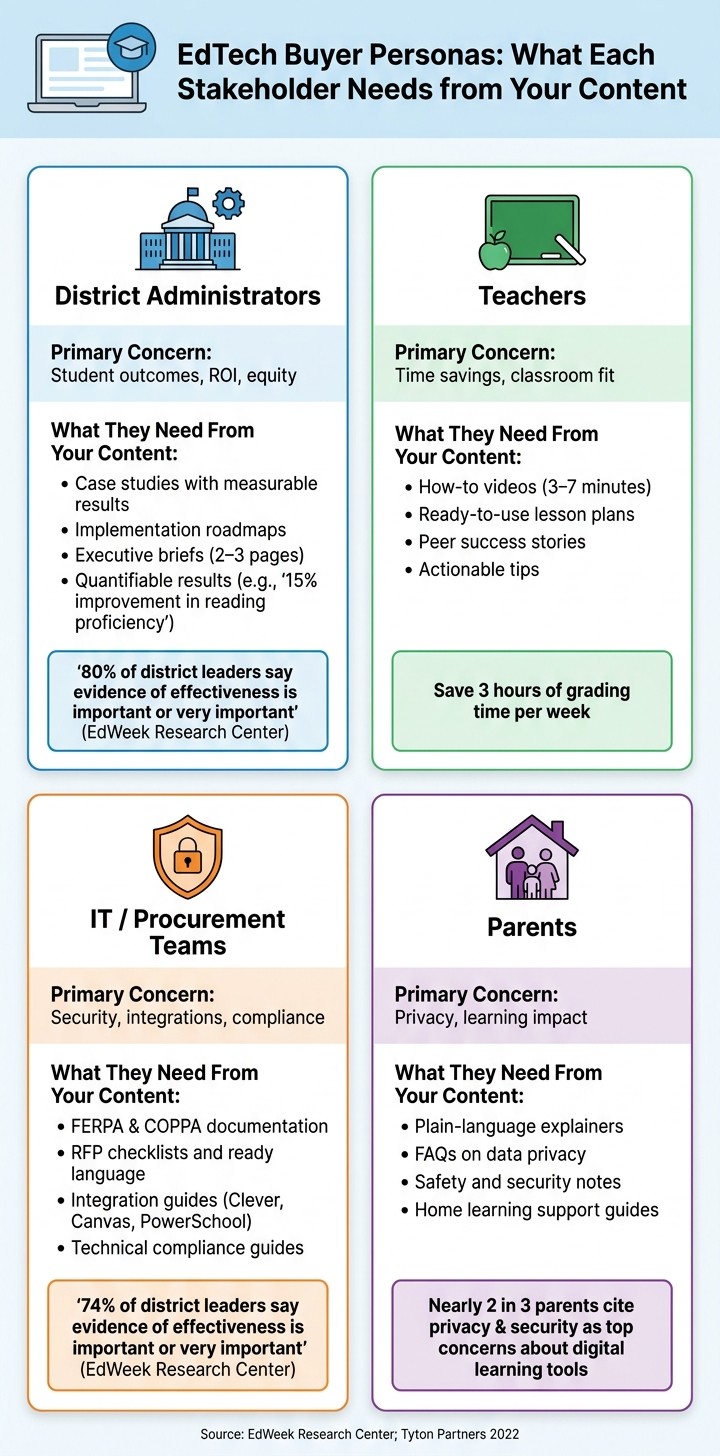
EdTech Buyer Personas: What Each Stakeholder Needs from Your Content
EdTech startups must create tailored content for each stakeholder involved in the decision-making process. In a U.S. K–12 district, a single purchase decision can involve multiple roles - superintendents, curriculum directors, technology coordinators, and procurement officers - all with distinct priorities. Recognizing these differences is key to crafting effective messaging.
Key Buyer Segments in EdTech
The individuals using your product aren’t always the ones making the purchasing decisions. Teachers are often the primary users, while district administrators - such as superintendents, curriculum directors, and CTOs - control the budgets and finalize contracts. Meanwhile, IT and procurement teams ensure the product meets security and compliance standards, and they have the power to veto deals, even if teachers love the tool.
Stakeholder | Primary Concern | What They Need From Your Content |
|---|---|---|
District administrators | Student outcomes, ROI, equity | Case studies with measurable results, implementation roadmaps |
Teachers | Time savings, classroom fit | How-to videos, lesson plans, peer success stories |
IT / Procurement | Security, integrations, compliance | |
Parents | Privacy, learning impact | Plain explainers, FAQs, and safety notes |
Each of these groups requires content that directly speaks to their specific concerns and priorities.
An EdWeek Research Center survey highlights that around 80% of district leaders consider evidence of effectiveness either important or very important when evaluating digital learning tools [4]. This underscores the necessity of producing content backed by solid data.
How to Tailor Content for Each Stakeholder
Once you’ve identified your key buyer segments, the next step is to align your content with their unique needs. For administrators, concise executive briefs (2–3 pages) and district-level case studies with quantifiable results work best - think along the lines of "15% improvement in reading proficiency within one school year."
Teachers, on the other hand, need practical and time-efficient resources. Short how-to videos (3–7 minutes), ready-to-use lesson plans, and actionable tips are far more appealing to them than lengthy white papers.
For IT and procurement teams, focus on reducing perceived risks. Provide detailed FERPA and COPPA compliance documentation, integration guides for popular platforms like Clever, Canvas, and PowerSchool, and RFP-ready language that aligns your product with district standards.
Parents want straightforward information that reassures them about their child’s safety and privacy. Use plain language to address concerns, offer FAQs, and provide simple guides on how they can support their child’s learning at home. Privacy and security are critical - nearly two-thirds of parents in a national survey identified these as top concerns regarding digital learning tools.
The key takeaway? Develop separate content tracks for each audience. For instance, a blog post titled "How Lincoln Unified School District Improved 3rd-Grade Reading Scores by 18% in One Semester" will resonate differently with a curriculum director than with a classroom teacher. By creating these distinct tracks, you’ll build a scalable content strategy that addresses the diverse needs of your EdTech audience.
High-Impact Content Types for EdTech Startups
Different stages of the buyer journey call for tailored content approaches. From quick LinkedIn posts aimed at teachers to detailed briefs for superintendents, the key is aligning the right format with the right moment. This distinction is what turns content into a pipeline-building asset rather than just calendar filler.
Content Formats That Build Awareness and Engagement
During the awareness stage, your objective isn’t to sell - it’s to provide value. Educational blog posts that target problem-solving search queries, like "how to improve reading comprehension in 3rd grade", are excellent for driving organic traffic while positioning your startup as a trusted resource. Long-form posts, typically between 1,500 and 3,000 words, perform exceptionally well in this regard. Startups with active blogs generate 35% more leads, and those publishing weekly see 320% more conversions compared to monthly posting [3].
Webinars are particularly effective in the U.S. K–12 market. Adding professional development (PD) certificates to your sessions can significantly increase sign-ups, as many districts require teachers to log PD hours. Scheduling webinars after school hours, such as 4:00–5:00 p.m. local time, and sending timely reminders can help maximize attendance. Additionally, short-form video content (1–3 minutes) showcasing real-world classroom applications resonates well with teachers and instructional coaches, especially on platforms like LinkedIn and YouTube, where quick, actionable insights are preferred over lengthy reads.
After establishing awareness, the focus shifts to content that supports evaluation and decision-making. Formats designed for the top of the funnel build trust, while those for later stages turn that trust into action.
Content for the Consideration and Decision Stages
Case studies are incredibly persuasive when they include concrete before-and-after data. A well-structured EdTech case study should include a school or district profile, the challenges they faced, the implementation process, and measurable outcomes (e.g., "27% increase in Algebra I pass rates within two semesters"). Including quotes from key stakeholders - such as teachers, administrators, and IT professionals - adds credibility and depth.
For finance and procurement teams, ROI calculators are invaluable. These tools can quantify benefits by converting variables like student numbers, teacher rates, and manual hours into estimated time and cost savings in USD. Preloaded scenarios for common U.S. institution sizes, such as a 500-student school or a 10,000-student district, make these calculators user-friendly and immediately applicable.
At the decision stage, security and compliance documentation often determines whether a deal moves forward or stalls. A concise one-page summary covering FERPA, COPPA, and relevant state-level student data privacy laws - along with integration guides for platforms like Clever, Canvas, and PowerSchool - provides IT and procurement teams with the information they need to expedite approvals. Pairing these documents with a brief efficacy summary is a smart strategy, especially given findings from a 2022 Tyton Partners study that showed 74% of district leaders prioritize evidence of impact on student outcomes when making procurement decisions. Tools like Averi AI can further refine these materials by aligning them with real-time insights and audience behavior trends. This allows teams to build a multi-channel content engine that maintains quality while accelerating production.
Building an Efficient Content Marketing Workflow
For EdTech teams of 3–8 people, delays in approvals and disruptions in publishing often stem from a lack of a clear, standardized workflow. The solution isn't to expand the team but to establish a repeatable process that smoothly transitions content from concept to publication without unnecessary bottlenecks.
Using AI Tools to Speed Up Content Production
The biggest time drain isn't the actual writing - it’s the surrounding tasks like keyword research, outlining, formatting, CMS publishing, and performance tracking. Traditional workflows can take up 15–20 hours a week, but AI tools can reduce this to just 2 hours.
Platforms such as Averi streamline the entire process - from strategy and drafting to SEO and CMS publishing - slashing the time commitment significantly [1][2]. The secret lies in how AI integrates into every step instead of being a one-off writing tool. For example, Averi begins with a quick, one-time Brand Core setup (around 10 minutes), where it learns your product positioning, target audience, and brand voice. After this setup, every draft it produces is tailored to your specific needs, whether you're addressing a district technology director or a classroom teacher, without requiring repeated input [1].
"We built Averi around the exact workflow we've used to scale our web traffic over 6000% in the last 6 months." - Zach Chmael, CMO, Averi [1]
For EdTech teams, AI also proves invaluable for compliance-heavy tasks, such as summarizing FERPA and COPPA policies or flagging unverified claims like "guarantees test score improvement" before review. However, while AI excels at handling production tasks, humans remain essential for judgment calls - especially in education, where credibility with administrators and parents hinges on accuracy and responsible messaging.
Once production is streamlined, the next step is to refine your review process to ensure consistent quality.
Setting Up a Content Approval and Review Process
With faster production enabled by AI, having a strong review process becomes crucial to maintain quality. A structured workflow ensures every piece meets your standards while complementing the earlier production strategy.
Review Gate | Focus Area | Primary Owner |
|---|---|---|
Gate 1: Brief | Strategy, keywords, unique angle | Head of Content / SEO Manager |
Gate 2: Draft | Voice, accuracy, flow, insights | Dedicated editor or SME |
Gate 3: Final Review | Technical SEO, links, formatting | Content coordinator |
Keep the approval process efficient by limiting mandatory sign-offs to two or three people. Assign clear SLAs, such as two business days for subject-matter expert review and one day for final approval. Use a shared document with tracked changes to centralize feedback and avoid version conflicts. Teams that adopt this kind of standardized review process can cut content rework by up to 30%, freeing up time for more impactful projects [2].
For EdTech-specific content, the subject-matter review at Gate 2 is especially critical. A product manager, instructional designer, or former educator should verify that pedagogical claims align with real classroom practices and that outcome statements are backed by pilot data or credible studies - not just marketing intuition. This ensures your content resonates with educators and maintains trustworthiness.
Measuring and Optimizing Content Performance
Once you’ve streamlined your content workflow, the next step is to evaluate its impact. A well-organized process combined with clear performance metrics ensures your content delivers measurable results.
The Metrics That Drive Results
Don’t fall into the trap of equating high pageviews with success. For instance, a blog post that racks up 50,000 views but results in zero demo requests from district administrators doesn’t move the needle for your business. What truly matters is the quality of outcomes, not just the quantity of traffic.
The metrics you track should align with the content’s role in the sales funnel. For top-of-funnel content, such as blog posts or thought leadership articles, focus on engagement metrics like scroll depth and growth in branded search volume (e.g., increases in searches for “[your product] LMS”). For mid-funnel content, such as webinars or comparison guides, monitor metrics like marketing qualified leads (MQLs) and resource downloads by your ideal customer profiles (ICPs). At the decision-making stage, key indicators include demo requests, trial sign-ups, and sales-qualified opportunities influenced by your content.
Funnel Stage | Content Examples | Metrics That Matter |
|---|---|---|
Awareness | Blog posts, thought leadership | Engagement rate, scroll depth, branded search volume growth |
Consideration | Webinars, eBooks, guides | MQLs, resource downloads, webinar registrations from ICP roles |
Decision | Case studies, ROI calculators | Demo requests, trial sign-ups, content-influenced win rates |
To tie content performance to revenue, use UTM parameters on every link you distribute and track conversions in your CRM. In platforms like HubSpot or Salesforce, assign a "First Touch Content URL" tag to each lead. This helps you identify which content pieces are initiating conversations. For example, if 65% of your closed K–12 district deals involved views of your FERPA compliance guide, you’ll know this content deserves further investment.
These metrics provide a foundation to refine your strategy over time.
Turning Data Into Actionable Insights
Once you’ve gathered performance data, use it to evolve your content strategy. Regularly reviewing this data ensures your approach stays aligned with what works. Dedicate 15–20 minutes weekly to analyze a Looker Studio dashboard connected to GA4 and Google Search Console. Look for opportunities, such as pages ranking between positions 11–30 on Google (which might benefit from minor SEO tweaks) or content with high engagement but low conversions, where the issue could lie in the call-to-action rather than the content itself.
Evaluate your content library by identifying underperformers and top performers. Refresh, combine, or retire the bottom 20% of content based on its influence on your pipeline. For the top 10%, analyze what’s working - whether it’s the topic, format, call-to-action placement, or target audience - and replicate those elements in future content. The goal is to create a self-improving strategy that builds on past successes rather than starting fresh each quarter.
"The loop means the content strategy improves from its own data over time." - Averi [1]
Tools like Averi can automate this process by tracking metrics such as impressions, clicks, and keyword rankings. They provide actionable recommendations, like alerting you to a post that’s losing its ranking or suggesting low-competition keywords and counter-angles when competitors publish on topics you dominate [1]. For lean EdTech teams, these proactive insights can save hours of manual analysis each month, freeing up time to focus on creating impactful content.
Common Content Marketing Mistakes EdTech Startups Make
Even with solid metrics and an efficient workflow, EdTech startups often fall into the same content traps. These missteps are surprisingly common but entirely avoidable with the right approach.
Mistake 1: Writing for Only One Stakeholder
In the K–12 EdTech world, a single purchase decision often involves multiple stakeholders - teachers, principals, curriculum directors, IT administrators, and district finance teams. If your content caters to just one group, such as classroom teachers, you risk alienating others who have a say in the decision-making process. For example, a teacher might love your product, but if the IT director sees no mention of data security or LMS integration, the deal could fall apart.
To avoid this, start by mapping out your stakeholder matrix. Identify each role's key goals, concerns, and influence on the decision. Then, develop messaging that addresses these needs using 3–5 core value pillars. For instance:
A teacher may care about saving three hours of grading time each week.
An administrator might want assurance that this saved time will be used for small-group instruction.
An IT director will look for seamless LMS integration and minimal support requirements.
By aligning your content with the priorities of all stakeholders, you’ll increase the likelihood of your message resonating with everyone involved in the buying process.
Mistake 2: Omitting a Clear Distribution Strategy
Even the best content will fail if no one sees it. Without a solid distribution plan, teams often assume "content doesn't work", when the actual problem is reach, not quality.
Distribution planning needs to happen before you even start writing. For each piece of content, define its purpose - whether it’s to drive demo requests, generate leads, or secure pilot sign-ups. Then, decide where and how it will be shared. For instance:
K–12 audiences are active in teacher Facebook groups and district-focused LinkedIn feeds.
Corporate L&D buyers are more likely to engage through LinkedIn Sponsored Content or HR tech partnerships.
A single case study can be repurposed in multiple ways: as a blog post, a LinkedIn thread, an email feature, or a sales one-pager - each tailored to a specific audience and stage of the buyer's journey. By integrating distribution into your content workflow from the outset, you can turn content into a powerful tool for building your sales pipeline.
Mistake 3: Making Claims You Cannot Back Up
EdTech buyers, especially those in schools and universities, are cautious and evidence-focused. Bold but unsupported claims like "guarantees job placement" or "doubles test scores" can erode trust and invite scrutiny during procurement or legal review. In the U.S., claims tied to student outcomes or employment carry significant regulatory and reputational risks.
"AI writing tools without brand context produce generic output. You then spend 60+ minutes per post adding context that should have been there from the start." - Zach Chmael, CMO, Averi [1]
This same principle applies to marketing claims. Specificity and context build credibility. Instead of vague promises, provide concrete data: "A pilot with 50 middle school teachers reduced grading time by 3 hours weekly over one semester." Include details like sample size and measurement methods. If you reference third-party research, link directly to the source. If you share customer results, include a direct quote.
In a field where trust is paramount, precision and transparency set you apart. These elements not only establish credibility but also foster lasting engagement with the educators and administrators you’re aiming to win over.
Conclusion: How to Build a Content Engine That Scales
Scaling content marketing isn’t about cranking out more articles - it’s about creating a repeatable content machine that operates seamlessly, even when your team is knee-deep in product development. Successful EdTech startups rely on three core elements: a well-defined understanding of their audience, a streamlined production workflow, and a feedback loop that continuously refines the process. The effectiveness of this approach is backed by solid data.
Here’s what the numbers say: Content marketing generates three times more leads than traditional outbound methods while costing 62% less[5]. Plus, companies that publish content weekly experience 320% higher conversion rates compared to those that only post monthly[3]. These results only come from a consistent, system-driven strategy.
Efficiency plays a huge role here. Among top-performing B2B content marketers, 64% have a documented strategy, while only 19% of underperformers can say the same[5]. A basic content calendar, pre-designed templates, and clear accountability at every step can bridge that gap without the need to expand your team. Tools like Averi AI simplify the process, handling research, drafting, SEO, and publishing for just $100 a month - letting you focus on strategy instead of expensive agencies.
"The content engine approach inverts the typical model. Instead of you creating content, the system creates content. You approve, refine, and direct." - Averi[2]
The strongest EdTech content engines don’t treat content as a standalone marketing task. They position it as a shared business function. When your blog answers frequent customer questions, your guides reduce support tickets, and your case studies showcase tangible outcomes, content evolves from being an expense to becoming a driver of leads, trust, and long-term customer retention.
FAQs
How do I prioritize content for admins, teachers, IT, and parents?
To create a well-structured content strategy, start by aligning content clusters with the specific pain points and search behaviors of each audience segment. Clearly define your Ideal Customer Profile (ICP) segments early on to address their unique challenges and search intent effectively. Leverage automated tools to identify keyword gaps tailored to each role, focusing on high-priority topics that resonate most with your audience. Finally, synchronize your content calendar with the buyer journey, ensuring it covers a range of needs and provides value across all four audience groups.
What should I publish first to support a 6–18 month school buying cycle?
To align with the lengthy 6–18 month school purchasing cycle, it’s crucial to develop content that establishes lasting credibility while addressing the key challenges faced by school decision-makers. Focus on creating educational materials that not only highlight problems but also offer clear, actionable solutions tailored to every stage of their buying journey.
Start by clearly defining your brand’s core values and identifying your Ideal Customer Profiles (ICPs). Once these foundations are in place, structure a steady stream of content mapped to specific funnel stages. This approach ensures your brand remains front-and-center when schools transition from the consideration phase to making a purchase decision.
How can I prove content is driving demos and revenue, not just traffic?
To demonstrate how content directly contributes to demos and revenue, you need to move past basic traffic metrics and focus on outcomes. Start by setting clear goals, such as increasing demo requests, and ensure your content and CTAs are aligned with these objectives. Use tools like Google Search Console and GA4 to monitor page-level performance. Additionally, implement a tracking system - such as Notion or Airtable - to connect publish dates, keywords, and URLs with conversions. This approach makes it easier to measure and showcase the tangible results of your content efforts.
Related Blog Posts

Zach Chmael
CMO, Averi
"We built Averi around the exact workflow we've used to scale our web traffic over 6000% in the last 6 months."
Your content should be working harder.
Averi's content engine builds Google entity authority, drives AI citations, and scales your visibility so you can get more customers.